There is nothing to buy on this page. No affiliate links, no product recommendations, no shopping list. It is an account of one storm and the two years after it. Where something on this site would genuinely help, it is linked — and we make nothing from your reading this.
🪟 The Cheapest Thing in the Yard Is What Saved the Glass
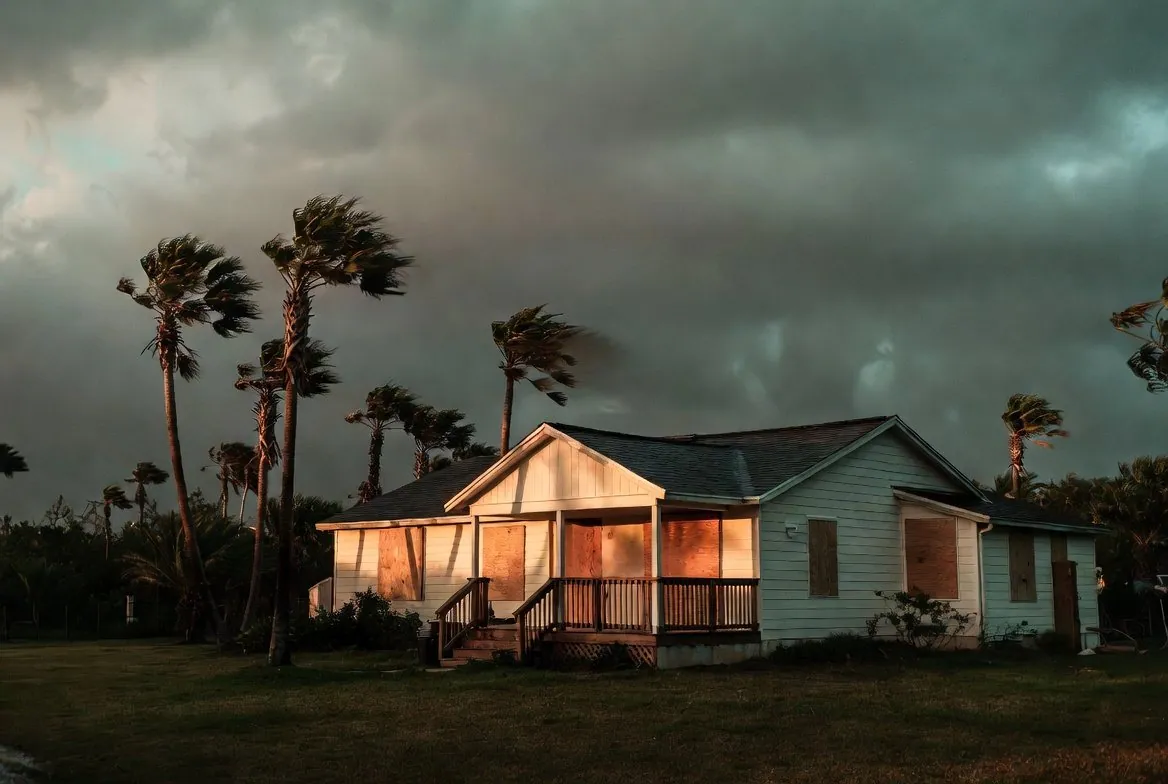
My family in Homestead came through it. The house was hit hard — most of the shingles were gone — but the roof stayed on and every window still had glass in it.
The reason was plywood, and the plywood was not their idea. It came from a neighbor who had lived in Puerto Rico. Down there, plywood is what most people use, because factory-made storm shutters are more than most families can afford. He told them to put it up. They put it up. It was up before the weather arrived.
I want to be careful about what I am claiming here, because I run a website that recommends buying good things. This is the opposite of that story. The cheapest available answer, handed over by a man who had learned it somewhere poorer, held against a Category 5 while houses on the same ground were taken down to their slabs. The variable was not money. The variable was whether it went up before the storm.
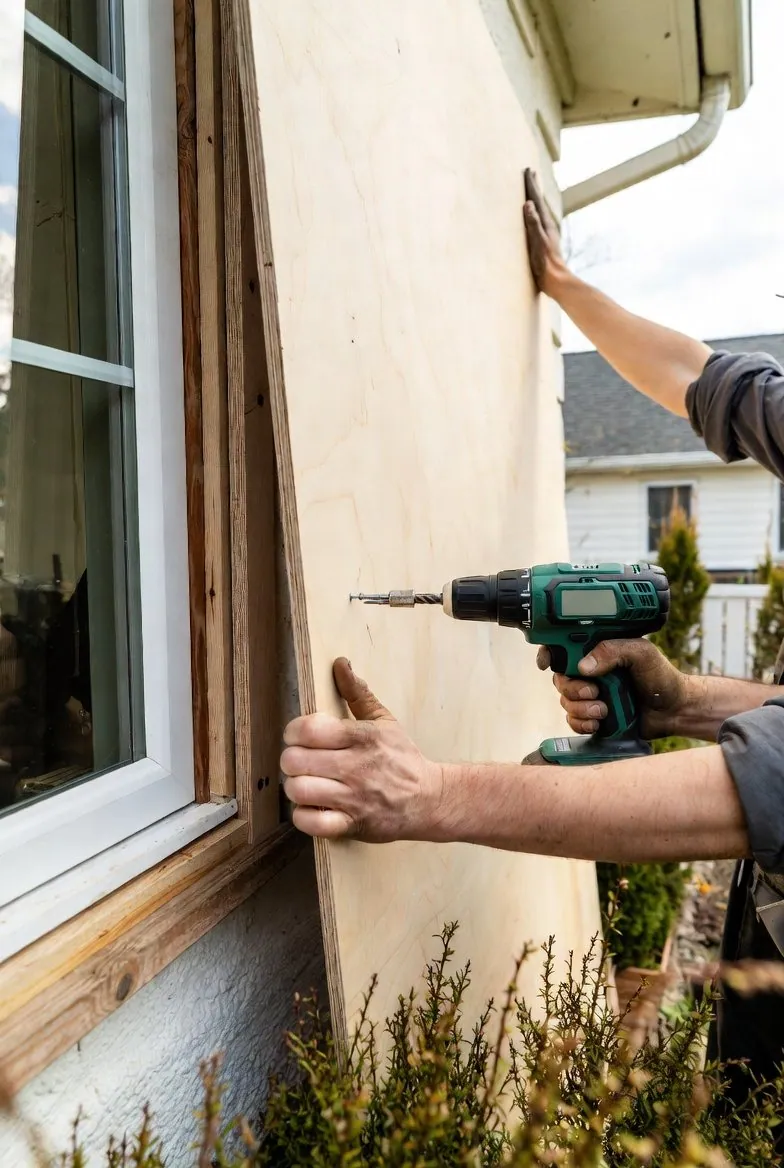
The honest limit, and it is the reason shutters exist. Plywood works. It also has to be lifted, carried, drilled and placed — heavy sheets, often on a ladder, in a wind that is already building, by somebody who has to be strong enough to do it. That is the job a seventy-year-old cannot safely do any more. Plywood is the young man's answer. Permanent shutters are the answer you buy at fifty so that at seventy you are not on a ladder. Our sister site HurricaneShutterCalc works through the sizing and the costs.
If you take one thing from this whole page, take that. Nobody in that family bought anything clever. They did a boring job early, on the advice of somebody who had seen it before, and it was enough.
🗺️ You Cannot Navigate a Town You Have Lived In
I knew Homestead. I had lived there for several years. I drove in expecting to recognize it.
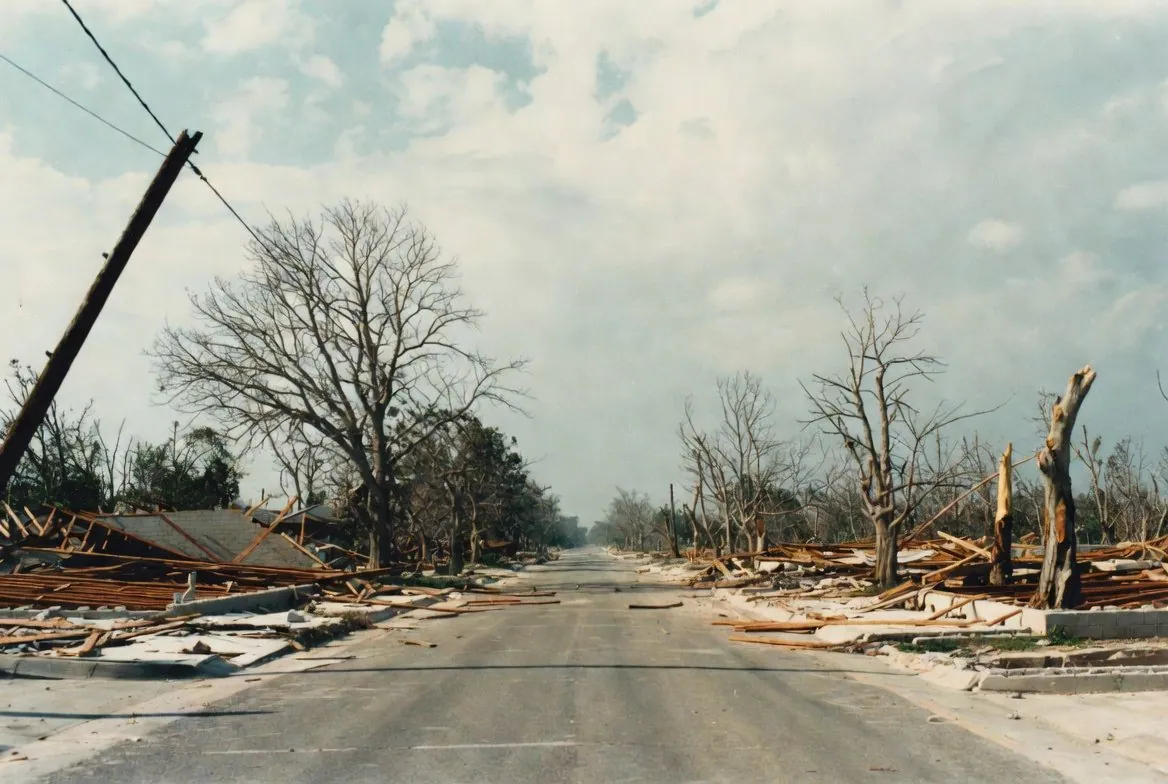
There was nothing left. Twisted and broken trees, and foundation slabs where there used to be houses. I literally could not tell what street I was on. The landmarks you steer by without thinking — a particular tree, a sign, the shape of a roofline — were simply not there, and neither were the street signs.
There was no cell service in Homestead proper. The towers were bent over. We had the big bag phones of the day and they were close to useless inside the damage; four miles out they worked. Everything I found out about my own family that first day came through other family members, relayed. They were all right. Shaken, and alive.
What this means for your own plan. Assume that after a direct hit you cannot navigate by sight, cannot call anybody, and cannot be called. Agree in advance where people will gather and who the one out-of-area relative is that everybody reports in to. That is a conversation, not a purchase, and it is worth more than anything in a go-bag.
⏱️ The First Four Hours
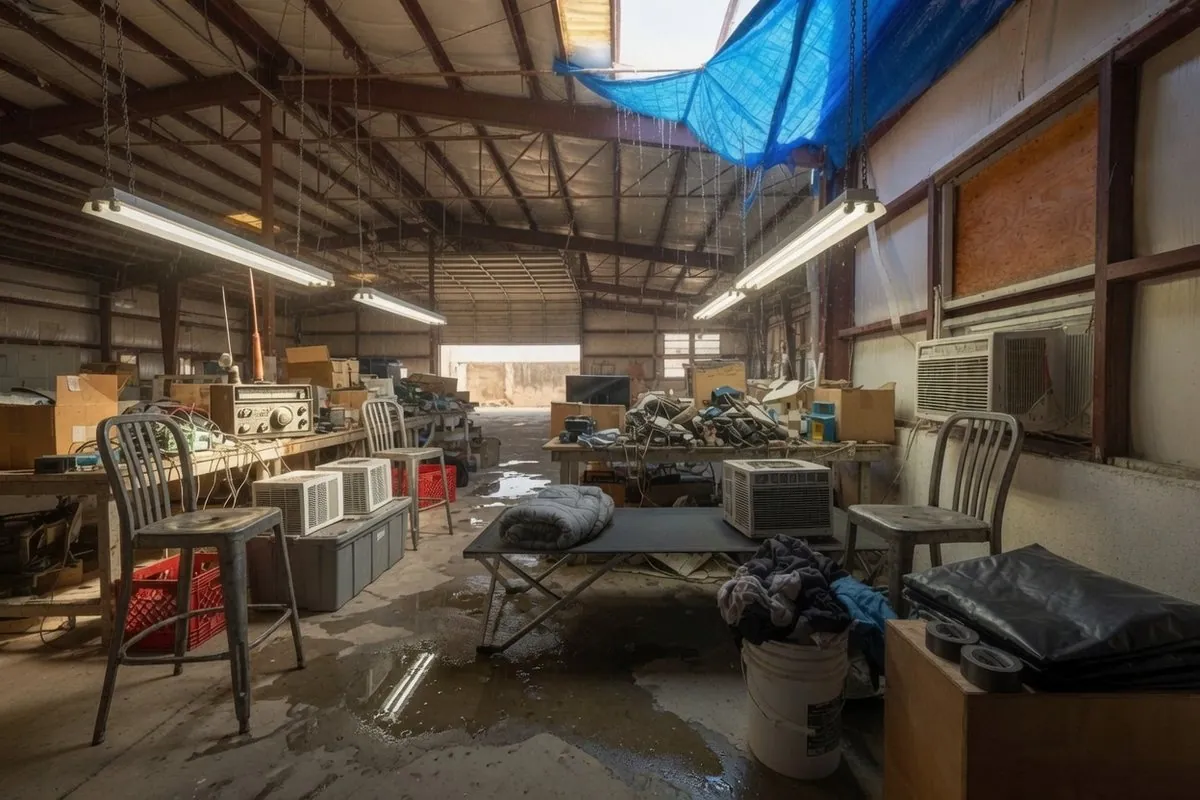
My friend Bob had a warehouse with half its roof gone. It leaked like a sieve. We moved in and made it base camp, and here is everything that happened before the afternoon was out.
We killed the breaker feeding the building from the pole. Not because we intended to power the building's own circuits — we did not — but because nobody knew what condition that wiring was in after what had just gone through it. Then we set up the generators outside and ran extension cords. A great many extension cords.
The water was still on, which was luck. Everything else was off.
We had radios, good for a couple of miles, and that was how the crew stayed in contact for weeks. The fire department brought out a hook and ladder, and we helped lash an antenna to the ladder and ran it up as high as it would go, to give the police and fire departments and the other essential agencies something to talk on. We found the Red Cross, who had a field station going, feeding and looking after people.
That was four hours.
The one that kills people, every single storm. The generator lives outside, well away from the house, away from every window, door and vent — and it never comes into a garage, not even with the door open. After the four hurricanes that crossed Florida in 2004 the Consumer Product Safety Commission investigated six carbon monoxide deaths in this state and another 167 people treated at Florida hospitals, nearly all of it from generators placed indoors or too close to an opening. Our generator guide covers the rest, and the electric skillet page covers how you eat hot food without carrying a flame indoors.
🔧 What the Lineman Checked
The bottleneck was the telephone. Nothing else we were trying to do worked properly without it.
The damage was about four miles from us. The phone company could not tell me when service would come back, and after two days of me working my contacts and Bob working his, we were told plainly that there was no manpower for one small line and we would have to be patient. Years later I understood that this was policy rather than indifference: what crews existed had been sent to the disaster assistance centers, the shelters and the field kitchens first. There was nothing wrong with that decision. It only meant nobody was coming for us.
So I went to find the break myself. And halfway back toward the warehouse, a telephone truck pulled up behind me and a lineman got out, and he was certain I was stealing something.
I do not blame him. That week, people were.
He was looking at my face the whole time, the way you look at a man you have already made your mind up about. I was in the middle of a call. I handed him the phone and told him to hold on.
And when he was done, he looked down.
What was hanging on my belt was the same kit he carried in the back of his own van. A butt set. A tone generator and a receiver. Wire cutters and the usual things a man carries. A handful of red beans. That equipment is only ever used for one thing, and it is not cheap, so there had to be a reason a man was wearing it — and if he was wearing it and had a reason, then he knew what he was doing with it. He worked all that out standing there, and the argument was over.
I was not trying to pull anything. I was trying to get two lines into a warehouse so we could start helping people.
What surprised me was that he did not simply take me for one of the extra hands the phone company brings in after a storm. I have decided it was because they had not got here yet.
This is an account, not an instruction. Storm-damaged telephone plant can have power conductors crossed into it, which is why that work is done with rubber insulating gloves and a foreign-voltage detector by people trained for it. It belongs to qualified crews. This site will not tell you to open your own breaker panel and it is certainly not telling you to touch a telephone cable.
I have thought about that afternoon a great deal since. He did not check a badge. He checked my tools. And I did not buy a single one of them that week, because there was nowhere to buy anything. Every one of them had been in my van for years, because that was my trade — and in the worst week of my life it was the only credential I had, and it was enough.
⌛ What I Ran Out Of Was Time
People ask what we ran short of. They expect me to say fuel, or water, or food.
I had brought enough gear to put four men to work besides myself. What ran out, especially in the first couple of months, was time. So many people needed so many things. There was more damage in that county than there were competent hands to work on it, and no amount of money changed that, because you cannot store skilled hours in a shed the way you store gasoline.
I want to be honest about what that means for a website like this one. Every preparedness list ever written, including parts of this site, is a list of things. Water, fuel, batteries, food. Those lists are worth having and I stand behind ours. But I showed up with three vehicles of professional tools and seventy gallons of gasoline and I still could not keep up, because the thing the neighborhood was short of was not stock. It was people who knew how to do the work and could be trusted to do it.
🤝 The Scamsters, and the Only Currency Left
It pulled in the scamsters like you would not believe. Every kind. Anything to do with construction, anything to do with insurance.
And here is the thing about that flood of people arriving to work after a disaster: the honest and the dishonest are drawn in by exactly the same signal. Recovery work pays a premium. That premium pulled good tradesmen in from all over the country — it eventually pulled my own crew away from me, and I will come back to that — and it pulled the crooks in on the same road, in the same week, driving the same kind of truck. A woman standing in her own driveway had no way to tell them apart by looking.
So people fell back on the only thing that still worked. They dealt with people they already knew, or people vouched for by somebody they already knew.
At first that was Bob, because Bob knew everybody down there. Everything I got to do in those first months I got to do on the strength of his name. After three or four months of working in front of people it started to be my own name, and by then there was enough work that I could go off and help people on my own.
How to check somebody today, which is more than we had in 1992. In Florida you can verify a contractor's license with the Department of Business and Professional Regulation and report price gouging or disaster fraud to the Attorney General's office. The warning signs are old and consistent: pressure to sign over an insurance check, a large payment demanded up front, cash only, no written contract, and no license number you can look up. A prosecutor who handled fraud cases after Andrew later said that local police and prosecutors had never seen anything like it and had to be educated as fast as the victims did. None of that machinery existed for us at the time.
My crew were good men and they all found other work inside six months to a year, with companies paying a great deal better for recovery services than I was paying. I could not match it. That is when I settled into doing satellite dishes and radio towers, which is what I had come down there knowing how to do in the first place.
🛏️ What I Would Load Differently
Truthfully? It was not the things I needed to do my job. I had that in spades.
That tarp is the reason I keep coming back to them. There is a whole page now on what a tarp actually lasts, and on the free federal programme that will cover a damaged roof for you — Citrus County was on the list last time, and the sign-up window shut in three weeks. The tarp, and the free federal one.
It was the creature comforts. There were no hotels. A cot. An air mattress. A tarp to keep the water out. Somewhere dry to sleep. The inside of that warehouse leaked, and the floor was wet more or less constantly for the first week, until we found tarps and made some quick fixes to stop the afternoon rain coming through what was left of the roof.
The heat was the worst of it. Sweltering, and no way to cool off at night, and you felt like hell in the morning because you had not slept. I had to get a friend to drive down from Orlando with heavy plastic sheeting from Lowe's, five or six rolls of duct tape, and two window air conditioners.
And here is what we did with them, which is the part I would tell anybody. You cannot cool a warehouse with two window units. Nobody can. So we did not try. We built a tent inside the building out of the plastic sheeting and the duct tape — a sealed room within a room, big enough for several of us to sleep in — and we connected both air conditioners to that. Two small units cooling one small volume instead of two small units losing an argument with a building that had a hole in its roof.
We ran them around the clock. Our productivity went up by the second night — not because anybody worked harder, but because everybody had finally slept.
This is the whole principle behind One Cool Room, and I worked it out on a concrete floor in 1992 before we ever wrote that page. Do not cool the house. Pick the smallest space that will hold the people who have to sleep, close it off with whatever you have, and put your power into that. A window unit that cannot cool four rooms will cool one easily, and a bedroom you have sealed off will hold that cold for hours after the machine stops.
We washed our clothes in a five-gallon bucket. The water was still on so the toilets flushed, and we took cold showers, because our generators were not big enough to push a hot water tank — and the shower itself had to be rigged, because the original one had been directly under the section of roof that went. Six people in a small space, sweating morning and night. That funk has to be experienced to be appreciated.
Morale went up when there was somewhere cool to sleep and a way to wash. It is surprising how much good even a cold shower does.
The list, and not one thing on it is a preparedness product: a cot or an air mattress · tarps · heavy plastic sheeting and tape · a five-gallon bucket · and a way to make one room cool enough to sleep in. It is cheap, it is dull, and it decided how much work six men could do in a day.
Two things there are worth saying plainly to anybody reading this at fifty or sixty-five. The first is that our cold showers were the right call. We could have sized generators around a hot water tank, and we would have been carrying and burning fuel for a luxury instead of running two air conditioners that let us sleep. Our own loads-to-skip guide tells you to leave the electric water heater off the generator, and I can tell you what that advice costs, because I lived on the other side of it for months: it costs you hot water, and it is still right. Work out your own numbers with the generator size calculator.
The second is that sleep and heat are not comfort questions once you are past fifty. They are safety questions. Heat is dangerous to older bodies in a way it is not to a thirty-year-old, and a week of bad sleep compounds fast. That is the whole reason we wrote One Cool Room and the heat risk calculator. Six young men in a warehouse found out the hard way. You should not have to.
🕑 A Disaster Has Two Phases, and Almost Nobody Writes About the Second
I ended up staying two years.
Once the electric company crews and the telephone company crews and contractors of every kind finally arrived and started to work, my own work changed completely. The first phase is splicing things together to make them work today. It rewards improvisation, a full tool belt and a willingness to do whatever will hold until somebody can do it properly. The second phase is doing it properly — refined work, at the quality you would expect from professionals, and it went on for years. Most of it was not at ground zero. It was in the outer band, five, six, seven miles out, where the damage was less spectacular and there was an enormous amount of it.
Every preparedness article you will ever read covers the first seventy-two hours. Almost none of them mention that the recovery is measured in years, that it needs completely different things from the first week, and that your neighborhood will be living inside it long after the news trucks have gone home.
❓ The Questions People Actually Ask
Short answers to the things people write in about. The story above is the long version.
Does plywood actually work on windows in a hurricane?
Yes — at the right thickness, properly fastened, and up before the weather. Timing decides it, not cost. What plywood cannot do is put itself up, which is the whole of the argument for permanent shutters.
How long do power outages last after a major hurricane?
After a direct hit, count in weeks. Andrew left more than a million customers without electricity and over 150,000 without telephone service, and the worst-hit parts of south Miami-Dade were still in recovery months later. A household plan built around three days is a plan for an inconvenience.
What do you actually run out of after a hurricane?
Time and skilled help, long before supplies. Fuel and food can be laid in. Competent, trustworthy labor cannot, and there is never enough of it to match the damage.
How do you cool a big space with a small air conditioner?
You do not — you make a smaller space inside it. Pick the room that has to hold the sleepers, shut it, block the gaps, and send everything you have into that. A sealed small room also holds its cold for a good while after the machine stops, which matters if the generator runs in shifts.
How do you avoid contractor scams after a hurricane?
Check the license, and be most careful with whoever knocks on your door. Florida DBPR verifies licenses; the Attorney General's office takes fraud and price-gouging reports. Both are linked above.
But the thing that worked in 1992 still works best now: a name that somebody you trust will vouch for beats the best-looking truck on the street. Ask a neighbor who has already had work done. That is a shorter and more reliable check than anything you can do online.
Is a generator or a shutter the better first purchase?
The shutter, if you can only do one — because it protects the house whether or not you are in it, and whether or not you are able to do anything that week. A generator needs fuel, attention and somebody fit enough to move it. Shutters work while you are asleep, or evacuated, or eighty.
Most people should do both, and the order is usually decided by what breaks first in your own life rather than by the storm.
🛒 Buy It at Fifty
Three things saved that situation, and I want to lay them next to each other because it took me years to notice they were the same thing.
The windows survived because a neighbor who had lived through storms somewhere poorer told the family what to do, and they did it early. The doors opened in the first months because Bob had spent a working lifetime being the kind of man whose name meant something. The air conditioners that let six men sleep arrived because a friend in Orlando loaded his vehicle and drove three hundred miles — there was nothing to buy locally, because there was nothing there.
Not one of those was a transaction. Every single one of them was a relationship, and every single one of them existed before the storm.
You cannot buy trust after the storm. You cannot buy skill, or a neighbor who knows something you do not, or a friend who will drive all day for you. Those are the only things that were genuinely scarce, and they are the only things on the list that have to be paid for in advance — in years, not dollars.
That is what this whole website is about, and Andrew is where I learned it. Buy the generator at fifty so you are not shopping for one at seventy. Put the shutters up while you can still climb. And know the people around you before the day you need them, because on the twenty-fourth of August nothing was open, and nothing was coming.
🗺️ The Other Regions
The same job in a different climate. Every region fails its own way, and the guide for yours is written to that failure rather than to a general one.