The short answer
Does Medicare cover eye exams and glasses?
Original Medicare does not pay for a routine eye exam, and it does not pay for glasses or contact lenses. You pay all of it.
It does pay for eye care that is medical rather than routine. After the Part B deductible, you pay 20 per cent for:
- a dilated eye exam for diabetic eye disease, once a year, if you have diabetes;
- a glaucoma test once every 12 months if you are at high risk — you have diabetes, a family history of glaucoma, are African American and 50 or older, or are Hispanic and 65 or older;
- tests and treatment for age-related macular degeneration;
- cataract surgery — and after each cataract surgery that implants a lens, one pair of glasses with standard frames or one set of contact lenses.
Nearly every Medicare Advantage plan adds some routine vision — 99 per cent of them in 2026 — but “some” means very different things from plan to plan, so read the booklet, not the brochure.
That is the paperwork. The rest of this page is the half nobody pays for either way: the light in your own house, and what the eye test at the licence counter does not measure.
Sources: Medicare.gov: Eye exams · Medicare.gov: Eyeglasses · Medicare.gov: Glaucoma tests · Medicare.gov: Eye exams for diabetes · KFF: Medicare Advantage 2026 · checked September 29, 2026
💡 The Light in Your Own House
First, what this page is. Nobody here is an eye doctor and this page does not try to sound like one. What we have done is read what Medicare actually pays for, what a driving test actually measures, and what the falls research actually found — and then done the arithmetic. Every clinical statement below is attributed to whoever made it. The part about the lighting in your own hallway is ours, and it is where this page starts, because it is the part you can do something about this afternoon.
And the teeth are the third of the same set, with the biggest bill attached. Original Medicare covers no routine dental either, and the average Advantage plan caps it at roughly one crown a year — the arithmetic is on the dental page.
Start in your own house, because this is the half of the subject that costs the least and gets ignored the most.
Several things happen to an eye over the decades, and they are ordinary rather than alarming. The lens thickens and yellows. The pupil gets smaller and is slower to open and close. The light-sensitive cells that handle dim conditions decline in number. The Max Planck Institute for Biological Cybernetics, working with the University of Basel, found that the pupil's ability to widen diminishes with age — so less light reaches the back of the eye, and the eye takes longer to adjust when the light changes.
Put together, that means one practical thing:
A room that a visitor calls well-lit can be genuinely dim to the person who lives in it. Not "feels dim." Is dim, in the sense that less light is arriving where it needs to arrive. Lighting designers work to a rule of thumb that somebody at sixty wants two or three times the light they wanted at twenty — that is a trade rule rather than a research finding, but it is the direction of travel and it is why the bulb that was fine in 1998 is not fine now.
What actually helps, and none of it is expensive
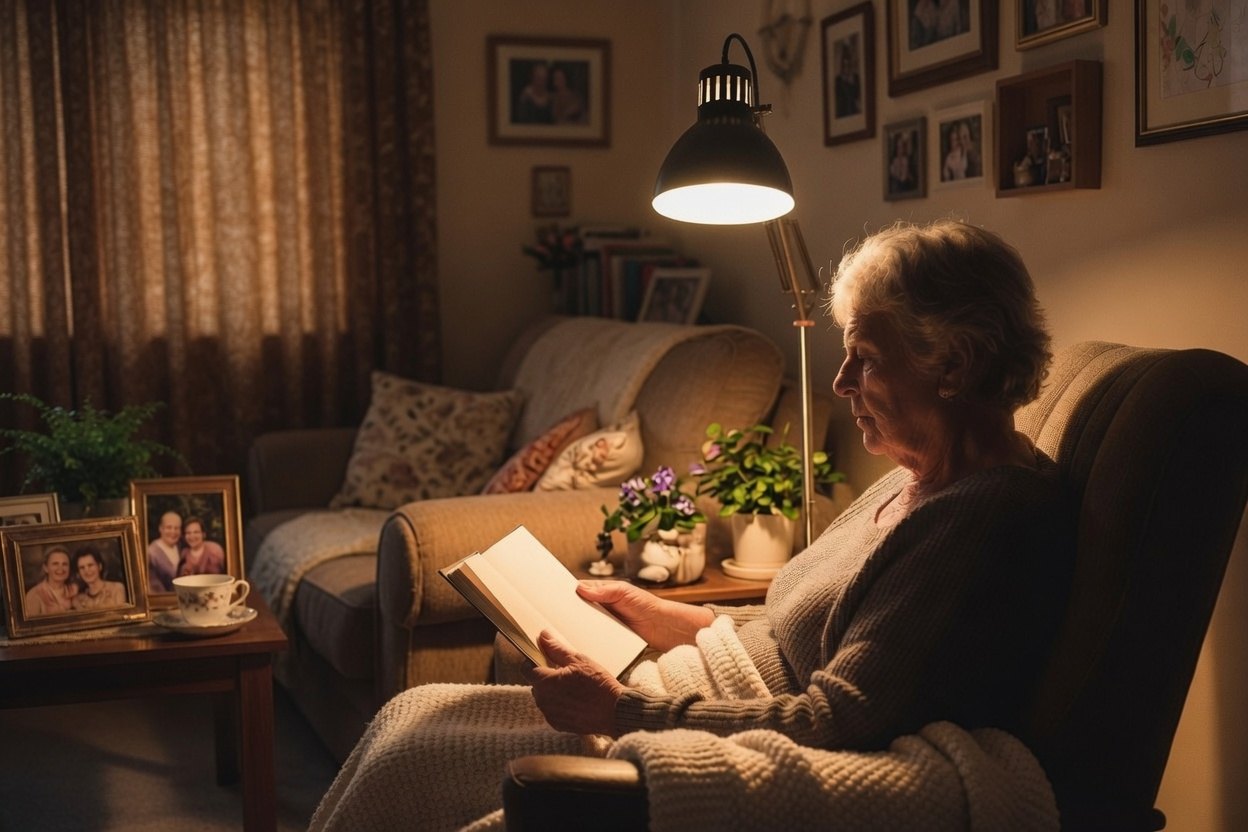
- Put the light where the job is, not in the middle of the ceiling. A lamp beside the chair you read in beats a brighter bulb overhead, every time, because the light that matters is the light landing on the page.
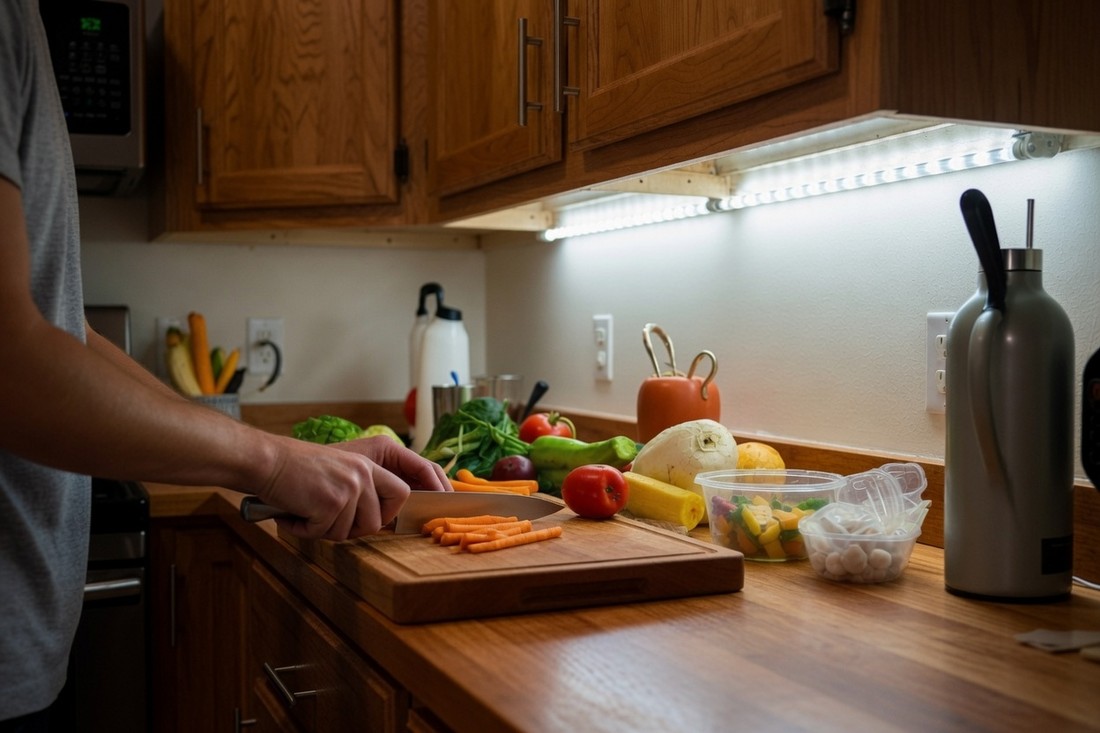
- Under-cabinet lighting in the kitchen is the single best value in the house. You work with your own shadow falling on the counter otherwise, and a knife is involved.
- Light the whole route, not the destination. Bedroom to bathroom at two in the morning is the trip that matters, and it is usually the darkest one in the house.
- Even it out. A bright room opening onto a dark hallway is worse than two moderately lit rooms, because the eye has to keep re-adjusting and it is slower at that than it used to be.
- Put a switch where your hand already is. The best-lit stairway is no use if the switch is at the wrong end of it.
And the stairs, which deserve their own answer
Stairs are the one place in a house where the lighting problem and the falling problem are the same problem, and where the usual fix — a bulb at the top — is close to the worst thing you could do. A single bright source at the top of a flight puts the light behind you as you climb, throws your own shadow down onto the treads you are about to use, and shines straight into your eyes on the way down.
What works better is light running along the stairs rather than down at them — a continuous strip at skirting height, or fittings set into the wall at intervals. Both are cheap now, both run on almost no electricity, and both can be left on all night for the cost of very little.
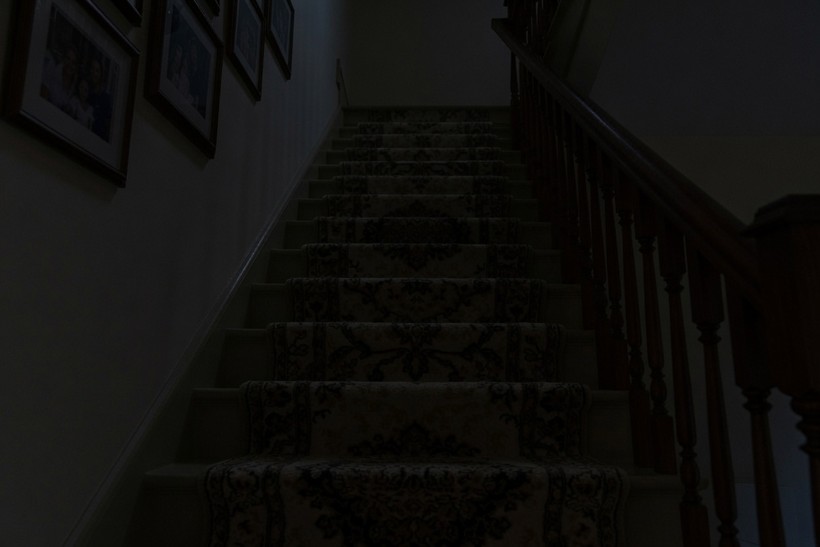
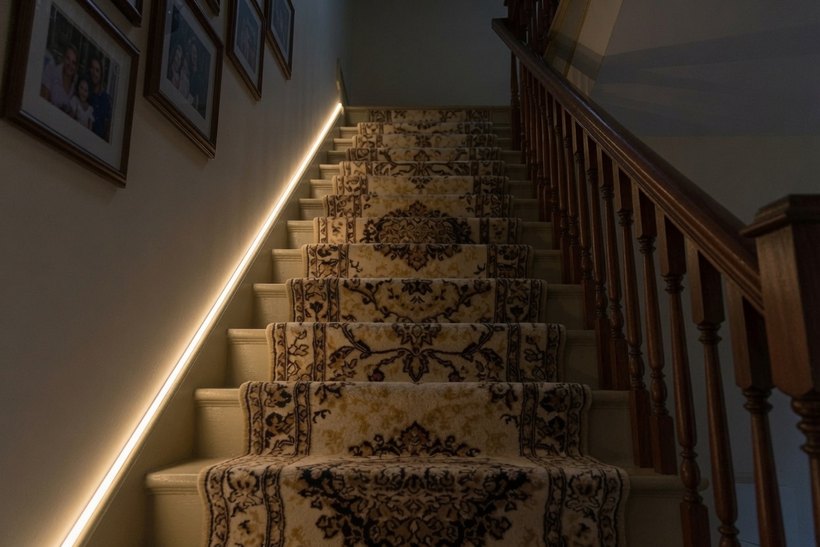
The same staircase, the same hour, one switch. We measured both: the light landing on the treads goes up more than fivefold — and nothing in the right-hand frame is shining back at you. Because the line follows the rake of the stairs it also does a second job nobody buys it for: it shows you where the stairs go, not just where they are.
What it costs to just leave it on
Which is the question worth answering before you buy anything, because a stair light that gets switched off to save money is a stair light that is off on the night it was needed.
Take an ordinary twenty-foot white strip of the sort sold everywhere for under-cabinet work. Thirty-six watts at full brightness — that is the whole twenty feet, lit up as hard as it goes. Running around the clock, every hour of every day:
The kilowatt-hours are the durable number and the dollars are not — electricity runs from about eleven cents in the cheapest states to three or four times that in the dearest, so take the 26 and multiply it by the rate on your own bill. Most of the country lands between three and five dollars a month. And that is the ceiling, not the figure: these dim, and nobody wants daylight-white at full blast in a hallway at three in the morning. Turned down to something civil, it is nearer two dollars. Cut the strip to the length of your actual staircase and it drops again.
So the honest question is not whether you can afford it. It is whether you think it is worth it. Two to four dollars a month, forever, to have the stairs lit every time anybody uses them in the dark — no switch to find, no decision to make at two in the morning, no calculation about whether this particular trip justifies turning a light on. Somewhere between a cup of coffee and a sandwich, once a month.
Some people will read that and think it is obviously worth it. Others will look at a light burning in an empty stairwell all night and find it wasteful, and that is not an unreasonable thing to feel. Only you can say which of those you are — but it is worth deciding it now, on paper, with the number in front of you, rather than at the wall switch on a night when you are tired.
Individual step lights set into the wall do the same work and look smarter. The thing to check with either is where the bright bit ends up: a fitting you can see the lamp inside is a small glare source at eye level in a dark stairwell, and glare is the thing the eye is slowest to recover from. If you can see the bulb rather than what the bulb is lighting, it is pointed wrong.
There is a whole page on the cheap end of this — the motion night lights that come on because something moved and go off again on their own, which removes the part of the job that depends on anybody remembering.
⚠️ Glare, Contrast, and the Falls Nobody Connects
Everything in the last section was about putting more light into a room. This section is about why that is only half the job — and it rests on a finding almost nobody acts on.
When people think about eyesight failing they think about sharpness — the letters getting smaller and blurrier. But sharpness is not the thing that puts people on the floor.
Researchers compared eighty-three older adults who had fallen with eighty-three of the same age who had not, and measured every visual function they could. Reduced visual function overall was associated with roughly three and a half times the odds of having fallen. But when they looked at which specific functions were doing the work, two stood out, and neither of them is sharpness:
- Depth perception — how well the two eyes work together to tell you where a thing is in space. Impaired stereo vision carried about three and a half times the odds.
- Contrast sensitivity — the ability to tell one shade from a very slightly different shade. Not black against white. Grey against slightly different grey.
Think about what contrast sensitivity actually does in a house. It is what tells you where the edge of a beige step is against a beige floor. It is what separates the last stair from the landing, the curb from the pavement, the wet patch from the dry floor. A person can read the bottom line of the chart and still not be able to see where the step ends.
And here is the finding that ought to be better known than it is. The same review of the falls literature reports that fewer than half of falls clinics assess vision at all as part of their assessment. Somebody goes down, gets examined thoroughly, is asked about their medication and their balance and their blood pressure — and in more than half of cases nobody looks at their eyes.
Glare is the other half, and it is the one people blame themselves for
Because the eye adapts more slowly than it did, a bright light in a dark surround is worse than a dim room is. Headlights on a wet road. A window at the end of a dark corridor. A bare bulb at the top of the stairs. The Max Planck researchers make the point directly: too much contrast between light and dark on a staircase, or outside a house at night, is a tripping hazard in itself.
Which flips the usual advice. It is not simply "more light." It is more light, spread more evenly, with nothing bare shining straight into your face. Shades on lamps. Bulbs out of the line of sight. Light bounced off a ceiling rather than pointed at a person.
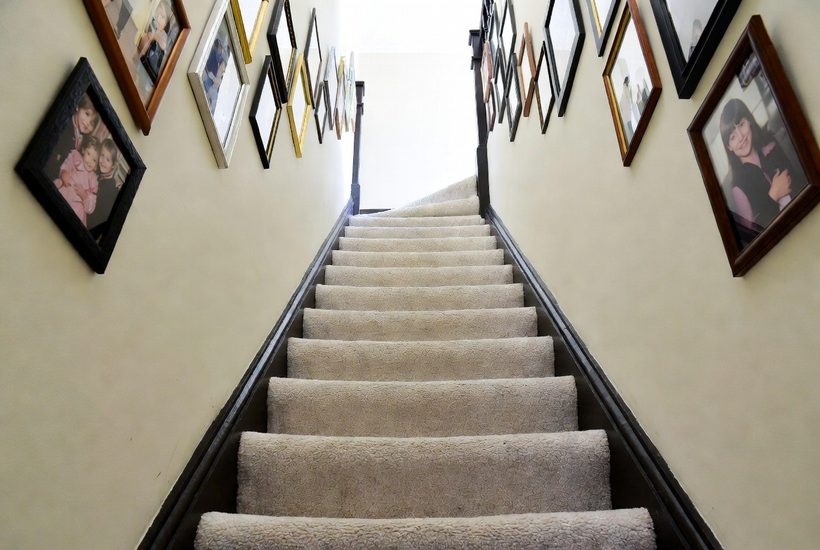
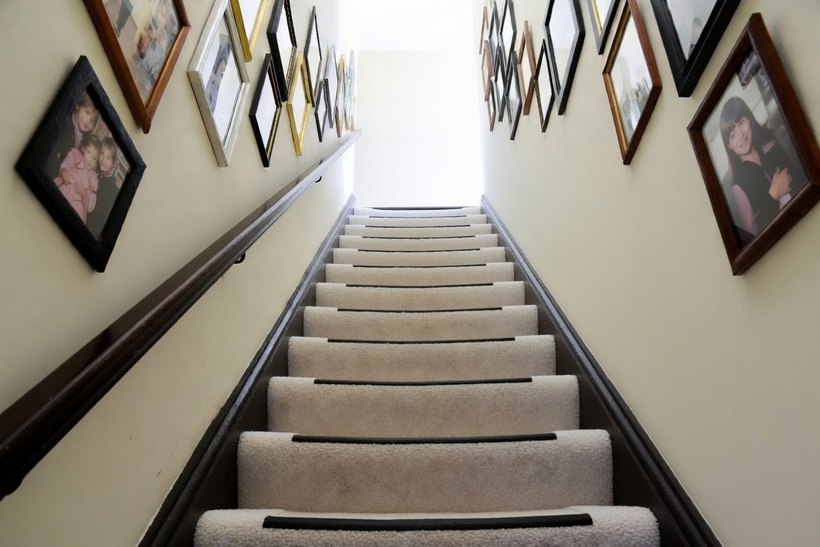
The same staircase, and about four dollars of difference. On the left every tread is the same cream as the one below it and the edges are carried entirely by shadow. On the right they are not carried by anything — they are simply there. We measured the two: the step edges come out roughly twice as strong once the strips are on, which is the whole point. It does not improve anybody’s eyesight. It removes the need for it.
The cheapest thing on this page
If contrast is what tells you where the edge is, then you can put the contrast back yourself, for a few dollars, this afternoon. A strip of contrasting tape or paint along the front edge of every step — dark on a light stair, light on a dark one — does not improve anybody's eyesight. It removes the need for the eyesight. The edge stops being something you have to detect and becomes something you cannot miss.
Same principle, same afternoon: a bath mat that is not the color of the bath. A toilet seat that is not the color of the floor. A doormat that does not match the tile. None of it is decorating advice — it is putting the edges back where the eye can find them.
🚗 The Eye Test at the Counter
Which raises an awkward question, because there is a test that is supposed to catch failing eyesight, almost everybody eventually takes it, and it does not measure either of the two things you just read about.
Most states screen vision when you renew a license. The usual benchmark for an unrestricted license is 20/40 acuity in at least one eye, with or without correction — meaning you read at twenty feet what a person with ordinary sight reads at forty. States also set a minimum field of vision, and those vary: New York asks for seventy degrees plus another thirty-five on the far side of the nose in one eye; California asks for a hundred and thirty degrees.
When the requirement kicks in varies enormously and it is worth knowing your own state rather than the general shape:
- Maine and Maryland tie vision reporting to renewal from as early as forty.
- Georgia reviews vision at every renewal from sixty-four.
- Arizona, Ohio, Oregon, South Dakota and Utah add age-based vision steps around sixty-five.
- California requires a vision test at every renewal from seventy.
- Texas requires vision and medical evaluation at seventy-nine, and in-person renewal every two years from eighty-five.
The daylight-only license, which more people hold than you would think
Failing the screen is not usually the end of driving. It is often the beginning of a restriction, and the commonest one is daylight only.
New York issues a restricted license to drivers between 20/50 and 20/70 in the better eye — daylight driving only, and driving at night on one is a traffic violation carrying points. Arkansas puts drivers at 20/50 or 20/60 with both eyes together on daytime-only, and does the same for anybody diagnosed with impaired night vision. Washington's rule says that a driver whose sight cannot be corrected to 20/70 is deemed not to have shown they are qualified to drive at night.
Worth sitting with what a daylight-only license means in practice, because it is a different thing in June and in December. In New York in midwinter that is roughly a nine-hour window. The restriction does not change with the season; the daylight does. Which is worth knowing before it arrives, because it is the difference between planning around it and being caught out by it.

And the part that is not on the chart
Now the honest bit.
The screen at the counter measures acuity. That is nearly all it measures. It does not test how quickly your eyes recover from oncoming headlights. It does not test contrast sensitivity. It does not test depth perception. It does not test how well you see at night at all.
And those — going by the falls research in the section above — are the functions that carry the risk. So passing the eye test tells you that you met a legal minimum on one measure. It does not tell you that you are safe on a wet road at eleven at night, and it was never designed to.
That is not a reason to stop driving. It is a reason to stop treating the DMV screen as a verdict on your eyesight, and to notice the things it does not ask about: whether oncoming lights leave a smear that takes a while to clear, whether the lane markings have got harder to find in the rain, whether you have quietly stopped going out after dark and told yourself it was for another reason. Those are worth raising at an eye exam, where somebody can actually measure them.
👁 What Is Actually Being Measured
All of which points at the one test that does measure those things properly. And there is a distinction about it that costs real money, which almost nobody explains before the visit.
The same appointment, in the same chair, with the same person, can be billed two different ways — and which one it is depends on why you came.
- A routine exam is the one where you came to check your prescription. Not covered by Original Medicare. You pay.
- A medical exam is the one where you came because something is happening — you have diabetes, or there is a condition being followed, or a symptom is being investigated. That is a covered service.
We are not suggesting anybody describe their visit as something it is not. We are suggesting you know which of the two you are having before you book it, and simply ask. The front desk deals with this distinction every day and will tell you plainly. Going in blind is how people end up surprised by a bill they could have predicted.
And what the machines are looking at
A full exam checks a good deal more than the letters on the wall. It measures how sharply you see at distance, how your eyes work together, the pressure inside the eye, and — if drops are used to widen the pupil — it gives whoever is looking a clear view of the back of the eye, which is the part you cannot see for yourself in any mirror.
That last part is the reason the appointment matters beyond the prescription, and it is worth saying plainly and then stopping: the eye is the one place in the body where a doctor can look directly at blood vessels and nerve tissue without cutting anything. What they do with that view is their business and not ours. But it explains why the exam is a different thing from picking out frames.
The one thing this page will not do is tell you what any symptom means. If something has changed about your sight — suddenly or gradually — that is a conversation with an optometrist or an ophthalmologist, not with a website, and it is not one to put off until the next renewal comes round. The American Academy of Ophthalmology publishes its own guidance on how often adults should have their eyes examined; that recommendation is theirs to give and worth asking about at your next visit.
💵 What Medicare Pays For, and What It Does Not
Now the money, because none of the above tells you what an eye exam costs — and this is the part people find out about standing at a counter with a card in their hand.
Original Medicare does not cover routine eye exams. It does not cover glasses. It does not cover contact lenses. Not at sixty-five, not at eighty, not ever — with one narrow exception we will come to. If you go to an optometrist to have your prescription checked and updated, you pay the whole bill yourself.
That surprises people in the same way the hearing gap surprises people, and for the same reason: it is the ordinary, predictable, once-every-couple-of-years expense that feels like exactly the sort of thing a health program would handle. It is not covered, and it never has been.
What is covered, which is more than people expect
The line does not run between "eyes" and "not eyes." It runs between routine and medical, and once you see that, the whole thing makes sense:
- Cataract surgery is covered under Part B — the pre-surgery exams, the anaesthesia, the facility fee, and a standard single-focus lens implant.
- And this is the one exception on eyewear: after cataract surgery with a lens implant, Medicare covers one pair of standard-frame glasses or one set of contacts. Standard frames and standard lenses — if you want the anti-glare coating or progressives or a frame you actually like, you pay the difference.
- A yearly dilated eye exam if you have diabetes, to look for diabetic retinopathy. That is a medical exam, not a vision check, which is why it is covered.
- A yearly glaucoma screening if you are considered at high risk.
- Treatment for macular degeneration, including the injected drugs given in the office — those fall under Part B rather than a Part D drug plan, precisely because a person administers them to you rather than handing you a box.
Not covered: LASIK and any other elective vision-correction surgery, which is treated as cosmetic. And upgraded lens implants — the multifocal or astigmatism-correcting kind — are not covered unless there is a medical reason for them, so the upgrade comes out of your pocket at the time of the operation.
A routine exam without insurance is commonly quoted somewhere between seventy-five and two hundred dollars depending on where you live, and the chains run cheaper. Those figures move, and so do the Medicare ones — the numbers above are as published in 2026 and you should check the current position at Medicare.gov rather than taking a website's word for it, including ours.
If you are on a Medicare Advantage plan
Most Advantage plans do include routine vision — an exam, and an allowance toward frames. But the allowance varies enormously from plan to plan, and some plans reduced or dropped their vision benefits for 2026. So it is worth reading your own plan's benefit schedule rather than assuming last year's arrangement carried over. There are also standalone vision plans sold separately, which are not Medicare products and are not regulated as such.
And the free help exists here too. Every state has a State Health Insurance Assistance Program — a SHIP — where the counseling is free, nobody is selling anything, and working out what your own plan covers is the whole of what they do. Between that and 1-800-MEDICARE, you can get a straight answer about your own coverage in an afternoon. Nothing on this page is a substitute for either.
❓ Questions People Ask
Does Medicare pay for a routine eye exam?
No. Original Medicare does not cover routine eye exams for glasses or contact lenses; you pay all of it. Some Medicare Advantage plans include routine vision as an extra benefit.
Does Medicare pay for glasses?
Usually not. Part B covers one pair of glasses with standard frames, or one set of contact lenses, after each cataract surgery that implants an intraocular lens. You pay 20 per cent after the Part B deductible, plus any upgrade to the frames.
Does Medicare cover glaucoma tests?
Yes, once every 12 months if you are at high risk: you have diabetes, a family history of glaucoma, are African American and 50 or older, or are Hispanic and 65 or older. You pay 20 per cent after the Part B deductible.
Does Medicare cover eye exams for diabetes?
Yes. If you have diabetes, Part B covers an exam for diabetic eye disease once a year. You pay 20 per cent after the Part B deductible.
Does Medicare Advantage cover vision?
Nearly all Medicare Advantage plans offer some vision benefit — 99 per cent in 2026 — but what is included varies widely. Check the plan’s own booklet for exams, frames, lenses and the yearly allowance.
📋 Why This Belongs on the Fifty List
Most of this page is a Saturday and about forty dollars, which is the only reason it is on this site.
A lamp beside the reading chair. A strip under the kitchen cabinets. Contrast tape on the stair edges. A shade on the bulb at the top of the stairs so it is lighting the stairs instead of your face. Every one of those is bought once, fitted once, and then works for the next thirty years without anybody remembering it is there — which is the same test the grab bar passes, and the water heater, and the long screws behind the strike plate.
And it is the same argument about timing that runs through everything here. Not because anybody is going blind, but because the light that was fine at fifty is quietly not fine at seventy, and nobody gets a letter about it. It changes a little each year, which is precisely why it never announces itself. Fit the lamp while it is a preference and not a necessity, and you will never have to notice the difference.
The rest of it — what Medicare pays, what the license screen measures — is not a purchase at all. It is the same thing this site does everywhere else: find out what the rules are while nothing is happening, so that the day something does happen you are not learning them at a counter.
And go and get looked at while nothing is wrong, so somebody has a record of what your eyes were like before anything changed. A baseline is only useful if it was taken early.
But start with the tape. The step at the bottom of the stairs is beige, the floor is beige, and you can fix that this afternoon for four dollars without anybody examining you.