🚗 Not Driving Is Not the Same as Not Going
First, what this page is. A plain account of how to get where you need to go without a car of your own — what services exist, what they cost, how to book them, and what the law says they cannot refuse you. It is not medical advice and it is not advice about whether you should still be driving. That conversation belongs to you, your family and your doctor. Everything here is checkable and linked, and it all varies by county, so ring and confirm before you rely on it.
Almost everything written about older people and driving is written as a loss. The keys get taken. Independence ends. Somebody becomes a burden.
That framing is wrong twice over. It is wrong about what actually happens, and it is wrong about who this concerns.
The disclosure, and then I will get out of the way. I hold a license and I can drive. I mostly do not. I do not drive because I do not want to drive — and sometimes I have to drive, and then I do it. That is the whole thing. My wife does most of the driving because she enjoys it and I do not, so it defaults to her.
I mention it only because it means this page is not being written at you from behind a steering wheel. The arrangement described below is one I actually run, and the sky did not fall in.
Which is the point. There are three kinds of people who need what is on this page, and they need exactly the same things. The person who can no longer drive. The person who would simply rather not. And the person who drives perfectly well and uses the bus anyway, because it is cheaper — who is the subject of the next section but one, and who is the best argument on this page.
And it turns out the week works, because most of what you need already exists, is already paid for, and is sitting there almost empty.
🚩 Two Different Services, Constantly Confused
Before anything practical, get this distinction straight, because it decides which phone number you ring and what you are entitled to.
1. ADA complementary paratransit
This is a civil right, not a courtesy. Where a transit agency runs ordinary fixed bus routes, federal law requires it to run a parallel door-to-door service for people whose disability prevents them using those routes. The rules are specific: service must cover a corridor three-quarters of a mile on each side of every fixed route, and a three-quarter-mile radius at the end of each route, at the same hours and days as the buses, for a fare no more than twice the ordinary fare.
It requires an eligibility certification, and it only exists where fixed routes already run. If you live out past the end of the line, it may not reach you.
2. General-public demand-response — the one this page is really about
This is a different animal entirely. Rural counties across the country run door-to-door services funded through the federal rural transit program, and the crucial difference is in the name: general public. No disability certification. No means test. County-wide rather than a ribbon either side of a bus route. You ring up, and it comes.
The distinction in one line. Paratransit is a right you have to qualify for. The county bus is a service anybody can use, and hardly anybody does.
🚌 The Bus Almost Nobody Knows About
Here is what mine costs and does, and it is worth reading as an example rather than a promise, because yours will differ in the details and probably not in the shape.
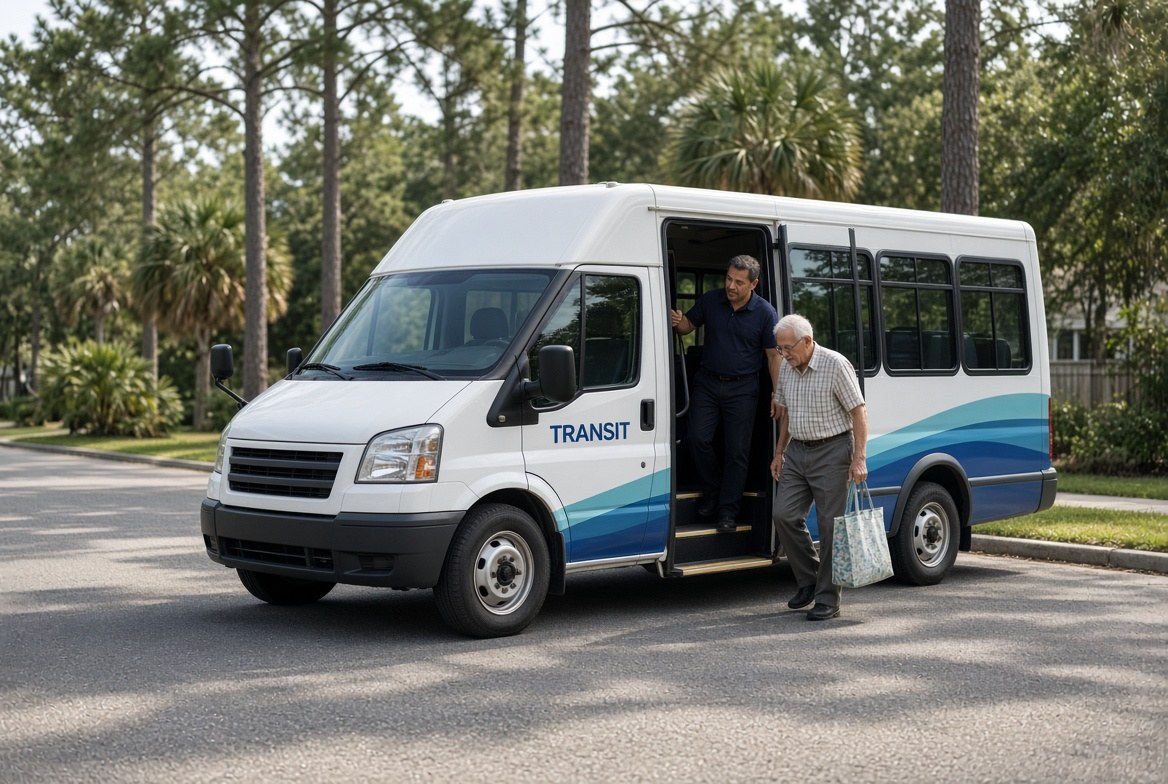
Not a route. Not a timetable you have to decode. You telephone, you say where and when, and a bus comes to the house and takes you there. Two dollars.
People picture something else entirely when you say senior transport — a minibus that goes to the senior center and back on Tuesdays. That is not what this is. It goes to the hardware store, the barber, the bank, a friend's house, the dentist.
And the thing I notice every single time I ride it: I am not the youngest person on that bus by much, and there is almost never anybody young on it at all.
It is not a seniors' service that young people are shut out of. It is a public service that only seniors have found. Anybody may ride it. Almost nobody under sixty knows it is there.
One more thing that surprised me, and it is not nothing. The people driving are usually about the age of the people riding. They say hello. They know who you are by the second trip. For anyone whose week has got quieter than it used to be, that is not a small feature of the service — it may be half of it.
💰 The Man Who Has a Car and Rides Anyway
There is a neighbor of mine — call him Tim — who owns a perfectly good car, holds a license, and drives it most weeks. He is also on the bus more often than I am.
His rule is simple and he applies it without sentiment. Anything within a mile or two — the supermarket, the drugstore, the hardware store — he takes the car. Anything further than that — the VA, a friend on the far side of the county, the strawberry festival in the spring — he takes the bus.
He is not doing it because he cannot drive. He is doing it because he has run the numbers and the bus wins. He calls it his free trip to the bank.
Work it through and he is plainly right. The two dollars is the smallest part of it. What he is actually not paying is the fuel, and the tires, and the brakes, and the share of every future repair that a long trip quietly buys. A car does not cost what the petrol costs. It costs the petrol plus a slice of the next four-hundred-dollar bill, and long trips buy a bigger slice than short ones.
And the part almost nobody thinks of
Insurers price partly on how far you drive in a year. Low-mileage discounts, mileage-verified policies and pay-per-mile cover all exist, the thresholds differ from company to company, and retirees are one of the groups they are aimed at squarely.
So the question is worth one phone call, in these words: “I drive a lot less than I used to. Do you have a low-mileage discount or a pay-per-mile policy, and what is the mileage I would have to be under?”
Then read your own odometer twice, a month apart, so you are answering with a real number rather than a guess. Nobody at the insurance company is going to ring and ask whether you have retired.
None of that is a reason to give up a car you want. It is a reason to notice that the bus is not only for people who have run out of options. The cheapest household in the county is very often the one that owns a car and does not put many miles on it — and the county bus is how you get the second half of that.
📞 How to Actually Use It
The mechanics are simple and nobody explains them, so here they are.
Book the day before
A day's notice is the common requirement. Some services take same-day trips when they have room; most would rather you rang yesterday. If you know on Monday that you have a Thursday appointment, book it Monday.
Give a rough time back, not an exact one
This is the part people get wrong and then decide the service does not work for them. You are not booking a return at a fixed minute. You give them a rough idea when you expect to be finished, and then you ring when you actually are. If the doctor runs late, the bus is not sitting outside with the meter running and it has not abandoned you.
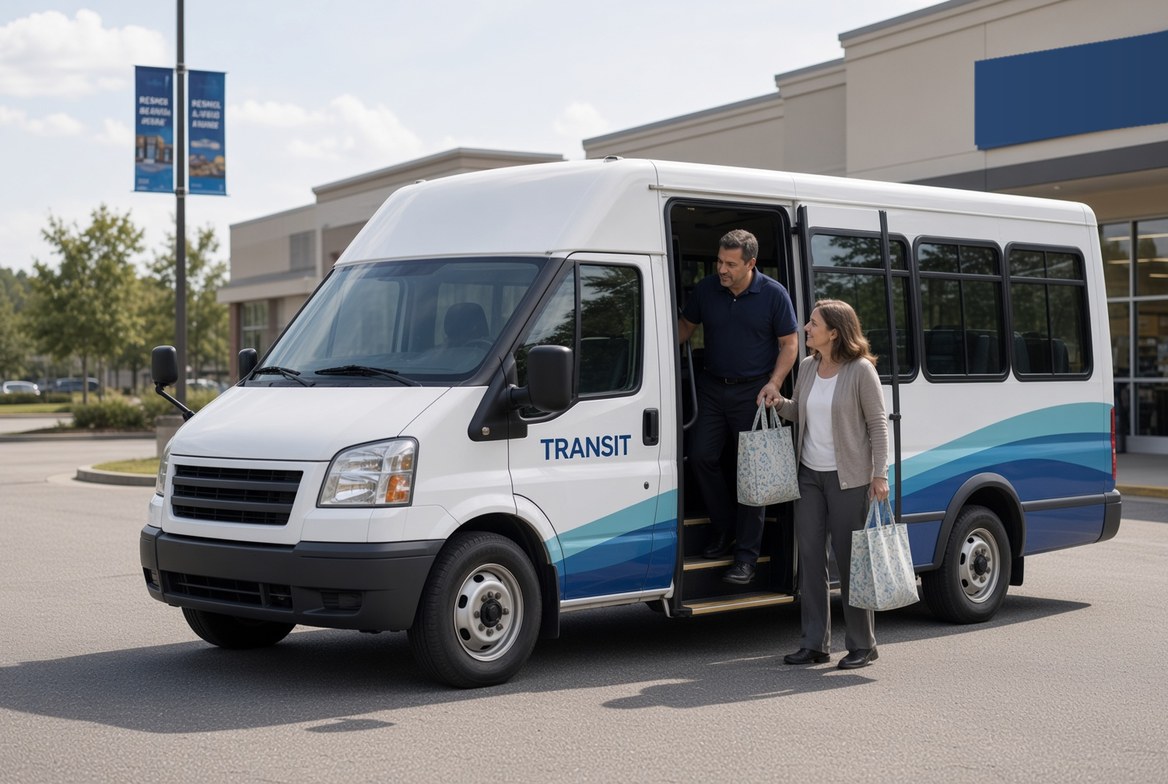
The trick worth the whole page. The men I ride with ring for the pickup when they are walking up to the checkout — not when they get outside. By the time the shopping is bagged and paid for and they are out the door, the bus is a few minutes away.
Nobody at the transit office will tell you that. It is the difference between a service that works and twenty minutes standing around in a parking lot in August.
Ask these four things on the first call
- How far ahead do I need to book — and do you take same-day trips at all?
- What does it cost, and can I buy a book of tickets or a monthly pass?
- Do you cross the county line, and if not, who does?
- Is there a separate service for medical trips, and does it work differently?
⚖️ What They Cannot Do
Three things worth knowing before you are told otherwise by somebody at a counter who is guessing.
They cannot restrict what the trip is for. On ADA paratransit, eligible riders can travel for any reason — medical appointments, groceries, social visits, employment, anything within the service area. Most people assume it is doctors only, and turn down a service they could be using for the shopping.
They cannot charge you more than double. ADA paratransit fares may not exceed twice the ordinary fixed-route fare for a comparable trip, and a personal care attendant should not be charged at all.
They cannot turn away your service animal, or ask you to prove anything. Under the Department of Transportation's ADA rules a service animal must be permitted to accompany its handler on transit vehicles and in transit facilities. Agencies cannot require identification cards or documentation, and cannot ask about your disability — staff may ask only two questions: is the animal required because of a disability, and what work or task has it been trained to perform. A "no pets" policy has to be modified to let a service animal ride.
Say it calmly, once, and most of the time that is the end of it. If it is not, the agency has a complaint process and a federal regulator behind it.
🏥 Getting to the Doctor Specifically
Medical trips have their own funding streams, and they are worth knowing about separately because they often cost nothing at all.
If you are on Medicaid, transport to appointments is a benefit, not a favour. Non-emergency medical transportation is a required Medicaid benefit, covering trips by taxi, bus, van and private vehicle, and states also reimburse mileage when a friend or family member drives you. The federal rules describe it as an assurance of transportation — the state has to make sure you can physically get to the care it is paying for.
The catch, and it is the same catch as everything else in this business: how it is run varies enormously by state. Most states use a broker you ring rather than the doctor's office. Notice periods differ — two business days is common. Some states cap the number of trips a year, and a few charge a small copayment. Ring your plan and ask how their transportation benefit works before you need it, not the morning of.
Ask your Area Agency on Aging as well. Many run volunteer driver programs for medical trips specifically, and those tend to be free, door-through-door, and staffed by somebody who will wait with you.
🇺🇸 If You Served
There is a whole separate transport network for veterans and it is badly underused.
VA's Veterans Transportation Program provides free rides to and from VA health appointments. Many facilities also offer free rides through the Volunteer Transportation Network, run with veterans service organizations, and the Disabled American Veterans organization provides free rides in many areas. DAV volunteer drivers operate at more than 247 VA locations around the country.
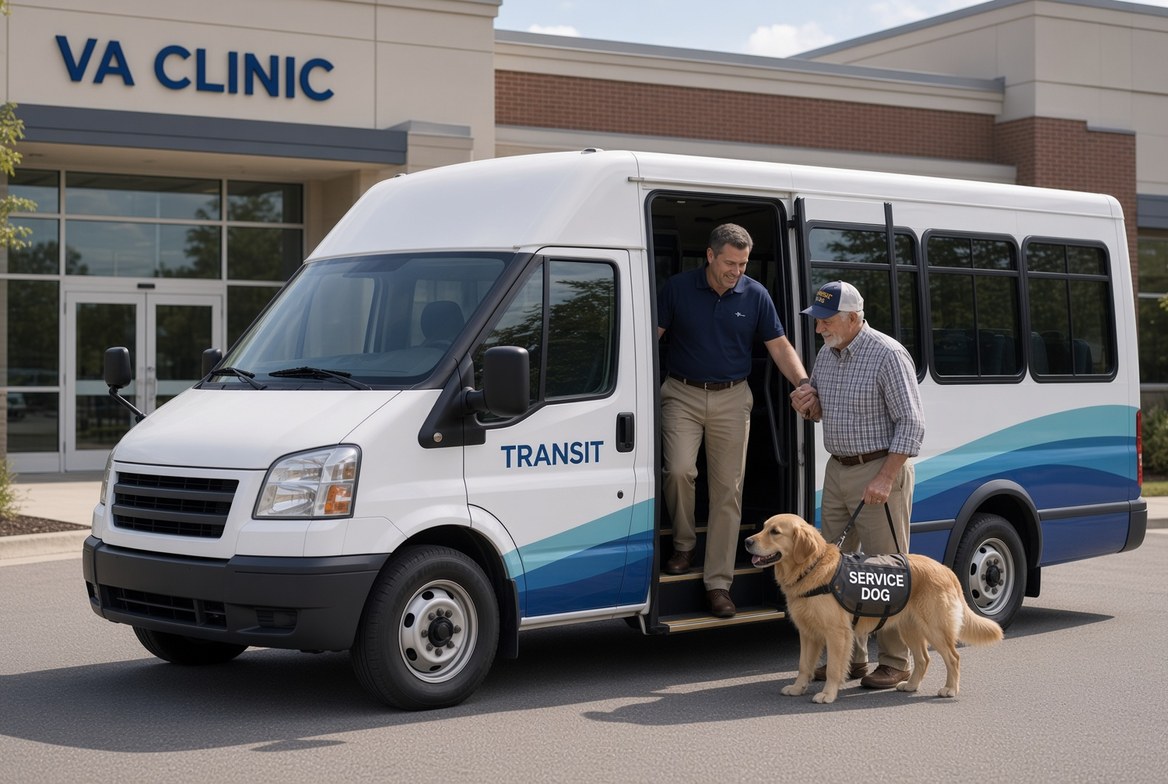
If you live somewhere genuinely remote, there is a program for that too: veterans in highly rural areas may be able to get free rides through the Highly Rural Transportation Grants program. You request rides through VA's online service or by ringing the transportation representative at your VA health facility.
Worth knowing: some county services run a dedicated day or two each week to the nearest VA medical center, separate from ordinary county trips. Ask about it by name.
Two honest limits. Most volunteer vans can only carry ambulatory passengers — people who can board and get off without the driver's help. And notice periods are longer than county transit; some ask for 48 hours. If you need a lift and a wheelchair, ask about the Veterans Transportation Service rather than the volunteer vans.
🏠 The Cheapest Trip Is the One You Do Not Take
Everything above solves the problem of getting there. This section is about the half of the problem that has quietly disappeared in the last few years, and it is the reason not driving is a smaller thing than it was in 1995.
A great many trips are now optional. Not because anybody made a plan about it — because the world changed underneath us.
- Groceries. An order placed online and brought to the door. No store, no parking lot, no line, and no lifting it in from the curb. If you are on food assistance, most states now allow those benefits to be spent online, so check before you assume it is not for you.
- Appointments that do not need a room. A great deal of routine follow-up now happens on a video call. Ask which of yours could — the answer is often more than you would think, and the ones that genuinely need hands on you are then worth the trip.
- Church and the meetings you would miss. Services, groups and classes stream now. It is not the same as being in the room, and anybody who tells you it is has not tried it. But it is a great deal better than the alternative on the weeks you cannot get there.
- The prescriptions. Ask the pharmacy about delivery and about ninety-day supplies. Two trips a year instead of twelve.
Do this arithmetic honestly and the picture changes. If deliveries take out the weekly shop and the pharmacy run, and video takes out half the appointments, what is left is not a transport crisis. It is two or three trips a month — and two or three trips a month is what the county bus is for, at two dollars each.
📍 Finding Yours — Three Calls
1. Dial 2-1-1. Three digits, free, around the clock. Ask what public transportation exists in your county and whether it is demand-response. This is the fastest route to an answer for most people.
2. Your Area Agency on Aging, through the Eldercare Locator on 1-800-677-1116. They know what your county actually runs, including the volunteer driver programs that are advertised nowhere and never appear in a search.
3. Your county government, and ask for "transit" or "transportation." Not the city — the county. In much of the country the service is a county department, which is exactly why people who search for a bus route never find it.
If you served, add a fourth: your county veterans service officer. And if you are on Medicaid, a fifth: your plan's transportation number, which is on the back of the card.
📋 Why This One Is on the Fifty List
Two things here are much easier to arrange while you still drive than after you have stopped, and both are the sort of thing nobody does in advance.
Find out what exists before you need it. Ring 2-1-1 at sixty and ask what your county runs. It takes ten minutes and you will very likely be told about something you did not know was there. The worst time to research a transport system is the week you have just been told you should not be driving — you are upset, somebody in the family is being tactful at you, and you will agree to whatever is suggested.
Ride it once while it is still a choice. Book a trip you do not need. Go to the hardware store. The first ride is the only awkward one, and doing it as an experiment at sixty-five is a completely different experience from doing it as a defeat at seventy-nine.
And the honest limit of this whole page. None of it replaces a car for everything. If you live twenty miles down a dirt road with no county service, some of what is above simply is not available to you, and no amount of cheerful writing changes that. Where you live decides how much of this works — which is itself worth knowing at sixty, when moving is still a decision rather than an emergency.
What I would say against the usual version of this subject is only this: it is treated as an ending, and for a great many people it is an adjustment. The keys are not the independence. Getting where you are going is the independence, and there is more than one way to do that.
📚 Where This Comes From
Every rule and figure on this page traces to a federal agency or an established non-profit and is linked where it appears. Local services vary enormously and change without notice — always confirm with your own county before relying on anything here.
- ADA paratransit rules — 49 CFR Part 37, Subpart F and the Federal Transit Administration.
- Service animals on transit — National RTAP ADA Toolkit, drawing on FTA ADA Circular 4710.1.
- Paratransit and aging — National Aging and Disability Transportation Center.
- Medicaid transportation — Medicaid.gov and MACPAC.
- Veterans transportation — U.S. Department of Veterans Affairs and DAV.
The money side of all this — what a fixed income actually covers and what goes unclaimed — is on Surviving on Social Security.
❓ Plain Answers
The short version of this page, one question at a time — the answer is always the first line.
Is there a bus that will pick me up at my house?
Many rural counties run a general-public, door-to-door bus that anybody can ride, with no disability certification and no means test. A day's notice is the common booking requirement. Dial 2-1-1 to ask what your county runs.
What is ADA paratransit?
ADA paratransit is a door-to-door service that transit agencies must run alongside fixed bus routes for people whose disability prevents them using those routes. It needs an eligibility certification, and fares can be no more than twice the ordinary fare.
Is paratransit only for doctor visits?
No, eligible ADA paratransit riders can travel for any reason, including medical appointments, groceries, social visits and employment, within the service area.
Does Medicaid pay for rides to the doctor?
Yes, non-emergency medical transportation is a required Medicaid benefit, covering trips by taxi, bus, van and private vehicle. How it is run varies by state, so ring your plan and ask how their transportation benefit works before you need it.
Can veterans get free rides to VA appointments?
Yes, the VA's Veterans Transportation Program provides free rides to and from VA health appointments. DAV volunteer drivers operate at more than 247 VA locations around the country.
Can I save on car insurance if I drive less?
Some insurers offer low-mileage discounts, mileage-verified policies or pay-per-mile cover, and retirees are one of the groups they are aimed at. Thresholds differ by company, so ask what mileage you would have to be under.