The Extension Cord Guide. What Gauge. What Length. One Chart.
🔗
Affiliate disclosure: Some links on this page go to Amazon. If you buy something
through one of them, we earn a small commission — at no extra cost to you. It never changes the
price you pay, and it never decides what we recommend. As an Amazon Associate I earn from qualifying purchases.How we make money →
Every motor on this website — the window AC in the One Cool Room, the refrigerator on the generator, the corded drill on the bench — drinks through an extension cord at some point. The wrong cord starves motors, melts jackets, and starts fires; the right one costs a few dollars more and lasts thirty years. This page is the chart nobody hands you at the store: gauge by amps by length, the appliance cheat sheet, and the generator section for the week everything in the house runs through one orange cord across the lawn.
The right cord is a safety tool. The wrong one is a fire.
Heavy-gauge cords sized for what you are actually running — especially off a generator. Buy the right ones once and stop guessing. Tap any item below to see it on Amazon.
ESSENTIAL 1
🔋 12-Gauge, 50 ft, Outdoor
Handles the AC, the fridge, and every corded tool with margin. The last cord most households ever buy
The heavy one costs perhaps twenty dollars more, and it is the only difference on that aisle that matters. A cord too thin for its load does not trip anything — it simply gets warm along its whole length, under a rug, behind a sofa, for as many nights as the outage lasts.
🔥 Warm to the Touch — Inglis, Florida
“Third night after the storm, we had the little generator running the refrigerator and the window unit in the back bedroom, all through the only extension cord in the garage — a skinny old thing from a Christmas-lights kit. Around ten o’clock my wife stepped on the cord in the hallway and said, ‘Why is this warm?’ Warm. Under the throw rug. Feeding two motors through wire the thickness of a phone charger cable.
The man at the hardware store the next morning did not laugh at me, which I appreciated, because he had sold eleven heavy cords already that week to people with the same story. He put a 12-gauge in my hand and said the sentence I am here to pass along: ‘The cord is not an accessory. The cord is part of the machine.’ Forty dollars. It ran everything cool to the touch for the rest of the outage, and it will still be doing it when my grandson borrows it. The old skinny one went in the trash where it had always belonged.”
— Retired citrus grower, 72, Inglis, Florida
🦴 The Cord Across the Hallway — Yankeetown, Florida
“Everybody worries about extension cords catching fire. Let me tell you the other way they get you. Fourth night of the outage, we had the generator cord coming through the window and across the hallway to the refrigerator, and at two in the morning my wife got up the way she has ten thousand times, and that cord found her foot in the dark. Broken wrist, catching herself on the door frame. Sixty-nine years old, in an emergency room running on backup power, because of where I laid a cord.
The ER doctor told us cords are one of the most common fall causes he sees in the weeks after every storm — the house fills up with lines that were never there before, and feet that have known that hallway for thirty years do not know to look. Now every cord in my house runs along the baseboard, taped down at the crossings with bright tape you can see by flashlight, and nothing — nothing — crosses a walking path. Her wrist healed. The lesson stayed.”
— Retired boat captain, 73, Yankeetown, Florida
🔗 The Daisy Chain — Chiefland, Florida
“My workshop is a hundred feet from the house and I am a frugal man, so instead of buying one proper cord I plugged three short ones into each other — a 16-gauge into a 14 into another 16, whatever was in the bucket. It reached. It worked. For a year I congratulated myself.
Then one afternoon my saw started sounding tired, and when I walked the line I found the middle connection lying in the grass too hot to hold, the plastic around one prong gone soft and brown. It never tripped a breaker. It never made a spark I saw. It just sat out there quietly cooking, a foot from a season’s worth of dry leaves. My son-in-law, who does electrical work, looked at my three-cord special and said every junction is a weak point and the ratings do not add up — they collapse to the weakest link. One 10-gauge, one hundred feet, one connection at each end. It cost me sixty dollars to stop being cheap, and the saw has never sounded stronger.”
— Retired dairyman, 76, Chiefland, Florida
📐 Gauge in One Minute
Three facts and you know more than most of the hardware aisle:
Gauge = wire thickness, and lower is thicker. A 12-gauge cord is much heavier than a 16-gauge. The number is printed right on the cord jacket — look for “12 AWG” or “12/3.”
Thin wire over distance starves the load. Electricity loses pressure traveling through skinny wire — motors run weak and hot, and the cord itself heats up. The longer the cord, the thicker it must be. That is the whole reason the chart below exists.
Find any appliance’s amps in five seconds: look at its label for amps, or take its watts and divide by 120. A 900-watt microwave is 900 ÷ 120 = 7.5 amps. That number is your row in the chart.
Extension Cord Gauge Chart — BuyItAt50.com
When in doubt, buy the thicker (lower-number) gauge. Space heaters: wall outlet ONLY, never an extension cord. General educational information based on published NEC/ESFI/UL guidance — your appliance label and manufacturer instructions are always the final word. BuyItAt50.com/extension-cord-guide.html
📊 THE CHART — Gauge by Amps by Length
Find your appliance’s amps on the left, your cord length across the top, and buy the gauge where they meet. When in doubt, buy the thicker cord — a heavier cord than needed is never a problem; a thinner one always is.
14–15 amps (space heater — see warning below, big saws)
12 gauge
12 gauge
10 gauge
Generator feed, multiple appliances (everything at once)
10–12 gauge
10 gauge
10 gauge
The one-cord answer for most households: a 12-gauge, 50-foot outdoor-rated cord handles nearly everything a home throws at it — the window AC, the refrigerator, every corded tool — with margin to spare. About $40, and it is the last one you buy. Shop 12-Gauge Cords →
🔌 The Appliance Amp Cheat Sheet
Typical draws for the things this website talks about — running loads, rounded honest. Your appliance’s label is always the final word:
Appliance
Typical Amps
Worth Knowing
Phone charger
under 1
Rounding error
TV + lamp
1–2
Light duty is fine
5,000 BTU window AC
4.5–6
Brief surge at compressor start
Refrigerator
Varies
Depends on size, age and make — read the rating label inside the door or on the back. With no label to go by, size the cord from the 8–10 amp row of the chart. Surges when the compressor kicks on.
Coffee maker
8–10
Heating elements pull hard
Microwave
10–13
Full draw the whole time it runs
Circular saw / big corded tools
12–13
Only while cutting
Space heater
12.5–15
⚠️ Manufacturers say wall outlet ONLY — no extension cord. Respect that one.
And they add up. One cord carrying the fridge (say 7A — yours is on its label) plus the window AC (5A) plus the TV (2A) is carrying 14 amps — near the top of the chart — and both compressors can surge at the same unlucky moment. This is exactly the math of an outage, which brings us to the generator.
⚡ Generator Cords — The Week Everything Runs Through One Cord
During an outage the whole plan — the refrigerator, the One Cool Room window unit, the phone chargers — funnels through the cord crossing the lawn. That cord is the plan’s artery, and it gets sized for the total, not for any one appliance:
The main run from the generator: 10-gauge, outdoor-rated. Add up every amp it will carry (use the cheat sheet), remember compressor surges, and give yourself headroom. Generator-specific heavy cords are made exactly for this. Shop 10-Gauge Generator Cords →
Branch inside with shorter 12–14 gauge cords to each appliance — the total on the main cord is what matters most.
Uncoil cords fully under heavy load. A coiled cord under load is a heater shaped like a spiral — it traps its own warmth.
Through the window, not the door. A cord pinched in a door for a week wears through its jacket. A window cracked over a folded towel — or a simple board with a notch — carries it safely.
Keep connections off wet ground — up on a brick, joints tented under a loose plastic bag. Water and cord joints do not negotiate.
The rule that protects the linemen, and it is absolute: a generator plugs into appliances — NEVER into a wall outlet. “Backfeeding” a house through an outlet pushes power out onto the grid lines, where it can electrocute the utility workers repairing your street — and it will very likely destroy your generator when the grid returns. If you want the generator to feed the house’s own wiring, that job has exactly one safe form: a transfer switch or interlock installed by a licensed electrician. Until then, appliances plug into cords, and cords plug into the generator. No exceptions, no clever workarounds, ever.
Run your full wattage plan — every appliance, surges included — through the Generator Size & Fuel Calculator before the season starts.
📋 The Documented Record — When Cords Go Bad
None of this page is theoretical. The Electrical Safety Foundation International counts about 3,300 home fires starting in extension cords every year in America — killing roughly 50 people and injuring 270 more. And the fires are only half the record: the Consumer Product Safety Commission estimates another 4,000 extension-cord injuries treated in emergency rooms each year, and about half of those are not electrical at all — they are falls: fractures, lacerations, and sprains from tripping over cords left where feet go.
On a website about keeping seniors on their feet, that number is the whole “cords never live in the walking path” rule wearing its statistics. One more, for every grandparent: among injured children under five, half the injuries are electrical burns to the mouth — a dangling cord end is a magnet for a curious toddler.
Two cases from the record, both real:
The couch. Federal fire investigators traced one house fire to an extension cord pinched under the corner of a couch — years of furniture weight quietly grinding through the jacket until the wires met. That is the entire “never under rugs, never under furniture” rule, written in one family’s ashes.
The window units. In one Oklahoma town during a stretch of extreme summer heat, the fire marshal told the local paper his department had worked three house fires in a single month — every one caused by an extension cord running a window air conditioner that ran flat-out through the heat until the cord overheated and lit.
The honest window-AC lesson from that Oklahoma month: safety officials’ first-choice answer is that a window unit plugs straight into a wall outlet — plan the unit’s window near an outlet and no cord is ever involved. When an outage makes a cord to the generator the only path, that job gets the heaviest cord on this page — 12-gauge minimum, as short as the run allows, fully uncoiled — and never, under any heat wave, the skinny spare from the Christmas box. Every one of those three Oklahoma fires was a thin cord asked to feed a compressor all day. The chart above exists so your house is not the fourth.
🛑 The Safety Rules — Short and Non-Negotiable
⚠️ The Three Ways a Cord Starts a Fire — Memorize These. Nearly every one of those 3,300 yearly cord fires starts one of three ways. One: a space heater on any extension cord. Manufacturers say wall outlet only, and that is not a suggestion — a space heater pulls near the limit of what household wiring carries, for hours on end. Two: a cord under a rug or pinched beneath furniture. The heat has nowhere to go and the jacket grinds away in the dark — that fire is being scheduled, not risked. Three: a thin cord feeding a big motor — the window AC on the skinny cord from the Christmas box ran an entire Oklahoma fire season by itself. And the test that catches all three: if a cord ever feels warm to the touch, it is too small for the job. Unplug it and step up a gauge — warmth is the only warning a cord gives before it stops giving warnings.
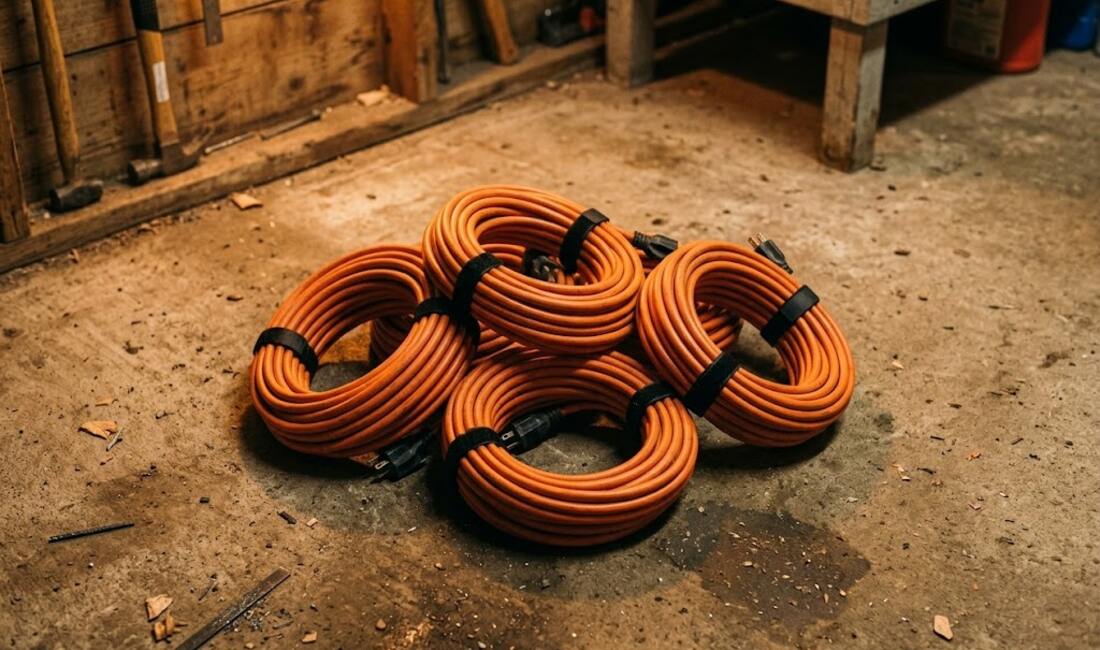
That is the entire subject in one photograph. Three cords — a 12-gauge fifty-footer, a 10-gauge generator cord, and a light one for lamps — bought once, marked with your name, hung on a hook. The fourth is the one you lend out and do not get back.
Never under rugs or carpets. A warm cord under a rug is a fire being scheduled. (Ask the man from Inglis.)
Never daisy-chain cords or power strips into each other — every junction is a weak point, and ratings do not add up, they collapse.
Outdoor use means outdoor-rated — look for “W” on the jacket. Indoor cords outside become brittle and crack.
Check before each season: cracks, exposed wire, loose or missing prongs — a damaged cord retires, it does not get taped.
Three prongs stay three prongs. Never snap off or bypass a ground pin.
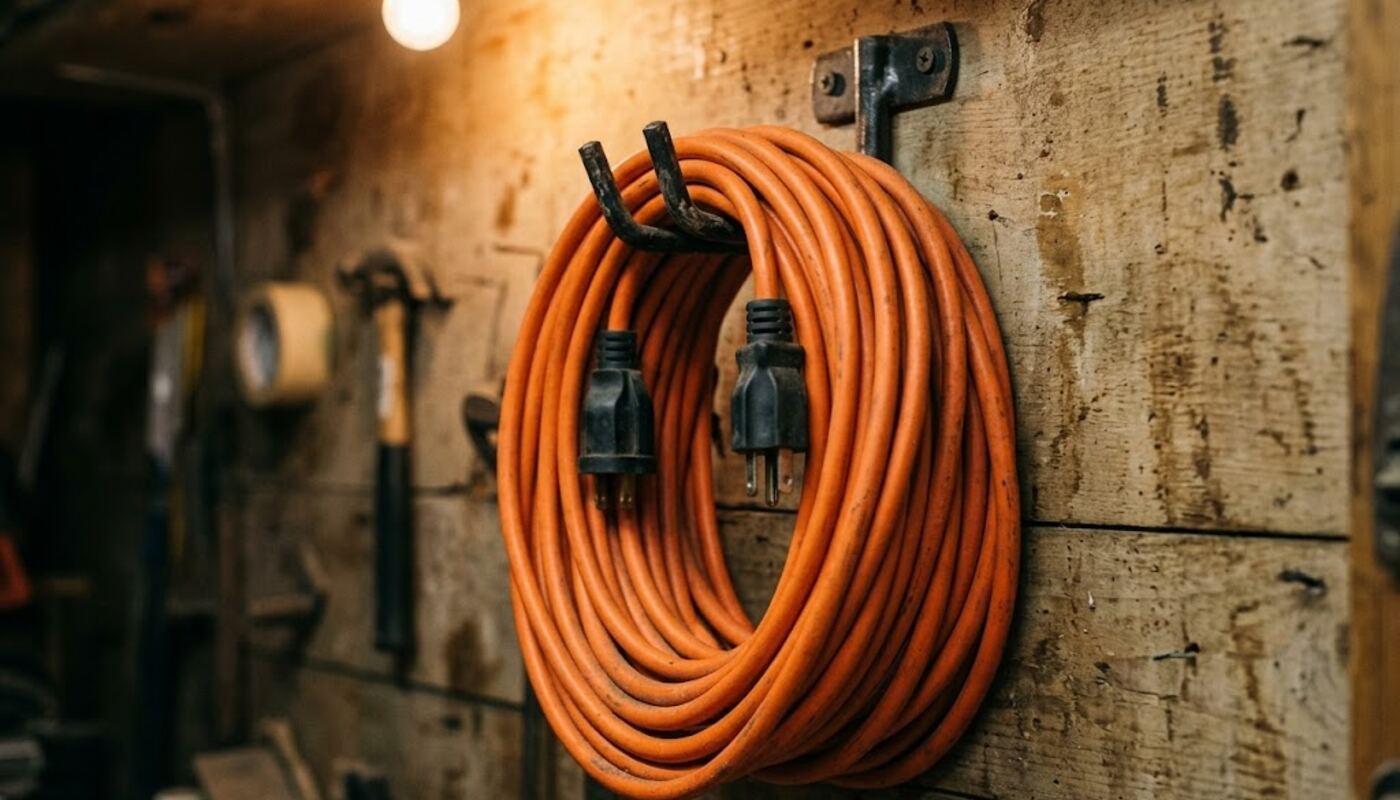
Cords never live where feet go — the same law as everything else on this website. Along walls, behind furniture, or up on hooks. Shop Cord Reels & Hooks →
That is the whole subject: three cords — a 12-gauge 50-footer, a 10-gauge generator cord, and a light one for lamps — bought once, marked with your name, hung on hooks. Under $100 for the set, and every motor you own runs cooler, stronger, and longer for it. See the Corded Tools guide for what to plug into them.
Still reading? Then you already know.
The short list at the top of this page is the whole answer. Start with the first item and build from there.
The short version of this page, one question at a time — the answer is always the first line.
What gauge extension cord do I need for a refrigerator?
For a refrigerator, use a 14-gauge extension cord up to 50 feet and a 12-gauge cord at 100 feet. A refrigerator’s draw varies with its size and make, so check the rating label on your own. When in doubt, buy the thicker, lower-number gauge.
What is the best all-around extension cord to own?
A 12-gauge, 50-foot outdoor-rated extension cord handles nearly everything a home runs, including the window AC, the refrigerator and every corded tool. It costs about $40.
What size extension cord do I need for a generator?
The main run from a generator should be a 10-gauge, outdoor-rated cord, sized for the total amps of everything it carries. Branch inside with shorter 12–14 gauge cords, and uncoil cords fully under heavy load.
How do I figure out how many amps an appliance uses?
Look at the appliance label for amps, or take its watts and divide by 120. A 900-watt microwave is 900 divided by 120, or 7.5 amps.
How many fires do extension cords cause?
The Electrical Safety Foundation International counts about 3,300 home fires starting in extension cords every year in America, killing roughly 50 people and injuring 270 more. The Consumer Product Safety Commission estimates another 4,000 extension-cord injuries treated in emergency rooms each year, about half of them falls.
Why is my extension cord warm?
An extension cord that feels warm to the touch is too small for the job, so unplug it and step up a gauge. Never run a cord under a rug and never daisy-chain cords together.
What This One Buys You
Power reaching the far corner safely.
The right gauge cord is what lets you run a saw in the driveway or a freezer off a generator without cooking the cord — a few dollars that stand between you and an electrical fire.
Disclaimer: This page is general educational information, not professional advice. Follow manufacturer instructions and use appropriate eye and hand protection with all tools. Power tools require properly rated extension cords; undersized cords are a fire hazard. Stories are illustrative composites reflecting common experiences. Product prices are approximate. Amazon links are affiliate links. Codes and local laws vary enormously. Building codes, electrical and plumbing codes, permit requirements and local ordinances differ by state, county and town, and they change. Check with your own building department, and with your landlord, HOA or insurer where they apply, before installing, altering or removing anything described here.Nothing on this page is legal advice. None of it was written by an attorney, and it is not a substitute for speaking to one about your own situation.Do not undertake any physical effort described or implied here — lifting, pushing, pulling, carrying, climbing, kneeling, or assisting somebody else — without first discussing it with your own doctor, who alone knows your medications, your bone density, your cardiac fitness, the condition of your back and joints, your grip strength and your balance, and whether such activity is appropriate for you. A pushing or pulling task can pull a muscle or injure a joint just as a lifting task can, and nothing on this site should be read as encouragement to attempt physical work you have not cleared with your doctor first. This site does not recommend that any reader attempt to move, tip or shift any tall or top-heavy item, alone or with equipment — those tasks belong to able helpers or to professional movers. Full disclaimer →