The Canning Shelf — Buy It Once, Fill It Every Fall
🔗
Affiliate disclosure: Some links on this page go to Amazon. If you buy something through one of them, we earn a small commission — at no extra cost to you. It never changes the price you pay, and it never decides what we recommend. As an Amazon Associate I earn from qualifying purchases.How we make money →
The gear lasts a lifetime and the jars last for generations. Here is what to buy, what is worth putting up — and the one book that holds all the how-to, on purpose.
Affiliate disclosure: Some links on this page go to Amazon. If you buy something through one of them, we earn a small commission — at no extra cost to you. It never changes the price you pay, and it never decides what we recommend.
Canning is having a moment again, and the pitch is a simple one: you put up a bounty cheap in the season it is cheap, and you eat it all winter. For the people this site is named for, the beautiful part is the gear. A canner lasts decades. Mason jars last for generations — there are pantries running jars older than the people using them. You buy the equipment once and fill the pantry every fall for the rest of your life. But canning is also the one job in this whole kitchen where you do not wing it: you get one tested book and you follow it to the letter, because the stakes here are not a rusty pan — they are your family’s safety. So this page does two things. It gets you the right gear, and it points you to the right book. The recipes and the times live in that book, on purpose, and in a minute you will see exactly why.
Which Canner You Need — the One Thing to Get Right
There are two kinds of canner, and which one you buy is decided by a single thing: how acidic the food is. This is the most important idea on the page, so we will say it plain.
A water-bath canner — really just a big, deep pot with a rack and a lid — is for high-acid foods: jams, jellies, pickles, most fruit, and tomatoes with a little added acid. The acid itself is what keeps the food safe; the boiling water finishes the job. This is the cheap, gentle, beginner end.
A pressure canner — a heavy pot that locks down and builds real steam pressure — is for low-acid foods: vegetables, meats, beans, soups. These must be pressure canned. Boiling water alone cannot make them safe no matter how long you boil them, because the danger in a sealed jar of low-acid food survives boiling and is only killed at the higher temperature a pressure canner reaches. There is no workaround for this, and no amount of added vinegar changes it.
One warning earns its own line: a pressure canner is not the same thing as an Instant Pot or an electric pressure cooker. The people who test this for a living do not approve those for canning low-acid food. If you are putting up vegetables or meat, you want a real, gauge-topped pressure canner — nothing else.
So the honest buying advice is short. If you are starting where most people start — jams, jellies, and pickles — a water-bath canner is all you need, and it is cheap. If you know you want to put up green beans or soup, budget for a pressure canner from the start. What time, what pressure, for which food? That is exactly what the book is for. It is the book’s job, not ours. Water-bath canners and pressure canners on Amazon.
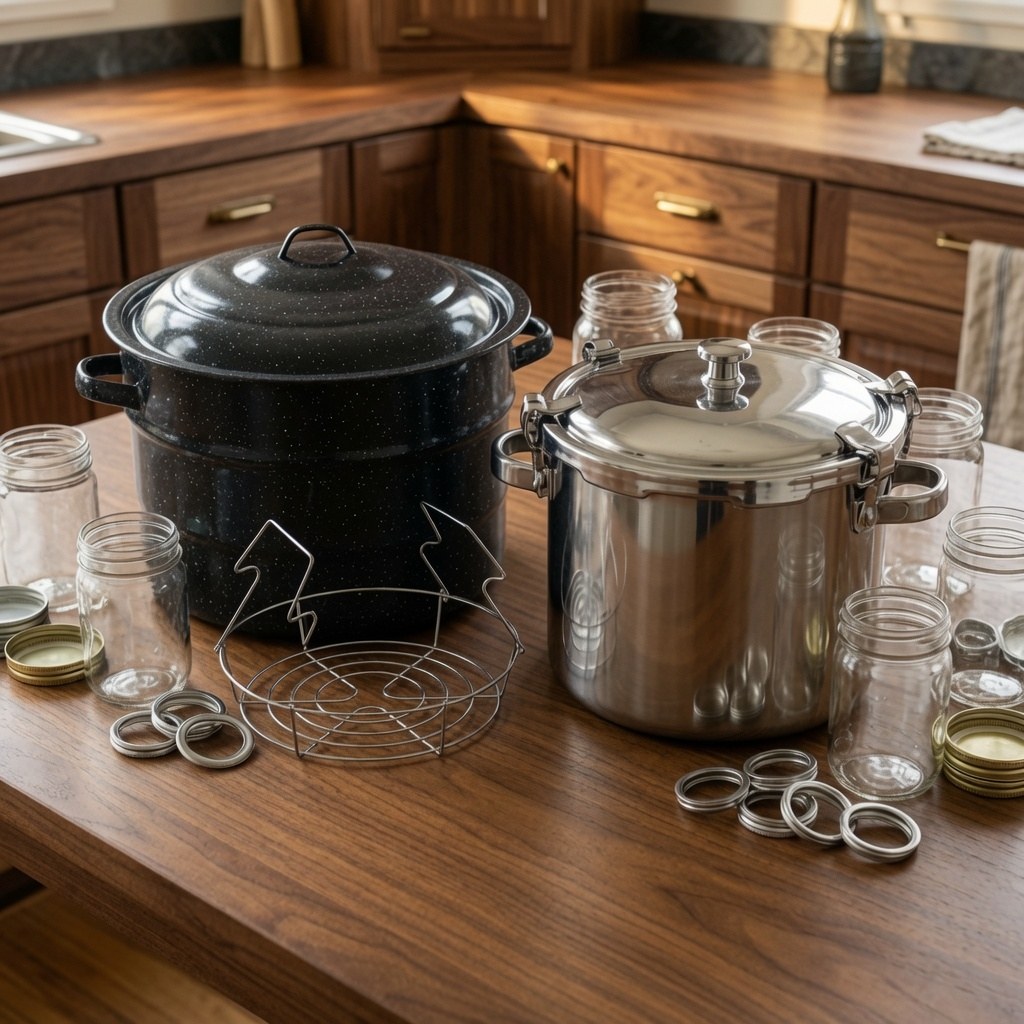
The two machines, and which food picks which: on the left the water-bath pot for the high-acid, forgiving foods — jams, jellies, pickles, fruit; on the right the pressure canner, the only safe way to put up low-acid vegetables and meats. The food’s acid decides, not your preference.
The Jars — The Real Buy-Once
Here is where canning becomes pure Buy It At 50. A canning jar is one of the few things you truly buy once. A good Mason jar lasts for decades — generations, honestly; there are jars on pantry shelves older than the hands filling them. You buy them once, wash them, and refill them every year for the rest of your life. Only one part is single-use: the flat metal lid, the disc that seals once and gets replaced each batch. The screw band that holds it down is reusable for years. Worth knowing why that matters more each year: grip is the first thing to go, and it starts at fifty, two decades before anything happens to your legs.
🫙 The Buy-Once
Mason Jars — Regular and Wide Mouth
Two mouth sizes, and they are not interchangeable, so pick one and stay with it or you will end up owning two of every lid. Wide mouth is easier on older hands — more room to get fruit in, and more room to get a jar lifter around the neck. Pints for most things, quarts for beans and sauce.
Get Mason jars — the two-piece kind, with a flat lid and a screw band. Regular-mouth is fine for jams and jellies; wide-mouth is easier for anything you have to pack in, like pickles or beans — and wide-mouth is friendlier to older hands, less fiddly to fill and to fish out.
Do not can in commercial food jars — the mayonnaise jar, the pasta-sauce jar. They are not built for the heat-and-cool of canning; they can crack in the canner or simply fail to seal, and a jar that does not seal is a jar you cannot keep.
Check the rim before every use. Run a finger around the jar’s top sealing edge. A chip or a crack there means it will not seal — retire that one to dry storage (dry beans, buttons, screws) and reach for a good one when there is food going in.
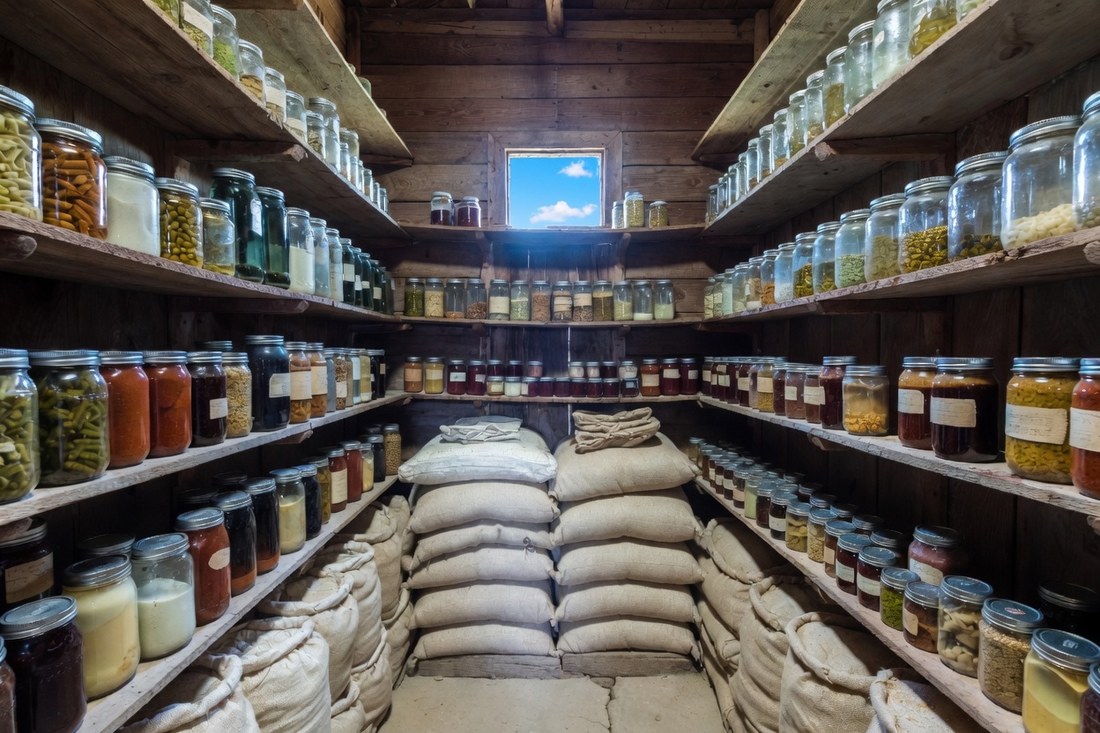
The buy-once shelf: fill these every fall for the rest of your life, and hand them down still working. The jars and bands come back year after year — the only part you rebuy is the flat lid on top and whatever summer you put inside.
🔁 The One Thing You Buy Every Year
Flat Lids — and Why Bands Are a Different Purchase
The flat lid is single-use for canning. Its sealing compound is good for one seal, and that is the whole reason it is the only part of this you ever rebuy. The screw band underneath is not: it comes off once the jar has sealed and goes back in the drawer for the next twenty years. Buy lids by the box before the season — not in August, when every shelf in the county is bare.
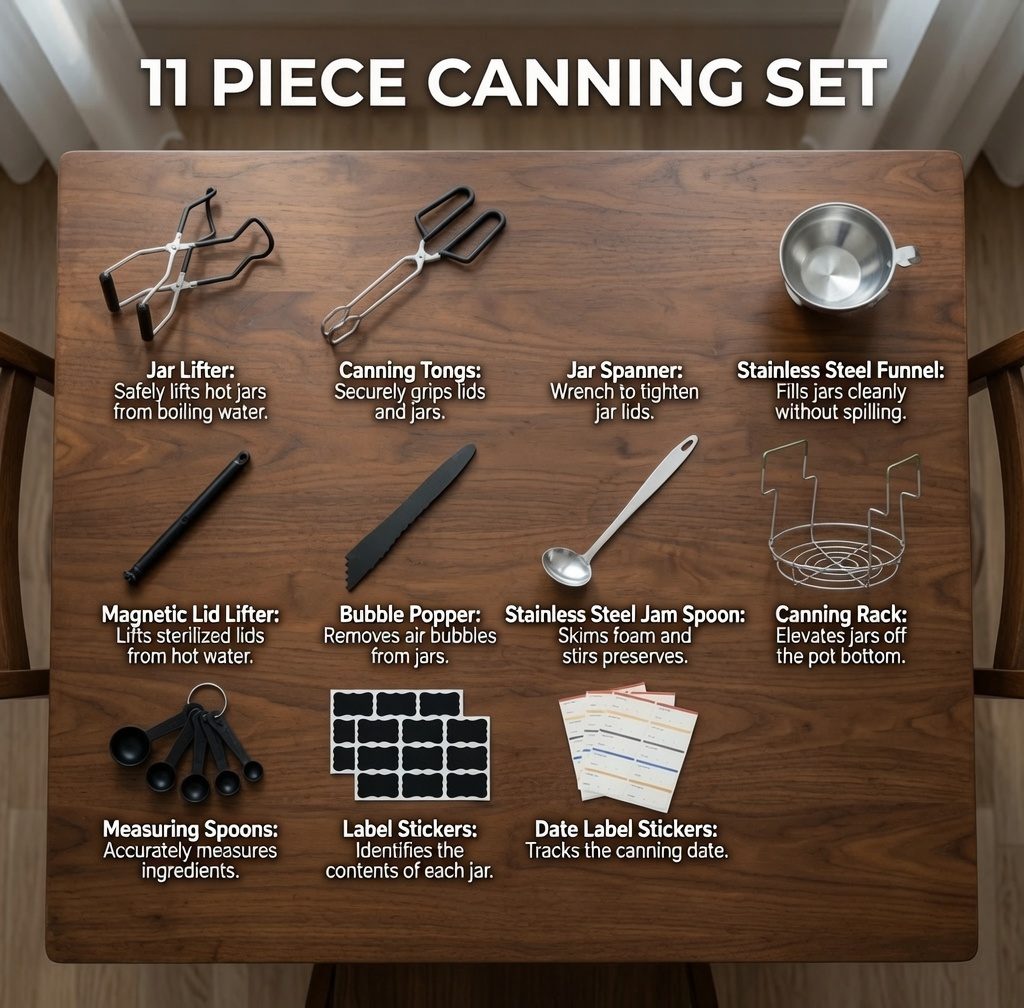
You can get by with just a pot and jars, but a handful of cheap tools turn canning from a scald-and-fumble job into an easy afternoon — and they matter more, not less, as your hands get older. The whole set costs about what two jars of store-bought jam do:
A jar lifter — rubber-jawed tongs that grip a hot, wet jar so you are never hauling a scalding jar out of boiling water with a slippery dish towel. If you buy one single tool, buy this one.
A canning funnel — a wide funnel that sits in the jar mouth so you fill the jar and not the counter, and keep the rim clean, which the seal depends on.
A bubble remover / headspace tool — a little plastic wand that slides down inside to free trapped air and measure the gap at the top of the jar. (How much gap? The book will tell you — that gap has a job.)
A lid lifter — a magnet on a stick to pull a flat lid out of hot water without burning your fingertips.
All four come bundled as a “canning tool set” for a few dollars. Buy the set — it is the cheapest comfort and safety you will ever add to the kitchen. Canning tool sets on Amazon.
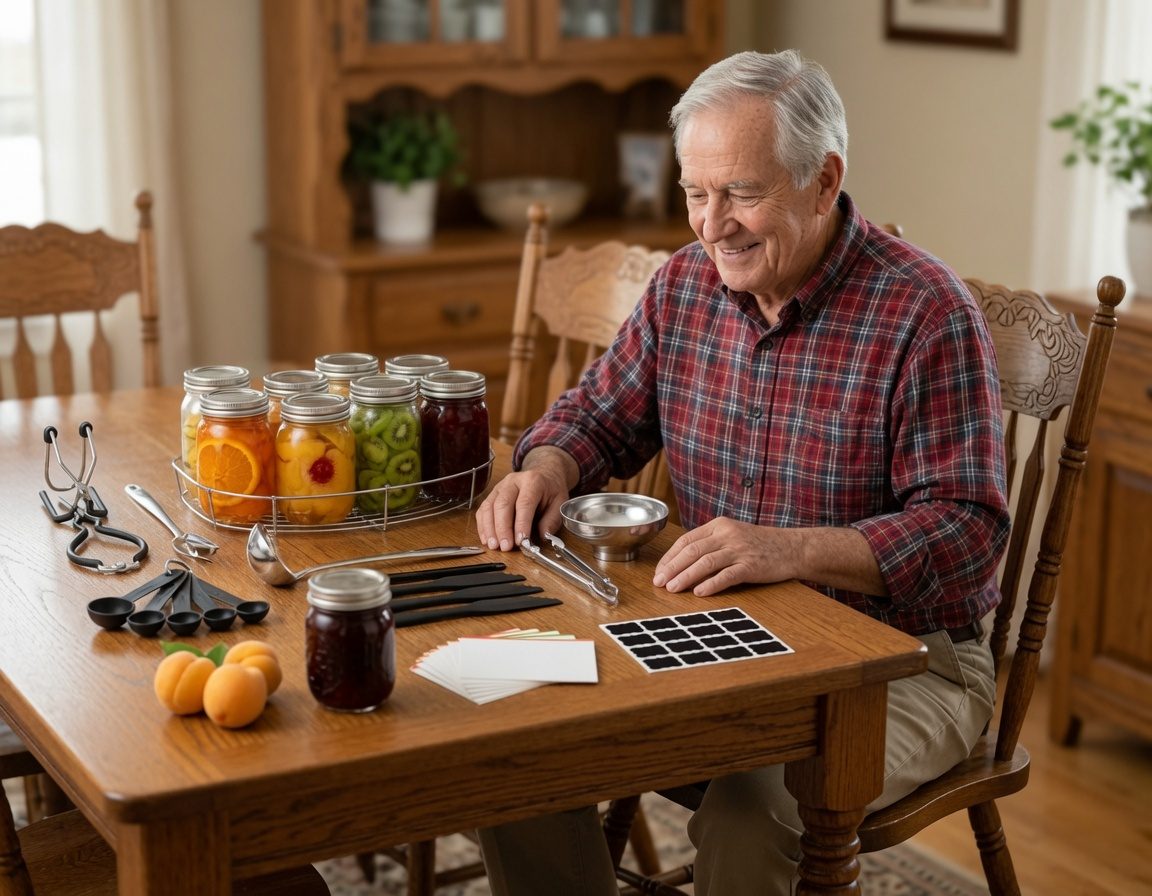
The whole kit, for the price of two jars of store jam: jar lifter, funnel, bubble remover, magnetic lid lifter. The jar lifter alone is worth it — it is the difference between lifting a scalding jar safely and dropping it.
What’s Worth Putting Up
Here is the fun part — what actually goes in the jars. We will not hand you recipes (that is the book’s job, and we mean it), but here is what is worth a beginner’s time, easiest first:
Jams and jellies. The perfect first project: high-acid, water-bath, and forgiving. Strawberry, blackberry, grape, apple — if you can boil fruit and sugar, you can make jam. This is where most folks start, and where plenty of them happily stay.
Pickles and relishes. Cucumbers of course, but also beans, beets, okra, peppers — the vinegar does the safety work and the water bath does the rest.
Tomatoes and salsa — with the added acid the recipe calls for. Tomatoes sit right on the line between high- and low-acid, so this is one where you follow the recipe to the letter, no eyeballing.
Fruit — peaches, pears, applesauce, pie filling. A shelf of summer to open in February.
And with a pressure canner: green beans, corn, carrots, soups and stocks, even meat and chili. The pantry version of a chest freezer that never loses power in a storm.
Every single one of these has a tested recipe waiting in the books just below. Pick a fruit, look it up, follow it exactly.
And not everything worth putting up goes in a jar. Rendered fat keeps for months in the refrigerator and longer than that frozen, costs nothing because it is a by-product of something you already cooked, and it is what the pantries these methods came from actually ran on. Saving bacon grease and rendering lard is on its own page.
Where the How-To Lives — The Books
Now the most important section on this page, and the one that makes canning different from every other subject on this site: we are not going to teach you how to can. Not because it is hard — because it is the one kitchen skill where a wrong number can genuinely hurt someone, and the people who worked out the right numbers already wrote every one of them down, tested them in a laboratory, and in most cases give them away for free. Your whole job is to get one of these and follow it exactly: the exact recipe, the exact time, the exact method. Never improvise the acid. Never shave the time.
The USDA Complete Guide to Home Canning. The gold standard — written by the government’s food-safety people, tested, and completely free to download. If you get one thing, get this. Download it free.
The National Center for Home Food Preservation — the same USDA-backed recipes, online and free, from the University of Georgia. Searchable, which makes it the easy one to use from your phone right there at the stove. nchfp.uga.edu.
The Ball Blue Book Guide to Preserving (or its bigger cousin, The All New Ball Book of Canning and Preserving) — the classic, made by the folks who make the jars, with every recipe lab-tested. The friendly, sits-on-the-counter option. Find it on Amazon.
So Easy to Preserve, from the University of Georgia — a big, thorough, fully tested book if you want one volume that covers canning, pickling, freezing, and drying all at once.
Get one. Follow it to the letter. That is the entire safety plan, and it is a good one.
My grandmother gave me the run of her kitchen on everything but one thing — canning, she watched me like a hawk and cut me no slack. Sixty years later I still can with the book open on the counter, following it a step at a time. Read the whole story →
An Honest Word on Safety — and on Older Hands
Two honest things before you start. First, the safety, since it is the reason this page keeps sending you to the book. The danger in canning has a name — botulism — and you cannot see it, smell it, or taste it. In a sealed jar of improperly canned low-acid food it can make a poison so strong that a single taste can be fatal. That sounds dramatic; it is simply true, and it is exactly why the tested recipes exist, and exactly why “grandma canned it in a water bath and was fine” is not a plan — it is luck, and luck runs out. Follow a tested recipe and canning is safe, simple, and one of the most satisfying things you will ever do in a kitchen. Skip the recipe and it becomes a gamble with the worst prize there is.
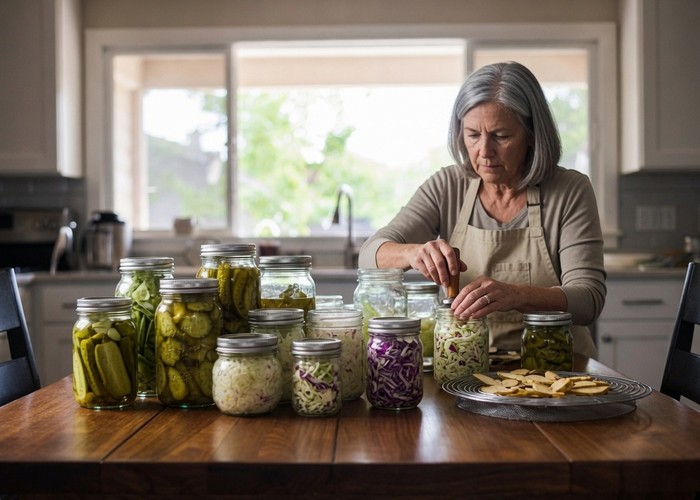
Second, the hands. Canning is physical work — you are lifting pots of boiling water and hoisting hot, full jars. Past fifty, size the job to your body, not your ambition: do smaller batches, use the jar lifter every single time, keep a clear path from the stove to the counter, and never wrestle a full canner you cannot lift safely. There is no medal for a big batch — and honestly, canning is more fun with a second set of hands anyway, which is as good an excuse as any to rope in a grandkid.
Buy It at Fifty — A Pantry That Fills Itself
Step back and look at what this actually costs. A water-bath canner, a case of jars, and a four-dollar tool set — and you are set for the rest of your life. The canner lasts decades. The jars last generations. The only things you ever rebuy are the flat lids and whatever summer you put inside. Do this at fifty and you are not buying a hobby gadget. You are buying a pantry that fills itself every fall for the next thirty years, and a shelf of jars your grandchildren will still be using after you.
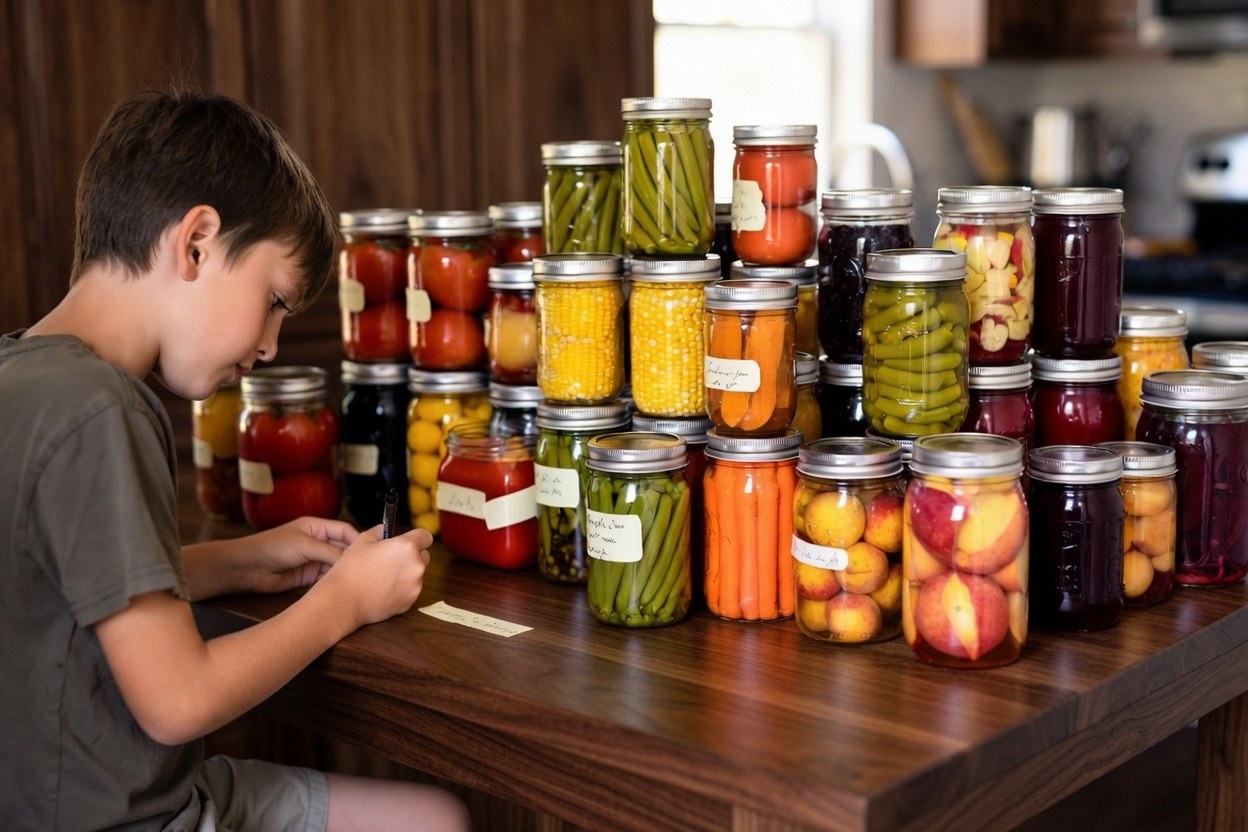
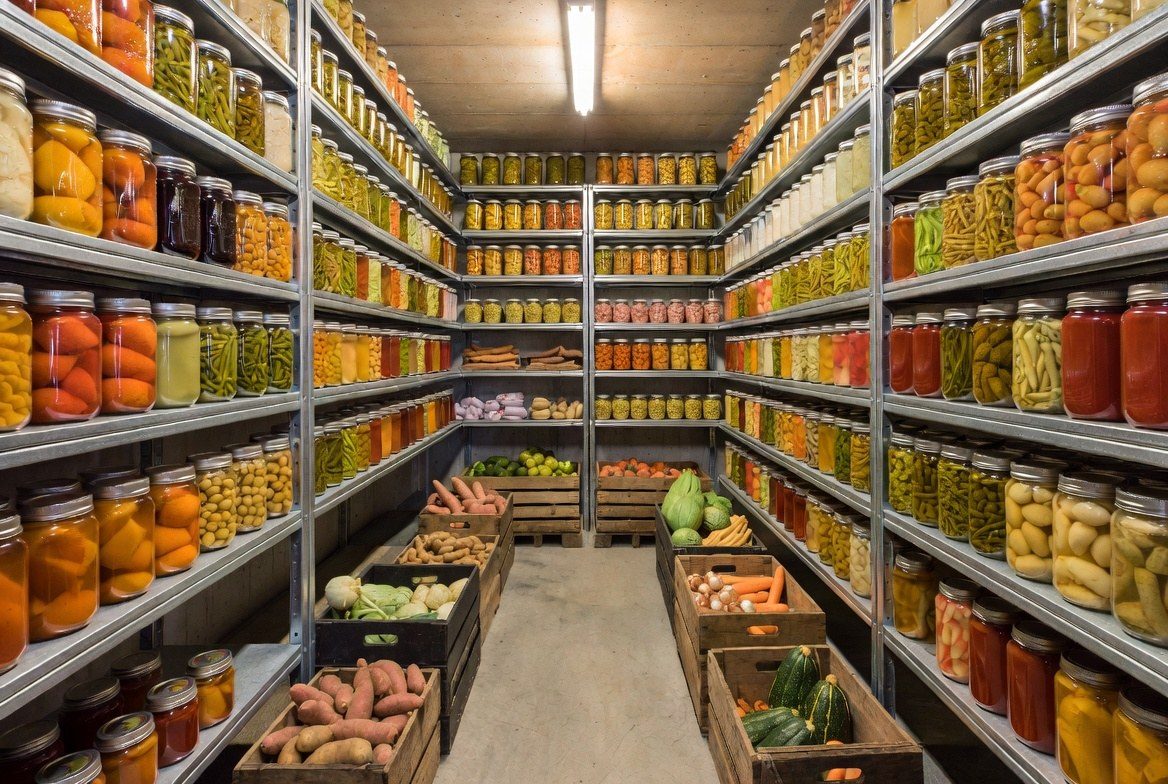
A pantry that fills itself: put up a little every fall, and this is what the years look like — a wall of summer waiting on winter, with the root crops keeping cool on the floor below. The jars come back every year; only the lids and the harvest are ever new.
And it fits the rest of the plan. If you are already growing a garden, canning is how the July tomatoes become January soup — grow it, then keep it. That is the oldest version of Buy It At 50 there is: the people on the hill I grew up on put up the whole summer every fall, because the store was a long way down the mountain and a hard winter was a certainty, not a maybe. Same jars, same idea, still on the shelf. Start with a batch of jam, and you have joined them.
Every jar on those shelves went up in a week when nothing whatever was wrong. A pantry like this cannot be built in an emergency — it is built one Saturday at a time across about fifteen summers, which is the whole of the argument for starting at fifty.
The short version of this page, one question at a time — the answer is always the first line.
Do I need a pressure canner or a water bath canner?
A water-bath canner is for high-acid foods like jams, jellies, pickles and most fruit, while a pressure canner is for low-acid foods like vegetables, meats, beans and soups. The food's acid decides, not your preference.
Can you can vegetables in a water bath?
No, low-acid foods such as vegetables, meats, beans and soups must be pressure canned, because boiling water alone cannot make them safe. No amount of added vinegar changes that.
Can I use an Instant Pot for canning?
An Instant Pot or other electric pressure cooker is not approved for canning low-acid food by the people who test canning methods. For vegetables or meat, use a real, gauge-topped pressure canner.
Can you reuse canning lids?
The flat metal canning lid is single-use, because its sealing compound is good for one seal, but the screw band is reusable for years. Mason jars themselves last for decades if the rim has no chips or cracks.
Can I can in old mayonnaise or pasta sauce jars?
Do not can in commercial food jars like mayonnaise or pasta-sauce jars, because they can crack in the canner or fail to seal. Use two-piece Mason jars with a flat lid and a screw band.
Where can I find safe, tested canning recipes?
The USDA Complete Guide to Home Canning is the gold standard for tested canning recipes, and it is free to download. The National Center for Home Food Preservation has the same USDA-backed recipes online for free. Follow the recipe exactly.
Get the book first. Then the gear.
Start with jams and jellies and a cheap water-bath canner — the gentle, forgiving end — and let the free USDA guide walk you through it. The pantry grows from there.
The equipment is bought once and used every fall, and a two-jars-deep pantry means you eat your own garden all winter whether the store is having a good week or not.
General Information Disclaimer: This page is general educational information, and some links are affiliate links (we may earn a commission at no extra cost to you). It is not medical, nutritional or food-safety advice, and it was not written by a food scientist, a dietitian or an extension specialist.Home food preservation carries a real risk of serious illness, including botulism, when it is done outside a tested procedure. Use only current, tested recipes and processing times from the USDA, the National Center for Home Food Preservation, your state Cooperative Extension service, or the current Ball Blue Book — family recipes and older editions are not a substitute. When in doubt about any preserved food, throw it out rather than taste it. If you have a health condition, ask your physician or pharmacist before changing what you eat. Nothing on this page is legal advice. None of it was written by an attorney, and it is not a substitute for speaking to one about your own situation.Full disclaimer →