
🕑 The Hour This Happens In
First, what this page is. A plain explanation of what federal law says about nursing home admission agreements and about being moved out of one. It is not legal advice, it was not written by an attorney, and nothing here tells you how any particular contract or any particular dispute will come out. The federal rules described apply to facilities certified for Medicare or Medicaid — which is nearly all of them — and state law adds protections that vary enormously. If real money or a real eviction is on the table, get a lawyer or call your state's Long-Term Care Ombudsman, whose help is free.
Picture the actual moment, because the moment is the whole problem.
Your mother has been in the hospital eleven days. This morning somebody said the word discharge and by lunchtime a bed had been found forty minutes away, and now it is late afternoon and you are standing at a counter in a corridor while a pleasant person slides a stack of paper toward you and says, kindly, that it is all pretty standard.
You have not eaten. You are frightened. You have never seen a document like this in your life, and everybody in the building is waiting on you. That is not an accident of scheduling. That is when these are signed, and everybody involved knows it.
So here is the whole page in one paragraph, in case you are reading it in that corridor right now on a telephone:
Do not sign anything that makes you personally responsible for the bill. Federal law says the facility may not even ask you to. Sign only as your parent's representative, and write those words next to your name. If there is a separate arbitration agreement, you do not have to sign it at all — and if you already did, you have thirty days to cancel it. Nobody can be thrown out for refusing any of this.
The rest of this page is why each of those sentences is true, and what to do when the facility tells you otherwise.
✍ The Clause That Turns Their Bill Into Your Debt
The federal rule is one sentence long and it is worth reading in the original, because the important word is not the one you would expect.
What the regulation actually says
42 CFR § 483.15(a)(3)The facility must not request or require a third party guarantee of payment as a condition of admission, expedited admission, or continued stay.
Request. Not merely require — asking is itself the violation. There is no version of this where the facility gets to put the clause in front of you and let you decide.
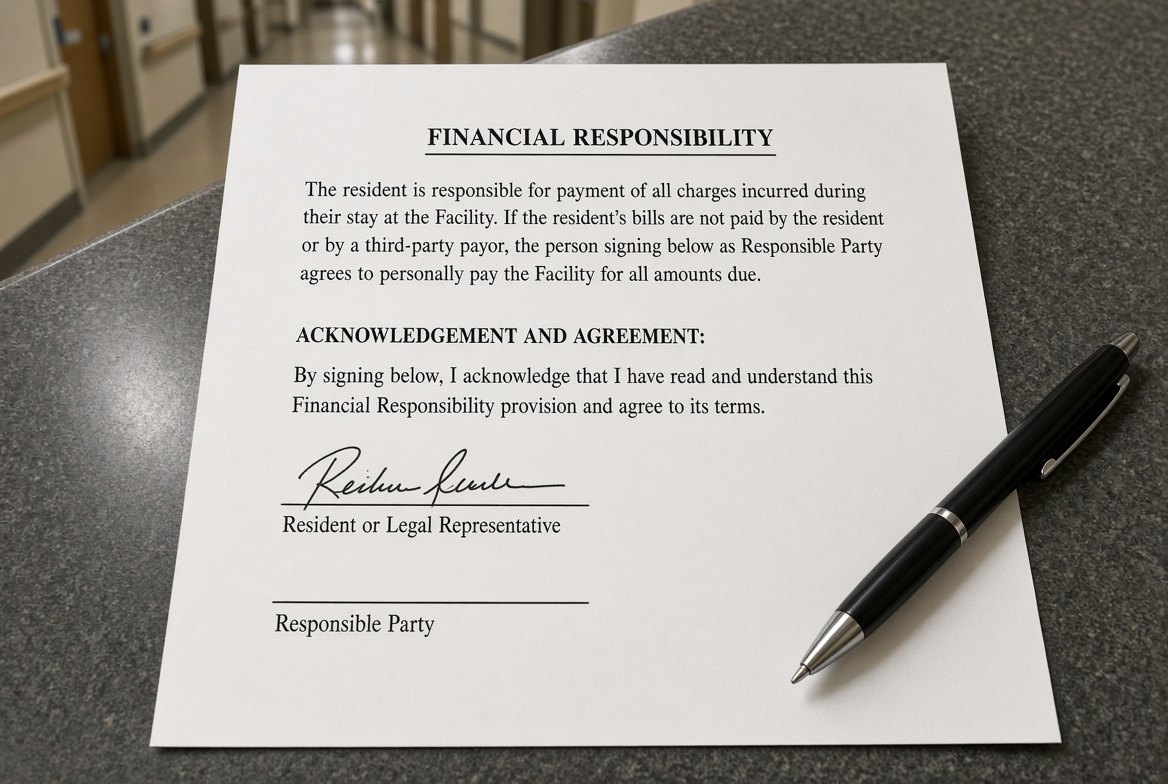
The regulation then allows exactly one thing, and the last five words are the entire distinction: a facility may require a resident representative who has legal access to the resident's income or resources to sign a contract agreeing to pay the facility out of the resident's money — “without incurring personal financial liability.”
So there are two very different promises, and they look almost identical on paper.
- Lawful: I have access to my mother's checking account and I will use my mother's money to pay her bill.
- Not lawful to ask for: If my mother's money runs out, I will pay you.
Everything in this section is about telling those two apart at four in the afternoon with a pen in your hand.
How the second one gets dressed up as the first
Almost no modern agreement uses the word guarantee. What it does instead is name you the “responsible party” and have you make three promises: that you have access to your parent's money, that you will use it to pay the facility, and that you will take all appropriate steps to get them qualified for Medicaid.
Read innocently, that is the lawful version. The trap is in what happens when a promise is broken. If the Medicaid application is late, or a bank will not release funds, or the paperwork sits in a drawer during the worst month of your life, the facility does not sue your mother. It sues you — not on a guarantee, which would be plainly illegal, but for breaching your own promise. Same money, different doorway.
Where this normally lands, and it is worth being honest about it: a great many of these lawsuits fail. The facility is trying to get around a federal prohibition, and as a general matter somebody acting as another person's agent is not liable for that person's debts. But not all of them fail. Courts have sided with facilities, most often where the family member had control of the resident's money and spent it on something else. Nobody should read this page and conclude that a signature cannot hurt them. Read it and conclude that the signature is worth four minutes of attention.
🔍 What Changed in 2025, and Why It Matters to You
This part is new enough that most people working in admissions have not absorbed it, let alone the families walking in.
In November 2024 the Centers for Medicare & Medicaid Services rewrote the guidance its inspectors use, and the revision took effect on April 28, 2025. Surveyors are now told to read admission agreements and cite the facility when the language creates a third-party guarantee.
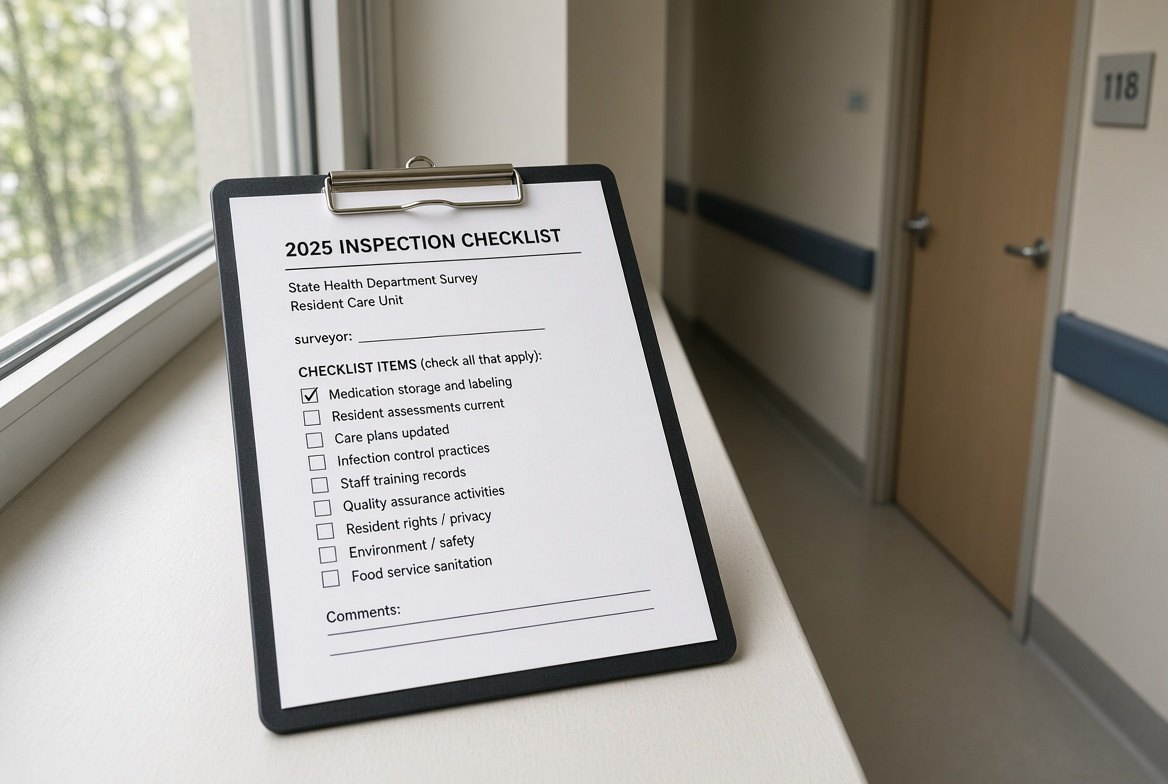
Two things in that guidance are useful to a family:
What CMS told its inspectors to look for
Effective April 28, 2025The word “guarantee” does not have to appear. Any language that seeks to hold somebody other than the resident personally responsible for paying the facility can be cited. Among the examples given: language holding the resident and the representative jointly responsible for sums due, and language holding the representative personally liable for breaking a promise in the agreement — including the promise to apply for Medicaid.
And the one that closes the loop: if the person signing does not actually have legal access to the resident's money, the facility may not request or require that person to pay at all.
What this does for you standing at the counter is simple. You are not asking for a favor and you are not being difficult. You are pointing at a clause the facility's own inspectors have been told to write them up for. Saying so, politely, out loud, changes the temperature of the conversation more than any argument about fairness will.
🖉 How to Sign, and What to Strike
Nothing here requires a lawyer, and all of it takes about four minutes.
The four minutes
Do this at the counter- Find every place your own name appears as anything other than a contact. Signature lines labeled Responsible Party, Guarantor, Sponsor, or Financial Agent are the ones to slow down on.
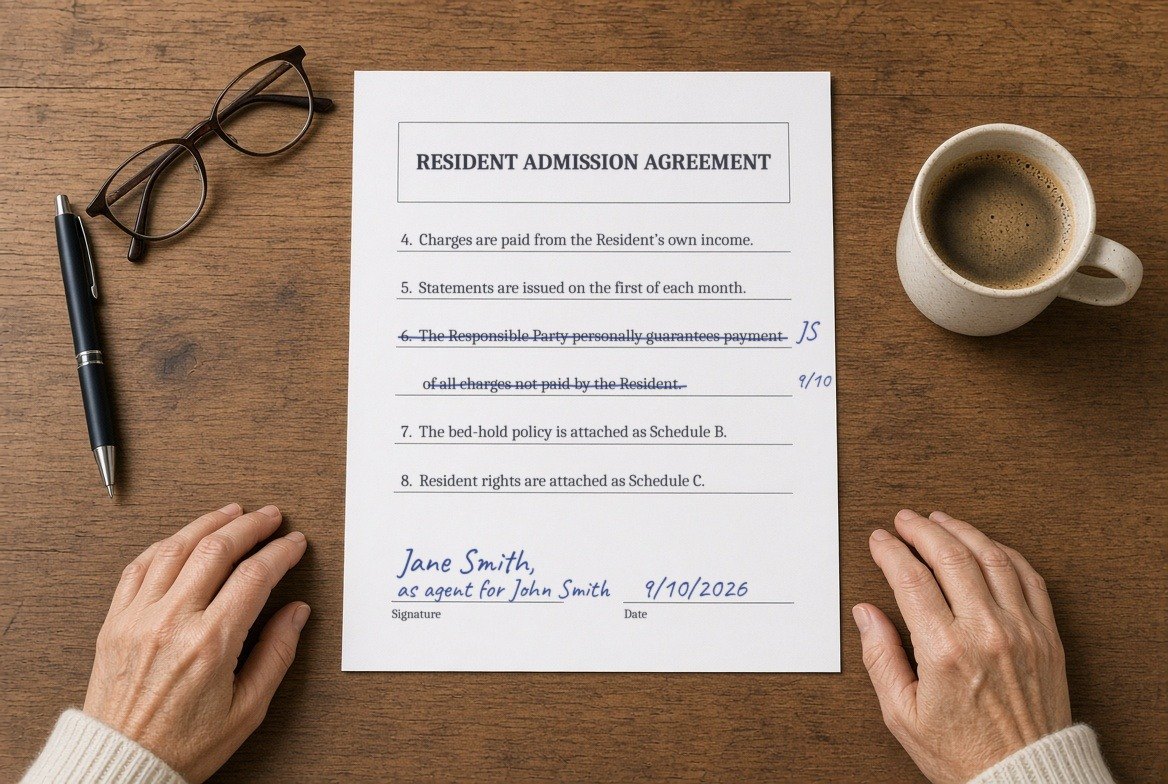
- Sign in a representative capacity and write it out. Not Jane Smith. Instead: “Jane Smith, as agent for John Smith.” If you hold power of attorney, say so — as attorney-in-fact for John Smith. A bare signature on a line marked Responsible Party is the thing being sold to you, and it costs nothing to refuse.
- Strike the clause, initial the strike, and date it. Draw a line through language making you personally liable, write your initials beside it, and hand it back. If they say the computer will not accept a marked-up form, that is a fact about their computer, not about the law.
- Take a photograph of every page you signed, before you hand it back. Facilities are required to give you a copy; photographs get taken and copies get promised. Do both.
- Write down who handed it to you and when. One line on your phone. It costs nothing and it is the difference between a memory and a record.
Two things that are true and that nobody tells you
If your parent has already been physically admitted, you have far more leverage than you feel like you have. Refusing to sign an admission agreement is not one of the lawful reasons a resident can be discharged. It is not on the list. The list is six items long and you will find it further down this page.
And do not sign it on the theory that it will all work out. That is the single most common decision made in that corridor, and it is the one that comes back. If it ends up in front of a judge, your signature is the strongest thing on the table, and it will be read against you no matter how tired you were.
You are allowed to say this out loud, exactly like this: “I'm happy to sign as my mother's representative and to pay her bills out of her account. I'm not signing anything that makes me personally responsible, and I understand federal law says you can't ask me to. Can we cross that out?” Most of the time it gets crossed out.
⚠ What Everybody Believes About Arbitration, and Why It Is Wrong
Search this subject and you will be told that nursing homes cannot make you agree in advance to arbitration. It is repeated everywhere, including by people who ought to know. It has been out of date since 2019.
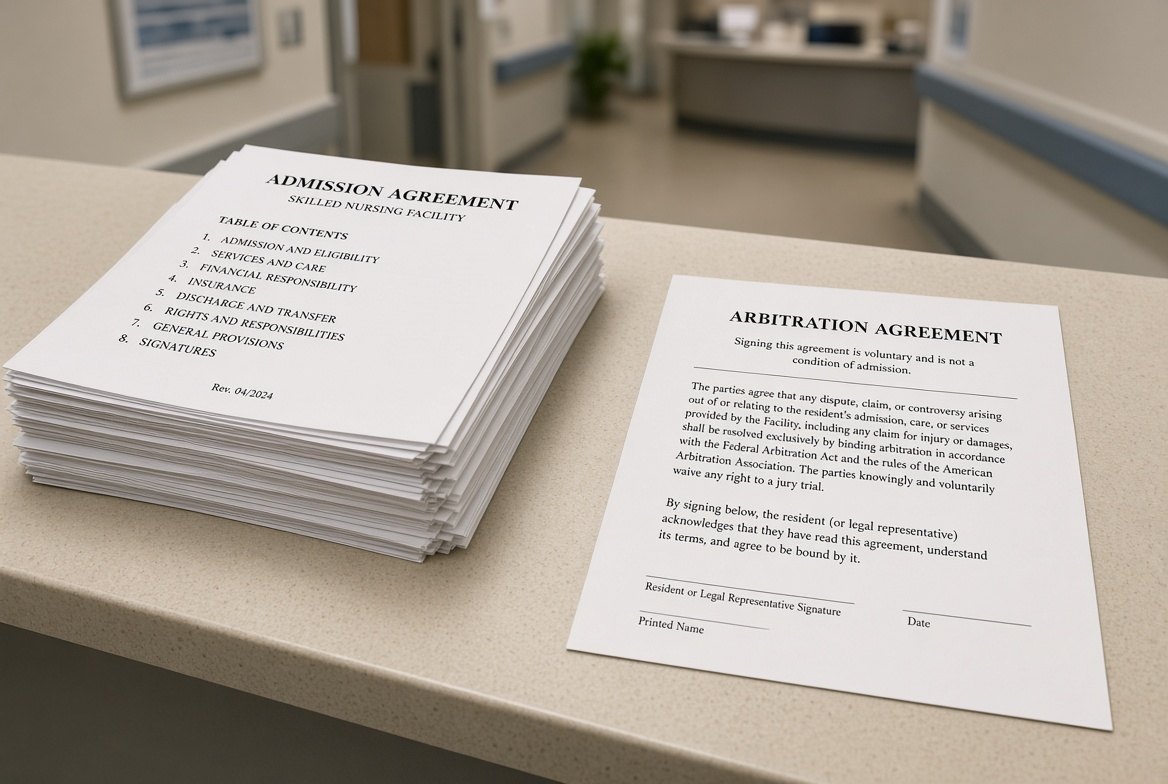
Here is what happened. A 2016 federal rule did ban these agreements outright. CMS removed that ban in 2019, and the new rule was challenged and upheld by a federal appeals court in October 2021. So a nursing home today may absolutely put a binding arbitration agreement in front of you before any dispute exists — an agreement that, signed, gives up the right to take a future injury claim to a jury.
What survives is still worth a great deal, and it is all in one regulation.
What the facility still may not do
42 CFR § 483.70(n)- It may not require an arbitration agreement as a condition of admission, or as a condition of continuing to receive care.
- The agreement must be explained in a form and manner you actually understand, and you must acknowledge that you understood it.
- It must explicitly say that neither the resident nor the representative is required to sign it.
- It must explicitly grant the right to cancel within thirty calendar days of signing.
- It may not contain language discouraging anyone from talking to state or federal officials, surveyors, or the Long-Term Care Ombudsman.
This is the most useful sentence on the page, so it gets its own box. If the papers were signed within the last thirty days, the arbitration agreement can still be canceled — and the facility may not discharge your parent or refuse care because you canceled it. Put it in writing, date it, deliver it, and keep proof that you delivered it. Then put a copy in the folder.
And the simplest version, for the corridor: the arbitration agreement is usually a separate document, and you can hand it back unsigned. Admission proceeds without it. If someone tells you otherwise, that is the sentence the regulation was written to make illegal.
🚪 The Only Six Reasons Anyone Can Be Made to Leave
Involuntary discharge is the most common serious complaint in this whole subject, and families almost never know the ground they are standing on. So here is the ground.
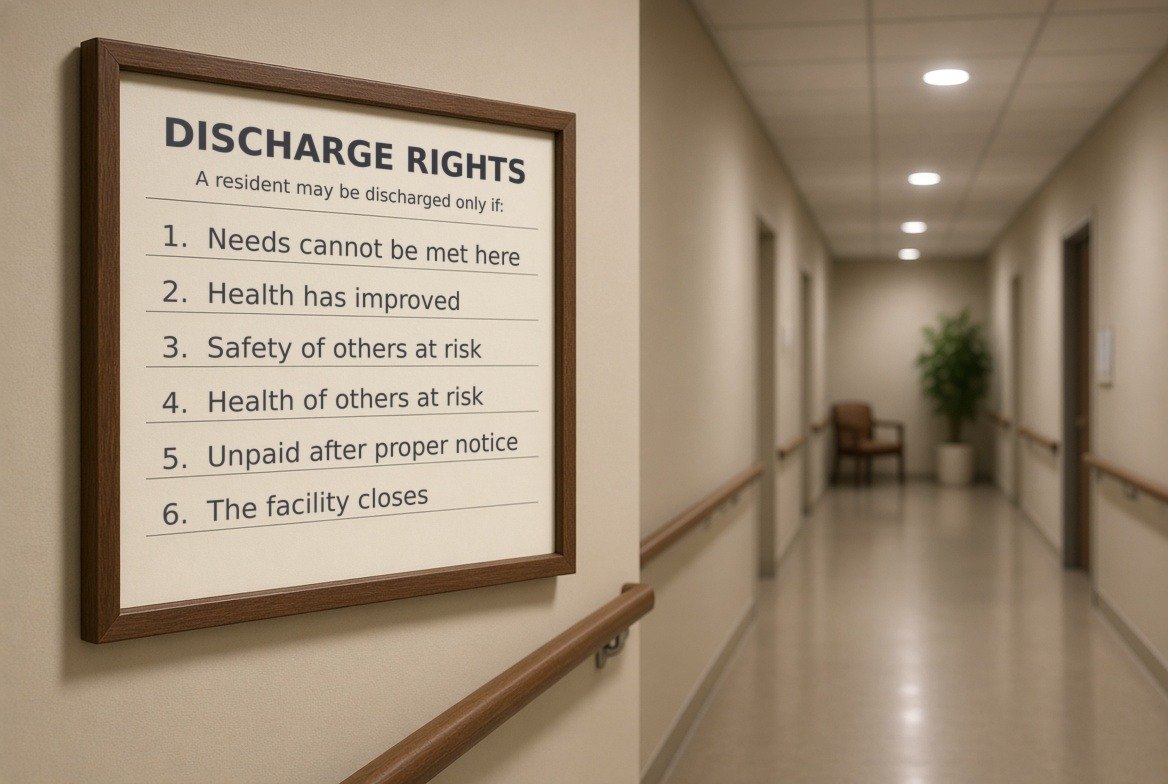
A resident may be transferred or discharged against their wishes for six reasons and no others:
The list, in full
42 CFR § 483.15(c)(1)- It is necessary for the resident's welfare and their needs cannot be met in the facility.
- Their health has improved enough that they no longer need the services.
- The safety of others in the facility is endangered.
- The health of others in the facility would be endangered.
- Non-payment, after reasonable and appropriate notice.
- The facility closes.
Being a difficult resident is not on the list. Having a family that complains is not on the list. Converting from private pay to Medicaid is not on the list. Refusing to sign an arbitration agreement is not on the list.
The protections that come with it matter as much as the list itself:
The notice is not allowed to be a sentence on a slip of paper. It must be in a language and manner you understand, and it must state the reason, the effective date, where the resident is being sent, the Ombudsman's contact details, and a statement of appeal rights — including where to send the appeal, how to get the appeal form, and how to get help filling it in.
And the provision that does the actual work: once an appeal is filed, the facility may not move the resident while it is pending. Filing is not a gesture. Filing is the brake.
The non-payment reason is narrower than it sounds. It applies where the resident has not submitted the paperwork a third-party payer needs, or where a payer has denied and the resident then refuses to pay. And for somebody who becomes eligible for Medicaid after moving in, the facility may only charge what Medicaid allows. “We don't take Medicaid anymore” is not one of the six reasons either.
🛌 The Bed-Hold Notice, and the Right to Come Back
Here is a quiet one that costs families their room every single week.
Your parent is in the nursing home. Something happens and they go to the hospital for nine days. When they are ready to come back, the nursing home says the bed is gone.
Two rules apply, and both are on the facility, not on you.
- Before the transfer to hospital or a therapeutic leave, the facility must give you written information about how long the state's bed-hold period runs, what it costs, and its own policy on holding the bed.
- At the time of the transfer, it must give you a second written notice stating the duration of that bed-hold. Two notices. In writing. Both times.

And then the part that is genuinely reassuring: if the hospital stay runs longer than the bed-hold period, the resident does not lose their place. They return to their old room if it is available, and otherwise to the first semi-private bed that comes free — provided they still need the care and are still eligible.
Not “go back on the waiting list.” First available bed.
🤝 The Free Advocate Every State Already Has
If there is one thing to carry away besides the signature advice, it is that a trained advocate whose only job is to take the resident's side already exists in your state, costs nothing, and is not employed by the facility.
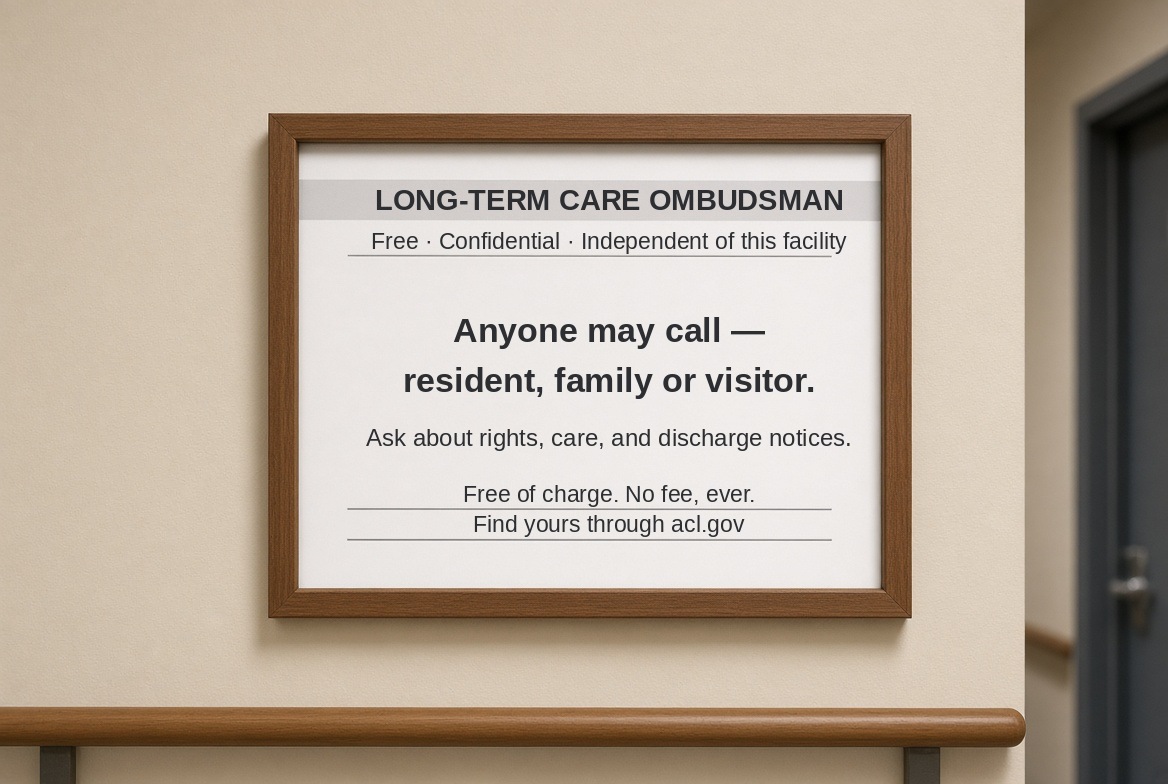
Under the Older Americans Act, every state — plus the District of Columbia, Puerto Rico and Guam — runs a Long-Term Care Ombudsman program covering nursing homes, assisted living and board-and-care homes. The service is free, confidential and resident-directed, and residents, families and even neighbors can call.
Find yours through acl.gov, or call the Eldercare Locator at 1-800-677-1116, which routes by zip code. Most facilities are also required to post the local ombudsman's name and number somewhere on the wall.
What they are good at: reading the agreement with you, telling you whether what you were just told is true, sitting in on a care conference, and pushing back on a discharge notice. What they are not: inspectors. They have no enforcement power and cannot win you money. For enforcement, the complaint goes to your state survey agency; for money, you need a lawyer. Knowing which of the three you need is half the job, and the ombudsman will tell you that too.
⚡ Why This One Is on the Fifty List
Everything on this page is small. Cross out a clause. Add five words next to your name. Hand back one document unsigned. Photograph what you signed. Know that six reasons exist and that a phone call puts a free advocate on your side.
None of it is hard. All of it is impossible in the hour it is needed.
Because that hour has a particular shape: somebody you love has just come out of a hospital bed, a place has been found and might not be there tomorrow, a pleasant person is waiting with a pen, and every instinct you have is telling you not to be the difficult one holding up your own mother's care. The document is designed for that hour. It is not handed to you on a Tuesday morning with a week to think.
So the value of this sits entirely in reading it now, when it is somebody else's parent, and remembering one sentence: sign as their representative, never as the responsible party.
And if you are reading it in the corridor, on a phone, with the stack in front of you — ask for four minutes. Nobody has ever been refused four minutes.
❓ Plain Answers
The short version of this page, one question at a time — the answer is always the first line.
Do I have to sign as the responsible party at a nursing home?
No, a nursing home certified for Medicare or Medicaid may not request or require a third party guarantee of payment as a condition of admission or continued stay. Sign only as your parent's representative, never as the responsible party.
How should I sign a nursing home admission agreement for my parent?
Sign in a representative capacity and write it out, such as “Jane Smith, as agent for John Smith,” or as attorney-in-fact if you hold power of attorney. Strike any personal-liability clause, initial the strike and date it.
Do I have to sign a nursing home arbitration agreement?
No, a nursing home may not require an arbitration agreement as a condition of admission or continued care. If you already signed one, you can cancel it within thirty calendar days, and the facility may not discharge your parent for it.
Can a nursing home kick out a resident?
A nursing home may discharge a resident against their wishes for only six reasons under federal rules. They include unmet welfare needs, improved health, danger to others' safety or health, non-payment after notice, and the facility closing, generally with 30 days' written notice.
Can a nursing home move a resident while an appeal is pending?
No, once a discharge appeal is filed, the facility may not move the resident while the appeal is pending. The written notice must state the appeal rights and a copy goes to the Ombudsman.
Who can help me with a nursing home problem for free?
Every state runs a Long-Term Care Ombudsman program, which is free, confidential and not employed by the facility. Find yours through acl.gov or call the Eldercare Locator at 1-800-677-1116.