The short answer
Does Medicare cover dental?
Original Medicare does not. Not cleanings, not fillings, not pulling a tooth, not dentures, not implants. It left teeth out when it began in 1965, and it still leaves them out in 2026.
A Medigap policy does not fill the hole either. Medigap only helps pay for what Medicare already covers, and Medicare never covered this.
There is one narrow door. Medicare pays for dental work only when the work stands in the way of a covered medical treatment: an exam and treatment before an organ transplant or heart-valve surgery, pulling an infected tooth before cancer treatment, or dental exams before dialysis. It is a rule about the operation, not about your teeth.
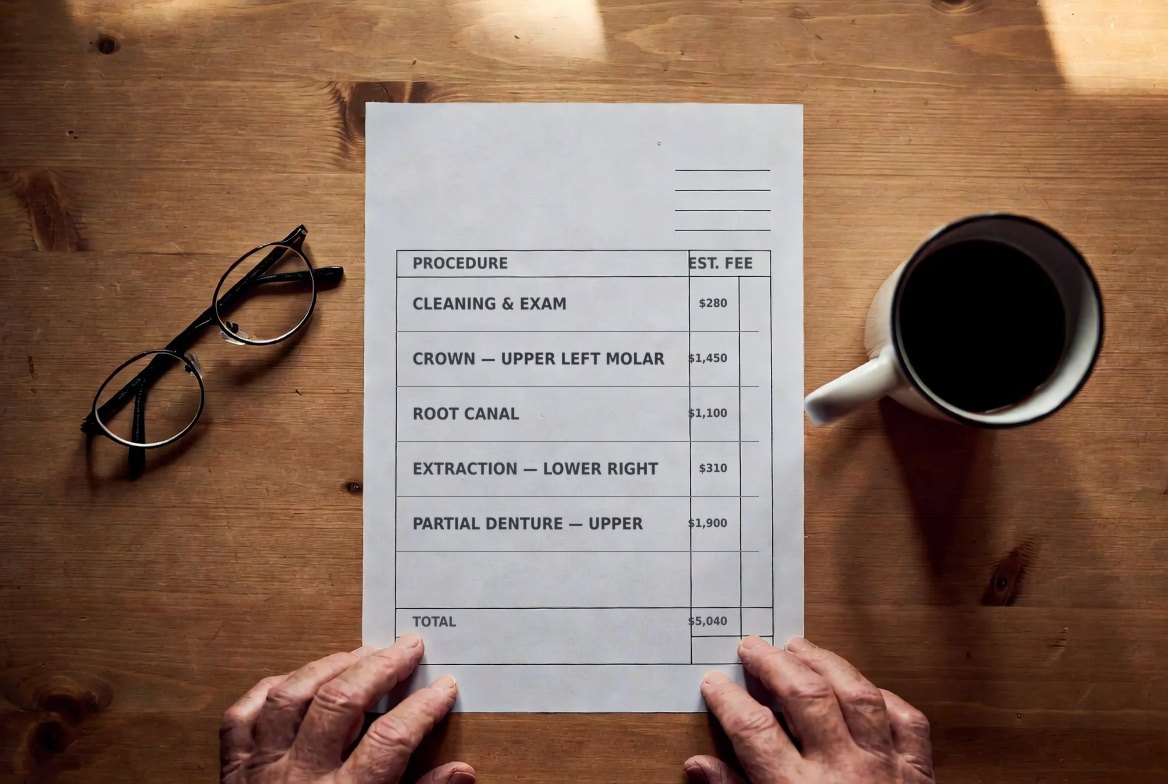
Almost every Medicare Advantage plan says it includes dental — 98 per cent of them in 2026. The yearly cap averages about $1,300. That is roughly one crown.
| Coverage | Cleanings, fillings | Crowns, dentures, implants | Dental work needed for a covered medical treatment |
|---|---|---|---|
| Original Medicare | No | No | Yes, in narrow cases |
| Medigap | No | No | Only its share of what Medicare covers |
| Medicare Advantage | Usually, up to the plan’s cap | Partly, up to the cap (about $1,300 a year on average) | Yes |
| Standalone dental insurance | Usually from day one | Usually after a 6–12 month wait | — |
The rest of this page is what the work costs, what to ask before you agree to it, and four routes that cost a fraction of the sticker price.
Sources: Medicare.gov: Dental services · CMS: Medicare dental coverage · KFF: Medicare Advantage 2026 · checked September 29, 2026
🦷 What Medicare Has Never Covered
First, what this page is. Nobody here is a dentist and this page does not pretend to be one. It will not tell you what any symptom means, and it will not tell you whether a treatment plan is right. What it does is set out what Medicare pays for, what the work actually costs, and the four ways of getting it done for a great deal less than the sticker price — and every clinical statement is attributed to whoever made it.

Start with the plain fact, because it surprises almost everybody and it has been true the entire time.
Original Medicare does not cover routine dental care. It never has. Not cleanings, not fillings, not extractions, not root canals, not crowns, not bridges, not dentures, not implants. The exclusion has been in the program since it began in 1965 and it did not change for 2026. Two bills before Congress proposed expanding it and neither of them passed.
And the thing people reach for next does not help either. A Medigap supplement adds no dental coverage of any kind. Medigap pays some of what Original Medicare leaves you owing — it does not add categories Medicare never had.
The one narrow exception, and it is narrower than it sounds
Medicare will pay for dental work when the dental work is directly required for a covered medical procedure. Jaw reconstruction after treatment for oral cancer. Dental clearance before certain heart valve operations, where an infection in the mouth would put the surgery at risk.
Notice what that is and is not. It is not a rule about your teeth. It is a rule about the operation your teeth are standing in the way of. The same extraction is covered on Tuesday because of what is happening on Thursday, and not covered at all in any other week of your life.
Worth knowing how common the gap is, because it is easy to assume everybody else has this sorted out. The Centers for Medicare & Medicaid Services report that close to half of Medicare beneficiaries have no dental coverage at all, and around thirty per cent have untreated tooth decay. This is not an unusual predicament. It is the ordinary one.
💵 One Crown Is the Whole Year
Now the part that catches people who thought they had solved it, and it is the reason this page exists.
Almost every Medicare Advantage plan includes dental. The Kaiser Family Foundation put it at ninety-eight per cent of plans for 2026. It is on the leaflet, it is in the advertisement, and it is very often the reason somebody chose that plan over another one.
Then look at what the benefit actually is.
The entire year's dental benefit is roughly one tooth.
That is not a criticism of anybody's plan and it is not a scandal. It is simply a number that almost nobody is given before they need it. The plan does exactly what it said it would do. It is the reader's picture of what "includes dental" means that is wrong — and the picture usually gets corrected in a chair, with a treatment plan on the counter and a receptionist waiting.
What the rest of it costs
The figures below are what people are quoted in 2026 without insurance. They move, they vary enormously by region, and you should treat them as a shape rather than a price list:
- A routine cleaning and exam — roughly $200 to $350.
- A crown — roughly $1,000 to $1,700.
- Dentures — roughly $1,500 to $3,500 per arch. That word matters: a full set is two arches, so the honest number for a complete set is double the one people usually quote.
- A single implant — roughly $3,000 to $6,000, because it is three separate things: a titanium post in the bone, a connector, and a crown on top.
Set those against a $1,300 cap and the arithmetic is not complicated. An Advantage dental benefit covers a cleaning, an exam and a filling comfortably. It does not cover the thing you were worried about.
If you are choosing or reviewing a plan, the number to ask for is not "does it include dental." It is: what is the annual maximum, what is the waiting period, and is my dentist in the network. Those three answers tell you what you have actually bought.

⏳ The One Thing You Cannot Buy When You Need It
This is the section that puts a dental page on a website called Buy It At 50, and it is the most literal example of the argument this site makes anywhere on it.
Standalone dental insurance exists. It runs somewhere around thirty to sixty dollars a month, with a deductible of fifty to a hundred and fifty. Preventive work — cleanings, exams — is usually covered straight away.
But major work is not. Crowns, bridges, dentures, implants: those almost always carry a waiting period of six to twelve months from the day the policy starts.
Read that again with a cracked tooth in mind. The policy you take out on the Monday after something breaks pays nothing toward the thing that broke. You will pay premiums for a year and then be covered — for whatever happens next. Dental insurance is the one product on this entire site that cannot be bought at the moment you discover you need it. There is no equivalent of ringing round for a plumber. The clock started or it did not.

Which turns the decision into a completely different one. It is not "should I buy dental insurance." It is "do I want cover for the thing that has not happened yet" — and that is a question you can only usefully answer while nothing hurts.
The honest arithmetic cuts both ways, and we are not going to pretend otherwise. At forty dollars a month you are paying $480 a year against a benefit that is often capped at $1,000 to $1,500. For somebody with good teeth and no history, the sums are genuinely marginal, and plenty of sensible people conclude that setting the same money aside themselves is the better bet. What tips it is history: if you already have crowns, if you have lost teeth, if your family runs to trouble — the odds are no longer a coin toss and the waiting period is the reason to decide now rather than later.
📋 What to Ask Before You Agree to Anything
None of what follows is dental advice. It is what to say in the room, and every one of these is a question any dentist answers as a matter of routine.
- "Can I have that itemised, in writing, before we book?" A treatment plan should list each procedure, its code, and its price. A total on its own is not something you can compare with anywhere else, and it is not something you can take to a second opinion.
- "Which of these is urgent, and which can wait?" A plan often contains work that must happen soon and work that could be done next year. Nobody minds being asked to sort the list, and it is the single most useful question for anybody paying out of pocket.
- "What happens if I do nothing?" This is the question almost nobody asks, and it is the one that produces the most honest answer. Sometimes it is "the tooth is lost within the year." Sometimes it is "nothing much, we watch it." You are entitled to know which.
- "Is there a cheaper option that is still sound?" There often is — a different material, a filling instead of a crown for now, a partial rather than a bridge. It may not be the best option and the dentist will say so. But the conversation only happens if somebody starts it.
- "Do you offer a payment plan, and does it charge interest?" Many practices do, in house, without a finance company involved. It costs nothing to ask and it is often better than the card.
And one thing that is worth more than all of the above. If a plan runs to several thousand dollars, a second opinion is normal, expected, and nobody is offended by it. Take the itemised plan somewhere else and ask what they would do. Treatment plans for the same mouth genuinely differ — not because anybody is dishonest, but because dentistry involves judgement about timing, and reasonable people weigh it differently.

🏛️ The Four Routes That Cost Little or Nothing
Here is the half of this subject that hardly anybody knows about, and it is the reason a large bill is not the end of the conversation. None of these is charity in the sense of being shabby. Two of them are teaching institutions and one is written into federal law.
1. Dental school clinics
Typically forty to seventy per cent below private practice rates, sometimes more. The work is done by students in their final years and by graduate residents, and every step is checked and approved by supervising faculty before it goes ahead.
The trade is time, and you should know it before you commit. Appointments run two to four hours rather than thirty to ninety minutes, and the overall treatment takes longer, because each stage waits on a faculty review. For somebody retired and not in a hurry, that is a very good exchange. For somebody still working, it may not be. Every accredited dental school in the country takes patients; the directory is at ada.org.
2. Federally Qualified Health Centers
Community health centers funded by Congress, and legally required to see patients regardless of ability to pay. Fees slide with household income, down to nothing at all at the lowest end. Many of them have a dental clinic.
Find one at findahealthcenter.hrsa.gov or by calling HRSA on 1-877-464-4772. Ring ahead: new-patient waits for dental are commonly four to eight weeks, though the emergency clinic is usually the fastest low-cost route if something is actually hurting.
3. Dental Lifeline Network
This one is aimed squarely at the people reading this page. Its Donated Dental Services program provides free comprehensive treatment to people who are sixty-five or older, living with a permanent disability, or medically fragile — through volunteer dentists and volunteer laboratories. Since 1985 it has delivered more than half a billion dollars of care to over a hundred and seventy thousand people.
There are waiting lists and there is an application. It is not instant. It is also not a discount — it is the work, done, at no cost.
4. Mission of Mercy events, and the number that finds all of it
State dental associations run free walk-in clinics on set dates, usually over a weekend, with no proof of income required. They are announced in advance and they are busy.
And if you remember nothing else from this page, remember this. Dial 2-1-1. It is free, it works around the clock anywhere in the United States, and the person who answers knows what dental resources exist in your county, which ones have waiting lists right now, and when the next free event is. One telephone call does what an afternoon of searching will not.

Medicaid also covers adult dental in a number of states, but the scope varies enormously and the rules change often, so the only sensible advice is to ask your own state's Medicaid office rather than trust any list — including one on this page.
❓ Questions People Ask
Does Medicare cover dental?
Original Medicare does not cover routine dental care — cleanings, fillings, extractions, dentures or implants. It covers dental work only in narrow cases where the work is needed for a covered medical treatment, such as an exam and treatment before an organ transplant or heart-valve surgery, or removing an infected tooth before cancer treatment.
Does a Medigap plan cover dental?
No. Medigap helps pay what Original Medicare leaves you owing. It does not add dental coverage.
How much does Medicare Advantage dental cover?
In 2026, 98 per cent of Medicare Advantage plans offer some dental benefit, but the yearly maximum averages about $1,300 — roughly the price of one crown. Before choosing a plan, ask for the annual maximum, the waiting periods, and whether your dentist is in the network.
Is there a waiting period on dental insurance?
Standalone dental plans usually cover cleanings and exams straight away. Crowns, bridges, dentures and implants often carry a waiting period of six to twelve months from the day the policy starts, so a policy bought after a tooth breaks will not pay for that tooth.
Where can I get low-cost dental care?
Dental school clinics, federally qualified health centers with sliding-scale fees (findahealthcenter.hrsa.gov), Dental Lifeline Network’s Donated Dental Services for people 65 and older or disabled, free Mission of Mercy events, and 2-1-1, which finds local dental help by zip code.
📋 Why This Belongs on the Fifty List
Because of the waiting period, and there is nothing else on this site quite like it.
Almost everything here is a thing you can still buy late. The grab bar goes up the week you decide. The generator arrives before the storm if you order it in time. Even the things this site says to do early can, at a pinch, be done in a hurry and at a premium.
Not this one. A dental policy bought the week a tooth breaks pays nothing toward that tooth and cannot be made to. The only version of this decision that works is the one taken while nothing is wrong, which is precisely when nobody feels like taking it.
So the useful things to do at fifty-five, when it is all still theoretical: find out what your plan's annual maximum actually is rather than that it "includes dental." Find out whether there is a waiting period and whether it has already run. And write down where the nearest dental school is, because that is a piece of information that is worth several thousand dollars on the day you need it and takes four minutes to look up on a day you do not.
The tooth will crack on a Sunday. It always does. Everything that decides how much that costs you was settled months earlier, by somebody who was not in any pain at the time.