
🔍 You Are Already Using It
Almost nobody decides to start using artificial intelligence. It arrives.
The Pew Research Center published a survey of just over five thousand American adults in June of 2026. It found that forty-nine per cent had used an AI chatbot at some point, up from thirty-three per cent two years earlier. Among people sixty-five and over it was twenty-three per cent — so if you have never typed a question into one of these things, you are in good and substantial company.
But that is not the number that matters. This one is:
Sixty per cent of American adults read AI-written summaries in their search results. That is the paragraph that now sits at the top of the page when you look something up — and most people reading it did not choose it, did not ask for it, and could not tell you where it came from.
So the question was never whether to start. You started. The question is whether you know which part of what you are reading was written by a machine, and what that machine is and is not good for.
And there is a second half to this that hardly anybody writes about. It is not only what you do with it. It is what is being done with it about you — by the company that decides whether your care is covered, by the system that reads your claim, and by the man on the telephone using it to sound like your grandson. Half of this page is about that.
✅ What It Is Genuinely Good At
Set aside the promises for a minute. Here is what these tools actually do well, in the specific situations a person over fifty is likely to be in.
- Explaining a letter you do not understand. Type out what a denial notice, an insurance form or a legal letter says and ask what it means in plain English. This is the single best use of the thing, and it is what it is genuinely good at — turning jargon into sentences.
- Drafting a letter you dread writing. An appeal, a complaint, a firm note to a contractor. Tell it the facts and ask for a first draft, then rewrite it in your own words. Starting from a blank page is the hard part, and it removes the blank page.
- Working out what questions to ask. "I have been offered X — what should I ask before agreeing?" is a question these tools answer well, because a list of questions cannot be wrong the way a fact can.
- Summarizing something long — a policy document, a manual, a set of terms — when you need the shape of it before you read it properly.
- Being asked a stupid question at eleven at night without a sigh, a bill, or anybody's time being wasted. That is not nothing.
Notice what those have in common. Every one is a job where you already know the facts and you need help with the words. That is where the machine is strong and where it is nearly impossible for it to hurt you.
⚠️ What It Will Get Wrong, Confidently
Here is the part the advertising leaves out, and the reason twenty-nine per cent trust it while forty-nine per cent use it.
These systems produce fluent, confident, well-organized text whether or not the underlying facts are true. They are not looking anything up in the way a librarian looks something up. They are producing the sort of sentence that usually follows the sentence before it — and most of the time that lands on the truth, and some of the time it lands on something that reads exactly the same and is wrong.
It will not hedge. It will not sound unsure. There is no tone of voice that tells you which paragraph is the bad one. That is the whole problem in one line: the wrong answer and the right answer are written in the same confident voice.
Where it goes wrong most:
- Specific numbers — prices, doses, deadlines, interest rates, dates.
- Anything current. These things are trained up to a point in time and then released. Ask about this year's rules and you may get last year's.
- Citations and sources. It can produce a study, an author and a year that do not exist, formatted perfectly.
- Law and benefits, where the answer changes by state and by year and the machine does not know which state you are in unless you tell it.
- Agreeing with you. Push back on a correct answer and it will often fold. That is not it changing its mind. It has no mind to change.
So here is the one rule, and it is the only one you really need: never let it be your only source on money, medicine or the law. Use it to understand the letter, draft the reply, and work out the questions. Then get the answer itself from the pharmacist, the doctor, the benefits office, or the person whose actual job it is. Treat it as a very well-read friend who is sometimes wrong and never says so.
One practical habit worth having: ask it to tell you where the answer came from, and then go and look. If it cannot produce a source you can check, you have not got an answer. You have got a paragraph.
📋 The Decision That Was Already Made About You
Now the half that is not about your typing at all.
Most people over sixty-five now get their coverage through a private Medicare Advantage plan rather than directly from the government. And for several years those plans have been using algorithms to help decide what gets approved — particularly for the care that comes after something has gone wrong. The rehabilitation after the hip. The skilled nursing after the stroke. The extra fortnight before going home.
What the investigations actually found
A United States Senate investigations subcommittee reported in late 2024 that the three largest Medicare Advantage insurers had used algorithmic tools while sharply increasing their denials of post-acute care between 2019 and 2022 — with the increases concentrated in skilled nursing facilities. According to that report, one insurer's denial rate for post-acute services rose from under nine per cent to nearly twenty-three per cent over four years, and its denial rate for skilled nursing rose ninefold.
Separately, a 2022 memorandum from the inspector general at Health and Human Services found that more than one in ten denials examined were for services that appeared to meet Medicare's own coverage rules.
We are not going to tell you that a computer denied your particular claim, because we do not know and neither does anybody else outside the company. What we will tell you is that "computer says no" is now a real thing that happens to real people in this country, at scale — and that almost nobody does the one thing that works about it.
The number nobody is told
Read those two together, because between them they are the entire argument of this page. When people appeal these denials, they win the overwhelming majority of the time. And hardly anybody appeals.
Think about what that means about the denial itself. If four in five are reversed the moment a human being looks properly, the first "no" was not really a considered judgement about your health. It was a first offer.
Patient and provider groups give the same reasons every time for why people do not appeal. They did not know they could. They assumed a denial was the end of it. The letter was confusing and sounded final. They did not want to make a fuss. Or they were, at the time, a person recovering from a stroke — which is precisely when a person has the least fight in them, and precisely when these decisions land.
📞 How to Insist on a Human
You have more standing here than you think, and it is worth knowing exactly what it is.

Under rules the Centers for Medicare & Medicaid Services put in place in 2024, a Medicare Advantage plan may not base a coverage denial on a general dataset alone. The decision has to rest on your own circumstances — your medical history, your doctor's recommendation, your clinical notes. CMS has also said plainly that prior authorization "should not function to delay or discourage care." Separate rules that took effect on 1 January 2026 require plans to answer standard requests within seven calendar days and urgent ones within seventy-two hours.
So the sentence that changes the conversation is not an angry one. It is this: "Was this decision based on my own records, and can I see the reviewer's notes?"
What to do, in order, and none of it costs anything:
- Ask for the denial in writing, with the specific reason and the rule it relies on. Verbal denials are not something you can appeal.
- Ask who reviewed it and what they looked at. You can request the reviewer's notes. Ask whether a licensed clinician reviewed your file.
- Tell your doctor's office you are appealing. A letter of medical necessity from the physician who actually treated you is the single most useful piece of paper in the process, and their office has written hundreds of them.
- Watch the clock. Appeal deadlines are real and they are shorter than you expect. The date is on the denial letter. Put it on the calendar the day the letter arrives.
- Ask for an expedited appeal if you are still in the facility or still need the care. There is a fast track and it exists for exactly this.
- Keep every letter and write down every call — date, time, the name of the person, what they said. The pad by the telephone does as much work here as it does against a scammer.
And the two numbers to have in the house before you ever need them. Call 1-800-MEDICARE. Then find your state's SHIP — the State Health Insurance Assistance Program. Every state has one, the counseling is free, they are not selling anything, and helping people through exactly this is the whole of what they do. Write both numbers on the same pad as everything else. Nothing on this page is a substitute for either of them.
🏛️ And It Is Arriving in Original Medicare Too
One development worth knowing about, because until now this has largely been a Medicare Advantage story and that is changing.
CMS is running a model called WISeR — Wasteful and Inappropriate Service Reduction — which brings technology-assisted prior authorization into original Medicare, where prior authorization has historically been rare. As announced, it runs from 1 January 2026 to 31 December 2031, it covers a limited list of services, and it operates in six states: New Jersey, Ohio, Oklahoma, Texas, Arizona and Washington. CMS describes it as combining machine learning with human clinical review.
If you live in one of those six states, this is the paragraph on the page for you. It does not mean your care will be denied. It does mean that a step which did not used to exist in original Medicare now may, for some services — and that the questions further up this page are worth having ready. Everything in this section is as announced and programs like this get changed, extended and cancelled. Check the current position at Medicare.gov or with your SHIP counselor rather than taking our word for it.
📱 The Voice on the Telephone
The other way this technology reaches you does not involve any institution at all. It rings your telephone and it sounds like somebody you love.
The FBI's 2025 Internet Crime Report, released in April 2026, counted AI-assisted fraud as its own category for the first time in nearly twenty-five years — 22,364 complaints and over $893 million in reported losses in a single year. Across all categories, Americans over sixty reported roughly $7.7 billion in losses, an increase of about fifty-nine per cent on the year before.
The mechanism is simpler than people imagine, and you do not need to understand the technology to understand the scam. Roughly three seconds of recorded voice is enough to produce a convincing imitation of somebody. Three seconds is a voicemail greeting. It is a few words in a video from a christening, a graduation, a church service, a fishing trip. It is on Facebook right now.
Then the call comes. It is your grandson, and he is frightened, and he is in trouble, and he needs money before a court date in the morning, and please do not tell his mother. Everything the old advice told you to listen for — the wrong voice, the odd phrasing — has just stopped working.
The defense is free and it defeats the whole thing.
1. Agree a family word. One ordinary word, agreed out loud with your children and grandchildren, never written down anywhere online. Anybody who calls in a crisis can be asked for it. No machine has it.
2. Hang up and call back on a number you already had. Not the number that called you. Not a number the caller gives you. The one already in your telephone. That single habit ends every version of this, including the ones nobody has invented yet.
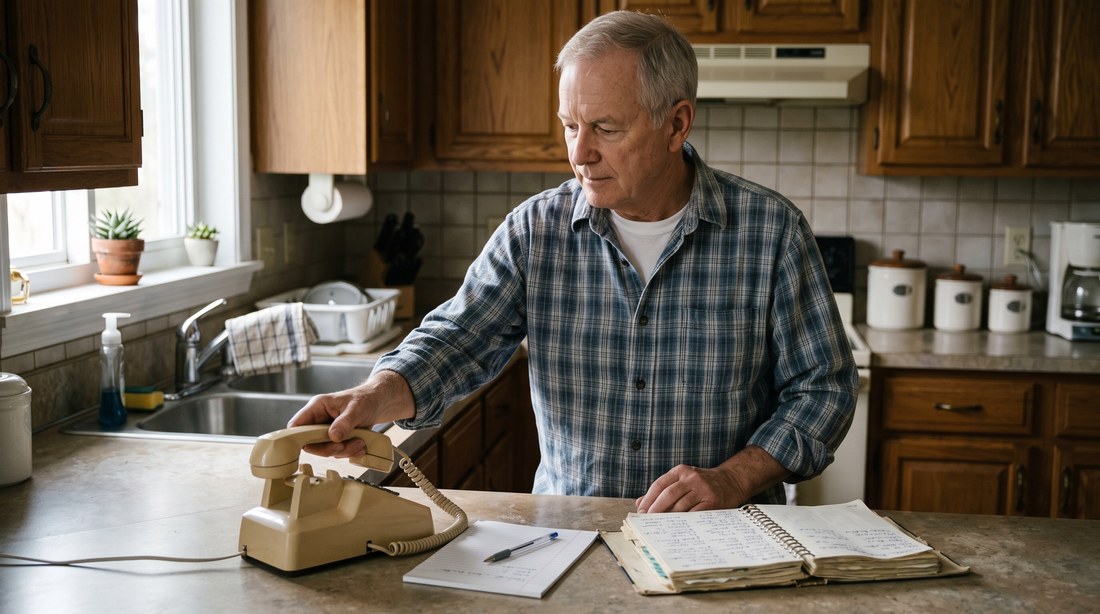
It is worth being blunt about why this works on sensible people. It is not gullibility. It is that the call is engineered to remove the pause — urgency, fear for somebody you love, and a request for secrecy, all inside the first thirty seconds. The FTC found that among older adults who lost ten thousand dollars or more to impersonation scams in 2024, forty-one per cent were first contacted by telephone. The whole trick is to keep you from putting the receiver down for two minutes. So put it down for two minutes.
If it has already happened, ring the bank straight away — some transfers can still be stopped — then report it at ReportFraud.ftc.gov and IC3.gov. And do not be embarrassed. These are engineered against everybody, and being taken in by one says nothing about you at all. There is more on this in the guide to telephone and internet scams.
🚫 A Tool, Not Company
One more thing, and we would be doing you a disservice to leave it out.
That same Pew survey found that about one in ten American adults now uses a chatbot for emotional support or advice, and about one in twenty for companionship. Those numbers are going up, and the products are being built deliberately to make them go up.
It is easy to see why. It answers immediately. It is never busy, never tired, never short with you, and never has somewhere else to be. If the telephone has not rung all week, that is not a small thing.
But it is not company, and this site is not going to pretend otherwise. There is nobody on the other end of it. It does not notice you have gone quiet, it will not turn up, and it cannot tell that today was the anniversary. It is very good at producing the sentences a friend would say, which is a different thing from having one — and the better it gets at the first, the easier it is to mistake it for the second.
The National Academies put roughly a quarter of Americans over sixty-five in the socially isolated category, and long-term isolation in the same bracket of health risk as smoking. That is a real problem and it deserves a real answer. A dog. A neighbor with your spare key. A standing Tuesday. The grandchildren taught to ring rather than text. There is a whole page on one of those answers, and it is not on this page by accident.

Use the machine for the letter. Use it for the draft, the jargon, the list of questions at eleven at night. Then close it and go and see somebody.
📋 Why This Belongs on the Fifty List
Because everything else on this site is a thing you buy once and understand for the rest of your life, and this is the same — except that what you are buying is an afternoon.
Sit down with it once. Ask it something you already know the answer to, and watch how it handles being wrong. Ask it to explain a letter. Ask it for a source and then go and check whether the source is real. An hour of that and you will have a working sense of what the thing is, which is more than most people who use it every day.
And learn the other half while nothing is happening. Agree the family word at a birthday, not during a frightening telephone call. Write 1-800-MEDICARE and your SHIP number on the pad now, not the week the letter comes. Every page on this site is the same argument in a different costume: the thing is much cheaper, much easier and much less frightening if you do it before you need it.
None of this requires you to be enthusiastic about any of it. Sixty-three per cent of Americans think the whole business is moving too fast, and they may well be right. You do not have to approve of the weather to own a coat.