❤️ Start With the Real Reason
They call a dog man's best friend and there is a reason for it, and the reason gets stronger after fifty rather than weaker.
One cheap layer most people never think of: a panel in the window they cannot see through — it takes away the only way to check whether anybody is home, and it insulates while it does it.
There is a large population of people out there that nobody comes to visit. Nobody rings. The telephone does not go all week, and the front door does not either. That is not a sad story about somebody else — the National Academies put about a quarter of Americans over sixty-five in the socially isolated category, and around forty-three per cent of people over sixty say they are lonely. The same body of work puts long-term isolation in the same bracket of health risk as smoking or high blood pressure. That is the actual epidemic on this page, and it is not burglary.
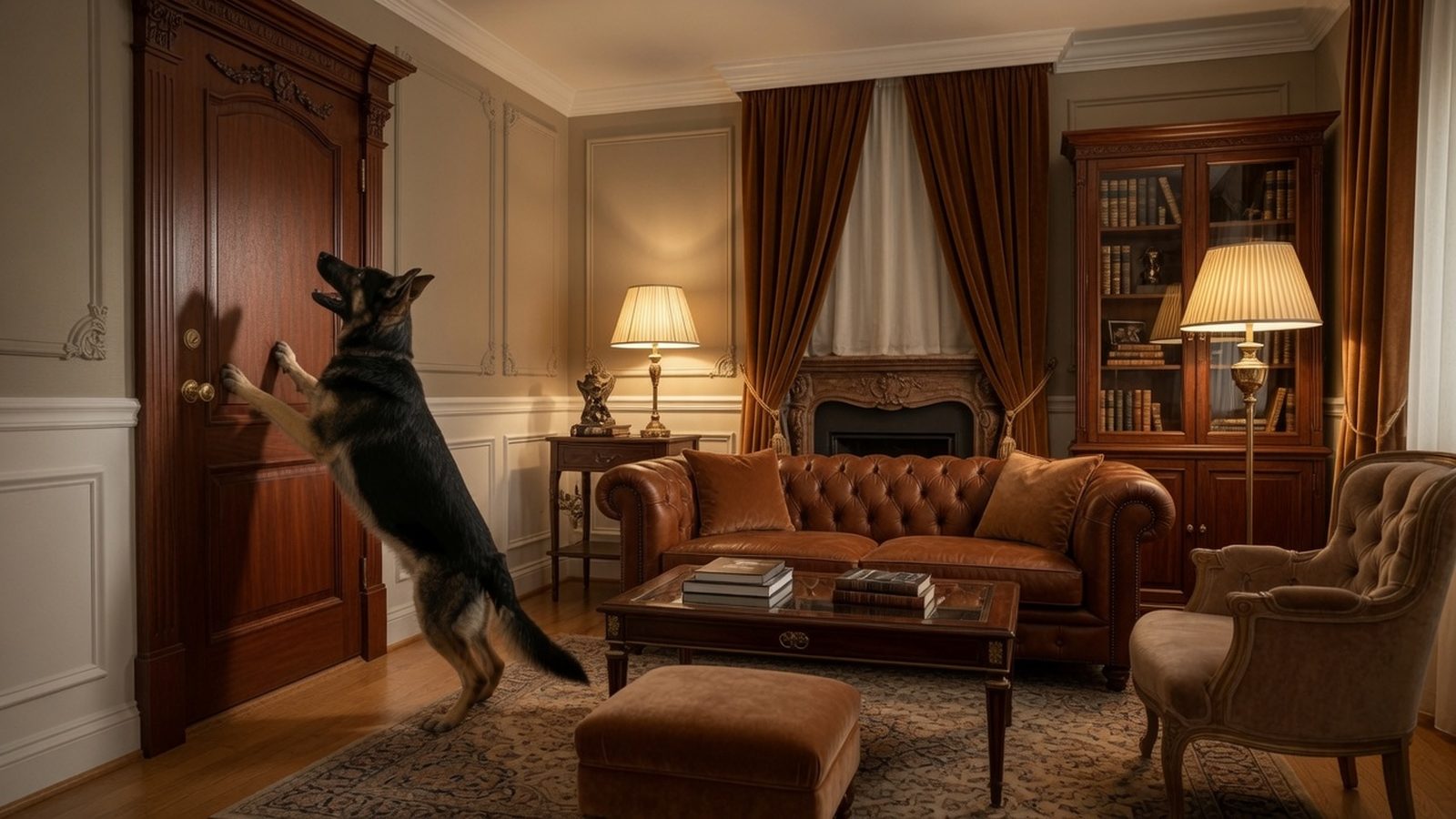
A dog answers that in a way that nothing you can buy does. Something is glad you got up. Something needs feeding at seven whether you feel like it or not. Something walks with you, which gets you out of the chair and out the front door, past the neighbors, twice a day, every day, in a life that otherwise gives you no particular reason to go anywhere. And something is glad you came home.
Everything else on this page — the burglars, the barking, the fall figures — is downstream of that. The dog is not a security device. It is company that happens to shout when somebody comes up the drive.
🔍 Do Burglars Actually Care About a Dog?
They say they do, and they said it without being asked.
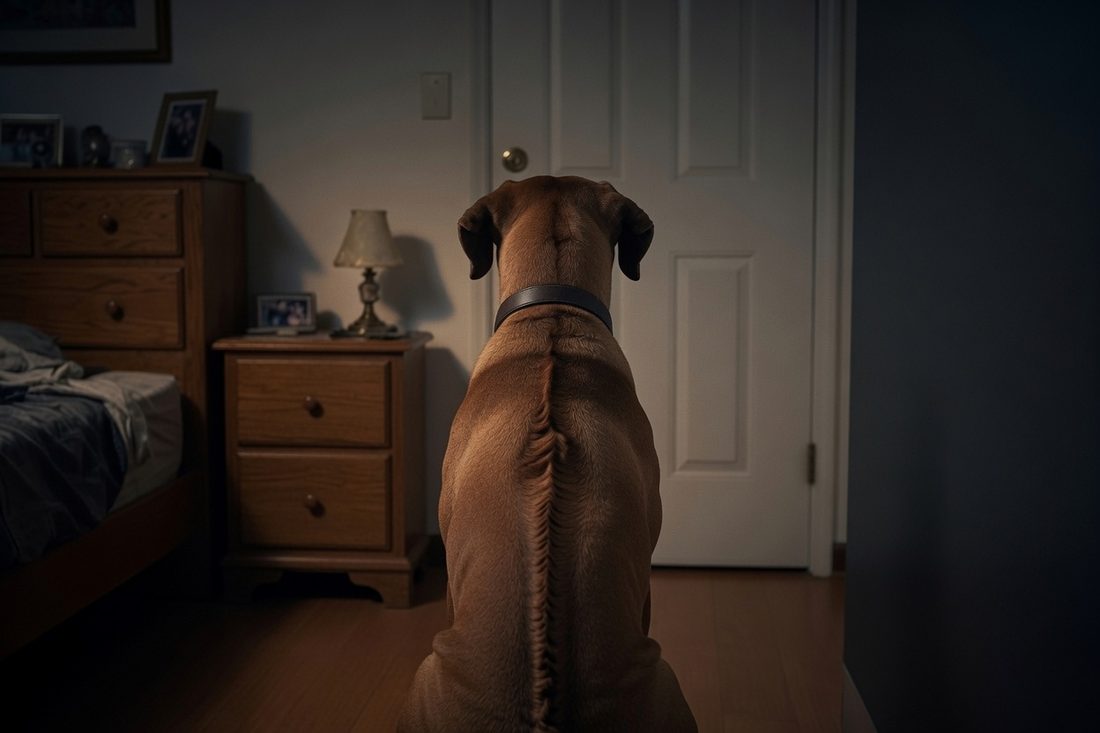
Researchers at the University of North Carolina at Charlotte put a questionnaire to 422 men and women serving time for burglary in North Carolina, Kentucky and Ohio, and asked what made them look at a house and keep walking. The answers came back as a short list: people nearby — traffic, neighbors, police — no clear way out, alarm signs, alarms, outdoor cameras, and a dog inside. The dog sits in that list beside the hardware, named by the people who were actually doing the choosing.
Two honest notes before anybody builds a plan on that.
The study was paid for by the alarm industry's own research foundation. That does not make it wrong — it is still the best evidence there is, because it asked the offenders themselves rather than guessing — but you should know it every time you see it quoted, including here.
And the numbers you will see attached to it are mostly invented. Article after article will tell you that thirty-four per cent of burglars, or nearly half of them, would turn around at the sight of a dog. Those figures are not in the study. They come from companies selling alarms and cameras, and they have been copied from one blog to the next for a decade. What the research actually supports is the plain version, and the plain version is enough: burglars notice dogs, and they brought it up themselves.
📢 A Dog Is an Alarm With an Opinion
The thing the films get wrong is that a dog is not a weapon. It is an alarm with an opinion. Nobody sensible is planning for their dog to fight anybody, and a dog that would is a liability rather than an asset. The value is noise and uncertainty.
A bark does three jobs in the same second.
- It tells you. The same head start a camera buys — knowing at second five instead of at the crash of the glass, which is the difference between a police car dispatched two minutes ago and one dispatched now.
- It tells the neighbors. Sound carries further at two in the morning than anybody expects, and the people most likely to be looking out of a window at your house are the ones already living beside it.
- It tells him he has been noticed, which is the one thing every burglar in that survey was trying to avoid.
Which means size matters far less than people think
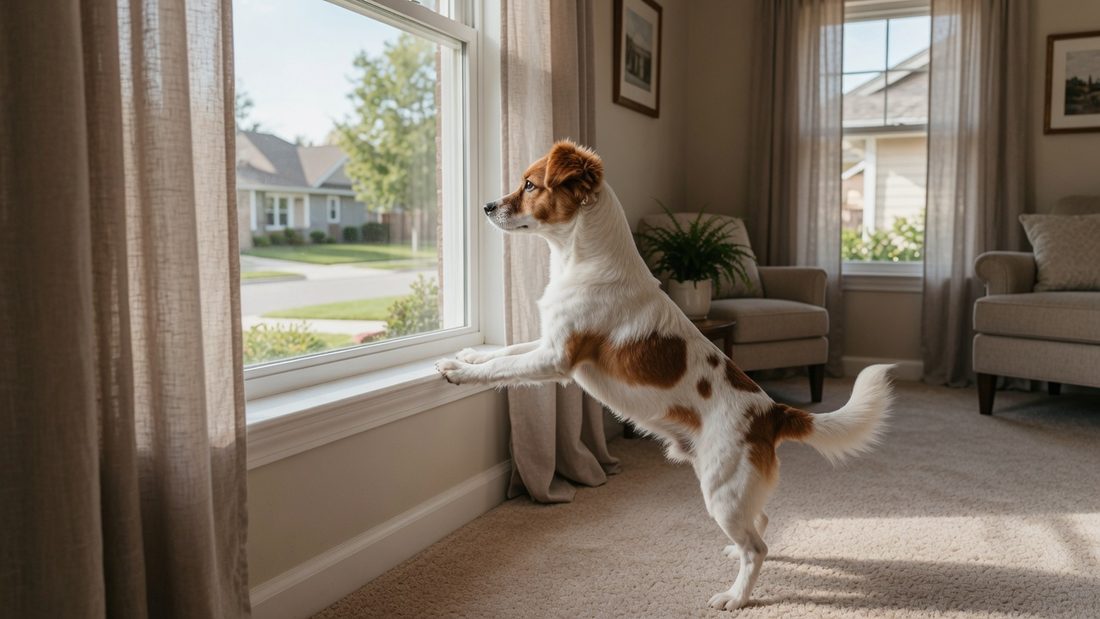
A big quiet dog asleep in a back bedroom does nothing whatsoever. A ten-pound dog that will not shut up does the entire job, and does it from behind a closed door where nothing can happen to it. Nobody standing outside in the dark can tell which of those two is on the other side of the wall, and he is not going to find out on purpose.
Two things decide whether the dog you have is doing this job. The dog sleeps where you sleep, or at least on the same floor — an alarm in the wrong room is not an alarm. And a dog that barks at everything has trained you to ignore it, which is exactly the failure that turns a camera into an ornament. The bark is only information if it is unusual, and that is a training matter like everything else here.
🎾 Training Him — Which Is Easier Than People Think
Nearly everything else on this page depends on this section, so it comes before the difficult part rather than after it.
This does not need to be hard and it does not need to be expensive. A handful of treats and a few evenings of videos will get the basics down quicker than most people expect — sit, stay, come, leave it, down, and walking on a loose lead. You are not training a competition animal. You are teaching a dog the manners that make it pleasant to live with, and dogs want to learn them, because a dog that knows what is expected of it is a calmer and happier animal than one that does not.
The part almost nobody tells you is that it never finishes. You keep working with your dog for the rest of its life. Not hours a day — a few minutes here and there, forever, because they need reminding. A dog that was perfect at two and has been left alone about it since is a different animal at six. The reminding is the job.
What a proper gentleman looks like
- Around children. Gentle, no jumping, no mouthing, no barging, and calm when a small hand arrives somewhere unexpected. This is the one you never let slide.
- Around strangers. Four feet on the floor, no lunging at the door, no barking at the postman for ten minutes after he has gone.
- And on the walk, they do not pull. In any fashion. Not a bit of leaning, not a tug at the corner. That is not a comfort issue at our age, it is the whole of it.
They also do not take after squirrels, cats, other dogs, or the neighbors' children. When you are walking, the dog is being your companion — it is not out playing with the neighborhood. That is the standard, and a dog held to it is a dog you can walk at seventy-five with no more thought than putting your coat on.
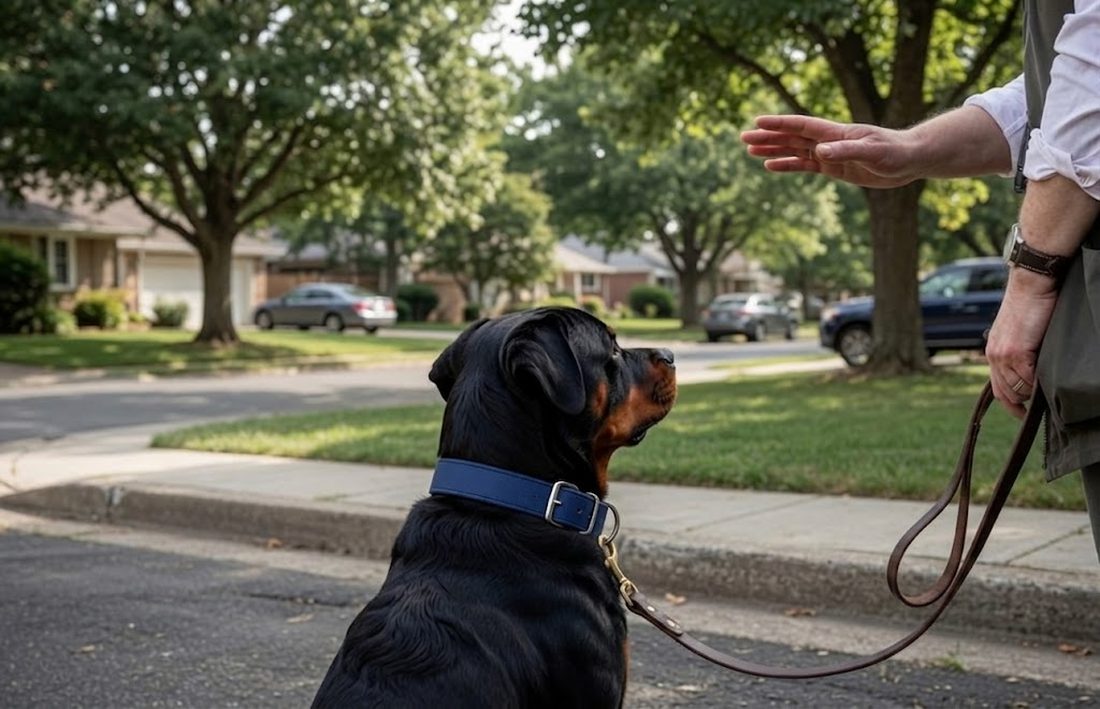
If the basics are not landing, a few sessions with a trainer will sort it, and it is cheap next to what the alternative costs. A dog that pulls is a decision, not a personality, and it is fixable at almost any age of dog.
🦴 Being Honest About the Injury Figures
There are numbers on this, and this site does not hide numbers. But they need saying properly, because printed bare they say something that is not true.
The federal injury survey behind the CDC's figures counted roughly 86,000 emergency-room visits a year from falls involving pets, dogs about seven-eighths of them, with fracture the commonest diagnosis and the highest rates in people over seventy-five. Fractures in the over-sixty-fives from walking a dog on a lead rose from about 1,700 a year in 2004 to about 4,400 in 2017, and across twenty years of those records the two commonest injuries in that age group were a head injury and a broken hip.
Now read what is actually in those numbers. Being pulled. Being pushed. Tripping over a dog, or over a bowl, in the dark. A lead wrapped round a wrist when something ran. Almost every one of them is either a dog that was never taught not to pull, or a house nobody ever tidied a path through, or a moment of not paying attention. They are accidents, and they are the ordinary kind — the kind people have with stepladders and wet floors and their own back steps.
These are not figures about dogs. They are figures about untrained dogs and dark hallways — which is a different thing entirely, and one you can do something about in a fortnight. A dog that walks properly on a lead does not appear in that data. Neither does a hallway with the water bowl out of it and a light on the skirting.
And keep the whole thing in proportion while you are at it. Depending on the street you live on, the dog is a long way from the most dangerous thing about your day, and for some people the neighbors are a good deal more trouble than anything on four legs ever was. Nobody writes a page telling you not to have neighbors.
⚖️ So Here Is the Rule
Get a dog because you want a dog. That is the only good reason and it has always been the only good reason. The company is the point, and it is worth more at seventy than it was at thirty.
The barking is a bonus, not a purchase. If you already have a dog you already own the deterrent the burglars named, for nothing, and it works whether the power is on or not — which is more than the camera can say. But a dog is a poor thing to buy for security, in the same way a dog is a poor thing to buy for anything. You are taking on a life, not a device.
And the injuries are a training problem, so treat them as one. Do the work in the first month, keep it topped up for the rest of the dog's life, keep the hallway clear, and the figures above simply are not about you. That is not optimism. That is what those numbers are made of.
🏠 Inside the House — the Ten Feet That Matter
The indoor half of those falls happens mostly on one route: bed to bathroom, three in the morning. Five minutes of thought and it is closed.
- Bowls, beds, toys and chews off that route. A water bowl in a dark hallway is a fall waiting for a night you got up too fast.
- A collar light. A few dollars, and the dark dog in the unlit hall becomes a moving light instead of a shin-high surprise. Best value on the page.
- Light the route anyway. Plug-in motion lights along the skirting solve the dog, the rug and the door frame at once, and there is a whole page here about nothing else.
- Teach one word that means move. Not a trick — a dog that shifts when told is a dog you are not stepping over in the dark. It takes about a week.
- Watch the stairs. A dog that races you to the top is worth teaching to wait.
🐾 If You Are Choosing a Dog at Sixty-Five
None of this is an argument against having a dog. It is an argument for choosing honestly, at an age when the choice has consequences it did not have at thirty.
- Weight you can physically hold on a bad day, on wet ground, when it has seen a cat — at least until the training is solid. That is the number that matters, not the breed.
- An adult, not a puppy. A four- or five-year-old rescue arrives with its personality already visible, usually house-trained, often already walking properly — and you are not signing up for eighteen months of a small animal underfoot at exactly hip height.
- Energy honestly assessed. A dog that needs two hard hours a day is a second job, and the resentment is worse for the dog than for you.
- Can you get it into a car? Onto a vet table? Out of a flooded yard?
- And the question nobody asks out loud: who takes this dog if you cannot? A dog you get at seventy may outlive your ability to walk it. Having an answer written down is a kindness to the dog and to whoever ends up sorting things out.
🚫 If a Dog Is Genuinely Not Right Just Now
Sometimes it is not, and that is a perfectly good answer — the wrong time, the wrong lease, nobody to take it if you go into hospital. If that is where you are, do not talk yourself into a dog on security grounds, because the security part is the part you can buy separately for very little.
- A door-wedge alarm under each outside door at night. No wiring, no app, nothing monthly. It screams if the door moves, and screaming was always the mechanism.
- Window and door contact alarms, a few dollars each, for the glass.
- A camera at the door, so you can see who is there without crossing the house to look — which was always the dangerous part.
That covers the burglar. It does not cover the quiet house, and it would be dishonest to pretend it does — so if the isolation at the top of this page is the part that landed, look at that separately. A neighbor, a standing coffee, a volunteering shift, a friend's dog walked twice a week. The dog was never the only answer to it. It is just a very good one.
And whether or not there is ever a dog in the house, the cheapest security on any street is the people already living on it. The yard two doors down is about what happens when nobody is paying that kind of attention.
📋 Why This Belongs on the Fifty List
Because every decision here is cheap and reversible at fifty-five and expensive later. Teaching a dog not to pull is a few evenings with a bag of treats now, or a fracture clinic in fifteen years. Moving the water bowl out of the hallway is free this afternoon.
And because this is the shape of most honest answers on this site. The security people will tell you a dog is a burglar alarm. The safety people will hand you the fall statistics. Both of them are holding one end of it, and neither is describing the animal that is actually asleep on the floor next to you while you read this.
A dog is company. It is company that gets you out of the chair, out of the door and past your neighbors twice a day, that is glad you came home, and that happens to shout when somebody comes up the drive. Train it properly, keep training it, keep the hallway clear — and you get all of that and none of the rest. The rest of the house, honestly →
And if the honest answer is that you want the noise handled properly rather than improvised, the alarm systems themselves — what they cost over ten years, and what your town does about false ones — are covered on their own page.