I want to tell you what I watched happen in a backyard, because I don’t think either one of them set out to do anything remarkable. They just started, and then they kept going, and by the end of it half the street was doing some version of the same thing.
It began with the grass coming out. That’s the part you’d have noticed from the sidewalk. One Saturday there were people I didn’t recognize in the yard — turned out to be folks from their church — and they were cutting the sod into strips and rolling it up like carpet. A man about my age was running a wheelbarrow back and forth.
Nobody looked like they were in a hurry, and nobody looked like they were being paid. That’s the first thing I’d want you to hear, before anything else: a big part of tearing out that grass and building up those beds got done by people who showed up because they’d been asked, and because they wanted to see it work.
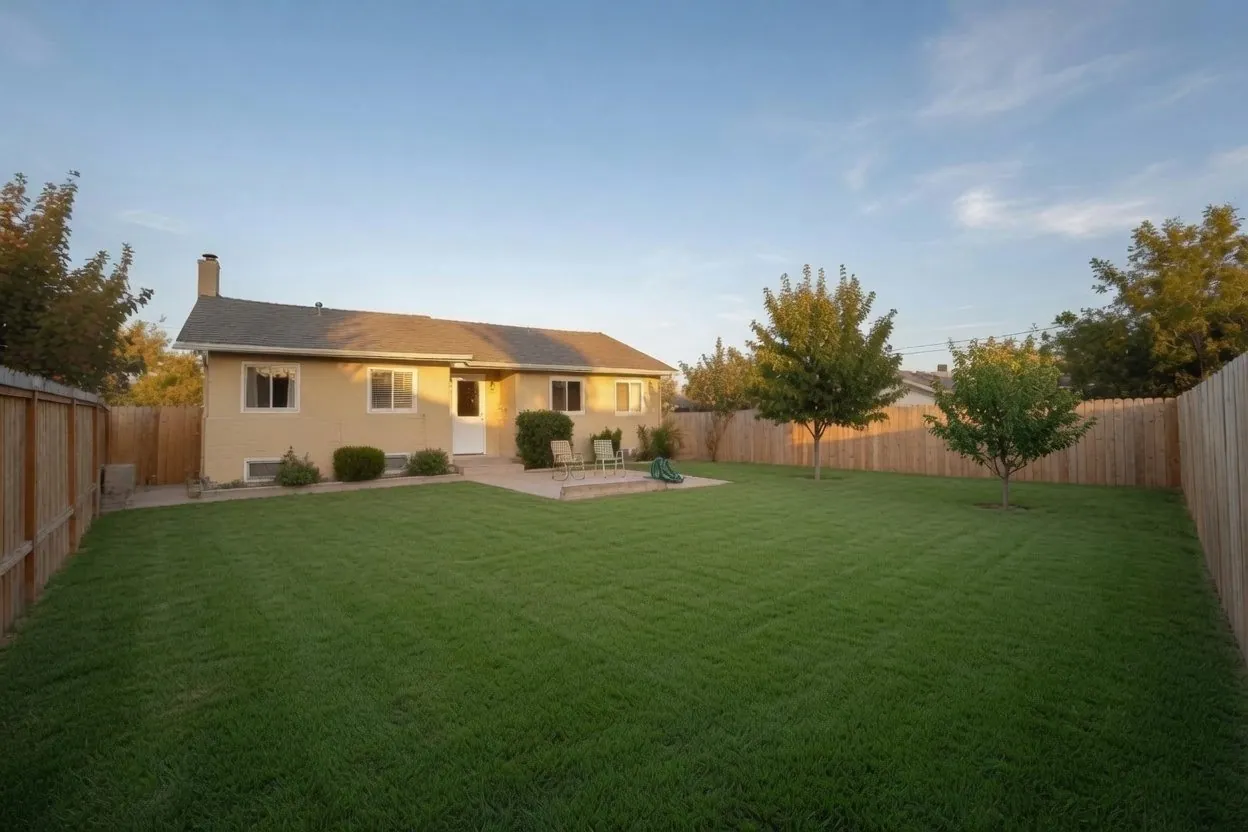 BEFORE
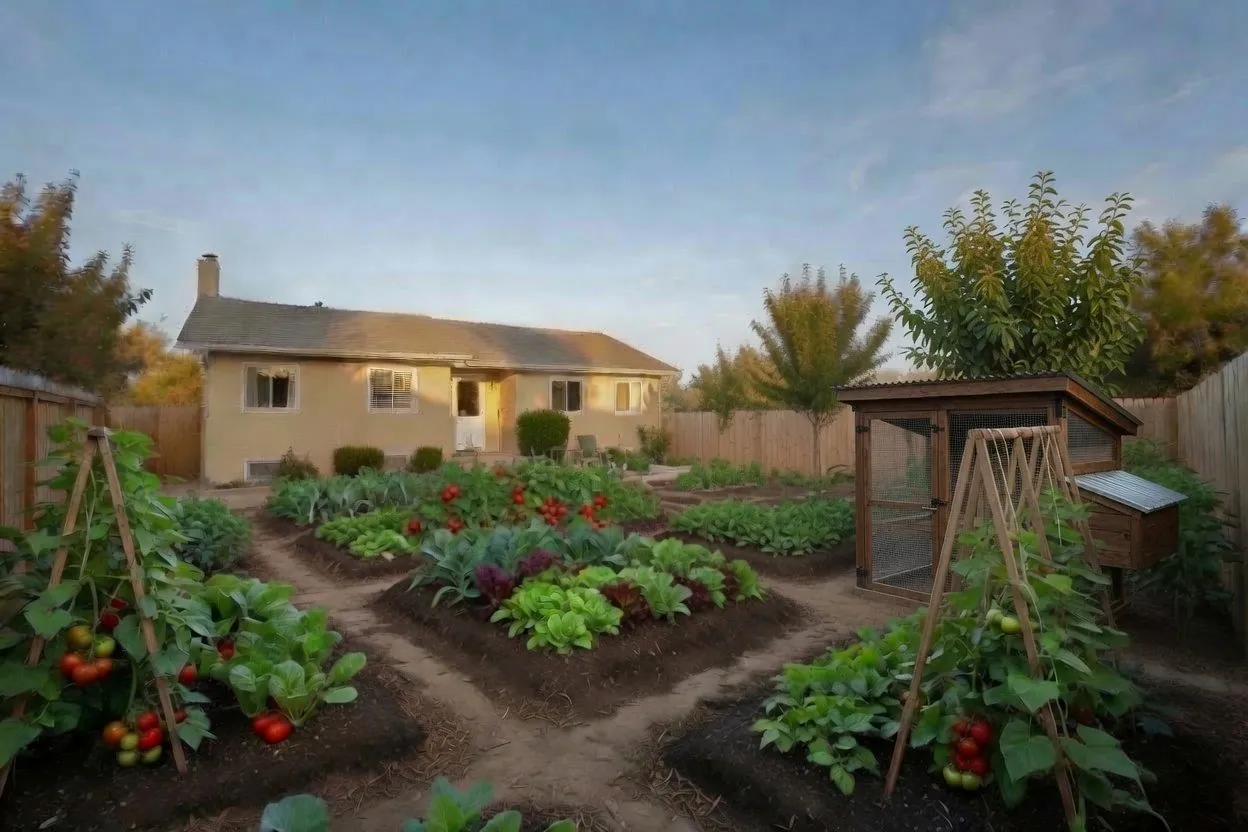 AFTER
AFTER
Eleven months apart. The same backyard — flat grass they paid to water and mow, and then everything it became.
They didn’t know what they were doing, not really. What they did was go find out. She told me later they’d driven their pressure gauge down to the county extension service to get it checked — she’d been canning, and you don’t guess on a pressure gauge, you have it tested. And while they were there, standing at the counter with their gauge, somebody mentioned that they could keep chickens where they lived. Hens, anyway. No roosters. They’d had no idea. They’d assumed it wasn’t allowed and never asked. One conversation at a counter they’d driven to for something else entirely, and suddenly there were chickens on the table.
What the beds gave back
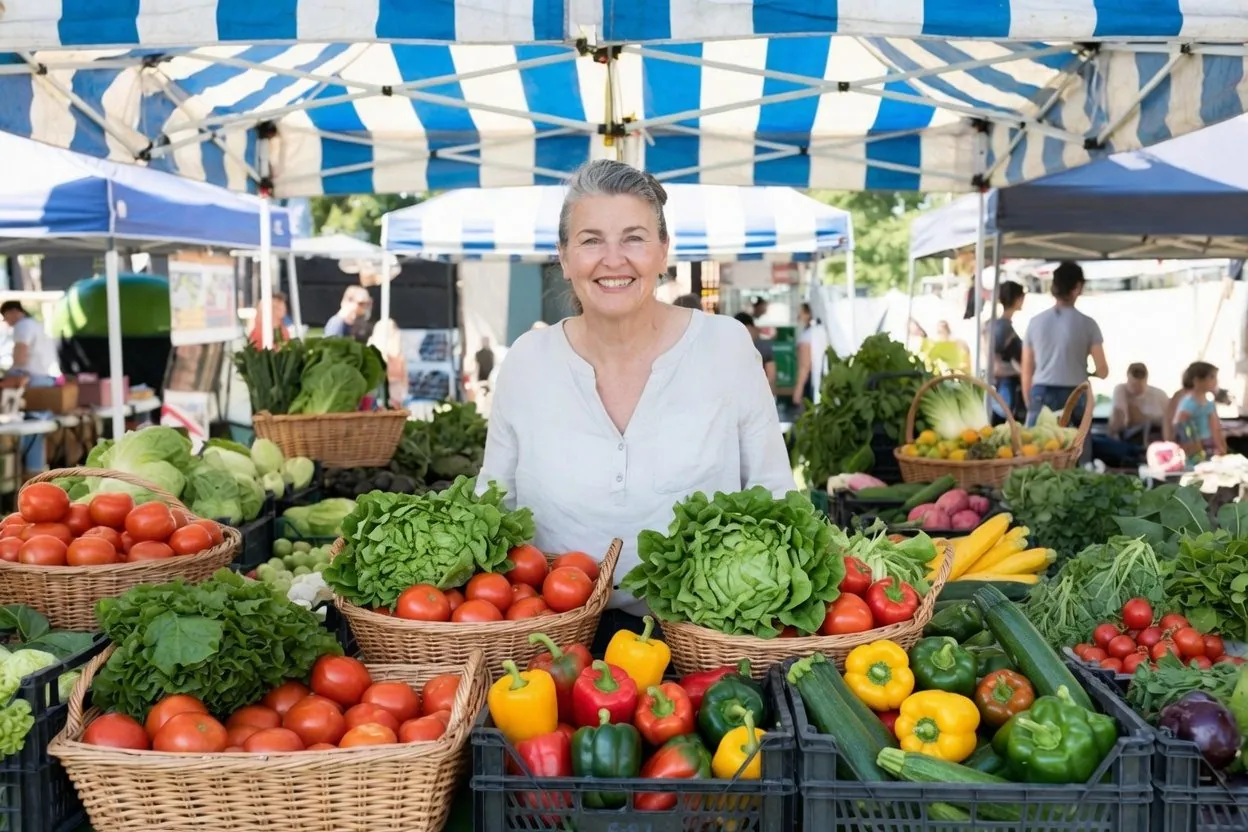
The beds went in raised, built up out of the flat lawn, and by high summer that yard was doing work. More than two people could eat. So they did the sensible thing with the surplus — they took it to the farmers market on the weekends and sold it. And here’s the part I’d underline for you: that was money. Not hobby money. Real money coming in on a Saturday morning, the kind that covers a bill, from a yard that eleven months earlier had been grass they paid to water.
The chickens gave back too, and not only in eggs. They ended up with three extra laying hens and handed them off to neighbors — just gave them away. And those neighbors could not get over the eggs. You’d have thought nobody had ever tasted an egg before. There’s a flavor a backyard hen’s egg has that the carton doesn’t, and once people taste it they don’t forget, and they start asking questions, and that’s how it spreads.
Nowhere does it say it was easy
I don’t want to make it sound like it floated along, because it didn’t, and I think you deserve the honest version.
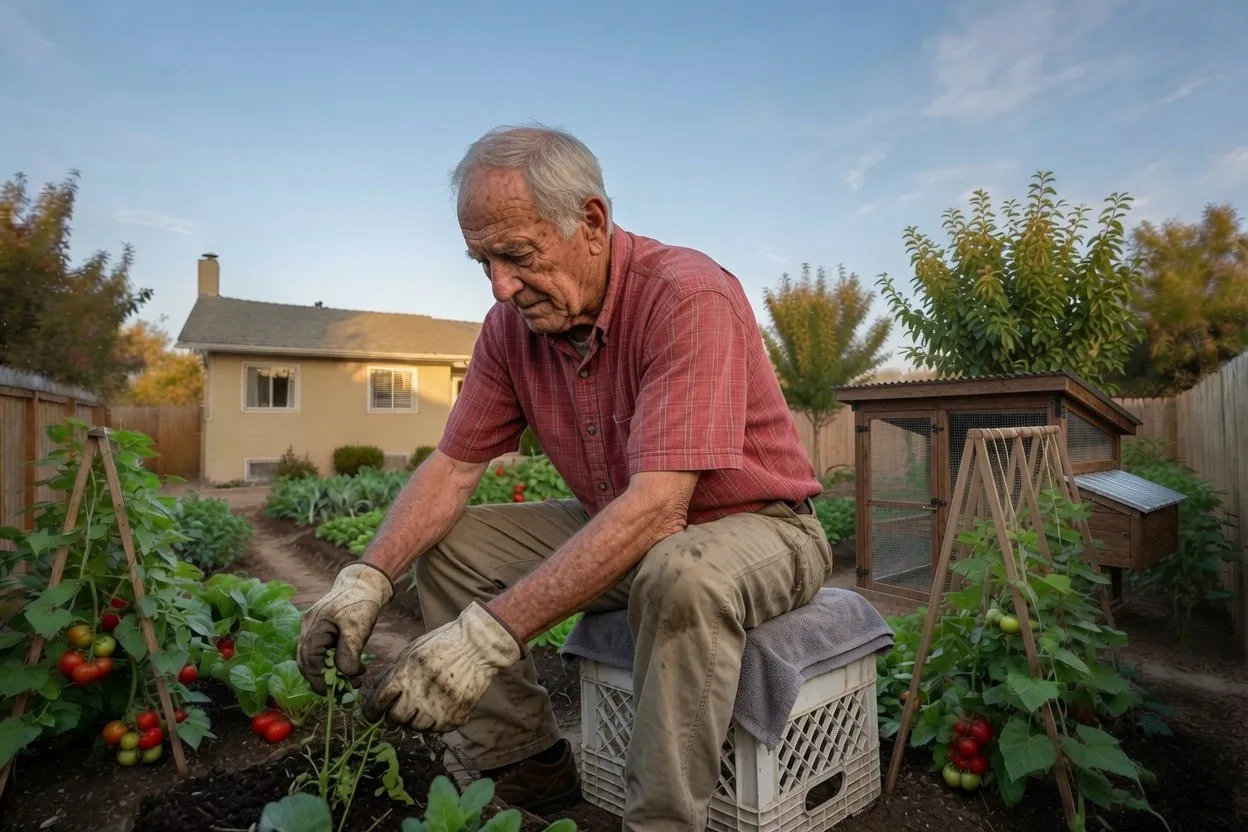
He had a hard time with the low work. Getting down to the beds and back up again was rough on him — his knee still hurt him, plain and simple, all the way through. He worked out a system: he’d sit on a milk crate to get himself down to plant height, with a towel doubled over underneath him, and when doubled wasn’t enough, tripled. That’s what it took. And even then it was his wife, honestly, who got the job done more days than not.
It got easier. I watched it get easier as the season went on and his body learned the motions and he learned his own tricks for it. But easier is not the same word as easy. Nowhere in any of this does it say it was easy. It became less hard. He earned every bit of that, one milk-crate morning at a time.
I say this because I think the glossy version of a backyard garden does people a disservice. If somebody tells you it was effortless, they’re either not remembering right or they’re selling you something. It was work. It was work he wasn’t sure his body could do. And he did it anyway, and it paid him back, and both of those things are true at once.
Then the street caught it
Here’s the part that surprised me most.
The neighbors and the church folks who’d been watching — and helping — started doing their own versions. Not all of them went the whole distance. Most never learned to can, and that’s fine; canning’s its own hill to climb. But a lot of them learned to grow vegetables. A lot of them learned to keep a few hens. A good number learned to compost, which is nearly free and mostly just patience. Everybody took the piece of it that fit their life and left the rest.
And a lot of these were older people. People with real medical situations — hearts, backs, the usual freight you carry at a certain age. Several of them did the responsible thing and asked their doctor first: am I strong enough to do this? And the answers that came back were telling. Because for most of them, the answer wasn’t no. The answer was some version of yes — and it’ll probably do you good. Moving in the morning air, bending and reaching, having a reason to go outside and a thing that’s counting on you. Turns out that’s not a risk to manage. For a lot of folks past sixty, that’s the prescription.
What it actually takes to start
I kept expecting there to be some big barrier — some tool or machine or expense that would explain why more people don’t do this. There isn’t one.
Almost everybody either already owns, or can pick up cheap at a garage sale, the entire starter kit: a shovel, a rake, a hoe, and a wheelbarrow. That’s the list. That’s what stood between that yard being grass and that yard being food. Four tools most of us already have leaning in the garage.
The other thing they figured out was when. They did nearly all of it early in the morning and again in the late afternoon into the evening, and stayed out of the yard through the worst of the midday heat. That one adjustment — working the cool ends of the day — is probably what made it survivable for two people in their sixties. You don’t fight the sun. You work around it.
And they watered two ways before they landed on the one that stuck. Some of it they did by hand, standing there with a hose, which is peaceful but eats your morning. Then somebody put them onto drip irrigation, and they will tell you flat out it changed their lives. Lay the lines once, let it run, walk away. For anybody whose knees are already negotiating, not having to haul a hose to every bed is not a small thing.
What I took from it
I’ve thought a lot about why that yard stuck with me, and I think it’s this: nobody showed those two how to do any of it. They weren’t handed a plan. They drove their pressure gauge to a counter and asked a question, and it unspooled from there — one thing they didn’t know they were allowed to do, then the next. The whole time, the only thing that was really required of them was the willingness to find out, plus a shovel and a milk crate and a towel folded over twice.
They were past sixty. He hurt the entire time. And that backyard fed them, brought money in on Saturdays, put eggs on three neighbors’ tables, and quietly talked half a street into feeding themselves too.
There are victories to be had at sixty-plus. Real ones, the kind you can eat. And an awful lot of them are sitting out there in your own backyard, waiting on nothing but the grass coming out.