
My grandfather’s truck rattled when it idled and smelled like motor oil and peppermint. Every fall, without fail, he would go out to my mother’s car and check that she had her own version of what he carried — a blanket, a light, water, cables. “A woman driving alone at night,” he’d say, “needs to be able to help herself.” Mama would thank him. Dad would roll his eyes.
My dad spent about thirty years being sure Grandpa was a worrier. He thought the blanket was silly and the jug of water was overkill and the cables were something you borrowed from a stranger when you needed them, not something you carried around like a superstition. Then came the night he needed all of it.
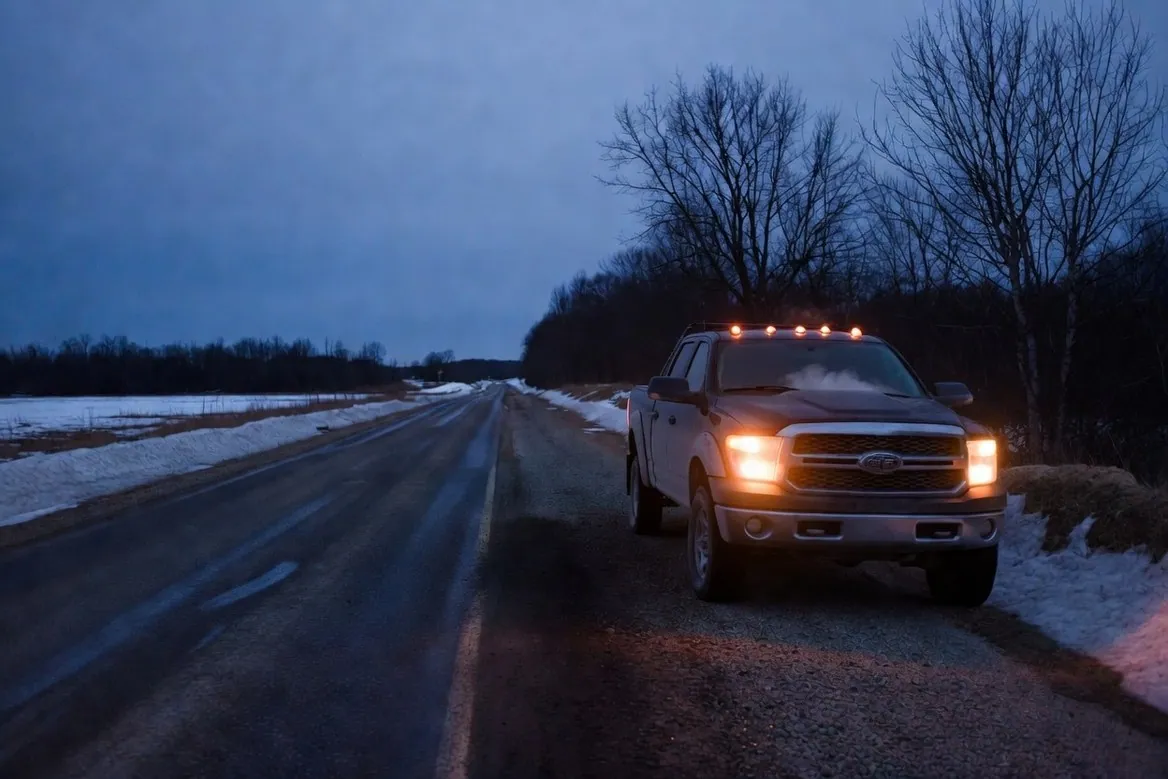
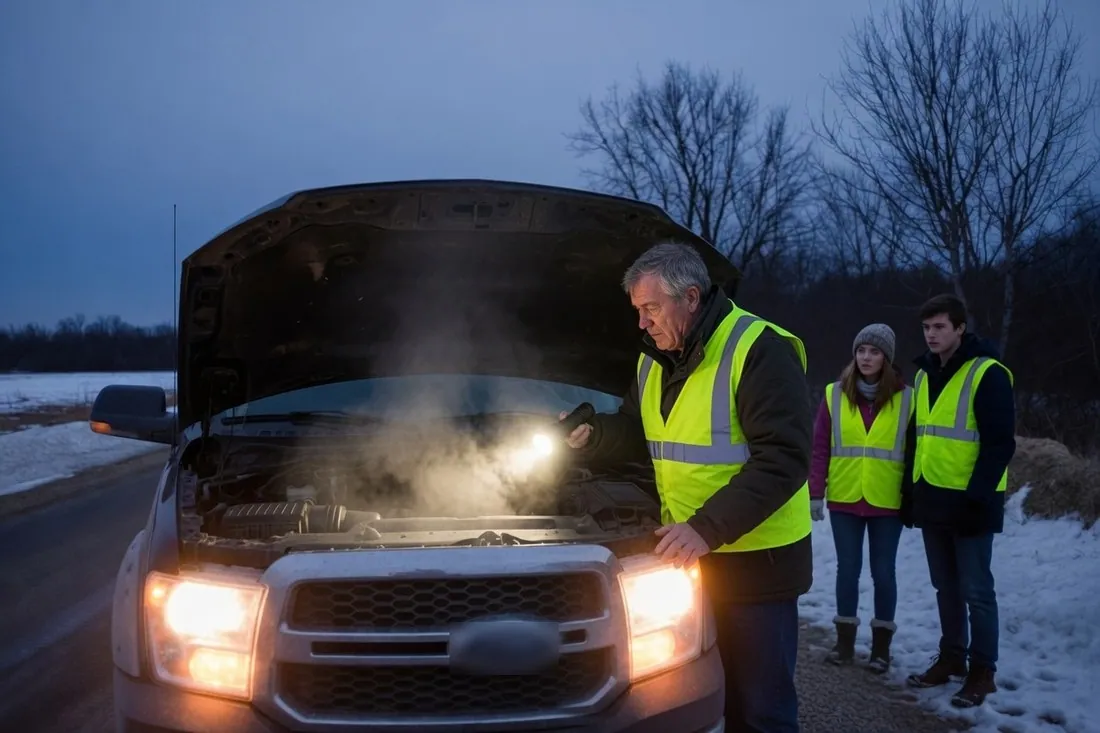
It was February. Dad was coming home the back way from my uncle’s place, alone, and the temperature was dropping fast. The temperature gauge — the one he’d been watching creep up since Thanksgiving — swung into the red, and a thread of steam curled out from under the hood on a stretch of county road with no houses and one bar of signal that came and went.
Here’s the thing they don’t tell you until it happens to you: this isn’t rare bad luck. AAA answers around 32 million roadside calls a year — dead batteries, flat tires, lockouts, and overheating engines are the ones that fill the phone lines. A cooling system that lets go is one of the most common ways a drive ends on the shoulder, and it doesn’t care one bit that it’s freezing outside. Grandpa wasn’t a worrier. He was playing the odds, and he’d packed his truck for every one of them.
Dad sat there in the cold and — he told me this years later, a little embarrassed — he could hear my grandfather’s voice. Not scolding. Just walking him through it, one thing at a time, the way he used to when he was talking to any of us.
Stepping out onto a live road is one of the most dangerous things you’ll ever do as a civilian, and the cars going by are doing 60 or better. This is no place to be overconfident. The instant you stop, turn on your hazard flashers — and leave them on the whole time you’re stopped. Then, before the hood ever comes up, take every chance to be seen — especially at night, when things are already hard to make out — in this order:
Only when you’re lit up from every angle and everyone’s clear do you start the actual fix — and not one second before.
⚠️ Don’t dig your kit out of the trunk in traffic. This one is worth understanding, because it’s a spot that gets people killed. When you stand at the back of your car pulling gear out of the trunk, you are standing directly between oncoming traffic and your own bumper. If a distracted or drifting driver clips your car from behind, it gets shoved forward — and you are crushed between two tons of moving metal and your own vehicle. There is no walking that off. So keep your kit where you can reach it from the passenger side or the back seat, set up from there, and never put your body in that gap between the traffic and your bumper. And if the repair itself forces you back there — lowering a spare from under the rear, say — you do it only after every light and triangle is already out and drivers can plainly see you. Never as your first move.
👶 A word about small children. Little ones wander — it’s what they do — and a roadside is the worst possible place for it. If there’s a second adult in the car, that adult has exactly one job: hold the children’s hands and keep them well off the road while you deal with the car. And if you’re alone with small kids, be honest with yourself: you cannot watch a toddler and fix a car at the same time. Don’t try. Pull as far off the road as you safely can, keep everyone buckled in their seats with the flashers on, and call for help and wait — safety experts agree you’re most protected staying belted inside the vehicle. A flat tire or a dead battery can wait for the tow truck. A child near a highway cannot.
The whole reason we’re telling you this — the story, the list, all of it — comes down to a single moment: the day your car breaks down, or the day you pull over to help someone whose car broke down, you are going to step out onto the side of a road. It is one of the most hazardous places an ordinary civilian can stand — and after dark, more dangerous still. Everything in this kit exists for that moment — so that when you open your door and step out, you are as safe as a person can be. Get seen. Get warm. Get moving — in that order.
🔋 One rule for every light in this kit: batteries you can replace. The flashlight, the headlamp, the road-flare discs — buy the kind that takes standard batteries (AA or AAA), not a sealed rechargeable pack. A built-in lithium battery wears out in a couple of years and dies the moment you reach for it in the cold, and then the whole tool is trash. A light with replaceable batteries runs practically forever — your grandfather’s fifty-year-old flashlight still works, because you just put fresh batteries in it. Keep a fresh pack of spares in the kit, swap them every fall, and never trust your life to a battery you can’t change. (The one exception is the jump starter — it is a battery, so that’s the one thing you keep topped off.)
Everything else in this kit lives behind the seat, which is exactly where you want it — right up until the trouble happens twenty feet from the car, or on the wrong side of a ditch, or on a morning you took somebody else’s vehicle. A whistle is the one thing here small enough to solve that, and the answer is not the glove box. It goes on the keyring, because your keys are the one object that comes with you whichever coat you put on and whichever car you get into.
It earns its place on physics rather than on sentiment. A whistle takes almost no breath, carries a great deal further than a voice, and goes through wind and a closed car window in a way that shouting does not — and it keeps working long after you are too cold, too winded or too shaken to make yourself heard. Nobody calling out from a ditch at nine at night gets heard by a car doing fifty-five. A whistle might. Three short blasts, a pause, then three more is the recognised distress signal, and that is the difference between a noise somebody talks themselves out of and one they come and look for.
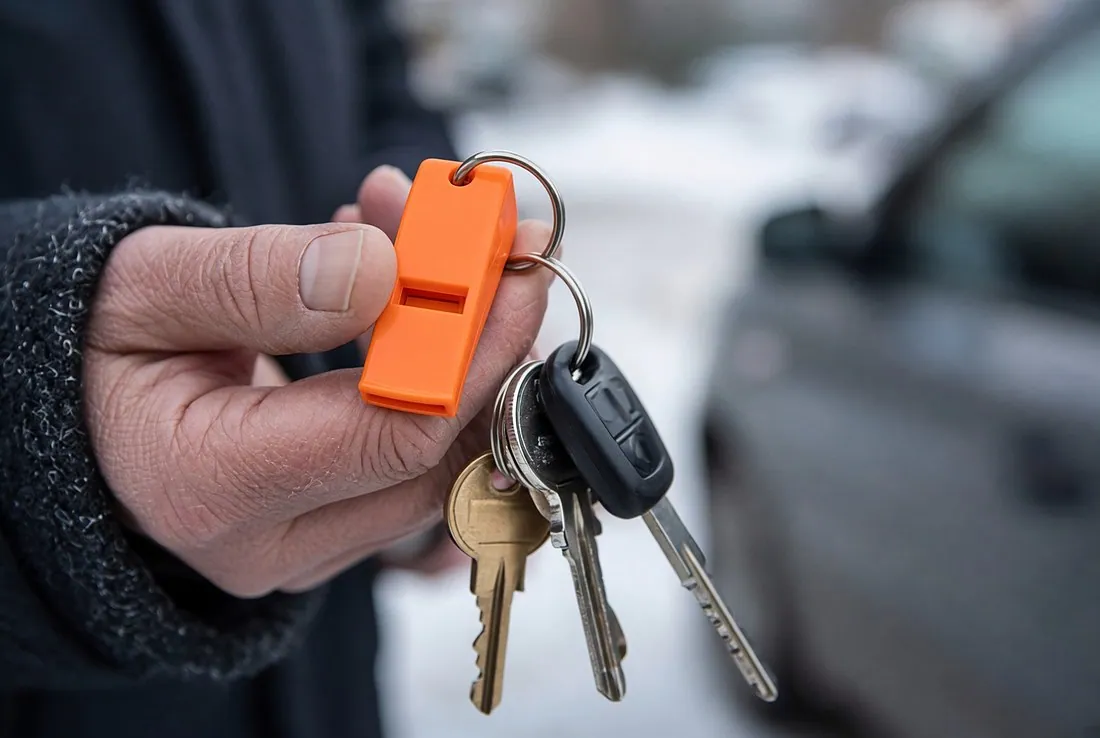
Two dollars. No battery to go flat, no bulb to blow, nothing to charge, and nothing that quits because it is twenty degrees out. It will do nothing at all for years. Then there is one evening where it is the only piece of equipment you own that still works. Put one on your own keys, and put one on the keys of everybody you would drive out at midnight for.
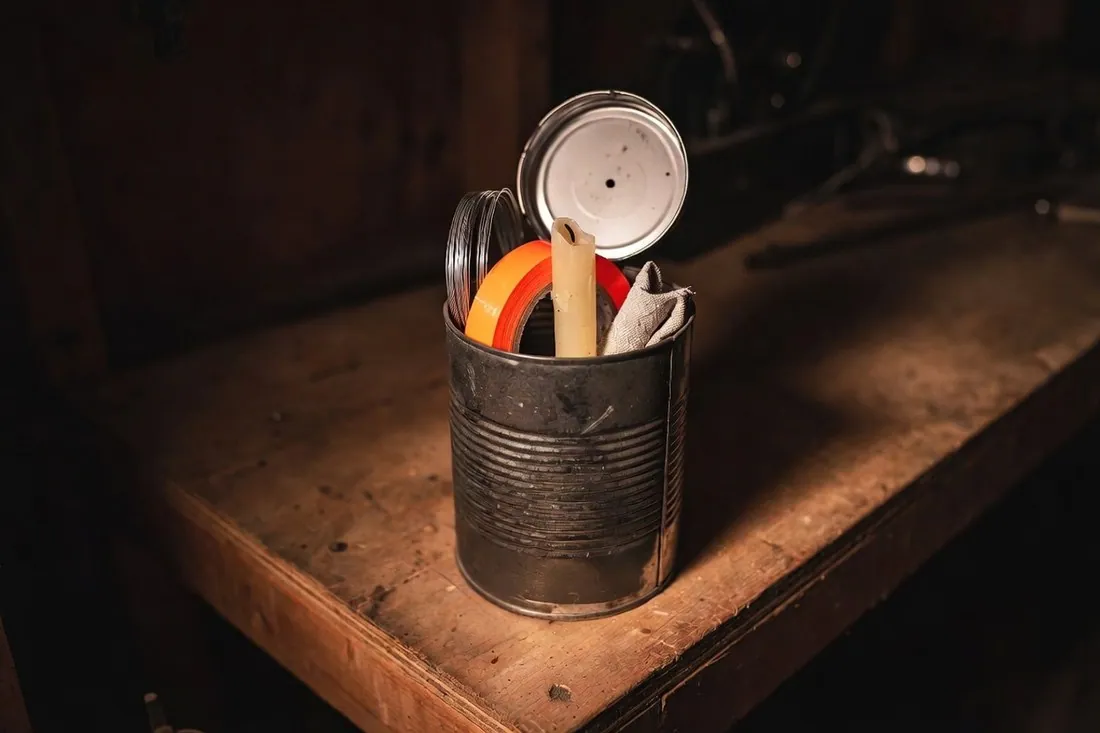
Grandpa kept a roll of bright flagging tape in the coffee can and never explained it until the day I watched him tie a strip to a mailbox so my uncle could find a turnoff after dark. Tie a length to your antenna, mirror, or door handle and a car on the shoulder instantly reads as someone needs help — the signal tow drivers and troopers are trained to look for. If you have to leave the car and walk, you tear off strips and flag your trail so you can find your way back and rescuers can find your car.
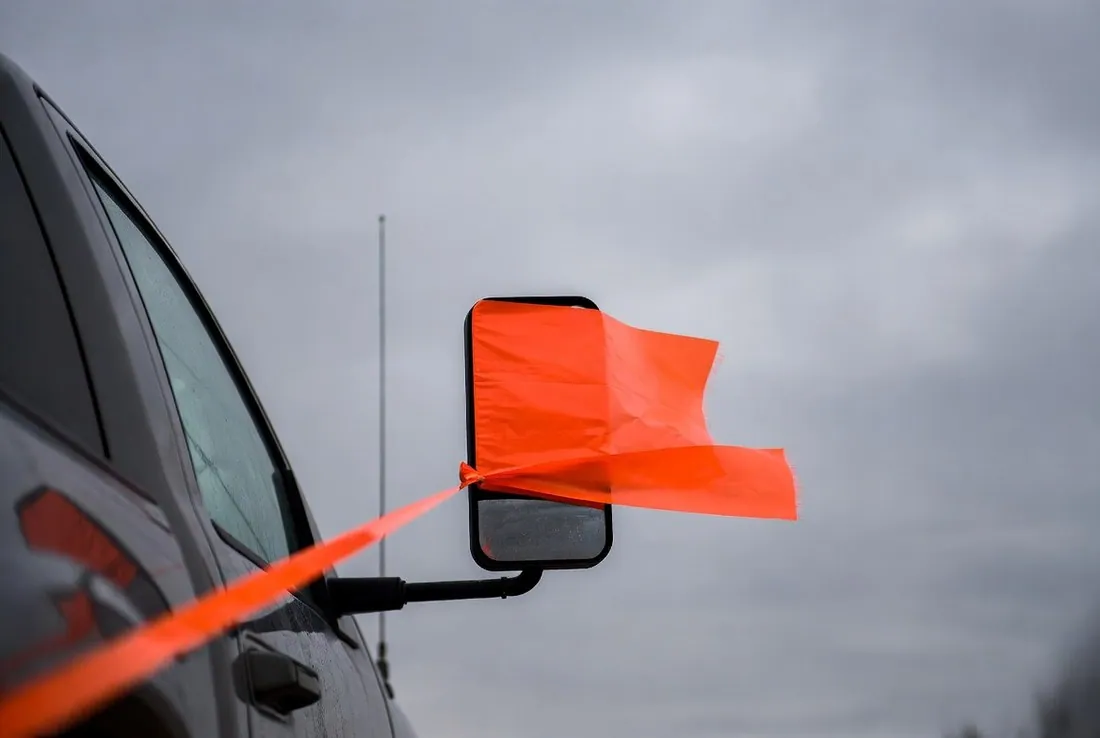
Here’s the part worth getting right: bright tape and a light aren’t rivals — they’re a day-and-night pair. In daylight, fluttering blaze orange wins going away; your side vision snaps toward motion, and orange pops against snow and asphalt where a cheap strobe washes out in the sun. After dark it flips: plain tape is just colored plastic and disappears. So carry the reflective kind — tie-on ribbon with a silver stripe that waves orange all day and throws approaching headlights right back at night. Then let a real light do the emitting after dark.
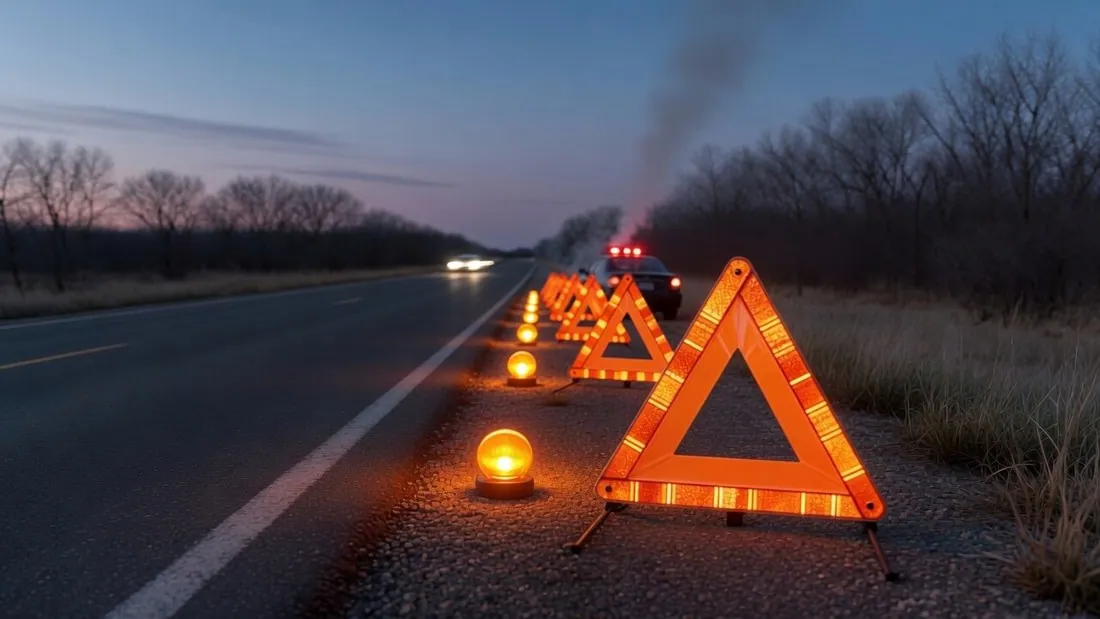
Your kit has three reflective triangles and a four-pack of magnetic strobe discs. Don’t bunch them up — stagger them, and you build a corridor of warning that feeds a driver one fresh signal at a time as he closes in. Working back from your car:
- Three triangles behind you at about 10, 100, and 200 feet, toward oncoming traffic.
- One strobe disc on the roof, toward the back of the car.
- One strobe disc on the traffic side, right by where you’re working — usually the front of the car.
- The last two strobes sitting on the ground, blinking — one between the first and second triangle, one between the second and third.
Now here’s what the driver sees, from far off to right on top of you:
That’s six or seven separate “move over” signals, stacked one after another. The triangles throw his own headlights back at him; the strobes make their own light and grab the eye. Alternating the two is far louder than a row of either — and by the time he reaches you, he’s had every chance in the world to see you and give you room.
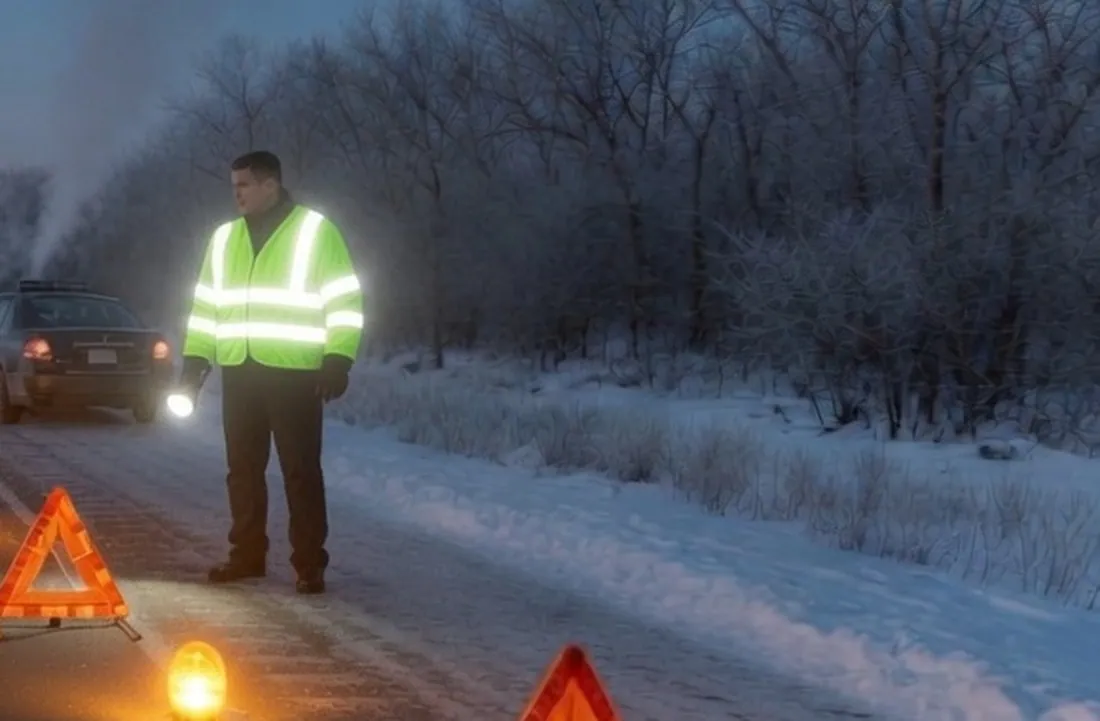
Being on the side of a road is one of the most dangerous things you will ever do as an ordinary civilian, so take every single opportunity to be seen. Get your vest and headlamp on before you’re exposed — while you’re still on the protected side of the car — and if it’s dark, wave your flashlight toward oncoming traffic to catch a driver’s eye as you move yourself around to the front of the vehicle, away from the traffic side. The cars going past are doing 60 miles an hour or more. That is no place to be casual or overconfident.
And this isn’t only for whoever’s doing the work. Every person who gets out of that car wears a vest — you, your spouse, your kids — even the ones standing on the far side, away from the road. A vest is eight dollars. A child is not. Don’t fuss over whether it fits a kid perfectly; just get it on them. For eight dollars a person, you protect everyone who’s out of that car.
The one that never got used — until, one February, it did. And here’s the thing Grandpa knew that most people don’t: it had to be wool, not the fuzzy fleece throw from the big-box store. Wool keeps you warm even when it’s wet. That’s not a folk saying — it’s how the fiber is built.
Wool holds insulating air pockets inside each strand even when soaked, and it actually gives off a little heat as it takes on moisture, which can delay hypothermia. A cotton or fleece blanket does the opposite: it collapses when wet and pulls the warmth right off your body. In a car — snow, slush, a spilled bottle, your own sweat — “still works when wet” isn’t a nice-to-have. It’s the whole point.
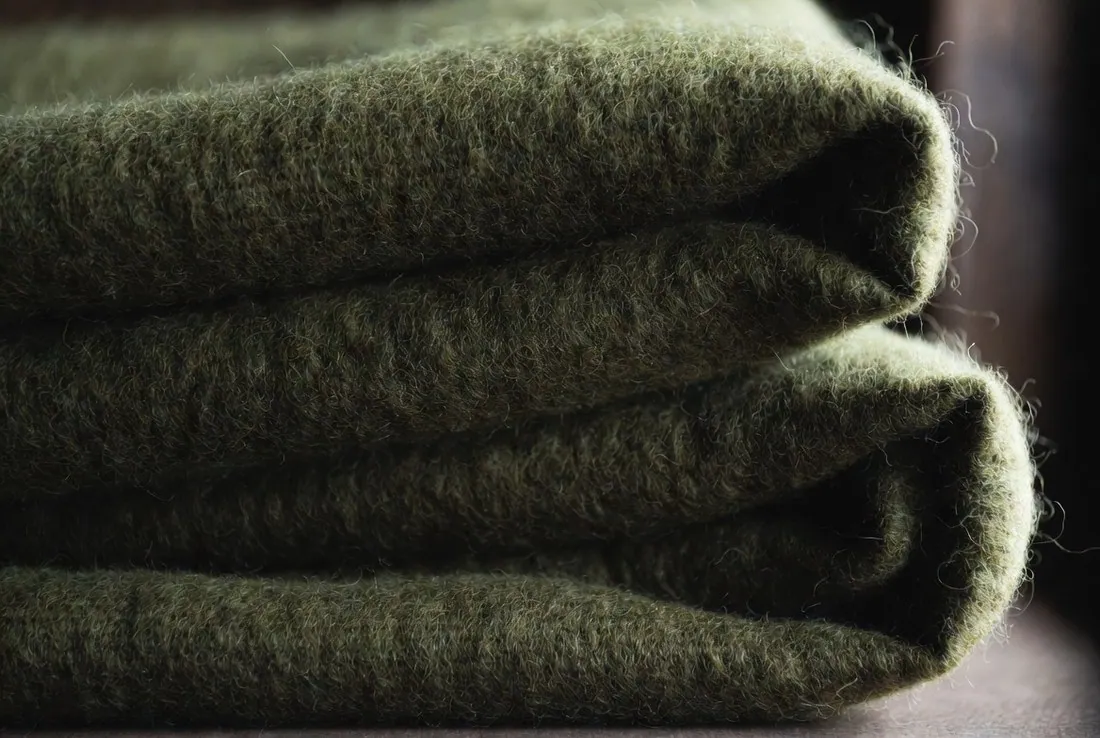
And this isn’t a trend or a nostalgia buy. The U.S. military has issued wool blankets to its soldiers since the Civil War — more than 150 years, through both World Wars and every winter war since — for one reason: nothing else keeps a cold, wet person alive as reliably. A century and a half of the Army betting soldiers’ lives on wool is the only product review that matters.
It’s not the lightest thing in the trunk, and it doesn’t ask for anything until the day it’s everything. It’s the exact kind of blanket the National Guard was handing out to drivers stranded overnight in the great Atlanta ice gridlock. Grandpa just kept his where he wouldn’t have to wait for the Guard to bring one. Shop the U.S.-Made Wool Blanket →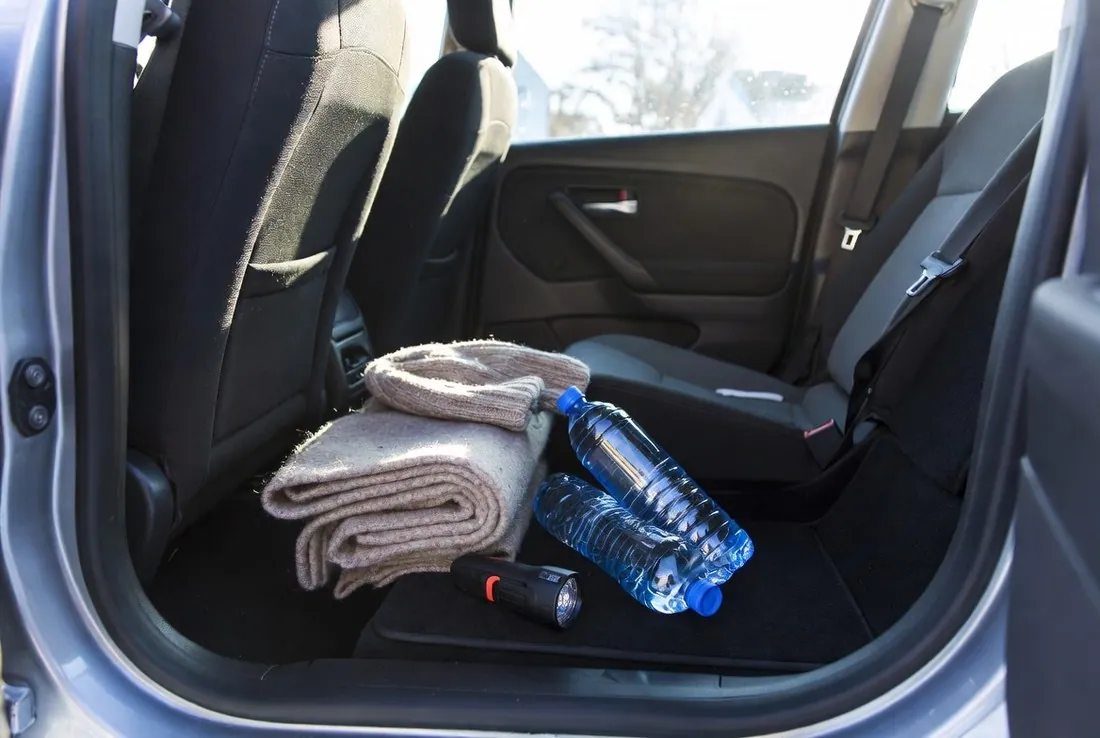
🤝 And a half-dozen mylar blankets — buy the extras on purpose. The thin foil sheets fold down smaller than a deck of cards and reflect your body heat back at you, and at roughly a dollar apiece, six of them costs less than a fast-food lunch. Because the day you’re stranded is the day you’ll pass three other cars stranded worse — and there is nothing in this world like rolling down your window and handing a shivering family a way to stay warm. A wool blanket is what you keep for your own; a stack of foil ones is what you keep for everybody else. See Swiss Safe blankets, 10-pack →
Dad got home around two in the morning, cold to the bone, and my mother met him at the door with coffee. He didn’t say much that night. But a few days later he drove over to Grandpa’s, and I went with him.
He just walked out to the truck, looked at the feed sack behind the seat, and said, “You were right about the blanket.” And Grandpa, who never once said I told you so in his life, just nodded and said, “Cold nights don’t care if you believed me.”
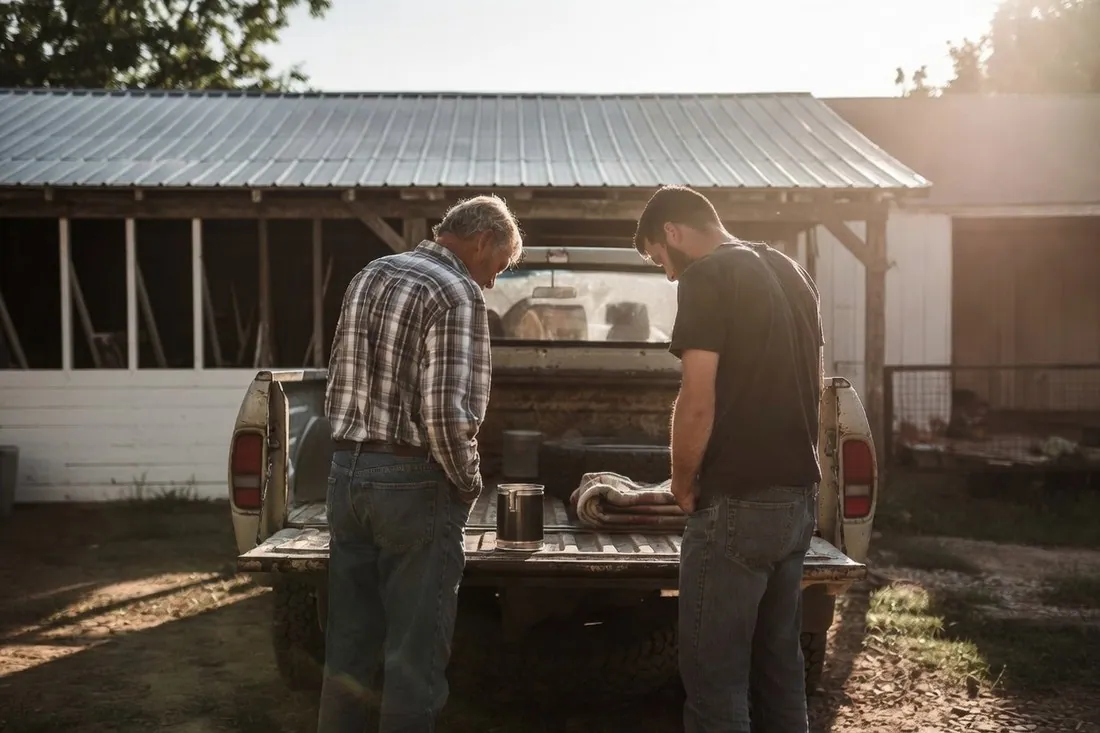
Dad has a full kit in his car now. Checks it every fall. Makes sure my mother has one, and me, and my kids. He’ll tell you it’s just common sense. But every time he opens that trunk, I think he hears the same voice I do — and I think, a little, he still hates knowing his father-in-law was right about every single thing in that sack.
Here’s the number that settles it: more than 40% of drivers carry no emergency kit at all. Which means most people reading this are the Dad in the story — right up until the night they aren’t. Don’t wait for the night. Pack the sack.
⚠️ Why the visibility items come first, not last: On average, nearly 350 people a year are struck and killed while standing outside a disabled vehicle in the U.S. — more than 1,600 since 2015 — according to the AAA Foundation for Traffic Safety. Most of those crashes happen in good weather at highway speeds, and about a third happen in broad daylight. The vest, the flagging tape, and the beacons aren’t extras. They’re the cheapest life insurance in the trunk.
- Compact Lithium Jump Starter — starts a dead battery, the most common breakdown, with no cables and no waiting on a stranger.
- Heavy-Duty Aluminum Flashlight — see under the hood and flag down help; the metal body doubles as something solid in your hand.
- LED Headlamp (AAA batteries) — hands-free light on batteries you can swap, so you work with both hands.
- Spare Batteries — a fresh sealed pack for every light in the kit; buy the tool once, buy batteries forever.
- A Jug of Water — drinking water for you, top-off water for an overheating radiator.
- Self-Fusing Silicone Tape — temporary seal for a leaking radiator or heater hose — let the engine cool first.
- Tire Inflator & Plug Kit — reinflate and patch a flat and drive to a shop — most new cars carry no spare.
- Heavy-Duty Repair Tape — hold a hose, mirror, or busted window together long enough to get home.
- Folding Knife — cut a jammed seatbelt, strip tape, open packaging.
- Leather Work Gloves — handle hot, sharp, or greasy parts without shredding your hands.
- Rubber Anti-Slip Grip Tape — wrap tool handles so cold, wet, or arthritic hands can still grip them.
- Tow & Recovery Strap — get pulled out of a ditch by the next passing pickup.
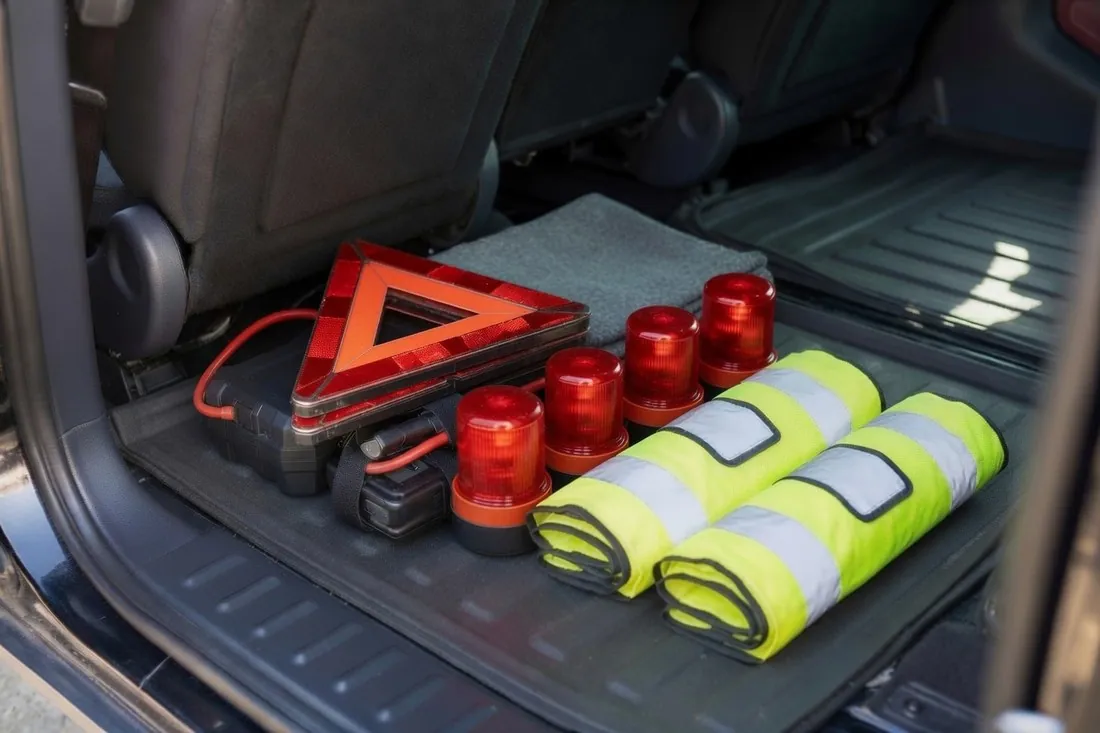
- Reflective Warning Triangles — set out behind the car at 10, 100, and 200 feet so traffic sees you from ~500 feet off. Kits come as three.
- Reflective Flagging Tape — tie to your antenna: signals “help needed” and reflects headlights back at night.
- High-Visibility Safety Vest — makes you visible the instant you step out; ANSI/ISEA 107, about $8. One for every person who gets out of the car.
- LED Road Flare Discs (magnetic) — flashing disc beacons with a magnetic base & hook; replaceable batteries, so they run for years (batteries not included; a 4-pack lets you ring the car). Put one behind you and one on the traffic side.
- U.S.-Made Wool Blanket — stays warm even when wet — the survival layer if help is hours away.
- Mylar Emergency Blankets (6-pack) — dollar-apiece body-heat reflectors; keep extras to hand to families stranded worse.
- Charged Power Bank — keeps your phone alive so a dead battery never stops you calling for help.
- Car First-Aid Kit — treat the minor injuries that come with roadside work.
Grandpa’s whole method in one line: get seen, get warm, get moving — in that order. Pack it once, check it every fall, and you’ll never be the Dad in the story.
❓ Plain Answers
The short version of this page, one question at a time — the answer is always the first line.
What should I keep in my car for emergencies?
A basic car emergency kit starts with five things: a lithium jump starter, a wool blanket, an LED headlamp, a whistle on your keychain, and reflective flagging tape. Those five cover a dead battery, the cold, the dark, not being seen and not being heard.
What is the best car jump starter for seniors?
A small lithium jump starter with clamps that will not spark or work if you connect them backwards — the NOCO Boost GB40 is the one we would buy. NOCO lists it at 1,000 peak amps, spark-proof and reverse-polarity protected, with a USB port to charge a phone and a 100-lumen flashlight, at 2.4 pounds. No second car, no jumper cables, no waiting on a stranger. Recharge it every few months so it is full when you need it. Source: NOCO.
What size jump starter do I need?
Match it to your engine size, which is in the owner’s manual or on a sticker under the hood. A 1,000-amp unit like the NOCO GB40 is rated for gas engines up to 6.0 liters and diesels up to 3.0 liters, which covers most cars, small trucks and SUVs. A big V8 truck or a larger diesel needs a bigger unit; buy for the largest engine in the household. Source: NOCO.
How far behind my car should I put warning triangles?
Set three reflective warning triangles behind the car at about 10, 100 and 200 feet, and farther on a fast road or before a hill or curve. Turn your hazard flashers on first, and walk facing oncoming traffic as you set them.
Should I stay in my car or get out when I break down on the highway?
Get out and move 20 to 30 feet off the road if you can do it safely, but stay belted inside with the doors locked if you cannot. A narrow shoulder, fast heavy traffic or small kids you can't manage are reasons to stay in. Never stand directly in front of or behind the car.
Why is a wool blanket better than a fleece blanket for the car?
A wool blanket keeps you warm even when it is wet, while a cotton or fleece blanket collapses when wet and pulls the warmth off your body. Wool holds insulating air pockets inside each strand even when soaked.
What is the whistle signal for help?
The recognised distress signal is three short whistle blasts, a pause, then three more. A whistle takes almost no breath, carries much further than a voice, and needs no battery, so keep one on your keyring.
How many people are killed standing outside a broken-down car?
On average, nearly 350 people a year are struck and killed while standing outside a disabled vehicle in the U.S., according to the AAA Foundation for Traffic Safety. About a third of those crashes happen in broad daylight.