Free Tool — No Sign-Up Required
Generator Size & Fuel Calculator
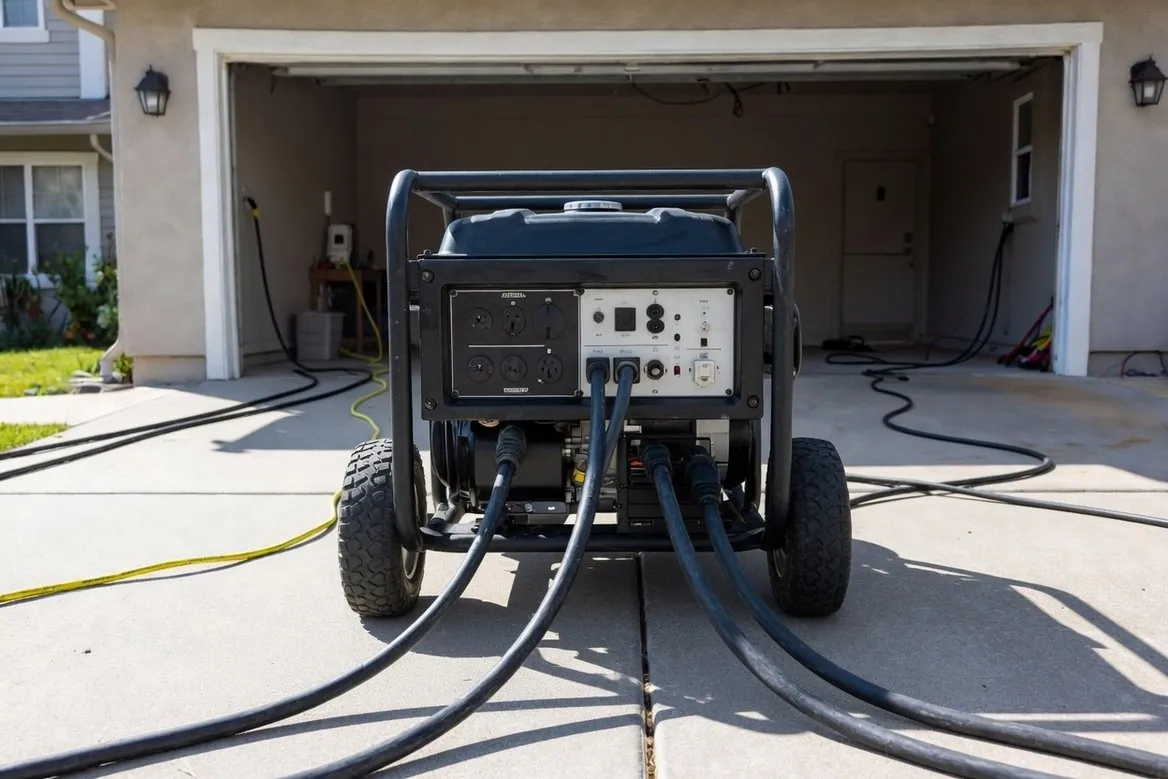
Tell us what you need to power and we'll tell you exactly what size generator to buy — and how much propane to store for 3, 5, 7, 14, or 30 days of outage.
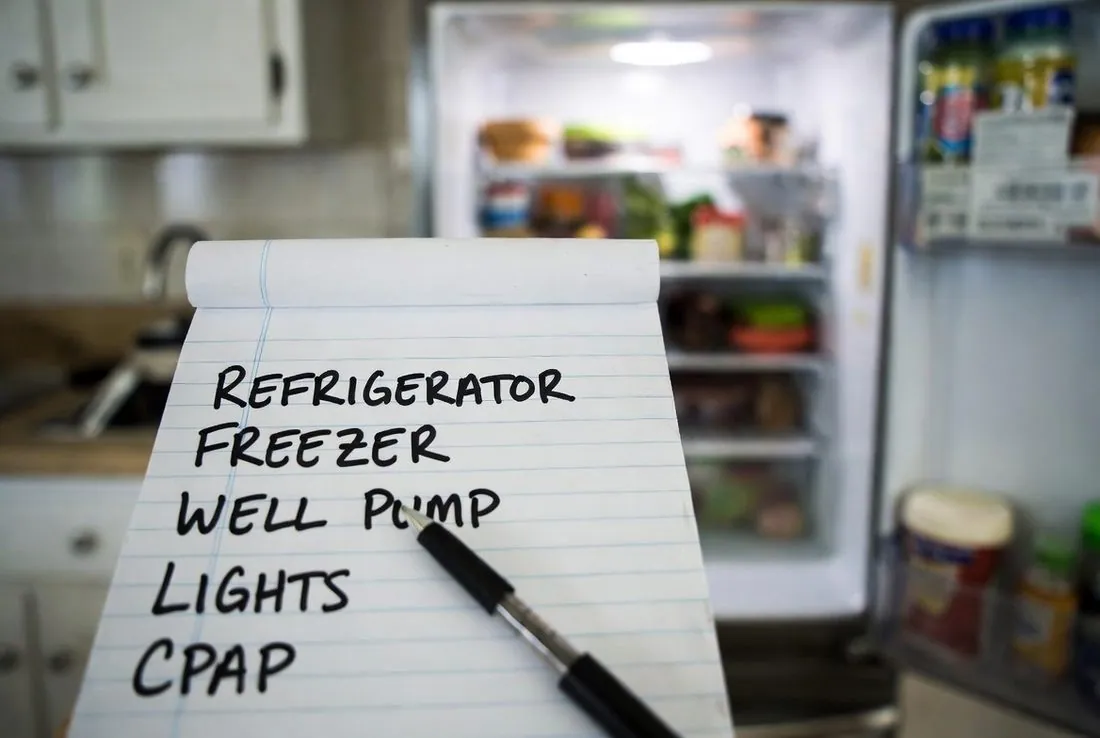
Free Tool — No Sign-Up Required
Tell us what you need to power and we'll tell you exactly what size generator to buy — and how much propane to store for 3, 5, 7, 14, or 30 days of outage.
The short answer
Add up the running watts of everything you mean to keep going. Put the single biggest start-up surge on top — only the biggest, because motors do not all start at the same instant. Then plan to use about eighty per cent of what the label says, and keep the rest for surges and for the machine’s own sake.
| What you want to run | Roughly what it takes |
|---|---|
| Refrigerator and lights | About 2,000 watts |
| Refrigerator, freezer, lights, fans, television, chargers, and one cooking appliance at a time | About 3,500 watts |
| Central air, an electric water heater, an electric range or an electric dryer | More than a 3,500-watt portable can carry — see the soft starter guide before you price a bigger machine |
The calculator below does that arithmetic on your own list. Then it does the part the showroom calculators leave out: how much propane it takes to keep going for 3, 5, 7, 14 or 30 days. When you have your answer, there is a button to print it.
These affect your load calculation. Answer as accurately as you can.
Check each item you want running during an outage. Adjust quantities where needed. Wattages are real-world averages — your actual usage may vary.
| On? | Appliance | Qty | Watts each | Hours/day |
|---|
Most people run a standby propane generator continuously (24 hrs). Portable gasoline generators are often run 8–12 hrs/day to save fuel. Adjust to match your plan.
One short checklist next — Step 4 — then enter your plate number in Step 5 and press the button.
Because motors need a hard shove to start turning and almost nothing to keep turning. A refrigerator compressor, a well pump and an air conditioner all draw two to three times their running watts for a second or two at start-up. The generator's surge rating — usually 15 to 30 percent above its running rating — exists to swallow that moment.
The practical consequence is the sum most people get wrong. Add every running watt together, then add only the single largest surge on top. Not the sum of the surges, because motors do not all start at the same instant. Size for the biggest one and stagger the rest by hand.
Anything that heats with an element rather than turning a motor. An electric skillet, a kettle, a coffee maker, a toaster, a slow cooker and a space heater all draw their rated watts the instant you switch them on and never a watt more. The number on the label is the entire load.
This is worth knowing because it turns the usual instinct upside down. A 1,500-watt electric skillet looks like a bigger burden than an 800-watt refrigerator, and in steady running it is — but the refrigerator is the one that will trip a small generator, because for a second or two it asks for 2,000. Cooking appliances are among the gentlest loads a generator ever carries.
No — size it generously for the loads you actually need, and be ruthless about which loads those are. The four appliances that drive generator quotes into the thousands are central air conditioning, the electric water heater, the electric range and the electric clothes dryer. Leaving all four off the list is what makes a $900 machine sufficient instead of a $9,000 one.
You already have a tank of hot water. You can cook supper on a countertop appliance. Clothes can wait. A window unit may cover the night where central air cannot. Our loads-to-skip guide works through each of those trades, and a soft-start kit can cut the air conditioner's surge enough to change the answer entirely.
Then leave headroom. Round up on the generator and round down on the list. A machine run flat out eight hours a day is a machine that quits on day five, and in a long outage day five is not the end of the story. Plan around eighty percent of the rated running watts.
Add up the running watts of everything you need on at once — that is your running-watt requirement. Then add the single largest motor start-up surge on top of that total; surge is not additive, because motors do not all start at once, so you size for the biggest one rather than the sum. If you are running a CPAP or anything with a circuit board, you also need a total harmonic distortion (THD) figure under 3%, which in practice means an inverter generator. Our free calculator returns all six specs so you can check any unit yourself.
A 10,000W generator running at 50% load uses approximately 1.5–2 gallons of propane per hour, or 18–24 gallons per day. A 100-gallon propane tank provides roughly 4–5 days of full operation. Use our calculator to get your specific numbers based on actual runtime hours.
A 500-gallon propane tank running a 10,000W generator at 50% load for 8 hours per day will last approximately 20–25 days. Running 24 hours per day reduces that to 7–8 days. Our fuel calculator lets you set exact daily runtime hours for precise results.
Five short lessons — the loads that decide generator size and fuel cost, and the panel that lets you steer them. Each has its own page — come back here with your answers.
Related tools: Propane Use · CPAP Battery Backup · Extension Cord Gauge · the full Power & Generators guide
Both boxes are optional — but the plate number above beats every estimate this calculator can make. Haven’t read yours yet? It’s a four-minute trip outside — the plate guide shows you exactly where to look.
No guesswork. Here's the math behind every number.
Generator size: We add up your selected appliance wattages, multiply by your quantity, then apply a 25% safety buffer (standard industry practice — never size a generator at 100% of your load). The result is rounded up to the nearest standard generator size available on the market.
Propane consumption: A propane generator burns approximately 1 to 1.5 gallons per hour per 10kW of output under typical load. We use a conservative 1.25 gal/hr per 10kW at your selected daily runtime, then multiply across each outage duration. Real-world consumption depends on actual load — a lightly loaded generator burns less.
Cost estimates: Based on 2024–2025 Florida Gulf Coast contractor pricing for equipment, automatic transfer switch, electrical connection, permits, and buried propane tank installation. Natural gas connections and gasoline portables have different cost profiles not reflected here.
What This One Buys You
Buying the right size once.
Undersize it and it stammers under load; oversize it and you paid for machine you never use — the number is worth getting right before the truck shows up.