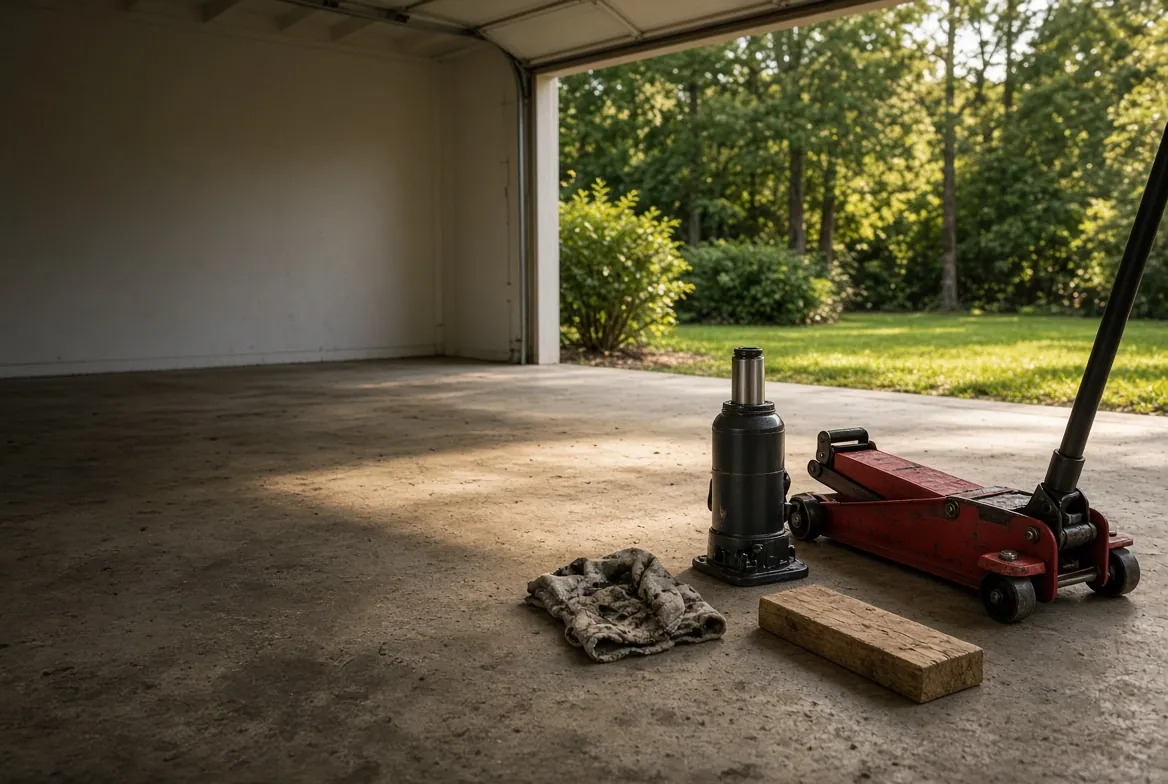

If you own one jack, own a bottle jack. Six or eight ton, about thirty dollars, weighs less than a bag of sugar and a half, and it will lift almost anything on your property that is not a car.
Buy the floor jack only if you work on vehicles. It is the better jack in a garage and a useless jack in a yard, and it weighs sixty to eighty pounds, which at our age is its own argument.
Whichever you buy, buy jack stands or cribbing in the same order. Not later. In the same order. The reason is further down this page and it is not negotiable.
💧 How a Jack Multiplies You

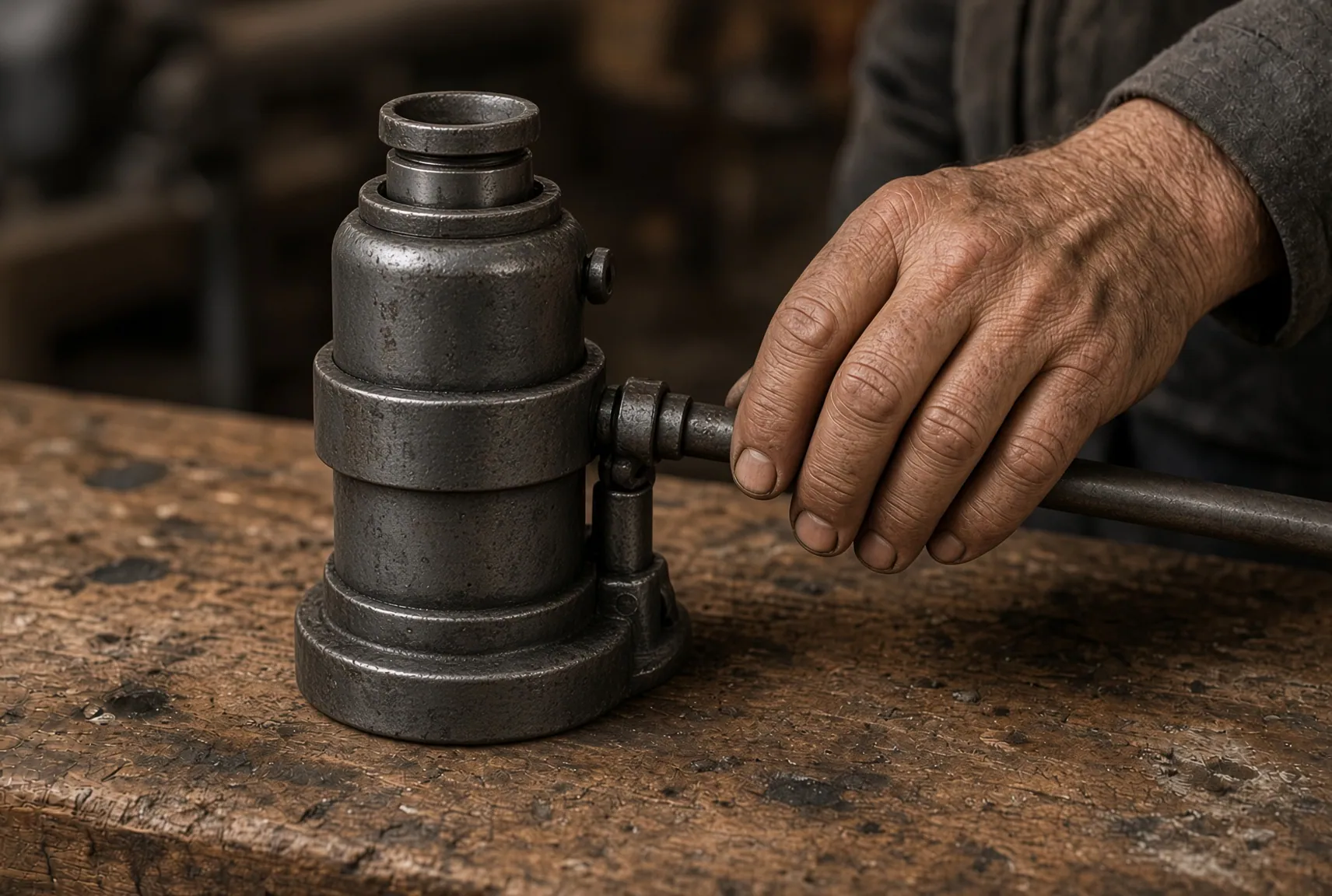
A pry bar multiplies your force with a lever. A jack multiplies it with a liquid, and the multiplication is much larger.
Inside the jack are two pistons, one small and one large, connected by oil. Push down on the small one and the oil has nowhere to go but under the big one. Because the big piston has more surface area for the oil to push against, it comes up with more force than you put in — as many times more as it is larger. That is the whole trick. There is no motor, no battery, nothing to charge, nothing to go flat in the shed over winter.
What it means in practice: a man pushing on a jack handle with the strength he has at seventy-two is producing several tons at the saddle. Not because he is strong. Because the oil does not care how strong he is. Hydraulics are the most honest deal in the toolbox — you give up speed and distance, and you get force back in exchange, at a rate no muscle can match.
The reason this belongs on this site: nearly every heavy job around a house is a lifting job in disguise. A sagging shed corner, a settled deck post, a washing machine that needs a dolly under it, a rock in the wrong place. At forty you did those with your back and a helper. The jack does not need either. It is not a concession — it is a better way to do it, and it always was.
🍾 The Bottle Jack — Small, Cheap, Goes Anywhere
A bottle jack is a squat steel cylinder with a screw pad on top and a socket for a handle on the side. It stands upright, it lifts straight up, and it looks like a bottle, which is where the name comes from and about the only decoration it has.
What it is good at
- It goes where the work is. A six-ton bottle jack weighs about ten pounds. You carry it out to the shed in one hand, along with the handle.
- Enormous capacity for the money. Twenty and thirty dollars buys four to eight tons. Twelve and twenty ton units exist and are not much dearer. You will never worry about capacity again.
- It works on dirt. Put a solid pad under it — a paving slab, a thick chunk of plank, a concrete block laid flat — and it will lift in a yard, in a crawlspace, on gravel. This is the thing the floor jack cannot do.
- It fits in tight places. Under a beam, between joists, inside a crawlspace where nothing on wheels will go.
- Nothing to break. No wheels, no arms, no linkage. A bottle jack that sat in a barn for twenty years usually still works.
Where it lets you down
- It is too tall to fit under a car. This is the big one and it catches people out. A bottle jack is typically seven to nine inches tall fully collapsed. Most cars do not have that much clearance at the jacking point. It will fit under a truck or an SUV. It will not fit under a sedan.
- It is tippy. Tall and narrow, with a small base. If the load shifts or the ground gives an inch on one side, it can lean — and a leaning jack under load is the beginning of a bad story. It must sit plumb on something firm.
- Most must be used upright. Lay a standard bottle jack on its side and the oil is in the wrong place. There are jacks built to work horizontally; the cheap ones are not.
- Short lift. The ram travels five to seven inches. The screw pad on top adds a couple more. Beyond that you have to block up and start again.
- Slow. Many small strokes. Not a problem for a shed. Tedious for a wheel change.
🛞 The Floor Jack — Low, Stable, Heavy as Sin
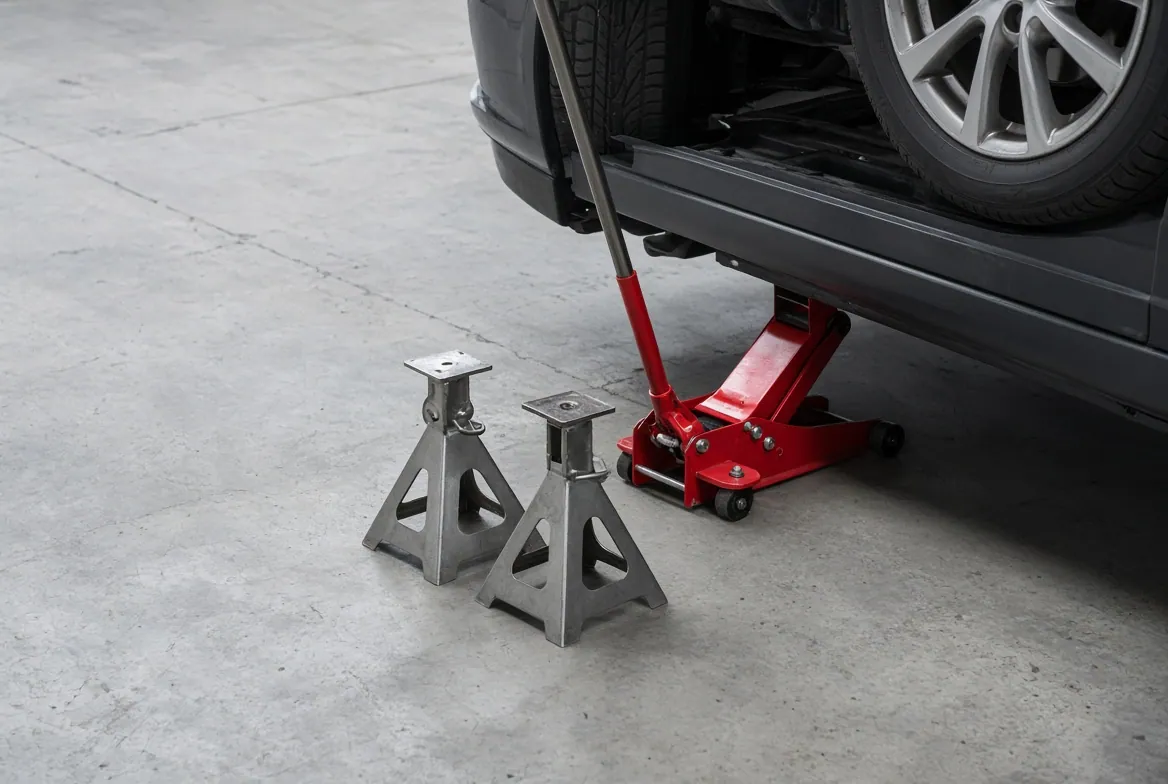
A floor jack — a trolley jack — lies flat on four wheels with a long handle and a saddle on a swinging arm. The hydraulic cylinder is horizontal inside it, which is what lets the whole thing be low.
What it is good at
- It fits under vehicles. Three to four inches of collapsed height, and low-profile models go under three. That is the entire reason it exists.
- It lifts far. Eighteen to twenty inches in one continuous go, where a bottle jack needs re-blocking twice to get there.
- It is stable. Long, wide, low, four points on the floor. Far harder to tip than a bottle jack.
- It is fast. A few strokes of a long handle and the wheel is off the ground.
- It rolls as it lifts. The saddle swings through an arc as the arm rises, and the wheels let the jack track along to follow it instead of dragging sideways against the car. That self-correction is the mark of a good one.
Where it lets you down
- The weight. A steel three-ton floor jack runs sixty to ninety pounds. It does not get carried; it gets dragged. An aluminium one is forty to fifty and costs roughly double. If you cannot comfortably move it, you will not use it, and it will sit in the corner rusting while you pay somebody else. Lift one in the store before you buy it.
- It needs hard, flat, level ground. Concrete, or good asphalt. On grass, gravel or dirt the wheels dig in, the jack cannot track as it lifts, and it starts loading sideways. This is not a minor inconvenience — it is genuinely unsafe.
- The cost. A hundred to three hundred dollars for one worth owning. The forty-dollar ones leak.
- Less capacity. Consumer models are one and a half to three and a half tons. Ample for a car. Nothing next to a twenty-ton bottle jack.
- It takes up floor space. Which in a full garage is a real cost.
⚖️ Side by Side
| Bottle Jack | Floor Jack | |
|---|---|---|
| Typical price | $25–60 | $100–300 |
| Weight | 8–15 lb | 60–90 lb steel · 40–50 lb aluminium |
| Capacity | 4–20 tons | 1.5–3.5 tons |
| Collapsed height | 7–9 in — too tall for most cars | 3–4 in — fits under vehicles |
| Lift range | 5–7 in of ram | 18–20 in |
| Works on dirt or grass | Yes — with a solid pad | No |
| Stability | Tippy — must sit plumb | Very stable |
| Carry it to the job? | One hand | Drag it |
Read that table one way and it settles the argument: the floor jack is a better jack in a garage, and the bottle jack is the only one of the two that goes out to the yard. Most of the heavy jobs at a house are in the yard.
🏚️ Five Real Jobs, and Which Jack Does Them
1. The corner of the shed has sunk
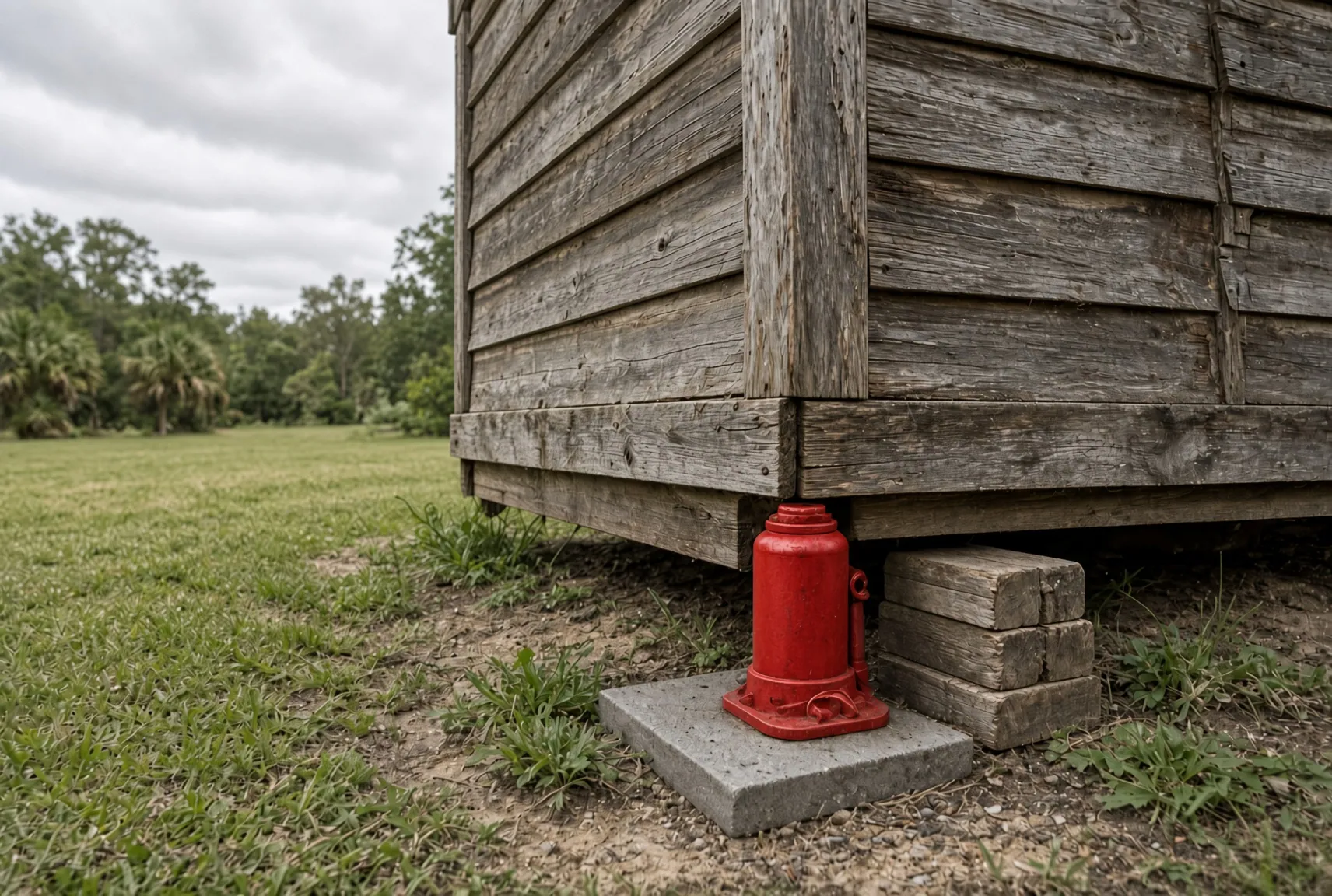
Bottle jack. Clear the dirt away and set the jack on something that spreads the load — a concrete paver, a doubled-up chunk of two-by-eight, a solid block laid flat. Never straight on soil; it will just press the jack into the ground instead of pressing the shed up.
Put the pad of the jack under the frame — the skid, the rim joist, the beam the wall actually sits on. Not the siding, not the floor sheathing, not the trim. Those will tear and you will have made a second job.
Then lift slowly, and a quarter inch at a time. A shed is a stiff box and it does not like being twisted. Go up a little, slide a block or a shim under, go up a little more. When it is where you want it, the load goes on the blocks and the jack comes out. The jack was never meant to stay there.
2. A rock in the wrong place
Bottle jack, and it barely matters which size. You are not lifting the rock to carry it — you are lifting one edge just enough to get something underneath. A stout plank, a couple of lengths of pipe, a scrap of plywood to slide it on.
Once there is a roller or a slick surface under it, a rock that two men could not carry moves with one hand and patience. This is the oldest trick on the list and it still works.
3. A deck post or fence post has settled
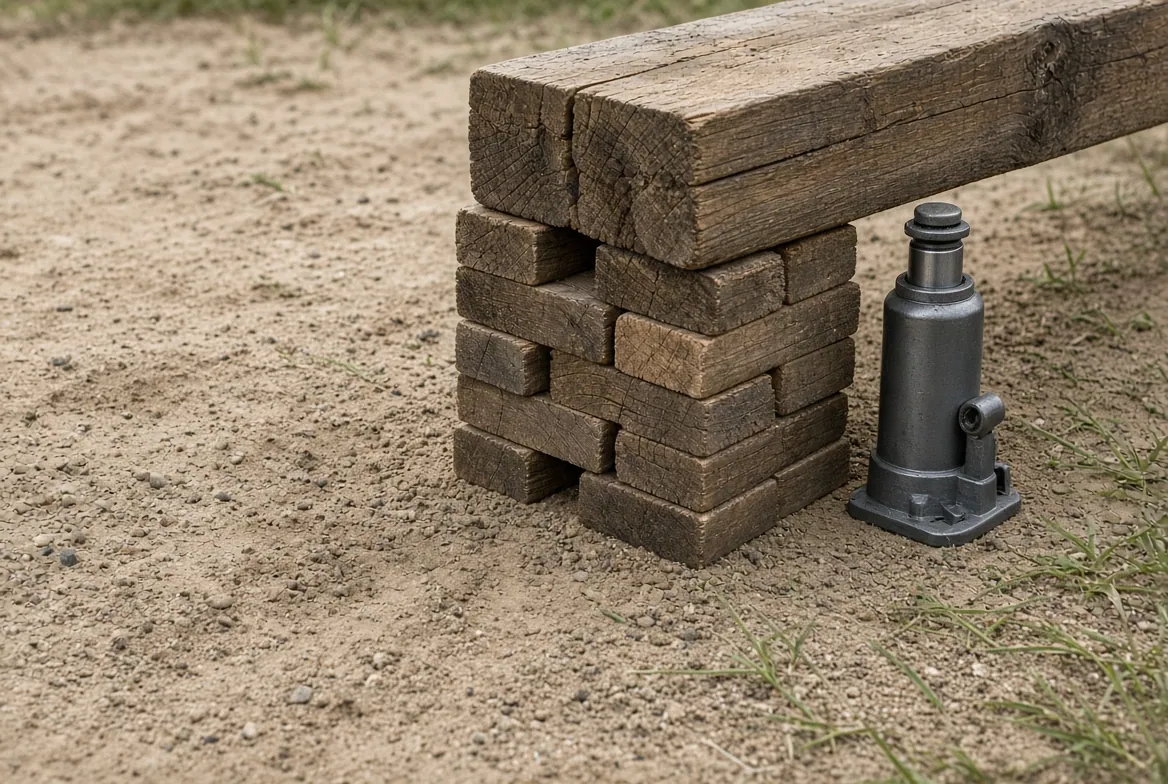
Bottle jack, on a pad, under the beam beside the post — not under the post itself. Lift the beam, take the weight off the post, and then you can shim the base, replace the footing, or set a proper block under it. Let the beam back down onto the fixed post. Ten minutes of jacking instead of a day of dismantling.
4. Getting a dolly under the washing machine
Either, but the bottle jack is easier because the floor jack's saddle is a poor shape for an appliance. Lift one end an inch and a half with a scrap of plywood between the jack and the machine, slide the dolly plate under, let it down. The alternative is the two-man tilt-and-shove that ends in somebody's back.
5. Changing a wheel, or getting under the car
Floor jack, if the car sits low. Bottle jack is fine under a truck or an SUV, where there is clearance for it and a solid frame rail to sit against.
And here the safety rule below is not advice. It is the whole job.
⚠️ The Rule That Keeps You Alive

A jack is a lifting device, not a holding device. Nothing goes underneath a load held by a jack alone — not a hand, not a head, not a foot. Not for a second, not for "I'll be quick."
Hydraulic jacks fail, and they mostly do not fail dramatically. A seal weeps and the load settles an inch over ten minutes. That is enough.
What holds a load
- Jack stands, rated for the weight, on hard level ground, under a proper support point. Under a vehicle: stands, always, both sides.
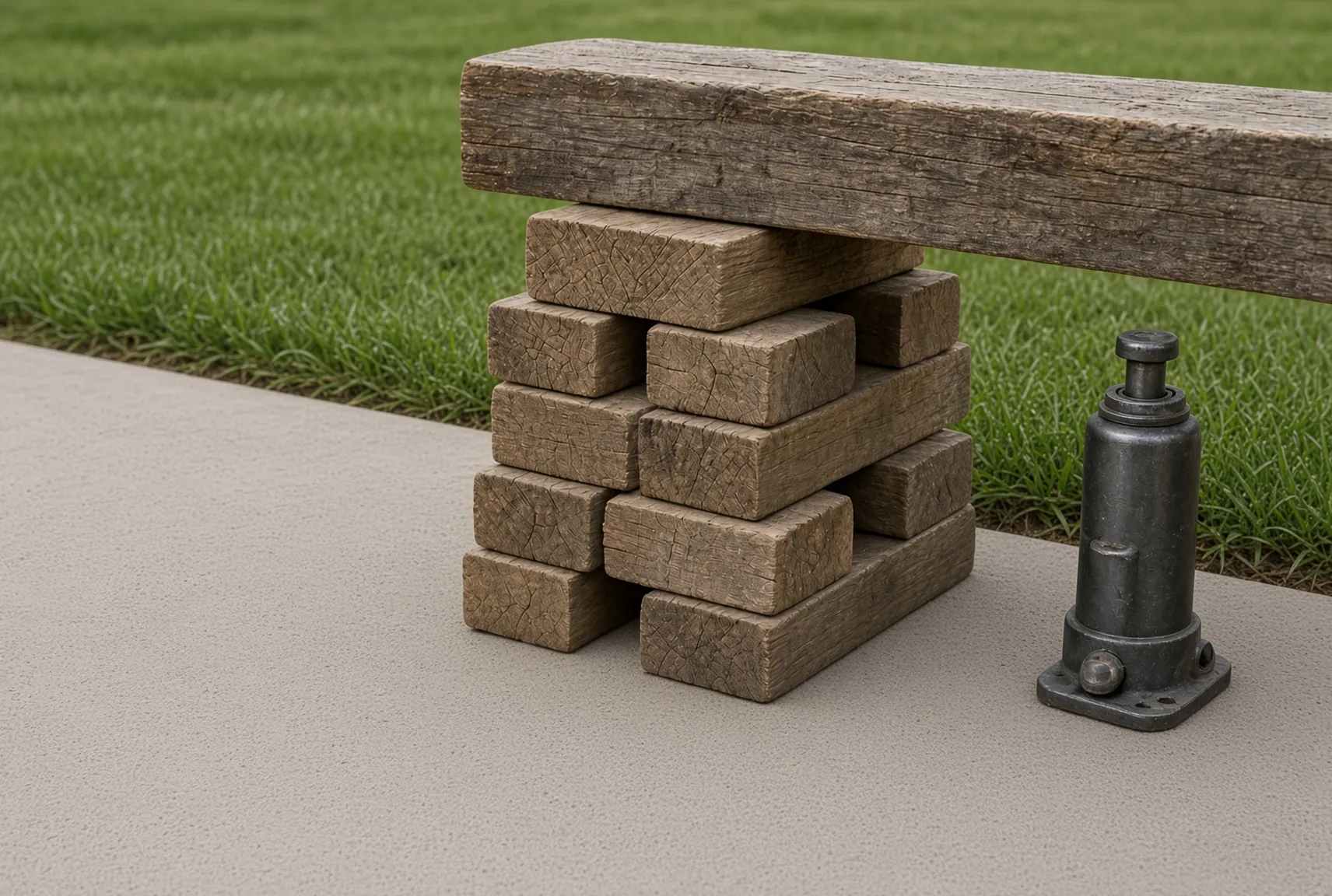
- Cribbing — solid blocks stacked square, or short lengths of timber crossed log-cabin style. This is what holds a shed or a beam. Cheap, and it does not leak.
- Lift and crib as you go. Raise a little, block it, raise a little more. Then you are never higher than your blocking, and if the jack quits it drops an inch onto wood instead of all the way onto you.
The rest of it
- Chock the wheels on anything with wheels, and set the parking brake, before the jack touches it.
- Spread the load underneath. A jack on bare dirt sinks. A jack on a paver does not.
- Buy well past what you need. A four-ton jack lifting four tons is a jack at the edge of itself. The extra capacity costs a few dollars.
- Shake it before you trust it. Once it is up on stands or blocks, push it hard from the side. If anything moves, it is not ready.
- Never leave a load up overnight. Ground settles, seals weep, and nobody remembers by morning what state it was left in.
- If the job can be done without lifting at all, do it that way. The safest lift is the one you did not need.
🧰 Where This Sits in the Rest of the Kit
A jack is one of a small family of tools that give back force rather than asking for it. The others are worth knowing about too:
- The pry bar — the same idea with a lever instead of oil, for the jobs a jack is too big for.
- The grandfather toolkit — what belongs in the box before any of this.
- Quality hand tools — why drop-forged steel is a grip aid in disguise.
- The tool sizes checklist — including the jack stands warning that sent us here.
- Tools and aging hands — the wider argument, in one place.
❓ Plain Answers
The short version of this page, one question at a time — the answer is always the first line.
What is the difference between a floor jack and a bottle jack?
A floor jack is low and fits under cars, while a bottle jack is small, cheap and portable and lifts things around the yard like sheds and posts. The floor jack is the one you bring the car to; the bottle jack goes to where the work is.
Will a bottle jack fit under a car?
A bottle jack is usually too tall for a car, at seven to nine inches collapsed, though it will fit under a truck or an SUV.
Is it safe to get under a car held up by a jack?
No, never put any part of your body under a load held up by a jack alone; use rated jack stands or cribbing on hard, level ground. Hydraulic jacks fail, often by a seal weeping and the load settling an inch over ten minutes.
How much does a floor jack weigh?
A steel three-ton floor jack weighs sixty to ninety pounds, and an aluminium one weighs forty to fifty pounds and costs roughly double. Lift one in the store before you buy it.
If I only buy one jack, which should it be?
If you own one jack, own a six- or eight-ton bottle jack, which costs about thirty dollars and lifts almost anything on your property that is not a car. Buy jack stands or cribbing in the same order.
Can I use a floor jack on grass or gravel?
No, a floor jack needs hard, flat, level ground like concrete or good asphalt, because on grass, gravel or dirt the wheels dig in. A bottle jack works on dirt with a solid pad under it.