Every guide on this site tells you to buy quality. That is true, and it is only half the sentence. A superbly made tool can still leave your hand aching after four hours, because it was never shaped for the hand you have now.
This page comes out of sixty years of using hand tools for a living and for pleasure — apprenticing alongside men who built houses, hanging drywall, painting, building cabinets and vanities at seventeen, repairing antiques for cash, and still making furniture today. Every tool named below is a good tool. Some of them are excellent. That is exactly the point.
Quality Protects the Work. It Does Not Protect the Hand.
Those are two separate purchases, and almost everybody only makes the first one.
A cheap tool costs you twice. It does the job badly — and, worse, it convinces you that you are bad at the job. A man buys a twenty-dollar set of chisels at fifty-eight, they will not take an edge, the joint comes out ragged, and he decides he is not a woodworker and puts them in a drawer. He was never the problem. Nobody selling the cheap set will ever tell him that, because the story that moves the cheap set is that anybody can do it.
Here is how that reads from the other side of it, after a working lifetime:
“Quality tools is where you realize that you’ve been working too hard and fighting with your tools, because they don’t work the way you had expected. Quality tools don’t do that to you. Once you learn how to use them it comes to you naturally. They feel good in your hand.”
So buy the good one. That is settled, and the rest of this site argues it at length. But a good tool is designed to do the work well — not to be kind to a seventy-year-old hand over an afternoon. Those are different design problems, and most tools solve only the first. The second one is yours to solve, and it starts with knowing which tools will do what to you.
Three Tools That Are Fine for an Hour and Wrong for a Day
None of these are junk. Two of them are among the best-engineered planes ever sold to a woodworker. They simply were not shaped for a hand doing hours of work.
1. The bullnose plane — the web of your hand
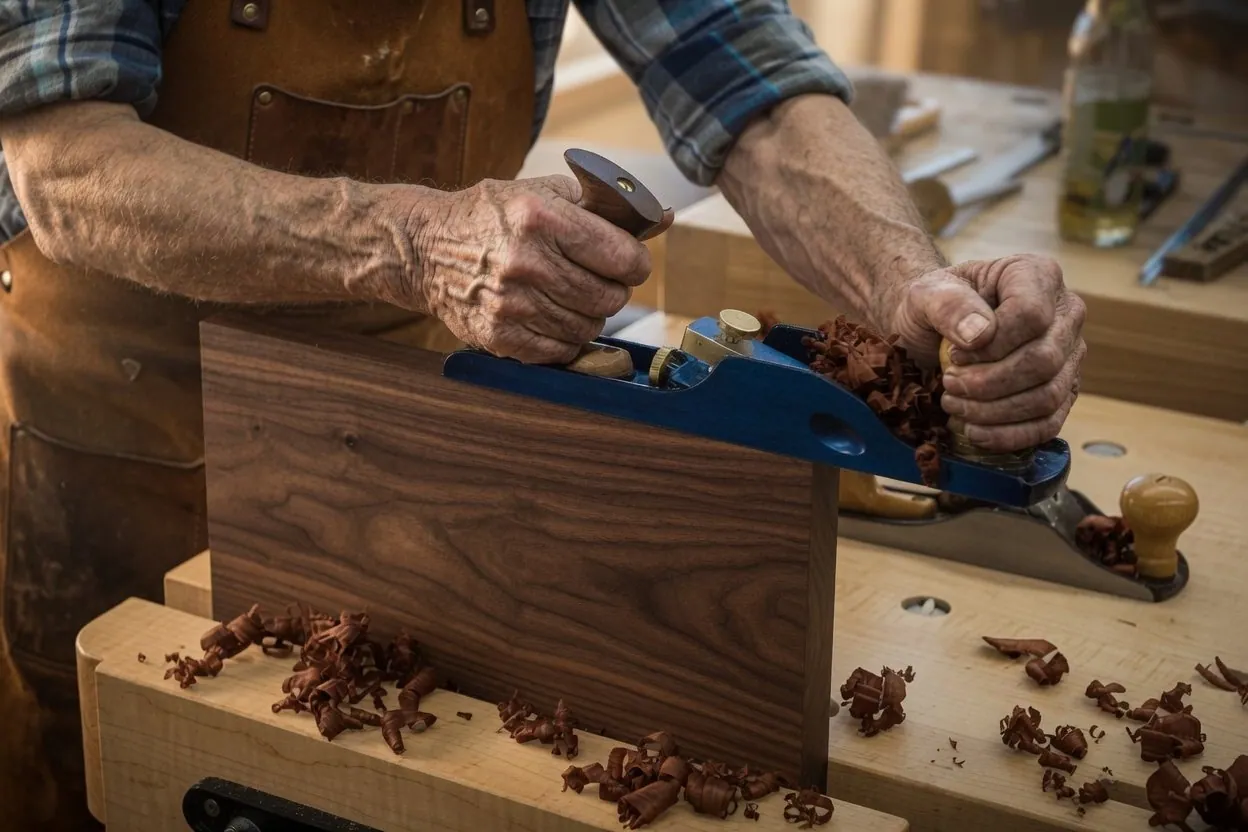
A bullnose is short, and there is nothing to hold but the body. You grip it well forward and you pinch it, rather than wrapping a hand around it the way you would a bench plane. After a stretch of cleaning up stopped rebates or getting into corners, the web between your thumb and first finger gets tired and the whole front of your hand goes crampy. It is not a sharp pain. It is a deep I have been holding this wrong ache.
2. The shoulder plane — the wrist and forearm
Different grip, different bill. You work lower and more controlled, and you keep steady side pressure on the tool to hold it true against the shoulder. That loads the wrist and forearm in a way that does not show up in the first twenty minutes. After a run of tenon shoulders or long rabbets the wrist just feels worked over, and stiff.
3. The block plane — the middle of your palm
When you are really leaning on one — a lot of end grain, or heavy chamfering — the body of the plane or the lever cap presses into the center of your palm. After a while it feels like a bruise developing right in that spot. Nothing dramatic. Just a dull, persistent pressure that makes you want to stop and shake your hand out.
Why It Happens — and Why It Is Not You
Here is the part worth knowing: all three of those are described in occupational health guidance, by people who study hands for a living. If you have felt them, you were not being soft and you were not doing it wrong.
The pinch is the expensive grip. NIOSH and Cal/OSHA guidance is blunt about it: a pinch grip produces far less power than a full-hand power grip, so applying force through a pinch means working harder for the same result. Their standing recommendation is that outside genuine precision work, tool handles should be designed for a power grip — and repetitive, forceful pinch gripping is associated with tendinitis and carpal tunnel syndrome.
Bend the tool, not the wrist. That is the phrase the ergonomists use. Sustained force applied with the wrist held out of line loads the forearm, and grip force is the main contributor to tendon strain at the wrist.
A short handle presses on the middle of the palm. Published guidance says a handle that is too short causes unnecessary compression in the center of the palm and should extend across the whole breadth of the hand — a preferred length of about five and a half inches, four at the minimum — and that the end of a handle should never press on the nerves and blood vessels of the palm. A block plane has no handle at all. It is a metal body you push with your palm. That is the bruise, described in a government pamphlet decades before you felt it.
Grip strength falls with age whether anybody warns you about it or not — which is the same reason a fatter faucet handle and a lever door latch make an old house usable again. The object did not get worse. The hand changed.
The same arithmetic decides a purchase nobody thinks of as a tool. A hearing aid with a battery door asks your fingers for the smallest job in the house, every few days, for years — which is why the rechargeable pair is the one to buy.
How Much, and How Soon — the Part Nobody Tells You
That sentence is usually where a page stops. It is worth going one step further, because the numbers are known and they are more useful than the warning.
Hand strength peaks in the early thirties. From there the loss from peak runs to roughly eight per cent for a man and four and a half for a woman by fifty, about twelve and fourteen per cent by sixty, and close to thirty per cent for both by seventy-nine. And the rate itself steepens during the fifties — that decade is where the slope changes, not the seventies.
Now the finding that ought to change how you plan. A ten-year study followed the same people and measured three things: grip, balance and walking gait. The consistent loss of grip begins at fifty. The worst deterioration in balance does not arrive until sixty, and in gait not until seventy.
Your hands go first. A full twenty years before your legs. Which is why a man who is still perfectly steady on a ladder can find himself beaten by a jar lid, and why that is not a sign of anything except ordinary arithmetic.
And the good news, which is real and is the reason this page exists. Of those three — grip, balance, gait — grip is the one that responds best to being worked, and it keeps responding into the seventies and eighties. It is the first to decline and the easiest to hold onto. Most people never give it a thought until a lid will not turn, which is about thirty years late to start.
Sources: NHANES 2011–2014 grip-strength analyzis, Journal of Hand Therapy; and a ten-year Swedish population study of bone density, muscle strength and functional performance in adults 50 and over.
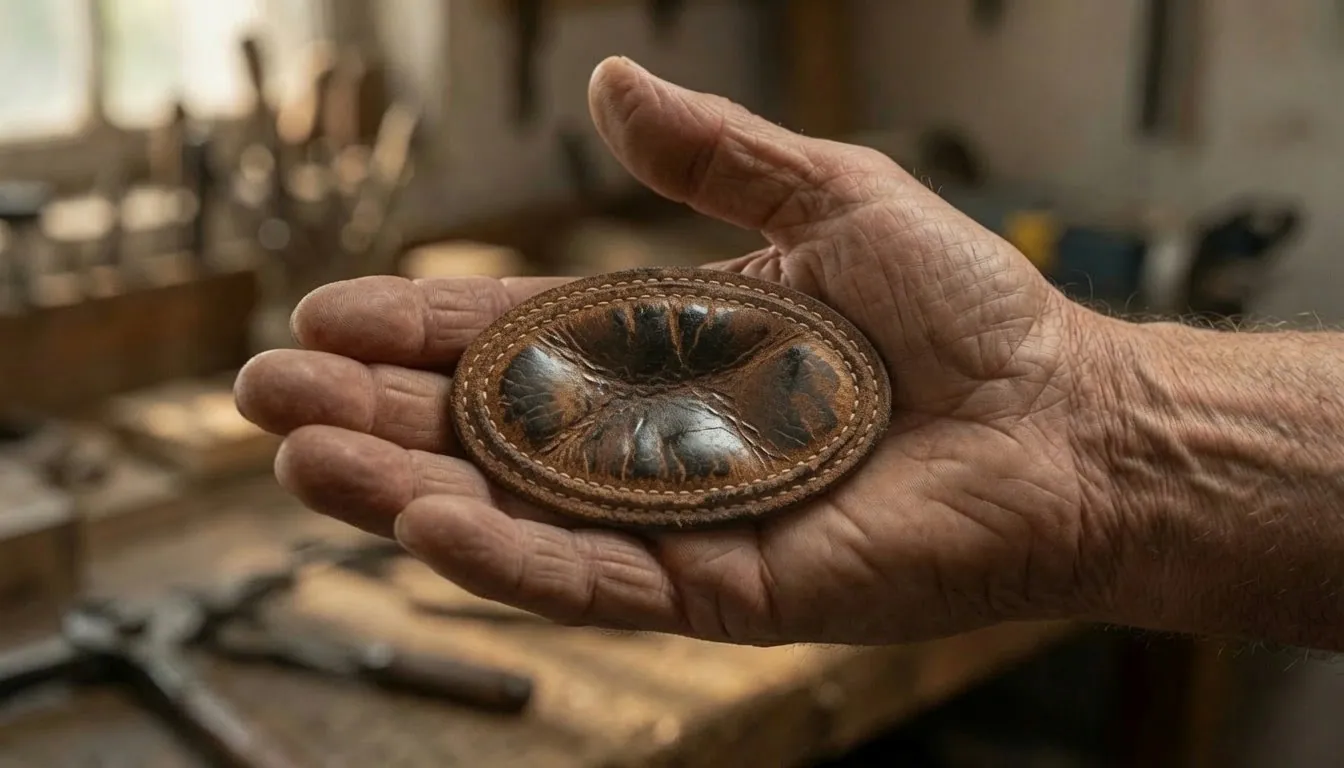
The honest answer is small. For the bullnose: a piece of thick leather, doubled over, between the hand and the tool. That is it. It costs nothing, you can do it this afternoon out of an old belt or a boot tongue, and it takes the edge off the worst of it.
A doubled piece of thick leather. An old belt, a boot tongue, whatever is to hand — it costs nothing and it takes the edge off the worst of it.
You will also read about padded sleeves to fatten a grip, shop-made wooden palm savers to spread the load, and choosing a longer tool so the push lands across more of your hand. Those are real ideas and worth trying. But here is the part nobody prints:
“Even with that, you work it long enough and something’s gonna hurt. It’s just the way it is.”
There is no pad, no grip, no accessory that makes four hours of hand work free. Anyone who tells you otherwise is selling the accessory.
The same argument decides which kitchen knife you should own, and for the same reason. A dull blade is a grip problem before it is a cutting problem — it makes you push, and pushing is how a hand with less strength in it than it used to have ends up somewhere it never intended to go. A forged knife set is the version of this that lasts.
The Machines Take Their Cut Too
The machines come and go — mine mostly got sold ahead of a move and rebought used at the other end, because a chisel travels in a crate and a table saw does not. But while you have them, they are doing something to you that hand tools do not.
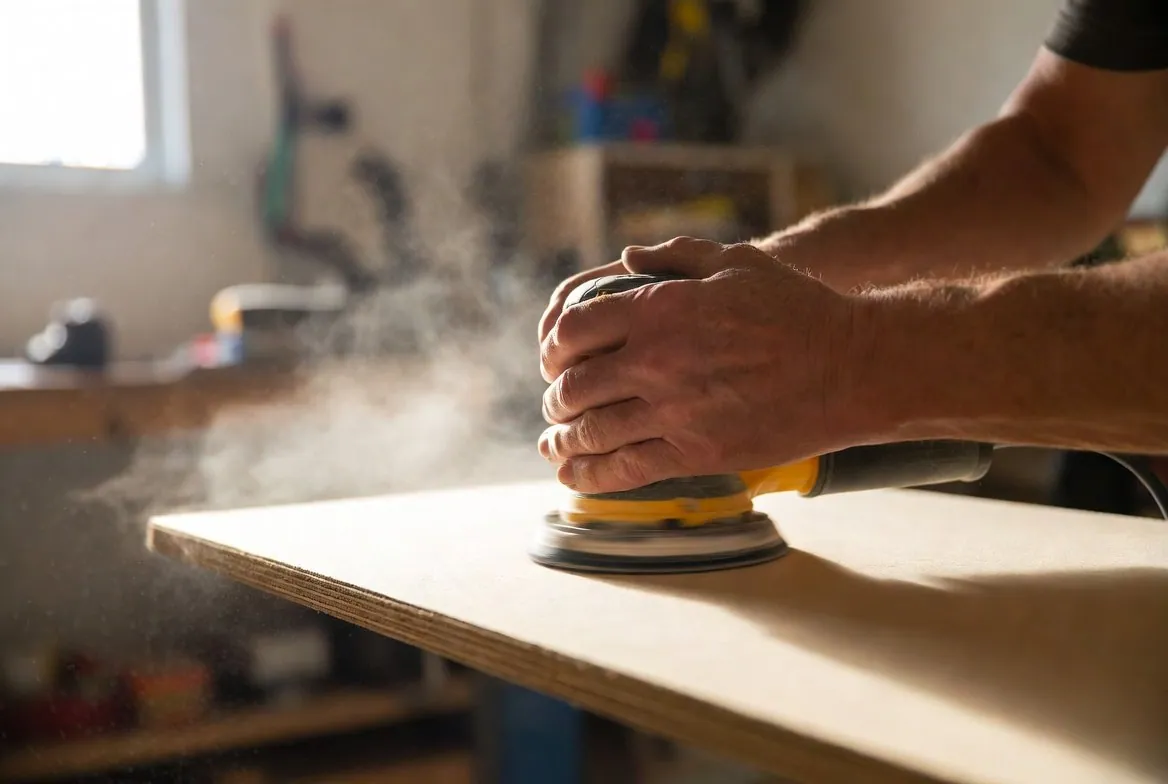
Hand tools are only half of it. Sanders, grinders, drills, saws — anything that shakes in your hand, and stationary machines that pass the shake up through the workpiece — are doing something you will not notice for years.
The tool you feel the least at the time is the one doing the quiet work. Vibration has a latency measured in decades.
NIOSH published a criteria document on occupational exposure to hand-arm vibration back in 1989. The condition has a name, hand-arm vibration syndrome, and it covers nerve, blood-vessel and musculoskeletal damage in the hand and arm. Reviews of the research put the increase in risk for exposed workers at roughly four to five times, and the occupational literature also associates hand-transmitted vibration with osteoarthritis of the wrist and elbow.
Their prevention advice is short and worth taping to a wall: keep the tool maintained, keep the handle warm, work in shorter bouts rather than long ones, rotate between tasks, and avoid over-gripping. That last one is the same finding you can arrive at yourself, holding a small plane too tightly for an hour.
Ask a man who has been at a bench for sixty years what he does about it, and you will not get a gadget. You will get this:
“Sometimes you have to work your way through it. It depends on how important it is to finish the job today, or maybe tomorrow, or the day after.”
That is not a workaround. That is the whole advantage of being seventy instead of thirty-five, and hardly anybody claims it.
At fifty-five you push through and finish today, because you are due somewhere Monday morning and the job cannot sit. At seventy you do two hours, put the plane down, and finish it Thursday — and the work is exactly as good. The tool did not change. The wood did not change. The deadline changed, and the deadline was the only part of it that was ever really yours.
You cannot buy a hand that stops hurting. You can arrange a schedule that does not require it not to. That is the argument our fix-it-yourself guide makes about time being the thing retirement actually hands you, and this is what it looks like at the bench.
What My Teacher Did About It
The carpenter I learned from had arthritis. He was sixty-two — younger than a good many of the people reading this. Years of pushing planes, hammering chisels, and vibration from every kind of equipment did not help the fact.
I used to watch him stop work and rub his palms and his hands while he was talking to me, and then go right back to it.
He never made a performance of it. He just looked at his hands for a moment, and then picked the tool back up.
And here is the thing he did that mattered most, the thing this whole page is really about: when he handed me a plane, or a chisel, or a tool of any kind, he told me what to expect. Not a warning to frighten a boy off the trade. Just the truth, given in advance, so I could decide with my eyes open. Your hands, your palms, your shoulders and your back — you are going to feel it.
Over time I got skilled enough to do quite a lot of that work for him. Which is what an apprenticeship really is, when you look back at it: you start unable to be trusted with anything, and you end up doing the work the older man's hands can no longer do.
So this page is not telling you to push through, and it is not telling you to stop. It is doing what he did. Telling you in advance what it costs, and leaving the deciding to you. Nobody showed him either, until somebody did.
One straight word about pain. Everything above is about tools and how long you use them. Hand pain that persists, wakes you at night, or comes with numbness, tingling, weakness or fingers that change color is a conversation with a doctor, not a shopping decision. There is no plane, pad or glove on earth that is the right answer to that.
🛒 Buy It at Fifty
Buy the good tool. It will do the work better, it will last past you, and it will stop convincing you that you are the problem.
Then buy the second thing, which is not for sale: the knowledge of what each tool does to a hand over four hours, so you can pick the day, pick the length of the session, and put a piece of leather in your palm before you need it rather than after.
The short version of this page, one question at a time — the answer is always the first line.
Why do my hands hurt using good hand tools?
Even a good hand tool can hurt aging hands, because it is designed to do the work well, not to be kind to an older hand over an afternoon. Grip strength falls with age. The tool did not get worse; the hand changed.
When does grip strength start to decline?
Hand strength peaks in the early thirties, and a consistent loss of grip begins at fifty. By seventy-nine the loss from peak is close to thirty per cent. Grip goes about twenty years before walking gait does.
Is a pinch grip bad for your hands?
A pinch grip produces far less power than a full-hand power grip, so pushing a tool with a pinch means working harder for the same result. NIOSH and Cal/OSHA guidance links repetitive, forceful pinch gripping to tendinitis and carpal tunnel syndrome.
How can I make a small plane easier on my hand?
A piece of thick leather doubled over between the hand and the tool takes the edge off the worst of it. An old belt or boot tongue works. Padded sleeves and palm savers are worth trying, but no pad makes four hours of hand work free.
What is hand-arm vibration syndrome?
Hand-arm vibration syndrome is nerve, blood-vessel and musculoskeletal damage in the hand and arm from tools that shake, like sanders, grinders, drills and saws. NIOSH advises maintained tools, warm handles, shorter bouts of work, rotating tasks and not over-gripping.
Can you get your grip strength back as you age?
Grip strength responds well to being worked, and it keeps responding into the seventies and eighties. Of grip, balance and gait, grip is the first to decline and the easiest to hold onto.
Where this standard came from. Before the houses and the cabinets there were boats — hull cracks on the Navy’s small craft at Coronado, where how much glass went on was decided by a blueprint and not by eye. A hull is made to bend; furniture is made to stay →
What This One Buys You
Knowing what it costs before it costs it.
The tool that hurts your hand at seventy is usually the tool nobody warned you about at fifty — and being told in advance is the difference between arranging the work around your hands and quitting the work because you assumed the trouble was you.
General Information Disclaimer: This page is general educational information, and some links are affiliate links (we may earn a commission at no extra cost to you). It is not engineering, mechanical or trade advice, and it was not written by a licensed mechanic or engineer.Never work or place any part of your body under a vehicle or load held up only by a jack — use rated stands or cribbing, on level ground, every time. Tools, ladders and lifting equipment cause serious injuries. Follow the manufacturer’s instructions and rated capacities for the equipment you actually own, and if a job is beyond you, that is the honest answer rather than a hedge. Nothing on this page is legal advice. None of it was written by an attorney, and it is not a substitute for speaking to one about your own situation.Do not undertake any physical effort described or implied here — lifting, pushing, pulling, carrying, climbing, kneeling, or assisting somebody else — without first discussing it with your own doctor, who alone knows your medications, your bone density, your cardiac fitness, the condition of your back and joints, your grip strength and your balance, and whether such activity is appropriate for you. A pushing or pulling task can pull a muscle or injure a joint just as a lifting task can, and nothing on this site should be read as encouragement to attempt physical work you have not cleared with your doctor first. This site does not recommend that any reader attempt to move, tip or shift any tall or top-heavy item, alone or with equipment — those tasks belong to able helpers or to professional movers. Full disclaimer →