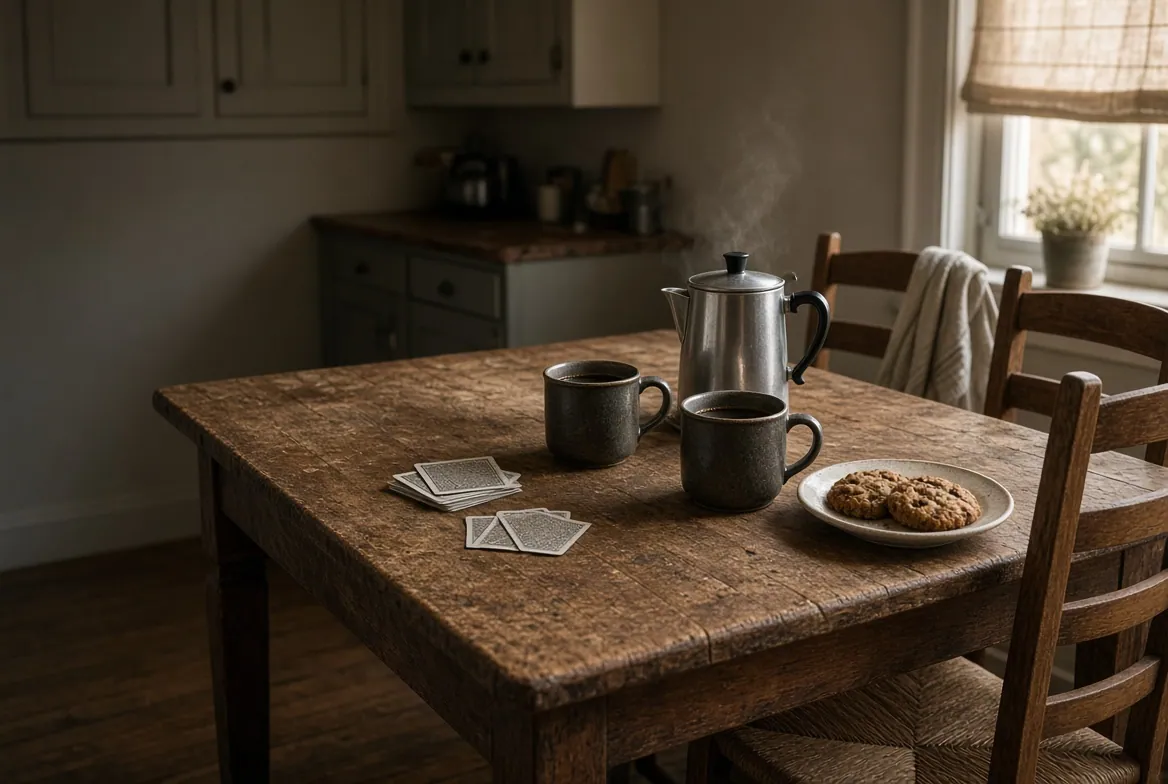

Ask one person over for coffee. Not dinner. Not an evening. Coffee, at your kitchen table, in the middle of a weekday, for an hour.
Have something on the table that is not the conversation. A deck of cards, a jigsaw, a plate of cookies out of a bag. It gives four hands something to do and it means nobody has to perform.
Then do it again the same day next week. That is the entire method. Everything below this box is the reasoning, and none of it is more important than the doing.
🚪 What Happens After the Door
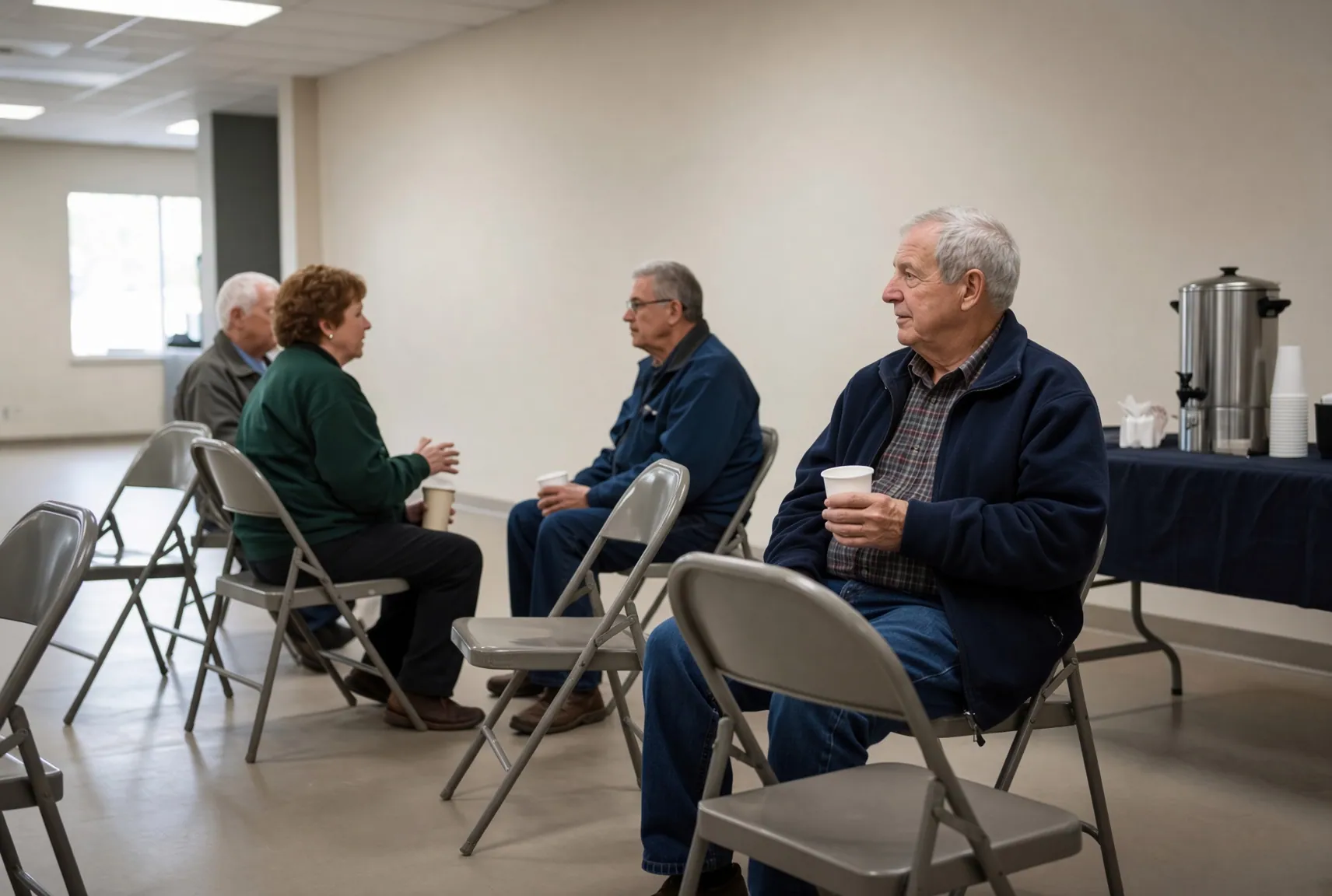
We have three pages on this site that between them get a person out of the house. One on what it is like when nobody comes. One on the five things that hold weight when family cannot. And one on how to find out what actually exists in your own town, which is the practical one — four phone calls and three visits and you will know your county better than your neighbors do.
All three of them stop at the same place. They get you into the room.
And a man who has been in the room three times and still does not know anybody's last name will quietly conclude that the advice did not work, or worse, that he did not work. Neither is true. What happened is that nobody told him the room was only the first half.
Here is the honest shape of it. You do not make a friend at a meeting. You make an acquaintance at a meeting. A friend gets made somewhere quieter, in smaller doses, over a longer stretch, usually with a cup of something in front of both of you. The meeting is where you find the candidate. What follows is a separate job, and this page is about that job.
And the thing worth saying before anything else: this is not a character problem and it is not an age problem. It is a structural one. The arrangements that used to do this work for people have mostly been dismantled, and nobody handed you a replacement. Nobody showed you. That is all that happened.
⏳ The Arithmetic Nobody Mentions
There is a piece of research on this that I find useful, mostly because it takes something people treat as mystical and turns it into a number a man can plan around.
Jeffrey Hall, a communication researcher at the University of Kansas, published two studies in the Journal of Social and Personal Relationships asking a plain question: how many hours does it actually take? He surveyed 355 adults who had recently moved to a new city, and separately followed 112 first-year students through nine weeks of new acquaintances.
His estimate, combining both:
And the finding underneath those numbers is the one that matters here: the hours have to be leisure hours. Time spent hanging around, joking, playing something, talking about nothing. Hall found that hours spent working alongside somebody counted for considerably less. Which will not surprise anybody who spent thirty years with a crew and then retired and discovered he had colleagues rather than friends.
Now, two honest cautions, because this site does not hand you a number without telling you where it came from. Hall studied people who had relocated and college freshmen. He did not study people in their seventies, and there is a decent argument that the arithmetic runs faster later in life, when people are less guarded and have more to say. And these are averages built from estimates, not a stopwatch. Take them as a shape, not a law.
But take the shape seriously, because it explains the thing that makes people give up. Fifty hours is a long time. An hour a week is a year. Two hours a week is half of one. A weekly card game of three hours gets you to casual friend in about four months and to friend inside a year, which sounds slow until you consider that the alternative is another year of nobody.
The useful way to read that number. It is not a warning that friendship is hard. It is permission to stop judging the first four visits. Nothing has gone wrong at hour six. You are at hour six. That is what hour six is supposed to feel like, and every friend you have ever had went through it while you were too young to notice.
🏔️ How It Worked on the Hill
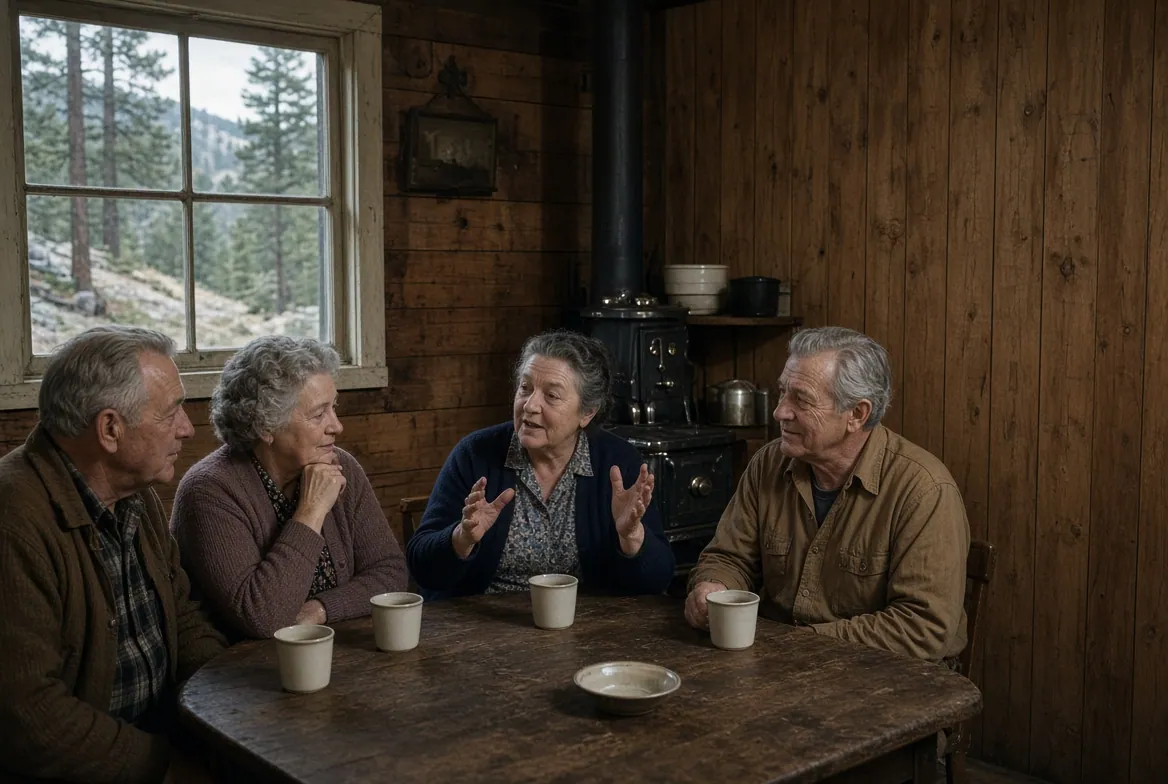
I grew up on a mountain in California, about five thousand feet up, in a community of cabins spread around a pond that had been a lake until the dam went. You have read about it elsewhere on this site — my grandmother's canning, the well the whole community drilled together, the smoke check in winter where everybody watched everybody else's chimney and went to knock if a house had none.
What I want to describe here is smaller than any of that, and I think it is the part worth copying.
People came over and had a cup of coffee.
That is it. That is the entire mechanism. Somebody would walk over — you could see most of the houses from most of the other houses, and you could tell from a car out front or the smoke from a chimney who was home — and there would be coffee, and then there would be stories. Work stories. War stories. Marriages that had gone well and marriages that had not. What a man had done for a living and what it had cost him.
That trade is what friendship actually is. Not shared hobbies. Not common interests. You tell somebody your account and they tell you theirs, and after enough of it you are known, which is the thing everybody is actually short of.
The pretexts
There was a quilting club. I do not believe for a moment that those women needed a quilting club. It was a reason to be in the same room, and everybody involved understood that perfectly well.
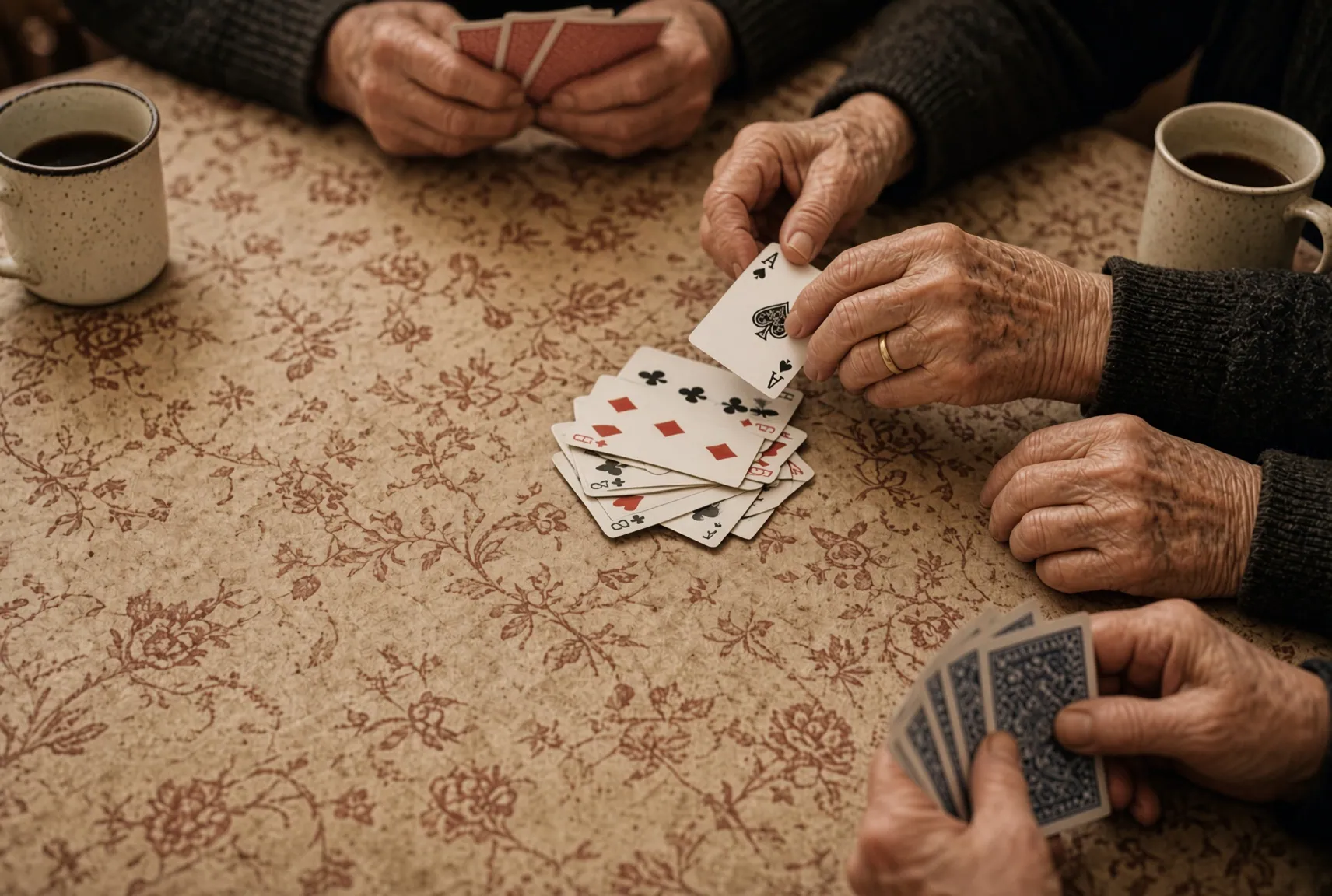
Same with the cards. Three or four people would turn up at our house and a deck would come out and it would be canasta or pinochle, and if they were three and needed a fourth I got dragged in, which tells you how seriously the card game was being taken.
And the same with hunting season, which is when the men on that hill bonded properly — endless argument about caliber and technique, and the one that got away, and the biggest one anybody had ever seen. Nobody was there for the deer.
The trade
Nobody up there was rich and nobody was poor in the way people mean it now. There was a retired plumber. Electricians. A mechanic who stayed busier than he had planned to. My grandmother sewed, and repaired small things for half the community.
Everybody grew or picked something and put it up. Strawberry, blackberry, whatever came off the ground around you. My grandmother made marmalade — she squeezed oranges for my juice, and before she squeezed them she grated the peel, so she got two things out of one bag of fruit and had the one preserve on that mountain that nobody else could make, because oranges did not grow at five thousand feet. So people traded. Not evenly. Nobody was counting.
And nobody was trying to get anything out of anybody. That is the part I would put in bold if I only got one line. Everybody was retired, everybody had a little of something, and the exchange ran because it ran, not because anybody was keeping score.
What happened when somebody new moved up
Everybody took a turn. Nobody organized it — the women around the lake would be making casseroles and finding a reason to walk one over. You knew whose turn it was because you could see the same moving truck everybody else could see.
And a casserole is a better instrument than a knock on the door, for a reason nobody up there would have bothered to explain: a dish has to be returned. The first visit builds the second visit into itself. That is a small piece of engineering and it was invented by people who would have laughed at the word.
Now the part I will not let this page get away with. It would be easy to finish that description with and we don't have that anymore, and leave a man sitting in his kitchen feeling he has failed at something his grandparents found easy.
They did not find it easy. They had conditions we do not have. Everybody was retired, so everybody was home. The houses were in sight of each other. The nearest town was down an hour of mountain road, so if you wanted company it was going to be somebody you could walk to. The arrangement did half the work. What is gone is the arrangement, not the people — and an arrangement is a thing you can build on purpose.
🃏 You Need a Pretext, Not an Activity
This is where most advice on this subject goes wrong, and it goes wrong in a way that sounds sensible. Find a group that shares your interests.
The trouble is that a shared interest gives people a way to be near each other for years without ever getting to the accounts. You can go to the same woodworking shop as a man every Tuesday for two years, discuss nothing but joinery, and know nothing about him. The activity fills the hour. That is what activities do.
What you want is the opposite: something small enough to occupy the hands and leave the mouth free. Cards. A jigsaw on a card table by the window. Shelling beans. Two men in a driveway with the hood up on something. Quilting, which is the reason there was a quilting club.
The pretext does three jobs, and every one of them matters more than the pretext itself:
- It gives you a reason to be there that neither of you has to admit is loneliness.
- It gives you somewhere to look. This is not a small thing. Two people at a bare table have to look at each other, and men in particular will not talk under those conditions. Give them both something to look at and they will talk for three hours.
- It gives the visit a shape and an ending. The game finishes. Nobody has to work out how to leave, which is the awkwardness that stops people inviting anybody in the first place.
Cheap pretexts, in rough order of how little they ask of anybody: a deck of cards. Dominoes. A jigsaw left out permanently on a side table so it is always mid-progress. Cribbage. A radio ball game on low. Something on a workbench. Coffee and a newspaper somebody else has already read.
🍪 Set the Bar on the Floor
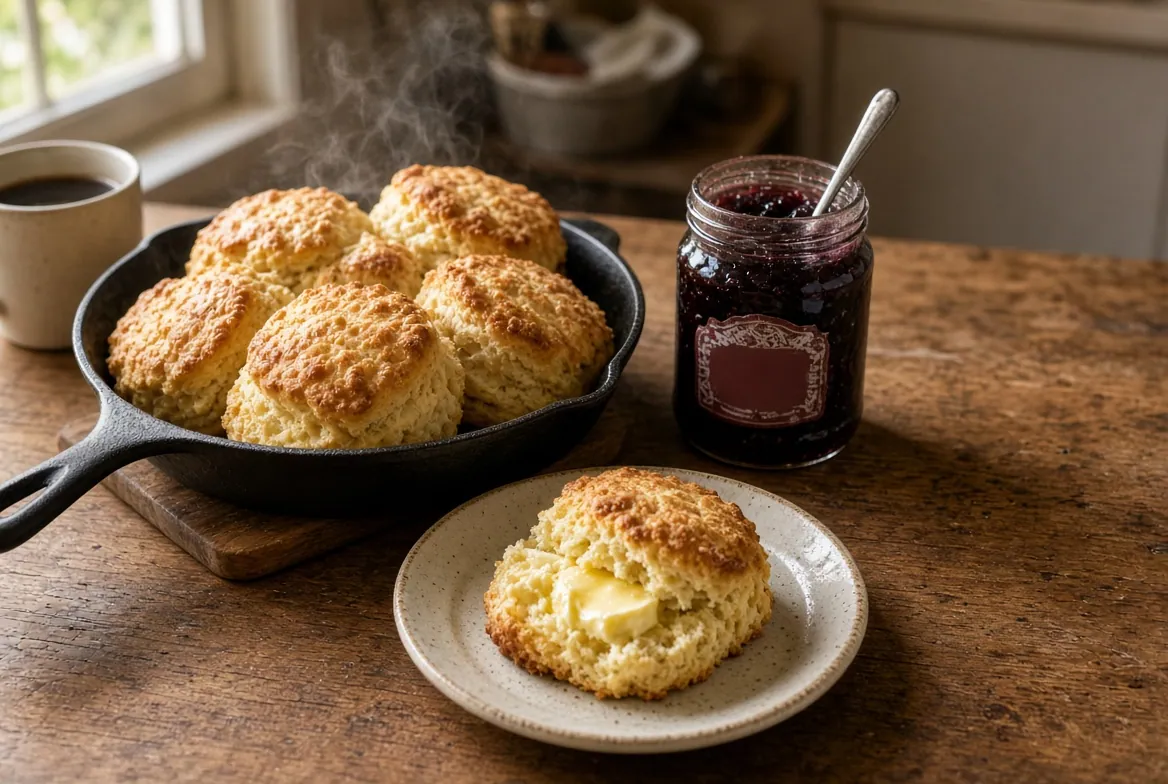
The single biggest thing standing between an older person and having somebody over is the belief that having somebody over means putting on a spread.
My grandmother could genuinely cook. She could bake. And what came out for company was cookies, or a batch of buttermilk biscuits out of a cast-iron pan with real butter and whatever jam was in the house. Twenty minutes and a hot oven. Sometimes there were cinnamon buns and that was a surprise, and the reason it was a surprise is that it was not the standard.
The standard was low on purpose, because a low standard is repeatable and a high one is not. You cannot put on a spread every week. You can put a pot on every week for the rest of your life.
So, plainly:
- Coffee. Or tea. Brewed, pressed, dripped, instant. Nobody has ever declined a second visit over the coffee.
- Something out of a bag is fine. Store cookies on a plate are a plate of cookies.
- The house does not need cleaning for this. Clear the table. That is the whole preparation.
- Midday is easier than evening, for you and for them. Nobody has to drive home in the dark, which for a good many readers is the difference between yes and no. Our page on getting around without driving covers the rest of that problem.
If you do want to bake, bake — and if you are already putting food up, you have the best possible excuse to hand somebody a jar. Canning and preserving and pickling and drying are on this site for other reasons, but a jar of something is the most natural gift in the world and it obliges nobody.
👋 Somebody Has to Go First

Here is the arithmetic that keeps two lonely people in two houses four hundred feet apart: both of them are waiting to be asked, and both of them are certain the other one is not interested.
There is research on precisely this. A 2018 study in Psychological Science by Erica Boothby and colleagues found what they named the liking gap — after a conversation, people consistently underestimated how much the other person had liked them and enjoyed their company. It held with strangers in a lab, with members of the public at a workshop, and among college students sharing rooms, where it persisted for months. It held whether the conversation was short or long.
The explanation the researchers offer is the one you would guess. You walk away going over your own performance — the story that went on too long, the thing you should not have said. The other person is not doing that. The other person is thinking that was a decent hour.
Translated into a rule you can use: when you leave a conversation feeling it was fine but nothing special, you are almost certainly wrong about how it went, and wrong in your favor. Ask anyway. The odds are considerably better than they feel.
What to actually say
Short, specific, and with a date in it. Vague invitations are refusals with better manners on both sides.
“I've got a pot on most mornings. If you're ever going past, stop in.”
“Do you play cards? I'm short a fourth on Thursdays.”
“Come by Tuesday about ten and have a cup of coffee.”
And if somebody new moves in near you, the hill's method still works and costs about six dollars. Take something over. A dish, a loaf, a jar. Make it something that has to come back.
On being turned down
You will be, sometimes, and it is worth deciding in advance what that means, because the wrong reading of it will stop you cold.
People say no because Tuesday is the day they have their daughter, or because their hip is bad, or because they are as nervous as you are. A no to a Tuesday is not a no to you. Ask the same person a second time about a month later and you will find that out. Most people never ask twice, which is why most people conclude that nobody wants them.
📅 Keeping It Going
This is where it lives or dies, and it comes down to two unglamorous things.
Make it a standing day
An arrangement that has to be re-arranged every time will not survive the winter. Anything that depends on somebody deciding to make a phone call dies the first week that both people are tired. Anything that happens at ten on Thursdays does not, because nobody has to decide anything.
That is the whole reason the quilting club existed, and the card night, and the congregate meal at the senior center. Not one of those things is about quilting or cards or lunch. They are devices for making company automatic, so that it does not depend on anybody being in the mood.
So put a day on it. Coffee Tuesday. Cards Thursday. Whatever it is, name it and let it be dull. Dull is the objective. Dull is what survives.
Be the one who calls
Somebody in every friendship does more of the calling. That is not an imbalance to be resented — it is a job, and if nobody takes it the friendship simply stops, quietly, with both parties assuming the other lost interest.
Decide to be that person and stop keeping score. At seventy the ledger is a luxury you cannot afford. The man who calls is the man who has friends, and the one waiting for his turn is right and alone.
The practical case, which is the one my neighbors would have made
On that hill people got over their disagreements, and not because they were finer people than we are. They got over them because you never knew when you would be the one on the side of the road in a snowstorm trying to get chains on by yourself.
There is a hard-headed reason to stay on speaking terms with the people around you, and it has nothing to do with sentiment. The person who notices your chimney is cold, who has a key, who takes you to the eye appointment you cannot drive home from — that person has to already exist before the day you need them. You cannot recruit them that morning.
Everybody on that mountain was on the far side of the middle of their lives and knew it. The clock was running and they were not going to spend what was left being right about something. That is not softness. That is arithmetic, done by people who were good at it.
⚠️ Two Things Worth Watching
The friendship that starts with a favor going one way. Helping a neighbor is how half of these things begin and there is nothing wrong with it. But if six months in you are doing all the driving, all the lifting and all the calling and it has never once run the other direction, that is not a friendship forming, and noticing it early is kinder to both of you than resenting it later.
The new friend who is very interested in your money. It is an ugly thing to have to put on a page about friendship, and it belongs here because the people who do this specifically look for someone who is lonely and glad of attention. Quick intensity, early talk of investments or a loan, pressure to keep the friendship private. Real friends do not need secrecy and they do not need your account number. See phone and internet scams, and if it has already happened, what to do in the first 48 hours.
✅ Where to Start
Smallest possible version, and it takes a fortnight.
- This week. Buy a deck of cards and put a pot of coffee on. That is the equipment. There is no more equipment.
- Write down three names. Not friends — candidates. The neighbor two doors down. Somebody from the meal site or the church or the post. The fellow who was also early last time.
- Ask one of them, with a day in it. Tuesday at ten. Not “sometime.”
- Have one thing on the table that is not the conversation.
- Ask again the following week, before either of you has decided how it went.
- If somebody new moves in nearby, take something over that has to be returned.
Then keep going long past the point where it feels like it is working, because at hour six it will not, and hour six is not where the answer is.
And the whole of this page in one sentence, which is the one I actually believe. A little coffee, a little conversation, something small to fill the time and a deck of cards — things that look like nothing at all — are the beginning of understanding each other. They work if you go into it for no other reason than that you might make a friend, for friendship's sake. That was the thing about the hill. Nobody was after anything.
📚 Related on This Site
- How to Find Your People — the four free ways to find out what exists in your town. Read that one first if you have nobody to ask over yet.
- When Family Cannot Be the Plan — the five supports that hold weight, and why family being busy is arithmetic rather than neglect.
- Loneliness After 60 — what it is like when nobody comes.
- Getting Around Without Driving — the transportation problem underneath all of this.
- My Grandmother's One Rule — the hill, the canning, and the pantry two jars deep.
- Canning and Preserving — because a jar of something is the easiest gift there is.
❓ Plain Answers
The short version of this page, one question at a time — the answer is always the first line.
How do you make friends after 60?
Ask one person over for coffee at your kitchen table in the middle of a weekday, with a deck of cards or a jigsaw on the table. Then do it again the same day next week.
How many hours does it take to make a friend?
Research by Jeffrey Hall at the University of Kansas estimates about 50 hours to go from acquaintance to casual friend, and about 90 hours to become a friend. The hours have to be leisure hours, and the figures are averages, not a law.
Do people like me more than I think after a conversation?
Yes, a 2018 study in Psychological Science found that people consistently underestimate how much the other person liked them after a conversation. The researchers called it the liking gap.
What should I say to invite someone over?
Keep an invitation short and specific, with a date in it. For example: “Come by Tuesday about ten and have a cup of coffee.” Vague invitations are refusals with better manners on both sides.
How do I keep a new friendship going?
Make it a standing day, like cards every Thursday at ten, so nobody has to decide anything each week. And be the one who calls, without keeping score.
What are warning signs a new friend is after my money?
Watch for quick intensity, early talk of investments or a loan, and pressure to keep the friendship private. Real friends do not need secrecy and they do not need your account number.