
✉️ The Envelope That Arrives Four Weeks Later
First, what this page is. A plain explanation of the financial assistance every nonprofit hospital is required to offer, how hospital billing and collection actually work, and what to do first. It is not legal, tax, financial or medical advice, it was not written by an attorney or an accountant, and nothing here tells you what you qualify for or what any hospital will agree to. Federal rules apply to nonprofit hospitals; for-profit and government hospitals differ, and state law varies enormously. Read your own hospital’s policy and confirm before relying on anything below.
The crisis is over by the time this arrives. Everybody has gone home. The casseroles have stopped. And then a window envelope comes with a figure in it that bears no relation to any sum of money that has ever passed through the household.
The first thing to understand is the most useful thing on this page, so it goes first:
That number is not a price. It is an opening figure, and it is the highest number in the entire process. It is what the hospital lists before insurance, before discounts, before the cap that federal law puts on what a qualifying patient can be charged. Almost nobody pays it. The people who do pay it are, overwhelmingly, the people who did not know they could ask.
And a second thing, which matters more than it sounds: nothing has to be decided this week. The clock most people imagine is running is not running. We will come to the two that are.
📋 The Bill You Have to Ask For
What arrives in the envelope is usually a summary. One line, or a handful of lines, and a total. That is not the bill.
The itemized bill is a separate document listing every charge individually — every test, every bag of fluid, every hour in a room. It exists. You have to ask for it, in writing if the telephone gets you nowhere, and you should ask for it before you pay anything or agree to anything.
Ask for it because billing at this scale contains ordinary human mistakes, and they run in one direction. Duplicate charges. Services that appear twice because two departments recorded them. Quantities that do not match what happened. A charge for a procedure that was planned and then not done.
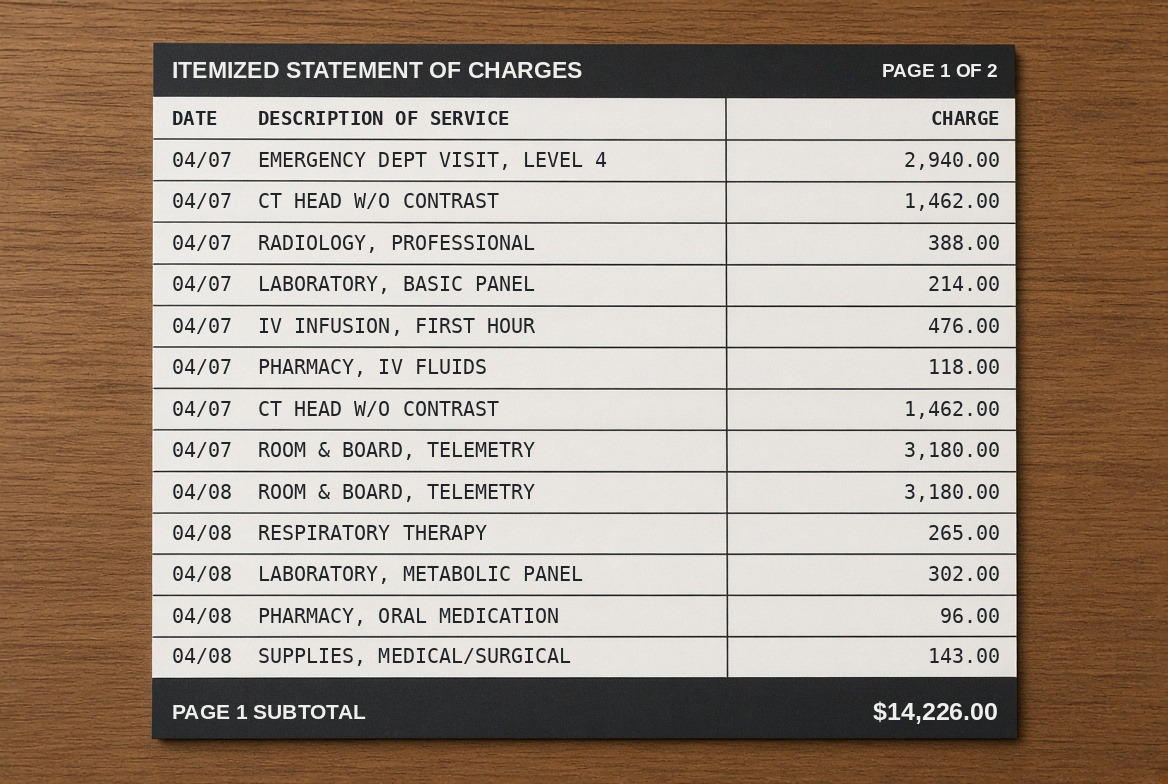
What to do with it when it comes. Read it beside the discharge paperwork and your own memory of the days. You do not need to understand the billing codes to notice that something is listed twice, or that a date is wrong, or that a room charge covers a night nobody was there. Those are the errors laypeople actually find, and they are worth finding.
📄 The Policy Every Nonprofit Hospital Is Required to Have
This is the part of the page worth the reading time.
Under section 501(r) of the Internal Revenue Code — added by the Affordable Care Act — every hospital in the country holding 501(c)(3) charitable status is required to have a written financial assistance policy. Not encouraged. Required, as a condition of the tax exemption.

What the law requires of it
Internal Revenue Code § 501(r)- It must be written, published and free — on the hospital’s website, on paper in the emergency department and admissions, and translated for the language groups in the community.
- It must state who is eligible, how the discount is calculated, and how to apply.
- Financial assistance information must appear on every billing statement. Look at yours. It is usually there, in the smallest type on the page.
- It must cap what a qualifying patient is charged at the “amounts generally billed” to patients who have insurance — not the gross listed charge.
That last point is the one that turns a bill into a different bill. The figure in the envelope is the gross charge. A patient who qualifies for assistance may not lawfully be charged more than what an insured patient’s coverage would generally be billed for the same care.
Now the part that is not in the law, and where the page has to be honest. Federal law sets no income limit. Every hospital picks its own. In practice most nonprofit hospitals give care free at or below twice the federal poverty level — which in 2026 is roughly $31,920 for one person and $66,000 for a family of four — with sliding-scale discounts commonly running up to three or four times that.
Which means a great many households who assume they earn far too much to qualify are inside the range and have never looked. Read your own hospital’s policy. It is the only document that governs.
Ask for it by name: the financial assistance policy, and the application form. Not “charity care,” which some hospitals will tell you is something else. The office is usually called financial counseling or patient financial services, and asking costs nothing.
⏳ The Two Clocks Already Running in Your Favor
Everybody who opens one of these envelopes believes something bad happens if they do not deal with it immediately. Two federal timers say otherwise, and neither is widely known.

Both clocks run from the first billing statement after discharge.
A hundred and twenty days is four months in which a nonprofit hospital may not take an extraordinary collection action against you. Two hundred and forty days is eight months in which you are entitled to apply for assistance — and if you are found eligible after the fact, the hospital is expected to correct what it charged and to reverse collection action it had already started.
And while a complete application is pending, collection must stop. Not slow down. Stop. That single sentence is worth more to a frightened household than any amount of negotiating advice, because it converts a panic into a process with a date on it.
So the correct first move on the day the envelope arrives is not to pay it, and not to ignore it. It is to telephone and ask for two things: the itemized bill, and the financial assistance application. Then put the date on the calendar.
⚖️ What a Hospital May and May Not Do
The phrase in the regulations is extraordinary collection action, and it is worth knowing exactly what it covers, because the list is broader than most people assume and every item on it is barred until the hospital has made reasonable efforts to find out whether you qualify for help.
An extraordinary collection action includes
Barred until eligibility is checked- Selling the debt to a collection agency
- Reporting adverse information to the credit bureaus
- Placing a lien on property, or foreclosing on one
- Seizing a bank account, or garnishing wages
- Filing suit
- Deferring or denying medically necessary care because of an unpaid earlier bill
Read the last one twice. A nonprofit hospital turning somebody away from necessary care over an old bill is not a hard-nosed business decision. It is a collection action, and it sits inside the same rules as a lawsuit.
If any of those has already happened and you were never given the policy, that is worth raising — with the hospital first, and then with your state attorney general’s office. Some states go further than the federal floor. Minnesota, for one, lets a patient go to court to stop collection where the plain-language summary of the policy was never provided, and recover attorney fees for doing it. What your state adds on top of the federal rules is a question for your state, and it is worth asking.
⚠️ What Everybody Now Believes About Medical Debt and Credit, and Why It Is Wrong
Ask around and somebody will tell you that medical debt does not go on credit reports any more. It is repeated confidently, it is in a great many articles, and it is not true.
Here is what actually happened. In January 2025 the Consumer Financial Protection Bureau finalized a rule that would have removed essentially all medical debt from American credit reports. In July 2025 a federal court in the Eastern District of Texas vacated it — on the joint request of the plaintiffs and the Bureau itself under new leadership — holding that it exceeded the CFPB’s authority and conflicted with the Fair Credit Reporting Act.
The rule never took effect. As of 2026 there is no federal ban on medical debt appearing on a credit report. A great many pages written in the first half of 2025 still say otherwise, and they were written before the decision.
What does protect people is real but weaker, and it is worth knowing precisely because it changes what is worth doing. The three credit bureaus made voluntary policy changes in 2023 that remain in force:
- Paid medical collections come off the report, whatever the amount.
- Medical collections under $500 are not reported at all.
- A medical collection cannot be reported until it is a year old.
Those are bureau policy rather than law, which means they can change without anybody voting on it. Roughly fifteen states have gone further and restricted medical-debt credit reporting by statute; whether yours is one of them is worth a look.
One practical consequence of the first bullet. A paid medical collection only comes off when the collection agency reports that it was paid. That does not always happen. Check the report thirty to sixty days after paying, and dispute it if the entry is still sitting there.
The year-long grace period matters too, because it lines up with the clocks in the section above. There is time. There is more time than the letters suggest.
💳 The One Thing Never to Do
Do not put a hospital bill on a credit card. Not an ordinary one, and above all not one of the medical credit cards offered at the desk with a deferred-interest promotion attached.
The reason is not really about the interest rate, though the rate is bad. It is about what you give up in the swap.
A hospital bill is a debt with no interest, a four-month floor before collection, an eight-month window to apply for assistance, and a legal cap on what you can be charged if you qualify. Put it on a card and it becomes ordinary consumer debt with an interest rate and none of those protections. You have paid the hospital in full and bought yourself a worse creditor.
The same logic applies to draining a retirement account or taking a home equity loan to clear it. Every one of those converts a soft, negotiable, capped, slow-moving obligation into a hard one. The hospital bill is the best-behaved debt in the house. Leave it where it is until you have read the policy and applied.
What is worth doing instead: ask for an interest-free payment plan directly with the hospital once the assistance question is settled, and get the terms in writing.
⚡ Why This One Is on the Fifty List
Nothing on this page is hard. It is one phone call asking for two documents, and a date written on a calendar.
What makes it belong here is the same thing that puts everything else on this website here: the hour you need it is an hour when you cannot possibly learn it. Somebody has just been seriously ill. The envelope is on the kitchen table. And the person opening it is doing arithmetic about a house.
In that hour, people do the two things this page is written to prevent. They pay a number that was never the real number. Or they put it on a card because the card makes the frightening thing go away today.
Both of those are decisions made in the first week, and neither can be undone in the second.
So the whole value of this sits in reading it now, when the envelope is hypothetical, and carrying away one sentence: ask for the itemized bill and the financial assistance policy, and do not pay or borrow anything until you have both in your hand.
❓ Plain Answers
The short version of this page, one question at a time — the answer is always the first line.
Do nonprofit hospitals have to offer financial assistance?
Every nonprofit hospital holding 501(c)(3) charitable status is required by federal law to have a written financial assistance policy. The rule is section 501(r) of the Internal Revenue Code. None of it happens automatically, so ask for the policy and the application by name.
How long do I have to apply for hospital financial assistance?
You generally have 240 days, about eight months, from the first billing statement after discharge to apply for financial assistance at a nonprofit hospital. While a complete application is pending, collection must stop.
How long before a hospital can send my bill to collections?
A nonprofit hospital may not take an extraordinary collection action for 120 days, about four months, after the first billing statement following discharge. It must also give 30 days' written notice before collection starts.
What should I do first when I get a hospital bill I can't pay?
Call the hospital and ask for two things: the itemized bill and the financial assistance application. Then put the dates on the calendar, and do not pay or borrow anything until both are in your hand.
Does medical debt still show up on credit reports?
As of 2026 there is no federal ban on medical debt appearing on a credit report, because a court vacated the CFPB rule in July 2025. The three credit bureaus do voluntarily leave off paid medical collections and those under $500.
Should I put a hospital bill on a credit card?
No, putting a hospital bill on a credit card turns it into ordinary consumer debt with interest and none of the hospital bill's protections. Ask instead for an interest-free payment plan directly with the hospital once the assistance question is settled.