
🦯 What This Page Is
This is a page about buying, and about the route to getting one. It is not a page about how to walk. There is exactly one section of fitting guidance further down and every word of it is quoted from the Mayo Clinic rather than written here, because the right height for a cane depends on a body that a website has never seen. Nothing here is medical advice, it was not written by a physician or a physical therapist, and nothing here tells you which device you need. That is a question for your doctor or a physical therapist, and the next section explains why going to them first is also the cheapest thing you can do. Every dollar figure is the published 2026 figure and they change annually. Check anything here with 1-800-MEDICARE, Medicare.gov, or a State Health Insurance Assistance Program counselor.
A cane is a simple object. A stick, a handle, a rubber foot. There is no engine in it and no software, and a good one will outlast the person who buys it.
Which is exactly why people buy them the way they buy a broom — off a shelf, on price, in the wrong size, without asking anybody. And a stick that is two inches too long is not a slightly worse stick. It is a thing that pushes your shoulder up and puts your weight where you did not intend to put it, held by somebody whose balance was already the problem.
So this page is about three things. The route that gets you the right one for a fraction of what you would pay in a shop. What the differences between these devices actually are, including one that runs backwards from what everybody assumes. And the small number of parts on any of them that decide whether the thing holds you up.
💊 The Cheapest Safe Route Is a Prescription
Here is the part that surprises people, and it is the reason this page is not a shopping list.
Medicare Part B covers canes, walkers, crutches and rollators as durable medical equipment when a doctor prescribes them for use in your home. You pay twenty per cent of the Medicare-approved amount after the Part B deductible, which is $283 in 2026. If you carry a Medigap policy, it may pay some or all of that twenty per cent.
Read that again with a shop price in your head, because the arithmetic runs the opposite way from how everybody assumes it runs. The doctor’s visit is not the expensive part. The doctor’s visit is the discount.
And it is not only cheaper. It is the route where somebody looks at you. A prescription means a clinician has decided which device fits the actual problem — and a person who genuinely needs a walker will sometimes buy a cane instead, because a cane is less of an admission. The device that gets bought out of pride is the device that gets used badly. That is not a lecture; it is the single commonest way this goes wrong.
Three rules govern whether it will actually be paid for:
- The doctor must prescribe it for use in your home, and both the doctor and the supplier must be enrolled in Medicare.
- Medicare pays for the least costly item that meets the need. So if you need a rollator rather than a plain walker, the prescription has to say why a standard walker will not do — that you cannot lift one with every step, say, or that you need to be able to sit down and rest. If nobody writes that sentence, the claim comes back.
- Some equipment is rented rather than bought, and with some items it becomes yours after a certain number of rental payments. Ask which applies before you sign anything.
One oddity worth knowing so it does not blindside anybody: Medicare covers walking canes but not white canes for the blind. Different object, different rules, and it catches families out.
🧾 The Question That Decides Whether You Get Paid Back
This is the step almost everybody skips, and skipping it costs the whole benefit.
The device has to come from a Medicare-enrolled supplier. Buy the identical walker from a pharmacy shelf, a big-box store or an online retailer that is not enrolled, and you get nothing back. Not a reduced amount. Nothing. The product can be perfect and the paperwork still does not exist.
And there is a second question underneath the first one. A supplier that participates in Medicare must accept assignment, which means they can charge you only the coinsurance and the deductible on the Medicare-approved amount. A supplier that is enrolled but not participating does not have to accept assignment, and can charge you more.

1. “Are you enrolled in Medicare?”
2. “Do you accept assignment on this item?”
Ask both. Ask them before delivery rather than after. And if you are ordering by telephone or online, ask by email so the answer arrives in writing. Medicare.gov has a supplier lookup tool, and the people at 1-800-MEDICARE will check a supplier for you at no charge.
It is a strange thing to have to say about a walking frame, but the four minutes spent on those two questions is worth more than any feature on the box.
The same supplier rules apply to a lift chair, where Medicare pays toward the motor but not the chair. The lift chair page sets out who qualifies and what it adds up to.
🪜 Cane, Walker, Rollator — and the Part That Runs Backwards
Three devices, and most people rank them in their heads as good, better, best. That ranking is wrong and the mistake it causes is not a small one.
A cane takes a share of the load off one leg and gives you a third point of contact. It is for a person whose balance is mostly sound and who needs help on one side.
A standard walker — four legs with rubber tips, or two rubber tips and two front wheels — is lifted or slid, and it is stable because it is not going anywhere. You put weight on it and it stays exactly where you put it.
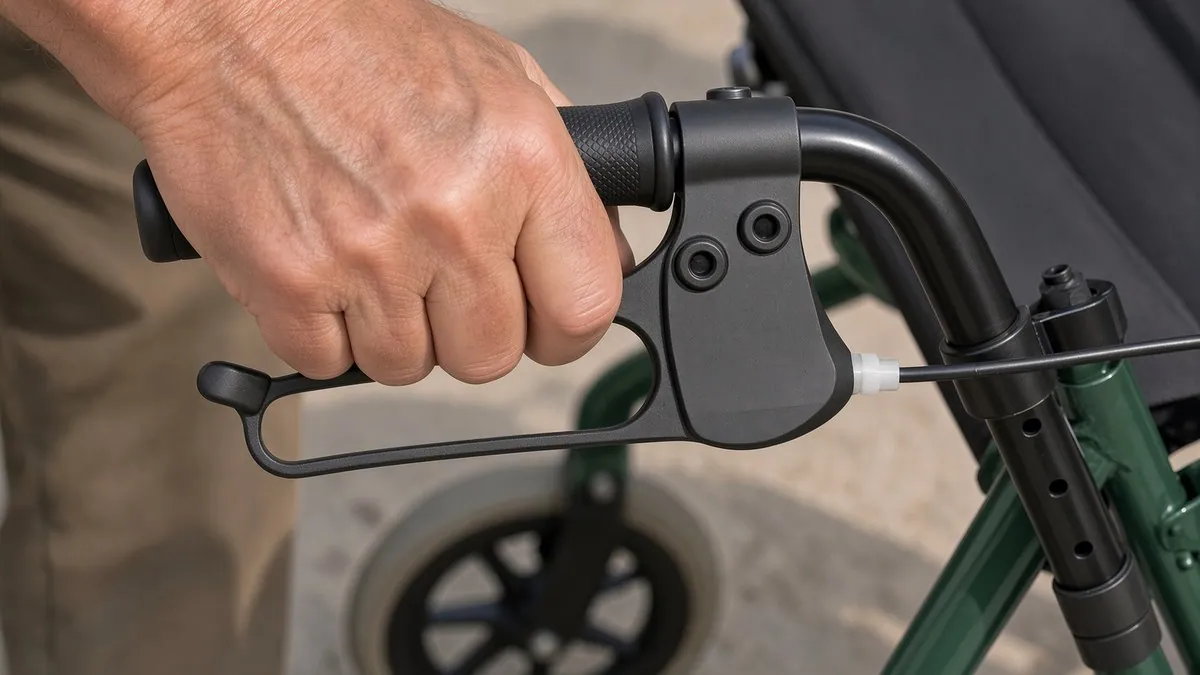
A rollator has four wheels, hand brakes and usually a seat. It is easier to move, it does not have to be lifted, and you can sit down on it when you need to.
Here is the part that runs backwards, and it is the most useful thing on this page. A standard walker gives you more support than a four-wheeled rollator, not less. The rollator is the one with more features, more money and more wheels, so it reads as the upgrade — and a great many people move to one because it looked like the better machine. What they have actually done is swap a device that stays put for a device designed to roll. For somebody who needs to lean on the frame to stay upright, that is a downgrade wearing the costume of an upgrade.

Which is the right one is not a question this page can answer and not one you should answer off a website. It is the exact question a doctor or a physical therapist answers in about ten minutes, and it is the question the prescription route above exists to settle.
⚠️ The Device Has a Fall of Its Own
Now the flat section, and there is going to be no wit in it, because this is the part where a charming sentence could put somebody on the floor.
A four-wheeled walker has a failure mode that a cane does not have and a plain walker does not have: you can fall off it, or with it. This is documented rather than theoretical. A Swiss level-one trauma centre reviewed 152 patients aged sixty-five and over admitted after falls from a rollator over a seven-year period. More than half of them were hospitalised there, and a further one in seven were transferred to another hospital. That is one trauma centre in one city.
The rules that follow are not suggestions and they are not written to be interesting.
A rollator is not a wheelchair. It is not for being pushed while somebody sits on it. The seat is for resting on when the walking stops, with the device stationary. Pushing a seated person on a rollator is the misuse that produces the worst of these injuries.
Lock both brakes before sitting down, and check they are locked with your hand rather than assuming. A rollator that rolls backwards as somebody lowers themselves onto it puts them on the ground from standing height.
Do not lean on a rollator to stand up from a chair. It moves. That is the entire point of it and it is the entire danger of it. Push up from the arms of the chair, then take hold of the rollator once you are already up.
Do not hang bags off the handles. Weight up high and behind the wheels is how a device tips.
None of that is an argument against rollators. They keep a very large number of people walking who otherwise would not be. It is an argument for knowing that the machine has its own way of hurting you, which nobody mentions in the shop.
📏 Fitting It, in Somebody Else’s Words
I am going to hand this section over, and I want to say plainly why.
The right height for a cane is a matter of your wrist, your shoes, your posture and which leg is the trouble. I have never seen you. So rather than write it in my own voice and have it read as though this website is qualified to set it, here is what the Mayo Clinic publishes, and you can go and read it at the source.
On height: with your arm hanging straight down at your side, the top of the cane should line up with the crease in your wrist. Too long and you work harder to pick it up and move it. Too short and you lean to one side, which throws off your balance.
On the elbow: with the cane in your hand, the elbow should bend at a comfortable angle, roughly fifteen to thirty degrees — possibly a little more if the cane is mainly for balance.
On which hand: hold the cane in the hand opposite the affected leg, and move the cane forward at the same time as that leg. That is what gives you support as you step, and it takes strain off the leg.
Source: Mayo Clinic, “Tips for choosing and using canes.”
The same wrist-crease test is the one used for setting walker handles, and a physical therapist will do the whole business in one appointment and watch you walk afterwards, which is the part no measurement can replace.
One thing I will say in my own voice, because it is observation rather than instruction: the commonest sign of a badly fitted device is a raised shoulder. If you catch sight of yourself in a shop window and one shoulder is riding higher than the other, the thing in that hand is too tall. That is worth looking for, and it is worth taking to whoever fitted it.
🔩 The Four Parts That Decide Whether It Holds You
Everything above is about getting the right device. This is about the handful of components on it that actually do the work, and they are the same four whether the thing cost thirty dollars or three hundred.
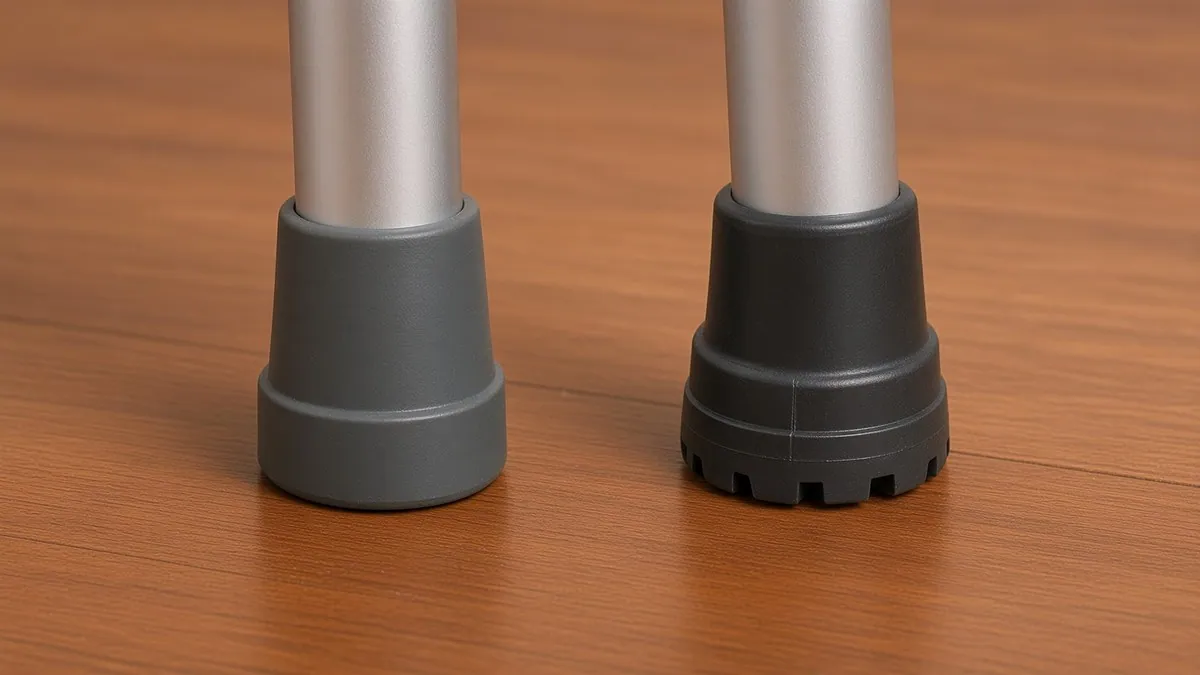
The tips. The rubber foot on a cane or a walker leg is the entire contact patch between you and the floor, and it is a wear item like a tyre. When the tread is gone and the bottom is polished smooth, it will slide on wet tile without any warning at all. They cost a few dollars, they are sold everywhere, and replacing them is the single cheapest safety improvement available to anybody reading this page. Look at yours now.
The weight rating. Every one of these is built and tested to a stated capacity, and it is printed on the box and in the specification. It is not a suggestion and it is not padded for comfort. If the person using it is near or over the number, buy the heavy-duty version instead — they exist, they are not exotic, and a supplier will have them.
The brakes, on anything with wheels. Rollator brakes run on cables, and cables stretch. A brake that engaged crisply two years ago can go soft without a single day where you noticed it getting worse. Squeeze both, every so often, and see whether the wheels actually stop.
The height locks. Adjustable legs are held by spring buttons or by a clamp. The button has to be fully through the hole — you should hear it and see it — and on a walker all the legs have to be on the same setting. A leg that is one hole out is a limp that the user will blame on themselves.
On buying used, since that is what this website usually recommends. The frame of a cane or a walker is a simple piece of metal and there is nothing wrong with a second-hand one — these turn up constantly at estate sales, and often barely used. But buy new tips for it before it carries anybody, check the weight rating for the person who will actually use it, and if it has brakes, test them in the driveway rather than in the house. Same rule as the batteries and the safety gear elsewhere on this site: the frame is worth buying used and the wear parts are not.
⚡ Why This One Is on the Fifty List
Because nobody buys their first cane on a good day.
It gets bought in a hurry, after something has already happened — a fall, a hip, a bad week — usually by an adult child, usually at whatever shop is nearest to the hospital, usually in whatever size was on the shelf. Nobody in that story asked whether the supplier was enrolled in Medicare, and nobody measured anybody’s wrist.
The version of this that costs almost nothing is the one where you already know, years ahead: that it goes through a doctor, that the doctor is the discount, that the supplier has to be enrolled and has to accept assignment, that the plain walker is steadier than the fancy one, and that the rubber tip is the whole thing.
That is six facts. None of them are hard and none of them cost a dollar to learn. And every one of them is unavailable on the afternoon you actually need them, because on that afternoon somebody is standing in a shop trying to get home before dark.
The other half of the fall problem: what a radar sensor notices that a pendant does not →
❓ Plain Answers
The short version of this page, one question at a time — the answer is always the first line.
Does Medicare pay for a cane or a walker?
Medicare Part B covers canes, walkers, crutches and rollators as durable medical equipment when a doctor prescribes them for use in your home. You pay twenty per cent of the Medicare-approved amount after the Part B deductible, which is $283 in 2026. Check with 1-800-MEDICARE or a SHIP counselor.
Where do I have to buy a walker for Medicare to pay for it?
A walker must come from a Medicare-enrolled supplier for Medicare to pay anything toward it. Before ordering, ask the supplier whether they are enrolled in Medicare and whether they accept assignment on the item.
Is a rollator better than a walker?
A standard walker gives you more support than a four-wheeled rollator, not less, because it stays put while a rollator is designed to roll. Which one you need is a question for a doctor or a physical therapist.
How tall should my cane be?
According to the Mayo Clinic, with your arm hanging straight down at your side, the top of the cane should line up with the crease in your wrist. A physical therapist can fit it in one appointment and watch you walk.
Which hand should I hold a cane in?
The Mayo Clinic says to hold the cane in the hand opposite the affected leg, and move the cane forward at the same time as that leg.
Can you push somebody sitting on a rollator?
No, a rollator is not a wheelchair and should not be pushed while somebody sits on it. The seat is for resting with the device stationary, and both brakes should be locked, and checked by hand, before sitting down.