
💺 A Good Chair, and a Small Check
Plainly, first. This page is for educational purposes only. BuyItAt50 is not a furniture store, medical equipment supplier, physician or occupational therapist, and it does not name or recommend any maker or seller of lift chairs. Whether a lift chair is right for a particular person is a question for that person’s doctor or occupational therapist.
You have seen the advertisement, or one like it. A comfortable chair, a gentle hum, and a person who could not get out of it a moment ago now standing up easily. Somewhere near the bottom, a line saying Medicare may help pay.
All of it can be true. A lift chair is a padded recliner with a motor underneath that tilts the whole seat forward and up, so the person in it ends up nearly on their feet before they have to do any work. For somebody whose knees or hips have quit on the hardest part of the day, which is the first three seconds of standing up, it can mean the difference between getting up alone and waiting for somebody to come and help.
What the advertisement does not tell you is what “may help pay” works out to. Medicare pays toward the motor. It does not pay for the chair. And it only pays toward the motor for a fairly narrow group of people, after the doctor has written down why.
None of that is a reason not to buy one. It is a reason to know the arithmetic before somebody in a showroom does it for you.
💵 What Medicare Actually Pays
Medicare treats a lift chair as two things stuck together: a piece of medical equipment, and a piece of furniture.
The medical equipment is the seat lift mechanism, the motor and the frame that does the lifting. Medicare Part B can pay toward that part as durable medical equipment when the coverage rules are met. The furniture is everything else, the frame, the padding, the upholstery and the recline.
You can see the split in Medicare’s own billing instructions. When a lift is built into a chair and sold as one unit, the supplier bills Medicare for the lift mechanism under one code and bills the chair under A9270, the code used for items Medicare does not cover (CMS, Seat Lift Mechanisms policy article). Medicare’s national coverage rule goes further: when the chair also reclines, payment is limited to what a lift without the recline feature would have been paid (CMS, National Coverage Determination for Seat Lifts).
The arithmetic
Do it before the showroomFor 2026, the Part B deductible is $283 (CMS). After you have met it, Medicare pays 80 percent of its approved amount for the lift mechanism, and you pay the other 20 percent.
U.S. News puts the lifting device itself at typically $250 to $300, and the whole chair at anywhere from a few hundred to several thousand dollars (U.S. News via WTOP, July 2026).
So on a chair that costs a thousand dollars or more, Medicare’s share is likely to be a couple of hundred dollars, and only if you qualify and only if you have already met the deductible that year.
Two more things decide whether you see even that much.
The supplier has to be enrolled in Medicare. A furniture store that is not a Medicare supplier cannot bill Medicare at all. You can look suppliers up on Medicare’s supplier directory.
Ask whether the supplier accepts assignment. A supplier that does is agreeing to take Medicare’s approved amount for the mechanism as full payment for that part. One that does not can charge you more than Medicare approves, and you make up the difference.
If you have a Medicare Advantage plan, the plan has to cover at least what Original Medicare covers, but it may use its own list of suppliers and its own rules for approval. Call the plan before you shop, not after.
🩺 Who Qualifies, in Medicare’s Own Words
This is where most people find out the advertisement was talking to somebody else. Medicare’s coverage rules for a seat lift mechanism require all of the following (CMS, Seat Lift Mechanisms coverage determination):
- Severe arthritis of the hip or knee, or a severe neuromuscular disease.
- The lift is part of your treating doctor’s course of treatment, prescribed to improve your condition or slow it from getting worse.
- You are completely unable to stand up from a regular armchair or any chair in your home. The rule says plainly that having difficulty getting up is not enough.
- Once you are standing, you can walk.
The medical record also has to show that other treatments, such as medication or physical therapy, were tried first. And the kind of lift matters: Medicare covers lifts that move smoothly and that you can control yourself, and it excludes the spring-release kind that pushes you up with a sudden jolt.
Read that list again with one person in mind. A great many people who would be glad of a lift chair are people who can still get up, slowly and with a push on the arms. That is a perfectly good reason to buy one. It is just not a reason Medicare pays for.
The honest version of the advertisement is this: if your doctor documents that you cannot stand up from any chair in your house and can walk once you are up, Medicare may pay most of a couple of hundred dollars toward the motor. Everything else is yours.
📏 Fitting the Chair to the Person
A lift chair is closer to a pair of shoes than to a sofa. It has to fit the person sitting in it, and a poor fit can make the standing harder rather than easier.
Lift chairs commonly come in three kinds. A two-position chair lifts and reclines partway but does not lie back fully. A three-position chair reclines further. An infinite-position chair can recline the back almost flat and is usually the most expensive (ThedaCare Home Medical). More positions are not automatically better. The right one is whichever the person will actually use.
The rest of the fit is a matter of measuring the person, not the room:
- Feet on the floor. Sitting all the way back, the person’s feet should rest flat on the floor. A seat that is too high leaves the feet dangling; too low and the knees come up and the lift has further to go.
- Seat depth. The back of the knees should clear the front edge of the seat.
- Width and weight. Ask for the chair’s rated weight capacity in writing and make sure the person fits between the arms without being squeezed.
- The hand control. Can the person read it, reach it and press it with the hands they have today?
- Sit in it first. Have the person ride it up and down several times before anybody pays, the way they will use it at the end of a long day.
If there is any doubt about whether a lift chair is the right answer at all, an occupational therapist is the person who knows. Ask the doctor for a referral. Getting up from a chair is exactly the kind of thing they assess.
And it is worth asking the plain question first: is the trouble the chair, or the getting up? A low, soft, deep sofa defeats almost anybody. Sometimes a firm chair of the right height with solid arms to push on is the whole answer, and sometimes strength work with a physical therapist buys back the ability to stand from an ordinary chair. A lift chair is a fine machine. It should not be the first thing tried.
🔌 When the Power Goes Out
This site spends a good deal of its time on power outages, so here is the question nobody asks in the showroom.
A lift chair runs on house current. If the power fails while the chair is reclined, or tilted forward halfway through standing, what happens? Some chairs are sold with a battery backup that can bring the chair back to the seated position when the power is out. Some are not.
Ask the seller three things, and get the answers in writing:
- Does this chair have a battery backup, and what kind of batteries does it take?
- With the power off, can the chair be returned to an upright seated position, and how?
- Where is the battery pack, and can the person who sits in the chair reach it and change it?

Then put fresh batteries on the same calendar as the smoke alarms. A backup with dead batteries is not a backup. The power and generators guide covers keeping the essentials running in a longer outage.
🧒 If Grandchildren Come to Visit
This part is not about the person in the chair.
Reclining furniture, lift chairs among it, has a mechanism under the seat and footrest that closes with a good deal of force. In 2023 the staff of the U.S. Consumer Product Safety Commission wrote to the industry’s standards committee asking for a safety standard to prevent children being trapped by reclining furniture. Their letter listed thirteen incidents from 2011 through 2021 involving children aged eight months to five years, seven of them fatal, most of them a child caught under a footrest or between the mechanism and the chair as it closed (CPSC staff letter, April 2023).
The habits are simple and they cost nothing:
- Look under and behind the chair before you lower it, every time, when there are small children or pets in the house.
- Do not let small children play on, under or behind it, or play with the hand control.
- If the chair can be switched off or unplugged at the wall when nobody is using it, do that while the little ones are visiting.
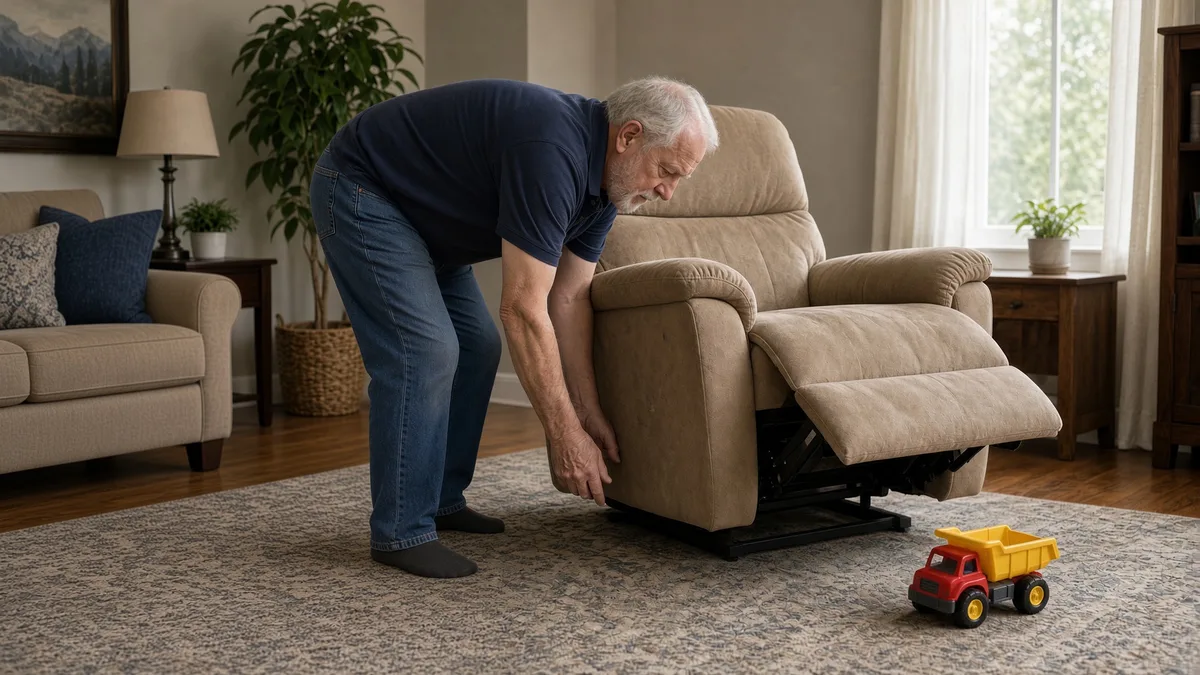
A lift chair moves a person’s whole weight. Do not take apart, adjust or repair the lift mechanism yourself. Follow the maker’s instructions and have it serviced by the seller or a qualified technician. You can search any model for recalls at the U.S. Consumer Product Safety Commission.
✍️ Before You Buy
If somebody comes to the house to sell you a chair, you have a rule on your side. The Federal Trade Commission’s Cooling-Off Rule gives you three days to cancel certain sales made at your home. It does not cover every sale, including sales finished at the seller’s own place of business (FTC).
Questions to ask, and to get answered in writing
Ask every one- Are you enrolled as a Medicare supplier, and do you accept assignment?
- What is the total price, and how much of it is the lift mechanism? On one sheet, with the chair and the mechanism shown separately.
- What paperwork do you need from my doctor, and who sends it?
- If Medicare turns the claim down, what do I owe?
- What is the rated weight capacity, and what are the seat height, depth and width?
- Is there a battery backup, and how does the chair return upright with the power off?
- What does the warranty cover on the motor, the frame and the upholstery, and for how long? They are often different.
- Who services it, and what does a service call cost?
- Can I return it if it does not suit, and who pays to take it away?
If you have a Medicare Advantage plan, add one more: is this supplier in my plan’s network?
If anybody tells you Medicare will pay for the chair, ask them to show you where it says so. Then check with Medicare yourself at 1-800-MEDICARE.
⚡ Why This Belongs on the Fifty List
Most people at fifty have no use for a lift chair. That is why fifty is the time to look at the chair they do have.
The furniture people buy in their fifties tends to be the furniture they sit in at seventy-five. A deep, low, soft sofa is lovely at fifty-two. At seventy-eight it is a trap you have to be helped out of.
When you next replace the chair you sit in every evening, buy one you could get out of on a bad-knee day: a firm seat at a height that puts your feet flat on the floor, and solid arms you can push on. It costs no more than the deep one, and it may be the reason you never need the one with the motor.
The right ordinary chair, bought early, is the cheapest lift chair there is.
❓ Questions People Actually Ask
Does Medicare pay for a lift chair?
Only part of it. Medicare Part B can pay toward the seat lift mechanism, the motor and lifting parts, when a doctor documents that you need it. It does not pay for the chair itself. The supplier bills the mechanism to Medicare and bills the chair under the code Medicare uses for items it does not cover.
Who qualifies for Medicare coverage of a lift chair?
Medicare's coverage rules require severe arthritis of the hip or knee or a severe neuromuscular disease, a lift that is part of your doctor's treatment, being completely unable to stand up from a regular armchair or any chair in your home, and being able to walk once you are standing. Having trouble getting up is not enough on its own.
How much will I pay for a lift chair with Medicare?
You pay the whole price of the chair, plus 20 percent of the Medicare-approved amount for the lifting mechanism after you meet the Part B deductible, which is $283 in 2026. U.S. News puts the lifting device itself at typically $250 to $300, so Medicare's share is a small part of the total.
Does it matter where I buy a lift chair?
Yes. Medicare only pays through a supplier enrolled in Medicare. A supplier that accepts assignment agrees to take the Medicare-approved amount for the mechanism as full payment. A supplier that does not accept assignment can charge you more. Ask before you order.
Are lift chairs dangerous for small children?
Reclining furniture can be. Federal safety staff collected thirteen incidents from 2011 through 2021 of young children caught under or in the mechanisms of reclining furniture, seven of them fatal, and asked for a safety standard. Check under the chair before you lower it, and keep small children from playing on or under it.
📚 Where This Comes From
Every figure on this page is linked where it appears, and every source is listed again here. Coverage rules and dollar amounts change; check them before you rely on them.
- Who qualifies for a seat lift mechanism — Centers for Medicare & Medicaid Services, Seat Lift Mechanisms (L33801).
- How the mechanism and the chair are billed — CMS, Seat Lift Mechanisms policy article (A52518).
- The recline limit and the spring-release exclusion — CMS, National Coverage Determination for Seat Lifts.
- The 2026 Part B deductible — CMS, 2026 Medicare Parts A & B premiums and deductibles.
- Typical cost of the lifting device and the chair — U.S. News, July 2026.
- Two-, three- and infinite-position chairs — ThedaCare Home Medical (a hospital system that also sells lift chairs).
- Children and reclining furniture — U.S. Consumer Product Safety Commission staff letter to ASTM, April 2023.
- Finding a Medicare supplier — Medicare.gov supplier directory.
- The three-day cancellation rule — Federal Trade Commission.
- Recalls — U.S. Consumer Product Safety Commission.