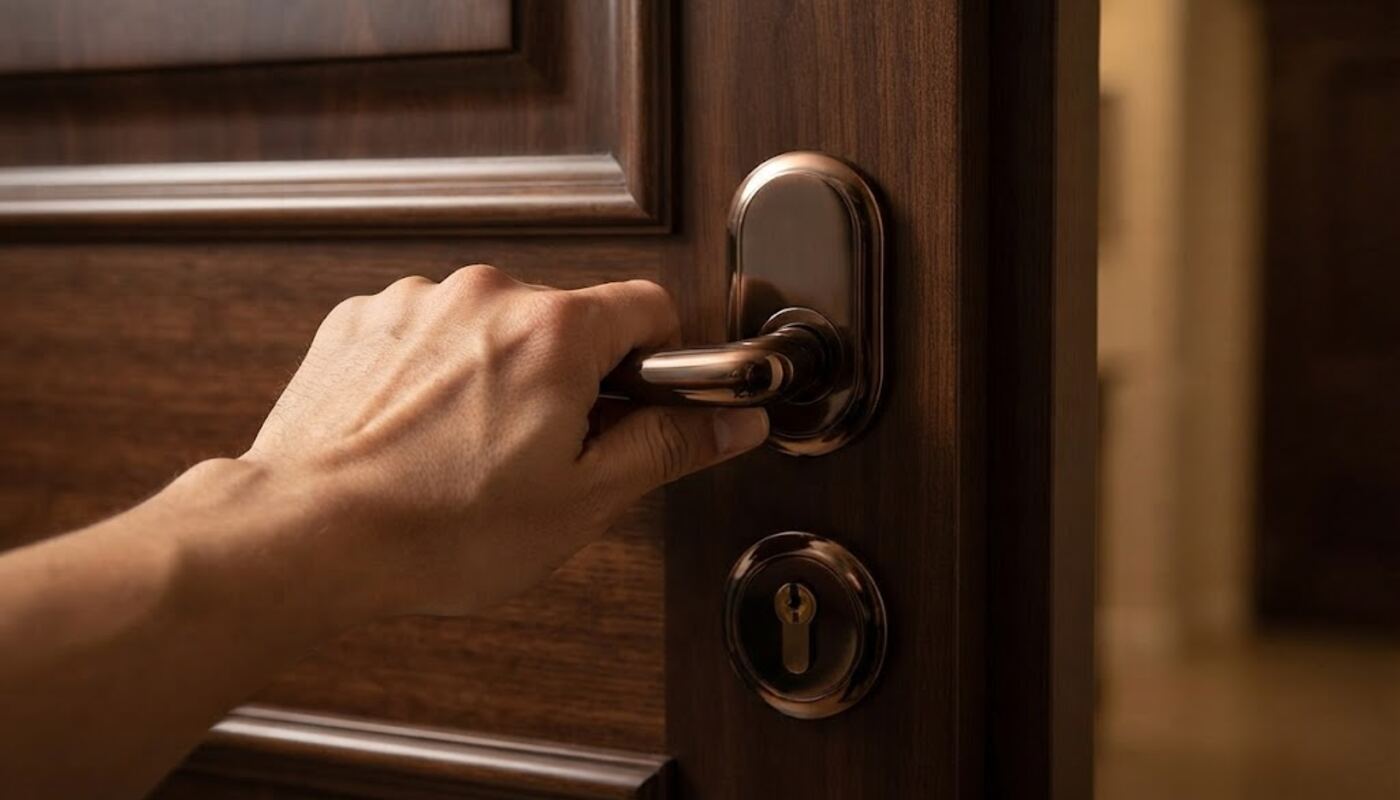

💬 The Doorknob Nobody Thinks About — Until They Do
Nobody plans for the day a doorknob becomes a problem. It just arrives — usually quietly, usually at the worst possible moment. These are the people who learned it firsthand, and the ones who got ahead of it.
🚪 The Bathroom Door — Ocala, Florida
“My mother is 81 and her hands have gotten stiff over the years. The house she and Dad built in 1978 has those beautiful round brass knobs on every door. Last spring she got stuck in her own bathroom — not locked in, just could not get enough grip on that polished knob with damp hands to turn it. She stood there for twenty minutes before she thought to use a towel. She never told anybody. I only found out because I noticed a hand towel looped over the bathroom doorknob and asked why it was there.
My brother and I replaced every knob in that house with lever handles over one weekend. Fourteen doors, one screwdriver, about $250 in hardware. Mom opens the bathroom door with two fingers now. With her wrist if her hands are full. What gets me is how easy it was — and how long she quietly worked around a problem we could have fixed in an afternoon.”
— As told by a daughter, 54, Ocala, Florida
🔧 The Man Who Did It Early — Crystal River, Florida
“I watched my father-in-law fight his own house for ten years. The stubborn deadbolt. The kitchen faucet you had to crank. The cabinet knobs he eventually just stopped using — he left the cabinet doors ajar instead. Everyone in the family called it stubbornness. It was not stubbornness. It was hardware.
The year I turned 55 I went through my own house like an inspector. Lever handles on every door. Single-lever faucets in the kitchen and both bathrooms. Bar pulls on every cabinet. A keypad deadbolt on the front door so there is no key to fumble at night in the rain. My hands are still fine. That is exactly the point — I did it while it was easy, on my schedule, at my prices. And here is what nobody tells you: it is just better. Everybody in the house uses the levers with an elbow when they are carrying groceries. The grandkids can actually open the silverware drawer. There is no downside. I did not give anything up to get ready for 75. I made the house nicer today.”
— Retired contractor, 61, Crystal River, Florida
🫙 The Jar Lid — Chattanooga, Tennessee
“For 52 years, Harold opened every jar in this house. Every stuck lid, every stiff valve, every key that would not turn — that was his department, and he loved being needed that way. When he passed, I discovered my house was full of things I could not operate. The pickle jar was just the first one. The outside spigot. The lamp with the little metal twist switch. The deadbolt on the back door that always needed his particular jiggle.
My grandson spent two Saturdays here. Levers on the doors, a paddle switch for the lamp, one of those under-the-cabinet jar openers screwed in where I can reach it, and a keypad on the back door. I cried when the jar opener worked the first time, and not about pickles. If you are reading this and your Harold is still with you — fix these things together, now, while it is a fun project and not a crisis. I wish we had.”
— Widow, 79, Chattanooga, Tennessee
🔧 The Renter Who Could Not Drill — Gulf Coast, Florida
“After my stroke, my right hand kept its shape but lost its squeeze. I rent, so swapping out the landlord’s hardware was not on the table — and I was not about to ask permission to be able to open my own bedroom door. My daughter found the clamp-on lever adapters — they grip over the round knob and give you a handle to press down instead. Twelve dollars, no tools, on in a minute.
We put one on the bedroom and one on the bathroom, and stretched the rubber grip covers over the knobs everywhere else. The whole fix cost less than the pizza we ate while doing it. When I move, it all comes off and goes in a shoebox. The landlord will never know, and my door has never known the difference either.”
— Renter, 72, Gulf Coast, Florida
These accounts are composite voices, built from the common, real experiences behind these decisions — the names and attributions are not those of real individuals, and these are not customer testimonials. Individual results vary.
✊ The Fist Test — One Rule That Sorts All Hardware
Professional accessibility designers use a beautifully simple standard, and you can use it in your own home today: if you cannot operate it with a closed fist, it fails.
Make a fist and walk through your house. Try the front door. The bathroom door. The kitchen faucet. The cabinet where you keep your coffee cups. The lamp beside your reading chair. A lever handle passes — press it down with a fist, a forearm, an elbow, and the door opens. A round knob fails instantly, because a knob demands two things at once: a pinching grip and a twisting wrist.
Those are exactly the two motions that many hands find harder with time, with cold mornings, with wet fingers, or simply with a bag of groceries on one arm. There is a reason this is worth doing before you think you need it: grip is the first thing to go, and it starts at fifty — a full twenty years before balance or walking are affected.
This is why public buildings stopped installing round doorknobs decades ago. The fix was never about age — it is simply better design for every hand, at every age. That is the theme of this entire page: nothing here makes your home look like a hospital. Lever handles, bar pulls, single-lever faucets, and rocker switches are what new high-end homes install anyway. You are not preparing for decline. You are upgrading.
Why age 50 is the right time, not 70: At 50, this is a pleasant weekend project. You climb the ladder, you drive to the hardware store, you install it yourself or shop for the best price on a handyman without pressure. At 75, the same project often happens as a scramble — after a struggle, after a scare, on somebody else’s schedule. Same hardware, same house. Completely different experience. And every year between now and then, you get to use the good hardware.
One honest note: Gradual change in grip over the years is common. But if a change in your grip comes on suddenly, affects one hand more than the other, or comes with pain, numbness, or weakness — that is not a hardware question. That is a conversation for your doctor, and sooner rather than later. This page is about houses, not hands. Your physician handles the hands.
📊 The Numbers Behind the Knob
The fist test is not a folk remedy — it is written into federal law. The ADA accessibility standard for public buildings requires that door hardware, faucets, and controls work with one hand and without “tight grasping, pinching, or twisting of the wrist.” Read that again: those are the exact two motions a round knob demands. The government studied what hands can reliably do, wrote the answer into the building code, and that is the real reason round doorknobs quietly disappeared from every public building you walk into. Your house was just never required to catch up. This page is you catching it up.
What the measurements say. The CDC counts about 53 million American adults — one in five — with doctor-diagnosed arthritis, and nearly nine in ten of them are 45 or older. The hands and wrists are among the most common places it settles.
And arthritis or not, the national health surveys that actually put a grip meter in people’s hands found the same quiet slope in everyone: grip strength peaks in your thirties, is down roughly five to eight percent by 50, twelve to fourteen percent by 60, and close to thirty percent by the late seventies. The knob on your bathroom door never changes. The hand does. Buy hardware for the hand you will have — not the one you had at thirty.
There is one more piece, and it is plain physics. A knob asks the smallest joints you own — fingertips and wrist — to squeeze and twist at the same time. A lever moves that same job onto the big muscles of the forearm and shoulder, and the long handle itself is a lever arm doing part of the work for you. Less force needed, bigger muscles supplying it, no twist at all. That is why a lever opens under a fist, an elbow, a forearm, or a hip — and why the swap works on the first day and keeps working through every year that follows.
Arthritis and grip-strength figures reflect U.S. Centers for Disease Control and Prevention (CDC) arthritis reporting and national health survey (NHANES) grip measurements; the hardware rule is from the federal ADA accessibility standard. We encourage you to check these sources yourself. This is general information, not medical advice — ask your own doctor how it applies to you.
🚪 Door Handles — The Biggest Win for the Least Work
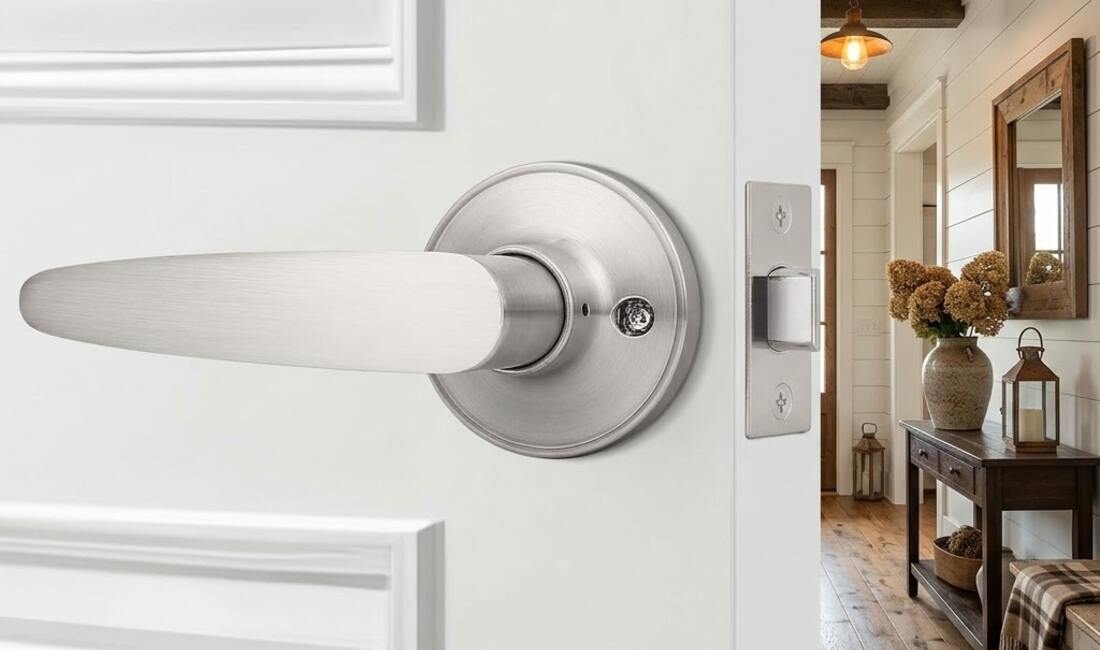
Round Knobs → Lever Handles
This is the single highest-value swap on this page. A lever handle can be pressed down with an open palm, a closed fist, a forearm, or an elbow. No pinch, no twist, no grip at all if you do not have one to spare. Standard levers fit the same bore hole and latch as the knob they replace — two screws out, two screws in.
Know the three types before you buy:
- Passage levers — no lock. Hallways, closets, and any door that never needs privacy.
- Privacy levers — push-button or twist lock on the inside. Bedrooms and bathrooms. Choose ones with an emergency release hole on the outside, so a coin or the included pin can unlock the door from the hall if someone needs help inside.
- Keyed levers — lock with a key, for exterior or garage-entry doors (though see the locks section below for a better idea).
Two details worth paying for: a return-to-door design, where the lever curves back toward the door at its tip so sleeves and bag straps cannot snag on it, and a reversible handing, meaning the same lever works on left-opening and right-opening doors — buy one style for the whole house and every door matches.
🚰 Faucets — Retire the Twist
Twist Handles → Single-Lever Faucets
A twist-style faucet handle is a doorknob that gets wet. Soapy hands on a round chrome knob is a genuinely bad combination, and old twist valves get stiffer every year as washers age. A single-lever faucet replaces the whole struggle: nudge it up for on, down for off, left and right for temperature. It works with the back of a hand, a wrist, two soapy fingers — it passes the fist test easily.
For a lighter touch than a full replacement, wrist-blade handles (the long flat paddles you see on sinks in doctors’ offices) retrofit onto many two-handle bathroom faucets and can be pushed with a forearm.
What about touch and motion faucets? They are real and they work — tap the spout with a knuckle and the water starts. Two honest cautions for this site’s readers: they run on batteries or a plug-in adapter, and in a power outage a battery-powered model keeps working while a plug-in model needs its manual mode. If you go this route, confirm the model has a manual override lever so it is still a plain faucet when the electronics are not. A good old-fashioned single lever has nothing to fail. Ever.
Before any faucet work: shut off the two supply valves under the sink and open the faucet to drain the pressure. If those under-sink shutoff valves themselves are ancient and will not turn — very common in older homes — that is your sign to have a plumber do the job and replace the shutoffs at the same time. Stiff shutoff valves are their own emergency-day problem worth solving now.
🗄️ Cabinets & Drawers — Stop Pinching, Start Pulling
Small Knobs → Bar Pulls
A small round cabinet knob demands the most fragile grip there is: two fingertips, pinched, pulling against the suction of a cabinet door. A bar pull (sometimes called a D-pull) lets you hook four fingers behind it and pull with your whole hand — or with one finger, or with a wooden spoon handle on a bad day. This is the cheapest room-transforming swap in the house, and modern bar pulls are exactly what new kitchens install anyway.
The one measurement that matters: if your cabinets already have two-screw pulls, measure the distance between the screw holes — the center-to-center spacing, usually 3″, 3-3/4″ (96mm), or 5″ (128mm). Buy pulls that match and every hole lines up. If your cabinets have single-screw knobs, each door needs one new hole; a $10 drilling template jig keeps every pull perfectly straight and takes the guesswork out.
While you are at it: the heaviest drawers — pots, pans, the junk drawer — benefit the most. And if any cabinet doors have gotten hard to keep closed or have started to sag into their neighbors, the hidden hinges usually adjust with two turns of a screwdriver. A cabinet that closes properly needs far less force to open.
A Field Guide to Pulls You Can Hook a Finger Through
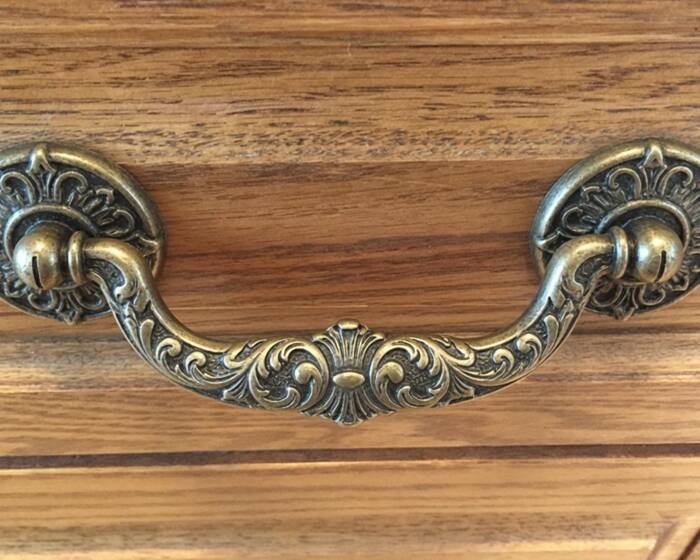
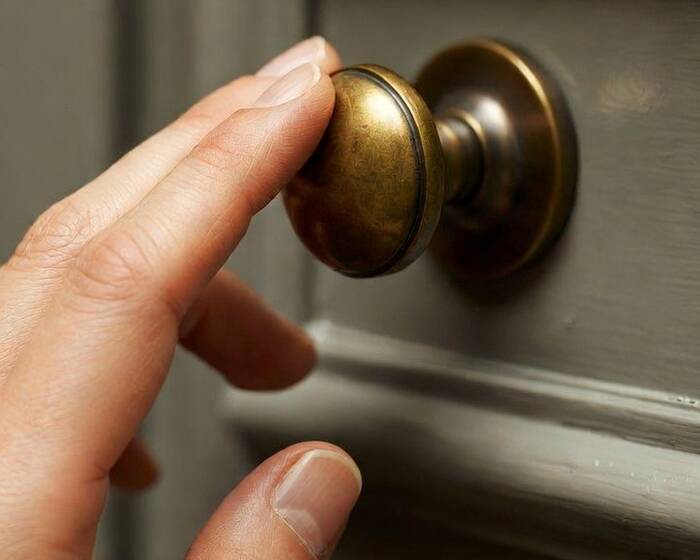
Look at those two photos for a moment. On the left, an antique bail pull that has been on somebody’s dresser for a hundred years — and your fingers hook through it, so the drawer opens with a curled finger and no thumb at all. On the right, the little round knob: two fingertips, pinched, pulling against the drawer’s resistance. That is the entire lesson of cabinet hardware in one glance, and it comes with good news: the hook-through family is enormous, it spans every style from Victorian to brand-new, and your furniture does not have to look like a hospital — or even look different — to work better.
The quick test for any pull, in the store or in your house: curl one finger like a hook, keep your thumb out of it, and try to open the drawer. If a bent finger alone can do it, the hardware passes. Here is the family:
- Bar pulls and D-pulls — the modern standard covered above. Four fingers behind a solid bar. The benchmark everything else is measured against.
- Cup pulls (bin pulls) — the half-shell you see on farmhouse kitchens and old library card catalogs. Fingertips hook up under the cup and the whole hand shares the work. Wonderful on drawers; not made for cabinet doors.
- Drop bail pulls — the swinging antique handle in the photo. Genuinely good grip once your fingers are through it, with one honest note: the bail swings, so it asks a little more aim than a fixed bar. If your hands shake, choose a fixed pull instead — but if you love your grandmother’s dresser, it already works better than any knob.
- Ring pulls — the round cousin of the bail. Same hook-through grip, same one note about swinging.
- Finger and edge pulls — a metal channel or lip along the drawer’s top edge, popular in newer kitchens. The whole hand curls over the edge; there is no hardware to grip at all.
- Appliance pulls — oversized bars, 12 inches and up, made for refrigerator panels and the heaviest drawers. If the pots-and-pans drawer fights you, this is its answer.
And if your home leans traditional, here is the part most people never learn: antique-style bail, ring, and cup pulls are all still manufactured new, in every finish from aged brass to oil-rubbed bronze. You can rescue a house full of pinch-knobs without changing its character one bit — the 1920s did easy-grip hardware beautifully, long before anybody called it that.
🔑 Locks & Keys — The Smallest Grip Problem With the Biggest Consequences
Keyhole Fumbling → Keypad Deadbolts
Think about what a house key actually asks of a hand: pinch a small flat piece of metal, align it into a slot the size of a coin — often in the dark, often in the rain — then twist it against the resistance of a spring. It is the fist-test failure of all fist-test failures, and it guards the one door you most need to get through, in exactly the weather this website exists for.
A keypad deadbolt removes the key from daily life entirely. Press your code, the bolt opens. Most install into the same hole as your existing deadbolt with a screwdriver, run about a year on ordinary AA batteries, warn you well before those batteries run low, and — the answer to everyone’s first question — keep working normally during a power outage, because they were never connected to your house power in the first place. Nearly all keep a regular keyhole as a backup; keep one physical key in your wallet and one with a neighbor you trust.
Smart locks add phone unlocking, family codes for the kids, and the ability to check whether you locked up — genuinely useful if you like that sort of thing, and this whole site was written by somebody who does. But the plain non-connected keypad model delivers 90% of the daily benefit with nothing to set up and nothing to update. Both count as a full win here.
The $8 version: a key turner — a chunky rubber or plastic handle that snaps around the head of an ordinary key — turns a pinch-and-twist into a full-hand grip. Perfect for the car key, the mailbox key, the shed padlock, and any lock you are not ready to replace. Buy a couple and you will find uses for them.
🚗 The Car Door — The Hardest Door You Own

Every door in your house holds still while you use it. The car door does not — and the car itself asks more of your body than anything in your home: drop down into a low seat, or climb up into a high one, then reverse the whole move in a parking lot with nothing solid to hold. It is the one door most people never think to fix.
🚗 The Parking Lot — Inverness, Florida
“Dad is 77 and his knees have been honest with him for years, even when he was not honest about them with us. Getting out of his SUV had become a whole production — swing the legs, rock twice, grab the door and haul. The door is the problem. A door swings. Last fall it swung with him holding it, in the grocery store parking lot, and he went down on one knee on the asphalt. He caught himself on the running board, thank God. Torn pants, scraped palm, and a father who did not mention it for two weeks.
My sister found the little handle online — a steel grip that slots into the door latch on the frame, right where the door closes. Fifteen dollars. He was insulted by it, to be honest. It sat in the glovebox for a month. Then one wet morning he used it, and now it comes out at every stop like it was always part of the car. It does not swing. It does not move. It is exactly where his hand wants something solid to be. He calls it his door handle for the door handle. Fifteen dollars, and I do not think about parking lots the way I used to.”
— As told by a son, 52, Inverness, Florida
This is not a rare story. Research published in the Journal of the American Geriatrics Society estimated that about 37,000 older adults are treated in emergency rooms every year for injuries from simply getting into or out of a vehicle — and getting out injures people at more than twice the rate of getting in. A 2025 University of Pittsburgh study looking at recent national injury data found the pattern holding across roughly 210,000 boarding and exiting injuries a year among all ages, with older adults the most likely to be hospitalized when it happens. The car door earns its place on this page.
Nothing to Hold → Portable Car Assist Handle
Open your car door and look at the door frame edge, about waist height — there is a U-shaped steel loop there called the striker, the piece the door latches onto. A portable car assist handle is a solid grip that slots into that striker and locks against it, giving you a fixed steel handle exactly where your hand reaches for support — for sitting down and for standing up. Unlike the door, it cannot swing away from you. When you are done, it pulls right out and goes back in the glovebox or door pocket.
Before you trust it with your weight: seat it fully into the striker and give it a firm test pull — it should feel like part of the car. It fits most cars, trucks, and SUVs, but not all: if your door latch is enclosed or flush rather than an exposed U-shaped loop, this style will not seat properly. Check your own door frame before ordering, and test it on your vehicle the day it arrives.
A bonus this site's readers will appreciate: most of these handles build a seatbelt cutter and a window-breaker point into the grip — genuine emergency equipment riding along in your door pocket for free.
The technique matters as much as the tool: scoot to the edge of the seat first, get both feet flat on the pavement, then push up on the handle — not on the swinging door. Going in, reverse it: sit down first, then swing the legs in together. And if getting in or out of the car is consistently hard or painful, say so at your next doctor visit — a physical or occupational therapist can watch you do exactly this transfer and suggest what fits your body and your vehicle.
The Rest of the Glovebox Kit
The handle solves the standing-up problem. These solve the rest of the trip — and every one of them is small enough to live in the car full-time. One more number from the research before the tools: in the Journal of the American Geriatrics Society study, women were injured getting in and out of vehicles at nearly double the rate of men, and when someone 65 or older was hurt this way, they were ten times more likely to be hospitalized than a younger person with the same kind of injury. Small tools, real stakes.

🛻 The Truck She Refused to Give Up — Homosassa, Florida
“When my husband passed, everyone assumed I would sell his pickup. It sits high, and after my hip surgery, climbing down out of that cab was the kind of thing my daughter did not want to watch. But that truck hauls my mulch and my feed bags and thirty years of memories, and I was not ready to drive something sensible.
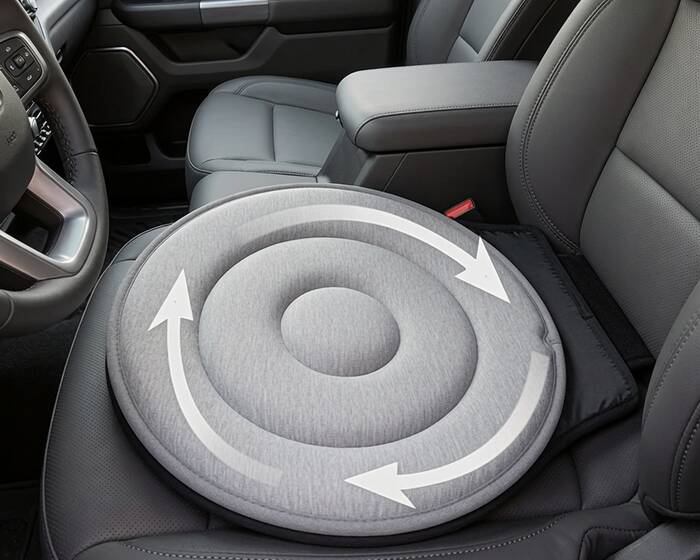
My physical therapist is the one who solved it, and it cost less than lunch for two. A swivel cushion on the seat, so I sit down first and turn my whole self with my legs together instead of corkscrewing my hip one leg at a time. And the little handle in the door latch, so coming down out of the cab I have something solid in my hand the whole way to the ground. She watched me do it twice in the parking lot and pronounced me roadworthy. Two years now. Still driving the truck. My daughter watches me get out and just shakes her head. I tell her — your father would have loved these gadgets, and he would have been insulted by them first, same as everybody.”
— Widow, 72, Homosassa, Florida
🔄 Swivel Seat Cushion
Two layers that rotate freely. Sit down facing out the door, then spin both legs in together — no twisting one leg at a time through the hips and back. $25–45. One honest note: they fit bench and flat seats better than deeply contoured bucket seats.
Shop Swivel Cushions →🧷 Seatbelt Grabber Handle
A rubber extension that clips onto the belt and brings it about 7 inches forward — no more twisting a sore shoulder backward to fish for the buckle. Around $10, installs in seconds, and passengers with shoulder trouble will ask where you got it.
Shop Belt Grabbers →🦵 Leg Lifter Strap
A stiffened loop of webbing: hook it over your foot and use your arms to help a stiff knee or post-surgery leg over the door sill. $10–25, and it works just as well for getting legs into bed or up on the couch.
Shop Leg Lifters →🪟 Window-Frame Assist Strap
A soft handle that loops over the open door’s window frame at whatever height you set. Honest ranking: it hangs on the door, and the door swings — the latch handle above is steadier. Where this strap earns its place is on vehicles whose latch is enclosed so the solid handle will not fit.
Shop Assist Straps →🔁 Pivot Disc & Transfer Board
One step beyond this page: a stand-on rotating disc and a smooth board that bridges wheelchair to car seat. These are for households where a caregiver helps with transfers — if that is your house, ask the doctor for an occupational therapy session to learn them safely.
Shop Transfer Aids →🧵 The Free Trick
Your grandmother knew this one: a square of slick fabric laid on the seat lets you slide and pivot with almost no friction — people recovering from surgery swear by it. One serious rule: it comes off the seat before the car moves. You want to slide getting in, not while driving.
The Seatbelt Reach — The Small Motion That Fights Back
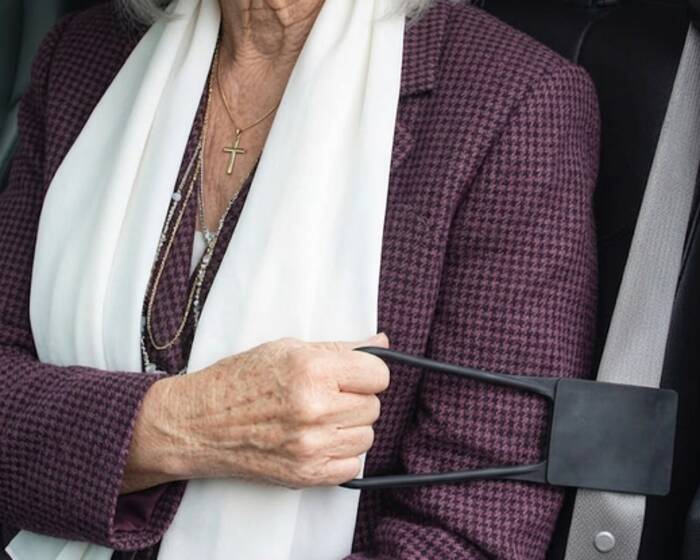
Think about what buckling up actually asks of your shoulder: reach your arm up, back, and behind your own body, then pull against a spring-loaded reel. That combination — rotation and extension behind the back — happens to be the exact motion aging shoulders like least. Published shoulder research shows why this reach bites so many people: ultrasound studies of adults with no shoulder complaints at all found rotator cuff tears in about 1 in 5 people in their 60s, roughly 1 in 3 in their 70s, and half of everyone over 80 — most of them walking around not knowing it, because the tear only announces itself on certain motions.
The seatbelt reach is one of those motions. Roughly 2 million Americans deal with rotator cuff problems every year, and orthopedic literature notes that after the mid-60s, when one shoulder has a tear, odds are about even that the other one does too. Which means the reach-back is a bad bet on both sides of the car.
🧷 Her Right Shoulder Remembers — Brooksville, Florida
“I was a floor nurse for thirty-four years, so my right shoulder earned its retirement the hard way. Rotator cuff repair at 68. The physical therapist cleared me for everything, one thing at a time — reaching the top cabinet, blow-drying my hair, sleeping on that side. The very last thing on her list, the one we practiced in the parking garage like a driving lesson, was reaching back for a seatbelt. She told me more of her post-surgery patients set their recovery back with that one motion than with anything they do in the gym. You do it eight, ten times a day and never think about it once — until it is the only thing you can think about.
She is also the one who told me the fix costs nine dollars. A rubber handle that clips to the belt and hangs it forward where my hand already is. No reach, no twist, no bracing before I do it. I put one in my car and one in my husband’s, and here is the thing — he uses his too, and his shoulders have never had a bad day in their lives. That is how you know it is not a gadget for patients. It is just a better place to put the seatbelt.”
— Retired nurse, 71, Brooksville, Florida
📋 From the record — the stories on this page are composites; the hands they describe are not. CDC data puts doctor-diagnosed arthritis at roughly 58 million American adults — including about 49% of women aged 65–74 and 58% of women 75 and older, which is why the jar lid, the round doorknob, and the stiff key are the most universal villains on this website. And the Brooksville shoulder is just as ordinary: the National Institutes of Health’s clinical reference reports rotator cuff tears in roughly 30% of adults over 60 and 62% of adults over 80 — and in the landmark ultrasound studies, most of those tears were silent, discovered only when the shoulder was finally asked to do something it could no longer do, like reach back for a seatbelt. Every upgrade on this page exists because these numbers are the normal course of human hands and shoulders — not anyone’s failure. The names are invented. The prevalence is not.
The belt grabber in the kit above is the whole solution — about $10, clips on in seconds, works in any car. And the honest medical line, same as everywhere on this page: a shoulder that aches for weeks, catches, or wakes you at night is a doctor visit, not a workaround. The grabber makes the reach unnecessary. It does not make a torn shoulder healed.
💡 Light Switches & Lamps — A Light Touch, Literally
Toggles & Twist Switches → Rockers & Touch
Wall switches: the little toggle switch takes fingertip precision; a rocker (paddle) switch takes a palm, a knuckle, an elbow, or the corner of a laundry basket. Rockers are the standard in every new home built today and cost $3–6 apiece. One honest caution, and it is the only one on this page: this swap involves house wiring. It is a quick job for a licensed electrician, who can often convert every switch in the house in a single visit — and for many people that is money extremely well spent. If you do it yourself, the breaker goes off first and a $15 voltage tester confirms the wires are dead before you touch them. No exceptions, no “it’s just one switch.”
Lamps are easier — no wiring at all: the tiny knurled twist switch buried under a hot lampshade is one of the worst grip tests in the house. Three no-tool fixes, from simplest up:
- Touch lamp converters — a small adapter screws in between the bulb and socket, and the whole metal lamp becomes the switch. Tap the base anywhere with a knuckle.
- Inline cord switches — a large rocker that sits on the lamp cord at hand height beside your chair, so the switch comes to you instead of you reaching into the shade.
- Smart bulbs — the lamp answers to your voice or a phone. For a reader of this site there is a bonus: pair one smart bulb near the bed with a voice assistant and darkness never requires walking across an unlit room to find a switch again.
Whichever route you choose, put the first one on the lamp beside the chair where you read. You will use it a dozen times the first evening, and that is when the “why did I wait” feeling arrives.
🍴 Kitchen Helpers — The Grip Tools Worth Owning
The kitchen concentrates more grip challenges per square foot than anywhere else in the house. These are the tools that have earned their counter space — none of them require installation beyond a couple of screws, and every one of them passes the fist test.
🫙 Under-Cabinet Jar Opener
A V-shaped grip that screws under any cabinet. Press the lid in, turn the jar with both hands. One-person operation for lids that used to take two people and a hot-water trick. The single most-thanked gift on this page.
⚡ Electric Can Opener
A manual can opener demands squeeze and crank at the same time — the two motions stiff hands like least. Electric models do the whole job at the press of one large button. Battery-powered versions keep working in an outage.
🍃 Rubber Gripper Pads
The humble flat rubber disc. Jar lids, stuck lamp finials, shower controls, stubborn bottle caps. Under $10 for a set; keep one in the kitchen, one in the bathroom, one in the garage.
🥄 Cushioned Big-Handle Utensils
Peelers, spatulas, and serving spoons with fat, soft, non-slip handles that fill the whole hand instead of demanding a fingertip pinch. They cost a dollar or two more than the thin-handled kind and feel better to every hand in the house.
💧 Automatic Jar & Bottle Openers
Battery-powered openers that clamp onto a lid and twist it off at the push of a button. For the days when even the under-cabinet opener asks too much of a sore hand.
🚮 Step-Pedal or Sensor Trash Can
Swing-top and pinch-latch trash lids fail the fist test every time. A foot pedal or motion-sensor lid means hands never touch the can at all — better on grip and better on germs.
💵 The Under-$25 Fixes — Renters, Snowbirds & This-Weekend People
Everything above assumes you can change the hardware. If you rent, if you winter somewhere else, or if you simply want relief today while you plan the bigger swaps, these clamp-on and slip-on fixes need no tools, no permission, and no holes — and they all travel with you.
- Doorknob lever adapters — a clamp-on arm that converts any round knob into a lever in about a minute. The genuine article works surprisingly well; buy one, test it on your most-used door, then outfit the rest.
- Rubber doorknob grippers — textured covers that stretch over a round knob, turning slick brass into a grippable surface. The half-step option where a lever adapter will not fit.
- Faucet grip covers — slip-on textured sleeves for round twist faucet handles, kitchen or bath.
- Key turners — the $8 fix from the locks section. One for every small key you regularly use.
- Lamp switch enlargers — oversized paddles that press onto the tiny knurled twist switch on a lamp, tripling its size instantly.
- Rubber gripper pads — listed again on purpose. At this price, they belong in every room and every glovebox.
The one-drawer trick: put every one of these helpers in a single, known place — one kitchen drawer, labeled if you like. A helper you cannot find on a sore-hand day is a helper you do not own. This is the same rule this site preaches about flashlights, and it is just as true here.
🗓️ The One-Month Plan — Whole House, No Overwhelm
Nobody needs to do all of this in a weekend. Here is the order that gets the most relief soonest, spread over four easy Saturdays:
- Week 1 — The doors you use most. Bathroom, bedroom, and the door you enter the house through. Three lever handles, one screwdriver, done before lunch.
- Week 2 — The front door. Keypad deadbolt in, spare key to a trusted neighbor, code memorized by everyone in the house.
- Week 3 — The kitchen. Bar pulls on the cabinets and drawers you open daily, the under-cabinet jar opener mounted, the electric can opener on the counter.
- Week 4 — Water and light. The worst faucet in the house replaced (or the plumber scheduled), and the reading lamp converted to touch or a cord switch.
Total for a typical house, doing the labor yourself: $400 to $700 — less than one month of most homeowners’ insurance, for hardware you will touch a hundred times a day for the rest of your life in that house. Remaining doors, remaining cabinets, and rocker switches can follow at whatever pace suits you.
Frequently Asked Questions
Are lever door handles hard to install?
No — this is one of the easiest jobs in home ownership. Two screws hold the old knob together; remove them, pull the two halves apart, slide the new lever through the same latch, and put two screws back. About 15 minutes per door with a screwdriver, no drilling, and the latch and strike plate stay where they are.
Do keypad door locks still work during a power outage?
Yes. Keypad deadbolts run on their own AA batteries and were never connected to house power, so an outage does not affect them. Batteries last about a year, the lock warns you weeks before they run low, and nearly every model keeps a standard keyhole as backup. Keep one physical key in your wallet and one with a trusted neighbor.
What size cabinet pulls are easiest to grip?
Bar pulls with at least a 4-inch grip area, so all four fingers fit behind the bar. Measure the center-to-center distance between the screw holes on your existing pulls before ordering — matching it means zero new holes. Single-screw knobs need one new hole per door, made painless with an inexpensive drilling template.
Do I need an electrician for rocker light switches?
Many people sensibly hire one — switch swaps are quick, and an electrician can often do the whole house in one visit. If you do it yourself, the circuit breaker goes off first, and a voltage tester confirms the wires are dead before you touch anything. This is the one job on this page where “when in doubt, hire it out” is the standing rule.
Do portable car door assist handles fit every vehicle?
Most, but not all. They seat into the U-shaped steel striker loop on the door frame — the piece the door latches onto. Open your door and look at the frame edge at about waist height: if you can see an exposed U-shaped loop, the handle will fit. If your latch is enclosed or flush with the frame, it will not seat safely. Always push the handle fully into the striker and give it a firm test pull before trusting it with your weight.
I rent — what can I do without changing the hardware?
Plenty. Doorknob lever adapters, rubber knob grippers, faucet grip covers, key turners, and lamp switch enlargers all install in seconds without tools, need no landlord permission, cost under $25 combined, and move out when you do. Start with a lever adapter on the bathroom door.