Affiliate disclosure: Some links on this page go to Amazon. If you buy something through one of them, we earn a small commission — at no extra cost to you. It never changes the price you pay, and it never decides what we recommend. As an Amazon Associate I earn from qualifying purchases.How we make money →
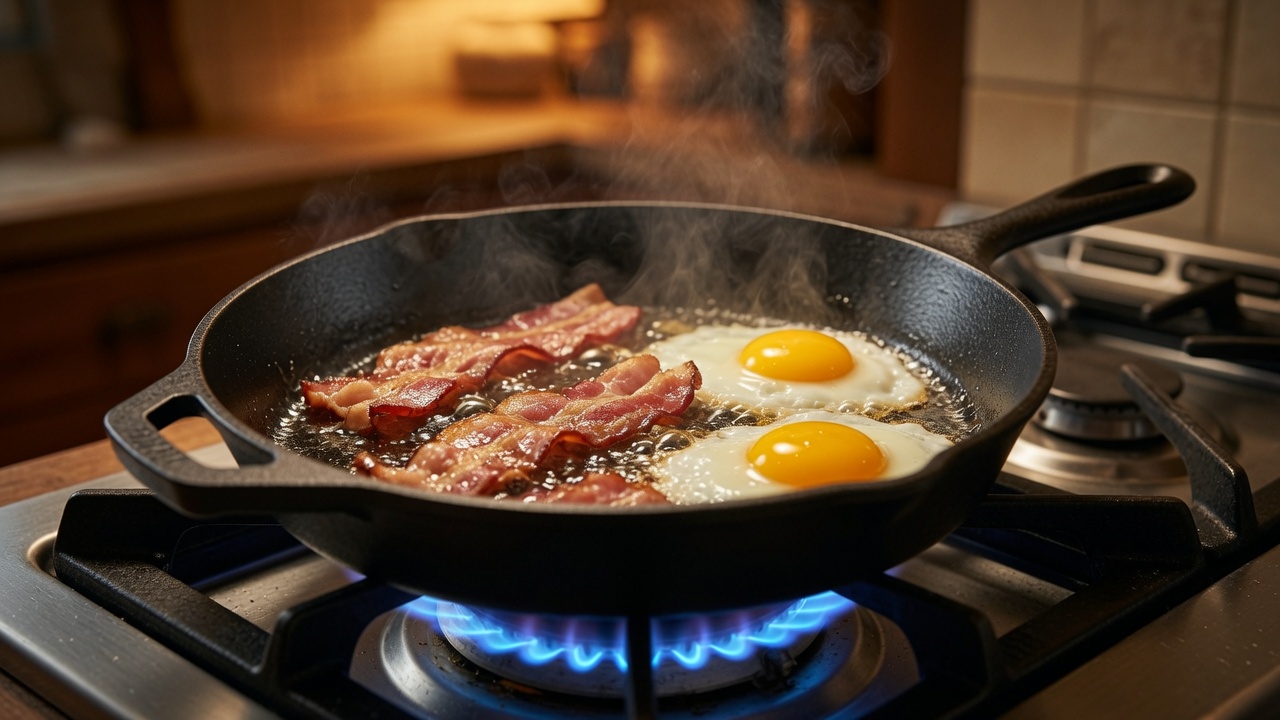
Most cookware is built to be replaced. Cast iron is the one thing in the kitchen built to be handed down — a $35 pan, or a $3 rescue, that cooks for the rest of your life and your grandkids’ too.
Walk down the cookware aisle and almost everything you see is built to wear out. The nonstick pan you buy today, you will throw away in three years when the coating flakes — then buy again, and throw away again. Cast iron is the one exception on the whole shelf. Season it, cook on it, wipe it out, and it does not wear down — it gets better. That is why a plain iron skillet is the rare thing worth buying at fifty and still using at ninety, and why so many kitchens have one that belonged to somebody’s grandmother. If you are past fifty — the people this site is named for — this is about as gentle as preparedness gets: one good pan, bought once, that never asks you for another dime. Here is how to get a great one for almost nothing, whether you buy it new or dig it out of a $3 box at a garage sale.
The Cheap Shelf — You Do Not Need a Fancy Pan
New cast iron is one of the few things worth buying new and cheap. There are no electronics, no coating to fail, no special parts they can stop making — it is a slab of iron, and the plainest one cooks the same as the priciest. This is the opposite of the shelves where the expensive name really does buy you something. Here, the expensive name mostly buys you a nicer box.
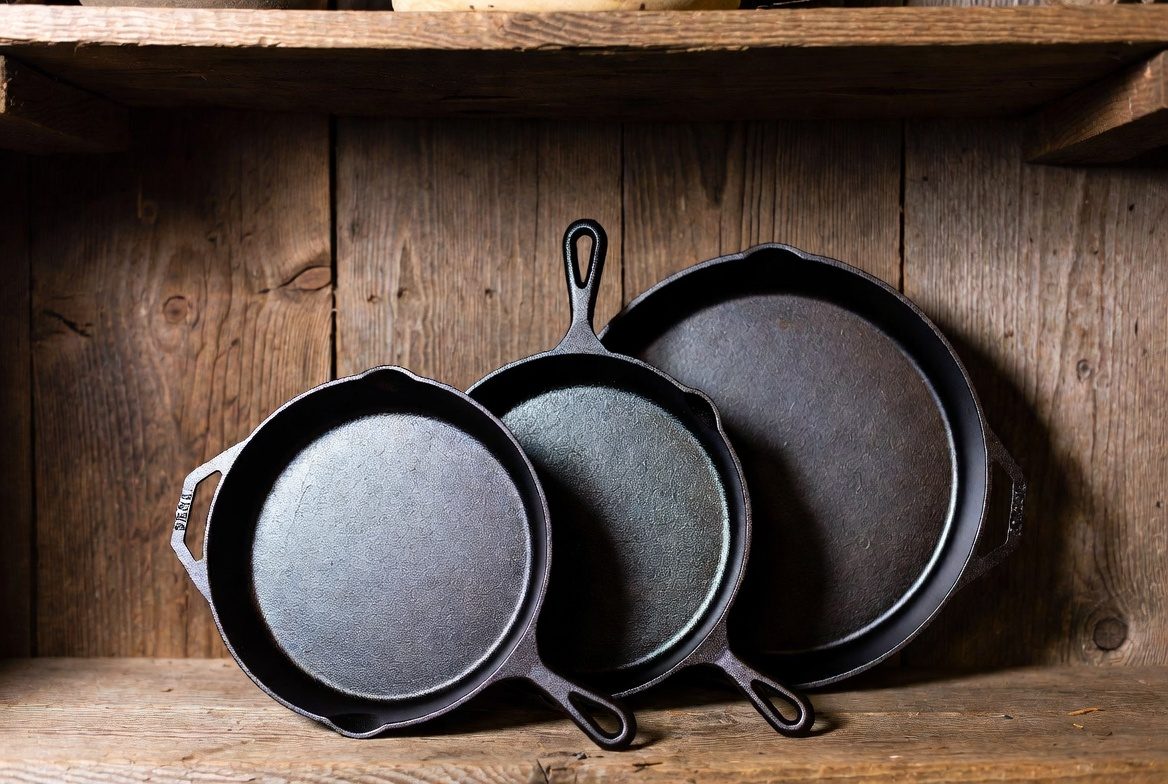
A plain three-pan starter set — a small, a medium, and a big skillet — runs about the price of a single middling nonstick pan, and comes pre-seasoned so you can cook on it the day it lands on your porch. The century-old American brand every hardware store carries starts at around five dollars for a small skillet all by itself. You are not buying a name here. You are buying iron, and iron is cheap. See cast iron starter sets on Amazon.
The whole starter kit, for about the price of one pan that would not have lasted: a small for eggs, a medium for everyday, a big one for company. “Pre-seasoned” means you can cook on it tonight — the deep shine comes later, with use.
Which three sizes, and what each is for, is really the whole buying decision — and it runs straight into the one honest drawback of cast iron, its weight. We will size it to your hands down below. First, the reason the old pans are the ones people fight over.
Smooth vs. Pebbly — Why Grandma’s Pan Cooks Better
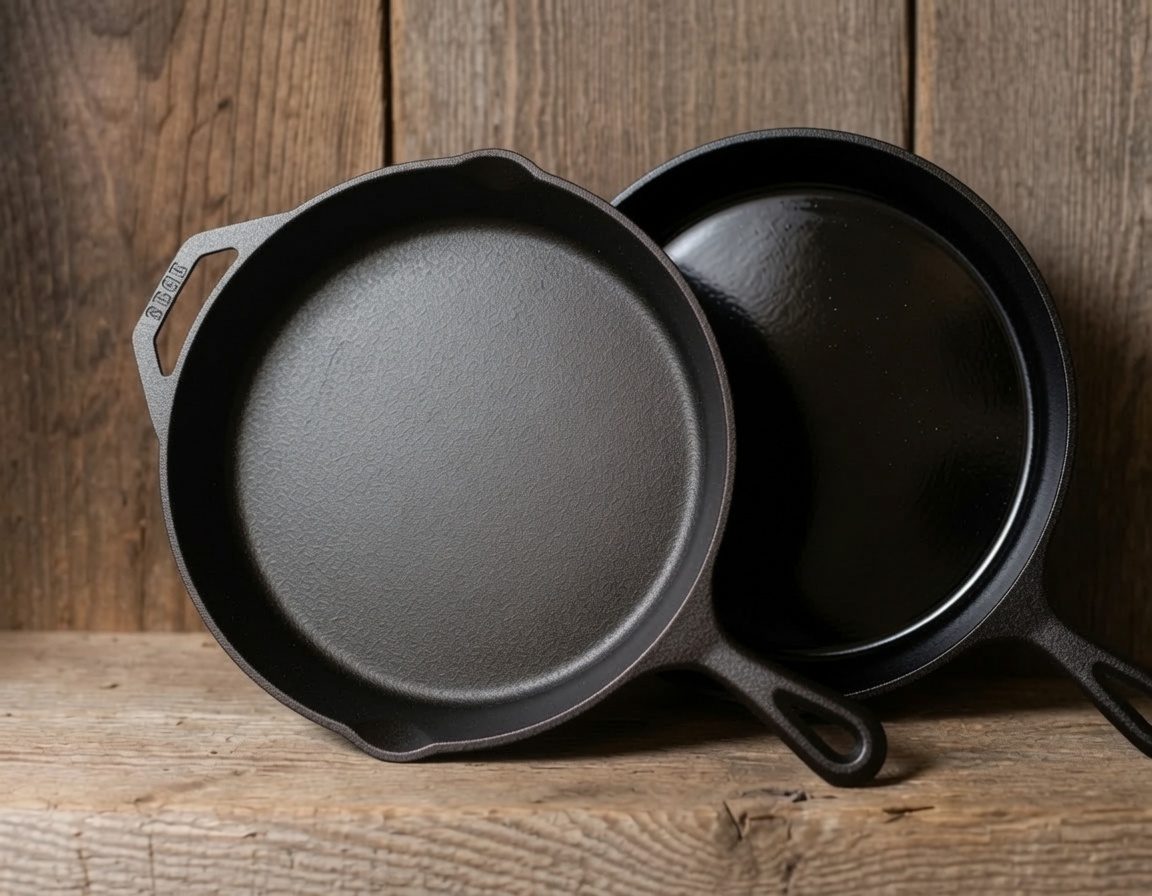
Run a finger across a brand-new skillet and it feels a little like fine sandpaper — a pebbly, sandy grain. Run it across a pan made before about 1950 and it can feel like glass. That is not age, and it is not wear. It is how they were made.
A hundred years ago, the good American makers — the great old names like Griswold and Wagner — poured iron into sand molds like everyone still does — but then they set the cooking surface against a grinding wheel and polished it mirror-smooth. That polishing took real labor and real time, and somewhere around the 1950s and ’60s the whole industry quietly dropped it: cheaper molding machines, cheaper imports, and the arrival of nonstick all pulled the market toward “good enough.” So today’s pans come out of the mold pebbly and go straight in the box. Same iron. One finishing step, gone.
Now the honest part, because this site does not oversell: a rough modern pan cooks just fine once it is seasoned, and plenty of good cooks actually prefer the pebbly surface, because fresh seasoning has something to grip. The smooth old pans do have a real edge — food releases easier from the very first fry, and they tend to run a little lighter too (more on that below) — but a well-used modern skillet closes most of the gap on its own. So knowing the difference is not about being a snob. It is about walking up to a table of junk at a garage sale and knowing which black pan in the box is the good one. That is the skill this whole site is built on: nobody ever showed you what to look for, so here it is.
The whole difference, side by side: on the left, the sandy, pebbly grain a modern pan wears straight out of the mold; on the right, a cooking surface worn smooth as glass, the way the old machined pans came. Your fingertip finds it faster than your eye does.
The Hundred-Year Pan — Living Proof
Here is the argument for cast iron that beats anything I can write down: somewhere in a lot of families there is a black skillet that is a hundred years old and still cooks dinner. I have my grandmother’s. It has outlived the stove it started on, the house it started in, and most of the people who ever ate from it — and it will fry you an egg this morning as well as it did the day she got it. Try to name one other thing in your kitchen you can say that about.
That is the part of cast iron you can never get from a price tag. It is not sold as an heirloom. It just quietly becomes one, because there is almost nothing to break: no coating to flake, no motor to burn out, no part they stopped making forty years ago. Crack it, or leave it out in the rain for a decade, and even then it can usually be brought back. A pan is the rare purchase where the hundred-year-old version is not a fragile antique — it is the proof that the new one will last just as long.
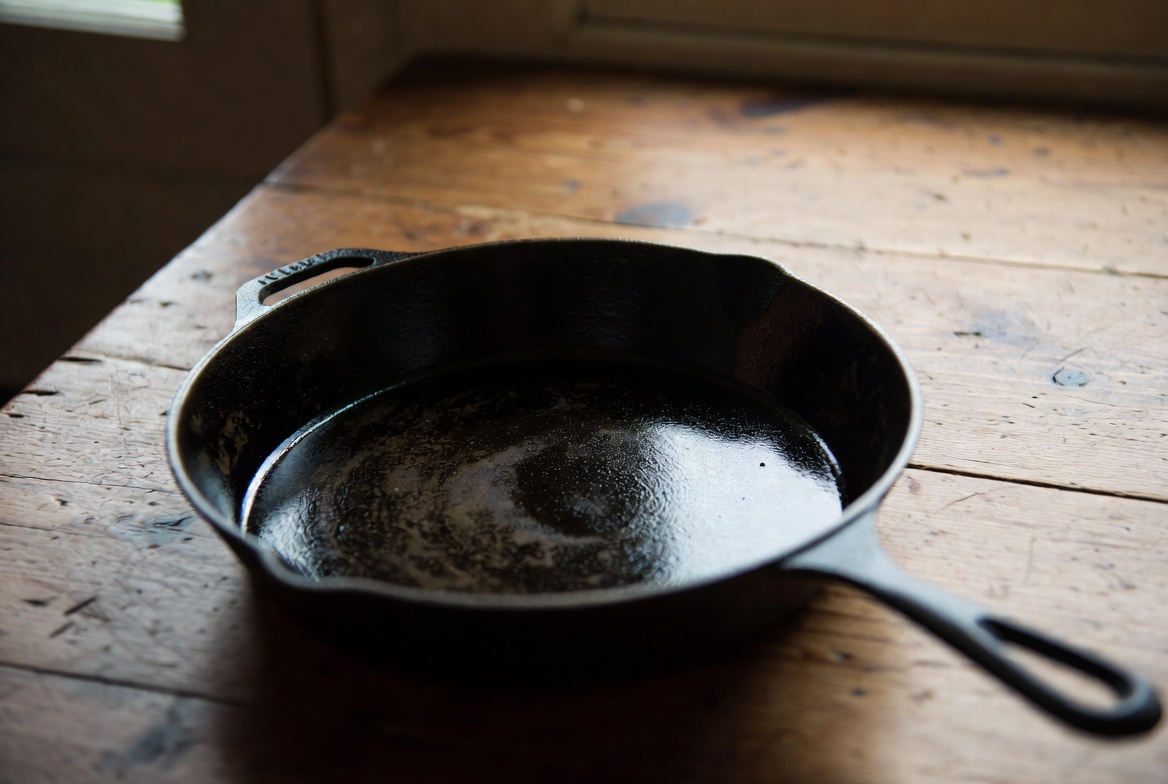
Living proof, still on active duty. A pan like this one was never bought to be special — it just never had a reason to quit.
Polish First, Then Season — The Curing How-To
Here is a trick the internet is full of and the pan aisle will never mention: if your new skillet came out pebbly, you can give it that old glass-smooth surface yourself, right at the workbench, before you ever season it. Folks call the whole business “curing” a pan. It is a Saturday project, not a chore, and it turns a barely-there $35 skillet into one you reach for every single day.
The idea is simple — smooth the rough surface first, then build the seasoning back on top of the smoothness. In order:
Strip it to bare metal first. Whatever seasoning or gunk is on there has to come off, so that you are sanding iron and not grime.
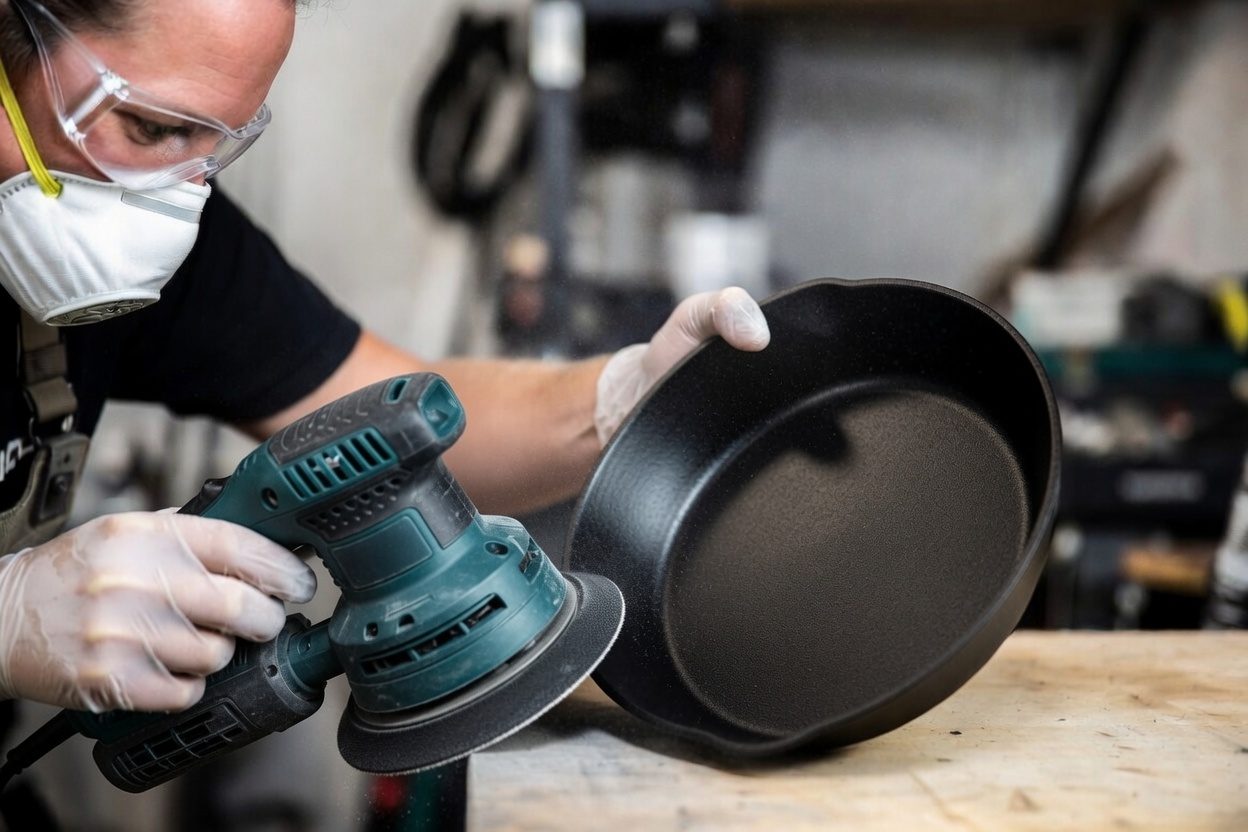
Sand from coarse to fine. Start with a rough grit and work your way up to a fine one. A random-orbital sander handles the flat bottom, and a little flexible pad chucked in a drill gets down into the corner where the wall meets the floor. Let the tool do the work — leaning on it digs divots and thin spots. Stop when the surface feels like glass and shines back at you. If a sander is a stranger to you, the corded tools guide covers the ones worth owning.
Clean off every speck of metal dust. This is the step people skip and regret. Wipe it down until a clean paper towel comes away clean — because any dust left behind bakes into your seasoning and leaves it gritty for good.
Season it in thin coats. Wipe on a whisper of a high-smoke-point oil — so little it looks like there is none left at all — and bake it. Then do it again. Three to five thin coats beat one thick coat every time; pile it on thick and it turns sticky and gummy instead of hard and slick.
Two honest cautions. First: never do this to an enameled pan — the pretty colored ones with the glassy baked-on coating. Sanding destroys that coating for good and ruins the pan. This is for bare black iron only. Second: this is power-tool work — safety glasses, a dust mask, and gloves, every time. And it is genuinely optional. Plenty of good cooks never sand a pan in their lives; a rough skillet seasons up and cooks fine with regular use, and the smoothing just gets you there faster and slicker. If the sander is more than you want to take on, season the pan exactly as it came and let years of cooking do the polishing for you.
The Saturday version of a hundred-year-old finish: smooth the surface, clean off every trace of dust, then build the seasoning back in thin coats. Safety glasses and a dust mask are not optional when the sander is running.
Everyday Care — Washing It and Putting It Away
Here is the good news after all that seasoning talk: keeping a cast iron pan is about the easiest thing in the kitchen, and the whole after-dinner routine takes about a minute. It has exactly one enemy — water left sitting on bare iron — and once you know that, the rest is simple.
Washing
Wash it while it is still warm, with hot water and a stiff brush or a chainmail scrubber. Most of what is stuck comes right off. For the stubborn bits, do not go at it with a chisel — simmer a little water in the pan for a minute to loosen them, or scrub with a spoonful of coarse salt, which works like a gentle sandpaper and rinses away.
And about soap, since everybody asks: the old rule that you must never use soap is left over from a hundred years ago, when soaps were made with harsh lye that really would strip a pan. A little mild dish soap on today’s well-seasoned iron is perfectly fine. What actually ruins a pan is two other things — never let it soak in the sink, and never put it in the dishwasher. Those are what strip the seasoning and start the rust. Soap is not the enemy. Standing water is.
Drying — the step that matters most
Dry it right away, and dry it all the way. This is the one rule never to skip, because rust starts the minute you set a wet pan down and walk off. Towel it dry, then set it over a low burner for a minute to chase off the last of the moisture you cannot see. When it is warm and completely dry, you are almost done.
A thin coat of oil, then away it goes
While the pan is still warm, wipe the thinnest film of cooking oil around the inside with a paper towel — a film so thin you would swear the towel came away dry. That is the seasoning topped up for next time. Then put it away bone-dry. If you stack your pans, slip a paper towel or a cloth between them so they cannot trap damp against each other. And if the pan has a lid, do not seal it on tight for storage — leave it cracked so the air can move, or the trapped moisture will rust the inside while it sits.
That is the whole of it: rinse warm, wipe dry, a drop of oil, put it away. No soaking, no hard scrubbing, no wrestling — light work for any pair of hands. And it is exactly this one-minute habit that turns a $35 pan into the hundred-year pan from up above. The care is the inheritance.
One thing that follows straight on from this, and it is the part people throw away without thinking: the fat you cook in is worth as much as the pan. Bacon grease and rendered lard were the default cooking fat in every kitchen that produced those hundred-year pans, they keep for months, and they cost nothing because you already bought them once. There is a whole page on saving and using bacon grease and lard, including how long each one actually keeps and when to throw it out.
The Garage-Sale Find — A $3 Pan Under the Rust
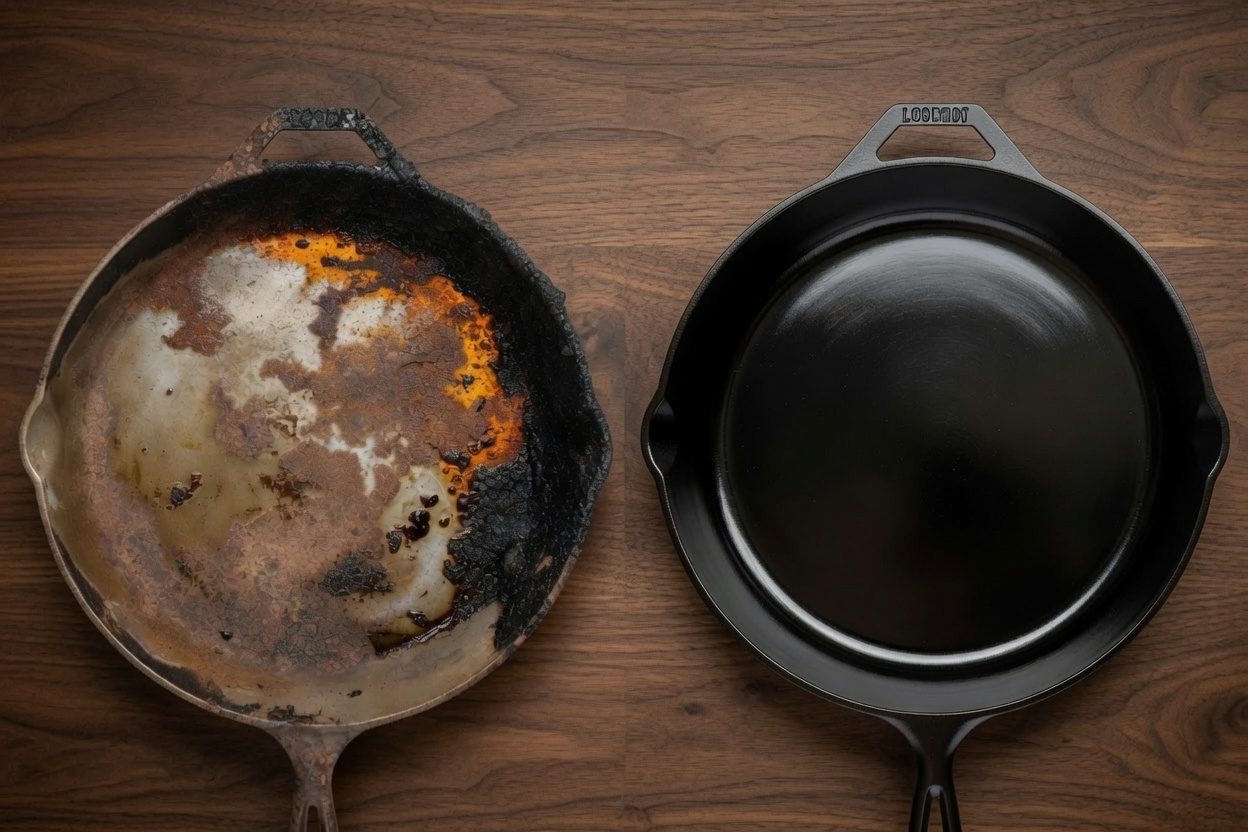
Three dollars and an afternoon: the same kind of pan before and after. Almost everything wrong with the one on the left is just rust and old grease — both come off, and the good iron underneath was never in doubt.
This is the part I love, because it is the whole idea of this website in one black, crusty skillet. At a lot of garage sales and estate sales there is a cast iron pan nobody wants — rusty, wearing fifty years of burnt-on grease, looking fit for the scrap pile. Three dollars, maybe five. And under that rust there is a real chance you are holding a smooth old American pan that sells restored for well over a hundred. Rust is not death for cast iron. It is almost always just a bad afternoon that scrubs right off.
Before you hand over your three dollars, look for a few things:
The maker’s mark on the bottom. Flip it over. A name or logo cast into the underside tells you who made it. The names collectors chase are the old American makers that long ago closed their doors — Griswold above all, and Wagner, with a few rarer ones like Wapak and Favorite. One honest catch on Wagner: the original foundry closed for good in 1999, so the good old pans turn up at sales cheap — but a new company now sells modern pans under the Wagner name, and those reissues are not the vintage piece you came for. A pan with one of these proud old marks was somebody’s good pan, and it can be yours for a few dollars.
A smooth surface under the crud. Reach past the rust and feel the inside. Glassy-smooth means an old machined pan — the good kind, the kind from the lesson above.
No cracks, no wobble. Set it on a flat counter and press the edges. If it rocks or spins, it warped in some long-ago fire — walk away. A hairline crack, same answer. Rust you can fix; a crack or a warp you cannot.
Bringing one back is honest work, not magic. Strip it all the way down to bare gray metal — a lye bath or an electrolysis tank does the heavy lifting, and a long soak in cheap vinegar handles light rust — and once it is clean iron with no rust or old gunk left anywhere, it is a perfectly safe pan again. Then you cure and season it exactly like the new one above. One quiet caution, learned the hard way by people before us: know a mystery pan’s story if you can. Every so often an old skillet spent its later life in a workshop instead of a kitchen — melting lead sinkers and the like. If a pan clearly lived in a garage rather than on a stove, let that one go. There are plenty that didn’t. The story behind this site was written on shopping trips exactly like these.
The Weight Question — An Honest Word for Older Hands
Cast iron has one real drawback, and this site is not going to pretend otherwise: it is heavy, and it gets heavier the bigger it is. Past a certain age, a pan you cannot lift safely — especially full, especially one-handed, especially over a hot stove — is not a good pan, no matter how well it cooks. So size it to your hands, not your ambitions.
What Each Size Actually Weighs
A modern skillet, empty — before you add a pound of dinner to it
8-inch skillet~3.5 lb
The everyday pan for one or two. Light enough for most hands, and the one to reach for first.
10¼-inch skillet~5 lb
The all-arounder — and about the top of comfortable one-handed lifting for a lot of us.
12-inch skillet~8 lb
Two hands, and heavier still with food in it. Think hard before you buy the big one.
A full 12-inch skillet coming out of a hot oven is a two-handed, oven-mitts, clear-your-path job. There is no shame at all in owning the 8 and the 10 and skipping the 12 entirely. And there are good ways around the weight:
Buy smaller. The 8- and 10-inch pans do the great majority of home cooking. You rarely need the monster.
Look for the lighter lines — and the old pans. Some makers now sell a lighter skillet that shaves around 15% off the standard weight. And here is the happy overlap with everything above: those smooth vintage pans were cast with thinner walls, so a good old skillet is often both smoother and lighter than a new one — a win twice over for tired hands.
Consider carbon steel for the big jobs. It is cast iron’s lighter cousin: it seasons the same way and takes the same fire, but weighs far less for the same size. A carbon-steel pan can be the “big skillet” your wrists will actually pick up.
Use both hands and the helper handle. Most skillets have a little stub handle opposite the long one. It is not decoration — it is where your second hand goes. Use it every time the pan is hot or full.
The handle gets hot too — so cover it
Here is the one thing about cast iron that catches everybody at least once: the whole pan heats up, handle and all. There is no cool plastic grip like the pans you may be used to — take hold of that handle bare off a hot burner and you will get burned, and a burn is a bigger deal at seventy than it was at thirty. The fix costs a few dollars and never wears out.
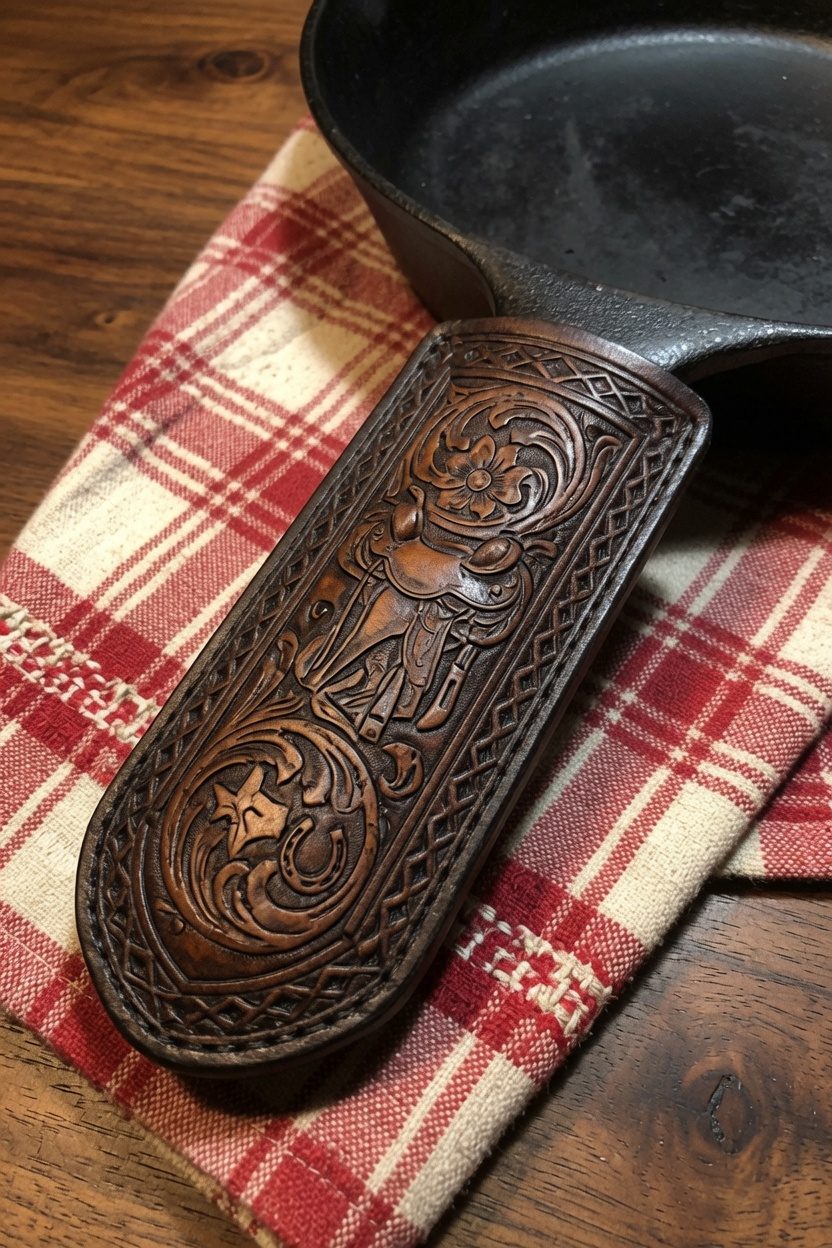
Slip a handle cover onto the handle and leave it there. A tooled leather sleeve like the one below is the handsome version — it looks like it belongs on the pan and lasts for years. A little silicone one does the same job for a couple of dollars and grips even better. Either one beats the old habit of reaching for the handle with a folded dish towel, which slips right when you need it and, left near the flame, can catch fire. Buy one, push it on the day the pan comes home, and let it live there — a cover in the drawer never saved a hand. See handle covers on Amazon.
The safe way to grab a hot handle: a leather sleeve that slides on and stays put. Leather like this lasts for years; a couple-dollar silicone one works just as well. Leave whichever you pick right there on the handle.
Buy It at Fifty — The One Time the Name Is Literal
Most of what this site tells you to buy at fifty is about getting out ahead of a bill that only grows — the electrician who costs more every year, the part that gets harder to find. Cast iron is the gentlest version of that whole idea, and the most literal one. There is no rush here, no rising price, no tradesman to book. There is just a $35 pan — or a $3 one you rescued — that you season once, cook on for the rest of your life, and hand to somebody who will do exactly the same.
Think about what that means next to the alternative. The nonstick pan is the opposite bargain: buy it, use it, throw it out when it flakes, buy the next one — a small tax you go on paying every few years, on and on. The iron skillet is bought once and never again. Run the arithmetic out over thirty years and the “expensive” pan turns out to be the cheap one. That is the pennies-not-dollars math this whole site runs on — and the story behind the name was written by a man who learned it at a workbench, over a discounted water heater, from a grandfather who never scrimped on quality but saved every time he could.
❓ Plain Answers
The short version of this page, one question at a time — the answer is always the first line.
Can you use soap on cast iron?
A little mild dish soap is perfectly fine on today's well-seasoned cast iron. What actually ruins a pan is letting it soak in the sink or putting it in the dishwasher.
How do you clean and store a cast iron skillet?
Wash cast iron warm, towel it dry and set it over a low burner, wipe on the thinnest film of oil, and put it away bone-dry. Its one enemy is water left sitting on bare iron.
Why are old cast iron pans smoother than new ones?
Old American cast iron pans had their cooking surface polished smooth on a grinding wheel, a step the industry dropped around the 1950s and '60s. A rough modern pan still cooks just fine once it is seasoned.
How heavy is a cast iron skillet?
An empty modern cast iron skillet weighs about 3.5 pounds at 8 inches, about 5 pounds at 10¼ inches, and about 8 pounds at 12 inches. The 8- and 10-inch pans do the great majority of home cooking.
Is a rusty cast iron pan still good?
A rusty cast iron pan can almost always be brought back, as long as it has no cracks and does not rock or spin on a flat counter. Strip it to bare gray metal, then season it. Let go of any pan that clearly lived in a garage rather than on a stove.
What old cast iron brands should I look for at a garage sale?
The old American cast iron names collectors chase are Griswold above all, and Wagner, with a few rarer ones like Wapak and Favorite. The original Wagner foundry closed for good in 1999, and modern pans sold under the Wagner name are not the vintage piece.
Now go find your pan.
New off the shelf for about thirty-five dollars, or three dollars and an afternoon at a garage sale — either way, you are buying the last skillet you will ever need.
Non-stick pans are a subscription you pay every few years; a cast iron pan bought at a garage sale for three dollars will still be cooking when your grandchildren inherit it.
General Information Disclaimer: This page is general educational information, and some links are affiliate links (we may earn a commission at no extra cost to you). It is not electrical, engineering, medical or trade advice, and it was not written by a licensed electrician.Generators, camp stoves and any fuel-burning appliance produce carbon monoxide, which is invisible, odourless and kills people every year after storms — never run one indoors, in a garage, or on a covered porch, and keep a working battery carbon-monoxide alarm. Anything behind the cover of an electrical panel, and any permanent connection between a generator and a house, belongs to a licensed electrician and is subject to local codes and permits. If you have a pacemaker or any implanted medical device, ask your cardiologist before using induction cooking equipment. Nothing on this page is legal advice. None of it was written by an attorney, and it is not a substitute for speaking to one about your own situation.Full disclaimer →