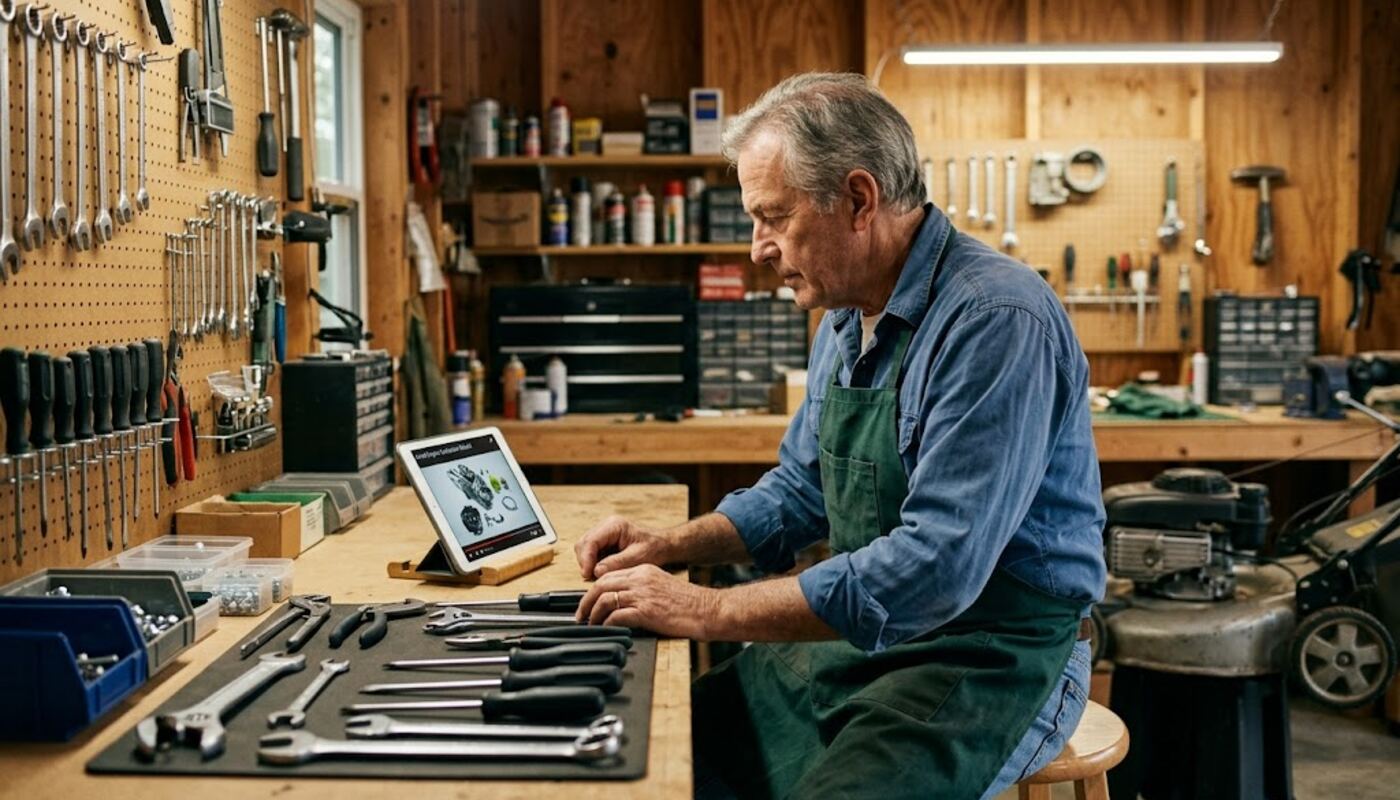
💬 The $280 Question
🪠 The Snake and the Estimate — Crystal River, Florida
“The bathroom drain backed up on a Tuesday. The plumber’s office quoted me $280 and offered me ‘sometime Friday, maybe Monday.’ Twenty years ago I would have paid it, because twenty years ago I had a job and no time. But I am 71, and what I have now is the opposite arrangement. I watched two YouTube videos over coffee — ten minutes — drove to the hardware store, and bought a toilet auger for eighteen dollars. The clog took me about fifteen minutes, and I will be honest, five of those were me being proud of myself.
Here is the arithmetic I want every 50-year-old to hear: that auger hangs in my garage now. It has cleared three clogs in two years — mine, my neighbor’s, and my daughter’s. Call it $800 in plumber visits, retired by an eighteen-dollar tool and a video made by a plumber in Ohio who explains it better than my own father did. The tool was never the hard part. Knowing it was possible was the hard part.”
— Retired route salesman, 71, Crystal River, Florida
⏳ Three Times as Long, Nine Times the Time — Hernando, Florida
“I wanted to replace that faucet myself for more reasons than the $340 a plumber wanted to fix it for me. Here is the truth about people like me: when you get diagnosed with something debilitating, something with a name you learn to pronounce and a future you learn not to ask about, a belief starts growing in you that you are permanently broken. You sit back. You get careful — then too careful. You stop pushing yourself at all, for fear of overdoing it and landing somewhere you cannot come back from. And one day you notice that what you are really doing in that recliner is waiting. I will say it plain, because somebody out there needs it plain: you start waiting for death. I have arthritis in both hands and a heart that gets a vote in everything I do, and I was further down that road than I like to admit.
“So the first thing I did was the thing I would tell anybody in my shape to do: ask somebody who actually knows. For me that was my doctor. His nurse called back the next morning, and his answer surprised me — most of it was about my breathing. Go ahead, he said: staying active beats sitting still for both of my conditions. But never strain against a stuck fitting while holding my breath — that bearing-down business is hard on a heart. Breathe through the effort. Let penetrating oil and leverage do what muscle should not. Work in short sessions, rest before my hands demand it, come up slow from under the sink, and chest pain or dizziness means stop and call, not push through. It made sense the moment I heard it — I knew that breath-holding feeling; I had felt it a hundred times without knowing it mattered. And knowing gave me something I had been short on: confidence. The nurse added her own line at the end: ‘He says he would rather clear you for a faucet than treat you for a recliner.’
“The faucet took me two afternoons that would take a young plumber forty minutes. That was the plan, not the failure: small, measured steps are how a man like me keeps the stress from ever piling up into something dangerous. Shut the water off and got the old one loose on Tuesday, sat when I needed to sit, quit while it was still going well. Wednesday I set the new one, snugged the lines, and checked for leaks with a paper towel like the video showed.
“And then I went back to my recliner — the same one — and sat in it a different man. Proud. I had done something for myself that was worthwhile, with these hands, in this condition. People who have never been sick cannot know what a little victory like that is worth. It is hope, is what it is. You are not just sitting there waiting anymore — you are still, on whatever limited basis your body allows, taking care of yourself, and what that does for your sense of worth I cannot fully explain. You are not broken. You are not helpless. You are challenged — and life is full of challenges. From that chair I started seeing other little challenges around the house that I could take on. I had to: between the medicine and the doctor visits, either I figure out how to do these things myself or they do not get done.
“Because here is the last piece. When you have owned a home a long time — a home full of your memories — you cannot just sit in the chair and watch it fall apart around you. Every broken thing becomes a daily reminder of your limitations. You stare at it, and it stares back, until somehow it gets fixed. If somebody else fixes it, that is nice. If you fix it, that is a victory — a moment of pride, and proof that you are not as helpless as you had come to believe. Everything takes me three times as long as it used to. I have nine times the time I used to. You do that math. The faucet does not know how fast it was installed. It just knows it does not leak — and I know who fixed it.”
— Retired school custodian, 74, Hernando, Florida
🏚️ The Four-Dollar Hinge — Ocala, Florida
“Every cabinet door in my kitchen was drooping like it was tired, and the handyman’s minimum service call is $150 before he touches a screwdriver. My granddaughter drove me to one of those nonprofit salvage stores — the kind that rescues good parts out of houses being remodeled — and we walked out with a paper bag of solid brass hinges, better than anything in my kitchen, for eleven dollars. One YouTube video, one screwdriver, one slow Saturday with the radio on — and my granddaughter right there beside me the whole day, holding each door steady while I set the screws, reading the next step off her phone, taking her turn with the screwdriver on the low cabinets while I supervised from a chair. Every door in that kitchen closes like the house is new, and we did it together.
The part nobody tells you: those stores are full of exactly what an older house needs — hinges, doorknobs, faucets, cabinet doors, even grab bars — at garage-sale prices, every day, and the money goes to a charity that builds homes for families who need them. My kitchen got fixed, some family got a little closer to a home of their own, and the handyman kept his $150 bill. I have been back four times.
“And the real arithmetic of that Saturday? The hinges were eleven dollars. The kitchen works like new. But what we were really building was not cabinet doors. Grandparents get to show a child life from a different place than anyone else can — a slower place, a patient place — and what that girl learned at my elbow was not hinges. She learned that she can do real things, important things, with her own two hands. That is a thing a person carries forever. She will remember that Saturday — the radio, the screwdriver, the doors closing one by one — until the end of her own long life, the way all of us carry the days our grandparents let us help. And my dearest hope is that someday, a long time from now, she hands a screwdriver to a grandchild of her own and passes the whole thing on. The memories of a day spent working side by side with my granddaughter — priceless. That is the only word for it. Priceless.”
— Retired bank teller, 77, Ocala, Florida
📇 The Memo at 4:30 on a Friday — Inverness, Florida
“For twenty years my Saturday habit was garage sales. I bought tools I had no particular plans for — a pipe wrench for three dollars, a box of clamps for five, one time a bench grinder for fifteen that the man apologized for charging me for. My wife teased me about it. My whole defense, every time, was the same sentence: maybe one of these days I’ll need it. Nothing was ever expensive. And over twenty years, three and five dollars at a time, it quietly put a complete shop at my fingertips in our two-car garage.
Then came 4:30 on a Friday, and a memo to everyone in my office: checks were coming, and the company was ‘going in a different direction.’ The direction did not include me. I was lucky in exactly one way — I was a couple of months from 62. But nothing makes you reevaluate your life choices like sitting at your own kitchen table staring at roughly $2,000 a month where $4,500 take-home used to be. The house was paid off, thank God — a modest two-bedroom, two-bath — but it was thirty years old, and I had spent a decade putting off its repairs because I was ‘too busy,’ because I needed my weekends to rest up and stay sharp for a job that let me go by memo.
Here is the silver lining, and it took me a while to see it: I had spent twenty years accidentally preparing for that Friday. The list of repairs I had been putting off met the garage full of tools I had been collecting, and it turned out they were made for each other. The water heater elements, the soffit, the toilet that ran, the fence, the disposal — one by one, on $2,000 a month, with YouTube on the tablet and a three-dollar pipe wrench in my hand. I thought I had been collecting bargains all those Saturdays. I had been building a pension. Maybe one of these days I’ll need it — well, one of those days came. And I was ready before I ever knew what I was getting ready for.”
— Laid off at 61, doing fine at 67, Inverness, Florida
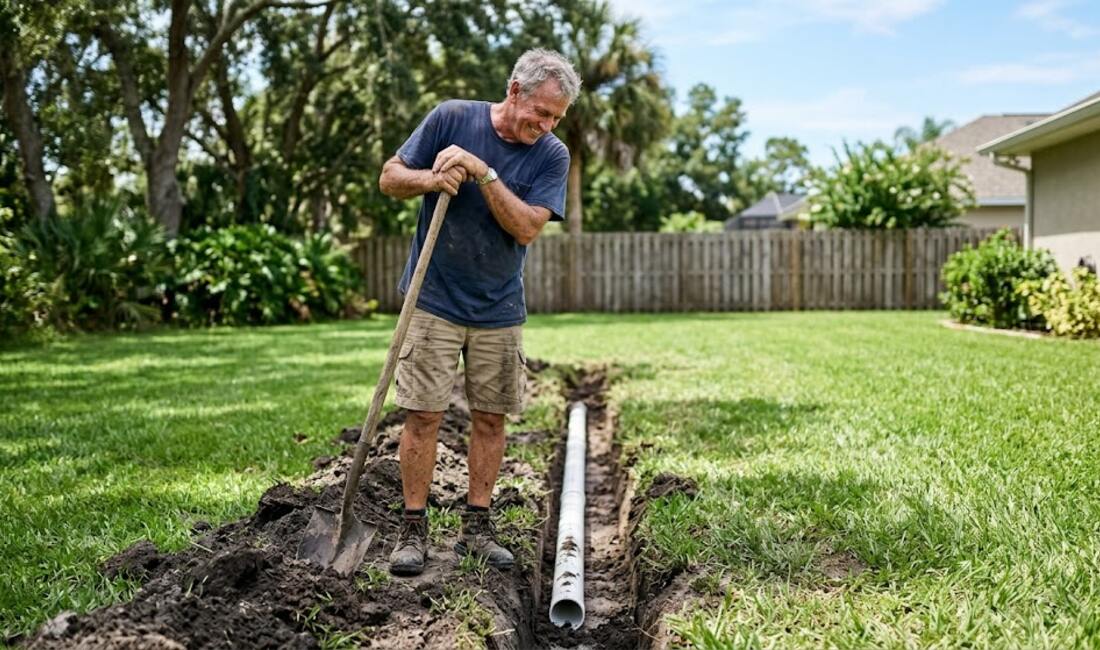
🚽 Thirty Feet of Pipe, One Hundred Dollars — Citrus Springs, Florida
“I am 60, healthy, in decent shape — and the four-inch pipe running from my house to the septic tank cracked. Thirty feet of it needed replacing. The contractors’ estimates started around $700 and ran to $1,500, and every one of those numbers would have taken a real bite out of my savings. So I asked the question that changed the whole week: why is it so expensive? I went online to the big box store and priced it myself — the pipe, the fittings, the glue. Less than a hundred dollars. The other $600 to $1,400 was labor. And labor, as it happens, is the one thing a retired man has in stock.
My wife got me onto YouTube years ago — she learned canning from our garden off it, then bread, then brownies from scratch. I am a veteran, and I found the veteran channels first; they reminded me of when I was stronger and, somehow, more important than a 60-year-old staring at a hole in his backyard. Then I found the plumbing channels. I watched a man lay that exact pipe, and I thought: I can do this. It might take me four or five days, and what a smelly mess it will be. But I could afford a hundred dollars without touching savings. And the first call I made was not to the pipe aisle — it was to 811, the free call-before-you-dig line the YouTube man was adamant about. Two days later a fellow came out at no charge and marked where the power and the other utilities ran under my yard, and I laid out my trench knowing nothing down there could surprise me. One free phone call, and the scariest part of the whole job was crossed off before the shovel ever touched grass.
Four days — and here is a detail you had better plan for: with that line cut, our house had no working bathroom, so our good neighbors two doors down handed us a key and the use of theirs for the duration. That arrangement cost me a box of doughnuts and a promise to return the favor, which is exactly the kind of economy neighbors run on. I dug out the old pipe, set the new run with my level pitched slightly downhill exactly the way the YouTube man said, glued it all up, filled it in, laid the grass back, and watered it. While I was watering, my wife hollered out the window, ‘Can I try the shower?’ Ready or not. While she showered I opened every cold tap in the house — cold only; a man does not chill his wife’s shower and expect a peaceful evening — and let it all run for half an hour. Then I shut it down, walked the trench, and stomped every foot of it looking for wet spots. Dry. I went inside, sat down at the kitchen table, still half-hoping I had done it right — and knowing for certain I had just saved somewhere between $600 and $1,400 for a few days’ work. My back hurt. My knees hurt. But I could do it. And I did do it.
“One thing I would do differently, and I will own it here: I never pulled a permit, because I figured an inspector was a man whose job is telling you no. I have since learned better — inspectors are mostly on your side. They check your slope, they confirm your connections, and they make sure you never have to dig that trench twice. If I had known that then, I would have driven down and pulled the permit before the first shovelful, and slept even better that night. Hindsight is always 20/20 — so borrow mine, and make that call along with your 811 call.”
— Veteran, 60, Citrus Springs, Florida
A friendly word from the site on that one: septic and sewer lines in most counties require a permit and inspection — and inspectors are on your side; they confirm the slope and save you from re-digging. Check your county building department before the shovel goes in. And before ANY shovel goes into ANY yard: call 811 first — the free national “call before you dig” line. They mark the buried gas, power, and water lines in your yard at no charge, usually within a few days. It is free, it is the law in most states, and it is the difference between a plumbing project and a very bad afternoon. The digging, the pipe, and the savings are still all yours.
💜 His Tools Finally Introduced Themselves — Weeki Wachee, Florida
“Ed did everything around our house for forty-one years, and then one Tuesday he was gone, and I was 63 years old in a house full of his tools that I had never once touched. The first time something broke — the toilet ran all night — I cried, and not about the toilet. Then I did what my granddaughter is always telling me to do: I looked it up on YouTube. A nice young man showed me a rubber flapper, eight dollars, no tools at all. I drove to the hardware store that same afternoon, and a clerk walked me right to the little package. The next morning — before breakfast, before I had even dressed, still in my nightgown — I could not wait any longer. I lifted that tank lid and fixed it in about four minutes, and then I sat on the edge of that tub and laughed and cried at the same time.
That eight-dollar flapper started something. The wobbly towel bar. The sticking door Ed always meant to plane. The kitchen faucet sprayer. One video at a time, one slow afternoon at a time, out in the garage with his tools — and I will tell you the strangest sweet thing: using them feels like he is helping. His tools finally introduced themselves to me. I am not handy. I am just a widow with YouTube, patience, and a garage full of a good man’s good tools. It turns out that is almost the same thing as handy.”
— Widow, 65, Weeki Wachee, Florida
🏃 Behind and Moving — Homosassa, Florida
“Here is our honest truth: neither of us ever expected to live this long. We were wild once, and we did not plan, because planning felt like a bet on a future we did not believe in. Then we went and lived anyway — and arrived at 68 with Social Security, no tools, no shop, and a fixed income that laughs at contractor estimates. Playing catch-up at our age is humbling. It is also completely possible, and that is the part nobody tells you.
We put a line in the budget: twenty-five dollars a month, for catching up. That is it. Every Saturday we make the rounds — garage sales, the church rummage, the online marketplace, the salvage store. A corded drill for ten dollars. A pipe wrench for three. A whole box of wrenches for five. A bench vise for twenty that the young man was thrilled to be rid of. Two years of Saturdays at twenty-five a month, and there is now a real workbench in a garage that used to hold boxes — and last month we fixed our own leaking trap under the kitchen sink, off a video, with that three-dollar pipe wrench. We are behind. We know we are behind. But behind and moving beats behind and waiting, every single Saturday.”
— Married 44 years, both 68, Homosassa, Florida
📋 From the record — the stories above are composites; these numbers are not. The Memo at 4:30 is statistically the most common retirement story in America: a landmark ProPublica / Urban Institute analysis of the national Health and Retirement Study found that 56% of workers who enter their 50s in stable, long-held jobs are laid off or pushed out before they choose to retire — and only about 1 in 10 ever earn as much again, with household incomes in that group falling by roughly 40%. The salvage stores in the Ocala story are real and nearly everywhere: Habitat for Humanity ReStores alone number about 900 nonprofit reuse stores across 49 states, and their proceeds fund home construction for families in your own county. And the Hernando doctor’s advice is the standard one: CDC physical-activity guidance for older adults says people with chronic conditions should be as active as their abilities safely allow, in consultation with their doctor — because for most conditions, moving beats the recliner. The names on this page are invented. The arithmetic is not.
🧮 The Retirement Math — Which Can You Better Afford?
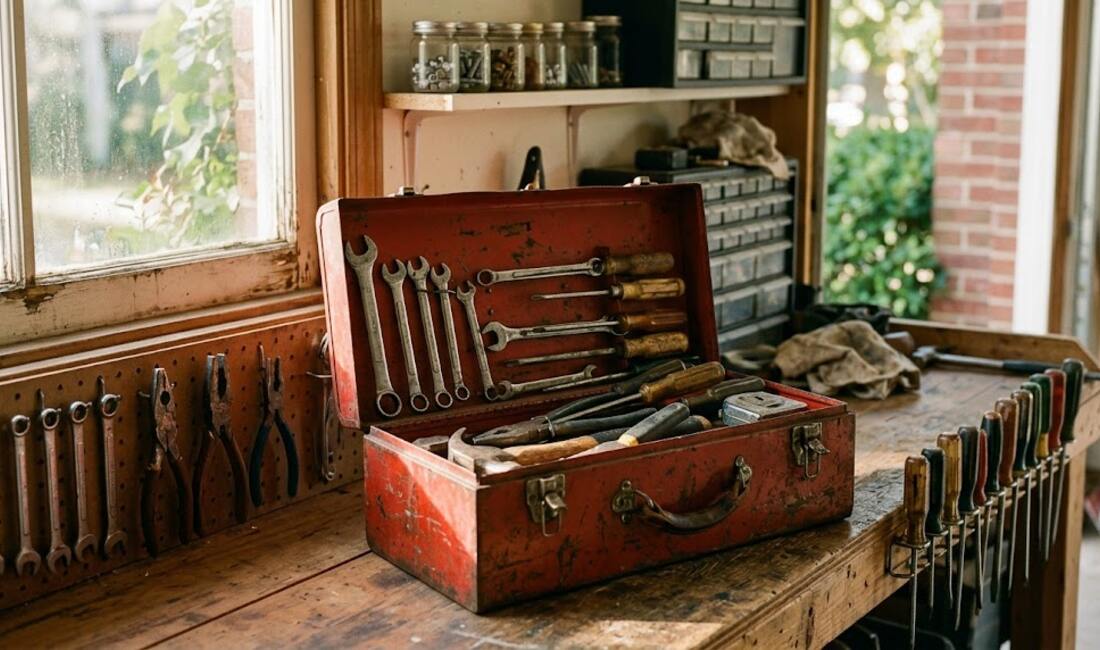
Working people trade money for time — they pay the plumber because Saturday is all they have. Retirement reverses the trade, and almost nobody updates their math. On Social Security and maybe a small pension, a $280 service call is real money. An afternoon is not. Ask the question the way the man from Crystal River asks it: which do you think you can better afford at 60 or 70 — hundreds of dollars, or fifteen minutes of your time? And the service call has a second price nobody bills you for: the waiting. Maybe they come today. Maybe a week from today. Your leak does not wait with them. If you have the tools, you know the job starts today — and if it takes into tomorrow, tomorrow is yours too.
This is also why this whole section of the website says buy the tools at 50: the toolkit assembled on working income is the one waiting in the garage when the fixed-income years arrive with a dripping ceiling. The hand tools and corded tools pages are the shopping list. This page is the reason.
⏳ Time Is the Superpower — The Health-Issue Reframe
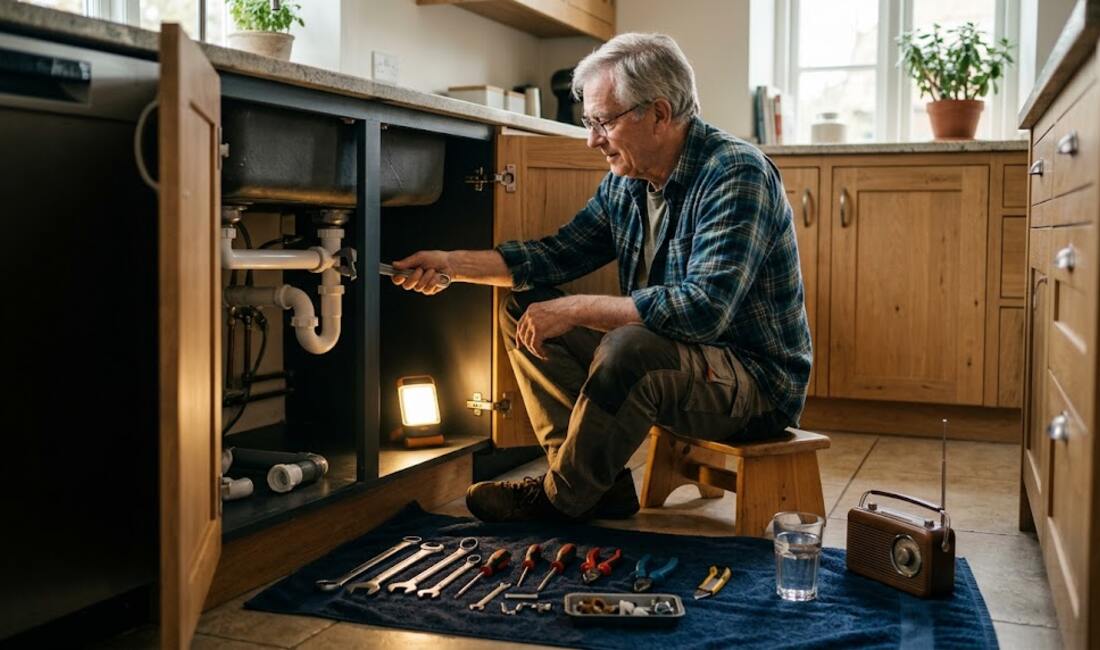
Read this sentence twice, because it changes retirements: a health issue mostly does not stop you from doing things — it makes them take longer. And you are retired: longer is exactly what you have. The faucet does not care that it took two afternoons. The hinge does not care that you sat down twice. Work the way retired bodies work best:
- Break every job into sessions. Shut off, disassemble, rest. Install tomorrow. A professional cannot afford to work this way; you can afford nothing else — and the result is identical.
- Set up the job like you plan to enjoy it: a stool to sit on, a good light (your headlamp earns its keep here), every tool laid out before you start, water within reach, radio on.
- The vise and the clamps are your extra hands — let the bench vise hold the work while your hands do only the skilled part.
- Quit while it is still going well. The last hour of a tired day is where knuckles get skinned. The job will be there in the morning, and so will you.
🤝 The Buddy System — And the Honest Mirror
Here is a tip that costs a cup of coffee and has saved more retirees than any tool on this page. If a job feels like it might be a little much for you — but you are bound and determined to try it — do not do it alone. Use the buddy system. Most retirees know other retirees. Offer one a cup of coffee, or a cold beer for afterward, to come sit in a lawn chair and keep you company while you work. That is the whole job description: sit there, sip, visit, and be present. Because if something goes sideways — you bump your head coming out from under the sink, the knife slips, your balance picks a bad moment — help is not a phone call and a prayer away. Help is right there, holding a coffee. And here is the secret both of you will learn: the watcher enjoys it. Retirees like being useful, and supervising a friend’s plumbing with commentary is one of the great unsung pleasures of the age.
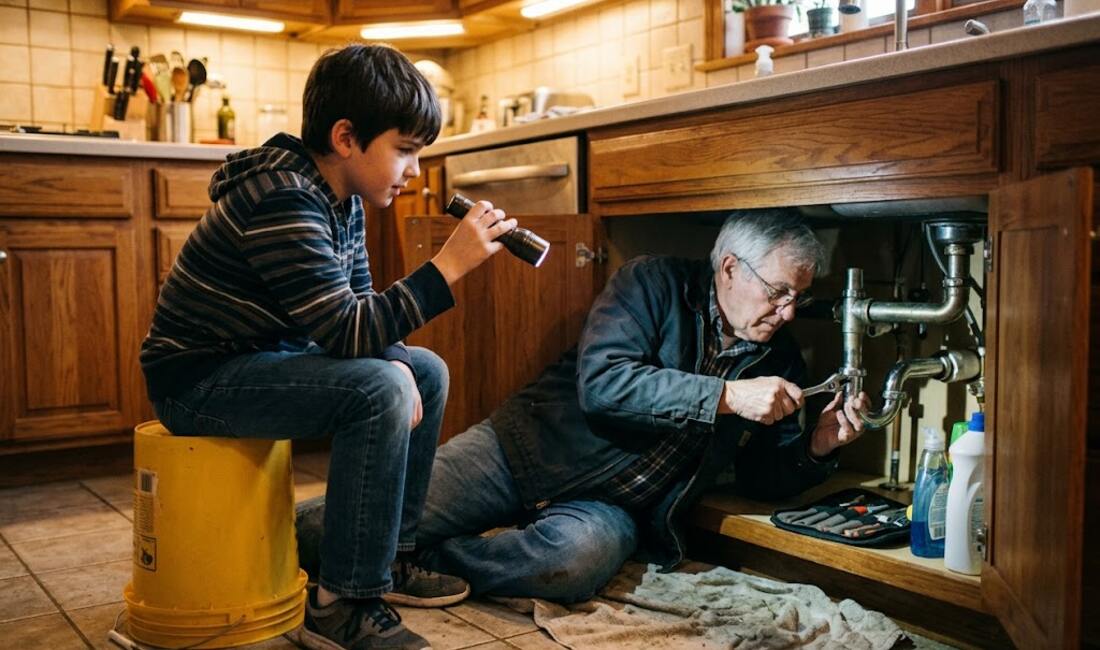
The best buddy story we know: one retiree we know of has his twelve-year-old grandson with him on weekends, the way family situations sometimes arrange things. The boy sits on an overturned bucket and supervises, and his grandfather swears there is no better encouragement in the world than a twelve-year-old who believes you can fix anything. And every so often, Grandpa hands him the flashlight, or lets him tighten the last screw — so the boy feels like he is doing something too. Which he is. He is doing the most important job on the site: making sure Grandpa is never working alone. One of them is learning tools. Both of them are learning something better.
Now the honest mirror — and read this in the encouraging voice it is written in. Do not be afraid of these jobs. But be honest with yourself about them, one question at a time:
- Can you hold that wrench — and push against it hard enough to actually break the fitting loose? Not “probably.” Honestly.
- Can you grip that screwdriver or that screw gun firmly enough to drive the screws home — ten of them, not just the first one?
- If you cannot lift a two-by-four, do not lift a two-by-four. Have it delivered, have the grandson carry it, or cut the job into pieces you can lift.
- If walking across the street winds you, do not stand on anything to replace a ceiling fan. That is not a fitness test worth taking. Overhead work on a ladder is the honest line for a lot of us — and there is no shame on either side of it.
Be sensible. Take your precautions. Nobody is going to hold it against you — not the neighbor, not your kids, and certainly not this website. Adjust the job to the body you have today: sit instead of kneel, two sessions instead of one, the buddy in the lawn chair, the grandson on the flashlight. And if a heart, lung, or balance condition is part of your picture, have the five-minute conversation with your doctor about physical projects before the season of them starts — not because you cannot, but so you know exactly how you can. Because the arithmetic of this entire page collapses at the emergency room door: the last thing you want is to save a hundred dollars on a plumbing bill and spend it back tenfold on a co-pay — plus three or four weeks out of commission, during which nothing in the house gets fixed at all. The honest mirror is not the voice telling you that you cannot do it. It is the voice that makes sure you are still standing there, tools in hand, for the next twenty years of jobs.
📺 YouTube University — Free Tuition, Every Repair Ever Made
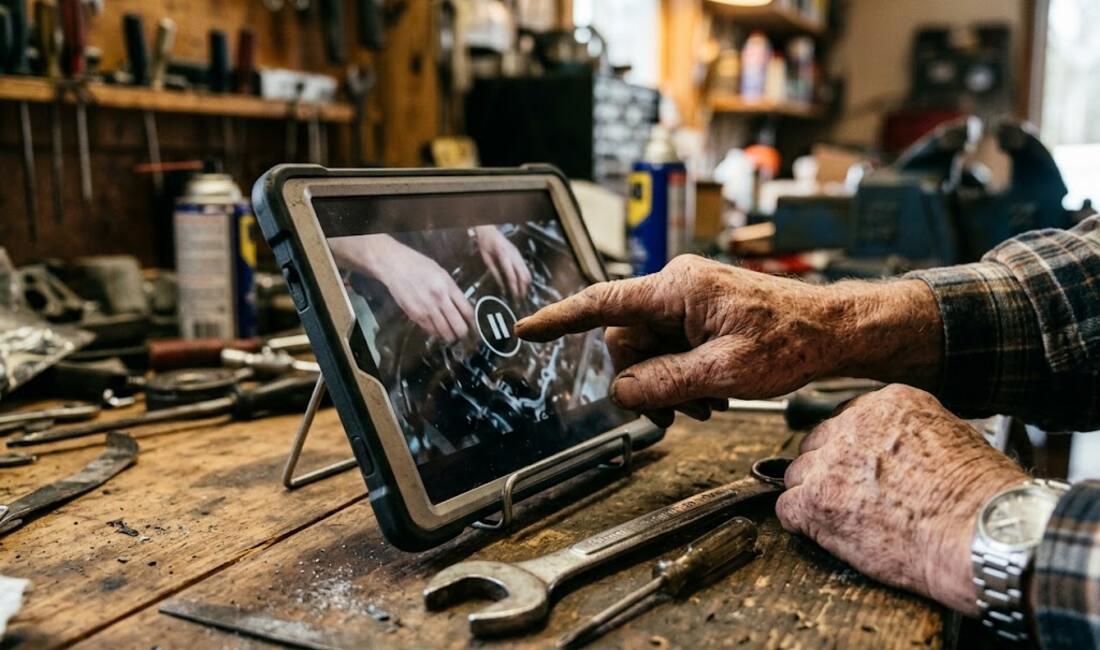
Thanks to YouTube, you can learn to fix just about anything in your house — taught by working plumbers, electricians, and carpenters who explain it plainly, for free, as many times as you need to watch. How to use it like a tool:
- Search specific: “how to replace cabinet hinge,” “how to use toilet auger,” “replace wall outlet” — and add your fixture’s brand or the model number off the label for an exact match.
- Watch the whole video once before touching anything. Then watch again with tools in hand, pausing at each step. The pause button is the patient teacher every one of us wished for at 25.
- Watch two different videos on the same job — where they agree is the truth; where they differ is a judgment call, and now you know it is one.
- Believe the comments — if a video skips a step, five hundred people have said so underneath it.
🏚️ The Salvage Secret — Good Parts From Good Houses

Before any repair sends you to the big box store, know about the salvage and reuse stores — nonprofit outfits (Habitat for Humanity’s ReStores are the famous ones, and most areas have independent architectural salvage yards too) that rescue good components out of houses being remodeled or taken down, and sell them for a fraction of new. Hinges for a few dollars. Solid-wood cabinet doors. Faucets, doorknobs, light fixtures, sometimes grab bars and lever handles — often better made than today’s replacements, because they came out of houses built when hardware was hardware. For a fixed-income household fixing up an aging house, these stores are the difference between “not in the budget” and “done by Saturday” — and the money funds housing charity on its way through. Playing catch-up in your 60s? This is where catch-up shops.
🔧 Five Fixes That Pay for the Whole Toolkit
- 1. The drooping cabinet door — a $4 hinge. Two screws out, two screws in, and the door closes properly for the first time in years. The gateway repair — do this one first and the rest of the list stops looking hard. Shop Cabinet Hinges →
- 2. The slow drain — a $15–30 toilet auger (the “snake”). If you have never met one, look it up — a crank handle and a flexible cable that clears what the plunger cannot. That $200–300 plumbing bill becomes ten or fifteen minutes of your time. Which can you better afford? Shop Toilet Augers →
- 3. The dead outlet or crusty light switch — $3 in parts. Breaker off, tester proves it dead, two wires, YouTube on pause. (The full safety ritual is in the red box below — it is short and absolute.) Shop Outlet Testers →
- 4. The weeping PVC joint — $10 of pipe and primer. A cracked fitting under the sink is a hacksaw, a coupling, purple primer, and glue — and catching it yourself this week is what keeps a leak from destroying your footing, your floors, and your ceilings. Shop PVC Repair Kits →
- 5. The dripping faucet — a washer or a cartridge. Two afternoons at retirement pace, hundreds saved, and the drip stops paying your water bill. Shop Faucet Repair Kits →
Total tools and parts for all five: well under $100. Any single professional visit costs more — and there will not be a single visit over twenty years; there will be dozens.
🛑 The Honest List — What You Never Touch
Electricity has one ritual, no exceptions: the breaker goes OFF, and a $10 outlet tester proves the power is dead before a screwdriver comes near a wire — never trust the switch, never trust memory, trust the tester. Work on outlets and switches only — and two honest caveats even there: some jurisdictions require a permit even for outlet swaps (a two-minute call to your building department settles it), and if your home has aluminum wiring (common in houses wired in the late 1960s and early 1970s — the wire is silver-colored instead of copper), outlet and switch work belongs to a licensed electrician, full stop; aluminum connections have special requirements and real fire history. The breaker panel itself, anything gas, anything on a roof, anything requiring more ladder than a step stool, and any digging before 811 has marked the yard belongs to professionals — that is not timidity, it is the same good judgment that got you to this age. The whole art of fixing things at 70 is knowing which jobs are patient work and which jobs are risk. Patient work is yours now. Risk is what the phone is for.