💬 Three Nights, Three Lessons
Ask around after any long outage and the lighting stories all rhyme. These three cover the whole curriculum.
🔋 The Paperweights — Spring Hill, Florida
“We thought we were the prepared ones. Two beautiful rechargeable lanterns, always topped up on their little charging bases, glowing away like appliances from the future. Night one of the outage, they were magnificent. Night two, one died at nine o’clock and the other at ten thirty, and there we sat — two people who had spent eighty dollars on lanterns, in the dark, with no way to charge them because the wall they charged from was the whole problem.
You know what got us through the rest of that week? A dented old lantern of my father’s from the garage shelf that takes four D batteries, and the pack of D batteries I keep beside it because that is how he kept it. Thirty seconds to swap, light for another two nights, swap again. The rechargeables are still nice — we still use them first. But now they are the opening act. The D-cell is the one that finishes the week.”
— Retired postal worker, 70, Spring Hill, Florida
🔦 Both Hands — Crystal River, Florida
“My husband takes six medications, two of them at night, and one of them you do not want to get wrong. The first outage we managed with a flashlight, and I will tell you exactly what that looks like: one hand holding the light, one hand sorting pills, no hands left over to steady anything, reading labels in a wobbling beam. I did it, but I did not like it.
My grandson gave me a headlamp for Christmas — as a joke, I think, because of the camping ones he wears. The joke is on him. The light goes where I look. Both of my hands do their jobs. Pills, water glass, his arm when he needs steadying — all of it, lit, hands-free. I keep it in my nightstand drawer now and I have bought three more as gifts. Every one of my friends laughed first and then asked where I got it. That is the headlamp story, every time: laughed at, then borrowed, then bought.”
— Wife and caregiver, 74, Crystal River, Florida
🕯️ Two Houses Down — Hudson, Florida
“The night after the storm, half our street sat in candlelight, the way people always have. It looks cozy from the sidewalk. Two houses down from us, a candle on a kitchen counter met a paper towel roll while the family was out on the porch, and the only reason that story ends with a scorched countertop instead of a lost house is a neighbor who smelled smoke and did not talk himself out of knocking.
The firefighter who came out said something I have repeated ever since: the nights after a storm are some of their busiest, and it is almost never the storm — it is the candles, the generators in garages, the improvising. We bought flameless LED candles that fall. They flicker warm, the grandkids can knock them off the table all day long, and the batteries last a season. If you want the glow, buy the glow. Leave the flame in the drawer.”
— Grandmother of five, 68, Hudson, Florida
📋 From the record — the candle warning is not opinion. The Hudson story matches what fire departments see after every storm. In the National Fire Protection Association’s analysis, candles caused an average of roughly 12,900 home fires a year — about 136 deaths, 1,000 injuries, and $471 million in property damage annually — and NFPA found that candles used for light during a power outage pose a particular risk of fatal fire. More than one-third of candle fires start in the bedroom, and more than half happen because the flame was too close to something that could burn — exactly the sleepy, unfamiliar, dark-house conditions of an outage. It is why every emergency-management agency’s outage guidance says the same four words — never use candles; use flashlights — and why the flameless LED is not a lesser choice on this page but the recommended one. The names in the story are invented. The fire statistics are the reason it is on this page at all.
🔋 The Three-Lantern Mix — The Plan the Paperweight Story Teaches
Rechargeable + D-Cell + Solar: Each Covers the Others
Here is the trap in one sentence: a rechargeable lantern in a multi-day outage is a paperweight from night two onward, unless you can feed it from a generator, a car, or a power station — because the wall it charges from is the thing that failed. Rechargeables are not bad; they are the first shift. The plan is a mix where each type covers the others’ weakness:
- Rechargeable lanterns — the comfortable everyday workhorses. Bright, dimmable, no battery cost. Use them first; recharge them from the car or generator if the outage runs long. Many double as phone chargers — a genuinely useful bonus.
- At least one alkaline D-cell lantern — the finisher. Thirty seconds to swap batteries and it is full again, no grid required. Keep two sets of spare D-cells beside it — not inside it, because alkaline cells can leak over the years and ruin the light they were meant to save. Write the purchase date on the battery pack; quality alkalines store 5–10 years, lithiums even longer and they shrug off garage heat.
- One solar / hand-crank lantern — the backstop that cannot permanently die. A day on the windowsill or a few minutes of cranking buys usable light forever. Not the brightest light in the house; the most certain one.
Test day is already on your calendar: the time-change weekends, when you check the smoke alarms anyway. Click every lantern on, top up the rechargeables, check the battery dates. Ten minutes, twice a year, and no light in your house is ever a question mark.
💡 Lumens, Translated Into Plain English

Every lantern box shouts a lumen number, and almost nobody knows what the numbers mean in a real room. Here is the translation:
For the main living-area lantern, 300–500 lumens with a dimmer covers everything an evening asks. Bedrooms are happy at 100–200. The garage or breaker-panel light is where the 1,000-lumen numbers earn their keep.
The run-time fine print: that “runs 12 hours!” claim on the box is almost always measured at the lowest brightness setting. The same lantern may run 3 hours on high. This is not lying, exactly — it is marketing — but it is why the Spring Hill couple’s lanterns died at nine o’clock. Find the run-time at the brightness you will actually use, and plan your evenings on that number. A dimmer switch is not a luxury feature; it is how one battery charge becomes three evenings.
🔦 The Headlamp — Laughed At, Then Borrowed, Then Bought

The lantern lights the room. The headlamp lights whatever you look at, and leaves both hands free — and in an outage, both hands is the whole game. Sorting medications. Working a can opener. Steadying yourself on the grab bar. Helping a spouse. Resetting a breaker. Every one of those is a two-hand job, and every one of them gets done one-handed and badly by flashlight.
- One per adult, living in the nightstand drawer. $10–20 each. This is the cheapest line on the whole plan and the one people thank you for.
- Look for a red-light mode — it preserves your night vision and will not fully wake a sleeping spouse when you get up at 2 AM.
- Simple beats fancy: one button, AAA batteries or USB charging, a band that fits over a bare head comfortably. If it takes a manual, it stays in the drawer.
And a word to anyone reaching for the phone flashlight instead: in an outage, your phone is your 911 line, your weather radar, and your family lifeline — the one device on this page you should not spend as a light source. A $12 headlamp exists precisely so the phone can keep its charge for the job only the phone can do.
📍 The Placement Plan — Lights Live Where Fire Extinguishers Live
A lantern you cannot find in the dark is a lantern you do not own. The plan is the same one this site preaches for everything: a known light, in a known spot, in every room where the dark can catch you — and it never wanders. Like the fire extinguisher, its address is part of what makes it work.
🛏️ Every Bedroom
One lantern (100–200 lumens, dimmable) on or in the nightstand, plus the headlamp in the drawer. The reading light and the emergency light should be the same device.
🛋️ The Main Living Area
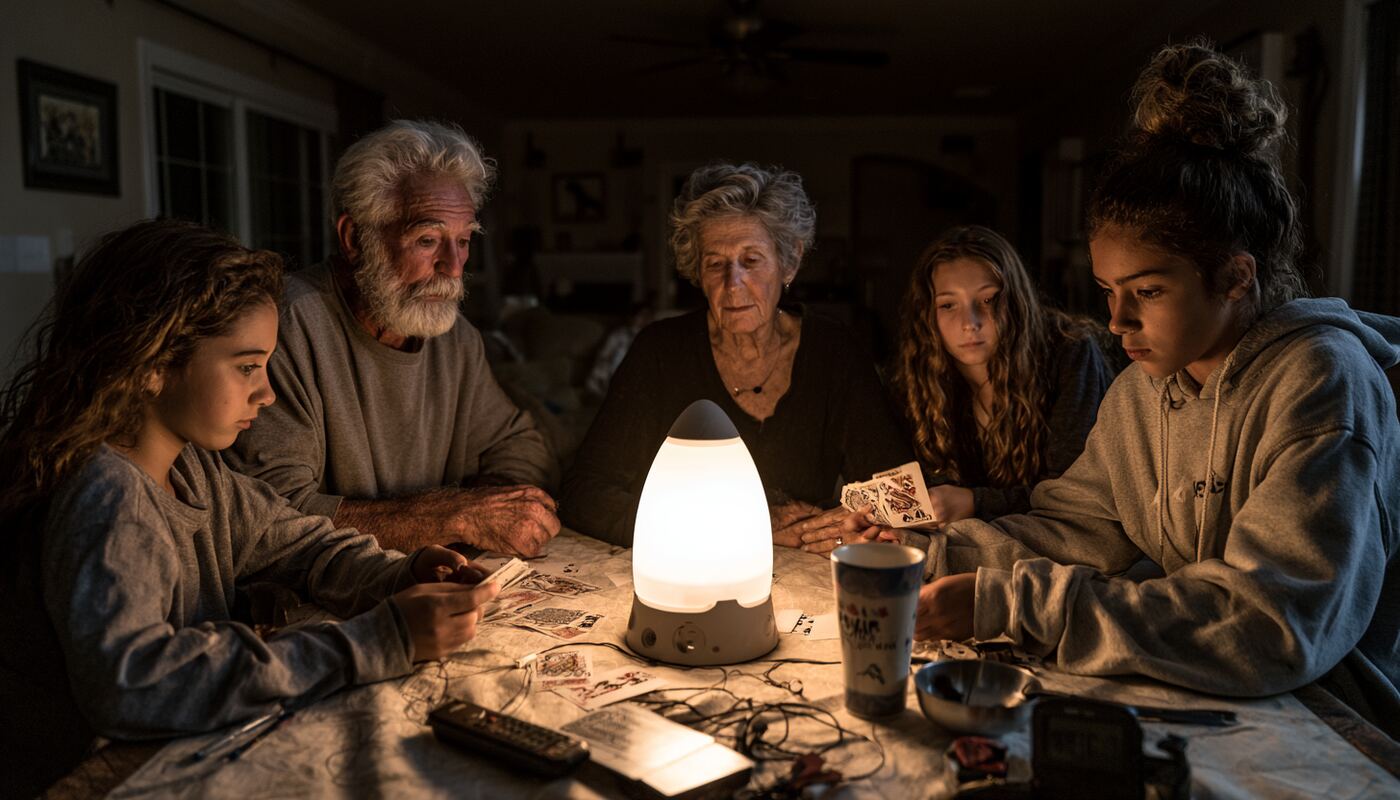
The big one — 300–500 lumens with a dimmer. This is where the household gathers, eats, and plays cards while the grid sorts itself out.
🚿 The Bathroom
A small lantern or puck light on the counter. The bathroom in the dark is this site’s least favorite room — pair it with the motion night lights that handle ordinary nights.
🍳 The Kitchen
Cooking by wobbling flashlight is how fingers meet knives. A lantern that hangs from a cabinet knob or stands on the counter turns the kitchen back into a kitchen.
⚡ The Breaker Panel
A cheap lantern or magnetic work light hanging right at the panel — because the first walk of every outage ends at that gray box, and it is always in the darkest corner of the house.
🚘 The Car & The Go-Bag
One more small lantern or headlamp in the glovebox and one in the go-bag. The outage does not always find you at home.
🕯️ The Candle Talk — Buy the Glow, Skip the Flame
The plain version: fire officials consistently urge battery light over candles during outages, and the days after a storm are reliably busy ones for fire departments — candles, garage generators, and improvised cooking do what the storm could not. An open flame in a dark, unfamiliar-feeling house with pets underfoot and tired people navigating by memory is a genuinely bad bet, and it is a bet nobody needs to make anymore: flameless LED candles give the same warm flicker for a few dollars, run a season on a battery, and can be knocked off the table by every grandchild in the county without consequence. If a real candle does get lit — it never burns unattended, and never while anyone sleeps.
That is the whole page: a mix that cannot all die at once, numbers you can translate, a light that leaves your hands free, a known spot in every room, and the glow without the flame. Total cost for a typical house, doing it right: $100–150. That is the difference between an outage being an ordeal and being an inconvenience with card games.
Frequently Asked Questions
How many lumens do I need in an emergency lantern?
Translate lumens into jobs: ~100 reads a book, ~300 lights a room for dinner, 1,000+ is a work light. For the main living-area lantern, 300–500 lumens with a dimmer covers everything. Caution: run-time claims are quoted at the lowest setting — check the run-time at the brightness you will actually use.
Are rechargeable lanterns or battery lanterns better for outages?
Both — that is the honest answer. Rechargeables are the comfortable first shift, but they become paperweights on night two unless you can recharge from a car, generator, or power station. Keep at least one alkaline D-cell lantern with spare batteries stored beside it (not inside it), plus one solar or crank lantern as the backstop that can never permanently die.
How long do batteries last in storage?
Quality alkalines hold most of their charge 5–10 years in cool, dry storage; lithiums store longer and handle Florida garage heat better. Write the purchase date on the pack, store spares beside each lantern, and rotate them at the time-change weekends when you test the smoke alarms and lanterns together.
Are candles safe during a power outage?
Fire officials consistently urge battery light instead, and post-storm days are among fire departments’ busiest — usually from candles, garage generators, and improvising rather than the storm itself. Flameless LED candles give the same warm glow with zero risk. A real candle, if lit at all, never burns unattended and never while anyone sleeps.
What is the best emergency light for reading in bed?
A headlamp, honestly — about 100 lumens on a warm or red setting, light aimed wherever you look, both hands on the book. Second choice: a small dimmable lantern on the nightstand. Either way, the reading light and the emergency light should be the same device in the same spot every night.