
✉️ The Month Nobody Prepares For
First, what this page is. A plain account of what happens to household money when a husband or wife dies, and what has to be claimed rather than received. It is not legal, tax or financial advice, it was not written by an attorney or an accountant, and nothing here tells you what you qualify for. Federal benefits work the same in every state. Probate, property tax relief and inheritance rules do not. Confirm anything here with the agency or the county before relying on it.
Everybody plans for the funeral. Almost nobody plans for the eleven months after it.
Here is what that stretch actually looks like. The mail keeps arriving, in the ordinary volume it always did, except now every envelope with a window in it is a question somebody has to answer. Some of them are bills. Some of them are notices that a benefit has stopped. A few of them — and this is the part that matters — are not there at all, because the money they represent has to be applied for and nobody sends a form to a house where somebody has died.

The person doing the answering is somewhere between sixty-eight and eighty-five, has just lost the person she talked things over with, and in a good many households has never been the one who handled the money. That is not a criticism of anybody. It is simply how a lot of marriages of that generation divided the work.
And so we should dispose of the feeling that arrives at about this point in the page. If a widow does not claim something she was entitled to, that is not a failure of attention on her part. It is a system that is opt-in by design — and a system that is opt-in by design is always claimed most by the households with an accountant, and least by the households that needed it.
The fix is not that she should try harder in the worst month of her life. The fix is that somebody tells her beforehand, in writing, while there is time to read it calmly.
That somebody is you, and it takes about an hour.
💰 The Check That Stops
Start with the one almost everybody has backwards.
A married couple drawing Social Security get two checks. When one of them dies, the survivor does not keep her own check and add a survivor benefit on top of it. She receives whichever of the two is larger, and the other one simply ends.
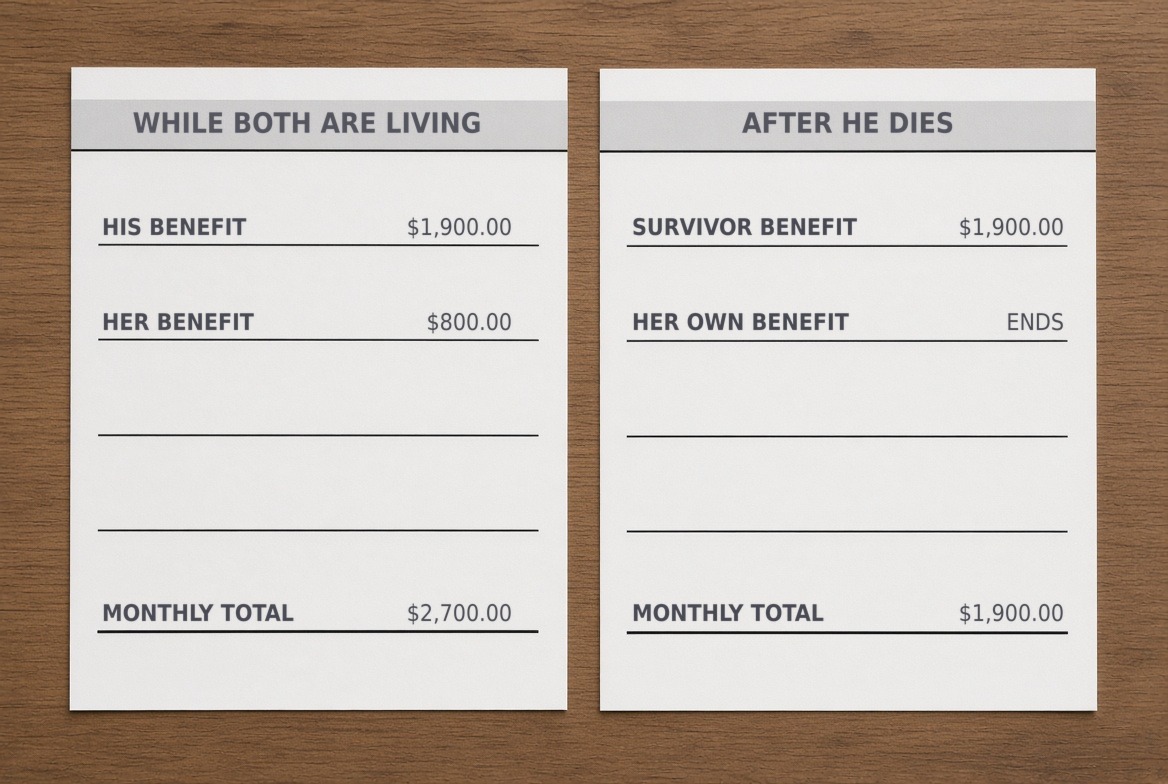
Read that picture the way a household budget reads it. Nothing was stolen and nothing went wrong. The rent, the insurance, the power bill and the property tax are all exactly what they were the week before — and eight hundred dollars a month has gone out of the house permanently.
Which way it falls depends on whose benefit was bigger. If his was the larger, she steps up to his amount and loses her own smaller one. If hers was the larger, she keeps hers and his stops. Either way the household ends up on one check instead of two, and it is always the smaller one that disappears.
Two details worth knowing before the arithmetic is done. A survivor benefit claimed before her own full retirement age is permanently reduced — it does not catch up later. And the Medicare Part B premium comes straight out of that check: $202.90 a month in 2026, up from $185.00 the year before. Whatever number you write down, take Part B off it before you decide anything.
There is also a lump-sum death payment from Social Security. It is $255, it goes to a surviving spouse who was living with the deceased, and it must be claimed within two years. That figure has not moved in decades. Set it beside the cost of an average funeral and it tells you plainly how much of that bill the government intends to carry. The rest of that bill, and the three or four ways it gets made smaller before anybody is grieving, is on the funerals and burial page — including the one instruction most planning advice gets backwards.
📝 The Money That Exists but Has to Be Asked For
Now the part that is genuinely worth money, and the part most often left on the table.
If your household includes a veteran, there is a monthly benefit for the surviving spouse called Dependency and Indemnity Compensation. It is tax-free at the federal level, it is adjusted for inflation every year, and it continues for the rest of her life. In 2026 the base rate is $1,699.36 a month. That is not a small correction to a household budget. That is most of what the missing Social Security check was.
Most people assume it only pays when a veteran dies of something the VA has already service-connected. That is one route to it, and it is not the only one.
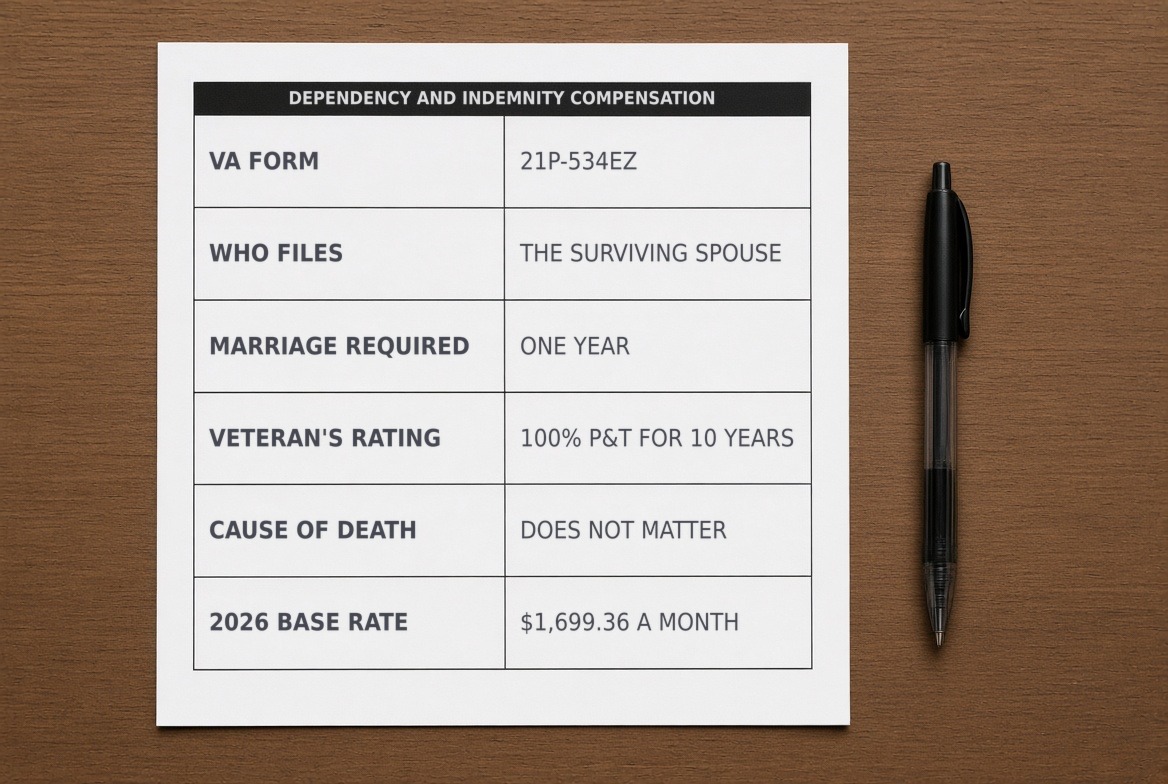
The second route is the one worth learning. If the veteran held a 100% permanent and total service-connected rating for the ten continuous years before death, the surviving spouse is entitled to the benefit regardless of what he actually died of. Heart attack, cancer, a fall, old age — it does not matter. What is being tested is the length of the rating, not the death certificate. There are two shorter variants of the same idea: five continuous years from the date of discharge, or one year in the case of a former prisoner of war.
The form is VA Form 21P-534EZ, and the effective date runs from when the VA receives the claim, not from when it is approved. Every month it sits unfiled is a month that cannot be recovered afterwards. A County Veterans Service Officer will help fill it in and will not charge for it.
Two other things sit in the same category of exists-but-must-be-claimed. Burial in a national cemetery is available to eligible veterans with no charge for the gravesite, the interment, the vault or the headstone — the family pays for everything else, but that is the single largest saving available to a great many households.
And property tax relief frequently survives the spouse. In a good many states a disabled-veteran exemption, a senior exemption or an assessment freeze passes to a qualifying surviving spouse who stays in the house and does not remarry. It does not, however, transfer itself. Somebody has to walk into the county office with a death certificate and re-apply. Rules here are state law and vary enormously, so the instruction on this page is not “here is the rule” — it is call your county assessor and ask what follows a surviving spouse.
⚠️ What The Internet Will Tell Her, and Why It Is Wrong
This section exists because of a specific error, repeated on a great many pages that rank well.
Search for that ten-year route to survivor benefits and you will find site after site — including several run by law firms — stating that the surviving spouse must have been married to the veteran for those same ten years. A widow married for four years reads that, concludes she is not eligible, and never files.
The statute says one year. Title 38 of the United States Code, section 1318(c), sets the marriage requirement plainly: the surviving spouse must have been married to the veteran for one year or more immediately preceding the veteran’s death, or have had a child born of the marriage. The ten years applies to the rating. It has never applied to the marriage.
There is a related rule that does use a long marriage, and confusing the two is probably where the error started. An additional amount — $360.85 a month in 2026 — is payable where the veteran was rated totally disabled for the eight full years before death and the spouse was married to him for those same eight years. That one genuinely does test the marriage. The base benefit does not.
So the two rules are different, and a page that blurs them costs somebody twenty thousand dollars a year for the rest of her life.
The practical instruction, and it generalises past this one benefit. When money is at stake, read the agency’s own page or the statute itself, not the summary. VA.gov, SSA.gov and the United States Code are free, they are searchable, and they are not trying to sell anybody a final-expense policy. File the claim and let the VA decide. An application costs a stamp. Talking yourself out of one on the strength of a blog costs everything the claim was worth.
✍️ The Signature That Decides It, Years In Advance
Everything above happens after a death. This one happens years before, usually at a desk, usually in about ninety seconds, and it settles more of a widow’s income than any other single document in the house.
If there is a traditional pension, the law does not leave the payout form to preference. Under federal law the default for a married participant is a joint and survivor annuity — payments continue for both lives, and the survivor’s portion must be at least half and may be all of what was paid while both were living.
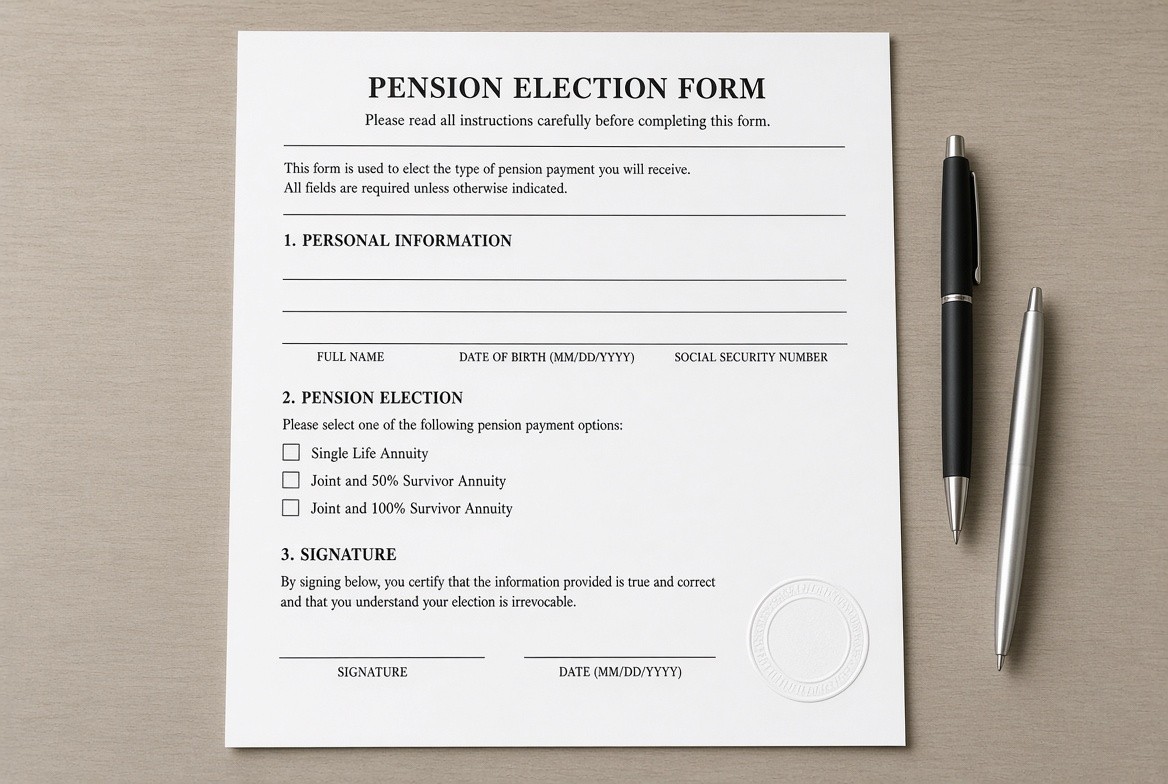
The single-life option pays a larger check every month for as long as the participant lives, and stops dead on the day he dies. It is genuinely the right answer for some households. But it can only be elected if the spouse consents in writing, witnessed or notarised. That consent requirement is the whole protection, and it works exactly as well as the conversation that goes with it — which is to say, not at all if the form is signed across the kitchen table with an explanation of nine words.
And there is an asymmetry almost nobody knows about. A 401(k) gives the spouse automatic beneficiary rights — naming somebody else requires her signed consent, the same as the pension. An IRA carries no such federal protection. The owner may name whoever he likes. Which means rolling a 401(k) into an IRA quietly removes a right she had, without any form crossing her desk, and nothing in the process announces it.
None of that is an argument for one choice over another, and this page is not the place to make that decision. It is an argument for a fifteen-minute job: find out, while both of you are alive, which accounts she is actually named on. A phone call to the plan administrator answers it. Most households have never asked.
One more piece of the same family. A surviving spouse is the only beneficiary in the tax code permitted to roll an inherited retirement account into one of her own and treat it as hers. That is worth knowing before anybody names a trust or a child out of tidiness.
📈 The Bracket That Closes Behind Her
Here is the one that catches people who did everything else right, and it happens automatically.
Most people believe a widow keeps joint tax treatment for two years. The status that does that is called Qualifying Surviving Spouse, and it requires a dependent child living in the home. A dependent parent does not count. A grandchild does not count. A sibling does not count.
Which means that for most households on this website — where the children are grown and long gone — there is no two-year grace period at all. She files jointly for the year of the death, and Single the very next year.
What that does, in 2026 numbers. The standard deduction falls from $32,200 to $16,100. The brackets compress to match — the 22% rate starts biting at roughly $50,400 of taxable income instead of about $100,800. Medicare compresses too: the income surcharge threshold drops from $218,000 to $109,000, and Medicare looks back two years, so a joint return filed while he was alive can raise her premium after he is gone.
Her income falls and her tax rate rises, in the same twelve months, for no reason she did anything to cause.
There is no clever way around it and this page is not going to pretend otherwise. There is one thing worth knowing, which is that the year of death is the last year a joint return can be filed — and a competent accountant can sometimes do useful work inside that window. That is a conversation to have with somebody qualified, in that year, and the only job of this page is to make sure nobody is surprised by it in the following April.
📄 The Page You Write At This Table Tonight
Everything above is information. This is the part that is actually work, and it is the only part of this page that has to be done by you rather than read by you.
Sit down with a legal pad and write her a page. Not a will — a will is a separate job and it belongs with somebody qualified. This is the plain-language page that tells the person left behind what exists and what to do first.
What Goes On The Page
One side of paper- Which of our two Social Security checks is bigger, and that the smaller one ends. So the number is not a surprise.
- Whether there is a VA claim to file, the form number — 21P-534EZ — and the sentence that matters: the internet will say you had to be married ten years; the law says one; file it anyway.
- Whether there is a pension, who administers it, and what survivor election was chosen.
- Every account, and who is named on it. Not the balances — those change. The institution, the account, and the beneficiary.
- Where the deed, the titles and the insurance policies physically are.
- The county assessor’s office and one line: ask them what property tax relief follows a surviving spouse, and re-apply.
- How to get into the computer. One master password, written once, kept where she can reach it.

Side one is the form you fill in. Side two is what she does first, in order, with the form number on it. No account numbers, no passwords — it records where things are, not what they say.
Then do the part that most people skip, which is not the writing. Tell two people where it is. One sentence, said out loud, twice: if anything happens, the folder in the bottom drawer of the desk has everything in it. Two people, because one of them may be away, or ill, or in the ambulance with you.
And put a note on it to look at it every year when the clocks change. A page written in 2019 is not a page. It is a set of leads.
One more line belongs on it. Companies that buy houses for cash go through public records for recent deaths, so an offer for the house can arrive in the same month as the sympathy cards. Write it down in plain words: nothing about the house gets signed this year until somebody has read it. The postcard page explains why.
⚡ Why This One Belongs On The Fifty List
Nearly everything else on this website gets more expensive if you leave it. The grab bars, the roof, the water heater, the teeth — wait long enough and the same job costs more, or gets done in an emergency by whoever answers the phone.
This one is different, and it is worth being exact about how. The page you write does not get more expensive. It stops being possible. There is no version of this that gets done afterwards. The only person who knows which accounts you are on, what the pension election was, and whether there is a VA claim to file, is you — and on the day it is needed, you are the one person who cannot be asked.
It also costs nothing. No contractor, no premium, no product. An hour, a legal pad, and one sentence said out loud to two people.
Somebody is going to sit at your kitchen table with a pile of unopened envelopes and try to work out what happens now. You get to decide, tonight, whether she is reading your handwriting or starting from nothing.
❓ Plain Answers
The short version of this page, one question at a time — the answer is always the first line.
What happens to Social Security when a spouse dies?
When one spouse dies, the survivor receives whichever of the two Social Security checks is larger, and the other check ends. The household drops to one check. A survivor benefit claimed before full retirement age is permanently reduced.
How much is the Social Security death benefit?
The Social Security lump-sum death payment is $255, paid to a surviving spouse who was living with the deceased, and it must be claimed within two years.
What is VA Dependency and Indemnity Compensation?
Dependency and Indemnity Compensation is a monthly VA benefit for a veteran's surviving spouse, with a 2026 base rate of $1,699.36 a month. It is tax-free at the federal level and continues for life. The form is VA Form 21P-534EZ, and a County Veterans Service Officer will help at no charge.
Does a widow have to be married ten years to get VA survivor benefits?
No, a surviving spouse only needs one year or more of marriage to the veteran before the death, or a child born of the marriage. On that route the ten years applies to the veteran's rating, not the marriage. File the claim and let the VA decide.
Can a widow file taxes jointly for two years after her husband dies?
A widow gets two more years of joint tax treatment only with a dependent child living in the home; otherwise she files Single the year after the death. In 2026 the standard deduction then falls from $32,200 to $16,100.
Does a pension keep paying the spouse after the retiree dies?
Under federal law, a married pension participant's default payout is a joint and survivor annuity, which keeps paying the survivor at least half. A single-life option stops when the participant dies, and it can only be chosen with the spouse's written consent, witnessed or notarised.