
⏰ The Hour It Actually Gets Decided
Nobody shops for this. That is the entire business model, and there is no point pretending otherwise. The decision gets made in the first day or two after a death, in an office with a box of tissues on the table, by the person in the family least able to make a careful decision about anything at all. She is asked twenty questions she has never thought about, and every one of them is a price. She will answer them in about an hour.

Here is what that hour costs, according to the funeral industry’s own trade association rather than anybody else. The national median for a funeral with viewing and burial is $8,300. Add a vault and it is $9,995. A funeral with viewing followed by cremation runs $6,280. Those are the medians from the National Funeral Directors Association’s 2023 General Price List Study, which is still the most recent complete study they have published.
Now the part that matters more than the numbers. Those medians do not include the cemetery plot, the opening and closing of the grave, the monument or the marker. They are the funeral home’s side of the bill and nothing else. Put the ground back in and a traditional burial commonly lands somewhere past twelve thousand dollars, and in a city it goes further than that.
They are also older than they look. The 2021 figure for the same funeral was $7,848, so it moved 5.8 percent in two years, and it has not stood still since. Anything you read that prints $7,848 as today’s number is quoting a study two editions out of date.
One thing said plainly before anything else. Nothing on this page is an argument that a family who spent nine thousand dollars did something foolish. People decide fast because somebody they loved has died and the funeral home needs an answer by Thursday. That is not a failure of planning. It is what grief does to arithmetic, and it happens to careful people.
The only claim being made here is that the same decisions are cheaper, calmer and better when they are made by the person they are about, on an ordinary afternoon, with nothing wrong.
📞 The Law That Is Already on Your Side
There is a federal rule covering this market, and it has been in force since 1984. It is the Funeral Rule, at 16 CFR Part 453, and it is enforced by the Federal Trade Commission. It gives you a set of rights that are real, specific and enforceable, and it is fair to say that most of the people it was written for die without ever knowing it exists.
Start with the one that is worth more than all the others put together, because it is the only one you can use from an armchair:
You can get price information over the telephone, and you do not have to give your name, address or telephone number to get it.
That is the FTC’s own description of your right under the Rule. It means you can price three funeral homes in your town this afternoon without anybody knowing who called, without a follow-up letter, and without being on a list.
The rest of it is nearly as useful, and all of it applies in the room as well as on the phone:
- A written, itemized General Price List when you ask about arrangements, and it is yours to keep and take home.
- A written casket price list before you are shown the caskets themselves. That one is quietly enormous. The standard sequence in a selection room is to start you at the expensive end and let you work down, and a price list in your hand before you walk in defeats it.
- You buy only what you want. Packages may be offered but cannot be required, and the price list itself has to say so.
- If state or local law genuinely requires an item, the price list must say so and cite the specific law. This is the best sentence in the whole regulation, because it turns “the law requires it” from something you have to take on trust into something printed on the paper in your hand, with a citation you can look up.
- They may not refuse, and may not charge you a fee, to handle a casket you bought somewhere else.
- A provider offering cremation must make alternative containers available — you are not obliged to buy a casket in order to have a cremation.
- Embalming is not required by law except in limited circumstances, and the Rule governs how that has to be disclosed to you rather than presented as a formality.
- The basic services fee is the only charge that cannot be declined. A second non-declinable fee stacked on top of it — a facility fee, a handling fee — is not permitted.
- All of it applies to pre-need arrangements as well as at-need. The salesman sitting in your living room at sixty is covered by the same price-list rules as the office visit at eighty-two.
The FTC does not simply publish this and hope. It runs undercover price-list inspections, and there is a standing programme — the Funeral Rule Offenders Program, administered by the industry’s own association on the FTC’s behalf — that homes can be put into instead of paying civil penalties.
Every one of those rights is worth precisely as much as your willingness to pick up a telephone. And that is the problem, because the week you need them is the week you do not feel like talking to anybody.
🕵️ The Hole in the Rule, and Why It Decides Everything
Here is what the Funeral Rule does not do. It does not require a funeral home to put its prices on its website. The FTC’s own consumer page notes that many homes post them although they are not required to do so — which is a polite way of saying that a good many do not.
Sit with that a moment, because it is the hinge this entire page turns on. Every protection in the Rule is triggered by you telephoning or walking in. Neither of those things happens in the week somebody dies. What happens is that a family calls the home their mother used, or the one the hospital mentioned, and they take what is in front of them, and the Rule never gets a chance to fire.
The FTC has been circling this. In November 2022 it published an advance notice of proposed rulemaking in the Federal Register asking seven questions, the first of which was whether providers should have to display prices online — along with third-party crematory fees on the price list, reduced basic-services fees, newer forms of disposition, embalming disclosure and plain readability. A public workshop followed in September 2023.
As of today, no amendment has been finalized. The Rule itself was reviewed in 2020 and kept as it stands in October 2022. There have been Federal Register notices since, in January and May of 2026, but those are ordinary paperwork housekeeping extending an office clearance, and it would be a mistake to read them as the rule changing.
So the comparison shopping the Rule protects has to be done in advance, by you, while nothing is wrong. Not because you are morbid, and not because you expect anything. Because the law hands you a telephone right that only works when you are calm enough to use it, and calm is the one thing that is guaranteed to be missing later.
That is the argument for doing this at sixty in a single sentence, and it is a better argument than the money.
⚠️ Now the Correction: Planning Is Free. Prepaying Is Not.
Everything above says arrange it early. The trouble is that “arrange it early” gets heard as “pay for it early,” and there is an entire industry standing by to help you hear it that way. So the instruction has to be split in two, and the split is the most useful thing on this page.
Planning is free, reversible and exactly right at sixty. Prepaying hands your money to one business, in one town, for a service to be delivered in twenty or thirty years. Those are not two versions of the same act. They are opposites wearing the same coat.
This is not a lone opinion. The Funeral Consumers Alliance — a consumer nonprofit that sells nothing, which in this field makes it nearly unique — says outright that it does not recommend prepaying unless it is needed to qualify for Medicaid. Their reasons are the plain ones:
- The money is often not portable. Move to be near a daughter, or die while visiting one, and what you bought may not travel with you.
- The home may not be there. Twenty-five years is long enough to be sold to a chain, to change hands twice, to earn a bad name, or to close. You will have paid the business that existed in 2026 for a service performed by whoever owns the building in 2051.
- The law barely protects you. Pre-need trust requirements are set state by state and vary widely, and by FCA’s account only New York and New Jersey come close to being genuinely consumer-friendly. New York requires the whole payment to be held in trust, refundable in full with interest on a revocable plan, and makes irrevocable plans transferable.
Ask yourself the same question you would ask about any other twenty-five-year prepayment. What else in your life has stayed in the same hands, at the same address, under the same management, since 2001? Now write that business a cheque for nine thousand dollars for work to be done in 2051.
The near cousin, and it is worse: burial insurance and “final expense” policies. These are small whole-life policies sold hard to older people, and on a great many of them the premiums add up to more than the payout if you live a normal length of time. You can end up paying twelve thousand dollars for a ten-thousand-dollar benefit and calling it a plan.
Two things worth knowing if one is put in front of you. A funeral home may not be the beneficiary of such a policy, and it may not take a commission on one. If the person arranging your funeral is also the person selling you the policy that pays for it, you are looking at two jobs that are not supposed to be held by the same hands.
The one real exception, stated precisely
There is a case where prepaying is the correct move, and it is worth getting exactly right because people get it backwards. An irrevocable funeral trust is excluded from countable assets for SSI and Medicaid. A revocable one is not, and will simply be counted and spent down. So if someone is heading toward Medicaid and needs to move money out of the countable column, an irrevocable prepaid arrangement does that legitimately.
Two conditions on it. Whatever is left over after the funeral is paid for is subject to Medicaid estate recovery — the state can come for the remainder. And FCA’s own warning is the one to keep: do not buy an irrevocable trust “just in case.” It is a tool for a specific situation, not a general good idea, and it is very hard to undo. If that situation is yours, it is an elder law attorney’s question, not a salesman’s. There is more on how Medicaid looks at money in the piece on nursing home admission papers.
And notice where the sale happens
Pre-need is very often sold the way walk-in tubs and roofing are sold: in your own living room, by appointment, by somebody pleasant who is not leaving until there is a signature. That means the same consumer protections apply, including the federal three-day right to cancel a sale made in your home. The page on hiring a contractor without being robbed covers how that rule works and what has to be handed to you in writing. It is the same rule, and most people never think to apply it here.
🏦 Where the Money Should Actually Sit
If the plan is free and the prepayment is a trap, the obvious question is what you do with the money in between. The answer is unglamorous, costs nothing, and is available at the bank you already use.
Open a payable-on-death account. Some banks call it a POD account, some call it a Totten trust, and the form takes about ten minutes. You name a beneficiary. That is the whole product.
What you get, and it is worth comparing line by line to what a prepaid plan gives you:
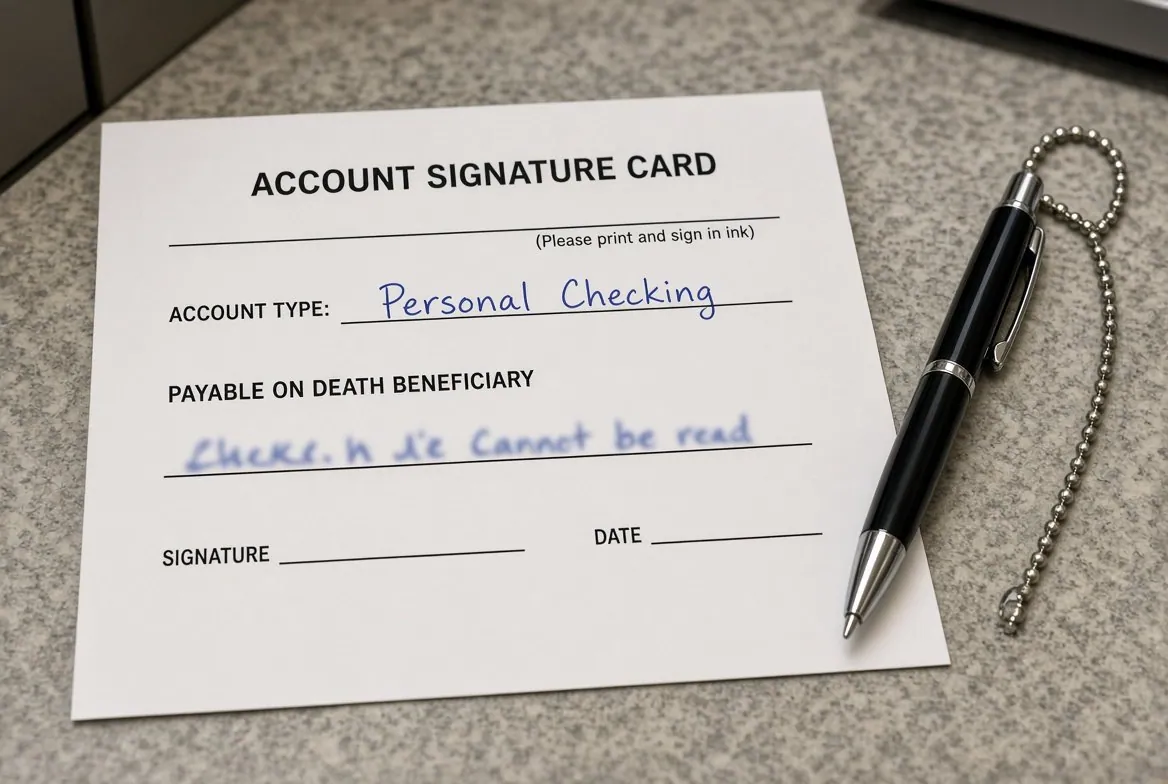
You own the money, not a contract. You earn the interest on it, not the funeral home. You can take it out any time you like, for a furnace or a roof or nothing at all, and answer to nobody. The beneficiary cannot touch a penny of it while you are alive. It is FDIC-insured like any other deposit. And when you die it is released to the person you named without waiting on probate — which matters, because the funeral bill arrives long before an estate settles.
A prepaid plan gives you a promise from one company. A payable-on-death account gives you money. In twenty-five years, one of those is much more likely to still be worth what you paid for it.
Then do the free half, which is the half that actually saves the money. Write the plan down. Not a legal document, not notarised, just a page somebody can find:
- Burial or cremation, and if burial, whether a plot already exists and where the deed is.
- Which funeral homes you telephoned, what each quoted, and which one you would use.
- Whether there is a veteran’s entitlement, and where the DD-214 is.
- Whether you want a viewing, a service, or neither — because that is the question your family will argue about, and your handwriting ends the argument.
- Where the payable-on-death account is, and that it exists at all. An account nobody knows about is not a plan.
That page belongs with the rest of it. The folder your family will need covers what goes in it and why half of it should not be in a safe deposit box, and what she will have to do covers the eleven months after the funeral, which is the part nobody plans at all.
Plan the funeral in writing. Fund it in your own name. That is the whole argument, and it fits on a napkin.
🇺🇸 The Money That Already Exists, and What It Honestly Covers
Some of the bill is already paid, and almost none of it arrives without being asked for. Here is what is real, with the parts that get overstated marked plainly.
Social Security: two hundred and fifty-five dollars
The Social Security lump-sum death payment is $255. It goes to a surviving spouse who was living with the deceased, or to a dependent child if there is no such spouse, and it must be claimed within two years. That figure has not moved in decades.
Set it beside a median of $8,300 and it says everything it needs to say. It is not nothing, and anybody eligible should claim it. But it is worth being clear-eyed about what it is: it will cover the death certificates and the flowers, and then it is gone.
Veterans: two different benefits, and people confuse them constantly
This is the largest single saving available to a great many readers of this site, and it is also the one most often described wrongly — usually by making it sound more generous and more automatic than it is. There are two separate things.
First, the cemetery entitlement, which is the big one. Burial in a VA national cemetery for an eligible veteran comes with the gravesite, the opening and closing of the grave, perpetual care, a government headstone or marker, a burial flag, and a Presidential Memorial Certificate, at no cost to the family. Eligible spouses and dependent children may be buried there as well, and may be buried there even if they die first. The family still pays the funeral home, and still pays to get the remains to the cemetery — but the ground, the marker and the care are covered, and those are exactly the costs the NFDA median leaves out.
Second, the cash burial allowance, which is not automatic and not universal. For deaths on or after 1 October 2025, VA pays up to $1,002 toward burial and funeral expenses, plus a separate $1,002 plot or interment allowance if the burial is not in a national cemetery. If the death was service-connected, the maximum is $2,000. A family that buys a private headstone instead of taking the government one can claim up to $441 toward it.
Now the condition nobody prints. The cash allowance is only payable if the veteran meets one of a specific list of circumstances — broadly, that the death was service-related, or that at the time of death the veteran was receiving VA pension or compensation, or was entitled to it but had chosen not to reduce military retired pay, or died while hospitalized by VA or in VA-contracted care, or had a claim pending that was later allowed, or died as a patient in a VA-approved state nursing home. The person claiming must also have actually paid for the burial and not been reimbursed from anywhere else.
Which means a veteran who served honourably, never filed a claim, and was never on VA compensation may be entitled to the cemetery, the headstone, the flag and the certificate — and to no cash at all.
That is not a loophole and it is not a scandal. It is simply how the benefit is written, and it is the sentence that gets left out of every cheerful summary. Plan on the cemetery. Treat the cash as a thing to check rather than a thing to count on.
Three practical notes. Eligible surviving spouses of record are often paid automatically when VA is notified of the death, with no application at all; the plot, interment and transportation allowances generally need a claim. The rates change every first of October, so any figure you read has a date attached whether it shows one or not. And there is a temporary expansion running for veterans discharged from VA medical or nursing care to receive VA hospice at home, covering deaths between 1 July 2025 and 1 October 2026 — a window that closes, which is exactly the kind of thing nobody hears about until it has shut.
And a warning that belongs here rather than anywhere else. There is a claim circulating online that veterans’ families can collect a $25,000 burial benefit. No such benefit exists in any VA programme. It is used to collect personal details from families in the first week after a death, which is the softest target there is. Anything genuine is applied for free at va.gov or through an accredited veterans service organization, and nobody legitimate charges a fee to file it for you. If it has already happened to somebody, what to do in the first forty-eight hours after a scam is the page for that.
Two more, worth knowing exist
State victim compensation programmes cover funeral costs for homicide victims and, in some states, certain accident victims — New York’s runs up to $6,000. And every county has some form of indigent burial provision. Neither is generous and neither is well advertised, but both are real, and a county clerk’s office can tell you in one phone call what exists where you live.
💰 The Cheaper Road, and Why It Stopped Being Unusual
A good deal of what makes a funeral expensive is the fear of appearing to have done it cheaply. That fear was well founded once. It is not any more, and the numbers say so plainly.
Cremation was projected to account for 63.4 percent of American families in 2025, against 31.6 percent choosing burial, and is projected to reach 82.3 percent by 2045 — again, the funeral industry’s own published figures, not a campaign by anybody. Whatever you choose, you are no longer doing something that will be remarked on. That ship sailed while everybody was still worrying about it.
The levers, in rough order of what they save:
- Direct cremation or immediate burial — no viewing, no embalming, no ceremony at the funeral home — is the floor of the market. A memorial service can be held afterwards, anywhere, at any time, by anybody, for the cost of the coffee.
- Buy the casket somewhere else. The Rule forbids them from refusing it or charging you a handling fee, and the mark-up on a casket bought in the selection room is where a great deal of the money lives.
- For a cremation, ask for the alternative container. They must make one available. A casket that will be burned is a purchase worth thinking about twice.
- Ask why, if embalming is proposed. It is generally not required by law, and the answer may be a genuine one about timing or a viewing — but it should be an answer, not an assumption.
- Watch for a second non-declinable fee. The basic services fee is the one that cannot be declined. Another one stacked beside it is not permitted.
Green burial, home funerals and body donation are all legal somewhere and regulated differently everywhere, and the honest answer is that the rules vary too much by state for this page to tell you what yours are. If any of them interest you, that is a question for your state’s funeral board or a local Funeral Consumers Alliance affiliate — and it is a much easier question to ask at sixty than at eighty-two.
📋 Buy It at 50 — What This Actually Looks Like This Week
This is the cheapest job on the whole site. It costs one afternoon and no money at all, and unlike the roof and the water heater, the price of waiting is not paid by you.
- Telephone three funeral homes in your town and ask what things cost. You do not have to give your name. Ask for direct cremation, immediate burial, and a funeral with viewing, so you have three points of comparison rather than one.
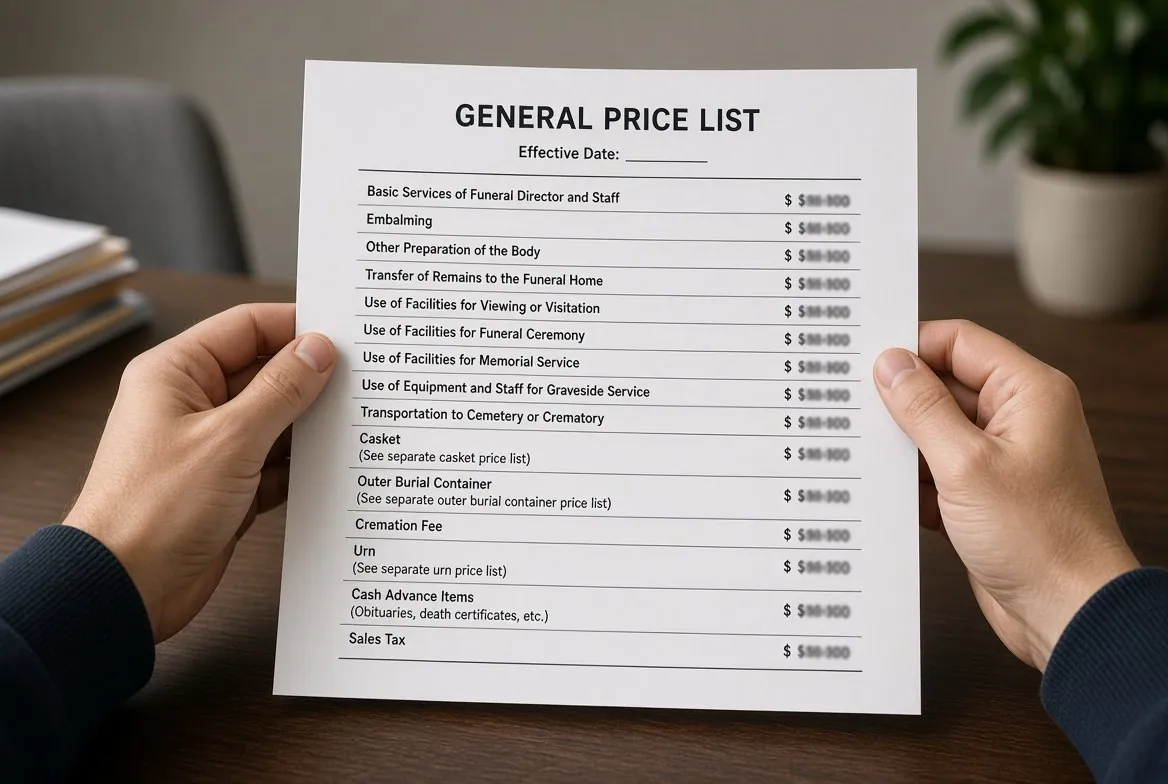
- Ask each of them to send you the General Price List. It is yours by right, it is itemized, and three of them side by side on a kitchen table will tell you more in ten minutes than a week of reading.
- Write the page. Burial or cremation, which home, whether you want a service, where the plot deed is if there is one.
- Open the payable-on-death account and tell two people it exists. Not one. Two.
- If you served, find the DD-214 tonight. Not next month. Tonight. Nothing else on this list functions without it, and the week it is needed is the week nobody can face turning the house over looking for a piece of paper.
What you are buying with that afternoon is not a cheaper funeral, although it will be one. You are buying the difference between somebody sitting in that office answering twenty questions she has never considered, and somebody sitting in that office with a page in your handwriting that answers them already.
She will still have the worst morning of her life. She just will not have to guess her way through it, and she will not spend the next ten years wondering whether she got it wrong.
❓ Questions People Actually Ask
How much does a funeral cost in 2026?
The national median for a funeral with viewing and burial is $8,300, or $9,995 with a vault, and $6,280 for a funeral with viewing and cremation. Those are the National Funeral Directors Association’s own figures from its 2023 General Price List Study, which is still the most recent complete study. They do not include the cemetery plot, the opening and closing of the grave, or the marker, so a traditional burial commonly lands past $12,000 once the ground is added.
Can I get funeral prices over the phone without giving my name?
Yes. Under the FTC’s Funeral Rule, 16 CFR Part 453, a funeral provider must give you price information over the telephone, and you do not have to give your name, address or telephone number to get it. You can price three homes in an afternoon without anybody knowing who called.
Should I prepay for my funeral?
Generally no. The Funeral Consumers Alliance does not recommend prepaying unless it is needed to qualify for Medicaid. The money is often not portable if you move or die out of town, the funeral home may be sold or closed by the time it is needed, and pre-need trust law varies by state. Planning the funeral in writing is free and reversible; prepaying is neither.
What is a better alternative to a prepaid funeral plan?
A payable-on-death bank account, sometimes called a POD account or a Totten trust. You keep ownership of the money, you earn the interest, you can withdraw it at any time, the beneficiary cannot touch it while you are alive, it is FDIC-insured, and it is released to your family without waiting for probate. Plan the funeral in writing and fund it in your own name.
How much does Social Security pay toward a funeral?
The Social Security lump-sum death payment is $255. It goes to a surviving spouse who was living with the deceased, or to a dependent child if there is no such spouse, and it must be claimed within two years. The amount has not changed in decades.
Does the VA pay for a veteran’s funeral?
Partly, and it comes in two separate pieces. Burial in a VA national cemetery is free for an eligible veteran and covers the gravesite, opening and closing, perpetual care, a government headstone or marker, a burial flag and a Presidential Memorial Certificate. The cash burial allowance is separate and conditional: for deaths on or after 1 October 2025 it is up to $1,002 plus a $1,002 plot allowance, or up to $2,000 for a service-connected death, but only where the veteran meets one of a specific list of circumstances. A veteran who never filed a claim and was never on VA compensation may receive the cemetery and no cash at all. There is no $25,000 VA burial benefit; that figure is used by scammers.