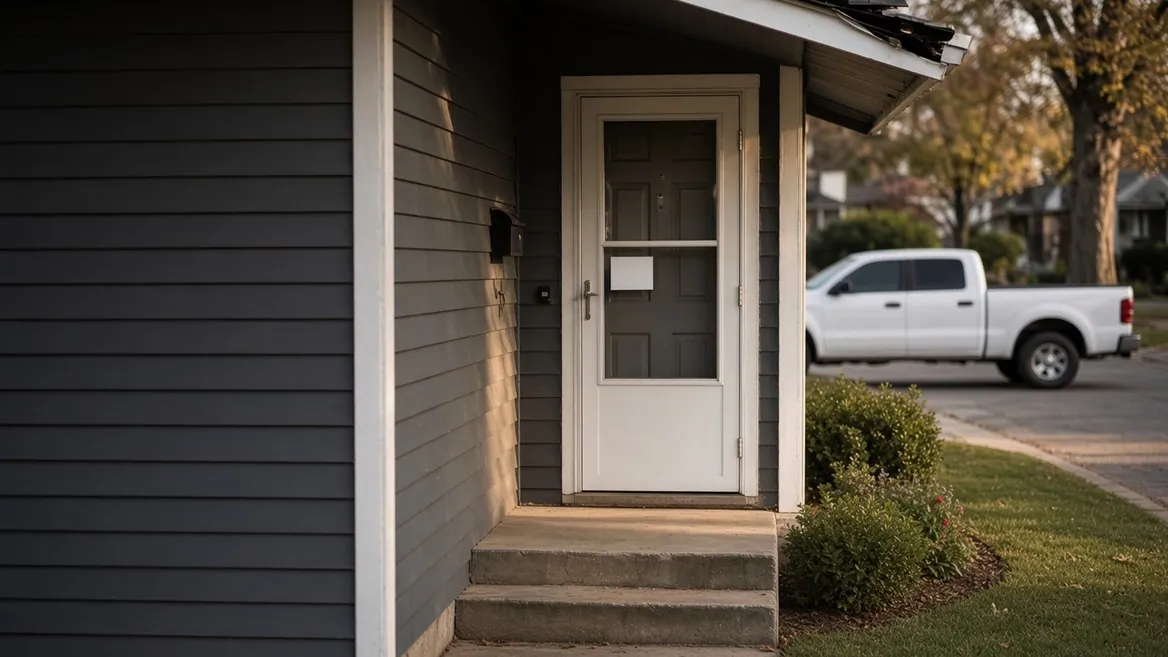
🚪 The Knock on the Door
It comes three or four days after the storm, and it is always the same sentence. We are working in your neighborhood and we noticed some damage on your roof.
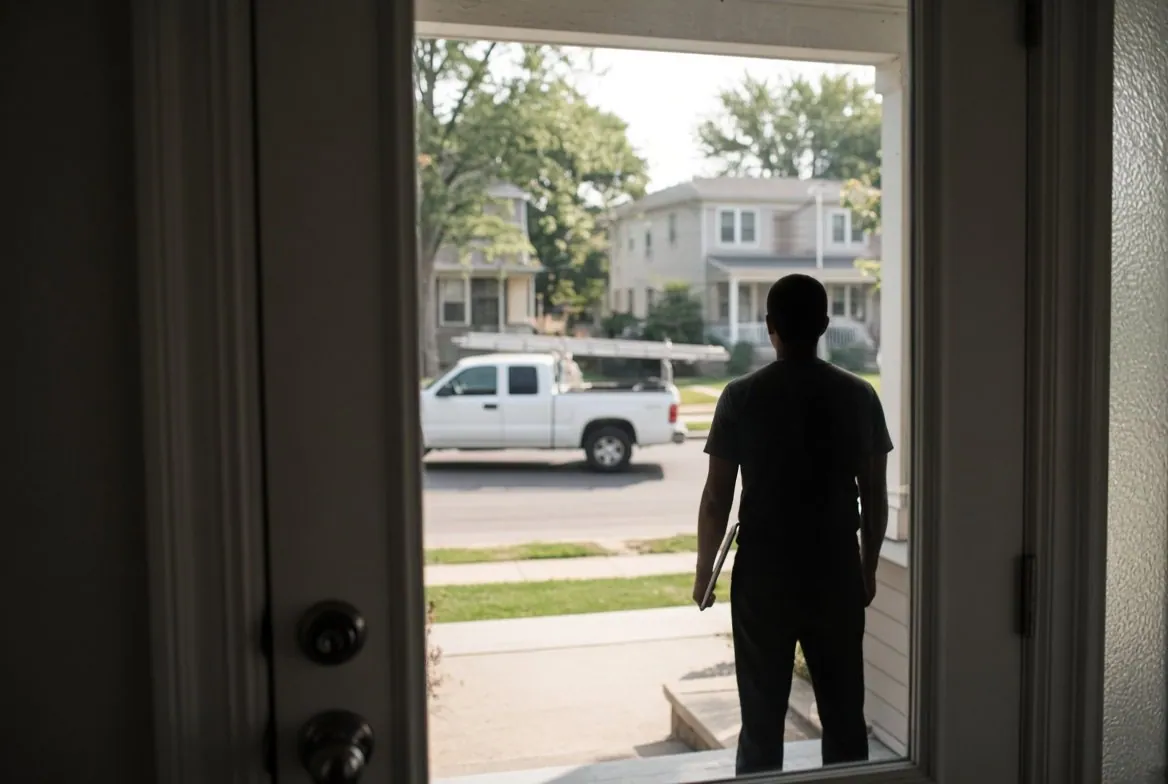
One product this applies to more than most: walk-in tubs are sold in your living room, by appointment, to people sitting alone — so the three days, the deposit limits and the lien rules all apply in full. The walk-in tub page covers what the advertisement leaves out.
Some of the men saying it are good tradesmen having the busiest fortnight of their lives. Some of them are not. And the ones who are not do not knock at random — they work the streets where the householders are old, because an eighty-year-old alone in a damaged house is the easiest signature in America to get.
The rule that sorts them costs you nothing and takes one minute. Anybody legitimate is happy to be checked. A licence number can be looked up on your state's website while he stands there. A man who will not give you one, wants cash today, wants the offer signed before he leaves, or tells you the price expires this afternoon is telling you exactly what he is.
Nobody honest has ever lost a job because a customer looked them up.
What follows is not about spotting a villain. It is about four pieces of paperwork that decide whether you can undo a bad decision — and every one of them is on your side, if you know it is there.
One knock deserves its own page: the one that says your air conditioner is now illegal because of its refrigerant. It is not. Here is what the rules really say.
📅 The Three Days You Already Have
Federal law gives you a right to cancel a contract signed in your own home, and almost nobody who has it knows it.
It is the Federal Trade Commission's Cooling-Off Rule, and it is short. If a sale of $25 or more is signed at your residence, you may cancel it for any reason at all by midnight of the third business day. Signed somewhere other than the seller's normal place of business — a hotel function room, a fairground, a restaurant, your workplace — the threshold is $130.
And the part people get wrong: it still applies when you invited him. The rule expressly covers sales made in response to or following an invitation by the buyer. Ringing a company and asking them to come out does not, by itself, cost you the three days.
Business day means any day except Sunday and federal holidays — so Saturday counts.
What the contractor is required to hand you
- A copy of the contract in the language he used to sell it to you.
- The cancellation statement in ten-point bold type, next to where you sign.
- Two copies of a Notice of Cancellation, ready to send.
- Verbal notice, out loud, that you have the right.
- Your money back within ten business days if you cancel.
There is one more that matters if the work is financed: he may not sell your note on to a finance company before midnight of the fifth business day. That exists so you cannot be cancelled out of your own cancellation.
The waiver on the clipboard, and why it is worthless
Here is the single most useful thing on this page, and you can check it at your own kitchen table.
There is an emergency exclusion. A contractor will sometimes wave a printed paragraph at you and say the three days do not apply because it is an emergency. Read what the rule actually requires.
To lose the three days on emergency grounds, you must have started the contact, and you must supply "a separate dated and signed personal statement in the buyer's handwriting" describing the emergency and giving up the right.
In your handwriting. Separate. Dated. Signed. A pre-printed clause on his clipboard is not that, and never can be.
And it goes further than that. The rule makes it an unfair and deceptive act to put a waiver of the cancellation right into the contract at all. A contractor who hands you a contract with one in it has broken the rule by handing it to you.
Which settles the man on the doorstep completely. He knocked, so you did not initiate the contact — and no exclusion in the rule reaches a solicited-at-home sale. You have your three days whatever he says.
One thing to keep in mind: the federal three days is a floor, not a ceiling. State law that gives you longer is not overridden. Several states do.
🏠 The Lien — Paying Twice for the Same Roof
This is the section that costs the most money and the one nobody writes for homeowners, so read it slowly even though it is dull.
You can pay your contractor in full, on time, and still lose the house.
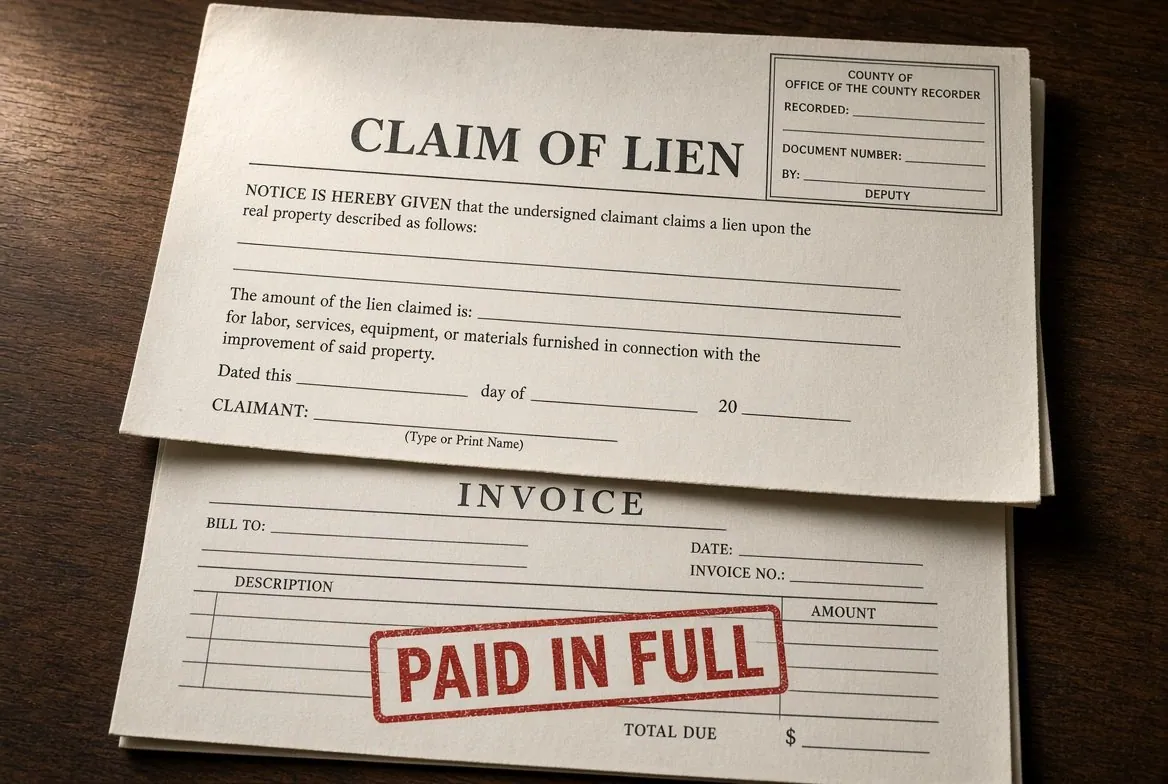
If he does not pay his own suppliers or his subcontractors, those people — whom you have never met and never hired — can file a lien against your property. The lien clouds your title. You cannot sell and you cannot refinance until it is cleared. And clearing it can mean paying the debt a second time, out of your own pocket, for materials you already paid for once.
The warning letter that is not a threat
A few weeks into a job, an envelope may arrive from a lumber yard or a roofing supplier you have never heard of. It is called a preliminary notice, or in some states a Notice to Owner.
It is not a lien and it is not an accusation. It is a supplier registering that he is involved and preserving his right to file one later if he goes unpaid. Treat it as your early warning system rather than as a nuisance — it is telling you exactly who has to be paid before this is over.
The deadlines differ by state. California gives 20 days from the first labour or materials, and a late notice only reaches back 20 days. Florida allows 45. Some states require none at all, which means the first you hear of a supplier may be the lien itself.
The paperwork that stops it
The instrument is a lien waiver, and the order it goes in is the whole trick:
- Conditional waiver at each payment — it takes effect only once your payment actually clears.
- Unconditional waiver afterwards, once it has.
Signing an unconditional waiver before the money has cleared gives away your protection for nothing. Several states publish statutory waiver forms, and a form that does not comply with the state's version may not be enforceable, so use your state's.
Two remedies worth knowing, both from the Minnesota Attorney General's homeowner handbook:
If a subcontractor's notice arrives and you have not yet paid the contractor in full, you may deduct that subcontractor's amount and pay him directly.
And you may withhold from the contractor for 120 days after completion as much as is needed to pay the subs directly — unless he produces signed waivers showing they have already been paid.
Two free government guides cover this properly and neither is trying to sell you anything: the Minnesota Attorney General's home building and remodeling handbook, and the California Contractors State License Board's homeowner's guide to preventing mechanics liens. Read whichever is closer to your own state's practice, then check your state's own rules.
💰 The Deposit, and the Rule Behind It
Ask a contractor for half up front and you will hear that it is standard. In one state it is illegal.
California caps the down payment at $1,000 or ten per cent of the contract price, whichever is less. No exceptions for special-order materials. The contract has to carry that sentence in twelve-point bold. And the licensing board extends the same cap explicitly to rebuilding homes in declared disaster areas — which is precisely when the pressure to hand over more is greatest.
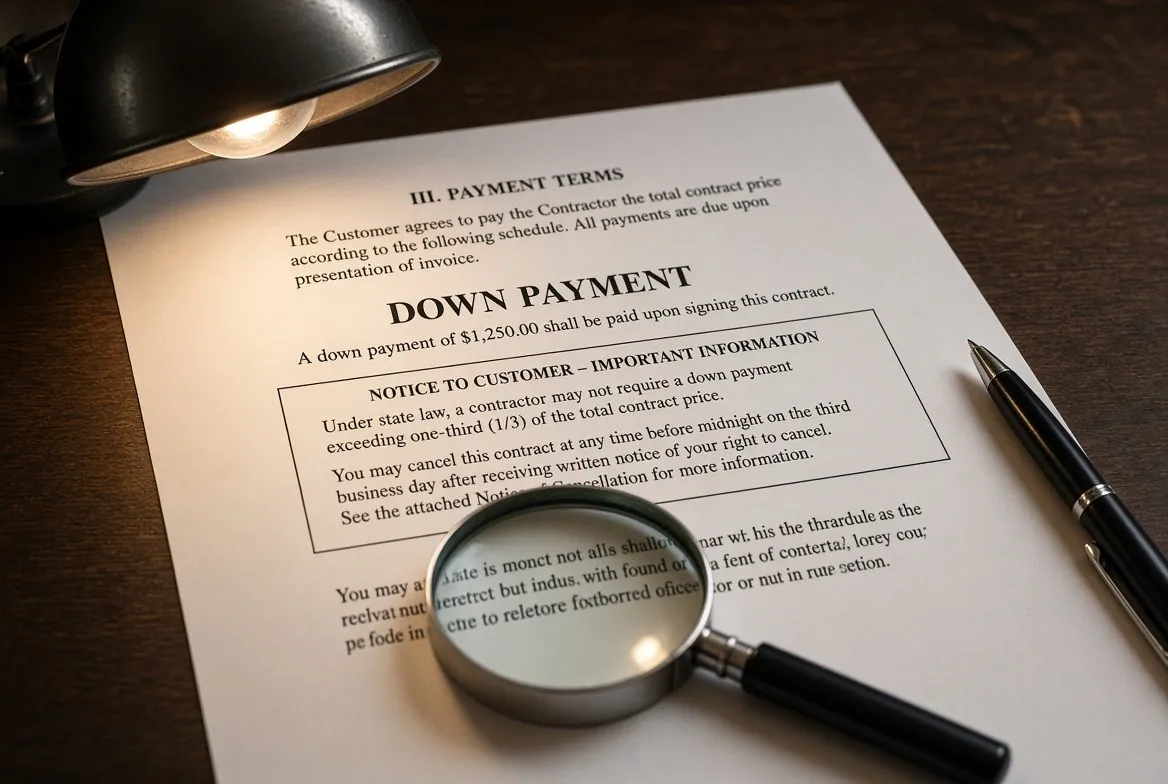
Your state may allow more. But California is the benchmark to measure any demand against, and a contractor asking for forty per cent before he has ordered anything is asking for something one large state considers unlawful.
The principle underneath it travels everywhere, and this is the sentence to build your payment schedule on:
After the deposit, no payment should ever exceed the value of the work already done or the materials already delivered.
Every progress payment should name what it buys. Not "second payment" — tear-off complete and debris removed, underlayment down, shingles delivered to site. If he will not write it that way, ask why.
The bank trick almost nobody uses
The Federal Trade Commission's own guidance on hiring after a disaster contains one mechanism that hardly anybody prints, and it is the strongest single practical item in this whole subject.
Arrange a Certificate of Completion with your bank or credit union. The bank holds the money and pays the contractor for each stage only after you have signed off on that stage. You are not chasing anybody for a refund, and he is not holding your money for work he has not done. The bank becomes the referee, and it costs very little to set up.
🧾 Why the Cheapest Bid Is the Expensive One
Three bids come in. One is thousands below the others. It is very hard, on a fixed income, not to take it.
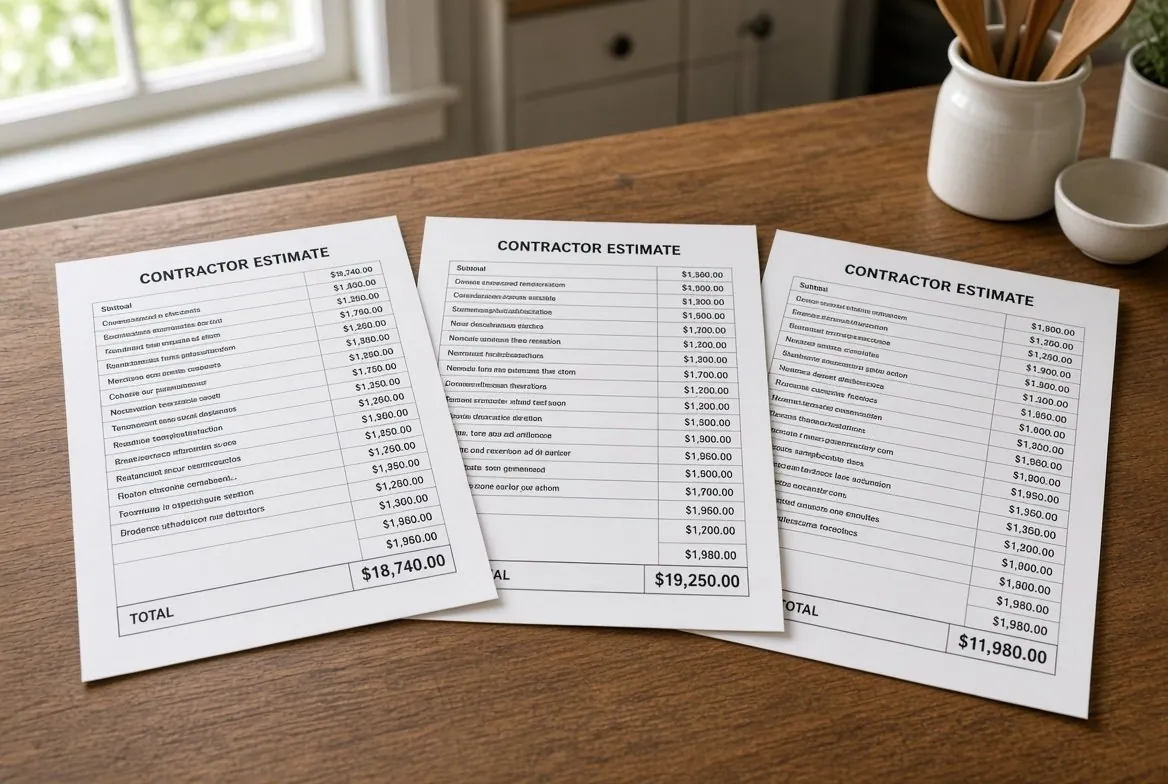
Here is the concrete version of why you should not, without any moralising about getting what you pay for.
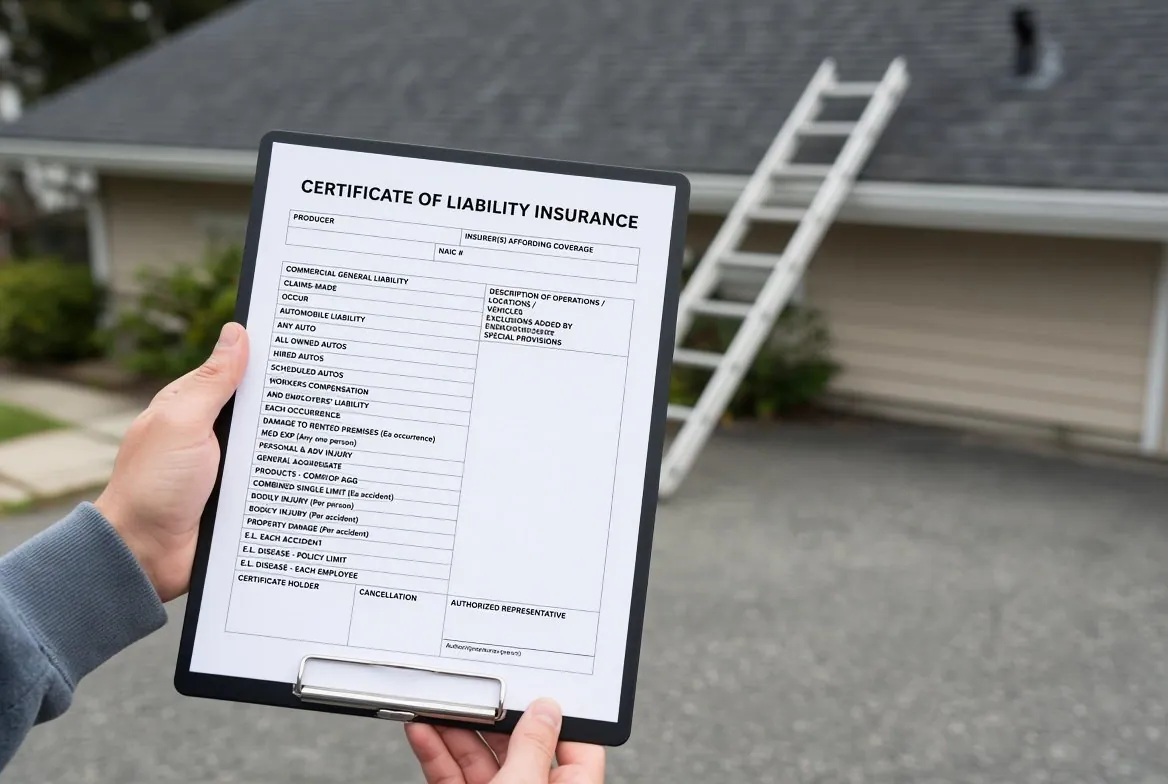
- Ask for the workers' compensation certificate. If an uninsured man falls off your roof, the exposure can land on you and your homeowner's policy. That is not a small risk and it is the one nobody mentions.
- Verify insurance and bond with the issuer, not from a photocopy. Ring the number on the certificate yourself. A forged certificate costs a dishonest contractor nothing.
- Understand what the licence bond does and does not do. It protects against certain misconduct. It does not protect you against a subcontractor's lien claim, which is the thing most likely to cost you.
- A bid that is thousands low is usually missing something — a permit, a tear-off, the disposal, the flashing. Ask what is in the others that is not in his, and make him answer in writing.
And unlicensed work carries real penalties in most states. In California it runs to administrative fines up to $15,000, criminal fines, and jail time, with a mandatory sentence for repeat offenders. The man without a licence is not saving you money. He is transferring risk to you.
🌪️ After a Storm, Specifically
Everything above applies harder in the fortnight after a disaster, because the pressure is real, the roof is open, and the honest contractors are genuinely booked.
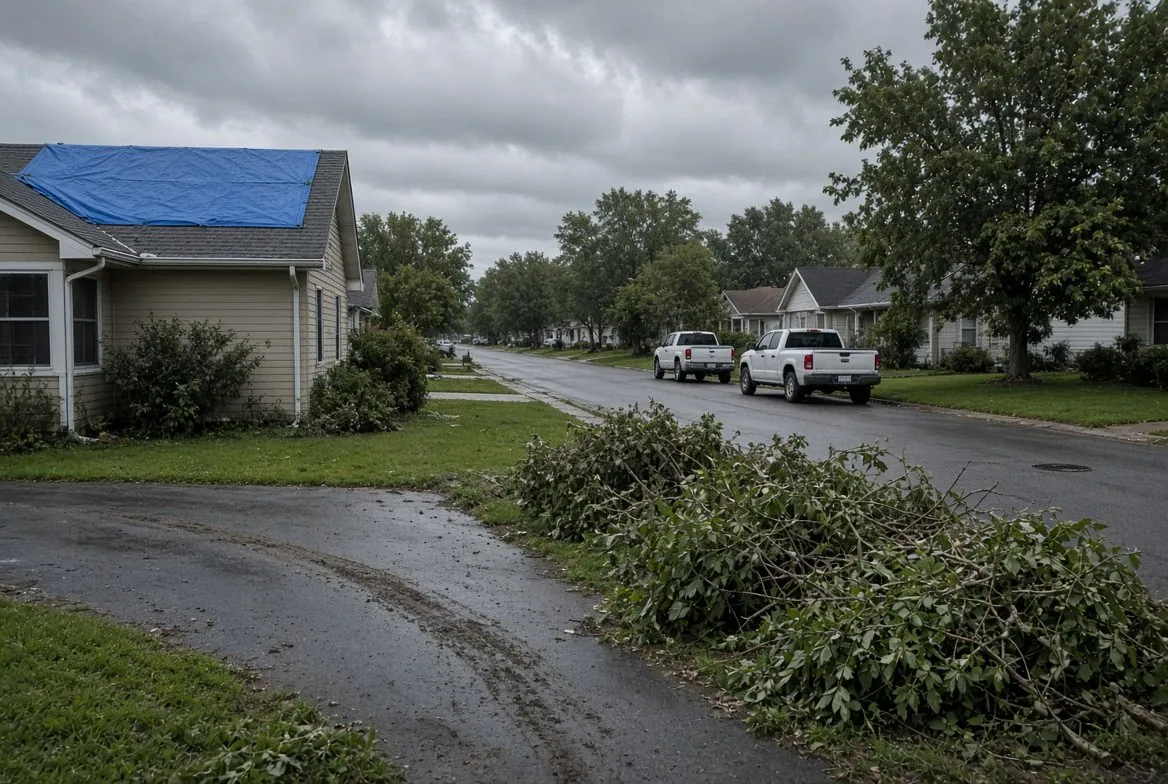
The Federal Trade Commission's warning signs, in its own words, are worth taping inside a cupboard:
- A claim that no licence is needed for this work.
- A discount that depends on signing immediately.
- Being told to sign over your insurance cheque.
- Full payment demanded up front.
- Payment by wire transfer, gift card, payment app, cryptocurrency or cash.
That last one is worth its own sentence. Every one of those payment methods is chosen for the same reason: it cannot be reversed. A cheque or a card can be disputed. A wire cannot.
And the calmest thing you can do in that fortnight is separate two decisions that feel like one. Getting the water out of the house is urgent. Choosing who rebuilds the roof is not. A tarp costs a few hundred dollars and buys you a month to make the second decision properly — see the tarp page, including the free federal programme that will cover a damaged roof for you if you sign up in time.
📋 Why This Belongs on the Fifty List
Because the only good time to find a contractor is when you do not need one.
Every protection on this page works. The three days, the lien waivers, the deposit cap, the certificate of completion — all of it is real and all of it is yours. And every one of them requires you to be calm enough to use it, which is precisely what you will not be with water coming through the ceiling and a man on the doorstep telling you the price goes up tomorrow.
So do the part that has to be done early:
- Find a roofer, an electrician and a plumber now, on an ordinary week, when they will answer the phone and take a small job. Use them for something minor. That is the audition.
- Write their numbers on paper and put them where the folder is — not only in a phone that may be dead.
- Look up your state's licence checker once, today, and write that address down too.
- Ask your bank now whether they will do a certificate of completion arrangement, so you are not learning the answer in October.
The knock will come. Everything that decides how it goes was settled months before, by somebody who was not standing in a wet hallway at the time.
❓ Questions People Actually Ask
Can I cancel a contract I signed with a contractor at my door?
Usually yes. The FTC’s Cooling-Off Rule, 16 CFR Part 429, gives you three business days to cancel a sale of $25 or more made at your home, and the seller must give you two copies of a cancellation form and tell you about the right. State home-solicitation laws often add to it. A waiver on a clipboard does not remove a right the rule requires the seller to disclose.
How do I check whether a contractor is licensed?
Verify the licence number directly with your state’s licensing board rather than accepting a card or a website screenshot, and confirm the bond and insurance with the issuing insurer rather than the contractor. Licensing requirements differ by state and by trade.
What is a mechanics lien and how can it make me pay twice?
A mechanics lien lets a supplier or subcontractor who was not paid place a claim against your property, even though your contract and your payment were with the general contractor. If the general takes your money and does not pay them, the claim can still attach to your home. Notice and deadline rules are set by each state.
How large a deposit should I pay a contractor up front?
Several states cap it by statute, and a request for a large share of the job before any work or materials arrive is the most common warning sign. Pay against progress rather than against promises, and never in cash.
What is a storm chaser?
A contractor who follows storm damage from area to area, works the streets door to door, asks for money up front, and is difficult to find afterwards. The defence is unglamorous: verify the licence with the state, check the address, and take the time. Nobody honest ever lost a job because a customer looked them up.