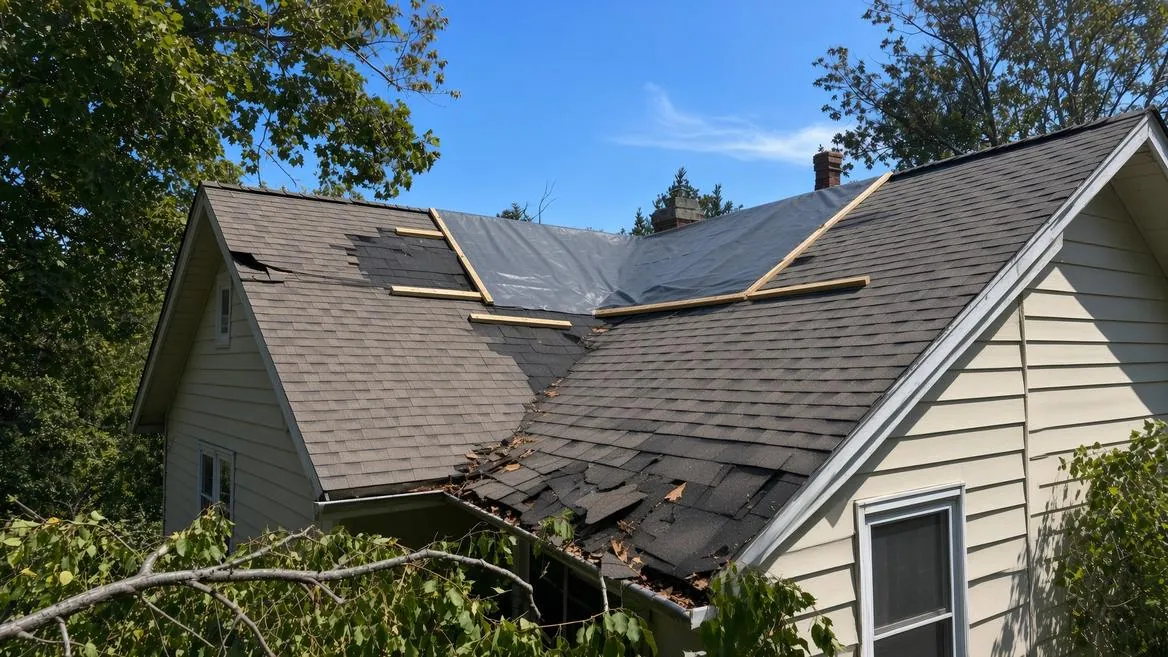
🌌 A Hole in the Roof and Nobody Coming
In 1992 I slept for weeks under a tarp strung inside a warehouse in Homestead, because the roof above it had a hole in it and there was nothing to be done about that for a long while. A tarp, a cot, and a bucket for the laundry. The whole of that is written up elsewhere on this site. What I want to say here is the part I did not understand at the time.
And whoever eventually does the permanent repair, you have three days to cancel a contract signed in your own home — federal law, and no printed waiver on a clipboard can take it away. Hiring a contractor without being robbed covers that, and the lien that can make you pay twice for the same roof.
The tarp was not the emergency supply. The tarp was the thing that let us stay.
That is what this page is about, and it splits three ways. What to buy while the shelves are still full. A free federal programme that will cover your roof for you and that most people have never heard of — including a good many who qualified for it, in this county, and missed it. And the honest question of what a man of seventy-two does about a holed roof when going up a ladder in the wet is not on the list of things he is going to do.
One word gets used carelessly on this subject and I am going to be careful with it here. Nobody in what follows gets a roof. They get a roof tarped — sheeting fastened over a hole, to keep the weather out until somebody who does this for a living can put it right. The federal programme is called Blue Roof, which does not help. A covering is not a repair, and the difference is a year of your life and a great deal of money.
💰 Everyone Quotes a Number and None of Them Agree
Ask how long a tarp lasts outdoors and you will get an answer. Ask a second person and you will get a different one. I went looking properly, and the spread is not small — it is a factor of a hundred.
Roofing companies say a blue tarp gives you ten days to three weeks. Tarp manufacturers say seven to ten years. Same material, same sun.
Here is the thing to understand before you read another word about tarps anywhere, including here. There is no independent testing on this. Every figure you will find is published by somebody with something to sell, and the number each one quotes lines up almost perfectly with what they are selling. The company that wants to come out and re-tarp your roof every three weeks quotes three weeks. The company selling you the tarp quotes years.
Neither of them is lying, exactly. They are answering different questions and hoping you will not notice which.
What the vinyl people claim for vinyl
Recycled billboard vinyl is genuinely interesting material. It is three layers — PVC on the outside, a woven polyester mesh inside for strength — and the UV protection is worked through it rather than painted on, because it was built to hang on a sign in the weather for years.
The sellers of it claim roughly this, and I pass it on as their claim rather than as fact:
An ordinary blue poly tarp with proper UV treatment sits somewhere in between — a light one gives you a year or two, a heavy sixteen-mil one with a scrim in it three to five. An untreated one is genuinely finished in a fortnight of Florida sun, and nothing on the packet will tell you which one you are holding unless it says UV-treated in plain words.
⚠️ The Catch Nobody Mentions About Billboard Vinyl
Billboard vinyl gets recommended for emergency roof work constantly. It is cheap, it is enormous, it is tough, and it lasts. I was ready to recommend it myself.
Then I read the small print on the website of a company that sells the stuff.
Used billboard vinyl is water resistant. It is not waterproof, and the people selling it say so.
It spent its working life bolted to a sign frame. It has mounting holes. It may have pinholes you cannot see. Their own words are that it should be treated as used material — and that if you need something genuinely waterproof, you should buy the new vinyl instead.
Read that again with a roof in mind. The company that would happily sell you a used billboard is telling you not to trust it over a hole above your bed. That is not a small caveat buried in a footnote. That is the whole recommendation, reversed.
There is a second thing worth knowing. The average billboard is up for about six months before it comes down, so a used sheet has already spent part of its life in the sun before it reaches you. Nobody is hiding that either. Nobody mentions it much.
Which does not mean the stuff is no good
It is excellent material and I would own some. Over a woodpile, over a generator, over the mower, over stacked lumber, under a leaking porch roof, as a ground sheet, as shade — it will outlast three poly tarps and cost less than one. Use it for everything except the one job where a pinhole matters.
One warning goes with every one of those jobs, and it is the reason to keep the gloves in the tote with the tarp. Anything you cover and then leave alone becomes shelter. A tarp over a woodpile, a mower, a stack of lumber or a heap of storm debris is dark, dry and undisturbed — which is exactly what snakes, scorpions, black widows, brown recluses, wasps and mice are looking for. Lift the cover from a distance and give it a moment before you go in. Never put a bare hand underneath, and never reach into a stack you cannot see into. More on covering a woodpile properly.
For the roof itself, buy something new and sold for the purpose, and buy it once.
🌬️ It Is Almost Never the Sun That Kills Them
Here is the part that reframes the whole subject, and it took me a while to see it in the numbers.
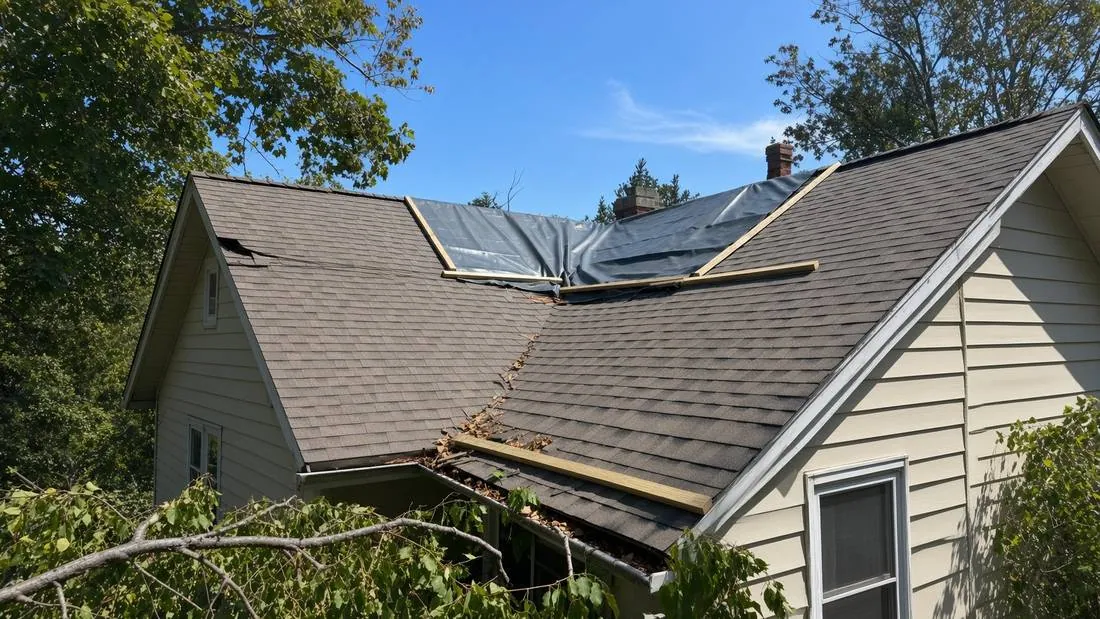
A thirteen-ounce vinyl banner, stretched tight on a frame, is rated by the people who print them at six months to a year. The same thirteen-ounce vinyl sold as a tarp is rated by the people who sell it at six to eight years.
Same material. Same weather. Twelve times the life.
The difference is not the vinyl. It is what is being done to it. A banner is stretched drum-tight and left to flap, and every gust works at the hems and the grommets until something lets go. One supplier puts a figure on it: a tarp stretched tight over a frame fails thirty to forty per cent sooner than the same tarp draped loose over stored equipment.
So the money question was never which material. It is how the thing is held down. A good tarp fastened badly will be in your neighbour's yard by Thursday. A cheap one fastened properly, over battens, with the load spread, will still be there in the spring.
Which is also why the grommets are the wrong place to tie to. They are the weakest point on the whole sheet and they concentrate every pound of wind load onto a half-inch ring of brass. Sandwich the edge between two lengths of one-by-three and screw through the wood, and the load spreads along the whole batten instead.
🏠 The Free One Nobody Told You About
Now the part I did not know until I went looking, and I have lived in this state a long time.
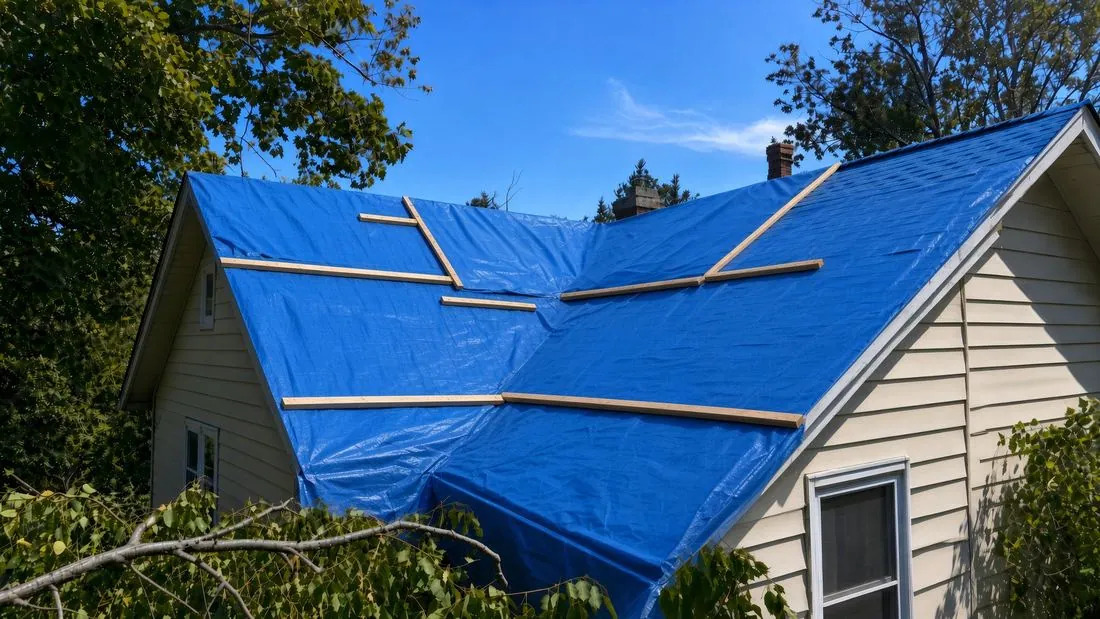
After a federally declared disaster, the US Army Corps of Engineers runs a programme for FEMA called Operation Blue Roof. Contract crews come out and fasten industrial fibre-reinforced sheeting over your damaged roof. It costs nothing. You sign a Right of Entry form so they are allowed onto your property, and they do the work.
Citrus County was on the list. So were Hernando, Pasco, Sumter, Lake and twenty others, after Hurricane Milton. It is not a programme for somewhere else.
What actually happened here, in numbers
Look at the first number and the last. Roughly one in four people who signed up never got theirs tarped. Some were never reached before the programme shut. Some were assessed and turned down. About a hundred acres of sheeting went on across twenty-five counties, for two storms that between them did billions of dollars of damage.
It is a real programme, it is free, and it is small. Both halves of that are true and you should plan around both.
Why people get turned down
- It has to be your primary home, or a rental somebody actually lives in. Not a holiday place.
- Less than half the structure destroyed. Past that it is a demolition question, not a tarp question.
- Shingles. Flat roofs do not qualify. Neither do metal, clay, slate or asbestos tile. Metal roofs and mobile homes get looked at case by case, which is not the same as yes.
- The debris has to be off the roof already. They will not clear your oak limb for you.
- The house has to be habitable once it is covered.
And separately, FEMA gives away plain tarps. You collect one from a distribution point and you put it up yourself. Taking one of those does not disqualify you from Blue Roof — you can have the free tarp now and the crew later, and if you are waiting your turn that is exactly what you should do.
⏰ The Part That Should Worry You
Here is the timetable from last time, and I would like you to read it as a clock rather than a list.
- 9 October. Milton comes ashore.
- 15 October. Sign-up opens. Six days gone.
- 5 November. Original deadline. Twenty-one days to hear about it, understand it, and get a form signed.
- 14 November. Extended once.
- 19 November. Last roof tarped in Florida. Programme over.
Five weeks from open to finished. Three weeks to put your name down.
Now put yourself in those three weeks. No power. A tree through the carport. An insurance adjuster who has not called back. A wife who has not slept. The phone at four per cent and the nearest working cell tower doing the work of six. Nobody is reading county press releases in that week.
That is the whole argument of this page and I will put it plainly. The free federal tarping has a deadline, and the deadline starts running while you are still finding your feet. If you learn it exists after the storm, you will probably learn it too late.
The number is 1-888-ROOF-BLU. That is 888-766-3258. The website is blueroof.gov. Write both on the inside of a kitchen cupboard door today, where they will still be legible when the power is out and the phone is dead.
🧠 What a Man of Seventy-Two Does Instead
Every article written on this subject assumes the reader is going up on the roof. I have read a dozen of them this week and not one of them stopped to ask.
I am seventy-two. My wife is not going up there. My sister-in-law certainly is not. And a wet asphalt roof at a four-in-twelve pitch, two days after a hurricane, with the sheathing possibly soft underneath, is not a place to find out how good your balance is.
So here is the honest version, and it starts with the thing nobody prints.
Falls are the leading cause of injury death for people over sixty-five, and most of them happen on level ground. A ladder and a wet slope is not a marginal increase in risk. If you take nothing else from this page: the tarp is worth having, and you are not the one who fastens it to the roof.
The things you can do, all of them from the ground
- Get on the Blue Roof list the day it opens, if there has been a declaration. Free, and somebody else climbs.
- Photograph everything before anything is touched. From the ground, from the yard, from a neighbour's upstairs window. Your insurer will want to see what it looked like before the tarp went on, and a tarp fastened over undocumented damage is an argument waiting to happen.
- Get the inside water under control. Buckets, bins, towels, and a small hole punched in a bulging ceiling to let the water down in one place rather than bringing the whole ceiling down at three in the morning. That is a ground-floor job and it saves more than the tarp does.
- Move what matters out from under it. Papers, photographs, the medicine, the computer.
- Have the number of a licensed roofer already, from before the season, when they were not busy and would take your call.
And about whoever knocks on the door
They will knock. After every storm, they knock. Some of them are good people working eighteen-hour days. Some of them are not, and the ones who are not go straight for the streets where the householders are old.
The rule that costs you nothing: anybody legitimate is happy to be checked. A Florida licence number can be verified in a minute. A man who does not want to give you one, wants cash today, wants you to sign something on his tailgate, or tells you the offer expires this afternoon, is telling you what he is. Nobody honest ever lost a job because a customer looked them up.
The slow leak is a different animal from the storm hole: a dark spot in the ceiling corner that grows a little every rain. The first look at that one is from the attic, not the roof, and it is on the page about the bills that come after the mortgage.
📋 Why This Belongs on the Fifty List
Because a tarp is worth nothing on the day you need it and cannot get one.
You know how this goes here. The cone shifts toward the Nature Coast on a Tuesday and by Wednesday afternoon there is no plywood, no water, no batteries and no tarps between Crystal River and Ocala. The shelf is not a supply chain. It is a snapshot of what nobody wanted yet.
So the list is short and it is all May work, not October work:
- One good tarp bought new, big enough to cover the damage and reach past the ridge, kept in a labelled tote.
- In the tote with it: the rope, the cap nails, two or three lengths of one-by-three for battens, gloves, a knife, a hammer. A tarp with no way to fasten it is a groundsheet.
- A couple of pieces of billboard vinyl for the woodpile, the generator, the mower and the shade — the jobs where a pinhole does not matter and the material will outlast you.
- Two phone numbers written down on paper: a roofer you have already spoken to, and 888-766-3258.
That is a couple of hundred dollars and one Saturday, and it is the difference between a wet week and a ruined ceiling.
The hole does not arrive on a schedule and neither does the help. The tarp you own in May and the number you already know are each worth more than either one alone — because the free federal tarping runs on a clock that starts before you have got your feet under you, and the shop shelf empties on the Wednesday.
❓ Questions People Actually Ask
What is Operation Blue Roof and who qualifies?
It is a free temporary roof-covering programme run by the US Army Corps of Engineers for FEMA after a federal disaster declaration, reached at blueroof.gov or 1-888-ROOF-BLU. It requires a signed Right of Entry form. Eligibility generally requires a primary residence or permanently occupied rental with less than 50 percent structural damage, a structure that is habitable once covered, and storm debris cleared first. Flat, metal, clay, slate and asbestos-tile roofs are not eligible; standard shingle roofs are.
How long do you have to sign up for Operation Blue Roof?
The sign-up window is typically about 21 days and then it closes. After Hurricane Milton in 2024 the programme opened on 15 October, was originally set to close on 5 November, was extended once to 14 November, and the last roof was tarped on 19 November.
Does everyone who signs up for Blue Roof get a tarp?
No. After Milton, 11,502 Rights of Entry were collected, 9,017 were assessed and 8,296 roofs were tarped — so roughly one in four who signed up never got theirs covered, either because the window closed first or because the roof was found ineligible. It is a real programme and a small one.
How long does a roof tarp actually last?
There is no independent testing, and every published figure comes from somebody selling something — roofing companies say a blue poly tarp lasts 10 to 21 days while tarp manufacturers claim years for similar material. What matters more than the material is how it is fastened: wind works at the hems and grommets, and a covering stretched drum-tight can fail far sooner than the same material laid with some slack and battened down.
Is used billboard vinyl waterproof?
The sellers themselves say it is water resistant rather than waterproof. Used billboard material arrives with mounting holes and pinholes and has already spent months outdoors, since the average billboard is up around six months. If you need genuinely waterproof material, the same sellers point you to new vinyl.