🛡️ Will Insurance Pay for a Slow Leak?
Plainly, first. This page is for educational purposes only. BuyItAt50 is not an insurance agent or company, a lawyer, a mortgage lender, an appraiser, a home inspector or a contractor, and it has no connection to any company that sells insurance, makes loans or does repairs. Every policy is different. What yours covers is written in your policy, and the people to ask are your agent and your insurance company. The stories on this page come from my own years doing handyman work; names and places are left out or changed.
Usually not. Most homeowners policies pay for water damage that is sudden and accidental: a pipe that bursts, a toilet that overflows, a washer hose that lets go. Most do not pay for damage from a leak that went on slowly, or for the rot and mold that grow out of it (Texas Department of Insurance).
The Texas Department of Insurance puts it in the plainest words I have found. The companies will not pay for damage that happens over time, and the examples it gives are rotted boards, cracked window seals and worn-out roofs (Texas Department of Insurance).
Washington’s insurance commissioner says the same thing from the other side. Most policies will not cover a gradual leak, like a faucet that has been dripping, and insurers generally look at mold and rot as a home maintenance problem (Washington Insurance Commissioner).
The industry’s own information office agrees. Standard policies do not cover poor maintenance, and most maintenance problems are the homeowner’s to deal with (Insurance Information Institute). Termites and other pests are left out too (Insurance Information Institute).
So here is the thing nobody says out loud.
The small leak you put off is not a claim waiting to happen. It is a bill with your name already on it.
The first two figures are from the Insurance Information Institute and describe claims insurers did pay (Insurance Information Institute). The third is the rule described above, not a statistic. Your own policy decides your own case.
☕ The Spot on the Ceiling
It starts the same way every time.
A man is sitting in the front room with his coffee and the television on. He looks up, the way you do, and there in the corner of the ceiling is a dark spot about the size of a baseball.
He watches it for a couple of days. It rains. The spot gets a little bigger. It rains again, and it gets a little bigger than that.
Something is going on up there, in the attic or on the roof. He knows it. And he does nothing, for two reasons that are both perfectly good reasons.
The first is that finding out means a ladder, and at his age a ladder is a frightening thing. At mine too. I understand that exactly. The second is that doing nothing costs nothing at the time. The spot does not send a bill.
Caught small, a leak like that is often a little patching and an afternoon. Left alone, it is a piece of the ceiling lying on the living room rug.
Here is the part I would like people to hear. The first look does not have to be from the roof. Most of the time the place to start is the attic, with a good flashlight, standing on a sturdy step ladder at the hatch. Wet insulation, a dark stain on the underside of the roof boards, a drip line down a rafter: you can see a great deal from the inside without ever setting foot on a shingle.
That is a job for a good ladder with a wide step and a rail to hold, and for somebody else being home while you do it. The roof itself is a different matter. If the fix is up there, that is what the telephone is for, and the page on hiring a contractor is there for the phone call. If the roof is open after a storm, the tarp page covers what to do instead of climbing.
Before any ladder work: do not climb alone, do not climb onto a roof that is wet, damaged or steep, and talk to your own doctor first about what you should and should not be doing. Your doctor knows your balance, your medications and your bones. I do not.
The tools are not for being a hero. The tools are for finding out early. A man who can look is a man who can call somebody while the job is still small.
🚽 The Toilet That Went Through the Floor
When I worked as a handyman, one of the commonest leaks I found was the one under the toilet.
There is a wax ring under every toilet. It seals the toilet to the drain in the floor. When it fails, a little water gets out every time somebody flushes.
The homeowner sees a few drops at the base, or a puddle you could cover with a coffee cup. It does not look like much, so nobody worries about it.
What they cannot see is underneath. If the floor is wood, that little bit of water goes into it, a little more every flush, and the wood never gets the chance to dry.
That is precisely the amount rot needs. Wood that stays dry does not rot. The fungi that cause decay need wood that is kept wet, well past the point where ordinary dry lumber sits (USDA Forest Products Laboratory). Below about 20 percent moisture, they cannot grow at all (NC State Extension). A slow leak is not too little water. It is exactly enough, delivered on schedule.

One man I did work for had been divorced a while. He admitted to me that his wife had always been the one who noticed things like that. He never had.
He noticed the day the toilet went halfway through the floor with him sitting on it.
The water had not stayed under the toilet. It had run along the cross bridging between the joists and soaked into the wood as it went, so the repair reached two joists, not one. Between my time and the materials it came to about four hundred dollars, and that was at what I charged back then. A wax ring costs a few dollars.
The thing I have never quite understood is that the toilet must have moved a little for a long time before that, and there must have been a smell. He said he never knew anything was wrong.
I believe him now. Damage that comes on slowly is the hardest kind to notice, because nothing is ever new. A toilet that rocks a little more each month just feels like your toilet. A smell you live with every day stops being a smell at all.
That is why the answer is not to pay closer attention. It is to check on purpose, once a year: take hold of the bowl and try to rock it gently. If it moves, or the floor right at the base feels soft, the wax ring wants replacing now. The plumbing page shows the job, and who helps you lift the toilet, because that part is never a one-person job.
And one more thing that story says. In a great many houses, one person is the one who notices. When that person is gone, through a divorce or a funeral, the noticing stops, and nobody realizes it has stopped until something gives way. A written list does that person’s job. So does the page on what a surviving spouse will have to take over.
🏚 The Corner That Was Sinking
I will call her Jane, which is not her name.
Jane lived in a house that was over a hundred years old, built over a crawlspace. She began to notice little cracks showing up in the walls. She did not think much of it. The house was old, and old houses crack. That is what everybody says.
Underneath, a leak had been running under the foundation for a long time, and the moisture had built up in the crawlspace. One corner of the house was slowly rotting and sinking into the mud. The sill, the wood the whole house sits on, was rotting along with it.
Now you are talking about a big job.
The cracks were not the house being old. The cracks were the house telling her, as plainly as a house can, that something underneath had moved.
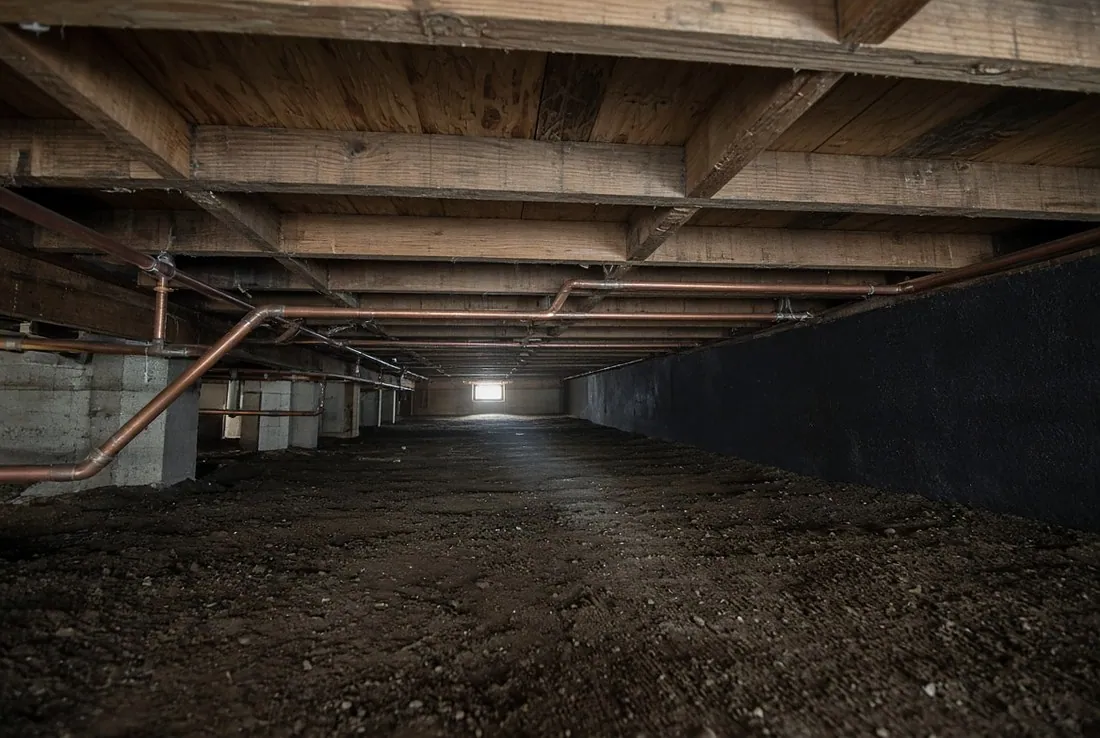
Oregon State University’s extension service recommends going through the house once a year for exactly this: looking in the crawlspace, probing the wood for rot, checking for water wicking up out of the soil, and writing down what you find so you can tell next year whether anything has changed (Oregon State University Extension). They also say most of this damage builds up over years, and that you fix where the water is coming from before you replace any wood, or the new wood goes the way of the old.
If you cannot get into a crawlspace any more, and plenty of us cannot, that is a job to pay somebody to do once a year with a flashlight and a screwdriver. It is cheap. A sill is not.
🔥 The Two That Catch Fire
Not every job that gets put off ends with water. Two of them end with fire, and I have seen what is left after both.
Dryer vents. Clean the lint filter every time you run the dryer, and have the vent pipe cleaned out at least once a year (Consumer Product Safety Commission). Failure to clean was the leading factor in home dryer fires from 2018 to 2020 (U.S. Fire Administration). Check that the outside flap opens when the dryer runs and that the duct behind the dryer is not crushed. Use rigid metal duct, not plastic or foil (U.S. Fire Administration).
Chimneys. Have the chimney and vents cleaned and inspected at least once a year by a professional (U.S. Fire Administration). Creosote builds up inside a chimney that is used and not swept, and creosote burns. In the U.S. Fire Administration’s study of home heating fires from 2017 to 2019, about half were confined to a chimney or flue (U.S. Fire Administration).
The Consumer Product Safety Commission puts the number of home dryer fires at about 6,400 a year (Consumer Product Safety Commission). For heating, the U.S. Fire Administration counted about 32,200 home fires and about 190 deaths in 2021 alone, and heating is the second leading cause of fire deaths among people sixty-five and over (U.S. Fire Administration).
Both of these are jobs you pay somebody to do once a year, and both cost very little next to the alternative.
💧 Ears Behind the Toilet
When I worked on people’s houses, a good many of them had a burglar alarm. Plenty of them had thought to add smoke detectors to it. Hardly anybody had thought to add a flood sensor.
A leak sensor is a small thing that sits on the floor and tells you when it gets wet. I would put one behind each toilet, one beside the water heater, and one under the kitchen sink. The washing machine, the dishwasher, the refrigerator if it has an ice maker, and the drain pan of the air conditioner’s indoor unit are good places too.
Many of them can be added to the alarm system you already have, and you can often do it yourself. The alarm company I use sells them for about ten dollars apiece. Others charge more.
Catching a leak in the first hour or two, even while you are at work, beats walking in the door eight hours later. Wet materials need to be dried out within 24 to 48 hours to head off mold (U.S. Environmental Protection Agency). Eight hours of a broken supply line can soak a floor that takes a great deal longer than that to dry.
One caution. A cheap sensor that only beeps is only as good as the person in the house to hear it. If you want it to help while you are out, buy the kind that sends an alert to your phone. A step past that is a valve that shuts the water off by itself when a sensor goes wet. The insurance industry’s information office recommends exactly that kind of leak monitor and shut-off (Insurance Information Institute).
And do not get me started on sink cabinets. I could not tell you how many cabinet floors I saw that had given way under the sink. A slow drip from the drain, or from one of the seals on the water lines, falls on the cabinet floor, and most cabinet floors are particleboard. Particleboard drinks water, swells up, and comes apart. Nobody sees it happen, because the cabinet is full of cleaning supplies.
The alarm system page covers the systems themselves.
🏦 What the Appraiser Sees
Here is where a put-off repair turns up again, years later, when you were not expecting it.
A good many people plan to live on the house one day, one way or another. Some will sell it. Some will take a reverse mortgage. Either way, somebody is going to come and look at the house who has a reason to look hard.
A reverse mortgage looks hard at the house. The federally insured kind, called a HECM, requires the house to meet FHA property standards. If repairs are needed, the loan can close before they are finished only when the remaining work comes to no more than 15 percent of what is called the maximum claim amount, with money held back to pay for it (24 CFR 206.47).
And it keeps looking after closing. Under the federal rules, the borrower must keep the property in good repair, and failing to keep the obligations of the mortgage can make the whole loan come due (24 CFR 206.27). The Consumer Financial Protection Bureau lists keeping your home in good condition among the things a reverse mortgage borrower has to do, along with paying the taxes and the insurance (Consumer Financial Protection Bureau).
A sale looks hard at the house too. The buyer’s lender sends an appraiser. HUD’s older reference guide for FHA appraisers told them the roof had to keep moisture out, and that where there was evidence of damage or leaks the appraiser should call for a further inspection (HUD archived reference guide). HUD has been rewriting its property rules since 2025, so the exact wording is changing (HUD Mortgagee Letter 2025-18). The idea is not. A lender lends against a house, and a house with water in it is a house a lender is slow to lend against.
When a house cannot easily be financed, the buyers left are the ones with cash. A buyer with cash knows exactly what that is worth to you, and he prices the rot in, and then some. The page on the postcard that wants your house explains how that end of it works.
A deferred repair is evidence in an argument you are not in the room for. The appraiser writes it down. The buyer’s lender reads it. The offer comes in lower. Nobody ever tells you that the toilet you did not fix ten years earlier is what it cost you.
📋 The Rest of the List
The toilet, the crawlspace, the dryer and the chimney are the ones I saw most. They are not the only ones. Each of these is cheap to catch and dear to ignore:
- A water heater past its years. The Department of Energy puts the life of a storage water heater at about 10 to 15 years (U.S. Department of Energy). An old tank that finally lets go puts its whole contents on the floor, and keeps the supply line running until somebody shuts it off.
- Rubber washing machine hoses. They crack with age and stay under pressure even when the machine is off. The insurance industry’s research institute says to replace them every three to five years and to use braided stainless steel (IBHS).
- Caulk and grout around the tub and shower. The same slow leak as the toilet, only behind the tile. Check it and repair it as needed (University of Georgia Extension).
- Gutters and downspouts. Water that comes off the roof and lands beside the house ends up under it. That is how a corner like Jane’s gets started (University of Georgia Extension).
- A septic tank nobody has pumped. The EPA says a household tank is typically pumped every three to five years, and that a failed system can cost thousands to replace (U.S. Environmental Protection Agency).
- Ice dams, in snow country. House heat leaking into the attic melts the snow on the roof, it refreezes at the edge, and the water backs up under the shingles and into the ceiling: the same dark spot, from a different direction (University of Minnesota Extension).
- Termites, in the South and Southeast. Slow, hidden, and not covered by insurance (UF/IFAS Extension).
- Dead limbs over the roof. They come down in the first big storm, and they pick where.
All of it, with how often and who should do which part, is on its own page: the once-a-year house checklist. Print it and put it on the refrigerator. If you are the one who notices in your house, it is also the list you leave for whoever comes after you. Water that gets in during a freeze has its own page too: frozen pipes.
⚡ Why This Belongs on the Fifty List
For most people, the income drops when the work stops. It drops a good deal, and it drops for good.
The house does not know that. It keeps on aging at the same rate it always did. The roof does not wait for a better month, and neither does the water heater.
So the time to put a twenty-year-old house in order is while the paycheck is still coming in. Replace the old water heater on your own schedule, not on its. Put in the leak sensors. Buy the good step ladder and the good flashlight. Get the chimney swept and the dryer vent cleaned, and write down the date you did it.
None of that will be cheaper later. Not the parts, not the man who comes to fit them. What will have changed by then is your income and your knees.
Paying off the house was the big job. Keeping it is a lot of small ones, and the small ones are the only kind you can still choose the timing of.
❓ Questions People Actually Ask
Does homeowners insurance cover a slow leak?
Usually not. Most homeowners policies cover water damage that is sudden and accidental, like a burst pipe or a washing machine hose that lets go. Most do not cover damage from a leak that went on slowly, or the rot and mold that come with it. Insurers generally treat that as a maintenance problem. Read your own policy, because policies differ.
Does homeowners insurance cover rot or termite damage?
Generally no. The Insurance Information Institute says policies will not cover damage due to lack of maintenance, mold, or termites and other pests. Rot from a long-running leak is treated the same way.
Can a reverse mortgage require repairs to my house?
Yes. A federally insured reverse mortgage, called a HECM, requires the house to meet FHA property standards. Required repairs that come to no more than 15 percent of the maximum claim amount may be finished after closing, with money set aside for them. After closing, the borrower must keep the house in good repair, and failing to can make the loan come due.
What home repairs do people most often put off?
Slow water leaks and the jobs nobody sees. A failed wax ring under a toilet, a dripping drain under the sink, a crawlspace that stays damp, a dryer vent full of lint, a chimney that has not been swept, gutters that dump water against the foundation, and a water heater past its years. Each one is cheap when it is small.
Are water leak sensors worth it?
For most houses, yes. A sensor behind each toilet, beside the water heater and under the kitchen sink can warn you of a leak while it is still a small one. The kind that sends an alert to your phone is the kind that helps when nobody is home to hear a beep.
📚 Where This Comes From
Every figure on this page is linked where it appears, and every source is listed again here. The stories are from my own handyman work; names and places are left out or changed. This page names no insurance company, lender, appraiser or contractor.
- What homeowners policies cover and do not cover — Texas Department of Insurance, When are water damage and mold covered by insurance?; Texas Department of Insurance, Five things your home policy won’t cover; Washington Office of the Insurance Commissioner, Leaks, water intrusion and mold; Insurance Information Institute, Homeowners Insurance Basics; Insurance Information Institute, Which disasters are covered by homeowners insurance?
- How often water claims happen, and what they cost — Insurance Information Institute, Facts + Statistics: Homeowners and renters insurance
- Leak monitors and shut-off systems — Insurance Information Institute, How to protect your home from water damage
- Why wet wood rots and dry wood does not — USDA Forest Products Laboratory, Strength loss in decayed wood; NC State Extension, Powderpost Beetles and Wood-Inhabiting Fungi
- The yearly crawlspace check — Oregon State University Extension, Annual home inspection for moisture, insects helps prevent costly damage
- Dryer and chimney fires — U.S. Fire Administration, Appliance and Electrical Fire Safety; U.S. Fire Administration, Clothes Dryer Fire Safety; U.S. Fire Administration, Heating Fire Safety; U.S. Fire Administration, Heating Fires in Residential Buildings (2017–2019); Consumer Product Safety Commission, March 2023 release
- Drying within 24 to 48 hours — U.S. Environmental Protection Agency, A Brief Guide to Mold, Moisture and Your Home
- Reverse mortgage property rules — 24 CFR 206.47, Property standards and repair set-aside; 24 CFR 206.27, Mortgage provisions; Consumer Financial Protection Bureau, Protections for reverse mortgage borrowers
- FHA appraisal and the roof — HUD, HOC Reference Guide: Roofs and Attics (archived); HUD Mortgagee Letter 2025-18
- The rest of the list — U.S. Department of Energy, Which Water Heater Is Right for You?; IBHS, How to Prevent Interior Water Damage from Plumbing and Appliances; University of Georgia Extension, Mold and Moisture Home Inspection Checklist; U.S. EPA, Why Maintain Your Septic System; University of Minnesota Extension, Dealing with and preventing ice dams; UF/IFAS Extension, Termite Prevention and Control