
⏱ The First Hour, and Why Silence Costs More Than the Scam
First, what this page is. A plain explanation of what to do in the hours after money or information has already gone, in the order that gives the best chance of getting some of it back. It is not legal or financial advice, it was not written by an attorney, and nothing here promises recovery. Most of what follows depends on your bank, your state, and how fast the money moved. Confirm anything that matters with your own bank and with the agencies named below.
One related trap worth knowing before it arrives: the contractor who knocks after a storm is making a home-solicitation sale, and federal law gives you three days to cancel it whatever he says at the door. That is on the contractor page.
The instinct, and it is close to universal, is to tell nobody. Not the bank, because you authorized it. Not the family, because they will say you should have known. Not the police, because what would they even do. So the first day goes by, and then the weekend, and by the time anybody is told, every door that was open has closed.
So before anything practical, two facts that are worth more than they look.

The first is that you are not a rare fool. In 2025 the FBI’s Internet Crime Complaint Center took 201,266 complaints from people aged sixty and over, reporting $7.748 billion in losses — a fifty-nine per cent jump in a single year. The average loss was $38,500. More than twelve thousand people lost over a hundred thousand dollars each. Those are only the ones who reported.
The second is that these are not clever individuals. They are industries. The FBI describes organized criminal enterprises running scam compounds in Southeast Asia, staffed in part by trafficked labor, working from scripts refined against thousands of people before they reached you. Voice cloning now makes a grandson sound like a grandson. Nobody outsmarted you personally. You were processed.
The one thing that actually changes the outcome is speed, and the one thing that reliably destroys it is embarrassment. Every hour spent deciding whether this is worth reporting is an hour the money spends being moved somewhere it cannot be reached. Report it as though you were sure, even if you are not.
The order, before the detail
Everything below is those four steps, explained.
📞 The Call That Has to Happen First
Before the police, before the family, before you have worked out how to explain it: the bank, building society or card issuer that the money left from. Ask for the fraud department by name. Say the words fraudulent transfer or fraudulent charge — that phrasing routes the call to the people who can actually do something rather than to general enquiries.

Two things to ask for, and the second one is the one nobody knows to say:
- Ask them to recall or reverse the payment. Whether that is possible depends entirely on how you paid, which is the next section.
- Ask what indemnification paperwork they need from you to start a recall — a hold harmless letter or letter of indemnity. That is the FBI’s own recommended wording, and asking for it by name tends to move a bank from sympathy to process.
Have the details in front of you before you dial. The exact amount. The date and the time. Any confirmation or reference number. Whatever you were told about where the money was going — a bank name, an account number, an app username, a wallet address, a card number you read out. Write it all on one sheet of paper now, because you will repeat it four or five times today and each retelling is a chance to lose a digit.

Do not wait for certainty. Banks and the FBI would both rather have a report that turns out to be nothing than one that arrives on Monday. If you find out an hour later that it was legitimate after all, you have lost nothing but a phone call.
❄ The Federal Freeze Almost Nobody Is Told About
This is the part of the page most worth the reading time, because it is real, it works, and it is almost never mentioned in the branch.
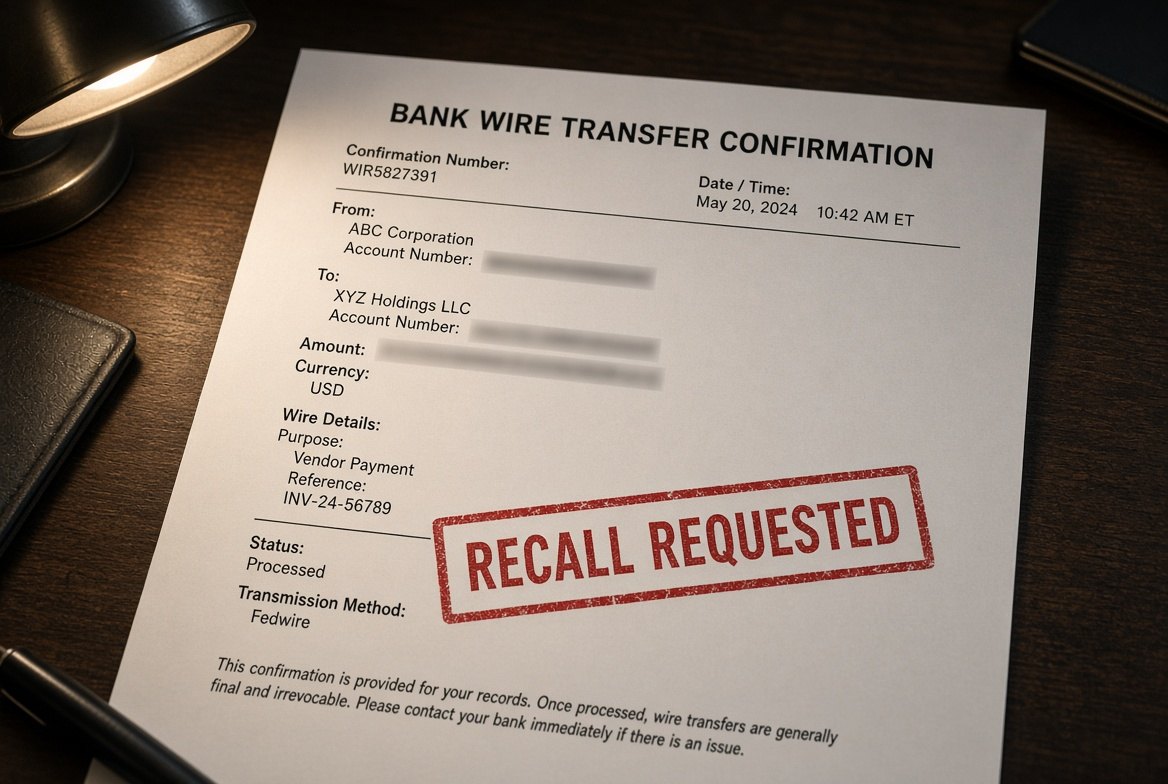
Since 2018 the FBI has run a unit inside its Internet Crime Complaint Center called the Recovery Asset Team. When a fraudulent transfer is reported quickly and in enough detail, the team can start a process called the Financial Fraud Kill Chain — in plain terms, it goes directly to the bank that received your money and asks that the account be frozen before the funds are released. If the money has already been split and moved on, it can chase the next accounts too.
What it actually recovered in 2025
FBI IC3 Annual ReportAnd specifically for older victims: 642 of those actions involved people aged sixty and over, covering $65.4 million in reported losses, of which $32.9 million was frozen. Roughly half the money, back. The three commonest kinds of case in that group were tech-support and account-takeover scams, wire fraud around a house purchase, and investment or cryptocurrency schemes.
What the internet gets wrong about this
Search this subject and you will be told, repeatedly and confidently, that the FBI only acts on transfers of $50,000 or more. People read that, decide their loss is too small to matter, and never file.
That threshold belongs to one narrow case — the international version of the process — and it is not a condition of reporting. The FBI’s own instruction in the 2025 report is the opposite, and it is worth quoting to yourself while you fill the form in: regardless of the amount lost, file a complaint at ic3.gov. Include the full transaction details, because a vague report cannot be acted on and a specific one can be sent straight to the receiving bank.
Two honest cautions so nobody sits waiting by the telephone. The IC3 does not write back. It is a hub, not a caseworker, and most reports do their work in aggregate rather than individually. And a freeze is not a refund — it stops money moving while the banks and the lawyers sort out who it belongs to. Neither of those is a reason not to file. The 58 per cent happened to people who did.
💳 What Is Still Reversible, and What Is Not
This is the part that decides everything, and it has nothing to do with how much you lost or how sorry anybody feels. It depends on the plumbing you paid through.
Wire transfer and ACH
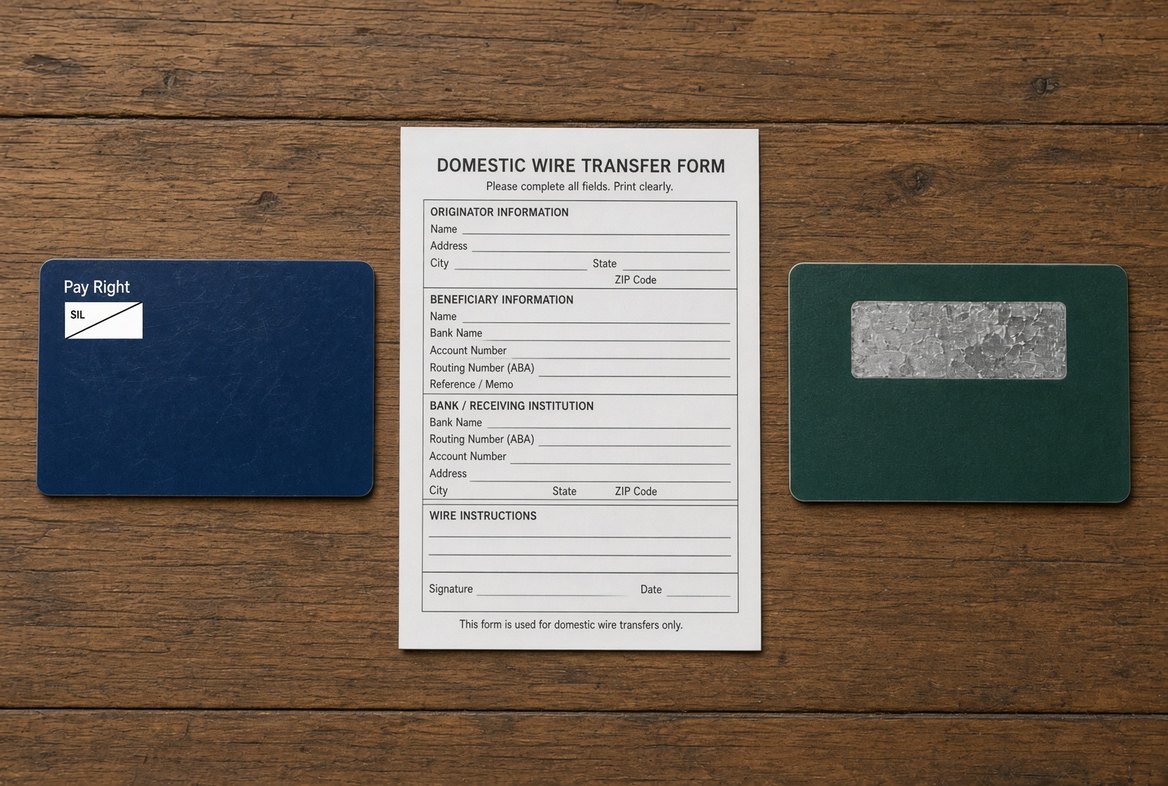
Fastest clock of allThere is no consumer right to reverse a wire. A recall is a request your bank makes of the receiving bank, and it succeeds mainly when the money is still sitting there. That is why this one is measured in hours: bank fraud department, then ic3.gov, the same day, ideally the same hour.
Debit card and other electronic transfers
Federal law, Regulation EIf a transfer was genuinely unauthorized — somebody used your card or your account without permission — federal law caps what you can be made to carry, and the cap depends only on how fast you spoke up:
And one line from the official commentary that ought to be read out loud to anybody sitting on this in shame: your own carelessness cannot be used to impose greater liability than the rule allows. Writing the PIN on the card does not forfeit the protection. Being fooled does not forfeit it either.
The hard case: a payment you made yourself
Say this part plainlyThose protections cover transfers you did not authorize. If you were talked into sending the money — a payment app, a transfer to “protect” your account, a wire to a fake title company — the transaction is generally treated as authorized, however dishonestly it was obtained. That is the single biggest reason people are told no.
Report it anyway, and do three things: put the report in writing as well as by telephone, ask for any refusal and its reason in writing, and ask specifically whether the receiving account has been reported by others. Banks settle more of these than their first answer suggests, and a written trail is what the next person up the chain reads.
Gift cards — not as hopeless as you were told
Federal Trade CommissionThe old advice was that gift card money is gone the moment you read the numbers out. That has changed. Some card companies now flag and freeze scam-loaded balances, and will give the money back if the scammer has not drained it yet.
So: keep the card and the store receipt, contact the gift card company — not just the shop that sold it — tell them it was a scam, and ask for your money back in those words. The FTC’s guidance is explicit that it is worth reporting no matter how long ago it happened. Sooner is better. Later is not pointless.
Cryptocurrency, kiosks, cash and couriers
The hardest groundThese are the least recoverable and the fastest growing. In 2025, people aged sixty and over filed 6,188 complaints involving cryptocurrency machines and kiosks, losing $257 million, and another $311 million went to schemes that sent a courier to the door to collect cash or gold.
Report these to the bank or exchange and to ic3.gov all the same — kiosk operators and exchanges do sometimes freeze accounts on a fast, specific report. And keep the FTC’s flat rule where you can see it: no government agency will ever tell you to move money to protect it, or to withdraw cash or buy gold and hand it to anybody. That instruction is the scam, every single time, with no exceptions.
🔒 Locking the Door Behind Them
Money is only half of it. If any information changed hands — a Social Security number, a date of birth, an account number, a code read from a text message — then the second half of the job is making that information useless.
The credit freeze, which is free and which people confuse with something else
Since September 2018 a credit freeze has been free by federal law, for you and for anybody you hold power of attorney for. It stops new credit being opened in your name, because a lender cannot pull a frozen file.
- You have to do it at all three bureaus separately — Equifax, Experian and TransUnion. A freeze at one is not a freeze.
- Requested online or by telephone, it must be in place within one business day, and lifted within one hour when you ask.
- A freeze is not a “lock.” Locks are a product, sometimes with a monthly fee attached. The freeze is the one guaranteed by statute, and it is the one to ask for by name.
The fraud alert, which is the opposite way round
A fraud alert tells lenders to verify who you are before opening anything. It is weaker than a freeze — but here you only contact one bureau, and that bureau is required to tell the other two.
- An initial fraud alert lasts one year and anybody who suspects trouble can place one.
- An extended fraud alert lasts seven years, and is available once you have an FTC Identity Theft Report or a police report. It also takes you off the pre-screened credit and insurance mailing lists for five years, which quietly removes a good deal of what arrives in the letterbox.
IdentityTheft.gov, and what it is actually for
The FTC runs two doors and they are not the same. ReportFraud.ftc.gov is the general report. IdentityTheft.gov is the one to use when information was taken, because it produces something: a personalised recovery plan, pre-filled dispute letters, and the FTC Identity Theft Report — the document that unlocks the seven-year alert and that businesses ask for when you tell them an account is not yours.

The Social Security move hardly anybody knows about
Social Security AdministrationYou can ask the Social Security Administration to block all automated telephone and internet access to your Social Security record. Not just if you have been defrauded — for any reason at all. It stops somebody claiming your online account, redirecting a benefit, or changing an address from a keyboard.
The catch is real and you should know it before you ask: the block includes you. Once it is on, your own dealings with Social Security happen with a person rather than a screen, and you will have to prove who you are to have it taken off again. For a lot of people who never used the website anyway, that is a small price. For somebody who manages everything online, it is a genuine trade.
One sequencing note: Social Security does not handle identity theft itself and will send you to the FTC first. Do IdentityTheft.gov, then call Social Security about your earnings record and the block.
⚠ The Second Wave, Which Is Aimed at You Specifically
Here is the part that catches decent, careful people who have already learned the lesson once, and it is the reason this page exists at all.
The people who took your money know that you lost it. Your name has a value now that it did not have last week — you are on a list of people who have money, who have been proved willing to act on a telephone call, and who are now desperate enough to try anything to undo it.
In 2025 the FBI logged 10,516 complaints about recovery scams, with $1.4 billion in losses. People aged sixty and over accounted for 2,529 of those complaints and $540 million — well over a third of all the money lost to a scam whose entire pitch is that it will get your money back.
They are inventive about it. During 2025 the FBI issued public warnings about fictitious law firms offering to recover cryptocurrency losses for a fee, about criminals impersonating the IC3 itself, and about people spoofing the IC3 website. There is a standing Justice Department alert about callers claiming to be Justice Department investigators, complete with a phone menu copied from the real one.
Three rules that close all of it
- Nobody legitimate charges an up-front fee to recover stolen money. Not a lawyer, not an investigator, not a “fund recovery specialist.” A fee to get your money back is the second scam wearing the first one’s clothes.
- No government agency will telephone you about a report you filed and ask for money, gift cards or account access. Reporting is free and always will be.
- Never use a number, link or address that arrived in the message. Look the agency up yourself and dial that. This is the same rule that would have stopped the first one, and it still works.
A loss like this sends people looking online for a loan, and that leaves a trail of its own. A North Carolina special deputy attorney general told AARP that details typed into loan websites can be bought by scammers and by companies that buy houses, who hunt for people in desperate financial situations. If a postcard offering cash for your house turns up in the weeks after, read this before you answer it.
🤝 The Number That Puts a Human on It
The Justice Department runs a free National Elder Fraud Hotline for anybody aged sixty or over: 833-372-8311 (833-FRAUD-11), managed by the Office for Victims of Crime.
What you get is a case manager — a person who stays your point of contact, works out which agencies your particular mess needs to go to at federal, state and local level, and helps you make those reports rather than handing you a list. For anybody trying to do this alone, at speed, from a kitchen table, that is worth more than any single piece of advice on this page.
What it is not: they do not investigate, and no case manager can promise your money back. Anyone who does promise that is the second wave. Hours vary and have changed — look them up on the Office for Victims of Crime site rather than trusting a number printed anywhere, including here.
And tell one person in the family today. Not for the money — for the isolation. Keeping the victim quiet and alone is not a side effect of these schemes, it is the mechanism, and it is what makes the second approach land. Saying it out loud once, to somebody who loves you, ends that.
⚡ Why This One Is on the Fifty List
Nothing on this page is complicated. It is four telephone calls in the right order and a form on a government website.
What makes it belong here is that the hour you need it is the worst hour of your life to learn anything. You have just understood what happened. You are ashamed in a way that has nothing to do with logic. Your hands are not steady. And a clock you did not know existed is already running down.
In that hour, people do the two things this page is written to prevent. They wait, because they cannot face saying it out loud. Or they answer the next call — the one from somebody who says they can get it back.
So the value of this is entirely in reading it now, while it is somebody else’s story, and carrying away one sentence: call the bank and file at ic3.gov the same day, whatever the amount, and never pay anybody who offers to recover it.
And if it has already happened — to you, or to somebody you are reading this for — then start at the top of the page and make the first call. Today is still early.
❓ Plain Answers
The short version of this page, one question at a time — the answer is always the first line.
What should I do first after I've been scammed?
Call the fraud department of the bank or card issuer the money left from right away, then file a report at ic3.gov the same day, whatever the amount. Next, freeze your credit at all three bureaus, and use IdentityTheft.gov if information was taken.
Can the FBI get my scammed money back?
The FBI's Recovery Asset Team can sometimes freeze stolen money at the receiving bank if a transfer is reported quickly and in enough detail. In 2025 it froze $679 million, with a 58 per cent success rate on what it could chase. A freeze is not a refund, and nothing is promised.
Does the FBI only help if I lost more than fifty thousand dollars?
No, the FBI says to file a complaint at ic3.gov regardless of the amount lost. The $50,000 threshold belongs only to the international version of the freeze process, not to reporting.
Is a credit freeze free?
Yes, a credit freeze has been free by federal law since September 2018, and it must be placed separately at Equifax, Experian and TransUnion. Requested online or by telephone, it must be in place within one business day. A lock is a different product that can carry a fee.
How much can I lose if someone uses my debit card without permission?
Under Regulation E, your loss from an unauthorized debit card or electronic transfer is capped at $50 if you report it within two business days of learning of it. After that it is $500 if reported within 60 days of the statement. Payments you were talked into making are generally treated as authorized.
Should I pay a company that says it can recover my scammed money?
No, nobody legitimate charges an up-front fee to recover stolen money, whether a lawyer, an investigator or a fund recovery specialist. In 2025 recovery scams took $1.4 billion. The free National Elder Fraud Hotline for people sixty and over is 833-372-8311.