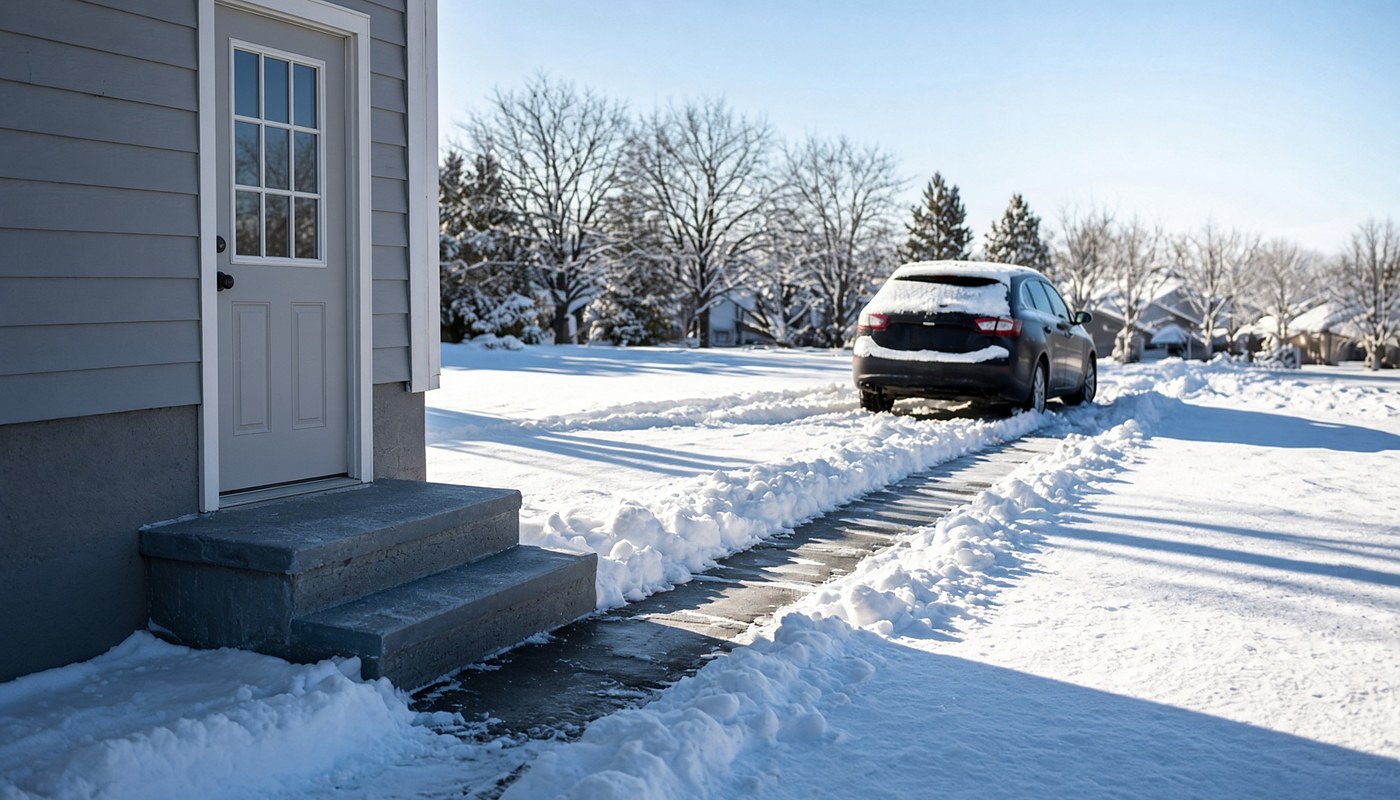
🚶 The Ten Feet Between the Door and the Car
Plainly, first. This page is for educational purposes only. BuyItAt50 is not a doctor, a cardiologist, a physical therapist or a contractor, and it has no connection to any company making boots, cleats, shovels or de-icer. It describes published research and public safety guidance in plain words. Whether shoveling snow is safe for you personally is a question for your own physician, and it is worth asking before the first storm rather than after one.
Ask somebody where an older person is most likely to fall in winter and they will describe a dramatic place. A steep hill. A frozen pond. A long walk somewhere.
It is almost never that. It is the ten feet between the back door and the car, on the same path they have walked twice a day for thirty years, carrying something, in shoes chosen for where they were going rather than for how they were getting there.
Nothing on this site gets written about more than falls, and yet every fall page we have — the risk audit, the grab bars, the slippers, the lighting — stops at the front door. This is the outdoor half, and it is a season rather than a hazard: it arrives every year, it lasts for months, and it turns a surface everybody has stopped thinking about into the most dangerous ground they will stand on all year.
Ice does not require you to do anything unusual. It only requires you to do the usual thing on a morning when the usual thing has changed underneath you.
There are three separate arguments in this page and they want keeping apart, because people muddle them constantly.
The first is about your heart, and it concerns the shovel. The second is about your feet, and it concerns what you are standing in. The third is about the ground, and it concerns chemistry. Each has real research behind it, and in each case the thing that is widely sold is not the thing that works.
❄️ The Shovel Is a Cardiac Question
Nearly everybody knows, vaguely, that shoveling snow is hard on the heart. It gets said every winter and it gets filed under things people say. The research underneath it is a good deal more specific than the folklore, and the specifics are what make it decidable.
The study most worth knowing looked at American emergency department visits for snow-shoveling incidents over seventeen years and found roughly eleven and a half thousand people a year. Ninety-six percent of it happened at home. More than half were soft-tissue injuries, a third were lower backs, and slips, falls, overexertion and being hit by the shovel accounted for most of the rest.
Then there is the line in that study that changes how you read all of it. Cardiac cases were only about seven percent of the visits — and one hundred percent of the deaths. Sixteen hundred and forty-seven of them, over those seventeen years, every single one cardiac.
So the back injuries are the common outcome and the heart is the one that kills, and they are not the same risk wearing two hats. A bad back is what happens when shoveling goes ordinarily wrong. The other thing happens to people who felt fine ten minutes earlier.
Why this particular chore, and not others
Here is the part almost nobody has heard, and it is the reason shoveling is singled out rather than being just another form of exercise.
A Mayo Clinic review found that ten minutes of heavy shoveling takes the heart to roughly 97 percent of its maximum rate. An emergency physician at Weill Cornell puts the same point in a sentence worth repeating: shoveling snow makes higher demands on the heart than a cardiac stress test does. A stress test is a thing done deliberately, in a hospital, with a cardiologist watching and a crash cart in the corridor. The driveway has none of that.
Barry Franklin, who led the American Heart Association's 2020 scientific statement on exercise-related cardiac events, has laid out why the combination is so unusually punishing. Five things stack up at once:
Five things happening at the same time
The AHA's own statement records that snow shoveling has repeatedly been associated with a rise in cardiovascular events after big snowstorms, and that the people most affected are the ones unused to heavy exertion. A Canadian study of more than 128,000 hospital admissions found heavy snowfall associated with a higher risk of admission for heart attack in men.
What this page will not do is give you an age. You will see forty-five quoted, and sixty-five, and the honest position is that the number is not the point — your own history is. This is a conversation to have with your doctor, in the autumn, before it is snowing. Ask it as a specific question rather than a general one: given my heart, my blood pressure, my medications and what I actually do all week, should I be shoveling at all? A plain answer to that is worth more than any figure on this page.
And if the answer is that you may, the AHA's practical advice is unglamorous: warm up first, push rather than lift wherever the snow allows it, take small loads, stop often, do not eat a big meal or smoke beforehand, and stop immediately — immediately — at chest discomfort, jaw or arm pain, lightheadedness, or breathlessness out of proportion to the work. That last one is the symptom people talk themselves out of, because it is easy to file under being out of shape.
⚙️ The Snowblower Is Not the Safe Answer
The obvious solution to a shovel is a machine, and it is a genuinely good idea for the back. It is a much smaller improvement than people expect for the heart, and it introduces a category of injury the shovel does not have.
On the cardiac side: wrestling a heavy machine through wet snow, hauling it out, restarting it, tipping and turning it at the end of every run, is still hard physical work in the cold. It is easier than shoveling. It is not light duty.
Then the other thing. A study of American emergency department data covering sixteen years found over ninety thousand snowblower injuries, and nearly half of those visits were amputations, fractures and lacerations. The mechanism is almost always the same and it is worth stating in full because it is so counterintuitive.
The machine clogs. You switch it off. You reach in to clear it — and the auger, which has been held under tension by the packed snow, springs round as the blockage frees. The engine is off and the machine still takes a finger, because the energy was already stored in it. Nothing goes into a snowblower but the clearing tool that came with it, and the machine is switched off and stopped before even that. Not a glove, not a stick, and never a hand.
If the machine is the route you take, the honest version of it is: a machine you can actually start and steer without fighting, on a surface you can keep your feet on, with that clearing tool clipped where you can reach it, and the same rule about stopping at any symptom that applies to the shovel.
🤝 Giving the Job Away
This is the section most pages on this subject leave out, and it is the one that actually solves the problem.
The obstacle is almost never money. Clearing a driveway is cheap work compared with a hospital stay, and most households can find it. The obstacle is that handing over a chore you have done yourself for forty years feels like a concession, and people would rather take the risk than make the admission. That is worth naming out loud, because once it is named it loses most of its force.
What is available, roughly in order of how little it costs:
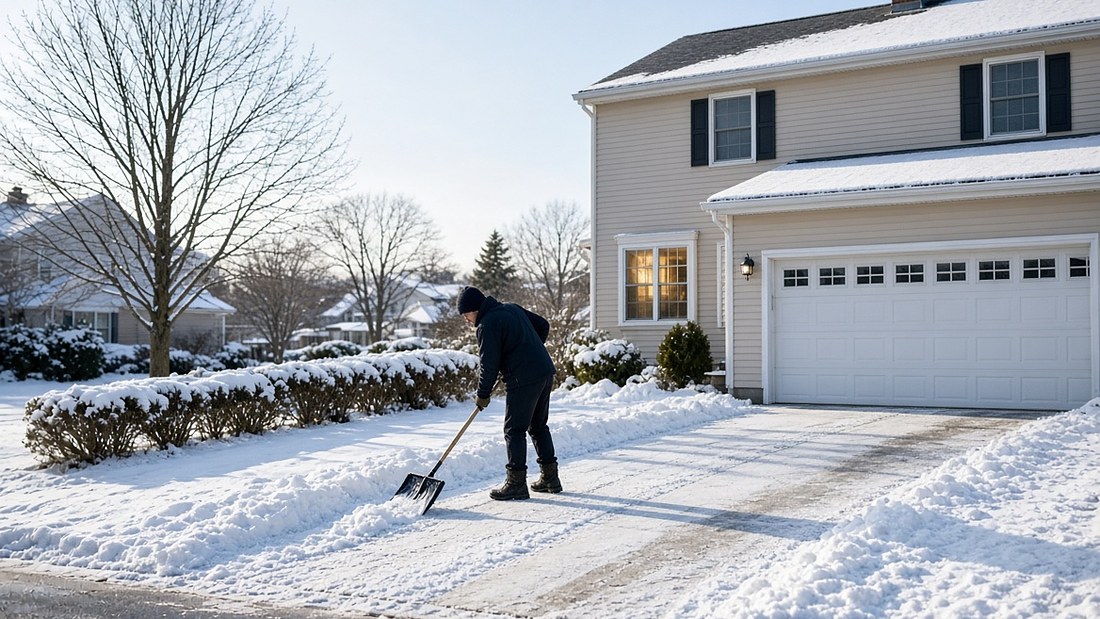
Who does it instead
One thing worth knowing if you are in a town rather than the country: many municipalities require the property owner to clear a public sidewalk within a set number of hours after a snowfall, and will fine you if it stays covered. The hours and the fines are local. If that applies where you live, it is another reason to have somebody arranged in advance rather than discovering the ordinance in a letter.
And keep the clearing honest about what it is for. What has to be clear is the route you actually use — door, step, path, the strip beside the car door, and wherever the mail and the deliveries land. A whole driveway cleared to the asphalt is a nice thing. A clear ten feet to the car is the thing that keeps you out of hospital.
🥾 Ninety of Ninety-Eight
Now the part that ought to be better known than it is, because it is the closest thing to a scandal in this whole subject.
Researchers at the KITE Research Institute, part of Toronto Rehab at the University Health Network, built a laboratory called WinterLab: a room with a floor of real ice, sitting on a platform that tilts. A person in a safety harness walks up and down it while the floor is tipped one degree at a time, until they slip. The steepest slope they can manage is the boot's score. It is tested on bare ice and on melting ice, walking up and walking down, and the boot's rating is its worst result of the four.
They set the passing bar at seven degrees, for a deliberate reason: seven degrees is the maximum slope Ontario's accessibility rules allow for a curb ramp. In other words, the minimum standard is simply can you walk up a wheelchair ramp if it were made of ice.
Of the ninety-eight winter boots they tested, ninety could not do it. Eight percent passed the easiest possible test, and not one earned more than the lowest of three grades.
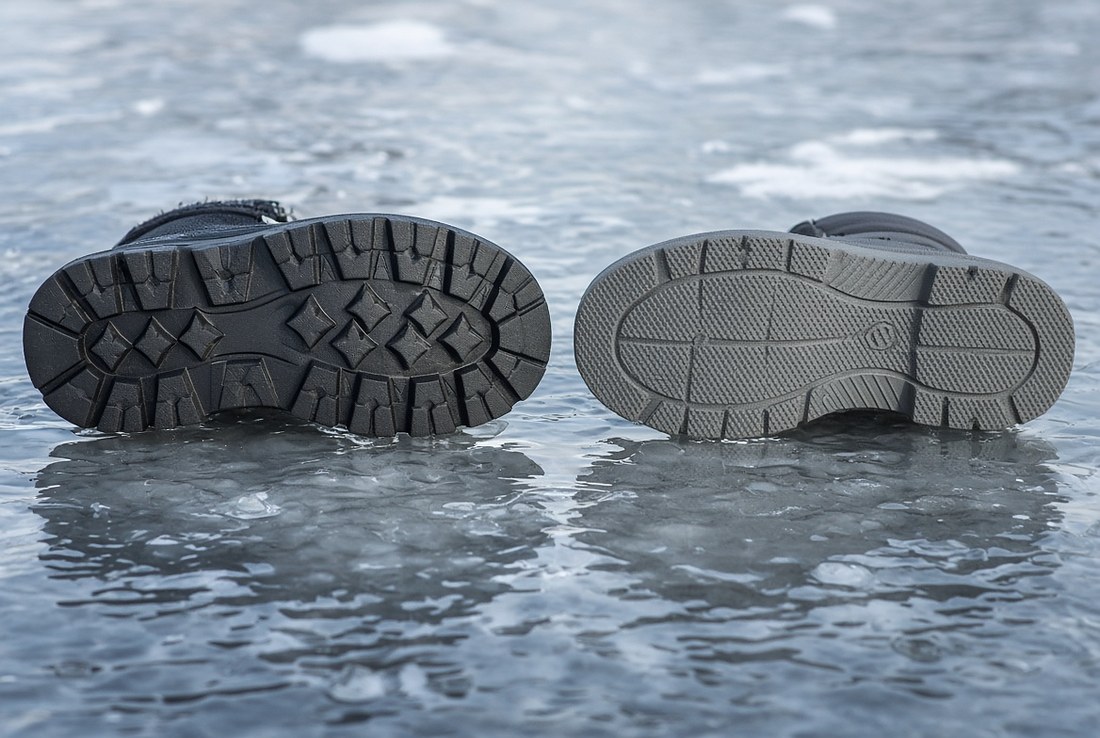
That is not a story about a few bad products. That is nearly an entire category of footwear, sold specifically for walking on winter ground, that cannot hold the gentlest slope it will meet.
And the reason it matters so much for this audience is that a boot cannot be judged by eye. Deep lugs, an aggressive-looking tread, a heavy sole, a high price, an outdoorsy name — none of it predicts behaviour on wet ice, which is the specific surface that puts people on the floor. That is a materials question, not a pattern question, and the two sole technologies that did pass in that round were distinguished by what the rubber was made of rather than by how it looked.
The practical upshot, and it costs nothing. The team publishes its ratings free at ratemytreads.com. Before buying winter boots, look up whether the pair has been tested and what it scored. It is a public database from a rehabilitation hospital, with nothing to sell you, which puts it in a different category from every review you will find attached to a shop.
If what you own is not on the list and you are not replacing it this year, that is exactly what the next section is for.
🧲 Cleats, and the Danger of Forgetting Them
Slip-on traction devices — rubber harnesses carrying coils or small spikes, stretched over whatever shoe you already own — are the cheapest serious answer on this page. They cost less than a bad pair of boots, they fit in a coat pocket, and on packed snow and ice they do what almost no sole does on its own.
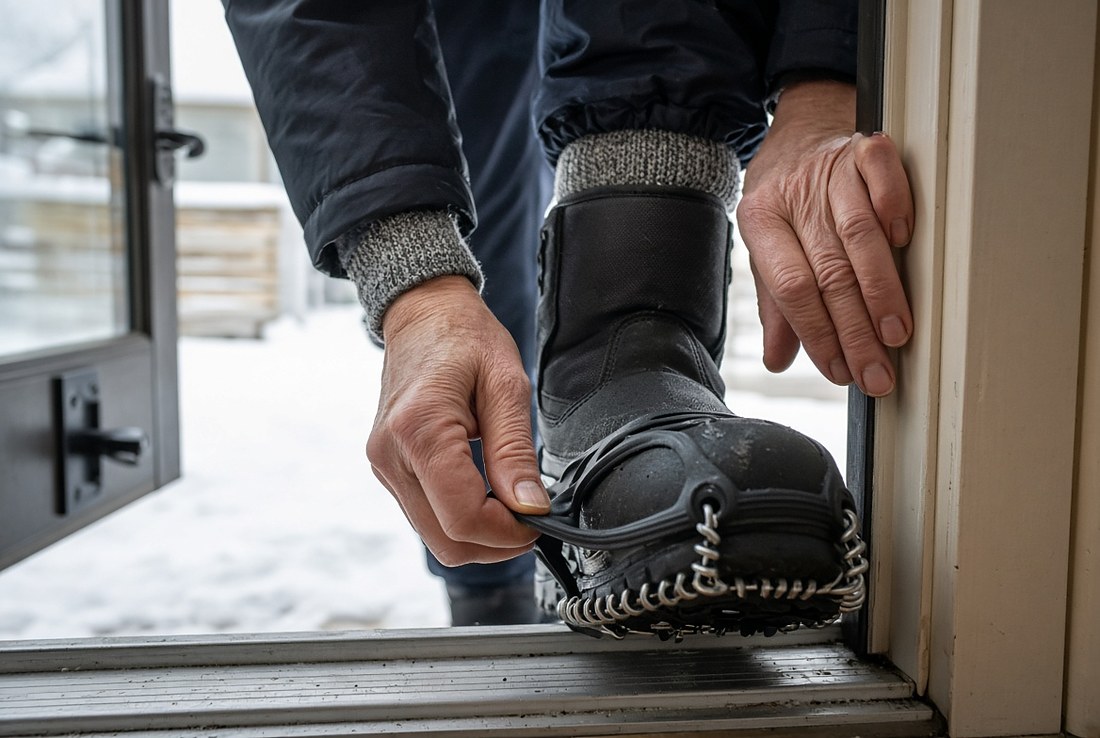
Three things worth knowing before buying a pair.
Getting them on is part of the product. A device you have to sit down and wrestle onto a boot with cold hands is a device that stays in the drawer. If grip or balance is already a consideration, that is the feature to shop for, and the test is whether you can fit them standing up, holding something, in gloves.
They want to go on before you go out, not once you are out. Fitting them in the doorway, while holding the frame, is a different act from deciding halfway down an icy path that you should have.
And the one that actually hurts people: take them off before you go inside. Metal coils or spikes on a tile floor, a shop's vinyl, a wooden hall or a smooth entrance mat are genuinely treacherous — you have made your footing worse than bare soles, at the exact moment you relax because you are indoors. Store shoes take people down in supermarket entrances every winter for precisely this reason. On at the door, off at the door.
They are also, worth saying, the only item here that helps somebody who is not going to change anything else. A person who will not buy new boots, will not shovel, and does not want a lecture will still put a pair of these on to walk to the mailbox.
👟 How to Actually Walk on It
There is a way of moving on ice that is measurably safer, and it is worth understanding why rather than just being told to shuffle, because the why is what makes it stick.
Researchers studying slips distinguish between a heel slip, where the front foot slides out as it lands, and a toe slip at push-off. The heel slip is the dangerous one, and the mechanics are unforgiving: as the leading foot shoots forward, your body's momentum keeps your weight over that foot, so you go over backwards. Backwards is the direction that breaks hips, fractures wrists thrown out to catch you, and puts the back of a head on concrete.
Everything in the advice below is aimed at not generating a heel slip in the first place.
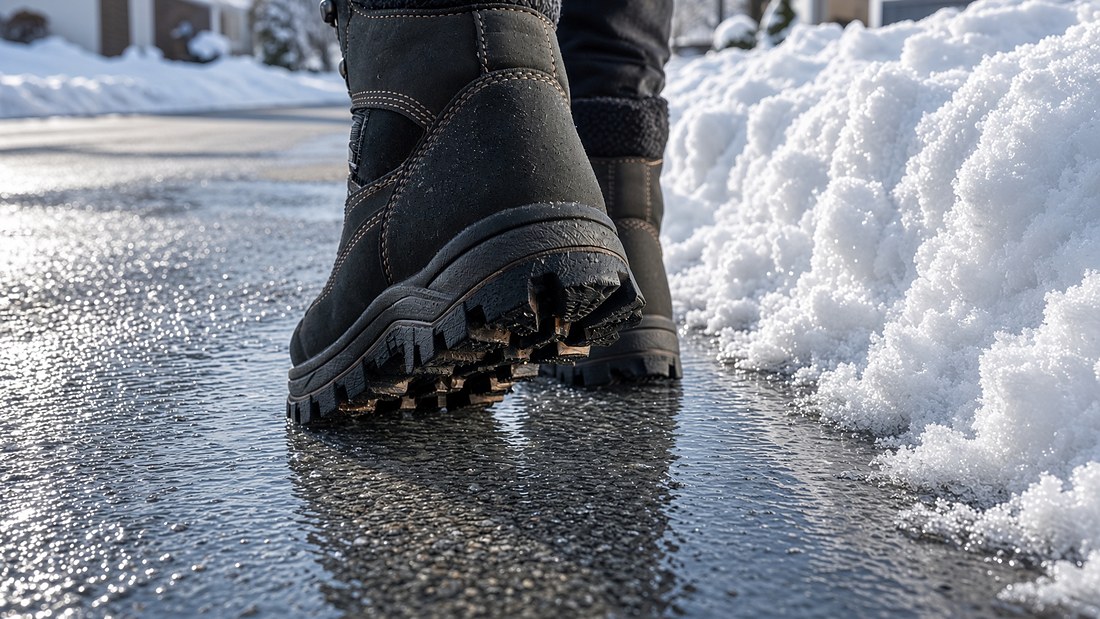
The way that works
One more, which belongs to the house rather than to your feet: a light that comes on before you step out. Winter mornings and afternoons at this latitude are dark at both ends, and the single most common time to meet ice is on a path you cannot see. A motion light over the back step is a cheap piece of fall prevention wearing a different coat.
🧊 Ice Melt, and What the Bag Does Not Say
The de-icer aisle is a wall of bags that all look the same and all say the same words, and they are not the same product. The difference is which chemical is inside, and the thing that separates them is the temperature at which each one stops being any use.
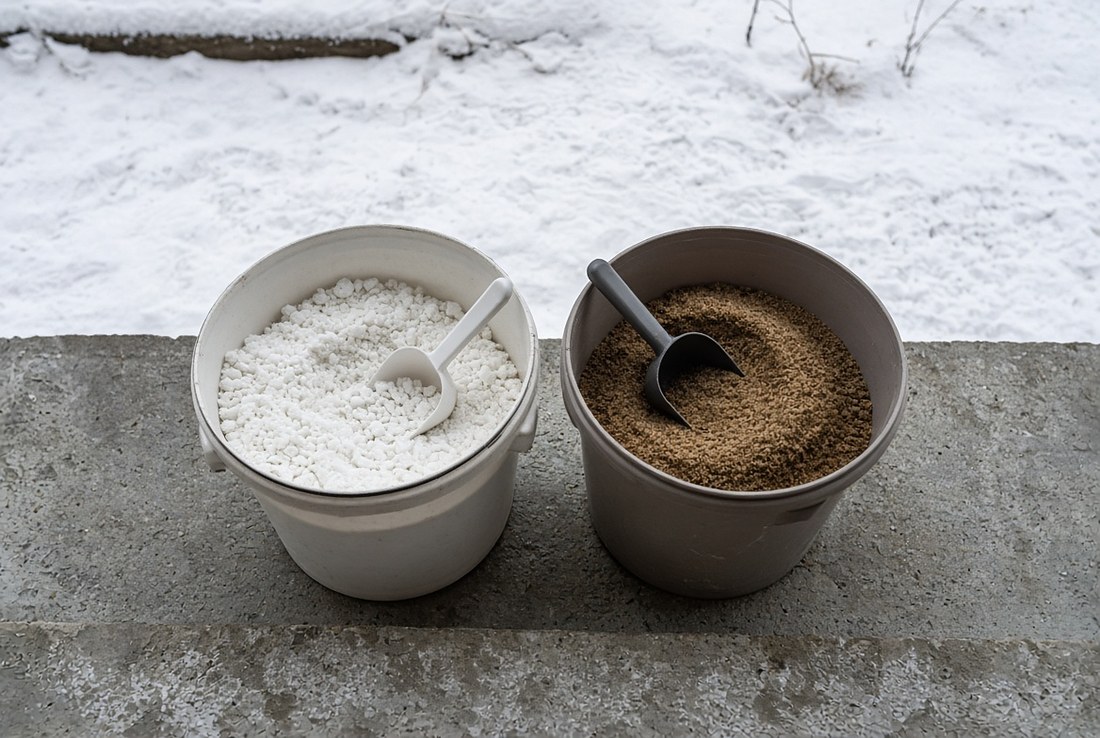
Kansas State Extension's comparison is the clearest we found, and the spread is wider than most people imagine.
What is in the bag
The trick in the numbers, and it is the single most useful thing on this page about de-icer. Suppliers frequently print the lowest temperature at which their chemical melts ice at all in a laboratory — a figure called the eutectic point — rather than the temperature at which it still melts fast enough to clear your steps before you need them. The practical working temperature is meaningfully warmer than the number on the bag. One calcium chloride manufacturer says so in print, which is a company arguing against the convention its own industry uses. So read any headline temperature as the optimistic end of the range, not the promise.
Three things that follow from all of that.
Every chloride de-icer is hard on concrete over time, and on the metal it touches. Newer concrete suffers most. Sweeping up what is left once the ice has gone is not fussiness — the damage is done by the stuff that sits there through repeated freeze and thaw.
Paws and planting take the hit. Salt burns a dog's feet, it gets licked off, and the runoff kills the grass along the edge of a path. If that matters at your house, magnesium chloride and the non-chloride acetate products are the gentler end, and rinsing a dog's feet at the door is the cheap answer regardless.
And below about fifteen degrees, a bag of sand beats a bag of the wrong chemical. This is the point most households get wrong: they keep buying the cheap salt, use it on the coldest mornings when it does nothing at all, and conclude that de-icer does not work. It worked. It was simply the wrong one for that morning.
The genuinely useful arrangement is two containers by the door. One of a de-icer rated for the coldest weather you actually get, and one of sand for the mornings below its range and for the strip beside the car, where traction is what you want rather than a puddle of brine.
🚨 If You Go Down
Everything above this is about not falling. This section is the other half, and almost nothing written about winter falls includes it — which is strange, because the research says the fall itself is frequently not the serious part.
A study that followed people in advanced old age through a year of falls found that 82 percent of the falls happened when the person was alone, and that 80 percent of those who fell were unable to get up unaided after at least one of them. Thirty percent had lain there for an hour or more.
And the figure that ought to be on a poster: an earlier study found that 47 percent of fallers who were not injured at all still could not get themselves up off the floor. Nothing broken, nothing torn, and half of them stuck there anyway.
An hour or more on the ground has a name in the medical literature — the long lie — and a list of consequences that have nothing to do with the impact: hypothermia, pressure injuries, dehydration, muscle breakdown and the kidney damage that follows it, pneumonia.
In that same study, lying on the floor for a long time was strongly associated with serious injury, with admission to hospital, and with moving into long-term care afterwards. The fall is an event. The long lie is what changes where you live.
That is the argument of this whole site arriving in one statistic, and it is why this section is here rather than in a footnote.
And outdoors, the clock runs faster
Indoors, a long lie is measured against dehydration and pressure. On a driveway in January it is measured against the cold, and the cold is winning from the first minute. You are not just in cold air — you are in direct contact with frozen ground, which pulls heat out of a body far faster than air does, and quite possibly through wet clothing. The National Institute on Aging's own warning is that indoor temperatures of sixty to sixty-five degrees can bring on hypothermia in older adults. Concrete at twenty-five is not in the same conversation.
So the outdoor version of this has an order to it, and the order matters.
First: do not move yet
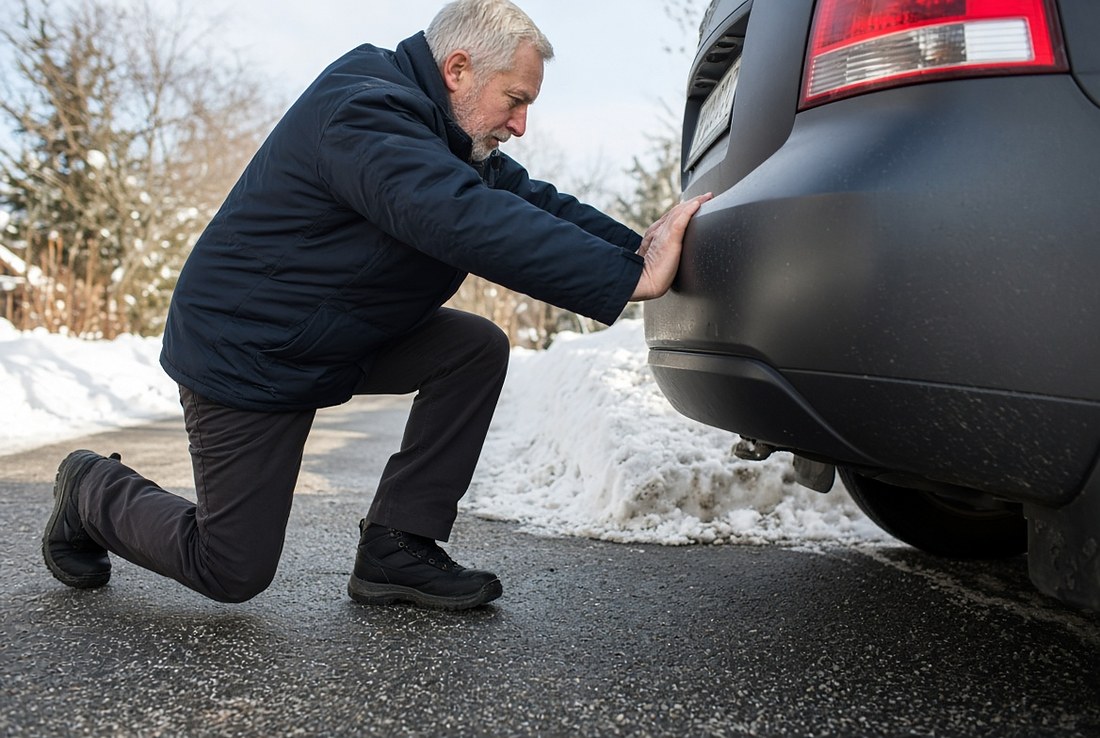
Then: the way up, which is the same on ice as on carpet
And if you cannot get up
Then the job changes completely. It is no longer about standing. It is about the cold and about being found.
What to do instead
Which brings us to the thing that decides all of it, and it costs nothing to fix. A telephone zipped inside a coat, under a layer, in an inside pocket, is of no use whatever to somebody lying on their back with a wrist they cannot use. In winter, the phone goes in an outside coat pocket on the side of your good hand — or you wear a button. That is the whole difference between ten minutes on the ground and the hour that has a name.
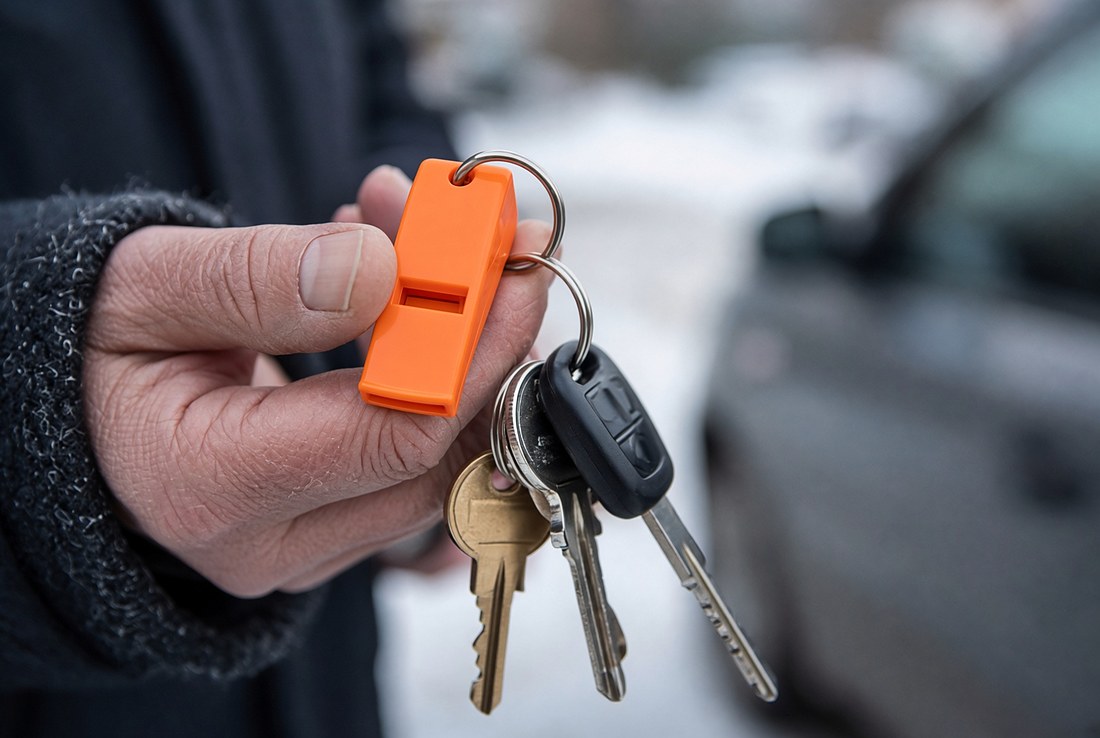
And put a whistle on your keyring. Not in a drawer and not in the bag in the hall — on the keys, because the keys are the one thing that comes with you whichever coat you happen to grab. It costs a couple of dollars, it never needs charging, it does not care that it is twenty degrees out, and it works with a hand that cannot grip and with a phone that is face down under the car. Unlike everything else on this page, a whistle is no use whatever in a drawer. It wants to live on the coat you actually put on to go outside.
And it is worth knowing the limit of the technology here, because the site has written about it elsewhere. Radar fall detection is genuinely good and it watches rooms. It cannot see your driveway. The outdoor case is covered by a pendant or watch with fall detection that works away from the house, or by a phone you can actually reach — and by the oldest system there is, which is somebody who knows roughly when you go out and notices when you have not come back.
One last thing, and it is the only homework on this page. Practise the way up, indoors, on a carpet, with somebody in the room, on an afternoon when nothing is wrong. It takes ten minutes. A sequence you have done once is a sequence you can do cold, wet, frightened and in the dark — and one you have only read about is not.
❓ Questions People Ask
Is it safe to shovel snow at 70?
For a lot of people the honest answer is no, and the reason is the heart rather than the back. A Mayo Clinic review found that ten minutes of heavy shoveling pushes the heart to about 97 percent of its maximum rate, and one emergency physician puts it plainly: shoveling makes higher demands on the heart than a cardiac stress test. The American Heart Association's 2020 scientific statement notes that snow shoveling has repeatedly been linked to a rise in cardiovascular events after major snowstorms, particularly in people not used to heavy exertion. This is a question for your own doctor, and it is worth asking in October rather than in January.
What is the safest winter boot for ice?
Far fewer than you would think are any good. Researchers at the KITE Research Institute at Toronto Rehab tested 98 winter boots by walking people across a floor of real ice that tilts, and 90 of them could not manage even a seven-degree slope, which is the maximum steepness Ontario allows for an accessible curb ramp. Their ratings are published free at ratemytreads.com. Look for a rating rather than for a description of the tread, because the look of a sole tells you almost nothing about how it behaves on wet ice.
What temperature does rock salt stop working at?
Ordinary rock salt, which is sodium chloride, loses its usefulness somewhere around 15 degrees Fahrenheit. Kansas State Extension puts calcium chloride at the other end of the range, working down to about 25 below zero, with magnesium chloride in between. Be careful reading the number on a bag: manufacturers often quote the lowest temperature at which the chemical melts ice at all in a laboratory, rather than the temperature at which it still works fast enough to be any use on your steps.
Does sand melt ice?
No. Sand does nothing to the ice at all. It gives you something to grip on top of it, which in very cold weather is worth more than a de-icer that has stopped working, and it does no harm to concrete, plants or animals. A lot of households are better off with a bag of each: the chemical for what it can melt, and the sand for the mornings when nothing will.
How should you walk on ice so you do not fall?
Short flat steps with your feet under you rather than out in front, arms free and out of your pockets, and weight kept over the front foot. The reason is mechanical: when a heel slides out ahead of you, your momentum keeps your weight on the slipping foot, and you go over backwards, which is the direction that breaks hips and strikes heads. Getting in and out of a car is the highest-risk moment of all, because you are standing up onto one foot on a surface you have not tested.
What should you do if you fall on ice and cannot get up?
Stop trying to stand and start working on the cold and on being found. Get off bare ice or concrete if you can move at all, get anything between your body and the frozen ground, curl up rather than lying spread out, and keep moving whatever you can move. Blow a whistle if you have one clipped to your coat — three short blasts is the recognised distress signal, it takes almost no breath and it carries far further than a voice. Otherwise shout at intervals while you still have the voice for it, and bang on anything metal within reach. Use a phone or a button early rather than late. Researchers call an hour or more on the ground a long lie, and it carries its own risks separate from the fall.
How do you get up after falling?
Lie still first and find out what hurts. If you hit your head or something hurts badly, do not get up at all. Otherwise roll onto your stronger side, push up onto your hands and knees, crawl to something solid that will not tip, bring your stronger foot forward flat so you are half kneeling, and press down through both hands and up through that foot together. Outdoors, crawl off the ice onto snow or grass first if you can, because you cannot push yourself up from a surface that will not hold your hands. Then sit down for several minutes.
💰 Why This One Is Bought in October
Everything on this page has a season and a price, and both of them are worse in January.
Boots are picked over and the sizes are gone by the first storm. Cleats sell out in a snap and arrive after it. A plow service booked in October costs less than the same service begged for in February, and the teenager down the street has already promised three other driveways by then. Every single item here is cheaper, better chosen and more available on a mild afternoon than on the morning you need it.
The whole of this page costs less than one ambulance ride, and rather less than one broken wrist that stops you driving for six weeks.
But the real argument is the one that runs under every page on this site, and it is about the order in which things are decided.
A fall on ice is not the end of anything by itself. What it starts is the conversation — the one where somebody else begins deciding what you can manage, and whether this house is still sensible, and whether next winter ought to be spent somewhere with the snow taken care of. That conversation is very hard to have on your own terms from a hospital bed in February. It is straightforward to have from a kitchen table in October, when the answer you are giving is that you have already sorted it out.
So the errand is short. Ask your doctor the shoveling question plainly, and take the answer. Look your boots up before you trust them to another winter. Buy a pair of cleats and put them where your coat is, and put a whistle on your keyring. Get the right de-icer and a bag of sand in before the aisle is empty. And find the person who will clear your ten feet, and agree it now, while it is a friendly arrangement rather than an emergency.
Then the ice can do what it likes.
Sources: emergency department figures for snow-shoveling incidents are from a 2011 study in the American Journal of Emergency Medicine using national injury surveillance data; snowblower injury figures are from a 2020 analysis of the same surveillance system. The cardiac material draws on the American Heart Association's 2020 scientific statement on exercise-related cardiovascular events, on a Mayo Clinic review, and on a 2017 Canadian Medical Association Journal study of hospital admissions after snowfall. Winter footwear testing, the Maximum Achievable Angle method and the snowflake ratings are the work of the KITE Research Institute at Toronto Rehabilitation Institute, University Health Network, published free at ratemytreads.com. De-icer comparisons are from Kansas State University Extension; the point about eutectic points versus practical working temperatures is made by a calcium chloride manufacturer and is noted as such on this page.