📋 What This Is For
You are standing at a table in somebody’s driveway holding a wrench, and the only question that matters is whether you already own that size. Not whether it is a good make. Not what it sold for new. Whether it fills a hole in what you have got.
So this page has no brand names in it anywhere. Names are somebody else’s argument and they change hands every few years. Sizes do not change. A half-inch bolt was a half-inch bolt in 1961 and it will be one in 2061, and the wrench that fits it is the same wrench.
Work through it once at your own bench and mark what is missing. Then you are not shopping any more, you are hunting, which is a great deal cheaper and considerably more fun.
💡 Two things worth knowing before you spend a dollar.
Buy the gap, not the set. A forty-piece set at a sale is usually four tools you need and thirty-six you already own twice. Sets are for starting from nothing. After that you are filling holes.
You need both measuring systems and there is no way round it. Anything American and older is in inches. Anything made after about 1980, and nearly every car on the road, is metric. A house has both in it. So does a garage.
🔩 Wrenches
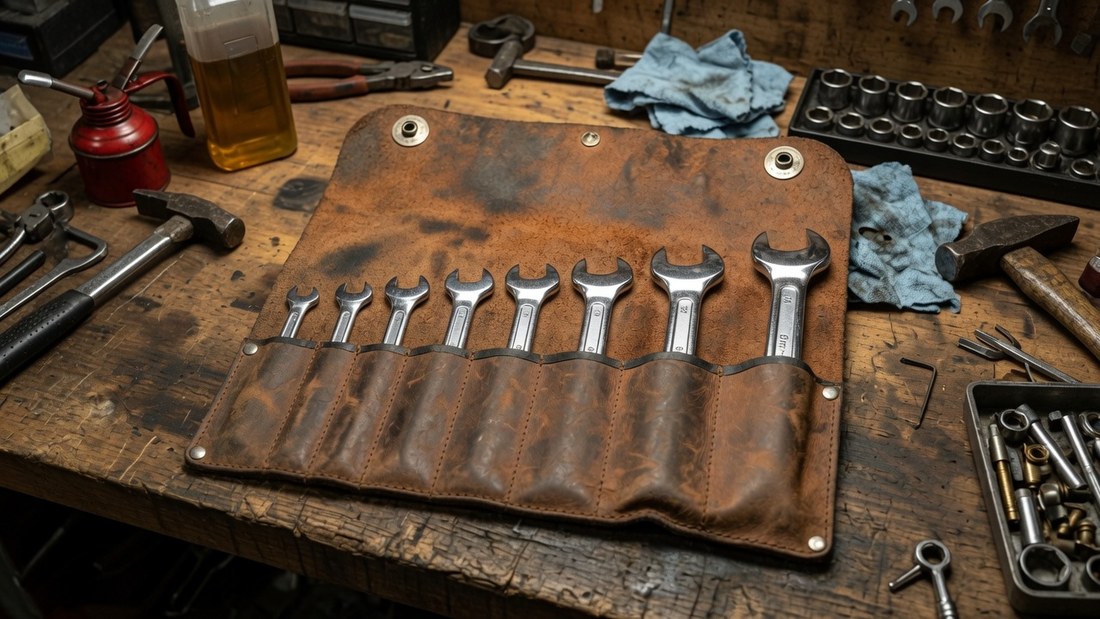
A combination wrench has a box end at one end and an open end at the other, and that is the one to own. Use the box end whenever it will fit. It wraps the whole head of the fastener instead of gripping two flats, which is the difference between loosening a bolt and rounding it off and turning a ten-minute job into an afternoon.
Inch sizes — the ones that earn their place
Those six do the overwhelming majority of household work. A full set runs 1/4 inch up to about one inch, and if a complete set turns up cheap take it — but if you are filling gaps one at a time, fill those six first. 1/2 and 9/16 are the two you will wear out.
Metric sizes — the ones that earn their place
A full metric set runs 8 mm to about 19 mm. Buy two 10 mm wrenches. That is not a joke and every mechanic in America will tell you the same thing — it is the single most used size on a modern vehicle and it is the one that walks off and is never seen again.
And two adjustables
- An eight-inch adjustable for the odd size you do not own and the plumbing nut nothing else fits.
- A ten or twelve-inch adjustable for the same reason with more leverage.
- A pipe wrench only if you have galvanised plumbing. If you have not, skip it and save the money.
An adjustable is a compromise and it will round a tight fastener faster than anything else in the box. It is what you use when you have not got the right wrench, not what you use instead of owning one.
⚙️ Sockets and Ratchets
Sockets come in three drive sizes, meaning the square hole the ratchet plugs into, and the mistake people make is owning one drive size and fighting everything with it.
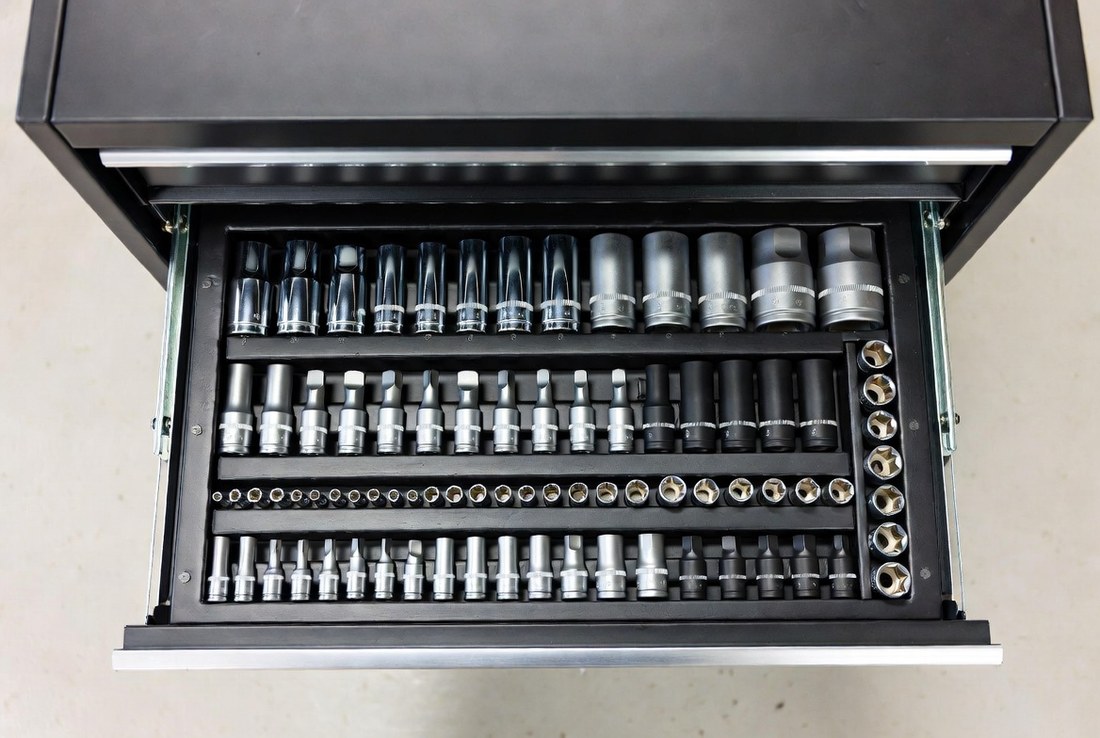
1/4 inch drive
Small, close, fiddly work. Interior trim, appliance panels, anything where a big ratchet will not swing. Sockets from about 3/16 to 9/16 inch, and 4 to 14 mm.
3/8 inch drive
The one you will use most. If you own only one drive size, own this. Sockets from 3/8 to 3/4 inch, and 8 to 19 mm.
1/2 inch drive
Wheel nuts, suspension, anything seized. This is the drive size that takes a breaker bar without snapping. Sockets from 1/2 to about 1–1/4 inch, and 13 to 24 mm.
The things about sockets nobody tells you
- Six-point over twelve-point, given the choice. Twelve-point fits on in more positions, which is handy in a tight corner. Six-point grips the flats instead of the corners, which is what you want on anything rusted, tight, or already a bit rounded.
- You want deep and shallow both. Shallow for ordinary bolts, deep for anything with a long stud poking through the nut. Half the sockets you own being useless on half the jobs is a special kind of aggravation.
- Extensions: three inch, six inch, and a ten if you see one. With a universal joint, which is the little wobble that gets you round a corner.
- A spark plug socket — 5/8 inch on most modern engines, 13/16 on older ones. It has a rubber insert inside to hold the plug. Buy the size your engine takes.
- A breaker bar in 1/2 inch drive, eighteen inches or longer. This is the tool that means you do not have to be strong. Length is leverage, and leverage is free.
- A torque wrench if you will ever put a wheel back on. See the car section below, because on a modern vehicle this one is not optional.
🪛 Screwdrivers and Bits
The whole trick with screwdrivers is using the right size, not the closest size. A driver that is slightly too small rides up out of the head under load — that is called cam-out — and it chews the screw into a smooth dish that nothing on earth will grip afterwards.
Phillips: #1, #2, #3
The cross-head. A #2 fits perhaps eight screws out of ten, #1 is for small work and #3 for heavy. If you own one, own a #2 — but the other two are what stop you wrecking heads.
Flat: 3/16, 1/4, 5/16 inch
The blade wants to fill the whole slot, top to bottom and side to side. Three sizes covers almost everything, and the widest one doubles as a small pry bar you will not feel guilty about abusing.
Torx: T15 to T50
The six-pointed star. Almost nothing in your grandfather’s box will touch it and it is all over modern cars, appliances and furniture. T20, T25, T30 and T40 are the common ones.
Hex keys, both systems
Inch from 1/16 to 3/8, metric from 1.5 to 10 mm. Flat-pack furniture, bicycles, set screws. A folding set of each lives in a drawer and takes no room.
Square drive: #1 and #2
Common in decking and cabinet screws. Grips better than a Phillips and cams out far less, which is exactly why deck screws use it.
Two stubby ones
A stubby #2 Phillips and a stubby 1/4 inch flat. For the day the screw is four inches from a wall and a full-length driver simply will not go in.
🗜️ Pliers
Five kinds cover a house, and they are genuinely five different tools rather than five sizes of one.
- Slip-joint, six to eight inch. The ordinary pliers everybody pictures. Two jaw positions. Good for a great many things and excellent at none.
- Tongue-and-groove, ten inch and twelve inch. The long-handled ones with the sliding jaw — the plumbing pliers. The jaws stay parallel at every setting, which is why they hold a pipe or a big nut when nothing else will. A small six-inch pair as well if you have got a sink to work under.
- Needle-nose, six to eight inch. Reaching, holding a nut you cannot get a finger to, fishing a dropped screw out of somewhere it should not have gone. A bent-nose pair is worth having too.
- Diagonal cutters, six or seven inch. For cutting wire and nothing else. The edges should meet with no daylight between them.
- Locking pliers — a seven-inch curved jaw and a long-nose. The ones you clamp on and they stay clamped. This is the tool that does the gripping for you when your hands will not. Set it, squeeze once, and it holds harder than a grip ever did. If you have arthritis in your hands, buy these before you buy anything else on this page.
🔎 What to check on any pair of second-hand pliers.
Work the pivot. It should move smooth with no grinding and no side-to-side slop. Close the jaws and hold them to a light — they should meet evenly along their whole length, and cutters should show no daylight at all. A sprung, bent or gappy pair is firewood no matter whose name is on it.
🚗 What Grandpa’s Tool Box Is Missing for a Modern Car
Here is the thing that catches people out. You inherit a beautiful old tool box, every wrench in it forged and worn smooth, and you open the hood of something built in the last twenty-five years and half of it is no use to you at all.
Not because the tools are bad. Because the car changed underneath them.
The gaps, in the order they will bite you
- Metric, all of it. An older American box is inch sizes almost start to finish. Modern vehicles are metric almost start to finish. This is the big one and everything else on this list is small beside it.
- Torx, and security Torx. Seat rails, brake calipers, interior trim, lamp housings. The security sort has a little pin in the middle of the star and needs a bit with a hole drilled up it. Neither existed in his day.
- A code reader. Every car sold in America since 1996 has the same diagnostic socket under the dash. A basic reader is cheap now, and it turns the check-engine light from a mystery into a part number. This is the single most useful thing in a modern tool box and it is not a tool at all.
- A torque wrench. He tightened things by feel and got away with it on cast iron and steel. Alloy wheels, aluminum engine parts and plastic housings do not forgive that. Wheel nuts in particular have a number and it matters.
- Jack stands and wheel chocks. Read the box below before anything goes under a vehicle.
- A cap-type oil filter wrench. Many engines now take a paper cartridge in a housing rather than a spin-on can, and the cap wrench has to match your engine’s size. Check before you buy one.
- A drain pan with a pouring spout, and a funnel. Obvious until the moment you need one and are holding four quarts of hot oil.
- Plastic trim tools. A screwdriver through a door panel breaks the clips and marks the plastic every time. A set of plastic wedges costs almost nothing.
- A digital multimeter. His test light told you whether power was there. A meter tells you how much, which on modern electronics is the whole question.
- A battery terminal brush and puller, and a memory saver if the vehicle will lose its settings when the battery comes off.
- A magnetic pick-up tool, an inspection mirror and a head lamp. Engine bays got tighter and darker every year since about 1985.
- A proper tire gauge. Digital, because the pencil sort in the door pocket has been wrong since the second Bush administration.
- Penetrating oil, thread locker, dielectric grease, zip ties and electrical tape. Consumables, all cheap, all the difference between finishing and stopping.
- Nitrile gloves and safety glasses. He did without. He also had eyes he was luckier with than he deserved.
⚠️ Before anything goes under a vehicle.
Never get under a vehicle held up by a jack alone. A jack is a lifting device, not a holding device, and jacks fail. Use jack stands rated for the weight, on level concrete, with the wheels chocked, and shake the vehicle hard before anybody puts a hand or a head beneath it. If the job can be done without lifting the vehicle at all, do it that way. Used oil and filters go to a recycling point, never in a bin or on the ground.
🛑 The Short List of Things to Leave Alone

This site is in favour of doing your own work, and it is equally in favour of being honest about where that stops. On a vehicle, these are not stubbornness and they are not skill. They are simply somebody else’s job.
- Anything with a yellow connector — that is the airbag system, and it is a small explosive charge with a wire on it.
- Orange cable on a hybrid or electric vehicle. That is high voltage and it will kill you outright. There is no careful way to have a go.
- Air conditioning refrigerant. Handling it is licensed work, and venting it is against federal law.
- Coil springs and strut assemblies. A compressed spring holds enough energy to take a hand off, and the tools people rent for it fail.
- Fuel lines on a running or recently run engine. The system holds pressure long after the key comes out.
Everything else on this page is a bolt, a screw or a nut, and a bolt has never yet cared who was holding the wrench.
Elsewhere on this site, if it is useful: which tools are worth owning once · the ones with no battery to go flat · the full toolkit, put together piece by piece · what to do when a good tool starts to hurt to hold · where to buy all of this for almost nothing · the repairs that pay for the whole box.
What This One Buys You
The end of the wasted trip.
Not a bigger tool box. A complete one — where the size you reach for is the size that is there, and the job that was going to take a fortnight and two hundred dollars takes an afternoon and a socket you already owned.