⚡ The Whole Argument Is Watts
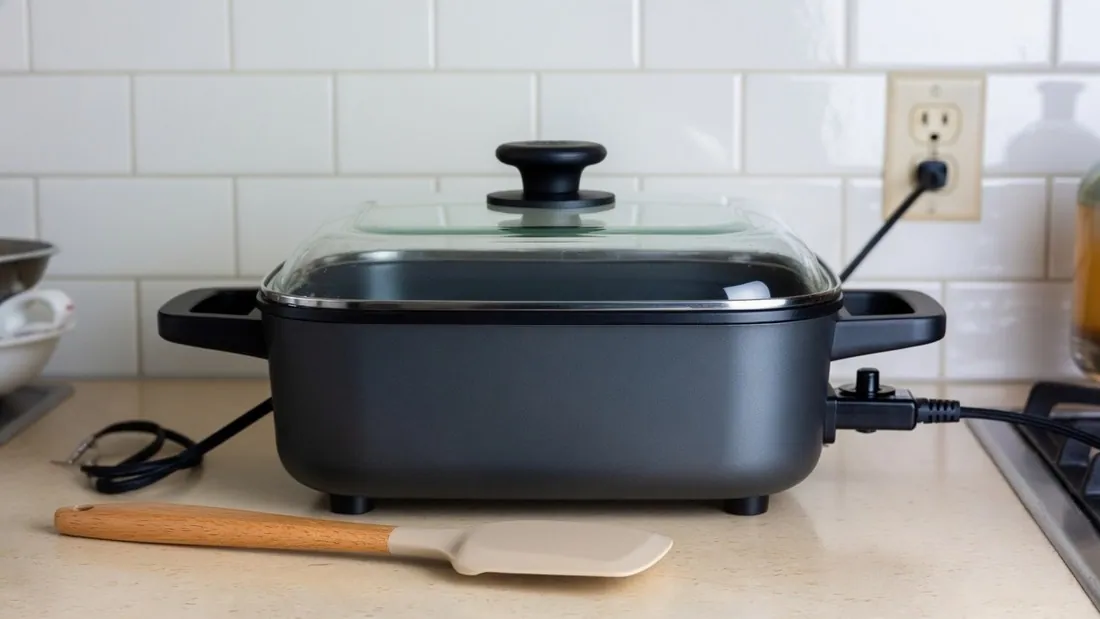
Electric skillets run roughly 1,000 to 1,800 watts, and the common twelve-inch size sits at 1,200 to 1,500. A 1,500-watt skillet pulls about twelve and a half amps on a household circuit. An electric oven, by comparison, runs somewhere between 2,400 and 5,000 watts, and an electric range with the oven and a couple of elements going is well past that.
That difference is the entire reason this page exists. Our own loads-to-skip guide tells you to leave the electric stove and the water heater off the generator, because sizing a machine around them costs thousands of dollars you do not need to spend. The obvious question that leaves behind is: then how do we eat?
The answer is that you do not need a stove. You need about fifteen hundred watts and a place to set it down. A small generator running the refrigerator and a few lights has room for a skillet without anybody doing arithmetic in the driveway — and unlike the range, you can turn it off the moment supper is done and give those watts back to the freezer.
Stagger it anyway. On a small generator, start the skillet when the refrigerator compressor is not kicking on, and do not run the skillet, a window air conditioner and a coffee maker at the same moment. Our generator size calculator will tell you what your own machine has to spare.
☠️ The Part That Actually Matters
Here is the reason this belongs on a preparedness site and not just a kitchen one. After a storm, when the power has been out for days and everyone is tired of cold food, people bring fire indoors. They set a charcoal grill in the garage. They light a camp stove on the kitchen counter. They run the generator on the porch, just outside the window.
That is what kills people after hurricanes — not the wind.
After the four hurricanes that crossed Florida in 2004, the Consumer Product Safety Commission investigated six carbon monoxide deaths in this state, and another 167 people were treated for carbon monoxide poisoning at ten Florida hospitals. Federal investigators found that misplaced portable generators — indoors, in garages, or outside too near a window — accounted for nearly all of those exposures. CPSC has counted hundreds of generator-related carbon monoxide deaths nationally over the years it has tracked them, and it repeats the warning before every hurricane season, including this one.
Carbon monoxide has no color and no smell. The early symptoms — headache, dizziness, nausea, confusion — read like the flu, or like being exhausted after a storm, which is exactly what makes it so dangerous. People who are asleep can die without ever waking up.
An electric skillet is the answer to the problem that causes those deaths. The generator stays outside, well away from the house and away from every window and vent, where it belongs. The cooking happens inside, on electricity, on a countertop, with no flame and no exhaust. Nobody has to choose between a hot supper and safe air.
The rules, plainly. Never run a generator indoors, in a garage, in a shed, or outside near an open window or a window air conditioner. Never burn charcoal indoors — not in the kitchen, not in the garage with the door open. Never use a camp stove or a gas grill inside the house. Put working carbon monoxide alarms on every level of the home and keep batteries for them. If an alarm sounds, get everyone outside first and call 911 second.
Sources: CDC — Carbon Monoxide Poisoning Following Disasters • CDC MMWR — Generator CO Poisoning, Florida 2004 • CPSC — 2026 Hurricane Season Generator Warning
One more thing worth knowing if you are still shopping for a generator: newer units certified to the current PGMA and UL standards carry carbon monoxide sensors that shut the engine down when CO builds up around it. That is a real safety feature that did not exist on the machines people died beside in 2004. It is not a license to run one indoors — nothing is — but it is worth asking about. Our generator guide covers the rest.
🌡️ The Dial Is the Feature
A burner does not hold a temperature. It cycles — full heat, off, full heat — and you correct for it by standing there and paying attention. That works fine when you are forty. It works less well when standing is the expensive part of cooking, and it works badly when you are cooking on a generator and want the job done.
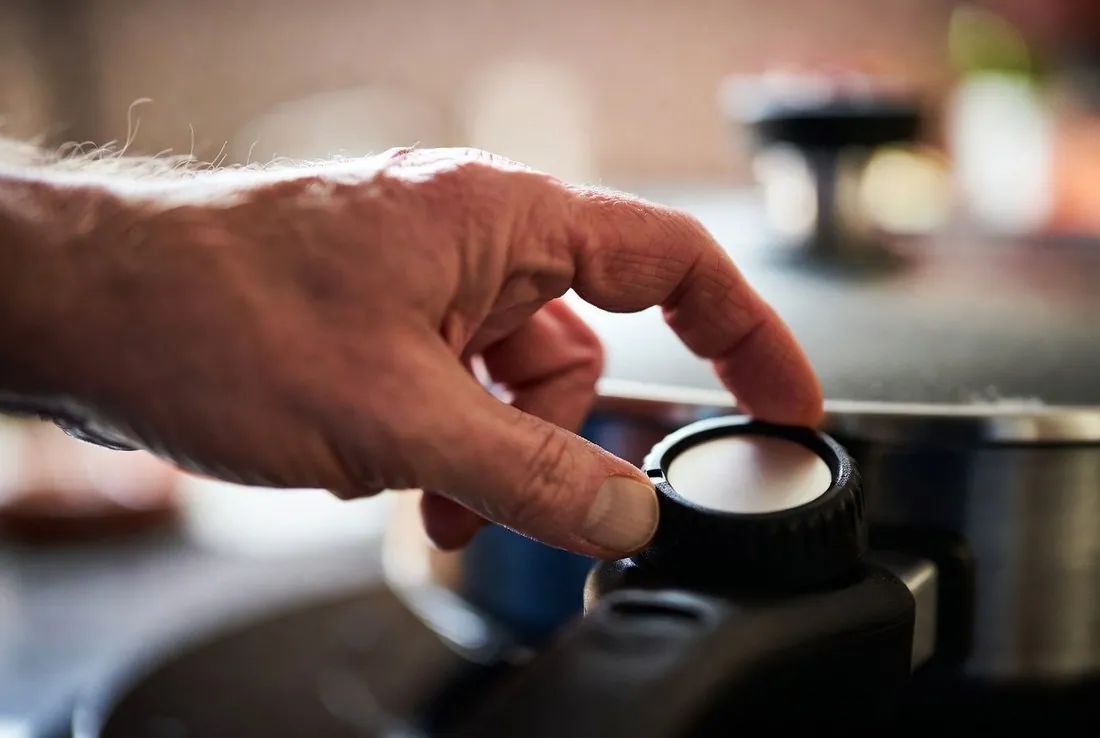
An electric skillet has a thermostat with numbers on it. You set 350 and it holds 350, adjusting itself, all the way through the cooking. For frying that is not a convenience, it is the entire difference between good and bad. Chicken wants oil somewhere around 325–350°F: too cool and it drinks grease and turns heavy, too hot and the crust is dark before the thigh is done. On a burner you are guessing, or you are clipping a thermometer to the pan and babysitting it. On the skillet you turn the dial to the number and go set the table.
The same dial is why it holds a simmer without scorching, keeps a pot of chili at serving temperature for an hour without anybody watching, and browns a piece of meat at a repeatable heat instead of whatever the burner felt like doing today.
🍗 Sunday Dinner on Generator Power
Fried chicken, mashed potatoes and gravy, cooked in one pan, in order, while the grid is down. This is the sequence, and the order matters because you only have the one pan.

- Potatoes first. Put the peeled, quartered potatoes in the skillet with water to cover, lid on, dial to high. A domed lid boils water perfectly well. Drain them, mash them in a bowl with butter and hot milk, cover the bowl, set it aside. They will hold their heat far longer than you expect.
- Wipe the pan and pour the oil. An inch is plenty — this is shallow frying, not a deep fryer, and an inch of oil is a great deal safer to work with than four. Dial to 350°F and let it actually get there before the first piece goes in.
- Fry the chicken. Do not crowd it; two batches beat one crowded one, because a full pan drops the oil temperature and the crust never sets. Lid on for the first half if you want the thighs cooked through without darkening. Chicken is done at 165°F internal, and an instant-read thermometer is the only honest way to know.
- Gravy in the drippings. Pour off most of the fat, leave the browned bits, dial down to about 250°F, whisk in flour, then milk or broth a little at a time. The low steady setting is what keeps it from catching while you whisk.
One pan, one cord, one dial, and a hot Sunday dinner on the fourth day of an outage. That is a considerable thing for a household to be able to do, and it is worth more to morale than most of what people buy for emergencies.
Used cooking oil, when the bins are not being collected. Let it cool completely, pour it back into a bottle through a funnel, and cap it. Never pour it down a drain, and never onto the ground after a storm when everything drains somewhere it should not.
🥘 What It Does the Other 360 Days
An appliance that only earns its keep during a hurricane is a bad buy. This one is not that. In a normal week it is a second burner that does not heat up the kitchen, and for a household of one or two it is very often the only pan that comes out.
- One-pan suppers — brown the meat, add everything else, lid on, low dial, walk away.
- Braising — the deep sided models with a domed lid do a pot roast as well as an oven, at a fraction of the power and without heating the house in July.
- Cornbread and biscuits — lid on, low setting, and it bakes. Not as well as an oven, but well enough that many cooks never turn the oven on for two people.
- A warming tray — at the lowest setting it holds a dish at serving temperature for an hour, which is what you want when the family arrives at different times.
- Big batches — sixteen-inch models will hold a full pound of sausage or enough green beans for a crowd, which is why they turn up at every church supper.
It does not replace cast iron, which will outlive everyone in your family and works on a campfire, or the dutch oven, which is what cooks when there is no electricity at all. Those are the no-power tools. The skillet is the some-power tool, and between them you are covered either way.
🔍 Buying One — and Why Used Is the Smart Buy
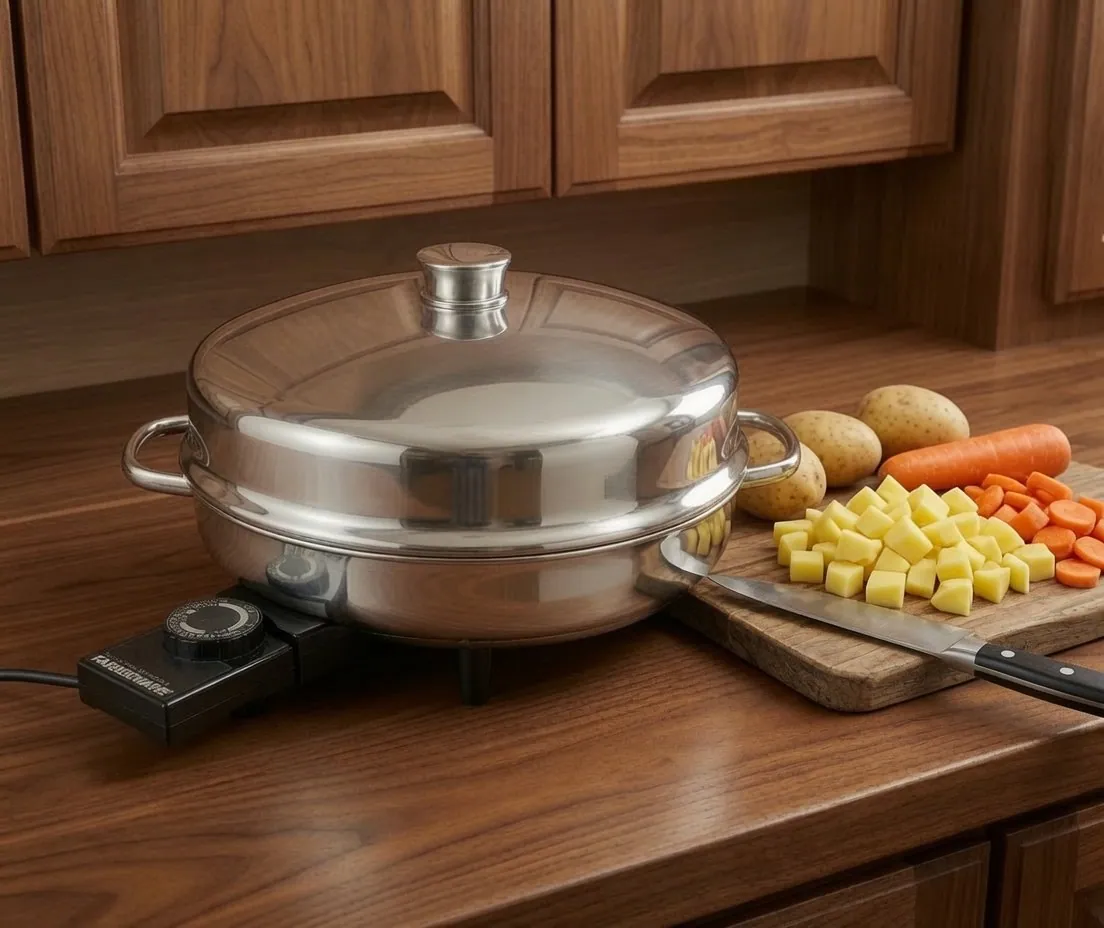
New ones run about $40 to $90. But the electric skillet is one of the great secondhand bargains in an American kitchen, because millions of them were bought, used for a few holidays, and put in a cupboard. Facebook Marketplace, eBay, estate sales and church rummage sales turn them up constantly, often for ten or twenty dollars, frequently barely used.
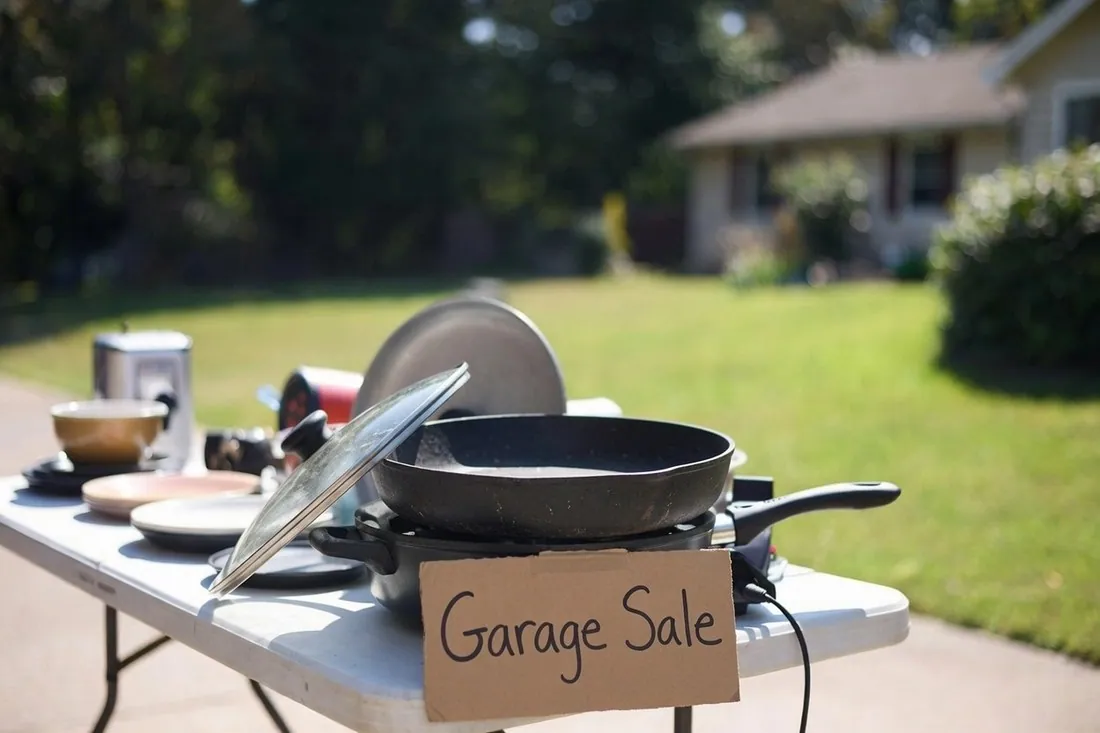
Farberware is the name most people over sixty will remember, and for good reason — the company started in New York in 1900 and its Bronx-made electric skillets, the deep stainless ones with the domed lid and the plug-in probe control, are still circulating sixty years later. Worth knowing before you shop: the Bronx plant closed in 1996 and the Farberware name has been licensed to other manufacturers for cookware and electric appliances ever since.
So the badge on the front does not tell you what you are holding. Check the function, not the name — which is the same test that has run through this whole site since the water heater my grandfather bought discontinued for a third of the price.
What to actually check, on any skillet of any age:
- The probe. The detachable heat control is the part that fails and the part that is hardest to replace, because it is matched to the pan. Make sure it is present, that the pins are straight, and that the dial turns without grinding.
- Plug it in before money changes hands. Set it to 300 and hold your hand well above the surface. It should be hot in a couple of minutes and you should hear or feel the thermostat cycle.
- The cord. Cracked insulation, a scorched plug, or exposed wire anywhere near the strain relief — walk away. Not worth it at any price.
- The base. Set it on a flat counter. A warped or rocking base means uneven heat forever.
- The surface. Stainless can be scrubbed back to life. A nonstick coating that is scratched, flaking or bubbling should be passed over — you cannot fix it, and you do not want to eat it.
- The lid. A missing lid takes away the braising, the baking and the boiling. It is most of what the pan can do.
❓ The Questions People Actually Ask
Will a 3,500-watt generator run an electric skillet?
Yes — and it will run the refrigerator at the same time. A 1,500-watt skillet plus an 800-watt refrigerator comes to 2,300 watts, which leaves better than a thousand watts of room on a 3,500-watt machine for lights, a fan and the phone chargers.
The part nobody tells you is that the skillet is the easy load, not the hard one. A refrigerator has a motor, and a motor asks for two or three times its running watts for a second or so every time the compressor kicks on — call it 1,200 to 2,000 watts of surge out of an 800-watt appliance. A skillet has no motor. It is a heating element, and a heating element draws its rated watts the instant you switch it on and never asks for a penny more. The number on the label is the whole story. That is the opposite of what the wattage makes people assume.
So the arithmetic that matters is this. Skillet 1,500 + refrigerator 800 + lights 200 = 2,500 watts running. But the moment that compressor kicks on, the refrigerator briefly asks for 2,000 instead of 800, and the total jumps to roughly 3,700 for a second or two. Most 3,500-watt generators are built to surge to 4,000 or 4,500, so that spike is inside what the machine was designed to swallow — but it is right at the edge, and it is the reason we keep saying stagger it. Start supper while the compressor is resting.
Leave yourself headroom anyway. A generator run flat out eight hours a day is a generator that quits on day five, and day five is exactly when you still need it. Plan around eighty percent of what the label says and you will still be cooking when your neighbor is not. Our generator size calculator will do the arithmetic on your own machine and your own list.
Will a 2,000-watt generator run an electric skillet?
Yes, but essentially by itself. A 1,500-watt skillet out of 2,000 leaves 500 watts, and 500 watts is not enough to absorb the refrigerator's start-up surge when it lands on top. On a small machine the honest answer is to cook, then go back to keeping things cold.
That is less of a sacrifice than it sounds. A refrigerator that stays shut holds its temperature for hours — the half hour it takes to fry chicken does not register. Cook supper, switch the fridge back on, and let it pull back down while you eat. Our food spoilage timer will tell you how much slack you actually have.
How many watts does an electric skillet use?
Between 1,000 and 1,800 watts, and the common twelve-inch size sits at 1,200 to 1,500. At 1,500 watts a skillet pulls about twelve and a half amps at 120 volts — most of an ordinary 15-amp kitchen circuit.
That last figure matters on house power as much as on generator power. If the skillet and the microwave are on the same circuit and both come on at once, the breaker is doing its job when it trips. The exact number for your pan is stamped on the plate on the underside; read it rather than guessing, because the difference between an 1,100-watt skillet and an 1,800-watt one is the difference between an easy load and a full circuit.
What can you cook in a power outage without a grill?
Anything you can fry, simmer, braise or boil — indoors, on electricity, with the generator sitting outside where it belongs. An electric skillet handles frying and braising, an electric pressure cooker handles beans, roasts and soups, an electric kettle handles coffee and hot water, and a portable induction burner stands in for a stove-top burner. All four are countertop appliances that plug into an ordinary outlet.
The point is not the menu. The point is that the fire stays outside. The people who die after hurricanes are not the ones who ate cold food; they are the ones who brought a charcoal grill into the garage or lit a camp stove on the kitchen counter because they were tired of it. If you have a generator and a countertop appliance, you never have to make that trade, and nobody in the house has to be the one who suggests it.
⚠️ The Honest Caveats
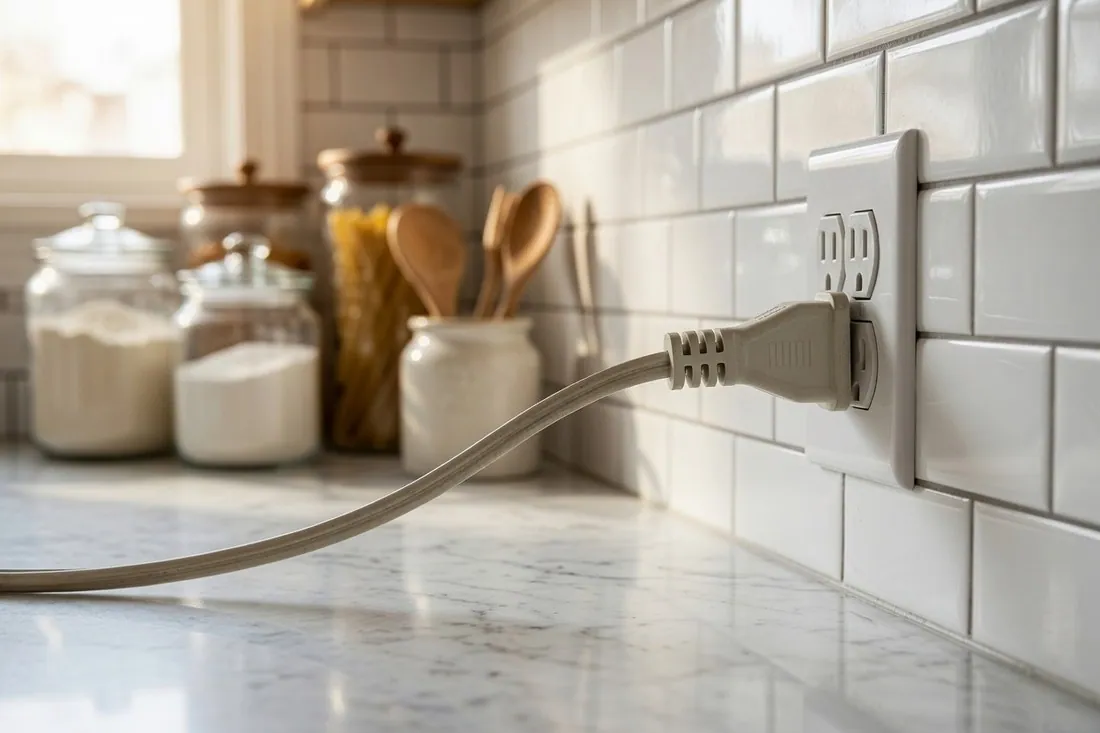
- It is a real load on a cord. Fifteen hundred watts is about twelve and a half amps, and that is precisely the situation where a long, thin extension cord overheats. If it will not reach the outlet, run the numbers first with our extension cord gauge calculator. Better still: put the skillet near the outlet and move the food.
- The control never goes in the water. The probe unplugs, and it stays dry. On most models the pan itself can be washed once the control is off — check the manual for yours, and if it did not come with one, look it up before you submerge anything.
- It dies with the power. No generator, no skillet. That is what the dutch oven and the outdoor cooking rules are for.
- Hot oil is hot oil. An inch, never more than a third of the way up the pan, dry food going in, and a lid within reach. Never water on a grease fire.
- Watch the trip hazard. A live cord running across a kitchen to a countertop pan full of hot oil is a genuinely bad arrangement. Short run, out of the walking path, every time.
🛒 Buy It at Fifty
This is a twenty-dollar decision at a garage sale and a ninety-dollar decision new, and either way it is the cheapest appliance on this entire site that does two completely different jobs well.
Buy it now, while you are shopping calmly and can look at four of them and pick the good one. Use it on ordinary Tuesdays so that you already know its dial and its habits. Then, on the fourth day after the storm, when the crews still have not reached your street and everyone is tired of sandwiches, you will not be learning a new appliance by flashlight. You will just be making supper — the same supper, in the same pan, that you made last week.