Affiliate disclosure: Some links on this page go to Amazon. If you buy something through one of them, we earn a small commission — at no extra cost to you. It never changes the price you pay, and it never decides what we recommend. As an Amazon Associate I earn from qualifying purchases.How we make money →
A portable induction burner boils water faster than your stove, holds a set temperature without drifting, and leaves the countertop cool enough to touch. There are three catches, and nobody selling one is going to mention them.
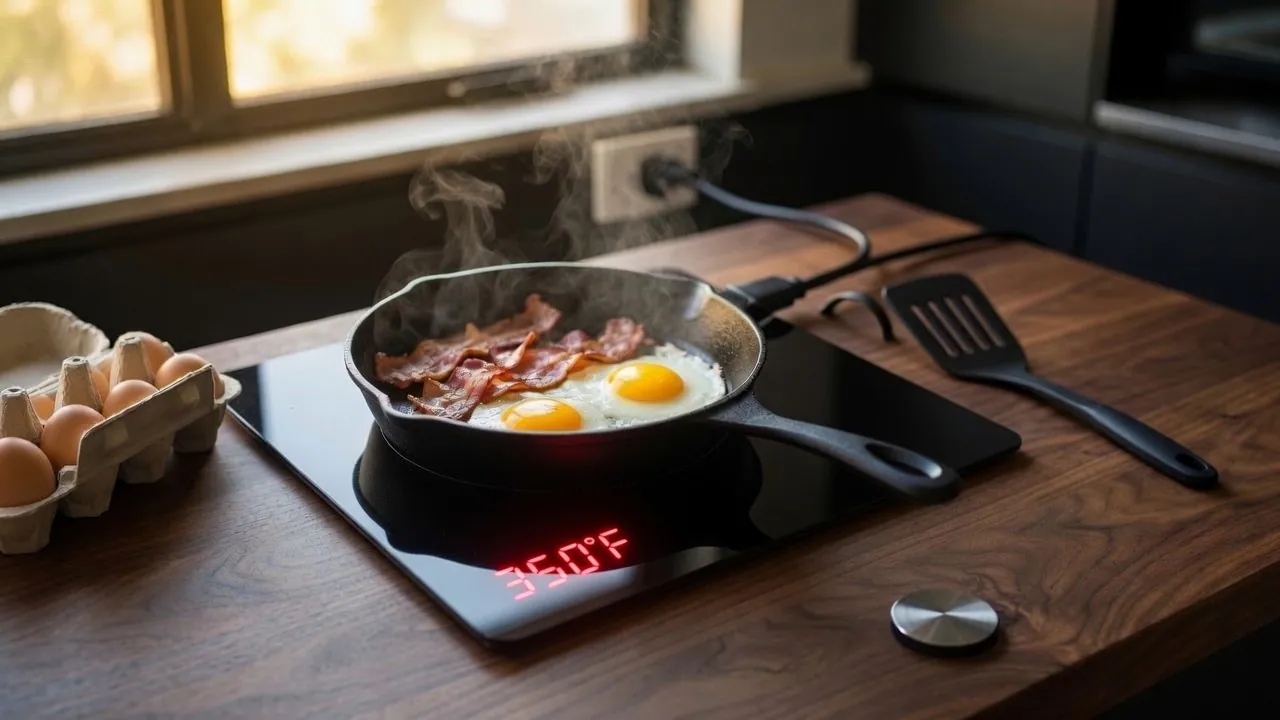
Cast iron on induction — the pan you already own, at a number instead of a guess.
An induction burner does not have a heating element. Under the glass is a copper coil, and when you switch it on that coil throws a rapidly alternating magnetic field up through the surface. If there is iron in the bottom of your pan, that field stirs up currents inside the metal and the pan becomes the burner. The glass only gets warm because the hot pan is sitting on it. Take the pan away and there is nothing to burn you, and on most units nothing even switches on.
The Three Catches, Up Front
We will do the good parts in a minute. These come first, because all three are things people find out after the box is open.
1. Half your pans will not work on it. No iron in the bottom, no heat. Aluminum, copper, most glass, and a lot of stainless steel simply sit there cold.
2. Eighteen hundred watts is a whole circuit. That is about fifteen amps at household voltage — essentially everything a standard kitchen circuit is rated to carry, with nothing left over for the microwave or the toaster on the same breaker.
3. If you have a pacemaker or a defibrillator, there is a distance rule. A real one, from Harvard Health and from the device makers, and it is in its own section below.
None of the three is a reason to skip it. All three are reasons to know what you are buying.
The Magnet Test — Do This Before You Buy Anything
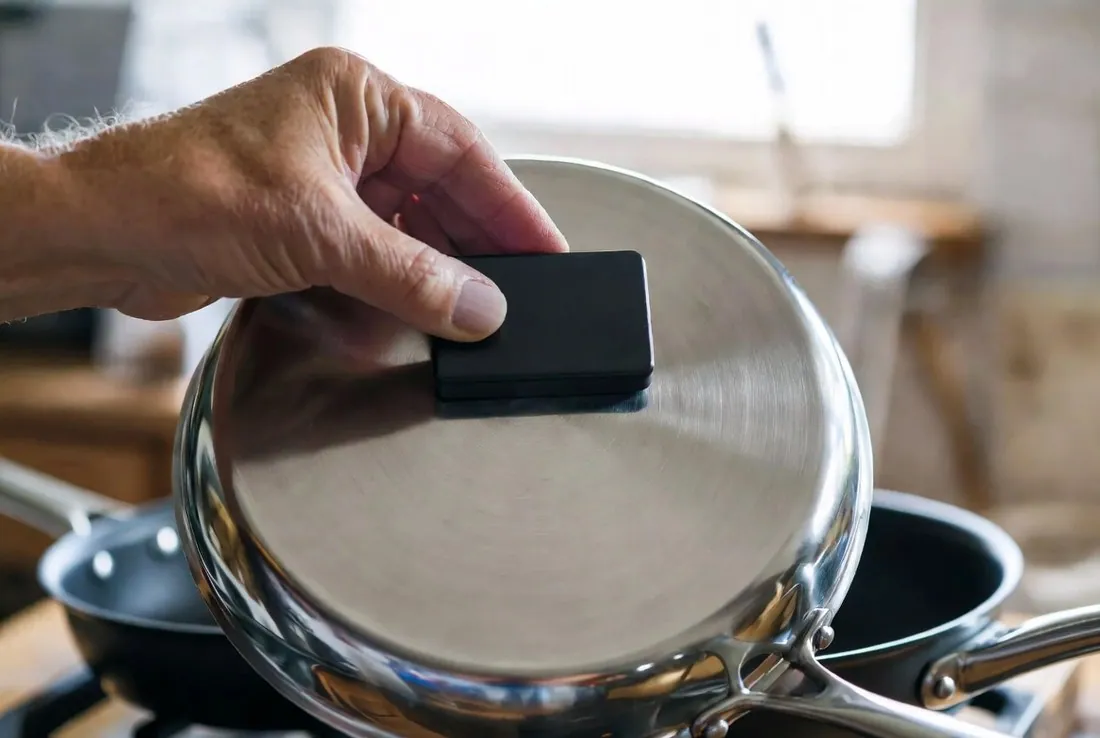
Take a refrigerator magnet to your own cupboard right now. Stick it to the bottom of each pan, not the side. If it grabs firmly, that pan will cook on induction. If it slides off or barely tugs, it will not.
A refrigerator magnet and two seconds, standing in your own kitchen. If it holds to the bottom of the pan, that pan works on induction; if it slides off, nothing on this page will change that — and the same test settles every pot you already own before you have spent a dollar.
Cast iron — works perfectly. It is the ideal induction pan, and if you already followed our cast iron guide you are equipped before you start. Same for the dutch oven.
Carbon steel, enameled cast iron, and magnetic stainless — work. Good stainless cookware usually has a steel disc in the base for exactly this reason. Check it anyway.
Aluminum, copper, glass, and non-magnetic stainless — do not work. No amount of patience will change that; the physics is not negotiable.
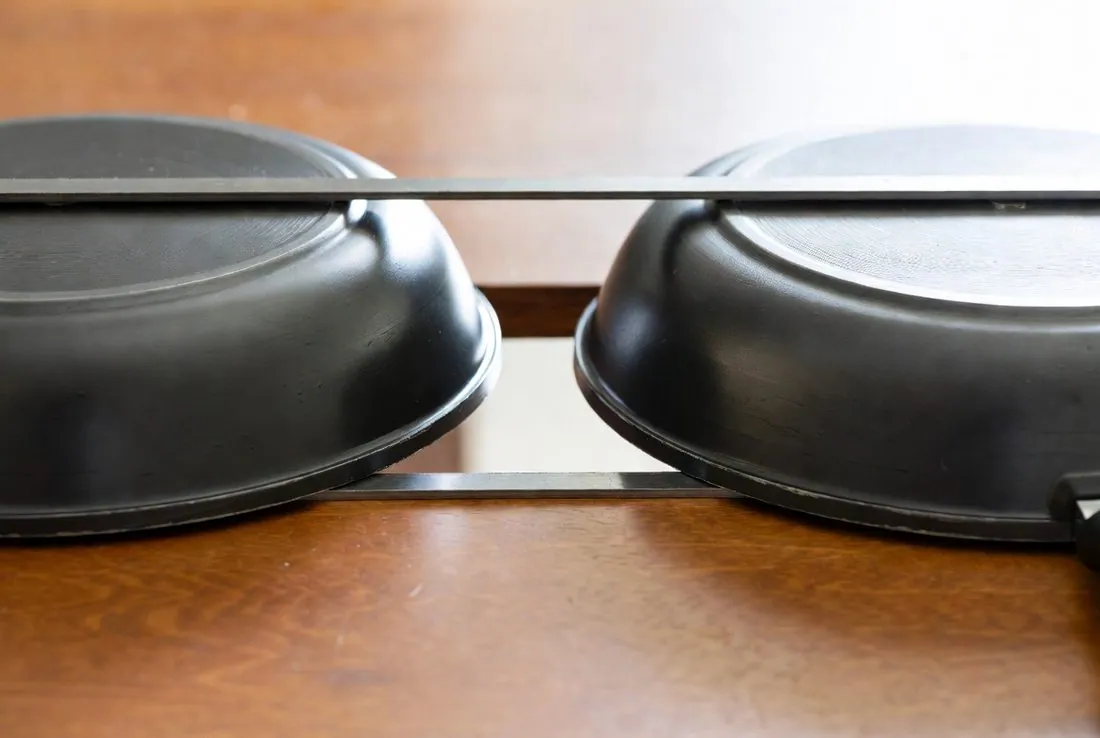
Flat bottoms only. A warped or ridged base makes poor contact and heats unevenly, and a small pan on a big coil may not register at all.
Pans upside down, bases uppermost, a straightedge laid across and your eye down at table level. What you are looking for is daylight. A base that meets the rule along its whole width will meet the glass the same way; one that does not will heat in a ring and cook in a ring. It costs nothing to do this with your own pans before you spend anything on a cooktop.
The honest arithmetic: if this means replacing four pans, the burner is not a hundred-dollar decision, it is a three-hundred-dollar one. If your kitchen already runs on cast iron, it costs exactly what the burner costs.
Eighteen Hundred Watts — What That Actually Means
An 1,800-watt burner draws about fifteen amps at household voltage. A standard kitchen circuit is rated for fifteen, and a good many kitchens run several outlets off one breaker. So:
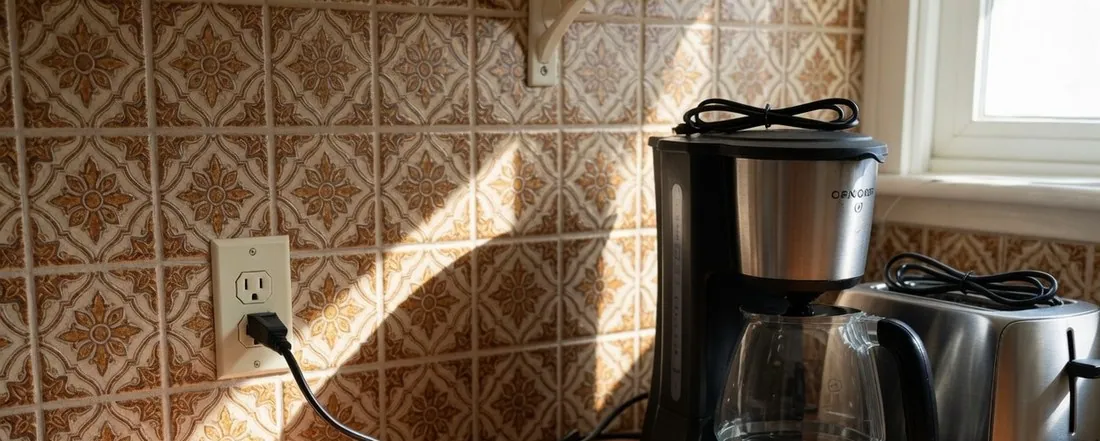
One cord in the wall, and everything else on that counter coiled up and unplugged. Eighteen hundred watts is about fifteen amps, and a kitchen circuit is usually rated for fifteen or twenty — so the burner does not share well, and the coffee maker is what trips the breaker halfway through supper.
Give it its own outlet, and do not run the microwave or a toaster oven on the same circuit while it is going. A tripped breaker is the polite version of what happens.
No thin extension cords. Fifteen amps down a long, light cord is how cords overheat. Plug it straight into the wall, or settle it with our extension cord gauge calculator first.
On a generator, it is a bigger bite than the skillet. Our electric skillet page makes the case for 1,500 watts as the load any generator can spare; 1,800 is more, and there is no way around that. What you get back is speed — the water boils in a fraction of the time, so the draw is short. Run it at a lower power level, run it alone, and check what your machine has to spare with the generator size calculator.
❤️ If You Have a Pacemaker or a Defibrillator
This is the section that belongs on a site written for people over fifty, and it is missing from nearly every product listing.
Induction works by making a strong magnetic field, and pacemakers and implanted defibrillators listen for very small electrical signals. Harvard Health advises anyone with an implanted heart device to keep twelve to twenty-four inches between the device and an induction cooktop, whether it is switched on or not. Device makers publish the same kind of guidance — Medtronic's patient material recommends about twenty-four inches from the cooking surface while it is on.
In practice that means standing back rather than leaning over the pan, keeping the pot centerd on the coil, and not resting your chest against the counter edge while you stir. The field falls off very quickly with distance; a modest gap does most of the work.
The rule that matters more than any of this: ask your own cardiologist about your own device. Models differ, and your doctor has your chart. We are not able to tell you whether it is safe for you, and neither is anybody selling the burner.
It does not heat the room. Nearly all the energy goes into the pan instead of into the air around it. In a hot August kitchen that is not a footnote — it is the difference between cooking and not bothering.
Speed. A pot of water comes to the boil dramatically faster than on a coil or a flame.
Real temperature control. Twenty power levels and a temperature setting mean a simmer stays a simmer instead of creeping up to a boil the moment you leave the room.
It is safer to leave alone. Nothing glows, nothing is on fire, and when you lift the pan off the heating stops. Add the timer and it shuts itself off. For anyone who has ever driven away wondering whether the stove was left on, that is worth real money.
Spills do not bake on. The glass is warm, not searing, so a wipe with a cloth is the whole cleanup.
It goes anywhere. A second burner at Thanksgiving, the whole kitchen in a small apartment, canning day out on the porch instead of in a hot kitchen, a burner at the church supper.
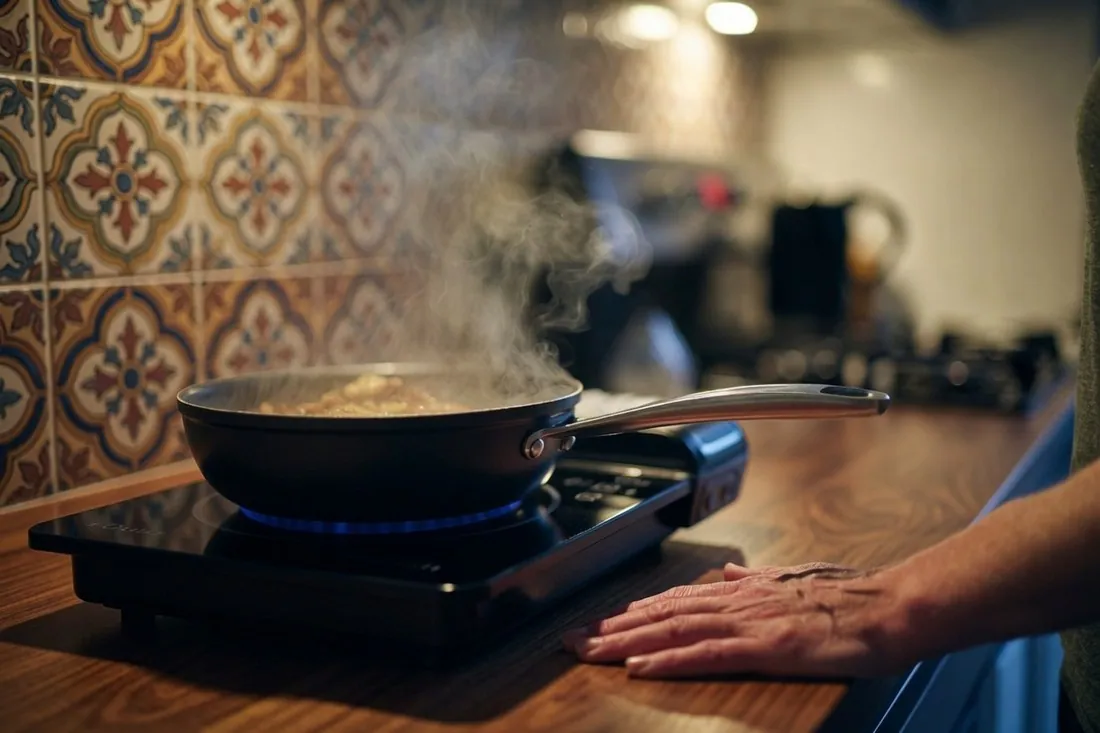
Look at where her hand is — flat on the counter, inches from a pan that is actively cooking. Induction heats the pan and nothing else; the glass gets warm only where the pan is sitting on it — which is why the counter an inch away is just counter, and why a spill beside the pot does not bake itself on.
The Efficiency Claim, Honestly
You will see induction advertised as forty or fifty percent more efficient. Against a gas flame, the advantage really is enormous — the Department of Energy puts induction at roughly three times the efficiency of gas, because a flame heats the air around the pan as much as the pan.
Against another electric appliance, the honest number is much smaller. ENERGY STAR puts induction at about five to ten percent more efficient than conventional electric resistance cooking. DOE figures land near 84 percent for induction against 74–77 percent for an electric coil. One utility-funded laboratory study measured induction at 76–77 percent and found the gain over conventional electric ranged from slightly negative to about a third better, depending mostly on pot size.
So buy it for the speed, the control, and the cool kitchen. Do not buy it expecting the power bill to drop noticeably — and be a little suspicious of anyone whose sales copy says otherwise. It is the same test that runs through this whole site: find out whether you are paying for the function or for the claim.
What to Look For
Temperature settings, not just power levels. Twenty power levels tell the coil how hard to work. A temperature setting tells it what to aim for. You want both.
A quiet fan. Every induction burner has a cooling fan, and the cheap ones whine loudly enough to be irritating in a small kitchen. This is worth reading reviews about specifically.
A large coil. A wide heating coil heats a big pan evenly instead of leaving a hot ring in the middle. It is the single biggest difference between a good unit and a frustrating one.
A timer with auto shutoff, and pan-detection that cuts power when the pan comes off.
A safety listing. Look for a UL or ETL mark on a 1,800-watt appliance. This is not the category to save eleven dollars in.
Buy this one new. We push secondhand all over this site — but a skillet is a heating element and a thermostat, while this is a circuit board and a power stage. Electronics are the failure point, there is no way to test one properly at a garage sale, and a dead board is not a repair. This is a new purchase.
❓ The Questions People Actually Ask
Short answers. The sections above are the long versions.
Is an induction cooktop safe if you have a pacemaker?
The published guidance is a distance rule rather than a yes or a no — twelve to twenty-four inches between the device and the cooktop. The detail, the sources and what it means at the counter are set out above. The part no page can answer for you: ask your own cardiologist about your own device.
Can you use cast iron on an induction cooktop?
Yes, and it is one of the best pans for it — solid iron couples with the field better than almost anything in the kitchen. Lift it on and off rather than sliding it, because the top is glass. And go in lower than you would on a flame; iron on induction heats faster than most people expect.
What pans will not work on an induction cooktop?
Anything a magnet will not hold on to — aluminum, copper, glass, ceramic, and stainless with a non-magnetic outer layer. Test what you own with a fridge magnet before you buy, because replacing a set of pots can cost more than the burner did.
Will an induction cooktop run on a generator?
Yes on a 3,500-watt machine, run more or less alone. A portable burner is typically 1,800 watts flat out. What you get back is speed — the draw is big but short, so start it when the refrigerator compressor is resting and keep the coffee maker off until it is done.
If you are choosing one appliance for outage cooking, choose the skillet. Induction is the better everyday burner, but 1,800 watts is a lot to hand to one pan on a small generator, and it will not work with the aluminum pots many people already own. The skillet asks for less and works with what is in your hand.
⚠️ The Honest Caveats
The glass is glass. Set cast iron down, do not drop it. A cracked top ends the appliance.
It dies with the power, like everything else that plugs in. The dutch oven and outdoor cooking are still what carries a no-power day.
Canning is a separate question. Before you put a loaded canner on a glass top, check what both the canner maker and the cooktop maker say — weight, base flatness and diameter all matter, and several manufacturers advise against it. Our canning page covers choosing the equipment.
Very low simmers can pulse. Cheaper units hold a low setting by cycling on and off rather than running gently, which shows up in delicate sauces.
It is one burner. Useful, portable, and not a range.
🛒 Buy It at Fifty
Around a hundred dollars, one outlet, and no installation. If your cupboard already holds cast iron it works the day it arrives, and if it does not, the magnet in your hand tells you the real price before you spend anything.
What you are actually buying is a burner that will not burn you, will not heat the house, will not stay hot after you walk away, and will shut itself off if you forget it. Those are ordinary conveniences at fifty-five. At seventy-eight they are the reason somebody is still cooking their own supper.
Test your pans before you spend a dollar.
A refrigerator magnet on the bottom of every pan you own settles the whole question in about ninety seconds — and tells you whether this is a hundred-dollar decision or a three-hundred-dollar one.
By name: the Duxtop 9610LS — 1,800 watts on an ordinary 120-volt outlet, 20 temperature settings from 100°F to 460°F, a countdown timer and a child safety lock, about $100.
Nothing glows, the heat stops when the pan lifts, and the timer shuts it down on its own — so the question that follows people out of the driveway at seventy-five, whether they left the stove on, stops being a question.
General Information Disclaimer: This page is general educational information, and some links are affiliate links (we may earn a commission at no extra cost to you). It is not electrical, engineering, medical or trade advice, and it was not written by a licensed electrician.Generators, camp stoves and any fuel-burning appliance produce carbon monoxide, which is invisible, odourless and kills people every year after storms — never run one indoors, in a garage, or on a covered porch, and keep a working battery carbon-monoxide alarm. Anything behind the cover of an electrical panel, and any permanent connection between a generator and a house, belongs to a licensed electrician and is subject to local codes and permits. If you have a pacemaker or any implanted medical device, ask your cardiologist before using induction cooking equipment. Nothing on this page is legal advice. None of it was written by an attorney, and it is not a substitute for speaking to one about your own situation.Full disclaimer →