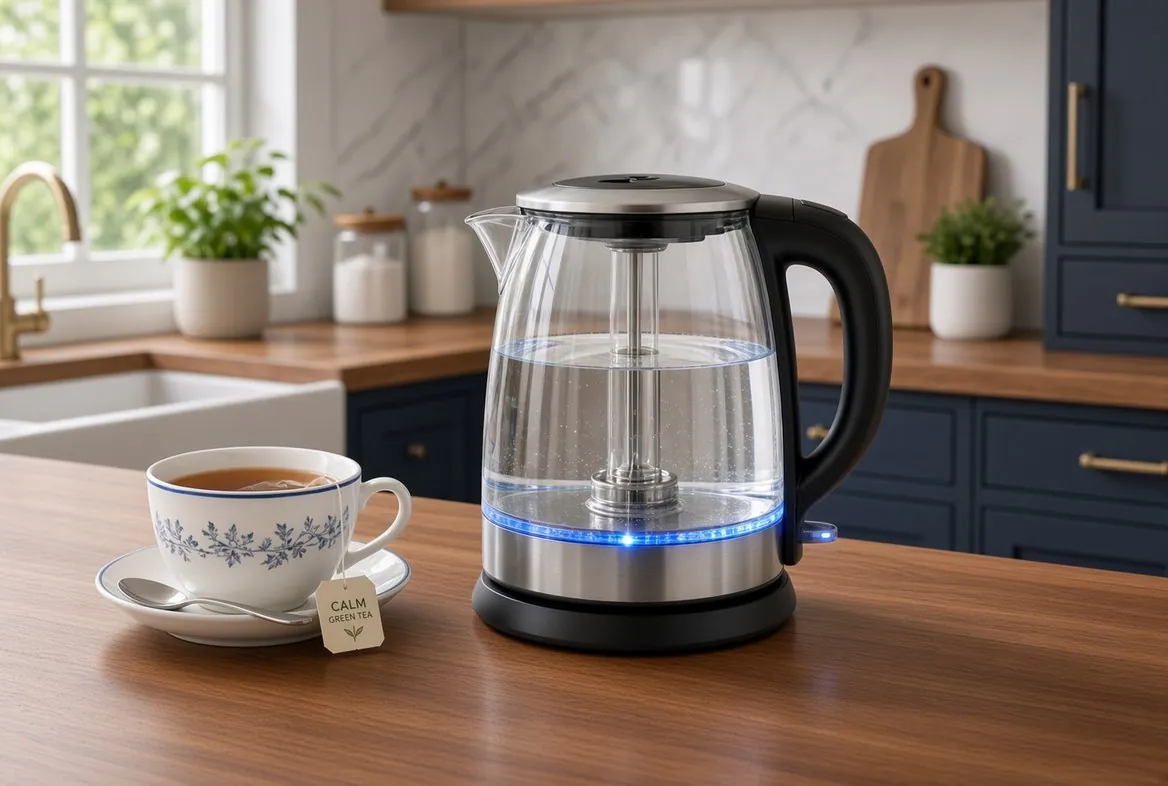
💬 Three Kitchens, One Lesson
Every electric kettle on a counter has a reason it is there, and the reason is usually a morning that went wrong first. As always on this site, the stories below are composite illustrations, not true stories — real patterns drawn from real kinds of kitchen accidents, with no real persons or events — and the numbers that anchor them are cited further down the page.
📖 The Whistle Nobody Heard
The stovetop kettle had whistled for forty years, and for forty years somebody had always been close enough to hear it. Then one October morning the phone rang in the den, the conversation ran long the way calls from grandchildren do, and the whistle sang itself hoarse to an empty kitchen until the water was gone and the steel began to smell. Nothing burned that day except the kettle bottom and a little bit of confidence. The electric kettle that replaced it has boiled every morning since, and it has never once needed anyone to remember it.
📖 The Wrist That Rolled
The old kettle lived on the back burner, which meant every cup of tea started the same way: reach across a hot stovetop, lift almost three pounds of steel and boiling water off the flame, and carry it to the counter. At 79 her grip was fine for teacups and garden trowels — but one Tuesday the full kettle rolled her wrist on the lift, and the splash caught her forearm before she could move. Burn units treat more than half a million scalds a year in this country, and the arms and hands take most of them. Hers healed. The routine did not survive: the electric kettle her son brought over that weekend sits at counter height, weighs less than a bag of sugar, and has never once asked her to reach over a flame.
📖 The Christmas Kettle
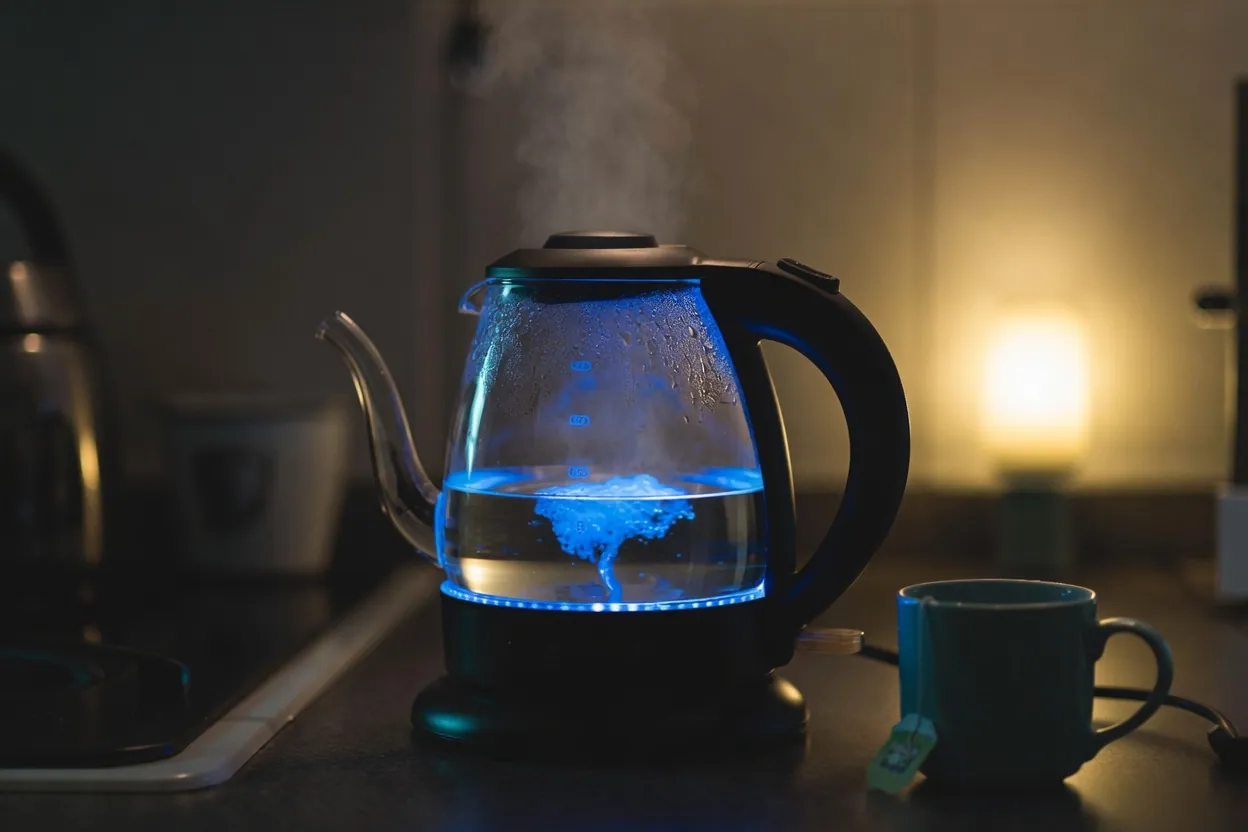
The grandkids pooled their money and bought him a glass one with a blue light in it, mostly because it looked like something from a spaceship. He grumbled that the stove had boiled water just fine since Eisenhower. Then he found out the blue light glows while it works and clicks itself off at the boil, and now he watches it the way other men watch the evening news. His daughter noticed something else by Easter: the burner knob on the back of the stove — the one everybody worried about — had not been touched since Christmas morning. Nobody planned that. The kettle just quietly retired the most dangerous habit in the house, one cup of tea at a time.
☕ Why Electric — The Machine That Cannot Forget
The whole argument fits in one sentence: a stovetop kettle depends on your memory, and an electric kettle does not need it. The flame under a stovetop kettle burns until a person turns it off. The electric kettle watches the water itself — the moment it boils, the switch clicks and the heat is done. Walk away, take the phone call, lose the thread of the morning entirely; the kettle finishes its job and sits there politely, warm and off.
Then come the quieter advantages, and they are all about hands. The kettle body lifts off a cordless base — no cord trailing across the counter to snag a sleeve, nothing to unplug. It is a light pitcher, not a heavy steel pot; even full, it weighs a fraction of a filled stovetop kettle.
And you pour at counter height, elbows low and wrists straight, instead of lifting boiling water off a stove and carrying it. For anyone whose grip or balance is not what it was at forty — which is the honest condition of every kitchen this site is written for — that is not a convenience. That is the difference between a routine cup of coffee and the kind of morning nobody plans.
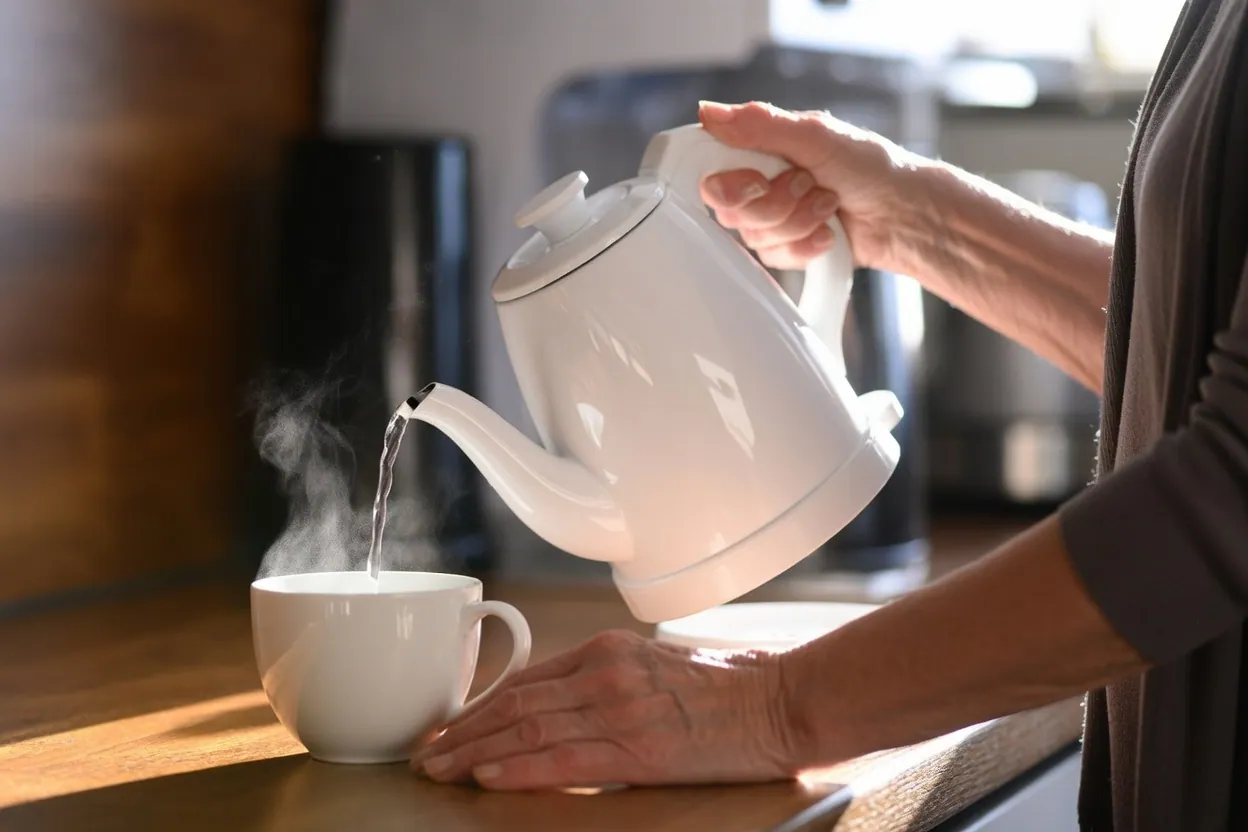
And yes — it is faster than the stove. Most electric kettles boil water in roughly half the time a stovetop burner takes, because the heating element sits in the water instead of warming a pot bottom and the air around it. The safe way is also the quick way, which is not something the world offers often.
📊 The Numbers Behind the Switch
Cooking is the number-one cause of home fires and home fire injuries in the United States, and the leading factor is the simplest one: unattended cooking — the burner that stayed on after the person stepped away. In recent years, American fire departments have answered an average of roughly 470 home cooking fires every single day. A kettle that turns itself off cannot be the kettle that stays on. It removes one whole category of “did I leave the stove on?” from a household — the category that starts fires.
The second number is about the pour, not the flame. Burn specialists are blunt about it: older adults have thinner skin, so hot liquids cause deeper burns with even brief exposure — and slower reaction time means the splash lands before the hand can move. Scald burns after 60 hospitalize more often and, in the words of the burn-prevention literature, frequently cost people their independence. Pouring from a light pitcher at counter height instead of hoisting a heavy kettle off a hot stove is exactly the kind of small mechanical change that prevents exactly that kind of injury.
🔍 What to Look For — Six Things, No Gadgets
1. Automatic shutoff and boil-dry protection
These are the two switches that make the whole case, and nearly every modern electric kettle has both — the first turns the kettle off when the water boils, the second turns it off if someone switches it on empty. Check the box anyway; those two lines are the reason you are buying it.
2. A cordless base
The kettle should lift free of its base, so what you carry to the cup has no cord attached. This is standard on anything decent.
3. Light in the hand, honest about capacity
A full 1.7-liter kettle is still several pounds of boiling water. The kettle being light empty is what matters — and the habit worth building is filling it for the cups you are actually making, not to the brim. Faster boil, lighter pour.
What size to buy: the standard 1.7-liter kettle is sized for a family of five — filled, it is close to five pounds in your hand. For one or two people, a 1.0-to-1.2-liter kettle is the honest size: it still makes four or five cups, it weighs about a pound less when full, and with less water to heat it boils noticeably faster. Buy the big one only if you regularly fill thermoses or pour for a crowd; otherwise the smaller kettle is lighter every single morning for the rest of its life.
4. A lid that opens with one press
Push-button flip lids beat pry-off lids the same way lever handles beat doorknobs — no tight grasping or twisting required, and your face is never over the steam wrestling a lid.
5. A water window or clear body
Being able to see the water level from across the kitchen beats guessing by weight.
6. One switch, no apps
A plain kettle with a single on switch will outlive two phones and never asks for an update. Variable-temperature models are genuinely nice for delicate teas — if that is you, take one — but nobody needs to connect their kettle to the internet.
A quality stainless or glass model with every feature above runs $25–$60 and lasts many years. And it earns its counter space beyond the teacup: hot water for the tea you grew yourself, for pour-over coffee, for instant oatmeal, for warming the pot before soup. The fastest hot water in the house ends up being the most used appliance in it.
🏷️ The Four We Would Actually Buy
Everything above is a list of features. Here it is with names on it. Four machines, each one checked on Amazon in October 2026, each one chosen for one reason — and each one with its catch set down plainly, because every machine has one.
For one or two people: Hamilton Beach 1 Liter Stainless Steel Kettle (model 40998)
The honest size for a small household, and the cheapest kettle on this page. One liter, so a full one is about a pound lighter in the hand than the standard 1.7-liter family kettle. It has both switches that make the whole case — automatic shutoff at the boil and boil-dry protection — plus a cordless base, a push-button lid and a water-level window. About $25. The catch: it is plain stainless, so the outside gets hot. Hold it by the handle and nowhere else. See the Hamilton Beach 40998 →
If you steady things by touch: Hamilton Beach 1.7 Liter Cool-Touch Digital Kettle (model 41033)
The maker says the outside, the handle and the spout stay cool to the touch — which matters with grandchildren in the kitchen, or for anybody who has started putting a hand on things to keep their balance. It shuts off, it has boil-dry protection, the base is cordless, and it has five temperature settings for anyone who takes tea seriously. 1,500 watts. About $57. The catch: it is the big 1.7-liter size, so fill it for the cups you are making, not to the line. And it holds the water warm for thirty minutes before it switches itself off, rather than clicking off the moment it boils. See the Hamilton Beach 41033 →
If you want to see the water: Hamilton Beach 1.7 Liter Glass Electric Kettle (model 40864)
The kettle from the story above. The whole body is clear glass, so you can see how much water is in it from across the counter, watch it come to the boil, and see that it has stopped. A blue light glows in the water while it heats — a signal you can read without your glasses and without listening for a click. It shuts itself off at the boil, it has boil-dry protection, and the base is cordless. About $35. The catch: glass gets every bit as hot as steel, so hold it by the handle and nowhere else. It is the full 1.7-liter size, so fill it for the cups you are making, not to the line. And glass can break — a chipped or cracked glass kettle goes in the trash, not back on the base. See the Hamilton Beach 40864 →
If nothing hot should be lifted at all: Zojirushi Panorama Window Micom Water Boiler (model CD-LFC30)
This is the no-lift answer with a name on it. Three liters of water held hot on the counter, and a button that dispenses it into the cup underneath. Nothing gets picked up, tipped or carried. You choose the holding temperature — 160, 175, 195 or 208 degrees — and a window on the front shows how much is left from across the room. America’s Test Kitchen tested it and recommended it. It runs on 800 watts, about $175 at the time of checking. The catch: it keeps the water hot all day, so it uses power all day — it has an energy-saving timer to cut that back. And three liters has to get into it somehow, so fill it from a small light jug, a little at a time, never by carrying the pot to the sink. See the Zojirushi CD-LFC30 →
Prices and models change. These were checked on Amazon in October 2026. If a model number has changed by the time you read this, buy whatever has the same features, not the same name.
🪶 When No Kettle Should Be Lifted at All
A fair question comes up here: is there a kettle you can hold with two hands? The honest answer is that two-handled electric kettles barely exist — the body gets hot, so there is nowhere safe to put a second handle. But the people who design kitchen aids solved the problem a better way: they removed the lift entirely. If wrists, grip, or tremor make even a small kettle a worry, there are two real options, and both keep the hot water in your life without putting it in your hands.
1. A kettle tipper for the kettle you already own
A wire cradle that sits on the counter and holds a standard kettle with a strap. To pour, you pivot the kettle in the frame — the cradle carries the weight, your hand only steers. Around $25–$40, no tools, and it works with the electric kettle this page already talked you into. See kettle tippers →
2. A countertop hot water dispenser
The no-hands answer. A tank sits on the counter and keeps its water hot; you put the cup under the spout and press a button. Nothing is lifted, nothing is poured, nothing can be dropped. Fill the tank with a small plastic jug — light even when full — and the machine does every hot part of the job. See the Zojirushi CD-LFC30 →
Which one? If pouring is fine and lifting is the problem, the tipper cradle is the cheapest fix. If both are hard, the hot water dispenser removes the whole question. Either way, the answer to a heavy kettle is never “be more careful” — it is hardware that makes careful automatic.
❓ The Questions People Actually Ask
What is the best electric kettle for an older person?
For one or two people, the Hamilton Beach 1 Liter Stainless Steel Kettle (model 40998). It turns itself off at the boil, it will not heat up empty, the base is cordless, the lid opens with one press, and at one liter a full kettle is about a pound lighter than the standard size. It costs about $25.
If the outside of the kettle needs to stay cool, the Hamilton Beach 1.7 Liter Cool-Touch Digital Kettle (model 41033), about $57. If you want to see the water, the Hamilton Beach 1.7 Liter Glass Electric Kettle (model 40864), about $35. If lifting hot water at all is the problem, skip the kettle and get a push-button water boiler such as the Zojirushi CD-LFC30, about $175. All four are covered above.
What is the best electric kettle for arthritis or weak hands?
The one that asks the least of your grip and your wrist — and that is mostly about size, not brand. For one or two people, the Hamilton Beach 1 Liter Stainless Steel Kettle (model 40998): a small kettle holds less water, so there is less weight to lift and tip, and the lid opens with one press instead of a pry. Fill it only for the cups you are making. If lifting a kettle of hot water hurts at all, stop lifting: the Zojirushi CD-LFC30 water boiler dispenses at the press of a button, and a kettle tipper lets the kettle you already own pour without being picked up. Both are covered below the picks.
What is the lightest electric kettle for an elderly person?
Buy a small one. Most of what you lift is the water, not the kettle. The standard 1.7-liter kettle is sized for a family, and filled it is close to five pounds in the hand. A 1-liter kettle still makes four or five cups and weighs about a pound less when full. That is why the Hamilton Beach 40998 is our pick for one or two people. Whatever kettle you own, filling it for the cups you need instead of to the line is the free way to make it lighter every morning.
Is an electric kettle safer than a stovetop kettle?
Yes. An electric kettle turns itself off; a burner does not. Cooking is the number-one cause of home fires in the United States, and the leading factor is unattended cooking — the burner left on after someone walked away. American fire departments answer roughly 470 home cooking fires a day. An electric kettle with automatic shutoff and boil-dry protection cannot be the pot left on, there is no open flame or hot burner, and you pour at counter height instead of lifting boiling water off the stove. The figures and their sources are above.
Is a glass or stainless steel electric kettle better?
Neither is cooler to the touch — both get hot on the outside. Choose by what matters to you. Glass lets you see the water level and the boil from across the room, and many glass kettles glow while they heat; our pick is the Hamilton Beach 40864. The catch is that glass can break if it is knocked or dropped. Stainless steel is tougher and will not shatter; our pick is the Hamilton Beach 40998. If the outside of the kettle must stay cool — grandchildren, or a habit of steadying yourself by touch — get a double-wall cool-touch kettle such as the Hamilton Beach 41033.
What is the safest electric kettle for someone who forgets it is on?
Any kettle with both automatic shutoff and boil-dry protection — those two switches are the whole point. Automatic shutoff turns it off at the boil; boil-dry protection turns it off if it is switched on empty. All three kettles we recommend have both. Keep it simple, too: one switch, no apps, no menus to forget. The Zojirushi water boiler works differently — it is designed to keep water hot all day — so it suits someone who would rather never handle a kettle at all.
Can you run an electric kettle on a generator?
Yes, and it is a smaller ask than the wattage suggests, because a kettle only runs for a few minutes. A typical American kettle is 1,500 watts, but it holds that draw for the three to five minutes it takes to boil and then shuts itself off. That is a big number for a short time, which is the easiest kind of load a generator ever carries.
Like an electric skillet, a kettle is a heating element rather than a motor, so it draws its rated watts the moment you switch it on and never surges above them. On a 3,500-watt generator you can boil water with the refrigerator still running. On a 2,000-watt machine, boil first and let the refrigerator have the power back afterwards — five minutes of coffee costs a closed refrigerator nothing.
The one thing worth timing: do not start the kettle and the pressure cooker in the same minute. Both are heavy for a moment, and there is no reason to make them heavy at the same moment.
How many watts does an electric kettle use?
Most American electric kettles are 1,000 to 1,500 watts, and the common size is 1,500. At 1,500 watts a kettle draws about twelve and a half amps at 120 volts — most of an ordinary 15-amp kitchen circuit, which is why the breaker sometimes objects when the kettle and the toaster go on together.
British and European kettles boil faster because their outlets carry roughly twice the voltage and their kettles are built to draw about 3,000 watts. An American kettle cannot do that, and no listing claiming otherwise is telling you the truth. Ours take a little longer. They are still faster than a pot on a burner.
Is an electric kettle worth having if the power goes out?
On generator power, yes. With no power at all, no — and that is the honest answer. A kettle is an electric appliance with no fallback; when the outlet is dead it is a jug. That is why this page pairs it with a way to boil water that needs no outlet at all.
The way to think about it: the kettle earns its keep on the ten thousand ordinary mornings, and the camp stove run outdoors by the outage-kitchen rules earns its keep on the handful that are not. You want both, and on the days in between you want the kettle plugged into the generator.
⚡ The Honest Caveat — It Dies With the Power
An electric kettle needs the grid, and this is a site about the days the grid is missing. So the honest plan is both: the electric kettle for the ten thousand ordinary mornings, and a way to boil water that does not need an outlet for the handful that are not ordinary — a camp stove run outdoors with the outage-kitchen rules, or a generator running the daytime-charger routine that already keeps the refrigerator cold.
The kettle is the everyday tool. It was never the hurricane tool, and it does not pretend to be. Keep both, and neither kind of morning catches you without hot water.
🛒 Buy It at Fifty
This is the whole philosophy of the site in a $40 appliance. Buy it at fifty and it is a convenience — faster water, no whistle. Keep it at seventy and it is quietly doing safety work every single day: no flame left burning, no heavy pot at stove height, no lid to wrestle over steam, and one entire category of kitchen fire — the unattended burner behind roughly 470 cooking fires a day — that simply cannot happen in your house. The best safety equipment is the kind you would have wanted anyway.