💬 Seven Suppers, One Lesson
Almost everyone over fifty carries a memory of a pressure cooker — usually their mother’s or grandmother’s, usually rattling on a stovetop while everyone kept a respectful distance. That memory is the main reason people skip the best kitchen appliance of the last twenty years. As always on this site, the stories below are composite illustrations, not true stories — real patterns with no real persons or events — and the engineering facts behind them are cited further down the page.
📖 The Lid That Would Not Open
She would not have the thing in her house. Her mother’s pressure cooker had blown its gasket across the kitchen in 1963, and sixty years later she could still point to where the stain had been. So her grandson did not argue — he plugged his in, brought it to pressure, and invited her to try to open it. She twisted the lid with both hands and it did not move an inch, because the same steam she was afraid of was the thing holding it shut. That is the whole trick of the modern design: the lock is powered by the pressure itself, so the lid cannot open until the danger is gone. She watched the pin drop when the steam was out, opened it one-handed, and said the pot roast was almost as good as hers.
📖 The Sunday Roast That Came Back
The Sunday roast disappeared the same year her hip did — not because she forgot how, but because the recipe was really three hours of standing: browning, basting, checking, stirring the gravy at the end when her feet had already given their opinion. The multi-cooker her daughter set up on the counter turned the same recipe into ten minutes of work at the beginning and none at all after. Sear in the pot, pour in the broth, lock the lid, sit down. An hour later the house smelled like Sunday again, and the machine had quietly switched itself to keep-warm without asking her to get up even once.
📖 The Cheap Cut That Ate Like Sunday
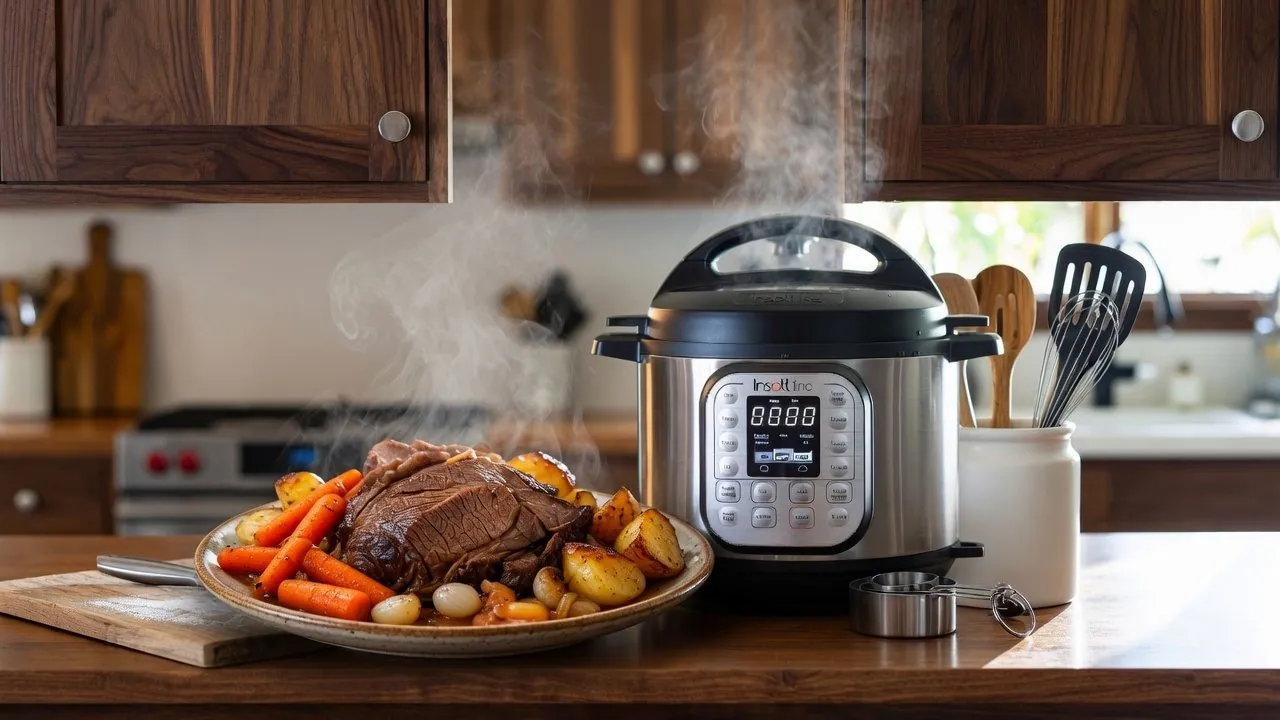
On a fixed income, the meat counter is a set of hard choices, and the tender cuts sit at the expensive end for a reason. He learned the workaround from the steam: at the temperatures a sealed pot reaches, a chuck roast — often several dollars a pound cheaper than the fancy cuts — comes out fork-tender in about an hour, and a bag of dried beans that cost less than a can of soup turns into a week of suppers without soaking overnight. The pot did not change his budget. It changed what his budget could buy.
📖 The Bottom Shelf at the Meat Counter
There is a corner of every meat case where the tough cuts wait with the orange discount stickers — bottom round, brisket flat, pork shoulder, the ones that punish a frying pan. He shops that corner on purpose now, and the butcher has noticed. What the expensive cuts charge for is tenderness, and his pot manufactures tenderness at home for the price of electricity: an hour of sealed steam and the four-dollar chuck pulls apart like the fourteen-dollar roast. The secret nobody puts on the sticker is that the tough cuts carry more flavor than the tender ones ever did — they just needed the one thing he finally owns. He walks that aisle like a man who knows something, because he does.
📖 One Pot, One Wash
His wife ran the kitchen for fifty-two years, and when she was gone the kitchen might as well have been a cockpit — the frying pan for this, the saucepan for that, the oven preheating for something else, three timers going and every burner a decision. So he ate sandwiches for a while, and toast, and he did not tell anybody why. The pot his daughter set up asked him for none of that. Brown the meat in it, pour the broth in it, close the lid, press the button — the same single pot start to finish, no stovetop, no oven, no juggling. Supper comes out real, the way it used to be, and when it is over there is exactly one pot in the sink. He cooks now. Not the way she did — but every night, and hot, and that turned out to be the part that mattered.
📖 The Recipe That Finally Fed One
Every recipe she owned fed six, because there had been six. Cooking for one meant either a week of the same leftovers staring back from the refrigerator or not really cooking at all — and like a lot of people at her table for one, she drifted toward the second. A neighbor is the one who told her the pot’s quiet secret: it scales down as happily as up. One chicken thigh, a handful of rice, a carrot, a cup of broth — twenty minutes later a single honest supper, hot and complete, with no pot of leftovers demanding loyalty for the rest of the week. She cooks for one now the way she used to cook for six: on purpose, and well. It turns out the loneliest part of the table was never the chair. It was the pot sized for a family that had moved away.
📖 The Chicken That Fell Off the Bone
He never announced it, but somewhere along the way tough food had quietly left his menu — the chewy roast, the dry chicken breast, the things that argue with a bridge and tired jaw muscles. He just ordered soup more often and said he preferred it. The pot brought the rest back. Chicken thighs come out of the sealed steam sliding off the bone; a chuck roast shreds at the touch of a fork; even the cheap round steak surrenders. Nothing needs a serrated knife and a negotiation anymore. His daughter noticed he ordered the pot roast at the diner again for his birthday — but the truth is he did not need the diner. The most tender meat in town was coming out of the pot on his own counter, any night he pressed the button.
🍲 Why One Pot — Four Appliances and None of the Standing
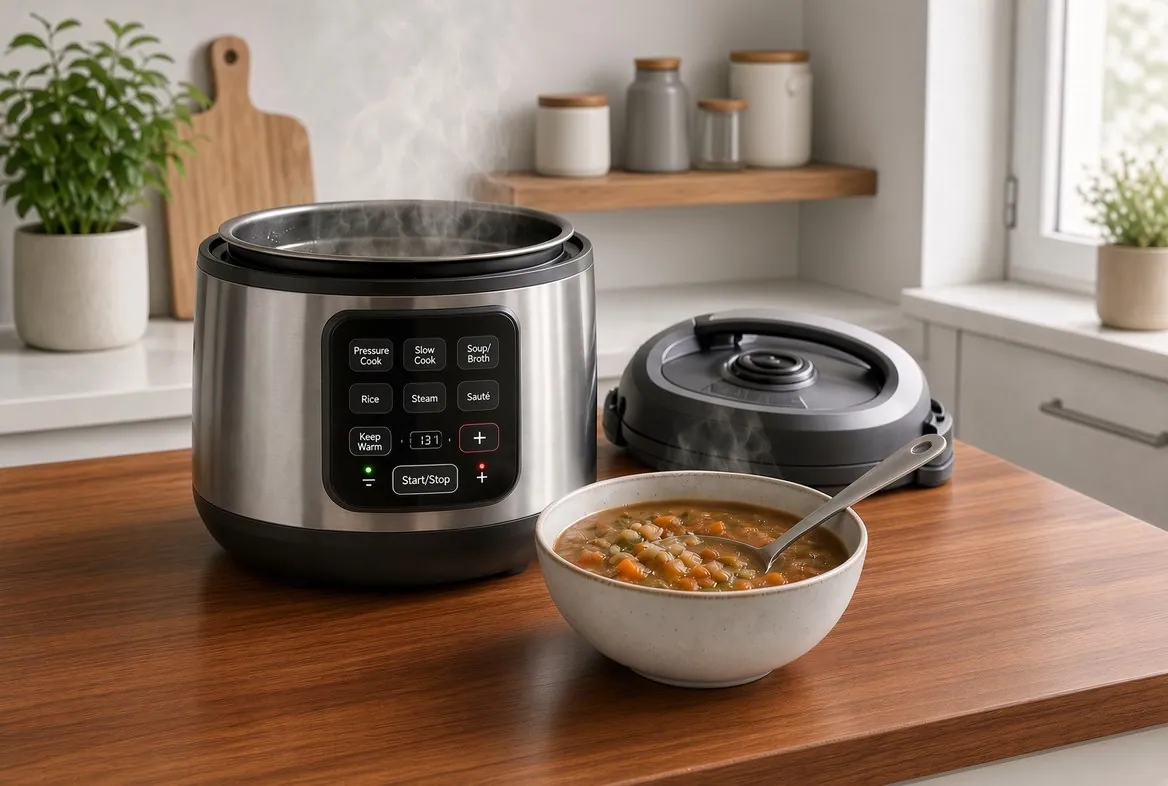
The homepage card makes the claim and the counter proves it: one appliance replaces the slow cooker, the pressure cooker, the rice cooker, and the steamer. Those are four boxes that no longer need cabinet space, four lids that no longer need washing, and one plug doing the work of a shelf full of machines. Same pot, different button.
But the real feature for this site’s readers is the one that never appears on the box: it does the standing for you. Stovetop cooking is a supervision job — stirring so it doesn’t stick, watching so it doesn’t boil over, standing because the stove cannot be trusted alone. A sealed multi-cooker is the opposite arrangement: the work happens in the first ten minutes at counter height, and then the machine cooks unsupervised, times itself, switches to keep-warm, and holds supper safely until you are ready. Knees, hips, and backs get the three hours back; the stove stays off entirely.
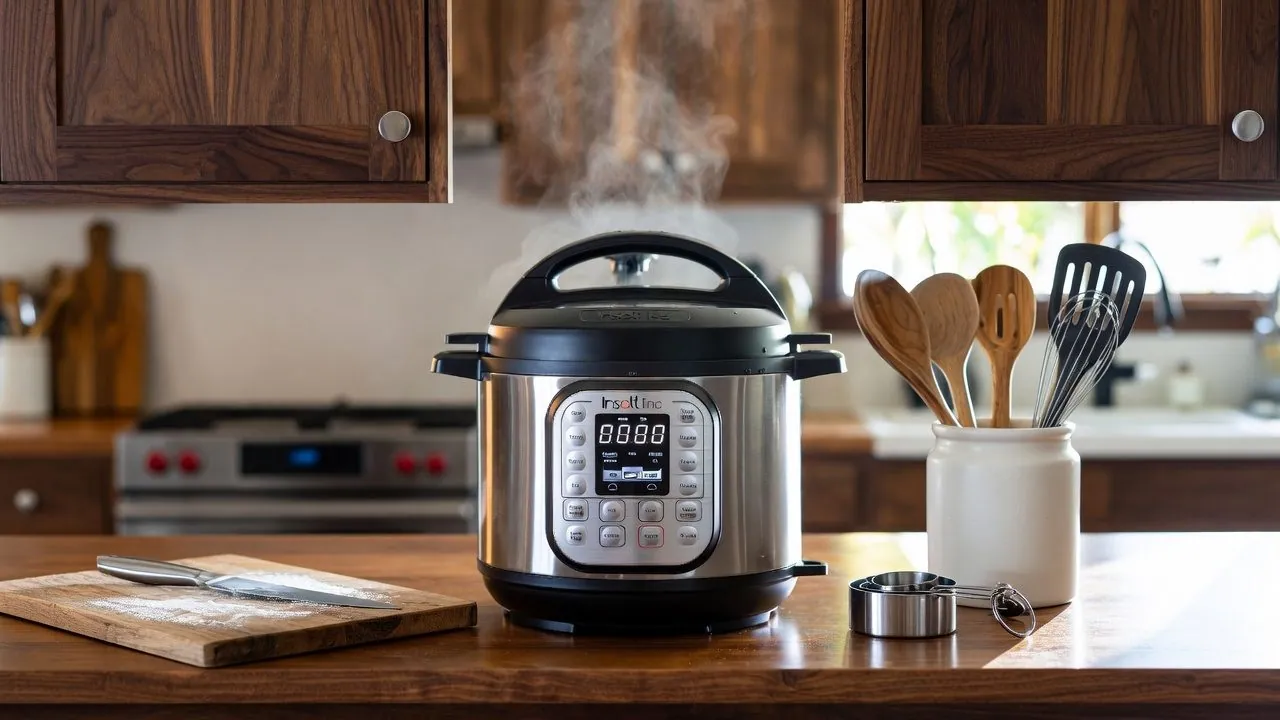
And like the kettle that turns itself off, it is a machine that cannot forget. Nothing on the stovetop is burning because nothing is on the stovetop — the pot heats itself, watches its own clock, and shuts its own heat down. The whole category of walked-away-from-the-burner simply does not apply to it.
📊 The Numbers Behind the Lid
The fear is inherited from real machines. Old stovetop pressure cookers could blow a gasket or a lid when a single valve clogged — that is not folklore, it is why the category nearly died.
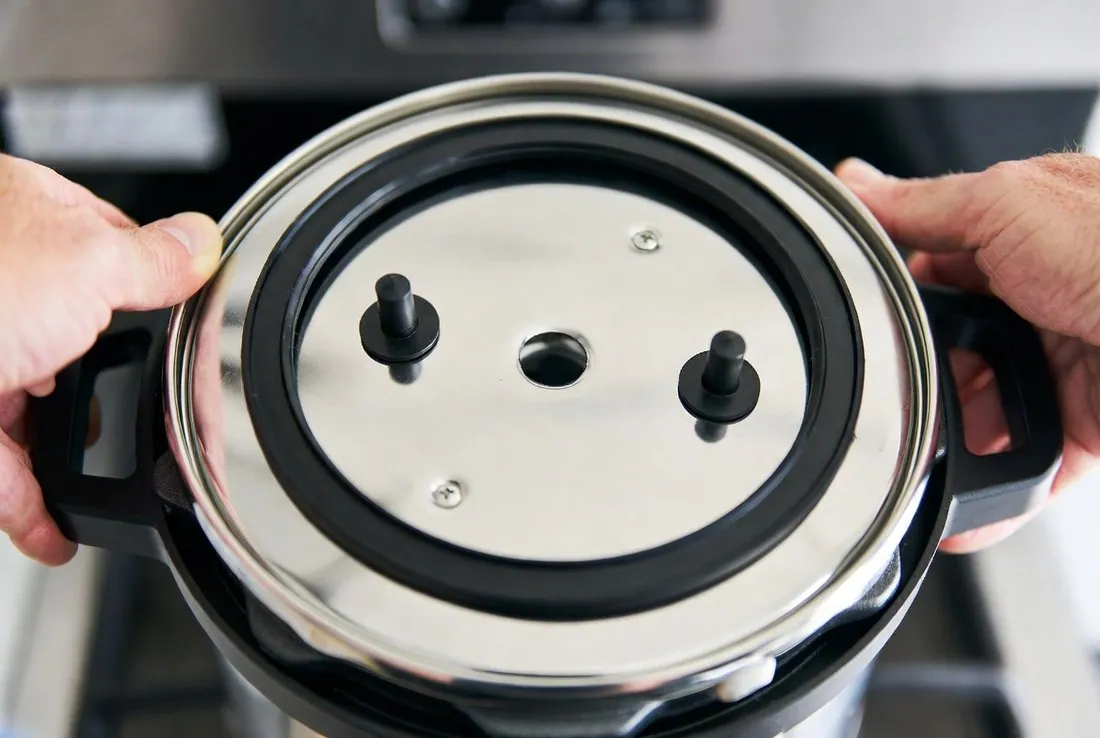
The modern electric pot is engineered like an answer to that exact memory: a lid pin-lock powered by the pressure itself (as long as pressure exists, the lid mechanically cannot rotate open — no electronics involved, pure physics), plus multiple relief valves instead of one, dual pressure regulators, thermal sensors that cut the heat, and a gasket designed to vent safely instead of failing loudly. The safety systems are layered so that several would have to fail at once before anything your grandmother remembers could happen.
The second number is the one that changes the grocery bill: sealed steam runs around 250°F — hotter than boiling water can ever get in an open pot — and that extra heat under pressure forces moisture into the food. It is exactly the treatment that turns tough, inexpensive cuts tender: chuck instead of tenderloin, thighs instead of breasts, dried beans instead of cans, all in a fraction of the stovetop time. Faster is nice. Cheaper-and-tender is the number that matters at the meat counter.
🔍 What to Look For — Five Things, No Gadgets
1. The 6-quart size
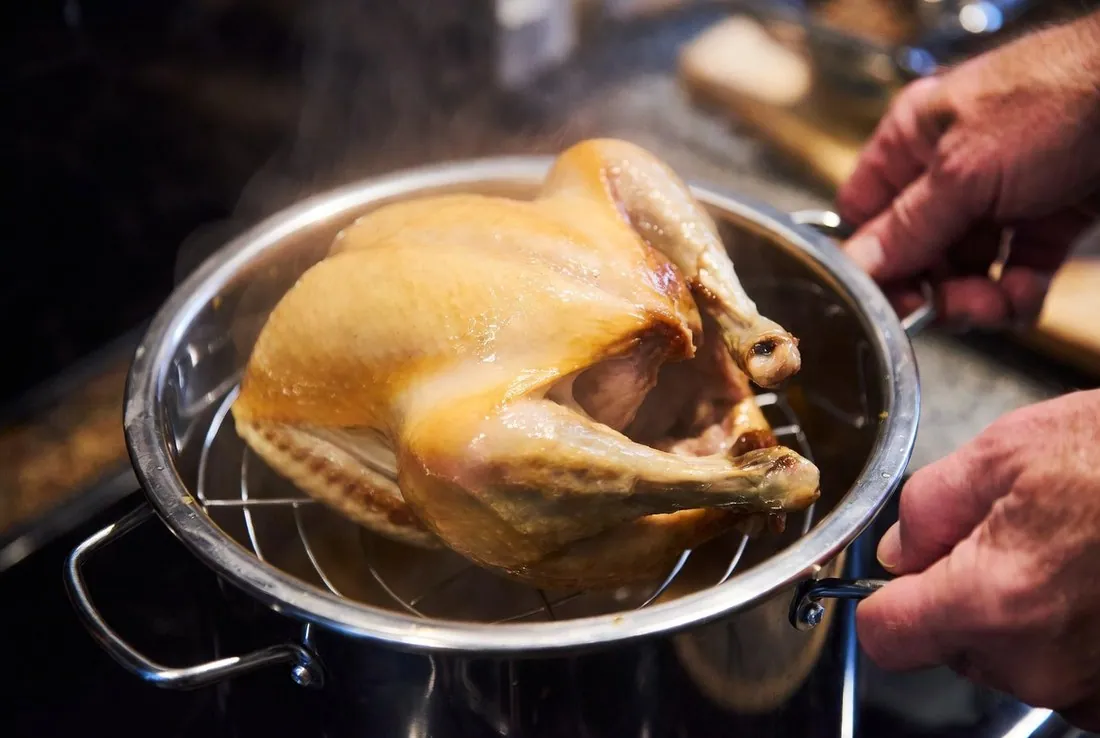
The standard. Big enough for a whole chicken, a chuck roast, or a pot of soup with a week of leftovers; small enough to lift and wash. The 3-quart is lighter but too cramped for a roast; the 8-quart is for feeding a crowd and is noticeably heavier at the sink. For one or two people who like leftovers — which is the smart way to cook once and eat three times — the 6-quart is the honest answer.
2. Automatic keep-warm
When the cooking finishes, the pot switches itself to keep-warm and holds supper there safely. Nobody has to be standing in the kitchen at the right moment. It is the same promise as the kettle’s automatic shutoff, pointed at dinner.
3. A steam release you do not touch with fingers
Look for a quick-release valve you can flip with the handle of a wooden spoon, or a model with a button-operated release set away from the steam path. The steam is the one hot part of an otherwise cool process; good design keeps your hand out of it entirely.
4. A stainless inner pot with handles
The inner pot is the part you actually lift — full of stew, over a counter, maybe with wet hands. Stainless steel with real side handles beats a bare-rimmed nonstick pot for grip, and it goes in the dishwasher without babying.
5. Buttons you can read, no apps
Big legible presets and one dial beat a touchscreen and a phone app. The pot has one job and needs no Wi-Fi to do it. A well-reviewed model with every feature above runs $60–$120, and the homepage card is right about the horizon: quality models last 10–15 years easily.
The Instant Pot is the brand that made the category famous, and it is a fine buy — but so is any well-reviewed electric multi-cooker with the five features above. Buy the features, not the label.
On a budget? Buy it used. Multi-cookers are one of the most common appliances on Facebook Marketplace, Craigslist, and neighborhood yard sales — wedding gifts that never left the box, downsizing households, kitchens that upgraded sizes — and they routinely sell for half or better off the new price. When you look one over: make sure it powers on and the inner pot is not dented, then spend ten dollars on a fresh sealing ring (the one part that wears, and the one part you want new anyway — see the sidebar). A five-year-old pot with a new ring does the same job as a new one, because there is almost nothing in it to wear out. Twenty-five dollars at a yard sale plus a ten-dollar ring is the cheapest fork-tender pot roast in town.
🏷️ The One We Would Actually Buy
Instant Pot Duo 7-in-1, 6-quart
The plain one. Pressure cook, slow cook, rice, steam, sauté, yogurt and keep-warm, run from big preset buttons and one dial — no app, no Wi-Fi, nothing to log into. It is the six-quart size this page recommends for one or two people with leftovers, and its listing rates it at 1,000 watts, the number to put on your generator list. Instant Brands, the company behind it, is based outside Chicago. The catch: the inner pot is stainless steel and full of hot food it is heavier than it looks — lift it out with both hands and oven mitts, or ladle the food out where it sits. See the Instant Pot Duo 6-quart →
❓ The Questions People Actually Ask
What is the best Instant Pot for seniors?
The plain Instant Pot Duo in the six-quart size — big buttons, one dial, no app. Six quarts holds a whole chicken or a week of soup for two and is still small enough to lift and wash. The fancier models add screens and Wi-Fi that do nothing the Duo cannot do with a button. The Duo is rated at 1,000 watts, which a 3,500-watt generator handles with the refrigerator still running.
Can you use an Instant Pot for canning?
Not for pressure canning — even if it has a canning button. The National Center for Home Food Preservation says it does not recommend its canning processes for electric multi-cookers, because nobody has shown these pots heat the inside of the jars enough to make low-acid foods safe. For canning, use a stovetop pressure canner. Source: National Center for Home Food Preservation.
Can you run an Instant Pot on a generator?
Yes — and of everything on a kitchen counter, an electric pressure cooker may be the single best supper a generator can make. A six-quart model is rated 1,000 watts, which is less than an electric skillet and well inside what a 3,500-watt machine has to spare with the refrigerator still running.
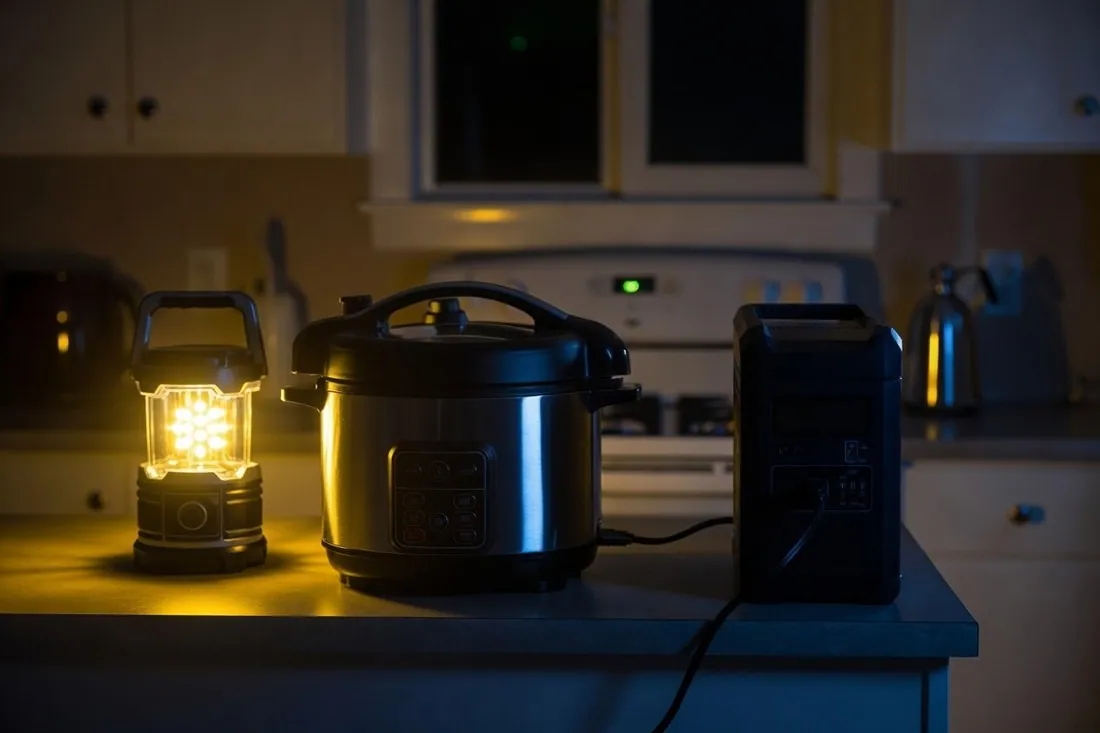
The part that does not show up on the label is the duty cycle. The element runs flat out only while the pot is coming up to pressure — roughly ten minutes. Once it seals, the element cycles on and off to hold pressure, and for most of the cooking time it is drawing far less than its rating. Averaged across a whole cook, a pressure cooker is one of the lightest ways there is to put a hot meal on the table. A conventional electric oven, by comparison, is 2,400 to 5,000 watts and is off the table on generator power entirely.
It is also the appliance that cares least about being left alone. You put the food in, close the lid and walk away — which matters more than usual when the generator is running outside and there are twelve other things to see to.
How many watts does an Instant Pot use?
About 700 watts for a three-quart, 1,000 watts for the common six-quart, and 1,200 to 1,400 for an eight-quart. The rating is printed on the plate on the underside of the base; that is the number to add to your generator list.
The eight-quart is the one to think twice about on a small machine. At 1,400 watts it is asking nearly as much as a skillet, and the extra capacity only earns its keep if you are cooking for a crowd. For two people the six-quart is the right pot on ordinary days and the easier pot on generator days.
What can you cook in an outage with an electric pressure cooker?
The things that normally take all afternoon — dried beans, a pot roast, soup, stew, rice, a whole chicken — and it does them faster than the stove would, on less power, without heating the kitchen in August.
That is the real argument for it after a storm. Dried beans and rice keep in a cupboard for years without electricity, cost almost nothing, and are exactly the food a pressure cooker is best at. A bag of beans and a working pressure cooker is a week of hot suppers off a shelf that never needed a refrigerator. Our canning and preserving guide covers the rest of that pantry.
⚠️ The Two Honest Caveats
1. It is not a pressure canner — even if it has a canning button
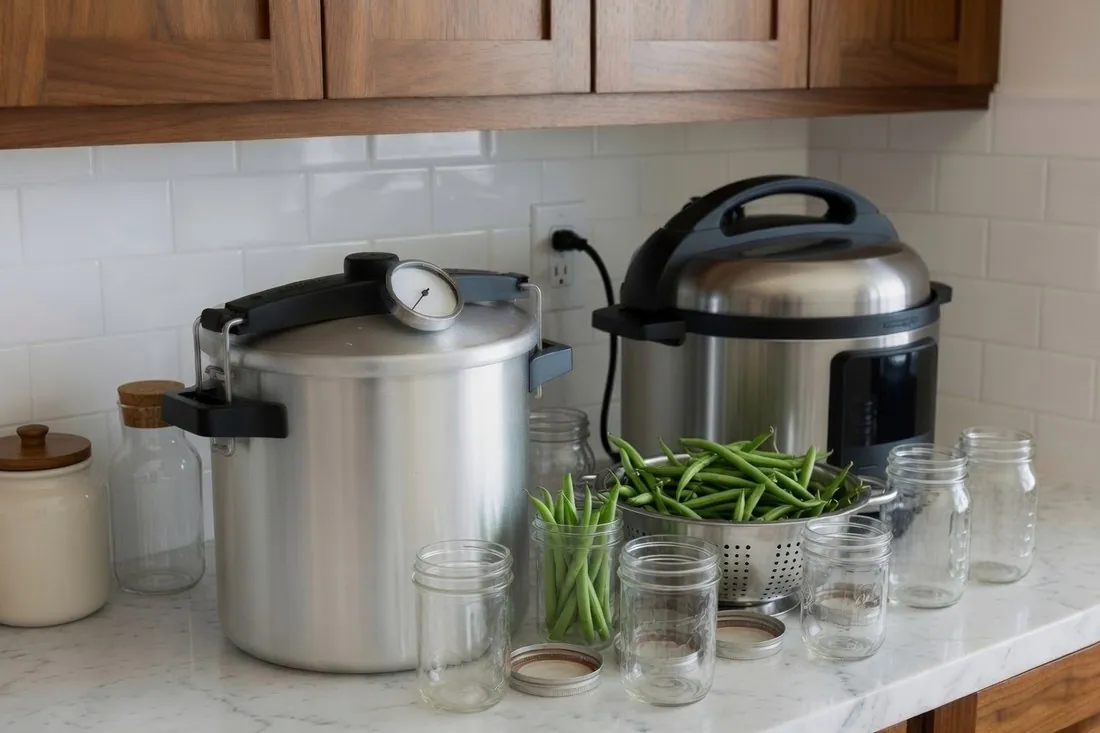
Some multi-cookers ship with a “canning” setting on the panel. The USDA and the National Center for Home Food Preservation say do not use it for pressure canning, full stop. Their tested canning processes were developed for stovetop pressure canners, and no research shows these countertop pots hold the temperatures that make low-acid canning safe. Cooking supper in the pot: completely safe. Canning green beans in it: not tested, not recommended, not worth the gamble. If canning is on your list, the canning and preserving guide covers the equipment that actually is tested.
2. It dies with the power
Like every good electric servant, it needs the grid. On the days the grid is missing, supper moves to the outage kitchen — the dutch oven and the camp stove run outdoors by the rules — or rides on the daytime generator routine. The multi-cooker is the everyday tool, not the hurricane tool. Keep both.
One more inherited habit worth keeping: stand the pot where its steam release points away from you and away from the upper cabinets. It is a small thing, it costs nothing, and it is the last piece of respect the old rattling cooker actually earned.
🛒 Buy It at Fifty
This is the philosophy of the site with a supper inside it. Buy the multi-cooker at fifty and it is a convenience: four appliances’ worth of cabinet space back, pot roast on a Tuesday, rice that never gets watched. Keep it at seventy and it is quietly carrying the load that the stove used to put on your feet, your hips, and your attention — ten minutes of standing instead of three hours, a lid that cannot open until it is safe, a machine that cannot leave the burner on because it has no burner to leave.
The cheap cuts get tender, the supper keeps itself warm, and the kitchen asks less of you every year while feeding you just as well. The best safety equipment is the kind you would have wanted anyway.