🎯 What He Is Actually Looking For
The best evidence we have on this comes from asking the people who did it. Researchers at the University of North Carolina at Charlotte surveyed 422 convicted burglars across North Carolina, Kentucky and Ohio about how they chose a house.
About 83 per cent said they tried to work out whether there was an alarm before going in, and 60 per cent said they would simply go and find another house if they found one. Among those who discovered an alarm after starting, roughly half broke off there and then.
What they said they weighed, in their own words: how close other people were — traffic, neighbors, somebody home — whether there was a clean way out, and any sign of trouble. Alarms. Cameras. Dogs inside.
Worth knowing who paid for it: that study was funded by the alarm industry's own research foundation. It is still the most direct evidence there is — you are asking the offenders themselves — but you should know that before you weigh it.
That first number is the strongest thing on this page, and it points at a decision this page does not cover: whether to fit an alarm system at all, and whether to pay somebody to watch it. That is a bigger question than it looks — it involves a ten-year bill, your town's false-alarm rules, and what happens to the whole thing when the power goes out. There is now a separate page on alarm systems that takes it apart properly.
None of that is about strength or courage or being clever. It is about looking like more work than the house next door. That is the whole of this page.
One cheap layer most people never think of: a panel in the window they cannot see through — it takes away the only way to check whether anybody is home, and it insulates while it does it.
And here is the honest arithmetic, because this site does not sell fear: people over sixty-five are the least likely age group in America to be victims of violent crime — well under one per cent in a year. But when it does happen to an older person it is roughly twice as likely to happen at or near their own home, and far more likely to involve a stranger. So the sensible money goes exactly where you live, and it goes there without anybody lying awake.
Before you fit any of it, check your own local code. Everything from here on gets screwed, bolted or wired to a house, and what is permitted varies enormously by state, county and town. Bars and grilles over bedroom windows, security screen doors, barricade bars, hard-wired floodlights, cameras with microphones and alarm systems all have rules attached somewhere — and if you rent, or you are in a condominium or an HOA, there is a second set of rules on top of the first. One call to your building department, and one look at your lease or your bylaws, before you buy rather than after you have drilled.
🚪 The Doors — Where the Frame Gives Out
More than a third of break-ins come through the front door, and more than half of all unlawful entries are through a door or window that was simply not locked. Start there and you have already done more than most of the street.
After that, the thing to understand is that doors rarely fail at the lock. They fail at the frame. A deadbolt is a good piece of steel bolted to a strike plate that came with three-quarter inch screws going into a thin strip of pine. One shoulder and the pine lets go, taking the lock with it.
The fix costs about four dollars. Take the strike plate off, and put it back with three or four inch screws — long enough to pass through the jamb and bite into the framing timber behind it. Do the hinges while you have the screwdriver out; the same short screws are in those. Now the whole wall is holding your door shut instead of a strip of trim.
Count your ways out before you fit a bar
Here is the honest answer, and no clever product gets round it. Anything strong enough to stop a man getting in is strong enough to stop the fire crew getting to you. That is not a flaw in the bar. That is the bar working.
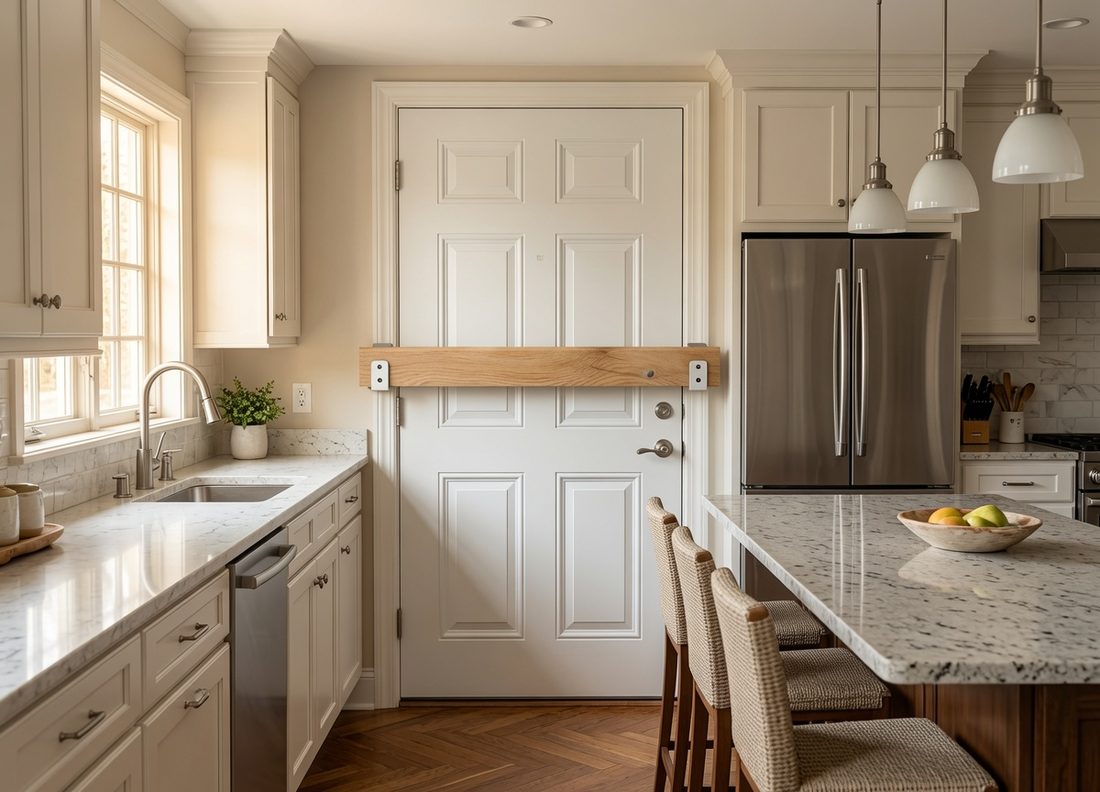
But the two are not equal, and this is the part worth understanding. A deadbolt — even a good one, even with four inch screws behind it — can be forced from outside by people whose job it is, with the tools they carry on the truck. A barricade bar cannot. It is built specifically to defeat the thing a fire crew does to a door, and it is very good at it. Bar a door and you should treat that door as walled up.
Which turns it from a question about products into a question of arithmetic:
- Front door, back door and a patio slider? You are golden. Bar the garage door as hard as you like — you still have two ways out and they still have two ways in.
- Only a front door and the garage? Then that garage door is half your exits, and a bar across it is not a security decision, it is trading one risk for a worse one. Harden it instead — solid door, real deadbolt, long screws through the strike and the hinges. That beats a shoulder and a pry bar, and it still comes open for a crew with the proper tools.
Two practical notes, because a drop bar is not the awkward object people picture. The bar for an ordinary door is about a yard long and weighs four or five pounds. It is a length of 2×4 slightly wider than the door, and lifting it out of its brackets is not a feat of strength at any age. It comes out from the inside, in one movement, with one hand.
And you get to choose the height. Set the brackets low — knee height, or lower. The bar holds exactly as well down there, because it is the brackets and the framing carrying the load, not the altitude. If a room has filled with smoke you are already down at that level, which is precisely where you want the one thing standing between you and the yard.
Be clear about which direction the problem runs. A bar does not trap you in — you lift it and go. What it does is keep people out, and that includes the fire crew coming to get you. So the question is never whether you can work it. It is whether you can afford for that particular door to be one nobody can come through.
One thing that genuinely helps and costs about thirty dollars: put a key in a lockbox outside, tell the people who would come, and ask your county whether it keeps a register of residents who would need help getting out. That does not undo a barred door — nothing does — but it fixes the ordinary version of this problem, which is not a fire at all. It is somebody on the floor who cannot get to the door to let anybody in.
The basement door nobody upstairs can hear
There is one door where the whole logic of this page stops working, and a great many houses have it. The walkout basement. A door at the bottom of the house, opening straight onto a grade-level yard, two floors below where anybody is sleeping.
Everything else here is built on the same three things going wrong for him: being seen, being heard, being interrupted. At a walkout door in the small hours, all three have already failed by construction. Nobody can see that side of the house. Nobody upstairs is going to hear him, and he knows it. He can work on that door for as long as he likes, as loudly as he likes. Every deterrent that depends on him being in a hurry has just stopped applying, which means the hardware has to do the whole job on its own.
That is the door for the bar, and it is very close to the only argument you need. It is rarely anybody's main way out, it is usually the least-used door in the house, and it is the one place where "walled up" is exactly the correct answer. Bulkhead and cellar doors are the same case. So are basement windows, which is where the noise-makers further down this page earn more than anywhere else on the property.
One thing to check first, and it decides the answer. If anybody sleeps down there, that basement has to keep a way out — a door or a window somebody can get through without a key or a tool. That is not an opinion, it is what the building code requires of any basement with a bedroom in it. Bar the door in a basement nobody sleeps in and you have made the house harder. Bar the only exit from a room somebody sleeps in and you have made it worse.
The glass beside the door
If there is a window pane in your door, or a narrow one beside it, look at where your thumb turn sits. If somebody can break one small piece of glass and reach it, the lock is decorative.
Do not solve this with a deadbolt that needs a key on the inside. That is how people die in house fires — in smoke, at night, hunting for a key. Put security film on that glass instead, or move the lock. Nothing on this page is worth being unable to get out of your own house.
Sliding doors come out by lifting
Nearly everybody puts a bar or a length of broom handle in the bottom track, and that is correct — it stops the panel sliding. It is also only half the job, because most sliding doors are not slid open. They are lifted off the bottom rail and swung out.
The other half is two screws. Drive them partway into the upper track, one at each end, so there is no longer enough headroom for the panel to rise. Leave them proud enough to see. Ten minutes, and the door now has to be broken rather than removed.
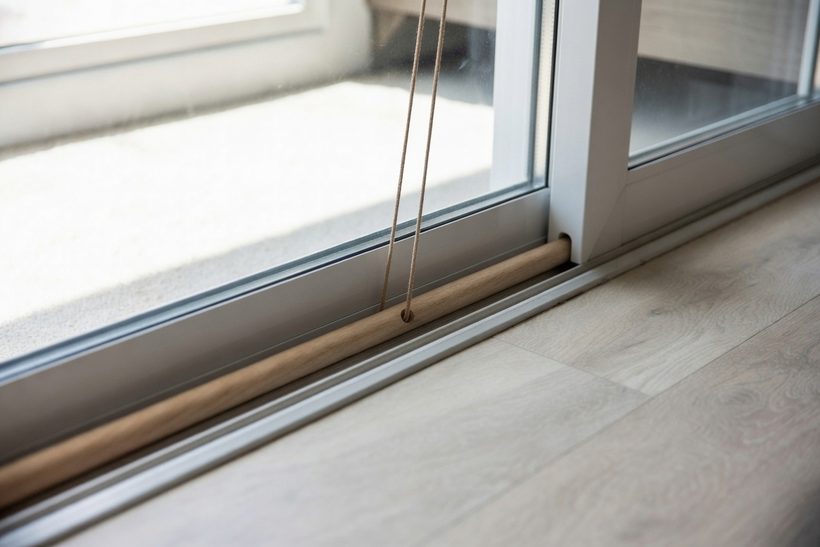
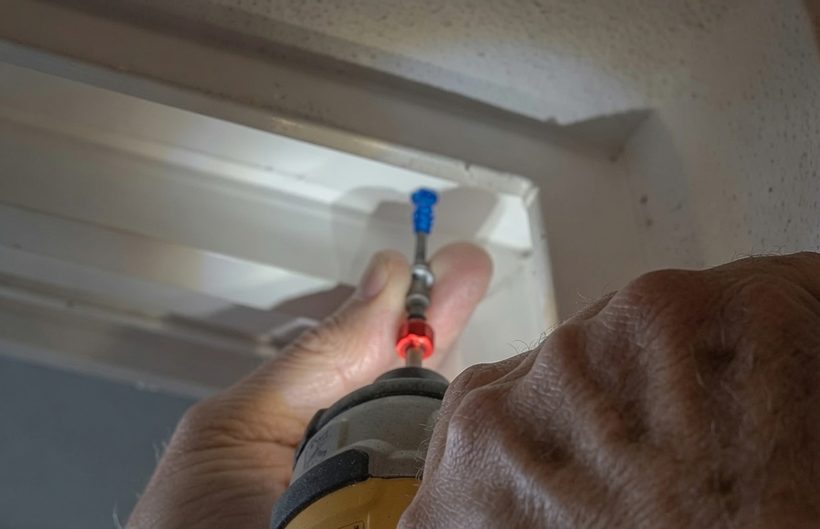
Both halves, and almost everybody does only the first. The dowel stops it sliding. The screw in the upper track stops it lifting. A slider fitted with one and not the other is a door that still comes out in about fifteen seconds.
The one lock that solves both problems
Everything above ends in an argument you cannot win. What keeps a stranger out keeps the ambulance crew out too, and no clever product gets round it. There is exactly one exception, and it is the cheapest thing on this page.
Put a bathroom privacy lock on your bedroom door, and turn it every night. Not a deadbolt. The little push-button or twist-turn that comes on a bathroom door — the kind with a slot on the outside that opens with a screwdriver, a coin, or the small key that lives on the door frame.
Here is why that one is different from everything else on this page. Police and paramedics open those doors constantly. Somebody has gone down in the bathroom and cannot reach up to the handle — it is one of the most ordinary calls there is. Nobody is going to stand in your hallway wondering what to do about your bedroom door. It is three seconds and they have done it a hundred times. To a stranger in a dark house at two in the morning it is a door that will not open, with no explanation of why.
That is the whole of the trade. You are buying minutes, not resistance. A privacy lock will not hold a door — a shoulder takes it, and anyone who wants through will get through. But he has to reach it, try it, find that it will not turn, and decide what he is going to do about that. Every one of those is time you did not have thirty seconds ago.
Three things worth doing with the minutes, in this order:
- Call first. Before anything else, before you have worked out what is happening. You already know somebody is in the house — that is a car dispatched now rather than when you hear him on the stairs.
- Everybody in the room. Whoever else is in the house comes to you. Nobody goes to look; there is more further down this page on why going to look is the dangerous part.
- Something in your hand. Not to go out and use it — to not be standing there empty-handed and half asleep if that door does come apart. Whatever it is, the point is that it lives in the bedroom with you rather than in the kitchen, which is the side of the door he is on. A bat, a heavy torch, the walking stick, the chair. Most people have never once thought about which side of their own door their own things are on.
- Wake the dog. Not to do anything — only to be heard. The burglars in the Charlotte survey named dogs inside the house alongside alarms and cameras, and a man working at a bedroom door who hears barking and growling on the other side of it has to decide whether he really wants to know what that is. There is a section further down on what a dog is and is not good for, and it does not all point one way.
Be plain about what a privacy lock is not. It is not security hardware. It is not rated for anything, it will not hold against a determined man, and fitting one is not a reason to skip the deadbolt, the long screws or any of the rest of it. What it does is buy you time on the one door you are actually behind when it matters — and it does that without ever becoming a door you cannot get out of.
None of that is a plan to fight anybody, and it should not turn into one. The whole value of the door is that you do not have to go and find out what is on the other side of it — the same rule as the noise at two in the morning, further down. You stay where you are, the police are already coming, and you are simply not going to be caught out standing in the dark with nothing.
That is the entire trade, and most people have never been told it is available to them for the price of a lever handle.
Standing behind that door is not hiding. It is the plan working exactly as designed.
The peephole, and the thing that can be bought for it
Almost every front door in the country has one, almost nobody thinks about it, and there is something about it worth knowing.
A device exists that lets somebody standing outside look in through your peephole. It is called a reverse peephole viewer, or a tactical door viewer, and it is a small lens assembly that undoes the optics of an ordinary door viewer — you hold it against the outside of the peephole and the picture comes back the other way. It was originally made for police serving warrants, so an officer could see whether anybody was waiting behind the door before going through it. It is now sold openly to anybody who wants one.
Before that gets frightening, here is the honest size of it, because the scare version is bigger than the real one.
The view through one of these is narrow and shallow — something like fifteen degrees, and only a matter of feet. It shows the patch of floor and hallway immediately behind your door. It does not show somebody your living room, your possessions or your evening. What it can show is whether a light is on, whether anything is moving, and roughly what is in the entry — which is enough to answer the only question that matters to somebody standing there: is anybody in.
And you do not strictly need the device at all. A peephole passes light both ways, so if the inside of the house is brighter than the porch, somebody close to it can pick up movement through the lens on its own.
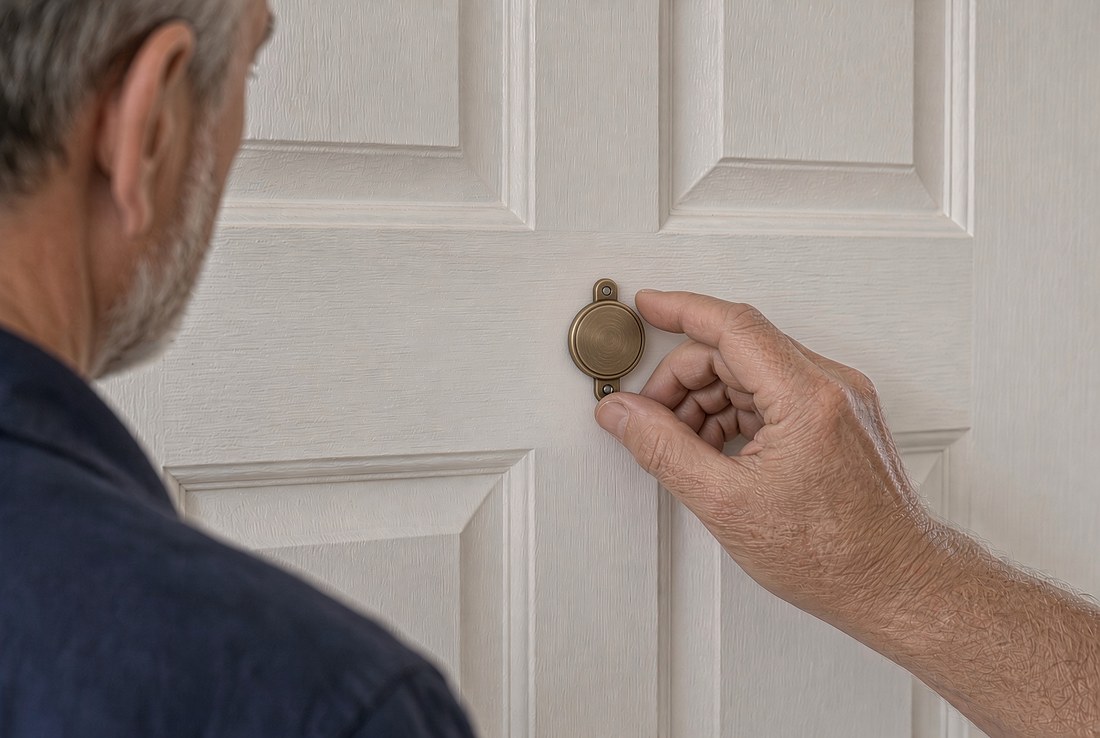
The fix is almost free, and there are four versions of it.
1. Anything opaque, this evening. A square of electrical tape, a scrap of card, a fridge magnet if the fitting is steel. Costs nothing and works completely.
2. A proper peephole cover. A small hinged or sliding plate that screws to the inside of the door over the eyepiece, a couple of dollars. Better than tape for one reason that matters: you will actually keep using it, because you flip it aside, look, and flip it back.
3. A door viewer with a cover built in. If the peephole is being replaced anyway, ask for one of these rather than the plain kind.
4. A digital door viewer. A camera on the outside and a small screen on the inside, with no optical path through the door at all, so there is nothing to reverse. More money and a battery to keep charged, and it gives you a bigger picture to look at, which for eyes that are not what they were is a real argument on its own.
What not to do is blind it. Painting over it, plugging it or taking it out is the wrong answer, because the peephole is a safety device and it is doing the most important job on this whole page — letting you find out who is at your door without opening it. Cover it when you are not using it. Do not lose it.
And while you are there, the bigger hole
This one is worth two minutes and almost nobody has checked it. Go outside and try to unscrew the outer ring of your own peephole with your fingers.
On a great many doors it turns. The two halves simply thread together through the door, and on an older or cheaper viewer they can be undone from the outside without a tool. If somebody can unscrew it, what you have is not a peephole with a vulnerability. It is a half-inch hole straight through your front door — and a hole is a great deal more useful to somebody than a narrow lens.
If yours turns, take it out, put a drop of thread-locking compound on the threads, and put it back tight. That is a dollar and ten minutes and it closes the whole subject.
And the same trick belongs in a suitcase. A strip of tape over the peephole of a hotel room door costs nothing, weighs nothing, and settles a question that a lot of people have never thought to ask about a room where they cannot choose the neighbours.
🚗 The Garage — the Hole in Most Houses
You can do everything above to your front door and leave it all undone by a door most people have never thought about once.
The door from the garage into the house is usually a hollow interior door with a knob lock on it. No deadbolt, sometimes no dead latch at all. And it opens into a room with no windows and a door that closes behind you — so a man working on it cannot be seen from the road, cannot be seen from next door, and can take as long as he likes.
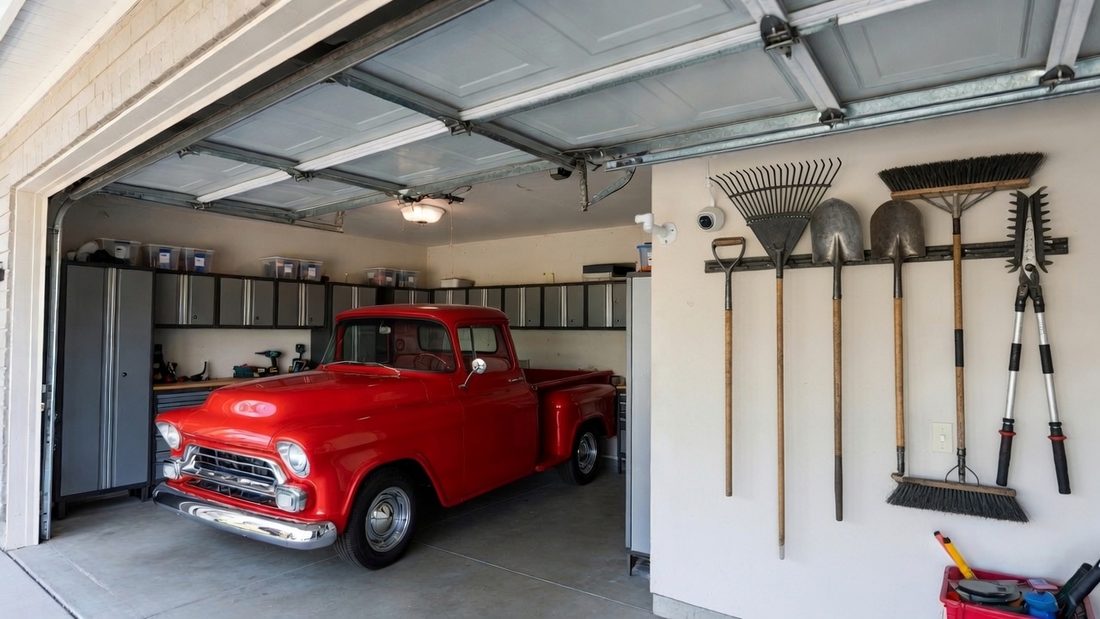
And now look at what else is in there with him. Shelves, a workbench, and a pegboard with every tool on it — a pry bar, a hammer, screwdrivers, a saw, a drill, and whatever is in the drawers. A man who gets into your garage has not merely found a room nobody can see into. He has found a fully equipped workshop, and the only thing left between him and your house is a hollow door with a knob lock on it.
He is not hurried any more, either. The one thing every burglar is short of is time in the open, and the moment that overhead door comes down he has as much of it as he wants.
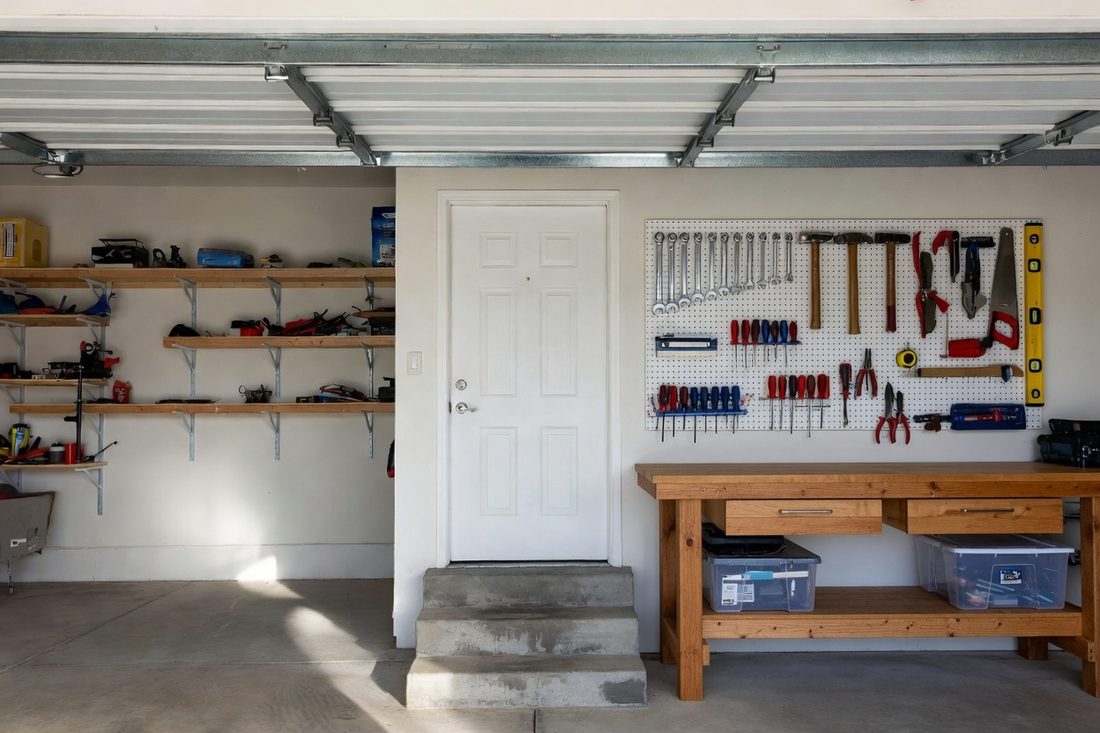
Treat it as an exterior door, because that is what it is. A solid door, a proper deadbolt, and the long screws in the strike plate.
And the release cord. On most overhead garage doors the emergency release lever can be reached by pushing a wire through the gap at the top of the door and hooking the cord — and then the door simply opens. A zip tie through the lever, or a small plastic shield over it, ends that. It costs pennies and almost nobody knows about it.
Fit it, then pull the cord by hand once from inside, so you know exactly how it behaves the day the power is out and you need the door open.
🪟 The Windows — Buying Yourself Noise
First-floor windows are about a quarter of break-ins, and glass is the fastest way into a house because it is over in three seconds and it does not need a tool.
Security film does not stop a window breaking. Anybody who tells you otherwise is selling something. What it does is hold the broken pane together in its frame, so the glass does not fall out and leave a hole. The man outside now has to keep hitting it, in the open, making a great deal of noise, for a length of time he has not budgeted for.
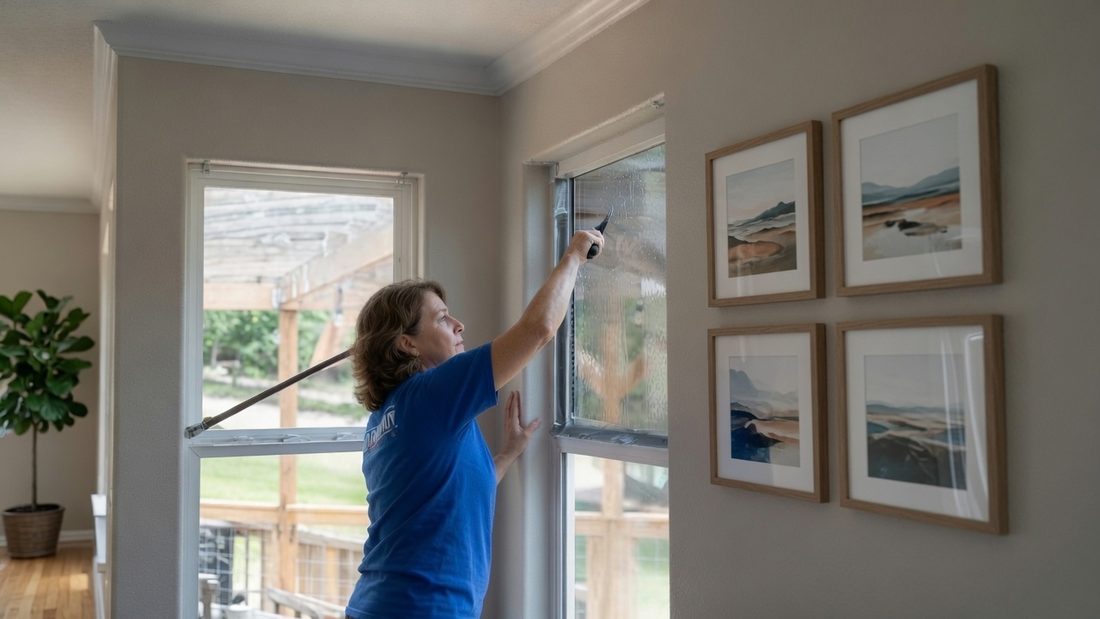
That is the same trade as everything else here: you are not buying a wall, you are buying minutes and racket.
While you are at each window, fit a stop or a pin that lets it open four inches for air and no further. A hot night is the reason most ground-floor windows are unlocked, and this settles it without making anybody choose.
Bars on the windows, and the honest word about them
Somewhere in this conversation somebody always lowers their voice and says you could always put bars on, as though it were a slightly shameful idea. It is not, and where I grew up in the San Fernando Valley it was not treated as one. Decorative iron over the windows and a steel security screen door hung ahead of the front door was simply what a house looked like. Millions of American houses look like that today — across the Southwest, through Texas and southern California, and in city neighborhoods in every state. Nobody living behind them thinks of their home as a bunker.
They are also, unlike almost everything else on this page, an actual barrier rather than a delay. Film buys you noise. Planting buys you reluctance. Bars buy you the window not opening.
The one thing you have to get right is the same thing as everywhere else on this page, and there is a clean answer to it. The building code specifically permits bars, grilles, covers and screens over escape windows. The condition it sets is that the device has to be releasable or removable from the inside without a key, without a tool, without special knowledge, and without more force than it takes to open the window normally.
So this is a purchasing instruction, not a warning. On any bedroom window — and on a basement window in a room anybody sleeps in — buy the pattern with the interior quick-release lever, and make sure everybody in the house has worked it once with the lights off. On a bathroom, kitchen or garage window the question never arises. What you must never do is bolt a fixed grille over the window somebody would climb out of.
A security screen door is the same bargain at the front of the house and it is the more useful of the two, because you can stand behind a locked steel screen and open the wooden door to talk to whoever knocked. That is the same job the doorbell camera does, done in iron, for people who would rather not have a subscription.
🌵 The Planting — the Cheapest Guard You Will Ever Own
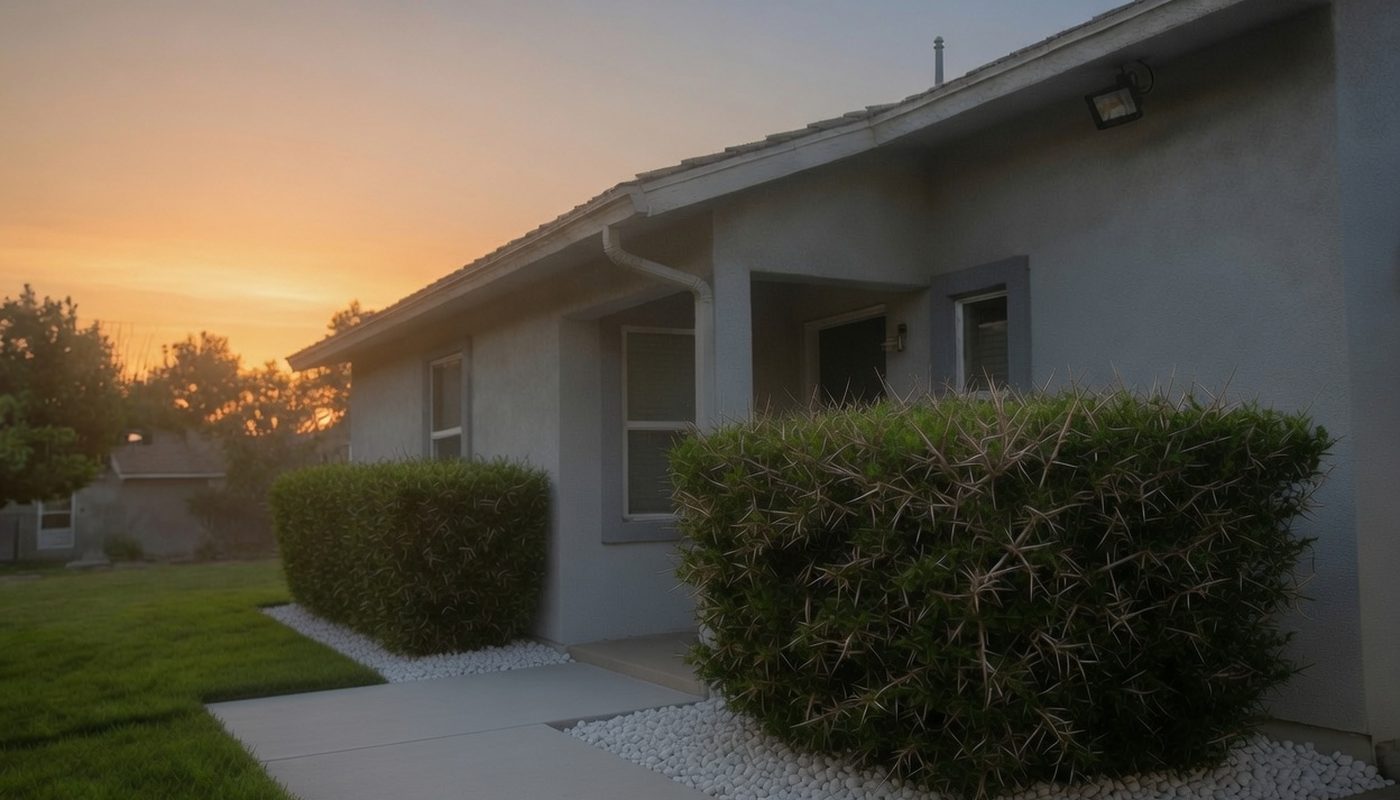
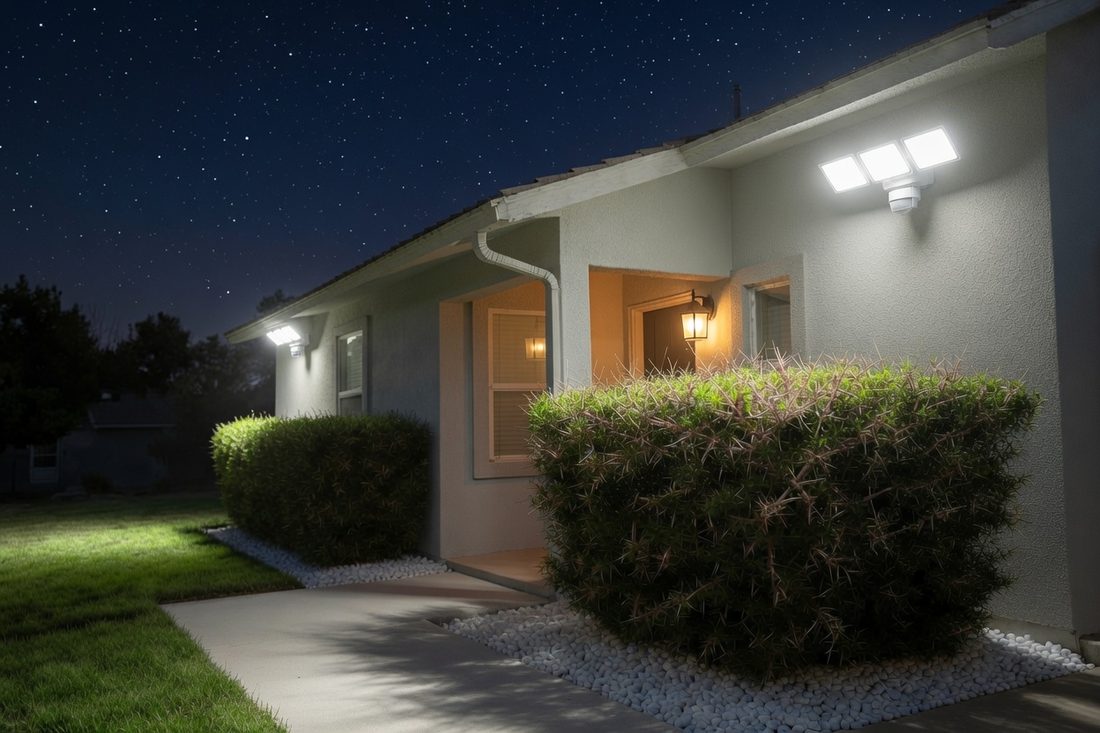
A thorn hedge under a window is a wonderful thing. It never needs a battery, it works in a power cut, it costs nothing to run, and it is beautiful in flower. And getting through it is a slow, noisy, painful business that leaves marks on the person doing it.
This is where a national page has to be careful, because the right plant depends entirely on where you are. Bougainvillea is superb and it is a Gulf and desert plant — it will not live through a winter much north of that. Pick from what grows for you:
- Firethorn (pyracantha) — dense, viciously thorned, orange berries, hardy across most of the country
- Hawthorn — a thorn tree that can be kept as a hedge, tough as anything, very cold hardy
- Barberry — low, dense, spines the whole length of every stem. Check first — it is a listed invasive in a number of states
- Holly — evergreen, so it works in January when the deciduous stuff is bare sticks
- Trifoliate orange — the most fearsome hedge in the South, thorns the length of your thumb
- Climbing roses on a trellis under the window, which nobody ever reads as security
Keep it low, and keep the path clear
Thorns go under the window, not beside the path you walk at night. And keep the whole bed below the sill. A tall shrub near a window cuts both ways — it may be spiky, but it is also a place to stand where nobody can see you working. Under three feet at the wall, and tree branches trimmed up above head height, and you have thorns without cover.
Gravel does the same job by ear. A bed of loose stone under the windows cannot be crossed quietly by anybody, at any hour. Keep it in the beds and off the walkway — deep loose gravel underfoot is exactly the surface that puts an older person on the ground, and a broken hip is a far likelier way to lose your independence than a burglar is.
💡 The Lights — Motion, Not Always-On
A light that burns all night is scenery. Nobody looks at it, nobody notices it, and it helpfully illuminates the ground for whoever is standing on it.
A light that snaps on is an event. It changes something. It makes a person look up from the television next door. And it tells the man in the yard that the house just noticed him, which is the one message worth sending.
So put the money into motion fixtures and aim them properly. Not just at the front door — at the driveway, the side gate, and the ground beside the car.
The double duty is the real argument. The lamp that catches somebody at the gate is the same lamp that stops you putting a foot wrong on the path with an armful of shopping. Falls end more independence in this country than crime ever has. You are buying one fixture and getting both.
An honest word about solar
Solar floodlights are excellent on a shed, a gate or a far fence where running a cable is a real job. Be realiztic about them all the same. Their worst performance comes in the short, grey days of midwinter, which is exactly when the nights are longest, and the batteries in cheap units are finished in two or three seasons. On the door you actually rely on, run a wire.
📷 The Cameras — and the Bill That Comes With Them
A camera does three jobs, they are not equally valuable, and almost everybody buys one for the job it does worst.
It deters. The burglars in that survey named cameras alongside alarm signs and dogs as a reason to pick a different house — and a camera does that whether it is recording anything or not.
It lets you answer the door without going to it. This is the one that earns its keep every week, and it is the one nobody buys a camera for. Remember that most of them knock first to find out whether the house is empty. A doorbell camera means the house answers while you are in the back garden, or at your daughter's, or simply not inclined to open the door to a stranger at dusk.
And it collects evidence — which is what they are sold on and the thing they are worst at. A grainy figure in a hood at three in the morning identifies nobody. Buy for the first two. Treat the third as a bonus that will probably never arrive.
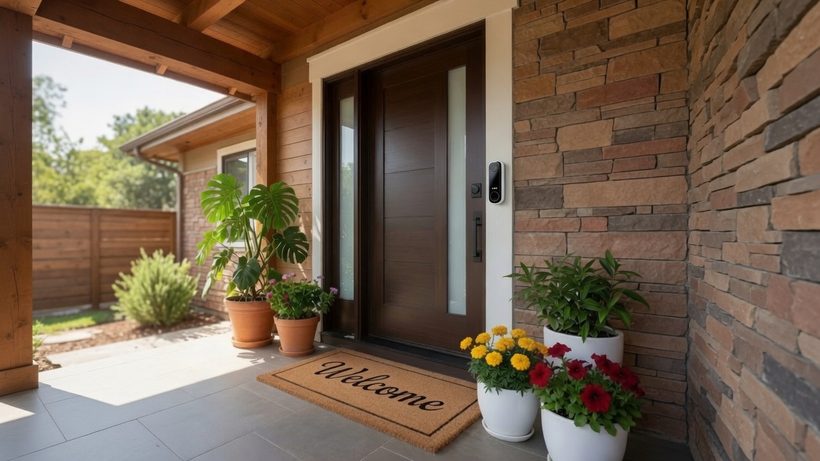

One button outside, one telephone anywhere. She does not have to walk to that door, and she does not have to be at home either. The man on the step is running a test — is anybody in? — and it has just come back yes, without her getting out of a chair or standing behind a door deciding whether to open it.
You have found out what is going on without standing up, without crossing the house, and without being anywhere near the door. For anybody over fifty that is not a convenience. It is the point.
And on the tenth time, you know at second five instead of at the crash. Getting into a house takes a man a minute or two of working at a door or a window, and that minute has just become yours. The call is made while he is still working. The difference between a police car sent two minutes ago and one sent when the glass went is very nearly the whole of it.
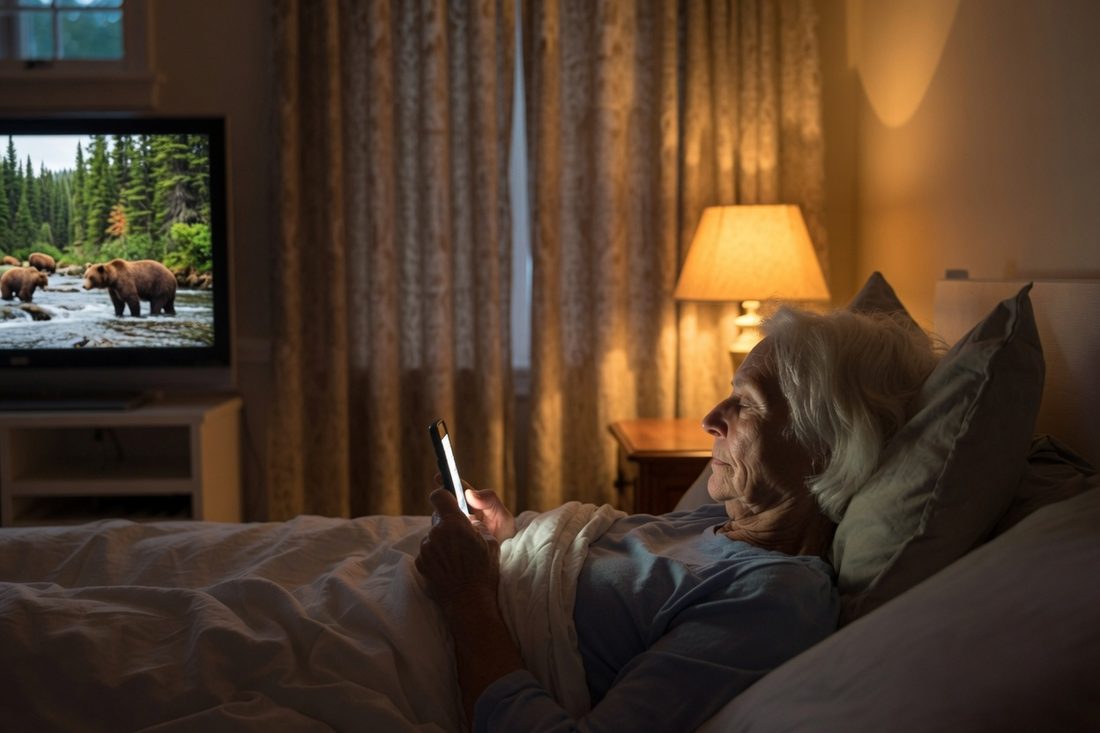
Or you pick the telephone up off the nightstand and look at the whole yard without moving.
You hear something outside. It is late. And the thing you would otherwise do — get up, cross a dark house, and put your face to a window — is the worst option available at any age, and a genuinely poor one past sixty-five. You are on your feet in the dark, half awake, walking to the one spot in the house that somebody outside would be watching. And when you get there you will see almost nothing.
Here is the use nobody puts in the brochure, and it may be the best one on this page.
The noise at two in the morning
Ask this before you buy anything
Not does it need a subscription. Ask: can I record, review, download and get at the footage I care about without paying every month?
This matters more on a fixed income than any specification on the box. Ring and Nest give you no video history at all without a plan — live view works, alerts work, and anything that happens while you are not watching is gone for good. Ring has no local storage option. Nest has none on any camera it makes. Others, Reolink and Wyze among them, record to a card in the camera and keep their detection features switched on for nothing.
Do the sum over the life of the thing, not the month. One published estimate puts a cloud plan at close to nine hundred dollars over five years. That is not a camera decision, it is a standing order — and it is one more bill arriving every month for as long as you own the house.
The types, and what each one really costs
- Doorbell camera — does the job above. If somebody buys one thing, this is the thing.
- Battery — goes anywhere, no wiring, and you are up a ladder every few months forever. On a page that has spent this long trying to keep you off ladders, that is a real cost. Cold shortens the interval.
- Solar — same honest caveat as the floodlights: worst in the short grey days of midwinter, which is when the nights are longest.
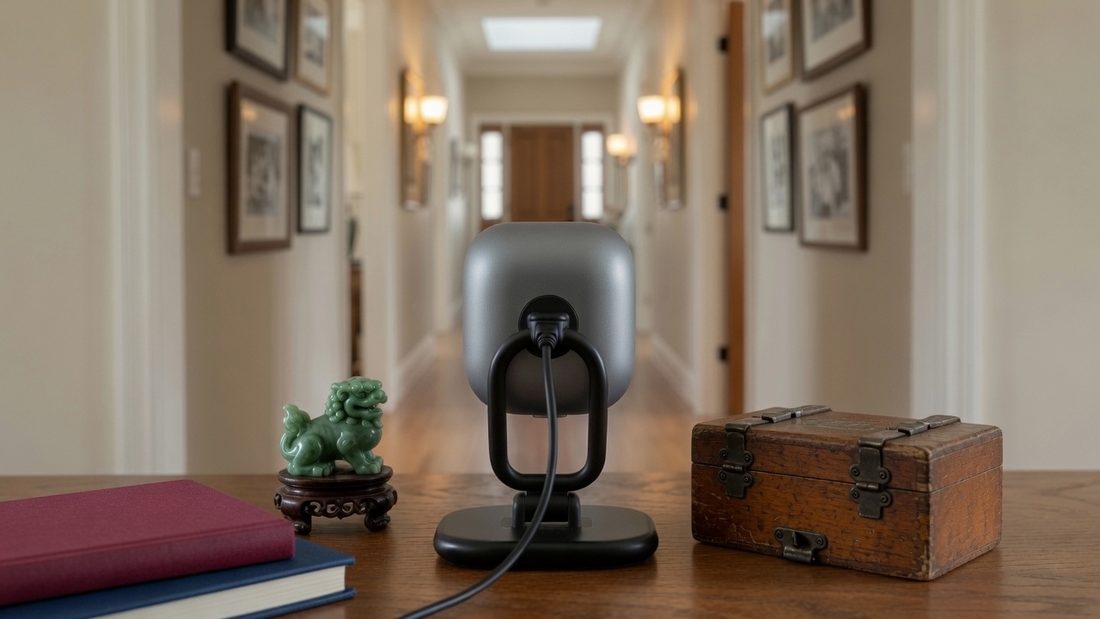
- Wired, or run to a small recorder — records around the clock, no monthly fee, keeps going in an outage. A proper install job, and the one still working in ten years.
- Floodlight camera — two things you already wanted in one fitting. Needs mains at the eave.
- Cellular — for a gate, a barn, a well house with no wifi. Comes with its own data bill.
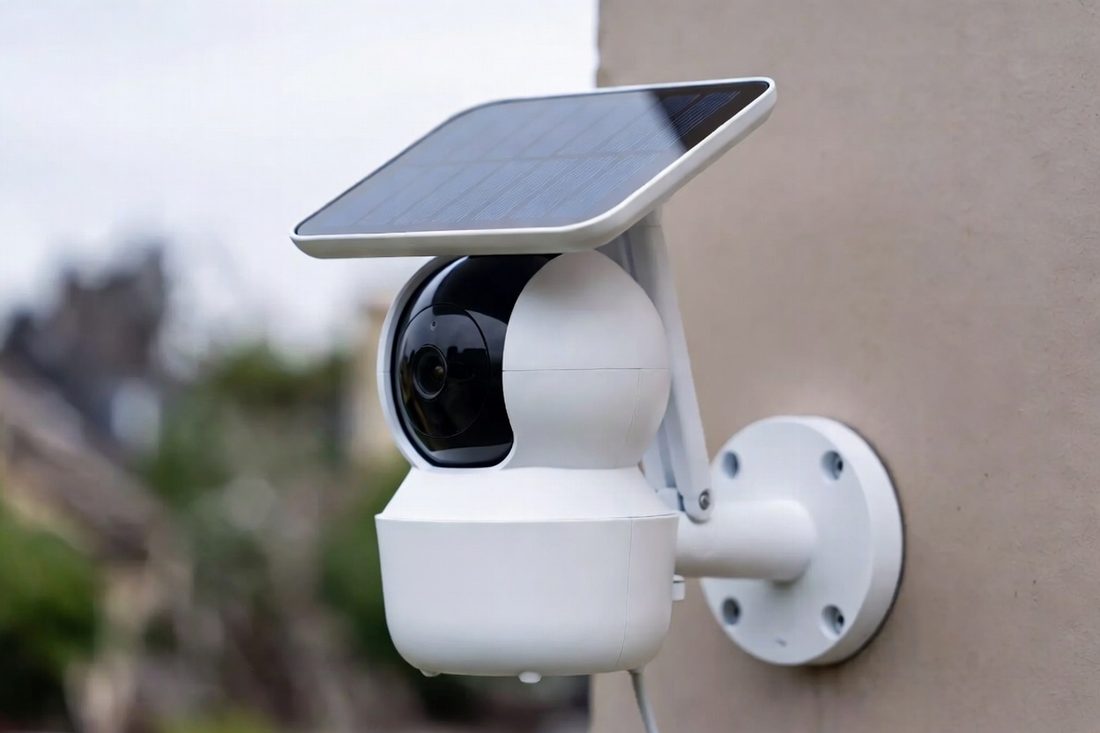
Point it at the approach, not at the door
The commonest mistake is a camera aimed at a doorway from four feet away, which gives you an excellent photograph of the top of somebody's hat. Point it down the drive, along the side gate, across the ground beside the car — the places a person crosses on the way in, where they are still upright and still deciding.
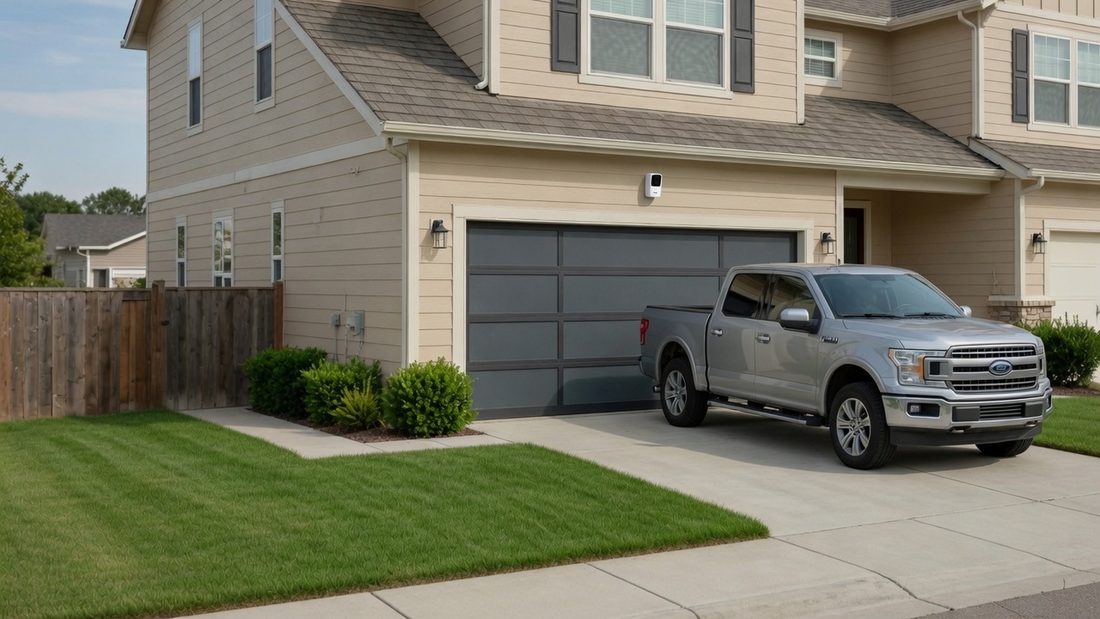
The other one worth having is not outside at all. It is in the garage — because that is the one room on the property where somebody can work unseen, unhurried, and with your own tools in his hands.
Two things that will decide whether you still use it in a year
Set the activity zones on the first day. Every passing car, every cat, forty alerts before lunch — and within a fortnight nobody looks at any of them. A camera you have learned to ignore is an ornament.
And know the law on sound before you switch it on. You need no permit or license to put cameras on your own property in any state, and video of your own porch, drive and perimeter is broadly fine. Audio is where ordinary people break the law without meaning to — wiretapping law is much stricter about sound, and a good many states require consent from everybody recorded.
The safe course, and it costs you nothing: turn the microphone off unless you have checked your own state. Doorbell audio falls under exactly the same rules as any other camera. And never point one at a neighbor's window or into their fenced garden — use the privacy zones the camera already has, and keep it on your own ground.
🐕 The Dog — an Alarm With an Opinion
When the Charlotte researchers asked four hundred and twenty-two convicted burglars what made them look at a house and keep walking, a dog inside came back in the same short list as alarm signs, alarms and outdoor cameras. It belongs on this page for that reason alone.
What the dog is actually doing is making noise, and that is worth more than it sounds. A bark tells you — the same head start the camera buys — tells the neighbors, and tells him he has been noticed, which is the one thing every burglar in that survey was trying to avoid. So size matters far less than voice. A big quiet dog in a back bedroom does nothing. A ten-pound dog that will not shut up does the whole job from behind a closed door.
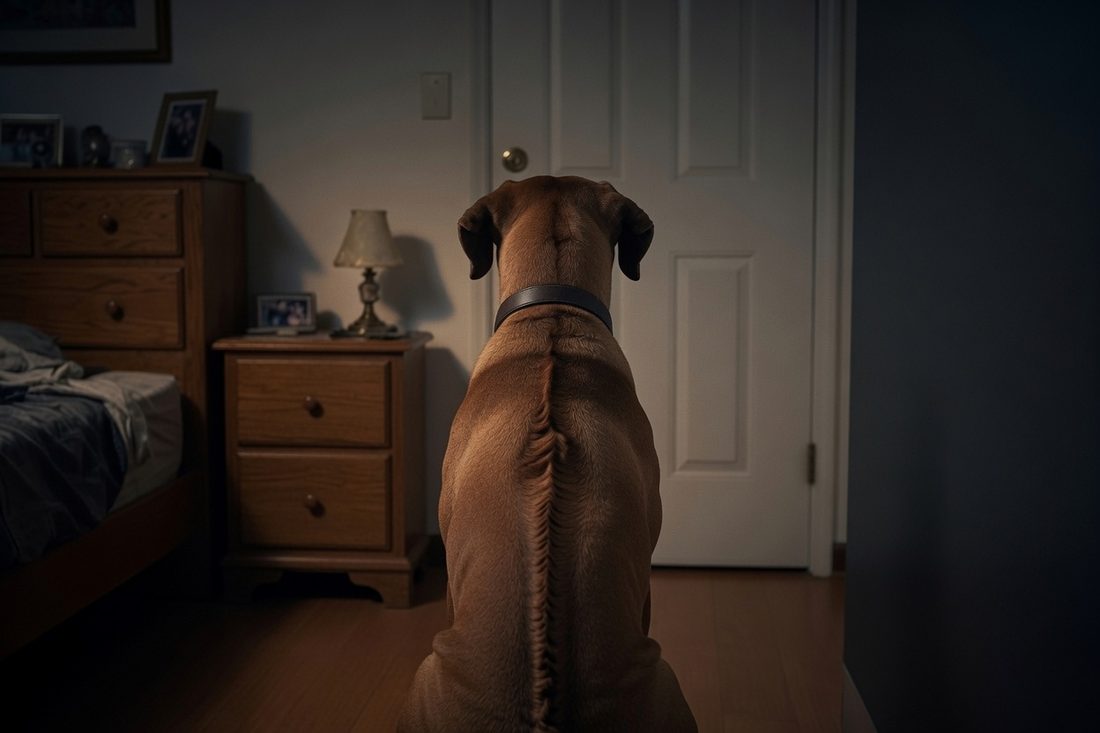
But nobody should get a dog for security, and this page is not going to pretend otherwise. A dog is company — that is the reason, and after fifty it is a better reason than it has ever been. The barking is a bonus you get for free on top. There is a separate matter of falls and pulled leads that gets quoted at older people constantly, and it is almost entirely a question of whether the dog was trained properly and kept trained. That deserves its own page rather than a scare in the middle of this one, and it has one.
👀 Looking Lived In — and What the Street Can See
Most burglars knock first. It is not boldness, it is arithmetic — they want to know whether anybody is home, and the doorbell answers it for free.
Which makes a video doorbell one of the most useful hundred dollars on this page, and not for the recording. It is useful because the house answers. You can be at your daughter's and still say "yes?" through the speaker, and the test he came to run has failed.
Alongside it, the unglamorous things that say somebody lives here and is paying attention: mail and newspapers stopped before any trip or any hospital stay, a lamp and a radio on a timer, and one neighbor who has your key and your telephone number. That neighbor is free and beats everything else on this page.
After dark, a lit room with the curtains open is a display case
This is the one nobody thinks about, and it is worth walking outside tonight to see for yourself. From a dark street, a lit window with the curtains open is a lit stage. Everything in the room can be studied at leisure, from the pavement, by anybody, for as long as they care to stand there — what you own, where you keep it, which door leads where, and whether you are alone in the house.
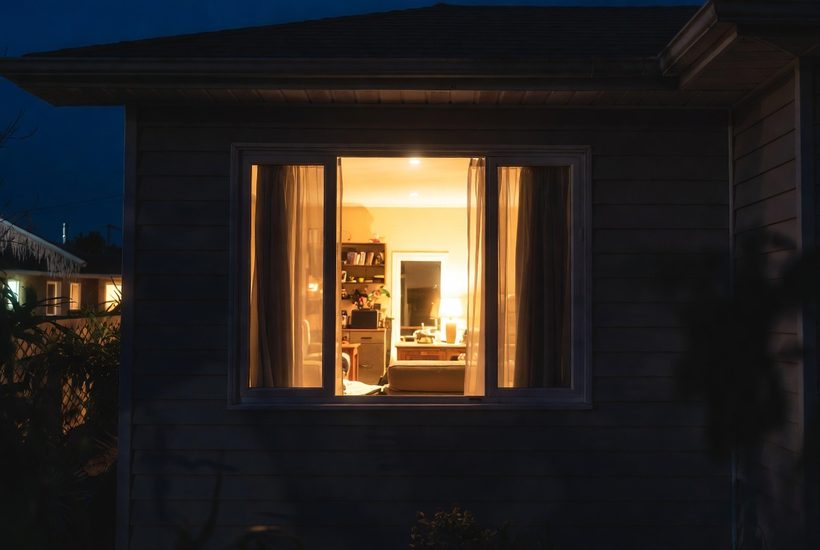
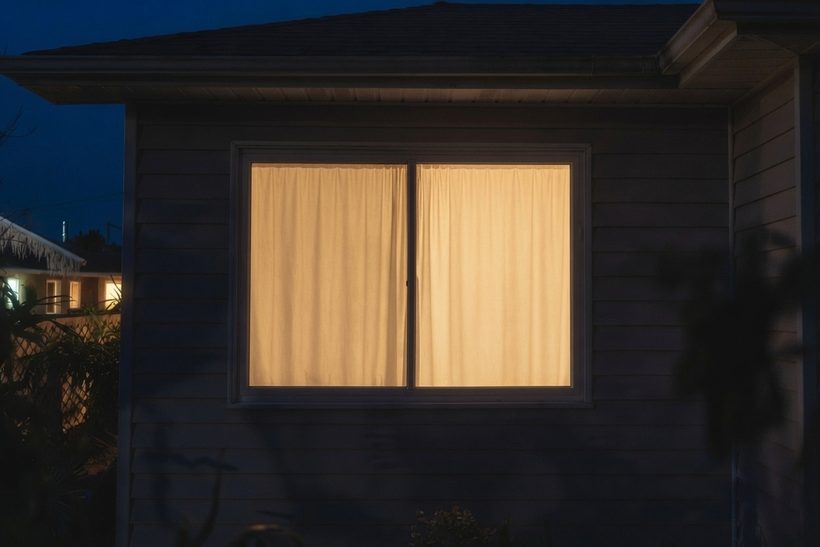
The same window, the same night. Open, it is a lit stage and anybody in the dark can study it for as long as they like — what you own, where it is, which door goes where, and whether there is anyone else in the house. Closed, it says the one thing you want it to say and nothing else.
Closed, that same window says the one thing you actually want it to say: somebody is home.
Which is really an argument about neighbors rather than about hardware, and it is worth reading one that actually happened. The yard two doors down is about the house on a street that nobody was watching, and what the people either side of it noticed too late.
🅿️ The Driveway — the Two Minutes Nobody Writes About
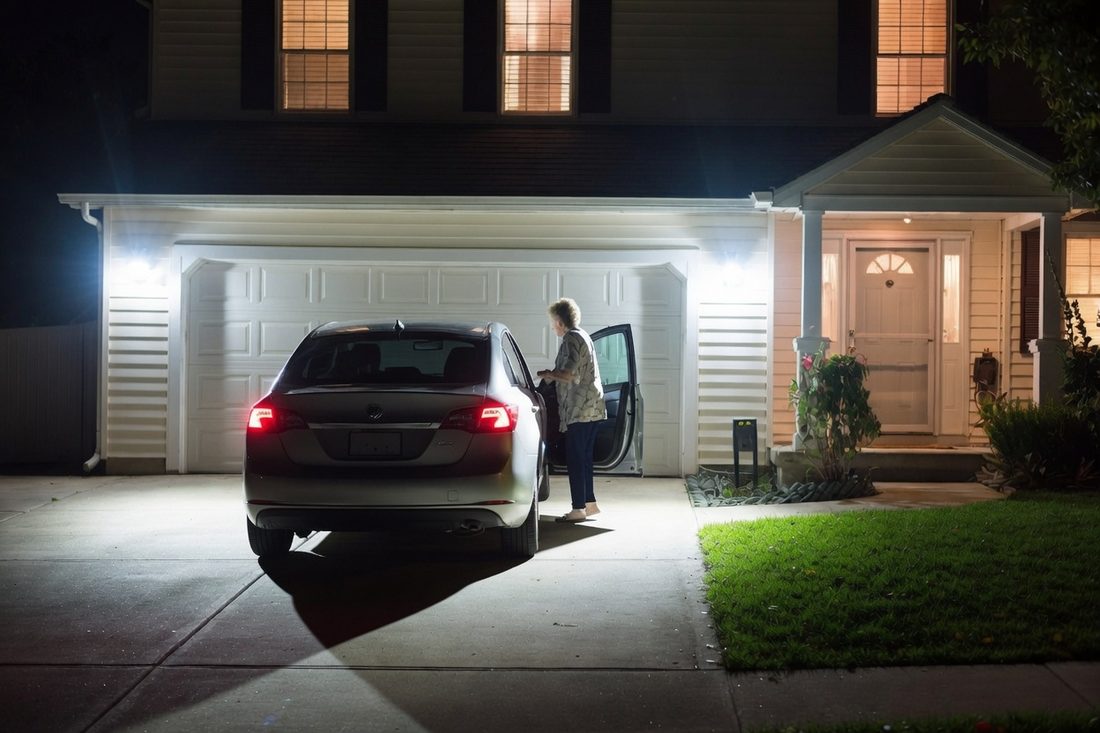
Almost every page like this one is about the house while you are out. Practically none of them cover the part where you are getting out of the car, and that is the part where an older person is most exposed: hands full, attention divided, back to the street, in the dark, at a place and time anybody watching the house could have predicted.
It is also the easiest thing on this page to fix, because none of it costs anything.
- Light the car, not just the door. Most driveway lighting stops where the pavement starts and leaves the vehicle in the dark.
- Back in, or park facing out. Costs nothing, and means leaving is one movement.
- Keys in your hand before you open the door. Not hunted for in a bag under a dome light.
- Do not sit sorting things out with the door open. Get out, close it, and sort the bags at the house.
- If you have a garage: pull in, put the door down, and get out then. In that order, every time.
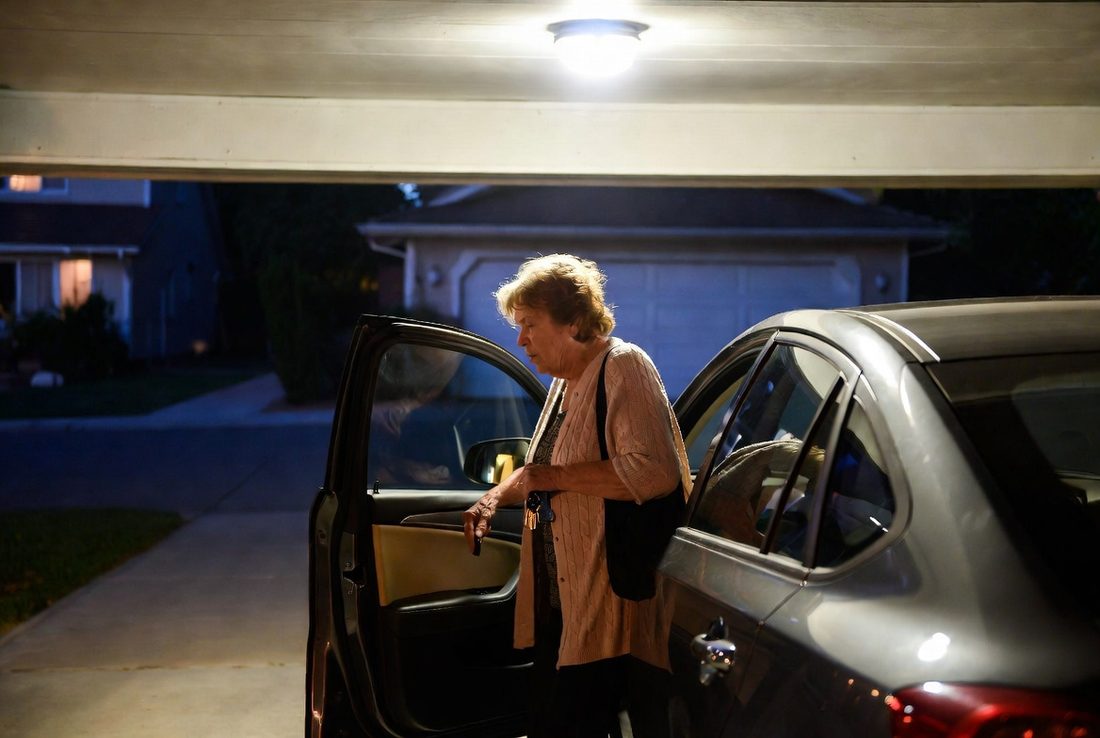
And the one that matters most: if something looks wrong, do not get out of the car. Drive away and telephone from somewhere else. People get out because getting out is what you do when you get home — it is a habit, not a decision. You are not obliged to walk up your own path, and nobody will ever ask you to explain why you did not.
🧰 What to Leave to Somebody Else
Most of this page is a screwdriver and an afternoon. Some of it is not, and there is no credit for doing those yourself.
- Anything on a ladder above single-story height. A floodlight is not worth a fall.
- New wiring for a hardwired fixture, unless you have done that work before.
- Cutting a new deadbolt into a door — the boring has to be square or the lock binds, and a lock that is stiff is a lock that stops being thrown.
- Anything on a door you rent. Ask first, in writing.
One thing worth saying plainly about locks and hands. A deadbolt that is stiff, or a key that needs turning hard, does not get used — it gets left. If your grip has started arguing with you, that is not a reason to skip the lock, it is a reason to choose a lever and a keypad instead of a knob and a key. There is a whole page on this: easy-grip upgrades around the house.
📋 Why This Belongs on the Fifty List
Every one of these jobs is a job for a man or woman of fifty-five. Digging a bed. Driving four inch screws into a stud. Getting up a ladder to a floodlight. Kneeling on a concrete garage floor to fit a deadbolt.
At seventy-five every one of them is a telephone call, a quote, and a stranger's afternoon at whatever the rate is that year.
And notice that not one thing on this page is bought only against the rare bad day. The motion light stops you falling. The gravel drains the bed. The long screws stop the door rattling every time the wind gets up. The thorn hedge is in flower in May and full of birds by August. The neighbor with your key is the person who notices when your car has not moved in two days.
You are not buying insurance against something that probably will not happen. You are buying a handful of things that earn their keep every ordinary week — and that happen to also cover it. More on the telephone and the screen →