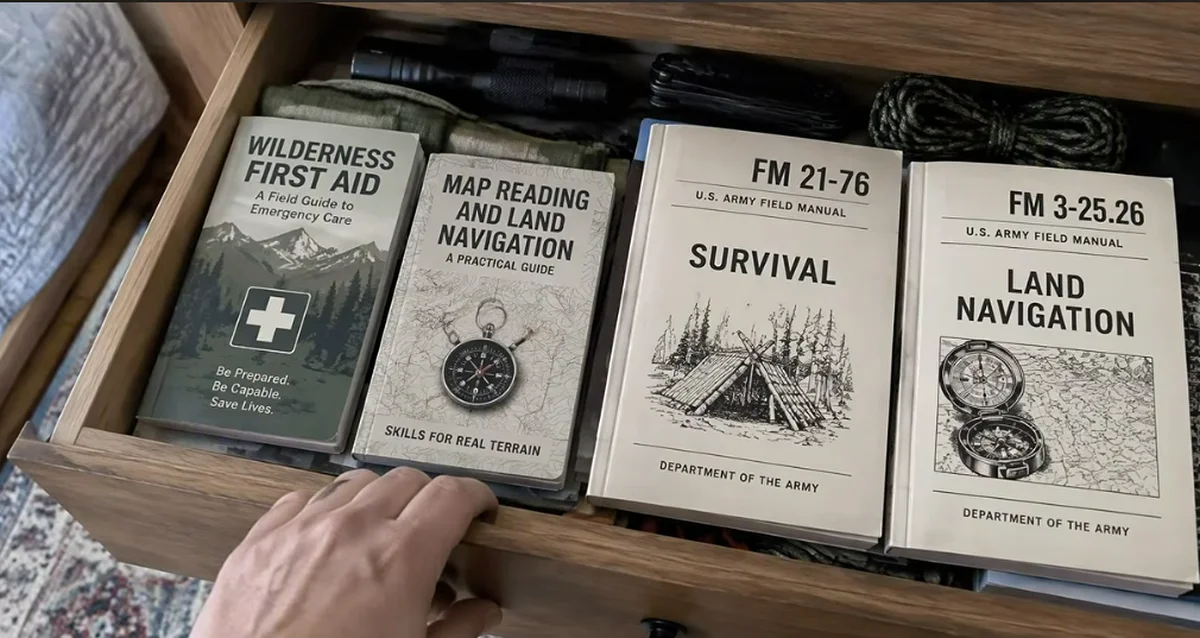
Six Books in a Drawer
Most houses have a drawer like this somewhere. A flashlight that may or may not still work. A coil of cord. A booklet that came free with something, years ago.
This page is about what ought to be lying on top of the flashlight.
Not a library. Six publications. Every one of them free. Every one written by people whose whole job was to get it right. And every one readable by a person with a pair of reading glasses and a quiet afternoon.
There is one catch, and it is the reason this page exists.
Free books get old, and nobody comes to the house to tell you.
The Army replaces its manuals. FEMA writes new guides. The canning people change a recipe when the laboratory finds out the old one was not as safe as everybody thought. The old copy goes right on circulating — on websites, in prepper bundles, in paperbacks with a new cover on them — looking every bit as official as it did on the day it was retired.
So under each book below you will find two things. The edition to keep, and where to get it for nothing.
How to Tell Whether a Manual Is Still Current
Now I am going to be dull for a minute, and I would take it kindly if you let me. There is no way to make this part entertaining, and it is the part that saves you from keeping the wrong book. So here it is, flat.
1. The date. Army publications print it on the cover or the first page. Write it down.
2. The “supersedes” line. Every Army manual says which older manual it replaced. If you find a newer manual that names yours in that line, yours has been retired.
3. The distribution statement. “Approved for public release; distribution is unlimited” means the book was meant for you. Anything else — “distribution authorized to U.S. government agencies and their contractors,” or the letters FOUO, For Official Use Only — means it was not meant for the public, and it is not yours to pass around.
There. That is the whole of it. Now we can go back to talking like people.
That third line matters more than you would think, and the map book is the best example of it.
The Army’s map and compass manual has been rewritten several times. The 2013 edition is marked for government agencies and their contractors only. The 2005 edition, and its 2006 change, are marked For Official Use Only. So the newest edition the Army ever handed to the public is the one dated 20 July 2001.
That sounds like a problem until you think about it for a second.
A map has not changed much since 2001. A compass has not changed at all.
The nineteen-dollar free book
There is a whole trade in selling people books they already own. Search any bookseller for an Army survival or first aid manual and you will find a shelf of paperbacks, fifteen to thirty-five dollars apiece, with the government’s words inside and a new cover outside.
Nothing is wrong with wanting a bound copy. A real book beats a phone in the dark, and some people would rather pay than print two hundred pages at the kitchen table. That is a fair trade.
Just read the cover before you pay. A good many of those paperbacks are the 1992 survival manual the Army retired more than twenty years ago, with “updated” printed somewhere on the front.
The Six
In the order I would hand them to you, starting with the one written for us and ending with the one that can actually make you sick if you keep the old edition.
1 · Start here
FEMA — Disaster Preparedness Guide for Older Adults
Most of what gets written about getting ready is aimed at a young family with a minivan and two good knees. This one was not. FEMA wrote it in 2023 for older adults and the people who look after them.
It works in three steps. Assess your needs. Make a plan. Bring in your people. The pages are worksheets, and you fill them in with a pen.
It is the one to start with, because it is the only book on this list that asks what you, in particular, are going to need.
Keep: the 2023 guide, “Take Control in 1, 2, 3.”
Get it: ready.gov/older-adults
2 · The survival manual
U.S. Army — ATP 3-50.21, Survival (2018)
The survival book in most drawers is FM 21-76, the Army Survival Manual. It is a fine old book. It is also from 1992.
The Army replaced it in 2002 with FM 3-05.70. Later it split that one into three, and ATP 3-50.21 is the survival part. It is dated 2018 and approved for public release.
It was written for a soldier cut off from help, so some of it will never come up in a house in Ohio. Skip what does not fit. The chapters on water, on treating injuries far from a doctor, and on finding your way are the ones worth a pencil mark in the margin.
If you already own the old FM 21-76, there is no need to throw it on the fire. Just know which one the Army stands behind today.
Keep: ATP 3-50.21, 2018. Look for it at the Army Publishing Directorate, armypubs.army.mil.
Get it: a public copy kept by the Federation of American Scientists
3 · First aid
U.S. Army — ATP 4-02.11, Casualty Response, Tactical Combat Casualty Care, and First Aid (2026)
This one is brand new. The Army released it on March 23, 2026, and it replaces TC 4-02.1, the first aid manual it had used since 2016.
So if the Army first aid book on your shelf is dated before this spring, it has been retired. That happened about seven months ago, and I would not expect anybody to have mentioned it to you.
It is written for soldiers, and a good deal of it is about combat. The parts that matter in a kitchen or a driveway are the ones on stopping bleeding, clearing an airway, cold and heat injuries, and bites and stings.
A book teaches you what to do. It cannot teach your hands how. Take a hands-on first aid and CPR class from the Red Cross, your hospital or your fire department. In an emergency, call 911 first.
Keep: ATP 4-02.11, March 2026.
Get it: Army Publishing Directorate download
4 · Maps and the compass
U.S. Army — FM 3-25.26, Map Reading and Land Navigation (2001)
Nobody at seventy is planning a march across a mountain. That is not what this book is for.
It is for the day the phone has no signal and the road you always take is closed. A paper map and a cheap compass will get you around a detour, and this is the book that teaches you to read them.
As explained above, the 2001 edition is the newest one the Army ever released to the public. The cover says “Approved for public release; distribution is unlimited.” That is the one to keep.
Keep: FM 3-25.26, dated 20 July 2001.
Get it: a public copy at the Internet Archive
5 · When the doctor is far away
Hesperian — Where There Is No Doctor, and Where There Is No Dentist
These two were written for village health workers in places where the nearest doctor might be a day’s walk off. They have been translated into a great many languages, and Hesperian, the nonprofit that publishes them, keeps them up to date.
They explain things plainly, with drawings, for people with no medical training. That is exactly who you are at two in the morning during a long outage.
Every chapter is free to download one at a time. The whole book as a single file costs money. Hesperian asks people to link to its download page rather than to the files, because the file names change when the books are updated, so that is what I have done.
These books are written for places with no doctor. In the United States, call 911 or your doctor first. These are for the hours before help arrives, not a reason not to call it.
Keep: the current chapters from Hesperian’s own site. Skip the old scanned copies passed around online.
Get it: Hesperian’s free download page
6 · The one where the edition can hurt you
USDA — Complete Guide to Home Canning (2015 Revision)
Every book above, kept in an old edition, leaves you a little behind. This one can make you sick.
Home canning has been worked out in a laboratory, one jar and one recipe at a time. When the testing changes a recipe, the old recipe does not become “a bit out of date.” It becomes the wrong one.
Use only tested recipes from the 2015 USDA guide or the National Center for Home Food Preservation. Do not can from an old cookbook, a relative’s recipe card or an undated copy of this guide. Improperly canned low-acid food can cause botulism.
The free electronic version comes in eight files: an introduction and Guides 1 through 7. If you would rather have it printed and bound, the National Center names Purdue Extension as the place that sells the printed copy. Buy it there and you know what is inside it.
There is more about the jars, the canners and the cost on our home canning page.
Keep: the 2015 revision.
Get it: National Center for Home Food Preservation
Why Paper, and Why the Drawer
Every one of these is a download, and that is a fine way to get them. It is a poor way to keep them.
A phone holds a thousand books right up until the battery dies. After that it holds none. A file on a dead phone is a book with the cover glued shut.
So print the parts you would want in a hurry. The FEMA worksheets, filled in. The pages on bleeding and on burns. The canning times for the things you actually put up. A three-ring binder holds all of it.
Print it big. A page you can read at a desk in daylight is a different page by flashlight with your hands shaking. Most printers will scale a page up, and paper is cheap.
Put the binder in the drawer, and put a spare pair of reading glasses in with it. The best book in the house is no use to a man who has to go looking for his glasses first.
A binder in a drawer has never once needed a charger.
Then Build the Kit That Goes With the Books
The books tell you what to do. The go-bag checklist tells you what to have in your hands while you are doing it, sized to your own household and your own medicines.
🎒 Build My Go-Bag List → Make a Medical Information CardFrequently Asked Questions
Are Army field manuals free to download?
Many are. Look for the distribution statement on the cover. “Approved for public release; distribution is unlimited” means the manual was released to the public. Manuals marked for government agencies and contractors only, or For Official Use Only, were not.
Is FM 21-76, the Army Survival Manual, still current?
No. The 1992 FM 21-76 was replaced in 2002 by FM 3-05.70. The Army’s current survival publication is ATP 3-50.21, dated 2018 and approved for public release.
What is the current Army first aid manual?
ATP 4-02.11, Casualty Response, Tactical Combat Casualty Care, and First Aid. It was released on March 23, 2026, and replaces TC 4-02.1. It is not a substitute for a hands-on first aid and CPR class.
Which Army map reading manual can the public download?
FM 3-25.26, Map Reading and Land Navigation, dated 20 July 2001. Its cover says it is approved for public release. The later 2005 edition is marked For Official Use Only, and the 2013 TC 3-25.26 is limited to government agencies and their contractors.
Which canning book should I use?
The USDA Complete Guide to Home Canning, 2015 revision, free from the National Center for Home Food Preservation. Use only tested recipes from it or from the National Center, never an old cookbook or an undated copy.
Is there a preparedness guide written for older adults?
Yes. FEMA’s Disaster Preparedness Guide for Older Adults, from 2023, walks through three steps: assess your needs, make a plan, and bring in your support network. It is free at ready.gov/older-adults.
📚 Sources
- • Ready.gov (FEMA) — Older Adults and the Disaster Preparedness Guide for Older Adults
- • FEMA — FEMA Introduces Disaster Preparedness Guide for Older Adults (September 20, 2023)
- • Department of the Army — ATP 3-50.21, Survival (2018)
- • Department of the Army — FM 3-05.70, Survival (2002), supersedes FM 21-76
- • U.S. Army — MEDCoE publishes ATP 4-02.11 (April 1, 2026)
- • Department of the Army — FM 3-25.26, Map Reading and Land Navigation (20 July 2001)
- • Federation of American Scientists — on the restricted 2005 edition of FM 3-25.26
- • Hesperian Health Guides — free downloads
- • National Center for Home Food Preservation — About the USDA Guide to Home Canning, 2015 revision
Page last reviewed: October 2026 | Author: Franklyn Galusha