🥬 An Essay — Nothing to Buy on This Page
The Garden Never Asked Me
When It Was Convenient
A spring house never preserved one single thing. What it bought me was the afternoon.
🥬 An Essay — Nothing to Buy on This Page
A spring house never preserved one single thing. What it bought me was the afternoon.
There is a notion abroad that a man who grows his own food has arranged matters so that he eats when he pleases. I have grown my own food, and I can tell you it is very nearly the opposite of that.
A bean does not care what else you had planned for Tuesday. It comes ready when it comes ready, and the row comes ready all together, and if you leave it out there to wait on your convenience it goes over and you have lost the whole of it. There is no arguing this with a vine. You cannot reason with it and you cannot put it off. The only vote you get is whether you go out and pick.
So we picked.
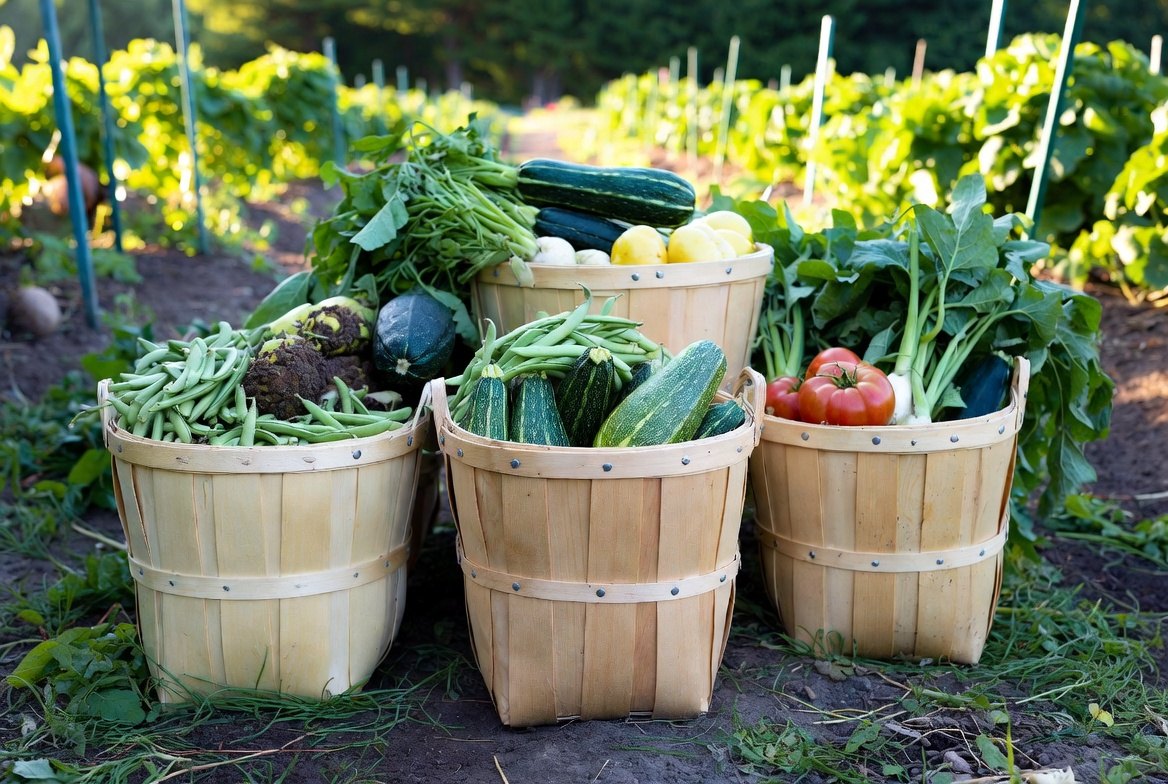
Not a basket. Bushels.
And that is where the trouble actually starts, because a bushel of vegetables standing in the shade is not a solved problem. It is a new one, and it began the moment the thing came off the plant.
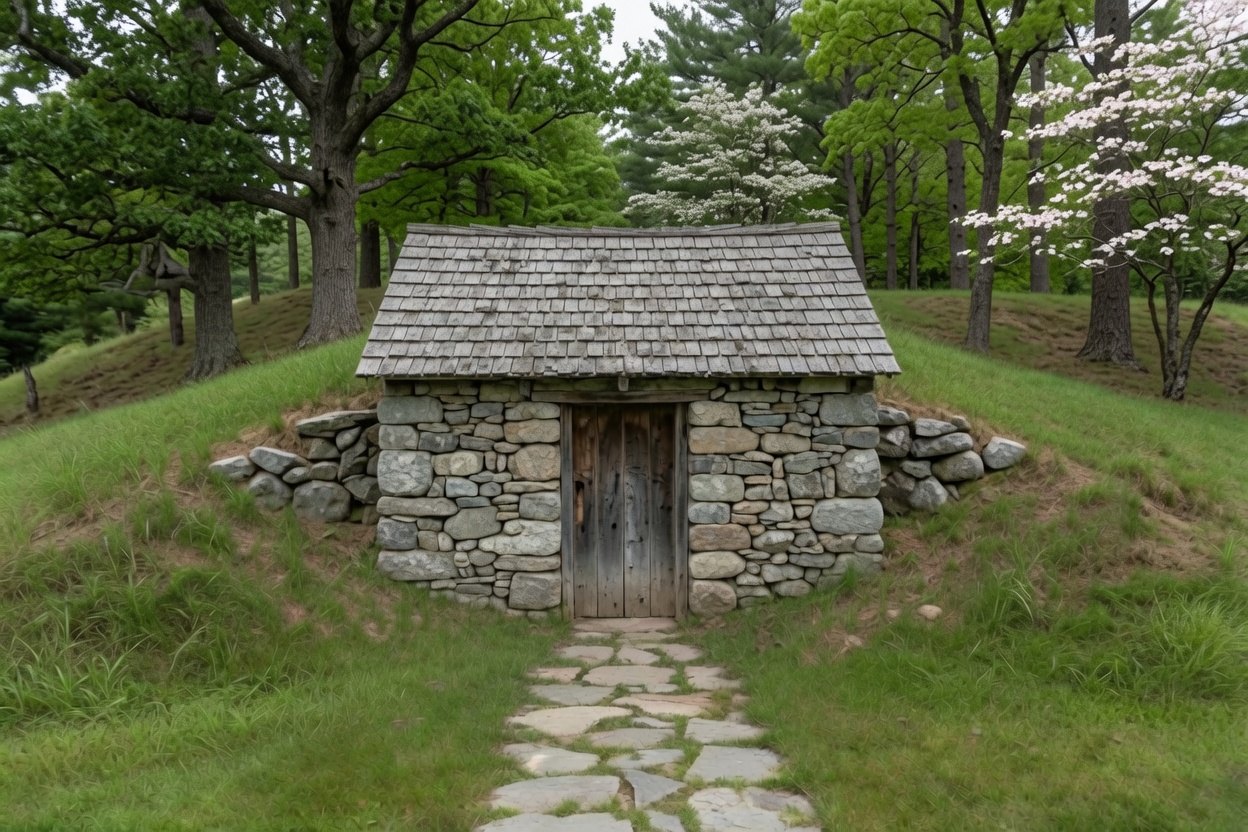
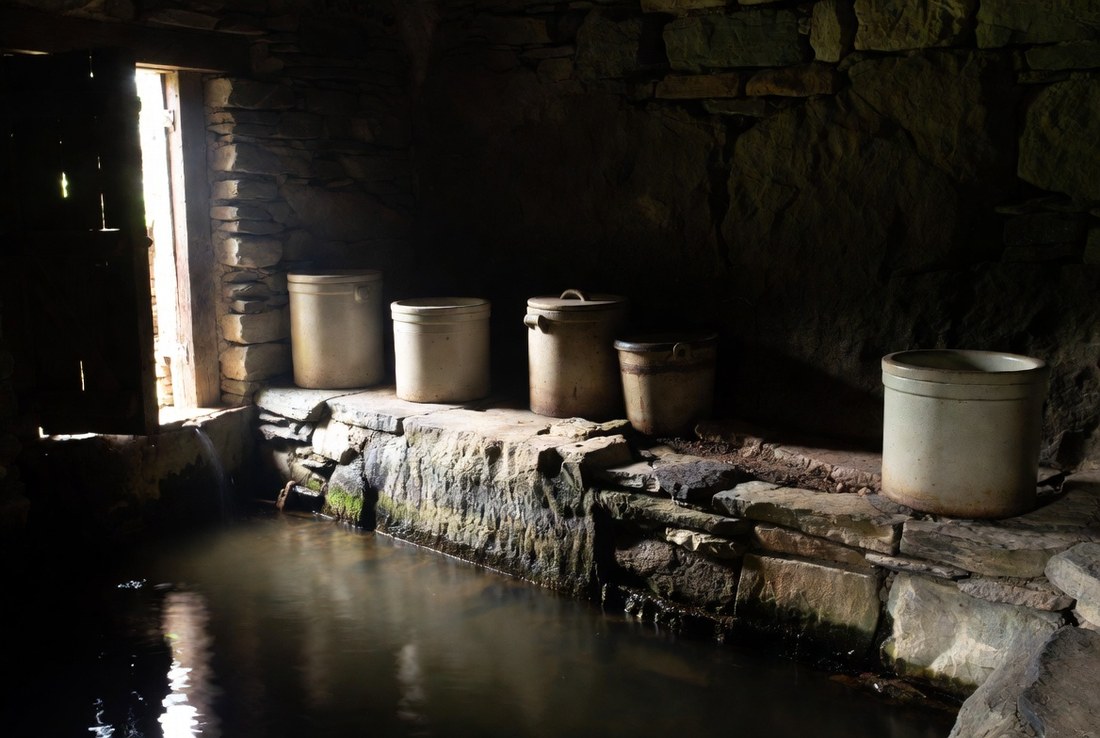
About the photographs on this page. Both images are illustrations — made pictures of the general kind of thing, not photographs of the building described here, which was gone long before anybody thought to take one. The essay describes only what I actually remember of it.
Here is a thing I did not know for a long while, and it explains everything that happened next.
A picked vegetable is alive, and it is still working. It goes right on breathing and burning through its own sugar the same as it did on the vine — only now the plant is not there to carry the heat away, so the heat stays in the basket and works on it. The growers have a name for this. They call it field heat.
The warmer a thing is, the faster it works. Every hour you leave it warm is an hour you do not get back.
Berries are the worst of them. Berries hardly wait at all.
So I would come in off the rows with more than any family could put up in a day, and I had two facts working against me at the same time. The harvest would not wait. And the canning could not go any faster.
What stood between those two facts was a spring house.
In the summer that building was a godsend.
The water came out of the ground cool, and it came out cool in August exactly as it came out cool in February. That is the whole trick of a spring, and it is not a trick at all. It is only the earth keeping its temper while the weather loses its own. Around fifty degrees, near enough, the year through.
Not cold. Cool.
I want to be plain about that, because a spring house is not an icebox and it is not a refrigerator and it will not do the work of either one. The refrigerator in your kitchen runs down in the thirties. A spring runs around fifty. That is not close, and anybody who tells you the old ways were every bit as good has never put a thermometer into both of them.
But fifty is a great deal cooler than ninety, and it turns out that is enough to matter.
There were two springs on that place. One of them fed the spring house. The other ran down to the chicken coop, the pigpen and the barnyard, so the animals had their water without anybody carrying it out to them.
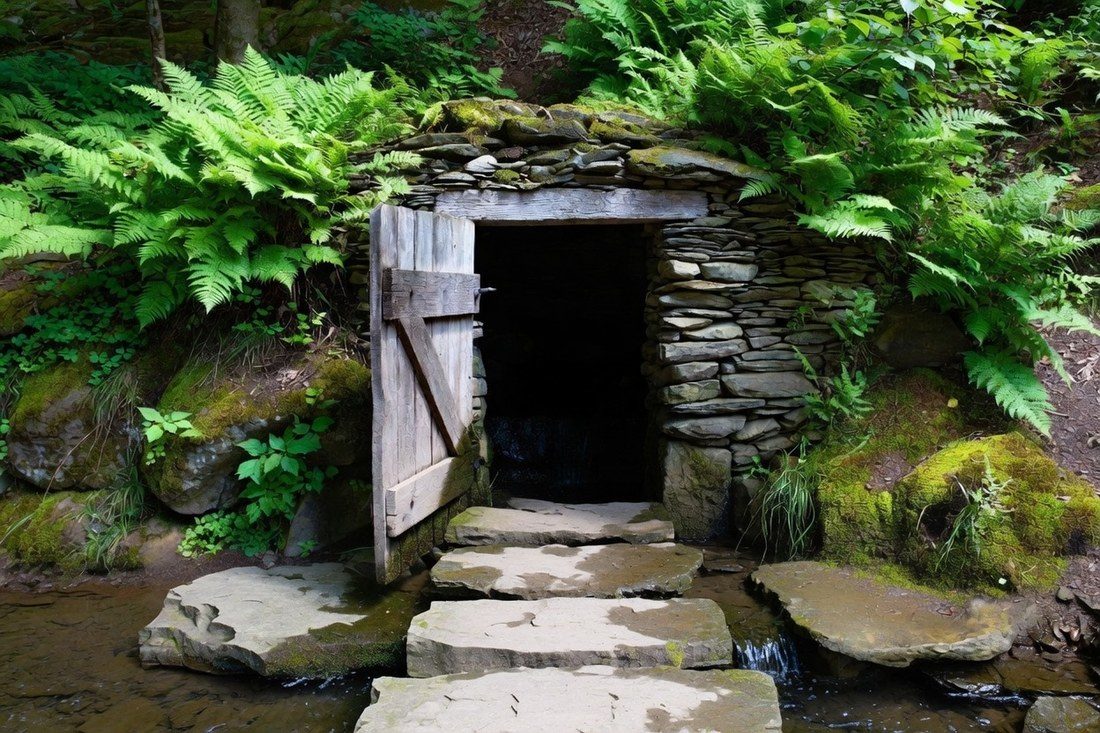
The spring house itself was stone. Stacked stone, with something worked in between the courses that I could not have named for you then and cannot name now.
The door end was timber, and heavy timber at that — two big uprights with one laid across the top, and the door hung in between them.
Inside, channels were cut so the water ran on through instead of standing.
And down in the floor there was a sump — a hole, stone-lined, big enough to take a couple of milk cans standing up with room around them.
The spring did not run into that hole from somewhere else. The spring came up out of the ground inside it. Right there in the floor of the building, bubbling up from underneath.
Which means the building was never a shed that somebody piped water into. It was a roof put over a spring where the spring already was.
That hole is the part worth stopping on, because that is where the work actually got done.
You did not set a crock on a shelf and hope for the best. You set it down in the water.
A ten-gallon milk can stands a little under two foot and runs about thirteen inches across, so two of them went down in there side by side with room left over, and the water came up around them.
For anything shorter than that there was a stack of bricks along one side. You built a little platform up under the container until it sat at the right height — water up the sides of it, and not a drop over the top.
That is the whole of the invention, and I have never once seen it written down anywhere. One hole. One water level, fixed by the spring and not adjustable by anybody. And every size of container on the place accommodated by adding brick or taking brick away.
It matters more than it sounds like it does. Cold air will cool a crock eventually, and it quits the moment somebody opens the door. Water does not quit and does not care, and it pulls the heat out of a can many times faster besides.
The people who cool produce for a living still do it that way where they can. They call it hydro-cooling now, and nothing moves heat out of a load faster. The one thing you keep out of the water is soft fruit, because a wet berry molds — berries want cold air moving over them and nothing touching them at all.
Open that door and the first thing you notice is that somebody has been at the floor with a chisel.
It is fieldstone, laid flat, and cut down into it is a channel about a foot wide that has no intention of going anywhere in a straight line. It leaves the sump, crosses the room, turns back on itself, crosses again, and carries on doing that until it has been over that floor five times.
Between the runs, strips of the original stone are left standing. Those strips are the point of the whole arrangement, and they are a little over a foot across.
A bushel basket sits on one of them square, with nothing hanging over the edge into the water.
That is not luck and it is not a rough guess. Some man laid that floor out around the size of the thing he already knew he was going to set down on it.
Now follow the water, because the order it goes in is the entire trick.
It comes up out of the ground in the sump at the back, and that is the coldest it is ever going to be, on account of it not having touched anything yet. It rises underneath the milk cans and up around their sides. Milk is the hardest thing in that building to cool, and it is sitting in the coldest water in the county.
Then, a little warmer for the trouble, the water sets off across the floor. Every basket on every platform is sitting on stone with cold water running along both faces of it, and quietly giving its heat down into that stone.
By the time it reaches the door end it has done its work, and it shows.
We never measured any of that. We did not have to. The stone either side of the door was the warm end of the building, and we knew it well enough that we did not set much of anything down there. Everything went on the platforms.
Then the water went out under a rock in the wall and that was the last of it indoors. Outside there was a little pond with a gravel bottom, and from there it ran off to a stream.
Which is the part I would ask you to picture, if you picture any of it. Standing in that yard, there was nothing to see. A stone shed with a plank door, and some wet gravel. No pipe, no tank, no motor, nothing to plug in and nothing to break. The whole works were under the roof and under the floor, and they had been running before anybody now living got there.
There is one more thing cut into that sump, and I want to tell it against myself.
Along the right-hand side of the hole there is a little ledge. Not wide. Just about wide enough to set a foot on.
Now, a ten-gallon can with milk in it is not a thing a man hands down into a pit while standing flat on the floor and bending at the middle. It is heavy, it is awkward, the outside of it is wet, and if you lose your grip you have lost the milk and likely the can with it.
Put one foot down on that ledge, though, and the whole business changes. You are braced. You are lower. Your back is out of it entirely, and the can goes down under control.
I used that ledge for a year before it once occurred to me to wonder why the wall was set back there.
I have to laugh at myself over that one. Some man cut that step out with a chisel for exactly the reason I eventually worked out for myself, and I stood on it every summer of that garden without ever once giving him the credit for it.
That is the thing about a building that was got right. It does not explain itself to you. It just quietly does the job, and waits to see how long you take.
Here is the part worth knowing, because it turns a feeling into a number.
Every ten degrees you drop the temperature, that breathing I mentioned slows to about half. Ten degrees, half. Another ten, half again.
A bushel comes in off the rows on an August afternoon warm — eighty-five, ninety, whatever the day happened to be. Carry it into a spring house at fifty and you have dropped it thirty-five degrees. Halved, and halved, and halved again, and then some.
Call it ten times slower.
Ten times slower is two days.
That is all the spring house ever gave me. Two days on the berries, and something like it on everything else. And two days was the whole difference between a harvest put up and a harvest thrown to the hogs.
Now read back over what I have told you and notice the thing that is missing from all of it.
It was not preserving one single item.
Nothing in a spring house ever got better. Nothing in one ever got fixed. Whatever went through that door was on its way down before it went in and was still on its way down when it came out — it had only stopped running and started walking. The building did not save a bean in its life.
The jars saved the beans.
What the spring house bought me was the afternoon. It bought me the hours between a harvest that would not wait and a kettle that could not hurry. It let the vine keep its schedule and let me keep mine, and it stood in the gap between the two of them and held the clock still for two days while I got the lids on.
That is not preservation. That is time.
Because once you have seen that shape you find it everywhere.
Your freezer is not saving your food. It is holding it still until you get around to it. A generator is not powering your house — it is buying you the days until the crew reaches your road. A full pantry is not feeding you; it is feeding you later, which is a different thing and a better one.
Not one of those buys you a solution. Every one of them buys you time to go and do the solving yourself.
Which is a comfortable enough arrangement, right until the morning the time runs out and something asks what you did with it.
We filled the jars. Every summer we filled the jars, and come January there they were on the shelf, in a row, with the summer still in them.
I loved that jam. I still do.
If you want the practical version of any of this, it is on the canning and preserving page and in the vegetable garden guide. This page is just where it came from.
Where the numbers come from. The respiration rule — that a ten-degree drop in temperature roughly halves the rate — is standard postharvest guidance from UMass Amherst Extension, which also places berries in the most perishable tier. “Field heat” and the case for cooling produce quickly after harvest are set out by Utah State University Extension. Spring water sits near fifty degrees the year round because the flow is constant and deep and the surrounding earth holds its temperature. Modern refrigerators are run in the thirties because spoilage organizms get going around forty.
What This One Buys You
Cold has never saved anything. It only lends you the time to save it yourself.
The freezer, the full pantry, the generator and the spring house are all the same machine — they hold the clock still while you go and do the work that actually keeps. Which is worth knowing before the morning somebody asks what you did with the time.