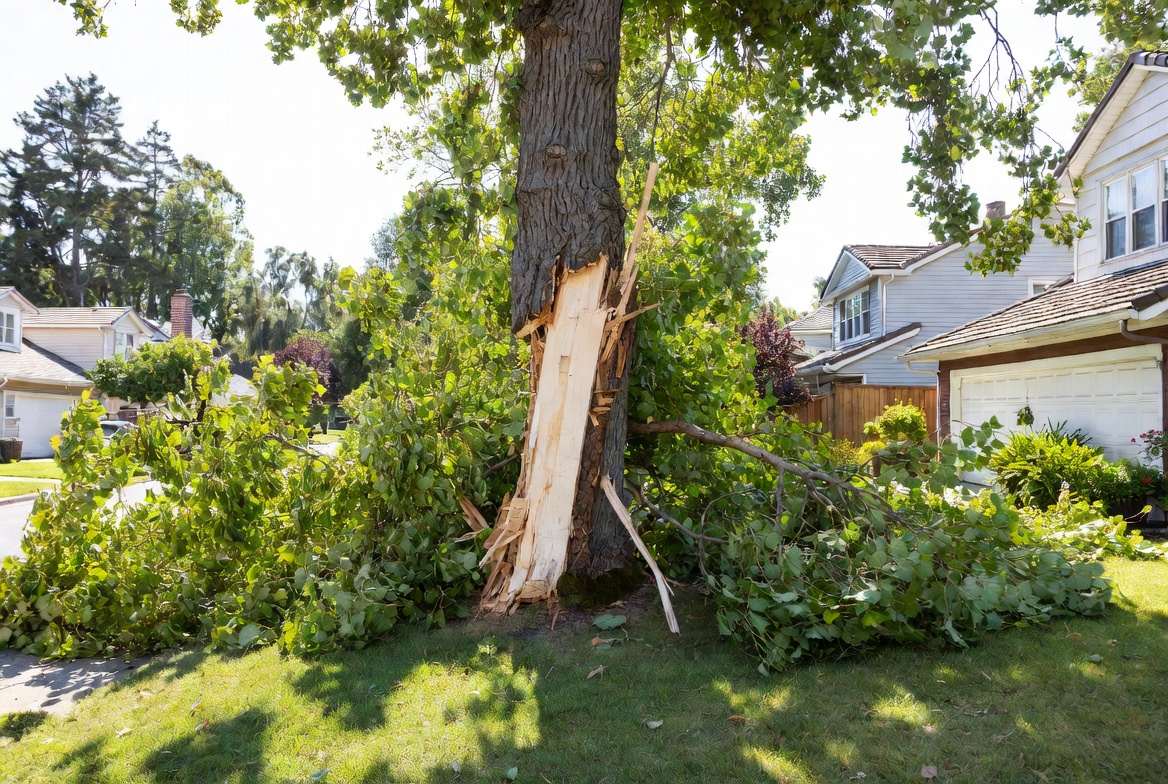
There is nothing to buy on this page. No affiliate links, no products, no recommendations you have to take on faith. This is a regional briefing, and every figure in it is attributed. The photographs are illustrations rather than pictures of the events described — they show what the account describes, and the sourced figures are the record. Where it points you somewhere else on this site, that is because the question it raises is answered properly over there.
☕ Just Another Monday
Start earlier than that. Six in the morning, before any of it.
Pick a street. Any ordinary street in that part of the country — modest houses, kept up, nothing about them worth photographing. What you notice is the trees. Maples and oaks and hackberries that somebody’s grandfather put in, grown up over sixty or seventy years until the branches reach out from both sides of the road and meet in the middle, so the whole street runs under a green roof. It is the coolest place in the neighborhood in August. It is half the reason people paid what they paid for those houses.
A sprinkler is going somewhere. A man comes down his driveway in his slippers for the newspaper, coffee in his other hand, and he does not look up. Why would he? That canopy has been over his head for thirty years. It shaded his children. Nothing about it has ever once asked him to think twice.
Hold that picture. The street, the trees, the coffee.
It formed over South Dakota not long after sunrise, and it turned east.
For most of that morning it was somebody else’s weather. Iowa went to work.
In downtown Cedar Rapids there is a newsroom with a picture window two stories high, looking out over the city. By early afternoon the people in that room had seen enough to want to be away from the glass, and most of them moved into the hallway. Their editor watched anyway. Through that window he saw the streetlights spinning, roofs peeling off buildings, street signs forty feet up in the air. He had covered tornadoes before. He said afterwards that the derecho was different.
Across town a police dashcam ran from 12:41 to 12:45. Four minutes. In that time the officer stopped to pull a woman out of her car, because a tree had come down on top of it.
The storm ran 770 miles in fourteen hours, South Dakota to Ohio. The gusts in Cedar Rapids were put at 140 miles an hour — Category 4 hurricane wind, in the middle of the continent, on a Monday. It did not politely break a few branches. It pulled grown trees out of the ground by the roots and snapped others clean off, in ordinary front yards, on streets that look exactly like yours.
A city of 133,000 went dark.
Some of it was still dark a week later.
And not one of them had a list ready. Not because they were careless people. Because until that Monday, nobody had ever given them a reason to make one.
A hurricane at least has manners. It gets a name, it sits on every television in the state for three days while the cone narrows, and it gives you time to buy fuel and fill the tub and get the prescription refilled. This one gave people the length of a coffee break.
Everything that ever warned me about anything gave me a season. The garden tells you. The woodpile tells you, every time you walk past it and see how far down it has gone. The animals tell you before the calendar does. A derecho tells you nothing at all — so every plan that starts with “when we hear it is coming, we will go and get…” is a plan this region will not honor. There is no going and getting. The store is shut, the road is blocked, and the pumps have no power to run.
So that is the monster. Now here is the part nobody tells you: it did not do this alone.
It had a partner in the business, and the partner was already standing in your yard before the wind ever showed up. You have known it your whole life. You have complained about it every autumn without once thinking of it as dangerous.
Go to your front window this coming October and look out at the lawn. Look at the leaves. That deep heavy blanket of them piling up on the grass, drifting along the sidewalk, packing into the gutter at the curb — the pile you will be raking on a Saturday with your back telling you about it, the one that fills more bags than you thought you owned.
Do you see where this is going?
🌳 Go Stand in the Middle of Your Street
That pile of leaves is the evidence. Now go outside and look up.
Not figuratively — actually walk out to the middle of your street, next time you take the bin out, and look at what is over your head.
Those big beautiful trees — the ones that made you want the house in the first place, the ones that arch over the road from both sides until the whole street is a green tunnel in July — nearly every one of them has branches somewhere over a wire. Yours. Your neighbor’s. The one belonging to the fellow at the end who has never spoken to anybody.
All those leaves came off all of that. One autumn’s worth of raking is the receipt for how much timber is hanging over the wire that feeds your house — and that thing has not stopped growing since before you moved in.
Now put ice on it. Freezing rain does not blow anything over — it coats every twig and every branch until the tree is carrying a weight nothing about it was built to carry, and then a limb the size of a fence post comes down through the wires and takes the power and the internet with it. Not just yours. The four houses either side of you, because that line runs the length of the street.
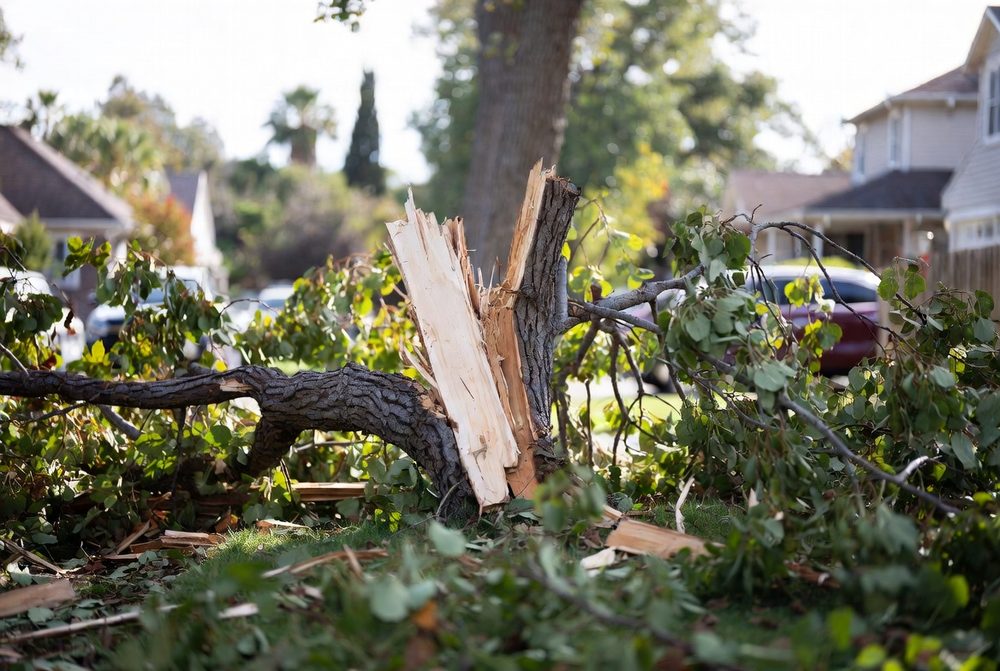
Or put an August wind on it. Those same branches snap like twigs — and if you have heard it happen you know it sounds like a rifle going off — and then the wind picks them up and throws them into a line a hundred feet away.
That is one house on one street. Here is the part that actually matters.
The same thing just happened at the same minute to every street in town. Not to you especially — to everybody. Cedar Rapids is estimated to have lost at least half of its tree canopy in a single morning. Half. Every one of those trees came down somewhere, and a great many of them came down across a wire.
That is why it takes a week.
It is not one big broken thing sitting somewhere waiting for a crew. It is thousands of small broken things, and each one wants a truck, a crew, a chainsaw and an hour of daylight — and there are only so many trucks in the state. A utility can put the big feeders back in a day and still leave your street dark for six more, because by then your street is its own separate job. So is the next one. So are ten thousand others.
So when the bulletin says street by street, house by house, that is not a turn of phrase. That is the literal work, and it is why the last few thousand households always wait so much longer than the first half of a city.
One more thing while you are standing out there, because people plan for the lights and forget this one. The wire the branch lands on is usually carrying your internet and your telephone as well. A generator will light your house and run your refrigerator, and it will not put you back in touch with anybody. That is a separate problem needing a separate answer, and it is worth reading about satellite internet before you need it rather than during.
📅 What a Week Without Power Actually Looked Like
The damage total is the number the newspapers printed, and it is the least useful number there is. Eleven billion dollars tells a man nothing he can use.
The figure that tells him something is the restoration count, published every day by the utilities while it was going on. It shows the shape a real recovery has, which is not the shape anybody imagines beforehand. Here it is the way a household would have met it — one morning at a time.
Day one is almost sociable. Everybody is out in the street looking at the same tree. Everybody has a version of where they were standing when it hit. Somebody’s cooler still has ice in it and there is a kind of holiday feeling that nobody admits to afterwards.
Day two the food goes. You knew it would and it stings anyway, standing over a bin with a freezer’s worth of meat in your hands, doing sums about what it cost.
By day four you have stopped listening for the truck. That is the morning more than 200,000 electric customers in Iowa were still without power. The novelty is gone and the arithmetic has started — how much fuel is left, how many batteries, how long a phone lasts when there is no tower for it to talk to.
Day five: 135,169 customers across Alliant Energy, MidAmerican Energy and the rural electric cooperatives. Day six: 93,004. Those are not estimates, they are counts, and the gap between them is one day of every crew the state could lay hands on.
Day eight, more than 30,000 households were still dark in Cedar Rapids alone. Eight days is not an inconvenience. Eight days is a way of living that nobody in that city chose. Alliant did not report power available to every Iowa customer until 28 August — eighteen days after an ordinary Monday lunchtime.
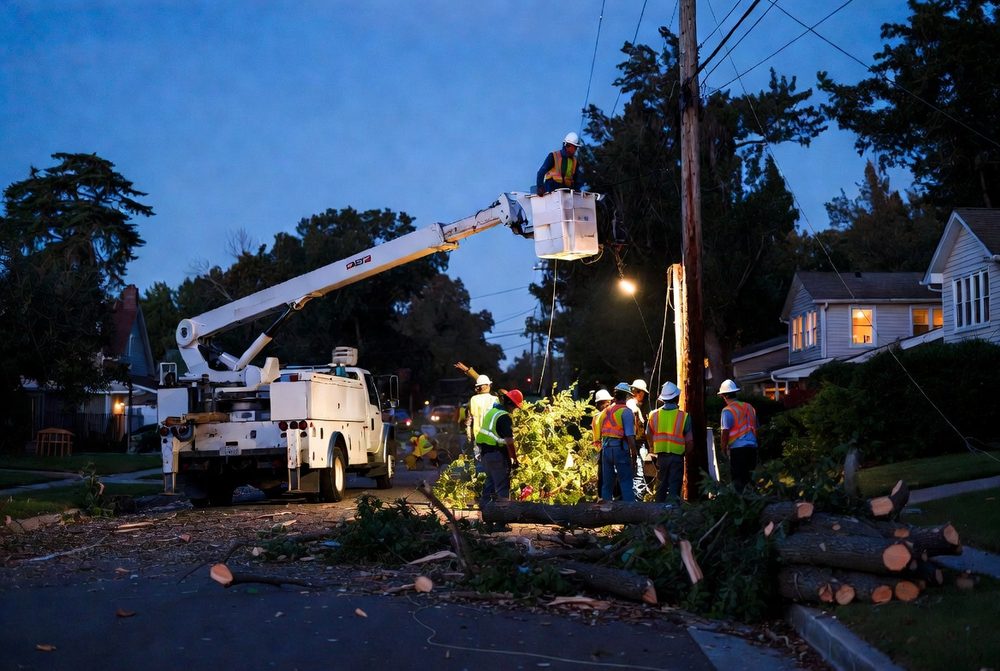
The city's own account of it is blunter than any of those numbers: the entire community was without power for a week or more, every traffic signal in the city was damaged to some degree, and damage to towers and above-ground cable took communications down along with the lights.
The honest planning figure for this region is a week, not three days. The seventy-two hours in most preparedness advice describes an inconvenience. It does not describe what happened in Linn County, and it does not describe what happens in an ice storm either. If your plan runs out on the fourth morning, it is not a plan for a Midwestern outage.
🪓 Eight Cords of Wood
I was not in Cedar Rapids when this happened, and I want that said plainly, because this site does not borrow other people’s disasters and wear them like a coat. Every figure further down this page came from a utility bulletin or a city record.
But Iowa is not a stranger to me. I had family in Indianola — Warren County, twenty-odd miles south of Des Moines — for better than fifteen years. The National Weather Service has the storm crossing central Iowa along the Highway 30 and Interstate 80 corridor, through the Des Moines metro and on through Ames, Newton and Marshalltown, where the highest official gust in the state was clocked at 99 mph.
That line ran north of my family’s town, and then kept going east until it did its worst to Cedar Rapids. So when I read that a city lost power for a week, I am not picturing a county on a map. I am picturing the kind of town it happened to, and the kind of people who live in one.
What I do have is the other end of the same problem. For a stretch of years I kept a stone farmhouse and seven acres outside Frederick, Maryland. Milk cows. Chickens. Sheep and goats. A garden that had to be weeded whether I felt like it or not, butter and cheese to make, eggs to gather, and canning that started in July and ran until I was out of jars or out of daylight. That first winter the house burned better than eight cords of wood.
Hold on to that number, because the rest of this page comes out of it.
You cannot buy eight cords of wood in January. Not because nobody sells it — because by January it is green, it is dear, every other cold household in the county wants it too, and a stone house does not wait politely while you sort it out. That wood was cut, split and stacked months earlier, by a man who was not cold at the time and had no particular reason to hurry. That is the whole of preparedness, and I learned it from a woodpile rather than from a website.
And I should say plainly what green costs a man, because I skated over it just then and it is the part that matters. Freshly cut wood is close to half water by weight. Before a log of it will warm anything at all, the fire has to boil that water off — and the heat to do the boiling comes out of the fire itself. So instead of a hot bed of coals you get a sullen hissing thing that foams at the cut ends and wants poking every twenty minutes. A cold house, and a fire you nurse instead of enjoy.
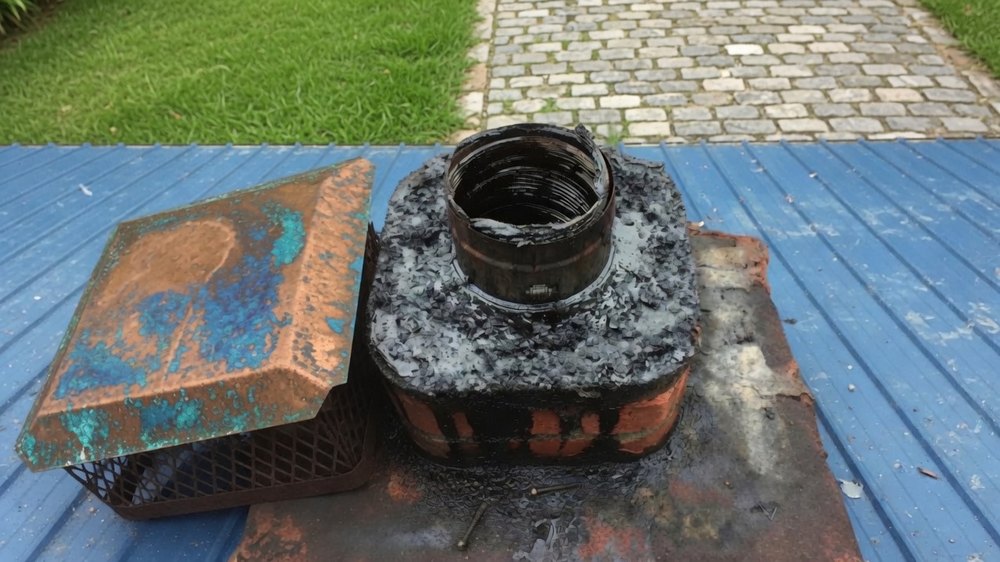
And then there is the chimney fire. A cool, smoky fire does not burn its own smoke. Those unburned gases go up the flue, meet cold masonry and condense into creosote — a tarry glaze that thickens coat by coat all winter. Creosote is what chimney fires are made of. A man burning green wood is building a chimney fire in his own flue, one damp log at a time. And it is quiet work. He does not find out he has been doing it until the chimney is roaring and somebody is calling the fire department.
None of that can be put right in January. Wood wants six to twelve months split and stacked before it will burn honestly, and oak wants a good two years and will punish you for rushing it. Which is why a woodpile is a spring job for next winter, and never a winter job for this one. The whole of it — drying times, stacking so it actually dries, and how to tell dry wood from wet while you are standing in somebody's yard — is on the firewood page.
How to tell it is ready, without buying a meter. Cracks running out from the end grain. Grey and dull rather than fresh-cut. Noticeably light in the hand. And knock two pieces together — seasoned wood rings, green wood thuds. It has to be split, too, not left in rounds: bark is waterproof, that is its entire job, and a round will sit out for three years and still be wet in the middle.
A farm teaches you that on a slow schedule. You get a spring, a summer and an autumn to understand that January is coming, and if you are paying attention the lesson costs you nothing worse than a sore back in September.
What happened in Iowa was the same lesson with the schedule taken away. No spring, no autumn, no sore back in September. One ordinary Monday morning, and then a household living the January version of its life with whatever happened to already be in the house. That is what makes this region’s storm different, and it is the only thing on this page I would ask you to remember.
🧊 The Other Half of the Year
All of that is a summer problem. The Midwest has a winter one as well, and it breaks the same wires by an entirely different method, so it is worth keeping the two apart.
The winter one comes for the plumbing too, and it does it at about twenty degrees rather than thirty-two — frozen pipes, and why the split is never where the ice is.
Wind throws things onto the wires. Ice does not throw anything at all. It simply gets on the wire and stays there, and keeps getting on, until the wire cannot hold what it is wearing.
Freezing rain arrives politely, a little at a time, and coats every conductor and every pole and every crossarm. Then one of them goes, and the one next to it now has that one’s load as well, and it goes too. That is why the great ice storms are counted in collapsed structures rather than in fallen branches. The 1998 storm across southern Quebec and eastern Ontario took down more than a thousand transmission towers and thirty-five thousand wooden poles, and some country districts sat in the dark better than thirty days.
Cold is heavier work than anybody expects who has not lived in it. On the farm I learned to judge how much straw to put down for the cows each night to carry them through a Maryland winter, and the lesson underneath the straw was this: winter does not arrive as an event you react to. It arrives as a weight that settles on everything and does not lift. Ice on a conductor is exactly that, and the line has no barn to go into.
Two things make ice slower to mend than wind, and neither of them is visible from a warm kitchen.
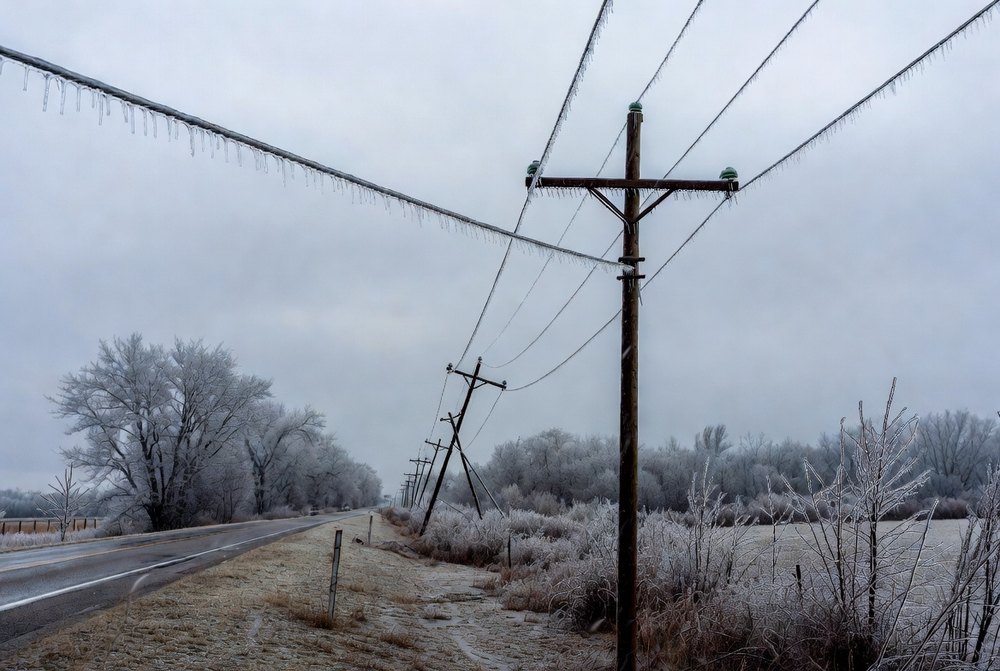
The first is that crews cannot work. You do not run a bucket truck up an iced road, and you do not park one underneath a limb carrying four hundred pounds of ice that has not decided yet where it means to fall. So the work waits. The weather clearing and the work starting are two different mornings, and sometimes several days apart.
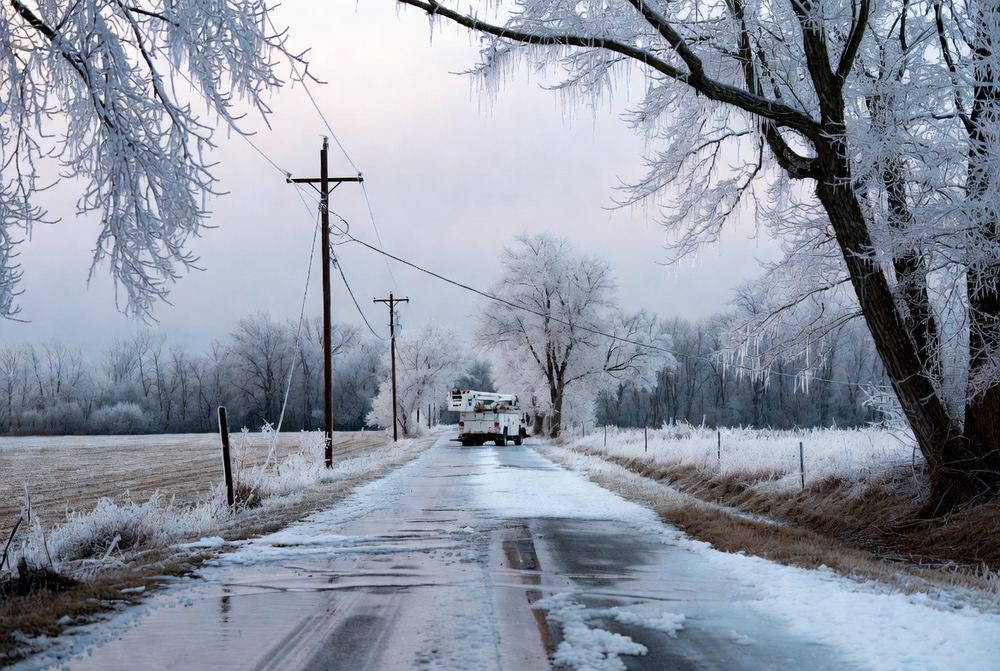
The second is that ice does not pick on one utility. It lays itself across half a dozen states in a night, so the mutual-aid crews that would come running to a single company’s disaster are being asked for by everybody at once. There are only so many bucket trucks in this country, and in an ice year every one of them is spoken for.
The winter version of the same lesson. With ice you often do get a forecast — and it does you less good than you would think, because the window between "they are saying ice Thursday" and "the roads are impassable" is short, and everyone else in the county is at the same store during it. The travel window closes even when the warning window opens.
The site has a plain-language account of what a long winter outage feels like from inside a house, written as a composite rather than a report, in Fourteen Days Without Power at Age 74.
🧓 What "No Warning" Means When You Are Seventy
Everything below comes off the same root, and it is worth saying once more before the list. The preparation window is nothing at all. Whatever is not already in the house is simply not going to be part of your week.
The August problem is heat, not cold. A derecho arrives in the hottest part of the year and takes the air conditioning with it. Thermoregulation declines with age, so the same August afternoon that is unpleasant at forty-five is genuinely dangerous at seventy-five. The site's One Cool Room approach is the realiztic answer — you do not try to cool the house, you cool the smallest space that will hold the people, and you put all the available power into that. The heat risk calculator is the place to work out where your own line is.
A shelf is not a clock. The refrigerator is dealt with below and it matters, but I want to say the older thing first, because most of what we ate in Maryland never went near a refrigerator. It was in jars, on a shelf, in a cool room — put up in July against a January nobody could see yet. Nothing in that room cared whether the power was on. That is not nostalgia and I am not asking anybody to take up canning; it is simply worth knowing that the pantry was invented by people who had this exact problem and no utility to blame.
And then there is the part nobody puts in a preparedness article. It is amazing what people will trade for eggs. I traded eggs for fresh corn, for peas, for string beans, for things I never thought to ask for. That is not a supply chain and it is not a stockpile. It is a neighborhood — and a neighborhood is what actually carries a household through a week with no power. You cannot open an account with one on the fourth day. Either those people already know your name or they do not.
The refrigerator is a clock, and so is the medicine in it. A closed refrigerator holds a safe temperature for roughly four hours, a full freezer for a day or two. If insulin or another refrigerated medicine is in there, that clock matters more than the food does — the refrigerated medication plan covers what the FDA actually says about it, and the food spoilage calculator covers the rest of the shelf. This is a conversation to have with your own pharmacist in advance rather than at hour six.
A phone is not a communications plan. The 2020 storm damaged towers and above-ground cable directly, and a charged phone with no tower to talk to is a flashlight with a good battery. That is what a battery radio is for, and it is why the out-of-area relative everybody reports to is worth agreeing on now.
Powered medical equipment sets the whole plan. If someone in the house runs a CPAP or an oxygen concentrator, the outage length that matters is not the average, it is the Cedar Rapids number. The CPAP battery calculator sizes that honestly, and your utility almost certainly keeps a medical-needs registry that is worth being on before you need it.
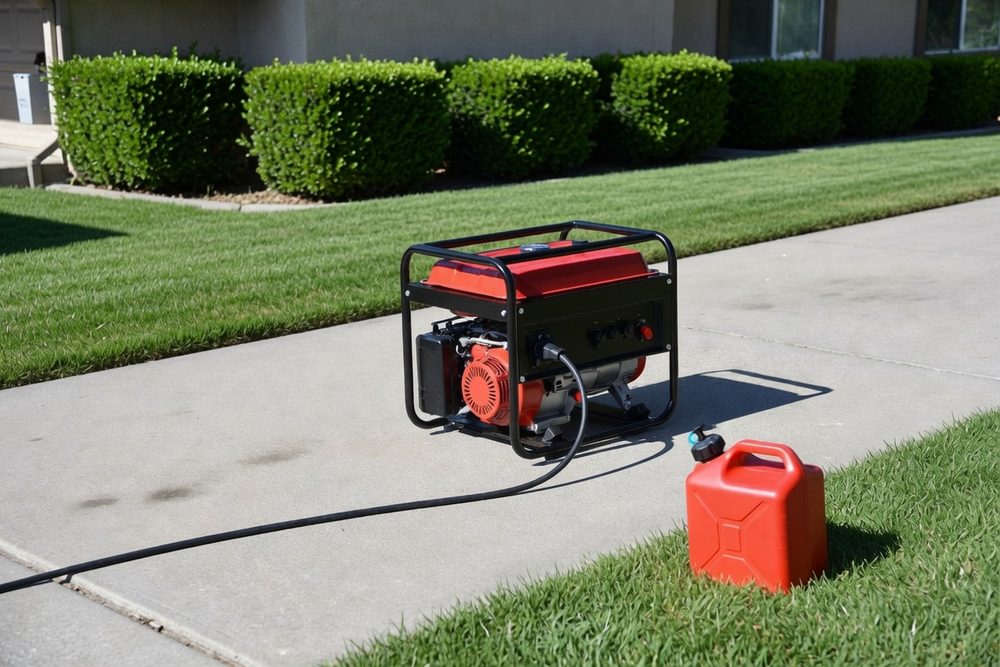
The one that kills people after every storm. A generator, a charcoal grill or a camp stove run indoors — including in an attached garage with the door up, or on a porch near an open window — produces carbon monoxide in lethal quantities, and you get no warning from your own senses. Generators run outside, well clear of the house and away from windows and doors, always. A battery carbon monoxide alarm on each sleeping floor costs very little and is the only thing in the house that will tell you.
🏠 What Has to Be in the House Already
Here is the practical end of it, and it is shorter than people expect.
Because the warning can be measured in minutes, being ready out here is a standing condition, not an errand you run. Nothing on this list is exotic, and not one item of it is a preparedness product sold in a bag with a logo on it.
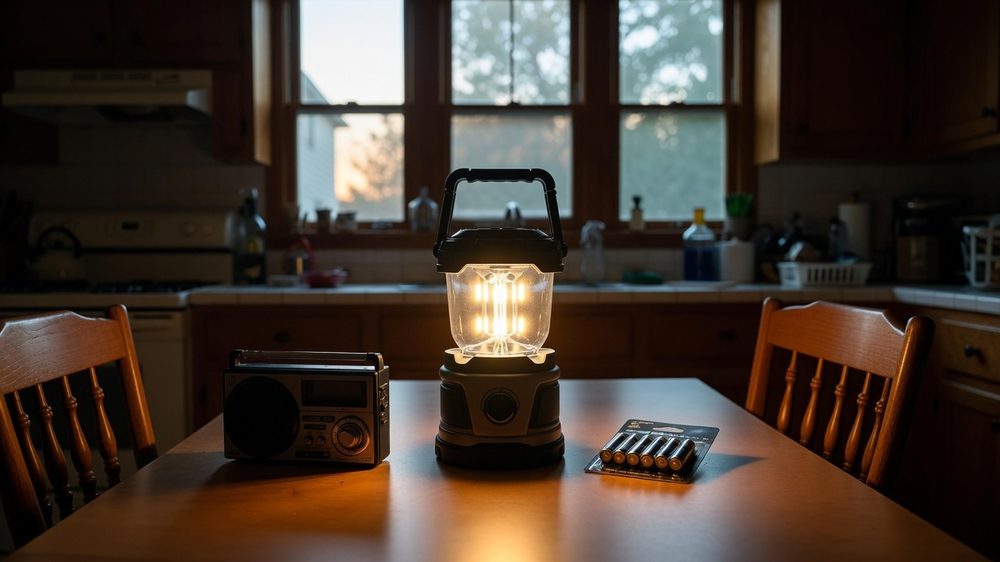
Light that does not need to be found in the dark. One light per room, in the same place every night, so the emergency light and the reading light are the same object. The lighting plan covers the rechargeable trap — a rechargeable lantern is wonderful on night one and a paperweight on night four.
The well is the one people forget, and it is the one I would put first. On a place with animals the power going out is not an event, it is a chore. A cow does not care what the utility is doing. She wants water twice a day whether the pump runs or not, and when it does not run, you carry it.
I have carried a great deal of water in my life, and I can tell you the exact number of trips it takes before a man starts thinking seriously about how he would do this differently. If you are on a well anywhere in the rural Midwest, that is your outage — not the one on the news. The lights are the least of it.
Water on the shelf, not on the list. Municipal supply usually survives a wind event, but pressure and treatment both depend on power somewhere upstream, and a rural well pump stops the moment the grid does. The water calculator does the arithmetic for your own household size.
Backup power sized for what actually matters. The instinct is to size for the house. The better question is which loads genuinely have to run — refrigeration, medical equipment, one cool room — and which are simply habits. The loads to skip page is the honest version of that conversation and the generator size calculator turns it into a number. Buy the fuel discipline with it: a generator with stale fuel and a full tank of good intentions has failed every household that owned one.
The paperwork, done in a quiet week. A medical information card on the refrigerator and in the wallet, the utility's medical registry, and the name of one out-of-area relative everyone calls. All three are free, all three take an evening, and all three are worthless if you start them on the morning of.
❓ The Questions People Actually Ask
Short answers. Where the page has already dealt with something properly, the answer points back to it rather than saying the whole thing twice.
How much warning do you get before a derecho?
Effectively none by the standards of a hurricane — the storm forms and arrives the same day. The full account of the 2020 timing is in The Storm That Does Not Send a Forecast.
How long do power outages last after a derecho?
Plan on a week in a badly hit area, not three days. The day-by-day restoration figures from 2020 are in What a Week Without Power Actually Looked Like.
What is the difference between a derecho and a tornado, for my house?
A tornado is narrow and catastrophic; a derecho is wide and simultaneous, and that difference decides how fast you get power back. A tornado destroys a path a few hundred yards across, and the crews, mutual aid and contractors of an entire region converge on it. A derecho damages every county along a track hundreds of miles long, so the same finite pool of line crews, tree crews and bucket trucks is spread across a dozen counties at once and nobody gets the cavalry. Structurally a tornado is more likely to take your roof; practically a derecho is more likely to leave you without power for a week.
Will my cell phone work during a regional outage?
Sometimes, briefly, and you should not build a plan on it. Cell sites carry limited battery reserve and generally need refuelling or grid power to keep running beyond it, and a wind event that takes down poles also takes down the above-ground cable and the towers themselves — which is exactly what was reported in Cedar Rapids in 2020. Assume voice and data are intermittent at best for the first days. A battery or hand-crank radio receives regardless, and a pre-agreed out-of-area contact means the family has one number to converge on instead of six people calling each other.
Is a portable generator enough, or do I need a standby unit?
It depends less on the storm than on who has to start it. A portable generator is far cheaper and covers a refrigerator, a window air conditioner and a few circuits perfectly well — but somebody has to carry it out, fuel it, start it and run cords, in the dark, possibly in the rain, and repeat that every few hours for a week. That is a very different proposition at seventy-five than at fifty-five. A standby unit starts itself. The honest way to decide is to picture the person who will actually be doing the work on night four, and size the decision to them rather than to the storm.
🛒 Buy It at Fifty
The argument running underneath this whole site is that the useful things get bought early. The Midwest makes that argument better than any other part of the country, and it makes it in the plainest possible way: it takes the shopping trip away from you altogether.
A coastal household gets a cone on the television and three days of warning. Linn County got a clear August morning. Everything that helped anybody that week — the lantern in the drawer, the radio with batteries beside it rather than inside it, the generator that had been run last month, the neighbor whose name you already knew — was in place before breakfast, because there was no moment afterwards in which it could have been acquired.
I stacked that wood in shirtsleeves, in no particular hurry, months before I needed a stick of it. It was not a dramatic afternoon and nobody would have made a television program about it. But it was the entire reason the house was warm in January, and there was no version of that winter in which I could have gone out and fixed it later.
That is all this site is, in the end, and it is all this page is asking. Do the unhurried version now, in a quiet week, while it is cheap and while you can still lift things. The woodshed is either full in September or you are cold in January — and on the tenth of August, in Linn County, nobody was given the chance to choose on the day.
🗺️ The Other Regions
The same job in a different climate. Every region fails its own way, and the guide for yours is written to that failure rather than to a general one.