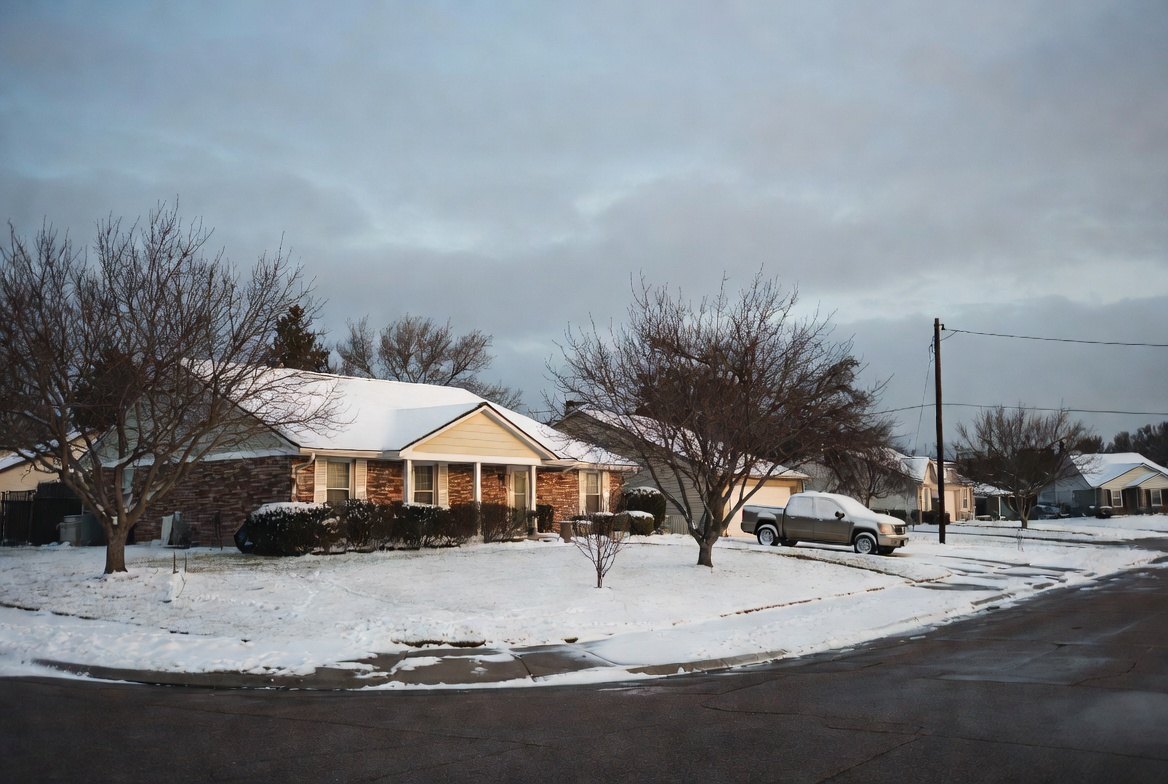
About the photographs on this page. Every image here is an illustration. This page describes a real, dated event in a real state, and none of these pictures were taken during it — they are made images used to show what the words describe. Every figure and number below came from a state agency review, a federal regulator’s report or a peer-reviewed study, and not from any photograph.
☕ An Ordinary Sunday Night
Start on the Sunday evening, before any of it. Valentine’s Day, 2021. A house in a Texas suburb with the porch light on and somebody rinsing a plate at the kitchen sink.
What the state’s own final death report says about who died, and the decision about when to stop holding one room and go, is on the one warm room page.
The forecast has been talking about cold all week and nobody has been especially bothered. Texas gets cold. It gets cold for about three days and then it stops, and in the meantime you put a towel over the outside spigot and you go on about your business.
So the towel goes over the spigot. That is the preparation. That is the whole of it, and for thirty years running it has been enough.
The plate gets rinsed and the tap gets turned off and nobody in that kitchen gives the tap one second of thought, because why on earth would they. It has run every day of their lives.
Hold that picture. The kitchen, the plate, the tap running.
By Monday morning the state has begun shedding load. By Monday afternoon four and a half million customers are dark. That part made the news everywhere and most people remember it.
Here is the part that did not travel nearly as far, and it is the reason this page exists.
The thing in that kitchen that was going to ruin the week was not the light over the sink.
It was the tap.
🚰 Go and Look at Your Own Tap
Water does not arrive at your house by gravity, and almost nobody knows that until the week they find out. It arrives because something upstream is pushing it, and that something runs on electricity.
Pumps at the plant. Pumps at the booster stations. Pumps filling the tower that holds the pressure steady overnight. Take the power off all of that and the water does not stop dramatically. It just goes soft. The pressure sags, and a pressure that sags below a certain point is no longer safe to drink even where it is still coming out of the wall, because the chlorine that keeps it clean needs pressure and movement to reach you.
That is a boil-water notice. It is not somebody being cautious. It is the system telling you it has stopped being able to promise.
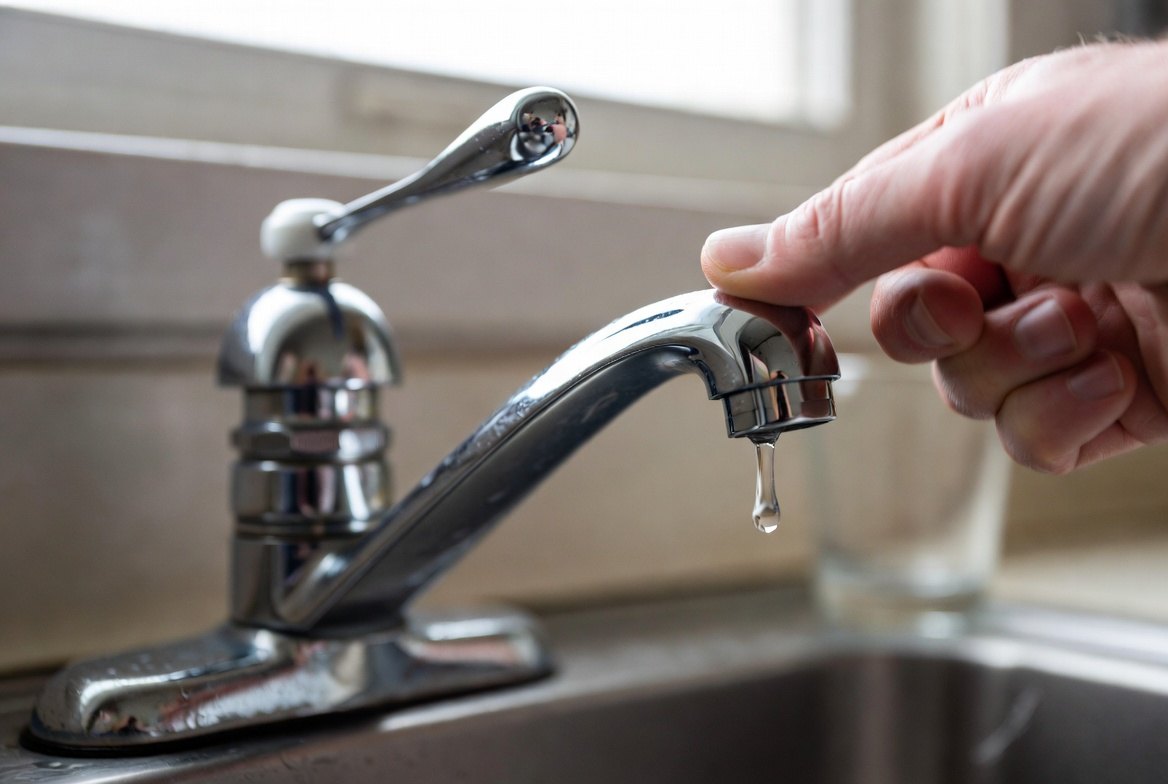
Nearly 40 per cent of the 4,647 community water systems in Texas issued one. The peak was somewhere close to fifteen million people under a notice at the same time, and one peer-reviewed count of the whole event puts it above seventeen million, with some systems still under notice more than a month later.
Now read that again with the electricity in mind, because the two facts are the same fact. The grid went down and took the water with it. There were households in Texas that week with a generator running the refrigerator quite happily and nothing coming out of the kitchen sink.
And here is the sentence to take away from this whole page: you cannot boil water you do not have. A boil notice assumes you still have pressure. A great many people had no pressure at all, and for them the notice was beside the point.
That is why it took a week. Not the wind, not a tree. A frozen pump house nobody could reach on an iced road, multiplied by two thousand systems.
📅 What Four Days Actually Looked Like
The number the papers printed was the load shed — roughly 20,000 megawatts, the largest controlled firm load shed in American history. It is an accurate number and it tells you nothing about a Tuesday.
Monday. The rotating outages start before dawn. They are called rotating because they are supposed to rotate. For a great many households they did not rotate; they simply stayed.
Tuesday. The house is down into the forties inside and dropping. This is the day the pipes start going, and they do not go where you can see them. They go in the attic and in the wall, and they do not announce it until the thaw.
Wednesday. The water notices spread across the map faster than the power comes back. Grocery shelves in the metros are stripped and the trucks cannot get in, because the same ice that took the pump house took the interstate.
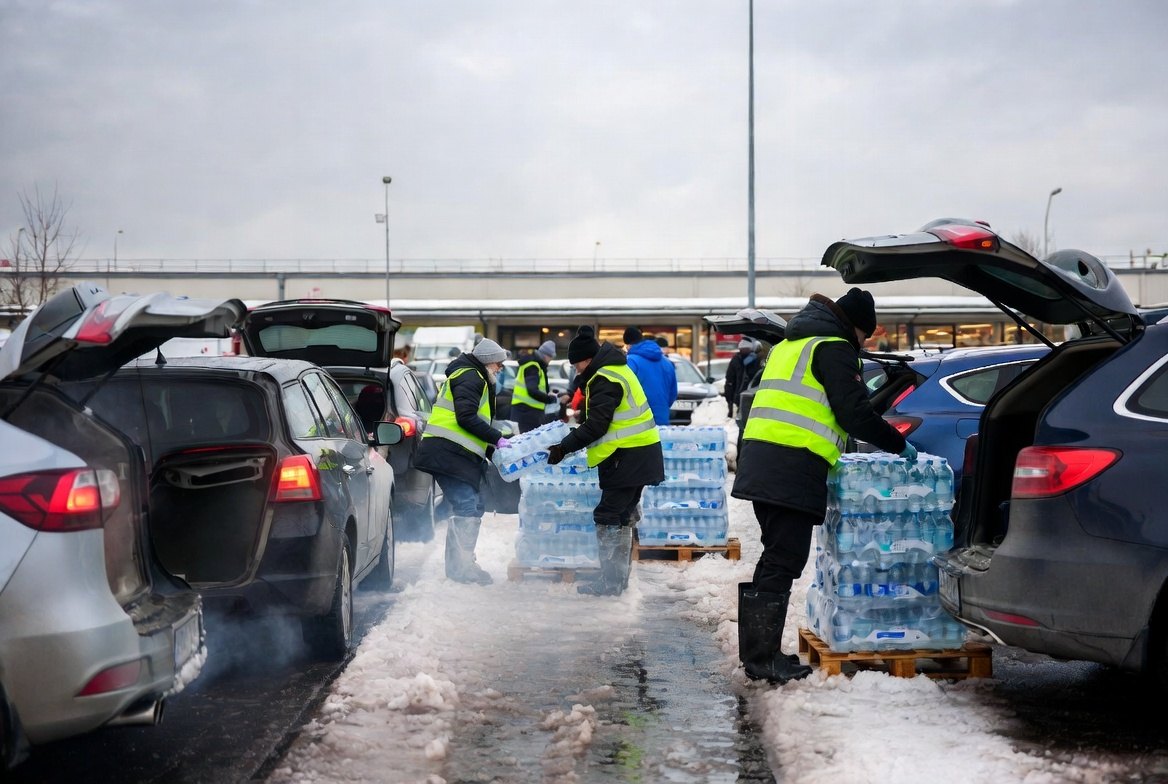
Thursday. Some people have had power back for a day and still have no drinking water. This is the part nobody plans for — the two systems do not come back together, and the one you did not think about is the one still out.
Then the thaw, which sounds like relief and is not. Every pipe that split quietly on Tuesday starts running on Friday, inside the wall, while the family stands in the hall listening to it.
The state’s final count was 246 dead across 77 counties. Of those, 161 were killed by the cold itself, and of the hypothermia deaths, 125 were people aged sixty or over.
Read that ratio twice. This storm did not kill Texans at random. It killed old ones, indoors, in their own houses.
Another nineteen died of carbon monoxide poisoning, trying to get warm.
Not one of those households had been told to keep a fortnight of water in the garage. Nobody had ever given them a reason to.
The figure of 246 is the state’s own, and it is disputed — independent analyzes at the time put the real number several times higher. I am using the official one because it is the one the state will stand behind, and because it is already bad enough to make the point.
🪣 I Have Carried a Great Deal of Water
I was not in Texas in February 2021, and I want that said plainly. Every figure on this page came out of a state agency review, a utility report or a peer-reviewed count, and not out of my memory.
But I know exactly what that week was, because I have lived the small version of it more times than I care to count.
We had a stone house on seven acres in Frederick, Maryland. Stone is wonderful and stone is merciless: it holds whatever temperature you give it, and if you stop giving it heat it will hold cold just as faithfully. That first winter went better than eight cords of wood.
The house was on a well. A well is a pump, and a pump is electricity, and so every time the power went out on that hill the water went out in the same instant. Not gradually. Together.
There were cows, chickens, sheep and goats out there, and a cow does not care in the slightest what the utility is doing. She wants water twice a day whatever the poles are up to. So you carry it.
And I will tell you the thing about carrying water that nobody believes until they have done it. It is not the weight. It is the arithmetic. A person is fine on the first trip and philosophical on the second, and somewhere around the ninth it stops being a chore and becomes the entire day. You are not doing anything else. You are a man who carries water now.
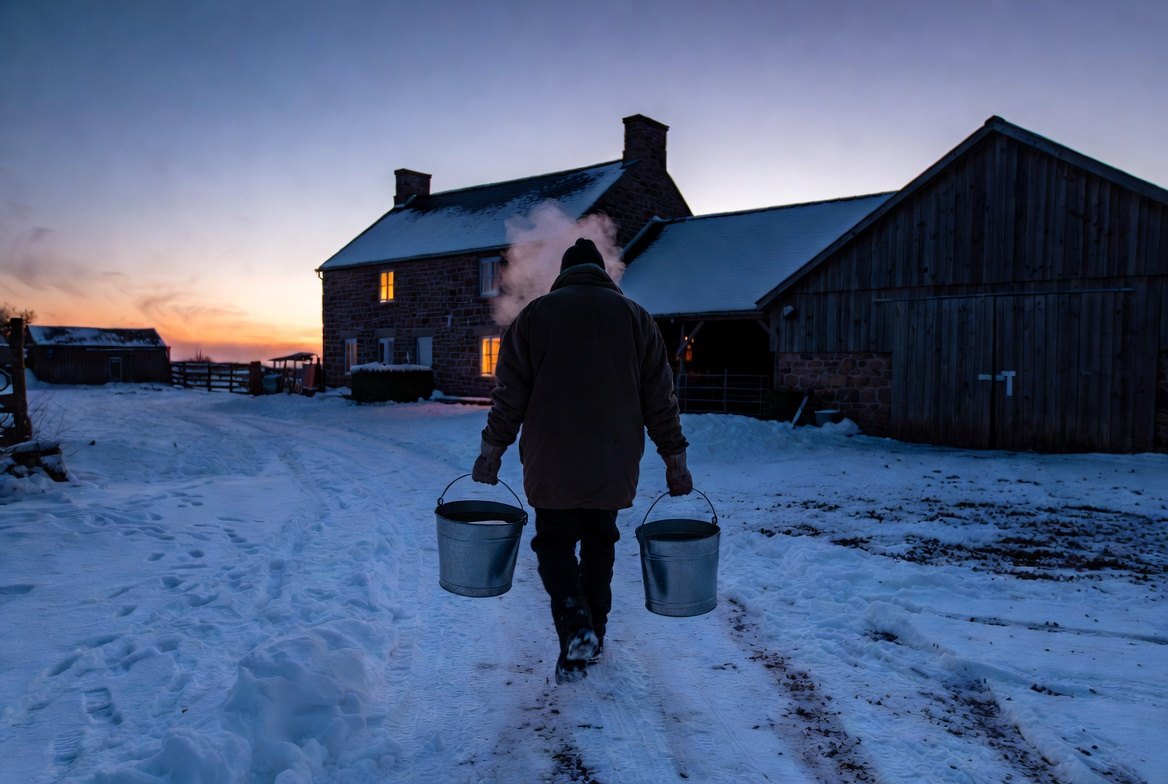
That is what a Texas kitchen turned into on the Wednesday, except there was no creek at the bottom of the property and no barn to walk to. There was a car that would not get down an iced street, and a store with nothing on the shelf when it did.
Which is why the answer on this page is water in the house, months ahead, bought on a boring afternoon when nothing whatever is happening. The people who were fine that week were not the prepared ones in any dramatic sense. They were the ones who happened to have a case of bottled water in the garage from some trip they took in October.
⚡ The Part About Texas That Is Genuinely Different
Most of the country, when a grid gets in trouble, borrows. The wires run across state lines and the neighbors send power. It is not charity, it is engineering, and it is the reason a bad night in one state is usually somebody else’s Tuesday.
Texas mostly cannot do that. The Texas grid runs as its own island for reasons that are political and historical rather than technical, and the connections to the rest of the country are small. When it ran short, there was nowhere much to borrow from.
I am not going to argue that question here; there are people on both sides of it who know a great deal more than I do. I only want the practical consequence stated, because it changes what a household ought to keep on the shelf: when this grid gets in trouble, help arrives more slowly than you have been raised to expect.
Now the part that ought to be better known. When the federal regulators finished their report, the failure was not exotic. Freezing accounted for 44.2 per cent of the unplanned generator outages and fuel problems for another 31.4 per cent — three quarters of it between them. Of the failures caused by fuel, 87 per cent were natural gas, mostly at the wells and the processing plants, which had frozen up themselves.
And this, which I have not been able to get out of my head since I read it: 81 per cent of the freeze-related outages happened at temperatures above the equipment’s own stated design temperature. The machines did not fail because the cold beat their rating. They failed in weather they were on paper supposed to handle.
The regulators added that protecting four types of component from ice would have prevented roughly two thirds of the ERCOT outages.
I have been in the building trades long enough to translate that without much trouble. It was not a mystery and it was not an act of God. It was a maintenance item that everybody agreed could wait, because it had always been able to wait before.
Which is the same argument this site makes about a grab bar, a water filter and a woodpile, scaled up to a state.
🧓 What This Looks Like at Seventy
Everything above happens to everybody. Here is what changes when the household is older, and none of it is about being frail.
Cold works faster on you and tells you less. An older body holds heat poorly and registers the loss late, which is a bad combination in a house dropping through the forties. The Texas dead were mostly old and mostly hypothermia, and a good many of them were indoors.
Water is medicine before it is anything else. Pills get taken with it. Some conditions get worse quickly without enough of it. A younger household can be casually dehydrated for two days and be merely miserable.
Carrying is the hidden cost. A gallon of water is a little over eight pounds. A case is about forty. If your plan is to go and get water on the day, be honest about who is carrying it up the drive on ice.
The car is not the backup you think it is. The reason those streets emptied was not fear, it was ice, and a fall on ice at seventy is its own catastrophe with the ambulance already busy.
🏠 What Has to Be in the House Already
Short list, and every item on it is dull, cheap, and bought months before it matters.
Water, and more than you think. One gallon per person per day is the standard planning figure and it covers drinking and minimal cooking, not washing. Texas ran four days for many and longer for some. Two weeks per person is not paranoid; it is a shelf in the garage.
A way to keep one room warm that is not the furnace. Almost every gas furnace needs electricity for its igniter, blower and board, so “we have gas heat” is not the answer people think it is when the power is off.
Heat the person before the house. Wool blankets and a sleeping bag rated well below what you expect beat any plan that involves warming three thousand cubic feet of air.
Let the taps drip and know where your shutoff is — before you need it, in daylight, with somebody watching who can also find it.
Two things this site will not tell you to do, and this is the one place on the page where I am going to be completely humorless, because people died of exactly this in that week:
⚠️ Carbon monoxide — read this even if you read nothing else on this page. Nineteen people died of it in Texas that week.
Never run a generator, a charcoal grill, a camp stove or a gas grill inside a house, a garage, a breezeway or an enclosed porch, and never in front of an open window or door. A generator must run outdoors, well away from the building, with its exhaust pointed away from every opening. Never heat a home with a cooking stove or an oven. Carbon monoxide has no smell and no color, and its early symptoms are indistinguishable from being cold, tired and unwell — which is exactly how you will feel anyway. Install a battery-powered carbon monoxide alarm and test it. If an alarm sounds, or if anyone becomes confused, dizzy, faint or unusually sleepy, get everyone outside into fresh air immediately and call 911 from outside.
The other is water from a source you have not checked. If it comes to that, a gravity filter belongs in the house before the week it is needed, not during it.
❓ The Questions People Actually Ask
How long can a house go without water in a winter power outage?
Plan for two weeks per person, not two days. In Texas in February 2021 many households were without safe water for four days and some systems stayed under a boil notice for more than a month. The standard planning figure is one gallon per person per day, and that covers drinking and minimal cooking only — not washing, not flushing.
Why did the water stop when the power went out?
Because water arrives under pressure, and that pressure is made by electric pumps. When the pumps stop, pressure falls, and once it falls below a safe threshold the disinfectant in the pipes can no longer be relied on. That is what a boil-water notice means. In Texas, nearly 40 per cent of the state’s 4,647 community water systems issued one.
Will my gas furnace work if the power goes out?
Almost certainly not. A modern gas furnace or boiler needs electricity for its igniter, its circulator or blower and its control board — typically a few hundred watts. The gas keeps arriving and the heat does not. Assume you have no heat unless you have specifically arranged otherwise.
Is bottled water or a filter the better plan for a winter outage?
Stored bottled water, for this particular failure. A filter solves contamination, and in a freeze the problem is usually that nothing is coming out of the tap at all. A filter is a fine second layer and a poor first one.
Why could Texas not get power from other states?
The Texas grid operates largely as its own island, with only small connections to the rest of the country, so there was little capacity to import when it ran short. The practical consequence for a household is simple enough: outside help arrives more slowly than most people assume, so what is already in your house matters more.
🛒 Buy It at Fifty
The useful things are cheap, boring, and bought long before anybody needs them. That is the entire argument of this site and Texas made it better than I can.
A case of water costs a few dollars and sits in the garage doing nothing for years. It does nothing, and does nothing, and does nothing — and then for four days in February it is the most important object you own.
You cannot buy it on the Tuesday. On the Tuesday the shelf is bare and the road is ice.
Buy it on a dull afternoon in October, when it is the least interesting purchase you will make that month.
Elsewhere on this site, if it is useful: work out how much water your household actually needs · light that does not involve a flame · medication that has to stay cold · a CPAP through the night · what in the refrigerator is still safe · what not to put on a generator · a gravity filter for the second week · the whole argument this site is built on.
What This One Buys You
In this region the water goes out with the power, and it comes back later.
Nearly forty per cent of Texas water systems issued a boil notice in one week, and the peak was close to fifteen million people at once. A generator does not solve that. Water bought months earlier, sitting in the garage being boring, does. That is the whole of the argument — the useful thing is cheap, dull, and purchased long before there is any reason to.
🗺️ The Other Regions
The same job in a different climate. Every region fails its own way, and the guide for yours is written to that failure rather than to a general one.