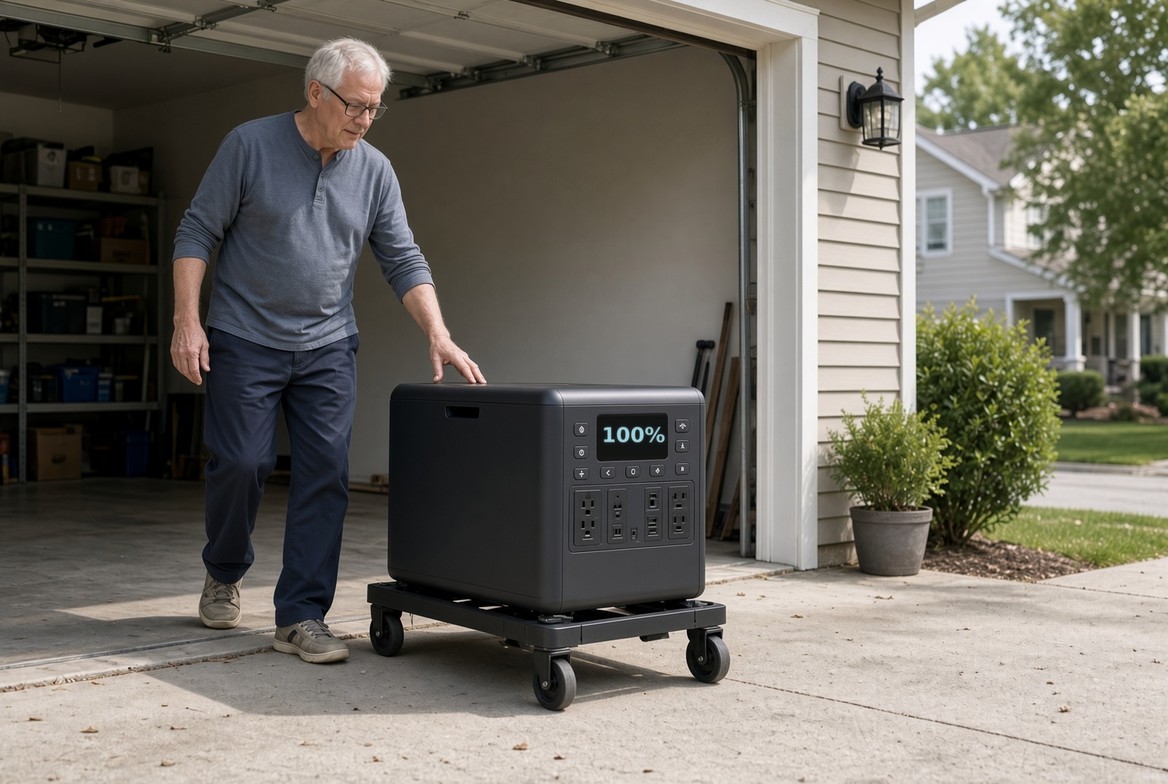
There is a kind of backup power that arrives on a truck, sits on a concrete pad beside the house forever, and costs as much as a used car. This page is about the other kind — the kind that lives in the garage, plugs in when you need it, and goes in the back of the car if you ever move.
It costs a fraction of the pad-mounted machine, it will run a house for days or weeks rather than hours, and the whole thing is a handful of separate pieces you can buy one at a time as the money allows. Nothing gets bolted to your house. That is not a compromise. On this site, it is the whole point.
Start Here: What the System Actually Is
Most people picture backup power as one object. A generator, roaring away in the side yard, chewing through gasoline until the power comes back or the gas runs out. That is one way to do it, and it is the way nearly everybody does it, and it is the most expensive way to buy a kilowatt-hour that has ever been invented.
The system on this page is a battery with an engine behind it. Six parts, and only one of them makes any noise:
- A battery — a big lithium power station that runs the house quietly, indoors, with no fumes.
- A small generator — which does not run the house at all. Its only job is to fill the battery back up, then shut off.
- A soft starter — a small box on the air conditioner or the well pump that cuts the startup surge, so everything else you buy can be smaller.
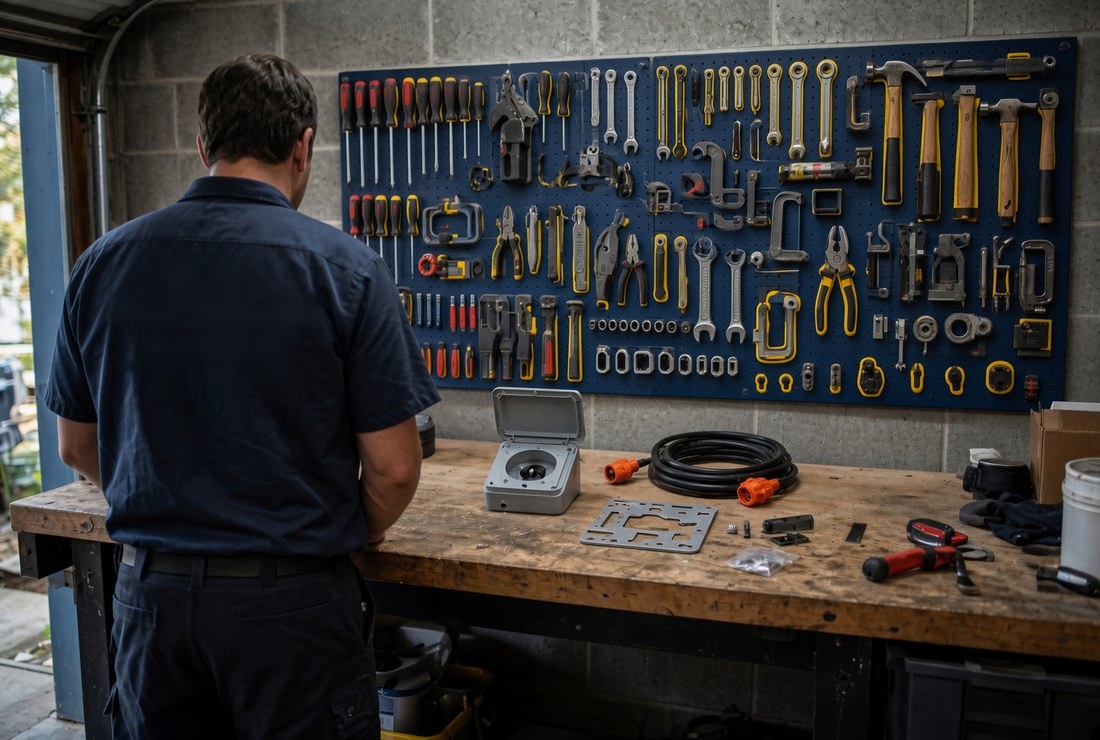
- A connection — an interlock kit and an inlet box, so the whole house feeds from one plug instead of a spaghetti of cords. This is the only part that touches the building, and it is one steel plate and one outdoor outlet.
- Fuel — a few cans, treated, or a couple of propane tanks that never go stale.
- Solar panels — optional, and the thing that turns days into weeks.
Buy them in that order, over as many months as you like. Every one of them works on its own the day it arrives. That is not true of a standby generator, which is useless until the last invoice is paid.
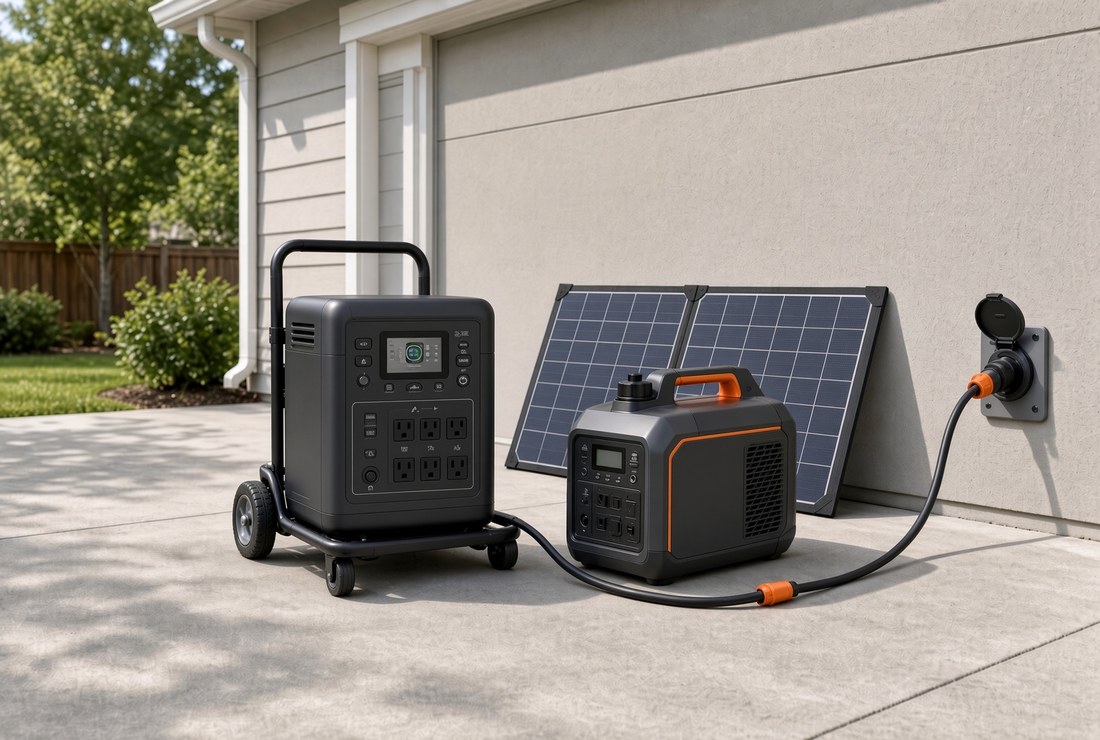
Carbon monoxide. A generator runs outdoors only — never in a garage, never in a shed, never on a covered porch, never in a doorway, and never with the garage door partly open. Fifteen feet from the house minimum, exhaust pointed away, windows on that side shut. Carbon monoxide has no smell and gives no warning. Put a battery-powered CO alarm in the bedroom hallway before you buy anything else on this page.
The Arithmetic Nobody Runs
Here is the number that makes the rest of this page make sense.
An engine is a machine with a sweet spot. Loaded up near its rating, it converts fuel into electricity fairly well. Loaded lightly, it converts fuel into noise and heat and very little else — but it burns the fuel anyway, because it still has to spin.
Now think about what your house actually asks for at two o'clock in the morning. A refrigerator cycling on and off. A freezer doing the same. Maybe a fan. That is a couple of hundred watts on average. And a 5,000 to 7,500-watt open-frame generator sitting in the yard will burn somewhere between four tenths and nine tenths of a gallon an hour to deliver it. Call it half a gallon. Around the clock, that is roughly twelve gallons a day to keep a refrigerator cold.
Now do it the other way. Start the small generator, let it run flat out — where it is efficient — charging the battery, and shut it off when the battery is full. A decent inverter generator turns a gallon of gasoline into about four and a half kilowatt-hours of stored electricity. A careful house on a battery uses around five kilowatt-hours a day: the fridge, the freezer, the lights, the phones, the internet, the fans, the coffee.
The same five gallons in the same red can is half a day the old way and three to four days the new way. That is not a clever trick or a rounding error. That is the entire argument of this page, and it holds on the second day of an outage the same as the first, when the gas stations have no power to run their pumps and the line at the one station that does is forty minutes long.
And there is a second dividend that does not show up on the fuel receipt: the engine is off almost all the time. It runs an hour or two in the middle of the day, on a schedule you choose, and then the yard is silent again. Your neighbors can sleep. You can sleep. The engine racks up two hours of wear instead of twenty-four, which is why the small one lasts.
The Battery — The Part That Runs the House
The battery is the piece doing the actual work, and it is the piece to buy first. What you are looking for is a lithium iron phosphate power station — LiFePO4 on the label, and worth insisting on. That chemistry is rated for a few thousand full cycles rather than a few hundred, which in this use means it will outlive the mortgage, and it is the chemistry that behaves itself when it is treated badly.
Three specifications matter and the rest is marketing.
Watt-hours — how much is in the tank
This is the size of the fuel tank, not the size of the engine. A station in the 2,000 to 5,000 watt-hour range is the working zone for a house. Five kilowatt-hours stored, against a careful five-kilowatt-hour day, means one full battery is one full day with no engine at all. Many stations take expansion batteries that plug into the side and add the same amount again — that is the cheapest kilowatt-hour you will ever buy, because you are not paying for a second inverter, and it is the upgrade to leave for next year.
Watts — how much it can push at once
The output rating is what decides whether the coffee maker and the microwave are allowed. Somewhere around 3,000 watts continuous covers a house running sensibly. Above that you are paying for a capability the rest of this page will teach you not to need.
240 volts — the specification people miss
This is the one that decides whether the system can ever feed your panel. A station with 120 volts only works with cords, and only with cords. A station that also does 240 volts can plug into an inlet box and light up the whole panel, well pump included. If there is any chance you will wire it to the house one day, pay for 240 volts now. Retrofitting it means buying a second station.
A worked example, because an abstraction is hard to shop for
Everything above is a specification, and specifications are difficult to picture. So here is one real machine that hits all three marks at once, named plainly rather than hinted at — and it is not the only one, it is simply a clear illustration of what the numbers look like when they show up on a box.
The Pecron F5000LFP stores 5,120 watt-hours, pushes 7,200 watts, and does 120 and 240 volts. Read that against the three specifications above: it is a full careful day of storage, output to spare, and the 240 volts that lets it feed a panel. Street price has been under two thousand dollars through mid-2026. It takes expansion batteries that add another 5,120 watt-hours each, up to six of them — so the same box scales from one day to something closer to a fortnight without buying a second inverter. It will also refill from an ordinary household outlet in about three and a half hours, which is exactly the trick this whole page is built on: fill it fast while the engine is working hard, then shut the engine off.
Two honest marks against it, and against most stations in this class. The inverter draws power simply being switched on — on a battery this large that is around four days to self-drain from full, which is fine in an outage and a nuisance if you leave it idling for a month. Switch the AC output off when nothing needs it. And the solar input has a minimum voltage — its port wants somewhere between 30 and 180 volts, which is the trap covered further down: a panel below that floor does not charge slowly, it does nothing at all.
Shop it against its rivals rather than taking anyone’s word for it, this page included. The three numbers to compare are always the same: watt-hours, watts, and whether it does 240 volts. Search: Pecron F5000LFP →
Search: LiFePO4 power stations with 240-volt output →
On price: the market has moved hard, and stations now change hands around forty cents a watt-hour when they are on sale, which is roughly half what the same thing cost three years ago. They go on sale constantly. Buying one at list price is a choice, not a necessity.
The Generator — Smaller Than You Think
Now that the battery is running the house, look at what is left for the engine to do. It has to refill a five-kilowatt-hour battery. That is all. It does not have to start an air conditioner, it does not have to carry a surge, it does not have to run all night, and it does not have to be big.
A 3,000 to 3,500-watt inverter generator will do it in about an hour and a half. That is a machine one man can carry, that costs a few hundred dollars, that runs quiet enough to hold a conversation beside, and that sips fuel because inverter generators throttle down instead of running flat out at 3,600 rpm forever. Street prices run $350 to $900, and the dual-fuel versions — which will run on gasoline or propane — sit at the upper end of that and are worth the difference for a reason we will get to.
Compare that with what most people buy: a 7,500-watt open-frame machine, three times the price, four times the weight, loud enough to argue about, and burning fuel around the clock to run a refrigerator. The big generator is not a better version of this. It is a different and worse strategy.
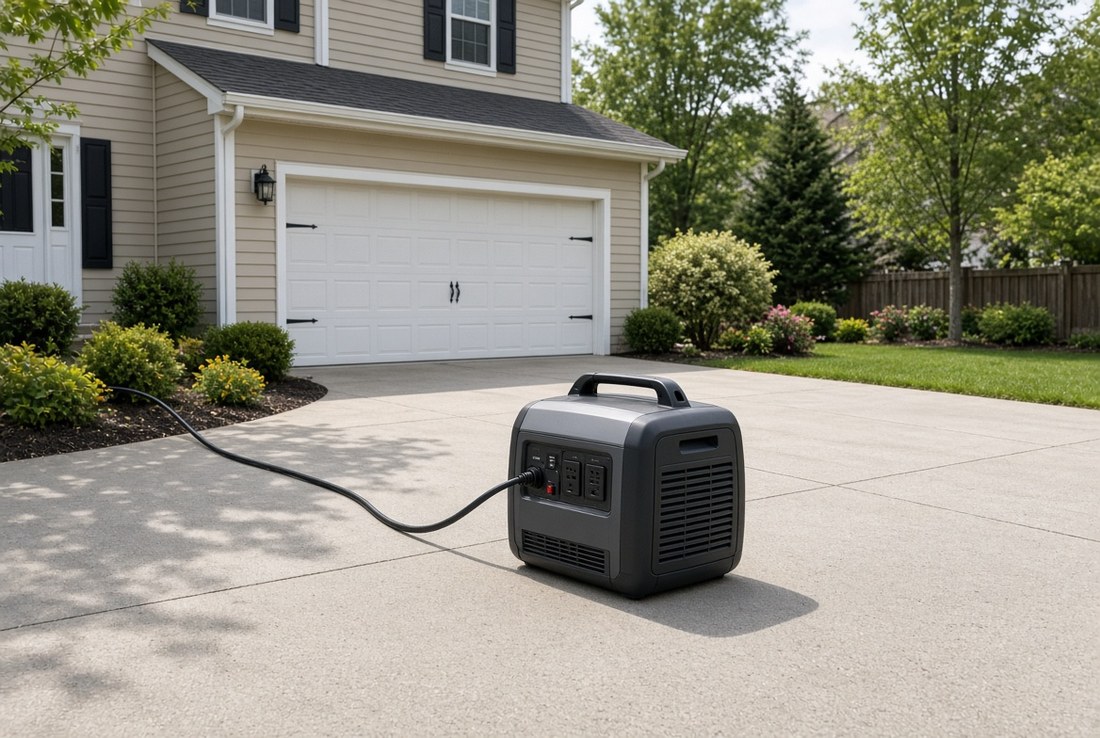
Search: dual-fuel inverter generators around 3,500 watts →
Two working notes. First, check that the generator has an outlet the power station's charger can actually use — most want a standard 120-volt household outlet, and most generators have two. Second, run it in the middle of the day. You want the noise while everyone is awake, you want the refuelling done in daylight, and you want a hot engine nowhere near bedtime.
The Soft Starter — The Part That Shrinks Everything Else
Every motor in your house asks for a great gulp of current in the first fraction of a second, then settles down to a fraction of it. The air conditioner is the worst offender by a mile. A compressor that runs on 15 amps will demand 80 amps to get moving, and that half-second is what forces people into a generator twice the size they need for the other twenty-three hours and fifty-nine seconds of the day.
A soft starter is a small sealed box that gets wired into the outdoor unit and ramps that surge up instead of slamming it on. The reduction is not marginal — these devices cut starting current by 65 to 75 percent. The manufacturer's own worked example on a five-ton unit takes it from 81.4 amps down to 26.2 amps, on a system that would not start on a 13,000-watt generator at all.
Read that again with your wallet open. The part costs a few hundred dollars. It changes what size battery, what size generator, and what size everything else you have to buy. That is why it belongs in the component list on this page rather than as a footnote — it is not an accessory to the system, it is load-bearing. The same logic applies to a well pump, which surges hard and briefly for exactly the same reason.
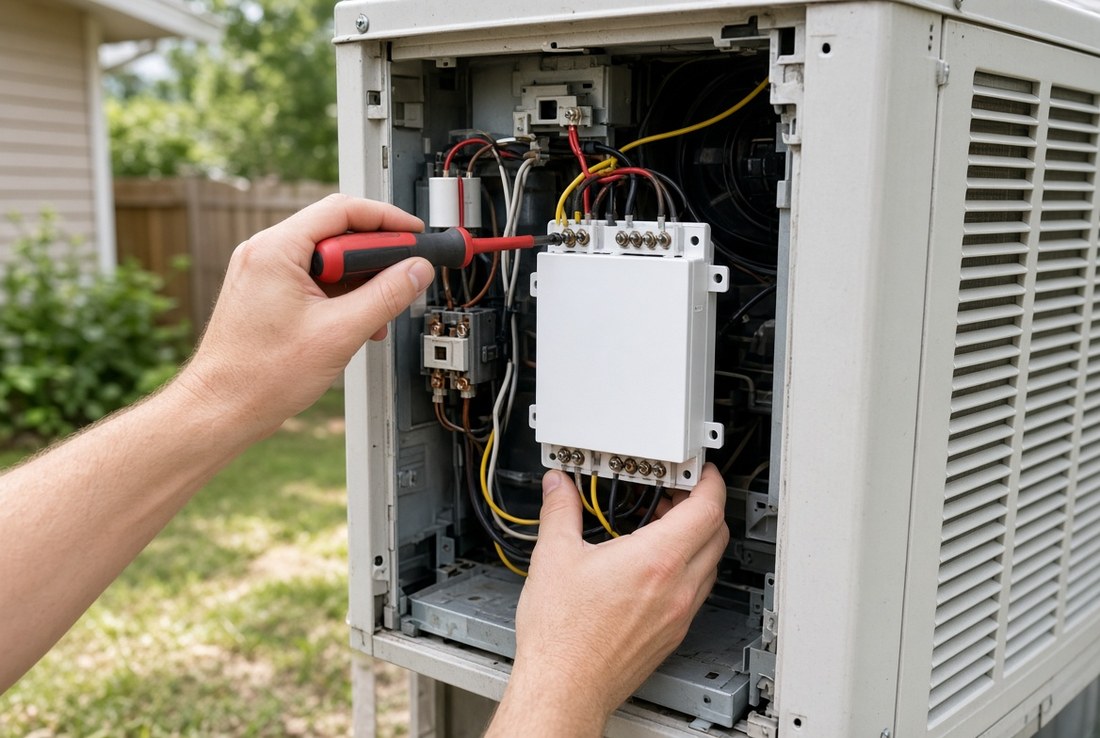
Search: air conditioner soft start kits →
There is a longer treatment of this part on its own page — the $300 part that changes the answer — including which units it does and does not suit.
The Connection — One Plug Instead of Nine Cords
You can run this entire system on extension cords, and plenty of people should. Cords cost nothing, need no electrician, and reach the fridge, the freezer, a lamp and a fan perfectly well. What cords will never do is run anything that is hard-wired: the furnace blower, the well pump, the sump pump, the ceiling lights.
To get those, the power has to go into the panel. There are three honest ways to do that, and one dishonest one.
The interlock kit — the sensible answer
An interlock kit is a small steel plate that bolts to the face of your breaker panel. It is a physical gate: it makes it mechanically impossible to have the main breaker and the generator breaker on at the same time. One must be off for the other to move. That plate, plus a power inlet box outside — a weatherproof outlet, wired backwards, that you plug the system into — is the entire installation.
Hardware runs $60 to $150 for the interlock and $60 to $200 for the inlet box. Installed by an electrician, the whole job typically lands at $400 to $900, and a permit where one is required adds $50 to $350. Compare a manual transfer switch at $1,000 to $2,200, or an automatic transfer switch at $1,800 to $5,500.
Get a kit that is made for your panel brand and model. They are not universal, and an inspector will fail a generic one.
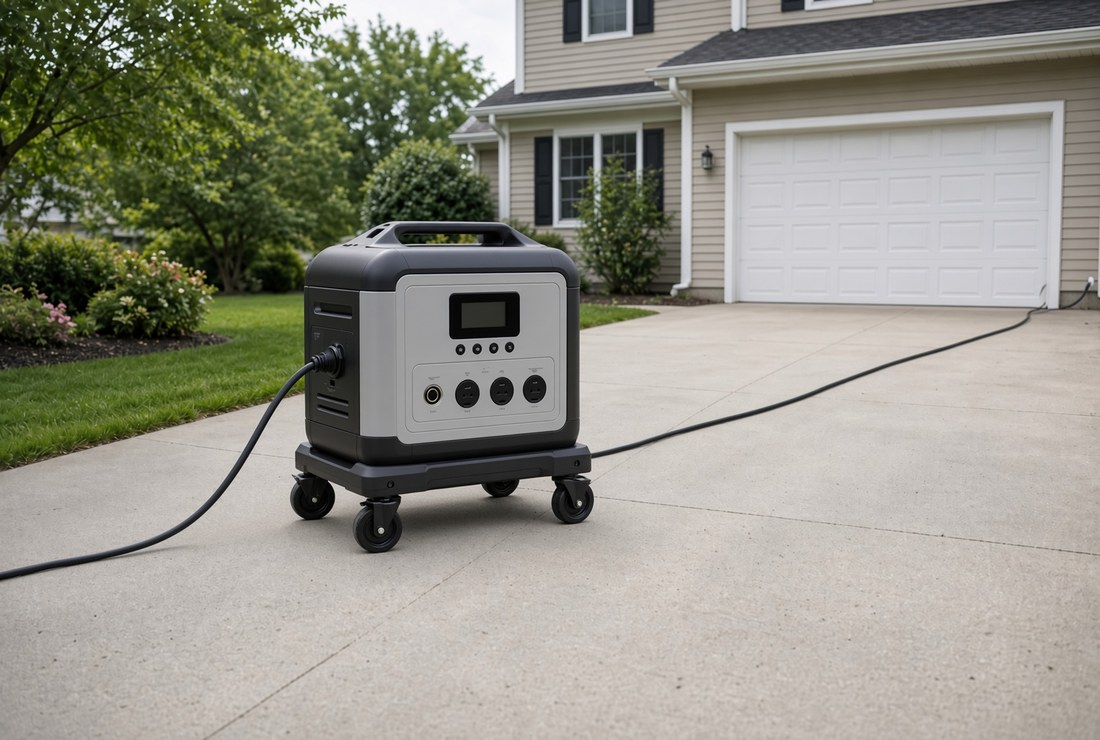
Backfeeding. Plugging a generator into a wall outlet with a double-ended cord — a "suicide cord" — pushes power backwards through your meter and out onto the utility line, where it can be stepped back up to thousands of volts by the transformer on the pole. Linemen have been killed by exactly this. It is also illegal essentially everywhere and voids insurance. The interlock exists solely to make it impossible. Never improvise around this one, no matter who tells you it is fine.
Search: generator interlock kits by panel brand → · Search: weatherproof power inlet boxes →
If you have never mapped what is on which breaker, do that first — it takes one afternoon and it costs nothing. The breaker panel guide walks it through.
The Fuel — And Why Dual-Fuel Wins
Gasoline is a perishable good. Untreated, in a sealed can, it starts going off in three to six months. With stabilizer added when it is fresh, you get twelve to twenty-four months. Stale gasoline is not merely weak; it varnishes carburetors, and the generator that would not start is nearly always a fuel story rather than an engine story.
Propane does not go off. Not in three months, not in ten years. A tank in the corner of the garage is exactly as good the decade after you bought it. It also burns clean, so the engine stays clean.
That is the argument for a dual-fuel generator, and it is the honest recommendation on this page. Keep two or three propane tanks as the fuel that is always ready, and keep some treated gasoline as the fuel with a bit more punch in it. You lose a few percent of the rated output on propane. You gain never once opening a can of varnish in an emergency.
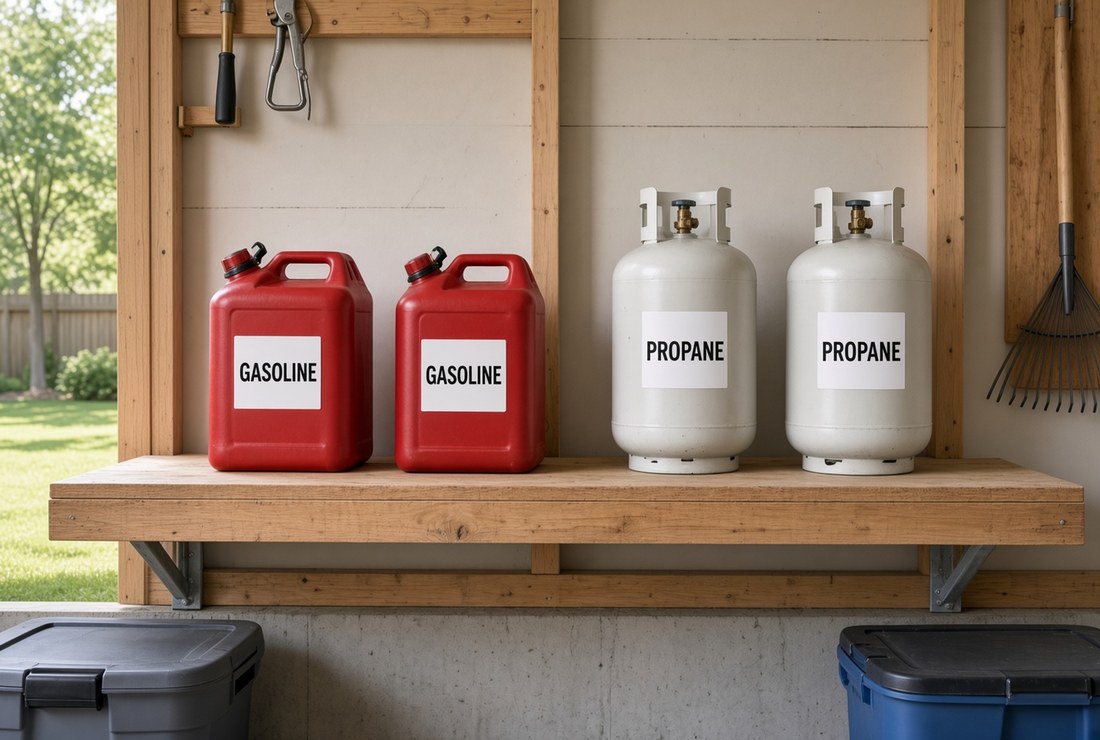
Fuel storage. Store fuel outside the living space, in approved containers only, upright, away from any pilot light, water heater, furnace or electrical panel — and never inside the house. Many local codes limit how much you may keep on a residential property, and those limits vary by town. Propane tanks are stored and used outdoors and are never brought inside, not even briefly. Refuel a generator only when it is off and cool; petrol on a hot muffler ignites.
The Shelf Beside It — Consumables You Cannot Buy Afterwards
Here is the part almost nobody plans for, and it is the part that ends outages.
Generators do not usually fail dramatically. They fail on a fouled spark plug, a clogged air filter, a quart of oil nobody had, or a cord that got run over in the dark. Every one of those is a five-to-twenty-dollar item. And every one of them is unobtainable in the week after a serious storm, because the hardware store has no power either, the shelves that had those parts were emptied on day one, and the roads between you and the next town over are somebody else’s problem for a while. The machine is not the scarce thing after a disaster. The six-dollar part is — along with the person who would fit it, and the road he would have to drive to reach you.
So when you buy the generator, buy the shelf that sits next to it. All of this fits in one plastic tote:
- Two spark plugs. Your manual names the plug and the gap — read it and write both on the tote in marker. A plug is a few dollars and it is the single most common thing standing between a dead engine and a running one.
- Oil, and a funnel. Whatever weight the manual specifies. Small engines hold well under a quart, so one bottle covers a change with some to spare. The funnel matters more than it sounds like it does when you are doing this by flashlight.
- An air filter. These are model-specific, so order it by your model number rather than by eye, and do it now while the internet works.
- A spare cord. Whatever plug your machine uses — and get the heavy one, long enough that the generator sits well clear of the house.
- Fuel stabilizer for the gasoline, and if you run dual fuel, a spare propane hose and regulator. Rubber perishes; the spare costs less than the trip.
- Work gloves, rags and a small funnel-top fuel can. Unglamorous, and you will want all three at two in the morning.
And if you own a second machine, keep it genuinely ready
A spare generator is the best insurance there is against the parts problem — but only if it starts. The machine that has never been run is the machine that will not run. Give it ten or fifteen minutes every three months, under an actual load rather than idling, and you have turned “I have a spare” into “my spare ran last month.”
Store it dry. Gasoline does its damage in the carburetor bowl, where the fuel sits and evaporates and leaves varnish behind, so shut the fuel valve and let the engine stall on its own before it goes away. If the machine is dual fuel, the spare never needs gasoline at all — hook it to a propane cylinder on the day and it starts on a carburetor that has been clean for years. And check the starting battery: electric and remote start need a charged one, and a battery that has sat a year is flat. That is one more reason for the quarterly run, and one more reason to pull the recoil handle once yourself, on a calm day, so you know it works and you know how hard it is.
Search: small-engine spark plugs → · Search: small-engine oil → · Search: generator air filters → · Search: fuel stabilizer → · Search: propane hoses and regulators →
The Panels — What Turns Days Into Weeks
Everything so far gets you days. Solar is what makes the days stop counting down.
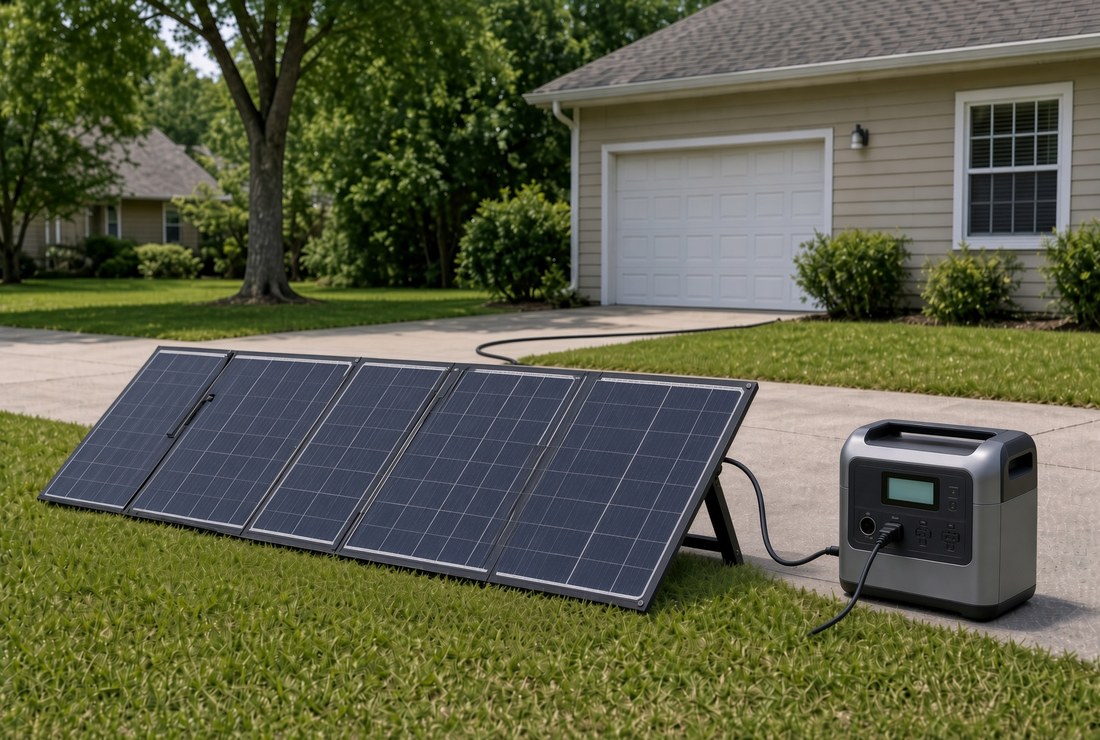
A folding 400-watt portable panel — the kind that unfolds on the lawn, not the kind that gets bolted to a roof — costs $300 to $600 and will put 1.2 to 2.4 kilowatt-hours into the battery on a real day, allowing for clouds and the fact that nobody moves the panel as often as they should. Against a five-kilowatt-hour day, that is a third to half of everything you need, arriving for free, silently, while you are doing something else. It stretches a tank of propane from four days to a week, and two panels can carry a careful house indefinitely in decent weather.
Panels have one gotcha worth printing in bold, because it is expensive and it is invisible on the box:
The Limits — What This Will Not Do
Every page on this site tries to tell you where the honest edge is, so here it is. This system will not run your house the way the grid runs your house. Anything that makes heat or cold out of electricity is a load of a completely different order:
- Central air conditioning — with a soft starter, a good system will start and run it. It will also empty the battery in an hour or two. Air conditioning is an afternoon's relief, not a way of life, and in a serious heat event that is a decision worth making deliberately.
- Electric water heater — 4,500 watts, for as long as it takes. Heat water on the stove, or take short showers on whatever the tank held when the power went out.
- Electric range and oven — no. Cook on propane, outdoors.
- Clothes dryer — no. This is what a line and clothes-pegs have always been for.
- Electric heat of any kind — no. Space heaters are the single fastest way to empty a battery ever devised.
The well pump is fine, and this surprises people. It is 240 volts and it draws hard, but it runs for ninety seconds to fill the pressure tank and then stops. Brief and heavy is exactly what a battery is good at. Same with the sump pump. The pumps have their own page.
The habit that makes it all work is the same habit the rest of this series teaches — decide in advance what you are not going to run. The loads you skip is the page on that, and the cold you already own explains why a full freezer is doing more of this work than you think.
What It Costs — Three Builds
Now I am going to be dull for a page, because this is the part people actually need and the part nobody prints. Three builds, from the one that needs no electrician to the one that runs for weeks. Every figure is a range, because prices move and your part of the country is not mine.
For comparison, a permanently installed standby generator with an automatic transfer switch, professionally fitted, runs from around eight thousand dollars to well past fifteen — plus a gas line, a concrete pad, a permit, and an annual service contract for as long as you own the house. It is a genuinely good machine. It is also a fixture, and it stays when you go.
Why You Buy This at Fifty
Here is the part that belongs to this site rather than to any product.
Every other backup system is a fixture. It is bolted to a pad, plumbed to a gas line, wired into the panel, and when you sell the house it stays and you leave. You paid for it once and you got the use of it until you moved.
Not this. The battery goes in the car. The generator goes in the car. The panels fold up and go in the car. The cords go in the car. What stays behind is one steel plate on the face of a panel and one outdoor outlet — call it seventy dollars of hardware, which the next owner will be delighted to inherit. Everything else follows you to the next house, the smaller house, the apartment, the daughter's spare room. It is the only thing we recommend on this site that you get to buy once and keep twice.
And there is a second reason for the timing that has nothing to do with money. The hard part of Build Two is not the hardware. It is the fortnight of telephone calls — three electricians, two of whom do not ring back, a permit office with a recorded message, an HVAC company that can come a week Thursday, and a delivery that arrives damaged and has to go back. That fortnight is an irritation at fifty-five. At seventy-eight, with the power already off, it is not a fortnight you have.
Buy the battery this year. Buy the generator when it goes on sale. Make the phone calls on a sunny Tuesday when nothing is wrong, and let the electrician come on his own schedule at his ordinary rate. Then the system is simply there, in the corner of the garage, for the next twenty-five years of storms — and the only thing left to do on the night the lights go out is walk to the garage and switch it on.
❓ Plain Answers
The short version of this page, one question at a time — the answer is always the first line.
How much gas does a generator burn running a refrigerator all day?
A 5,000 to 7,500-watt open-frame generator burns roughly twelve gallons a day just to keep a refrigerator cold. Charging a battery with a small inverter generator instead, a careful five-kilowatt-hour day takes about one and a quarter gallons.
What size generator do I need to charge a battery power station?
A 3,000 to 3,500-watt inverter generator will refill a five-kilowatt-hour battery in about an hour and a half. Street prices run $350 to $900.
What should I look for in a battery power station for home backup?
Look for a lithium iron phosphate power station, labeled LiFePO4, and compare three numbers: watt-hours, watts, and whether it does 240 volts. A station in the 2,000 to 5,000 watt-hour range is the working zone for a house.
How much does it cost to install a generator interlock kit?
An interlock kit and inlet box installed by an electrician typically land at $400 to $900, plus $50 to $350 for a permit where one is required. A manual transfer switch runs $1,000 to $2,200, and an automatic one $1,800 to $5,500.
How far from the house should a generator be?
A generator should run outdoors at least fifteen feet from the house, with the exhaust pointed away and the windows on that side shut. Never run one in a garage, shed, covered porch or doorway, and put a battery-powered CO alarm in the bedroom hallway.
Does propane go bad for a generator?
Propane does not go bad, while untreated gasoline starts going off in three to six months, or twelve to twenty-four months with stabilizer added when fresh. That is the argument for a dual-fuel generator.