Some links on this page are affiliate links and we may earn a commission if you buy through one. It costs you nothing extra. Nothing in the safety sections is influenced by it, and we have left out products we would not put in our own house.
📅 The Backup You Buy Like Groceries
Plainly, first. This page is for educational purposes only. BuyItAt50 is not an electrician, not an engineer and not a battery company, and it has no connection to any company that makes or sells anything named here. Products and prices are named only as examples of what was on the shelf when this was written. For your own house and your own equipment, read the manuals that come in the boxes, and ask a licensed electrician where anything is unclear.
Most backup power is sold the way cars are sold. One large number, one large decision, and a man in a polo shirt explaining the financing.
That is no good to a great many of the people who need it most. A widow on a Social Security check does not have five thousand dollars sitting in a drawer. She may very well have a hundred or two left over at the end of the month, most months, if nothing breaks.
So here is a different question. Could somebody buy a real backup the way she buys groceries? A piece at a time, out of the monthly money, with no loan and no installer — and end the year with something that actually keeps her house going when the lights go out?
The answer is yes. But only if the pieces are chosen with that in mind from the very first one, because most backup systems are not built to be bought that way at all. They are built to be bought all at once, and a third of one is worth nothing.
This page gives you two ways to do it. The first is the one to use if you are doing this by yourself. The second is cheaper, and it needs a helper who is handy with tools.
✅ Three Tests Every Piece Has to Pass
Before anything goes on the list, it has to pass three tests. They sound fussy. They are the whole reason this plan works.
One: it has to work on its own the day it comes home. The power does not wait for you to finish. If the storm comes in month three, the pieces from months one and two have to be doing something useful, not sitting in a closet waiting for the rest of the set. A plan that only works when it is complete is a plan that fails whenever the weather is early.
Two: no wiring. Nothing that has to be joined with a wrench, nothing that goes into the walls, and nothing a landlord needs to hear about. Everything plugs in with an ordinary cord, the way a toaster does.
Three: nothing she cannot manage. That rules out a surprising amount of what is sold as home backup. The big rack batteries weigh about ninety pounds each. A lead-acid battery is fifty or sixty. Anything in this plan should be something one careful person can move on a hand truck or a little cart, and even then, the first rule on this site holds — ask for help, and talk to your doctor before taking on any lifting at all.

Hold the usual answers up against those three tests and most of them fall over at once. A standby generator fails the first and the second. A wall of rack batteries fails all three. What passes is smaller, and more ordinary, and it is sold in the same aisle as the camping gear.
🔌 Way One: A Power Station at a Time
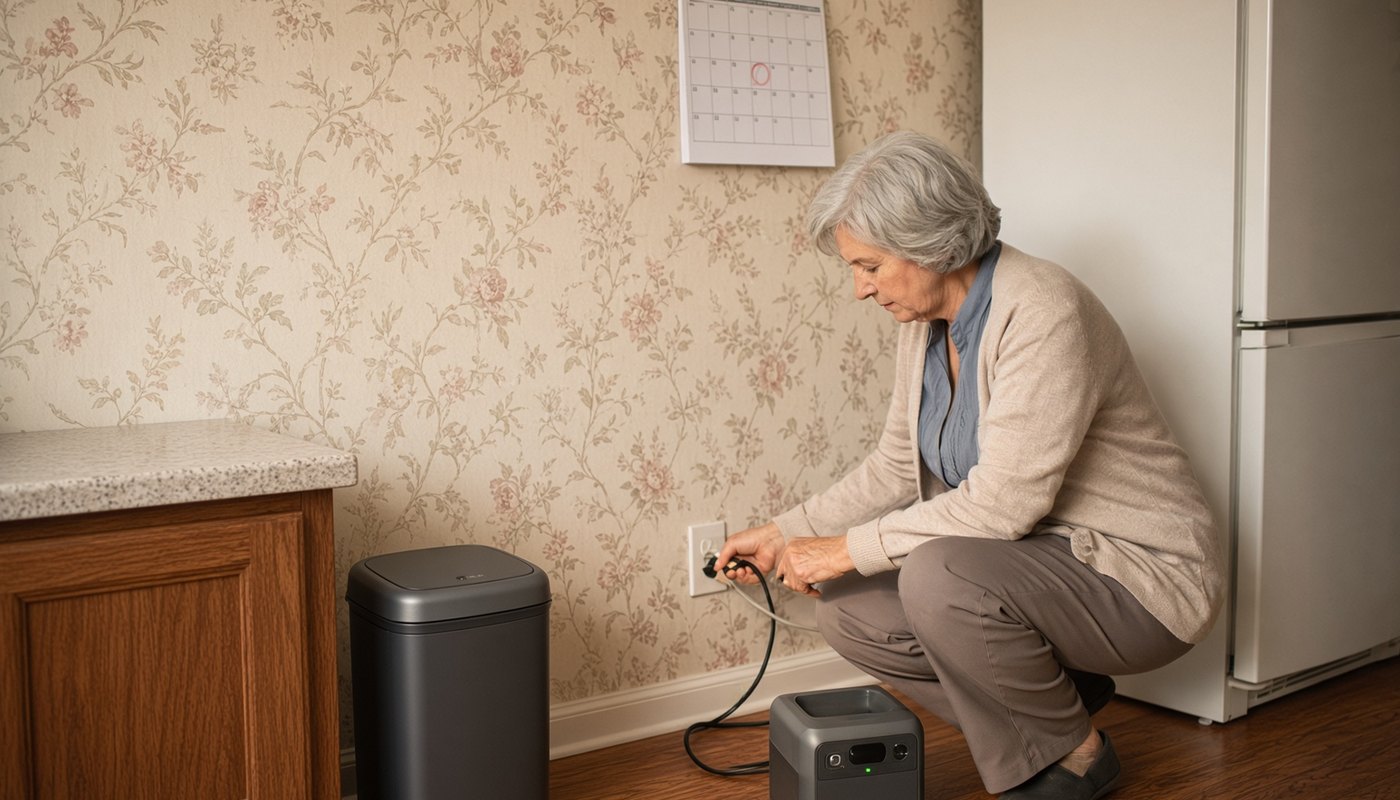
A portable power station is a battery, an inverter and a charger, all packed into one box with a handle on top. It charges from a wall outlet. It has ordinary household outlets on the front. You plug a refrigerator into it and the refrigerator runs. That is the entire instruction manual, very nearly.
For this plan, it is the right piece, because every single one passes all three tests. It works the day it arrives. It needs no wiring. And a one-kilowatt-hour station, which is the size to buy, typically weighs somewhere around twenty-five to thirty-five pounds — heavy enough to respect, light enough to roll on a little cart.
The trick is to stop thinking of them as one big system and start thinking of them as a small battery for each job. One station runs the refrigerator. Another runs the bedroom. Another keeps the internet up. None of them depends on any of the others, and if one fails, the rest never notice.
What to look for on the box
This next bit is a checklist and it reads like one. It is kept plain on purpose, because these are the words to look for on a label, and a label is no place for anybody's jokes.
The Size to Buy, Every Month
📋 The Order to Buy Them In
The order matters more than the brand. Each month's station goes to the job that would hurt most to lose, and the jobs run downhill from there.
| Purchase | Its Job | Why It Comes Here |
|---|---|---|
| First | The refrigerator | It holds food safely only about four hours with no power. Food and any refrigerated medicine live here. |
| Second | The bedroom | A lamp, the phones, a fan, and a CPAP if it has no battery of its own. |
| Third | The living room | The internet router, the television for the news, a second fan. |
| Fourth | The freezer, or a spare | A full freezer holds about 48 hours on its own, so it can wait. After that, a spare to swap in while another recharges. |
| Then | A way to refill them | A folding solar panel, or a small generator. This is what turns one night into a week. |
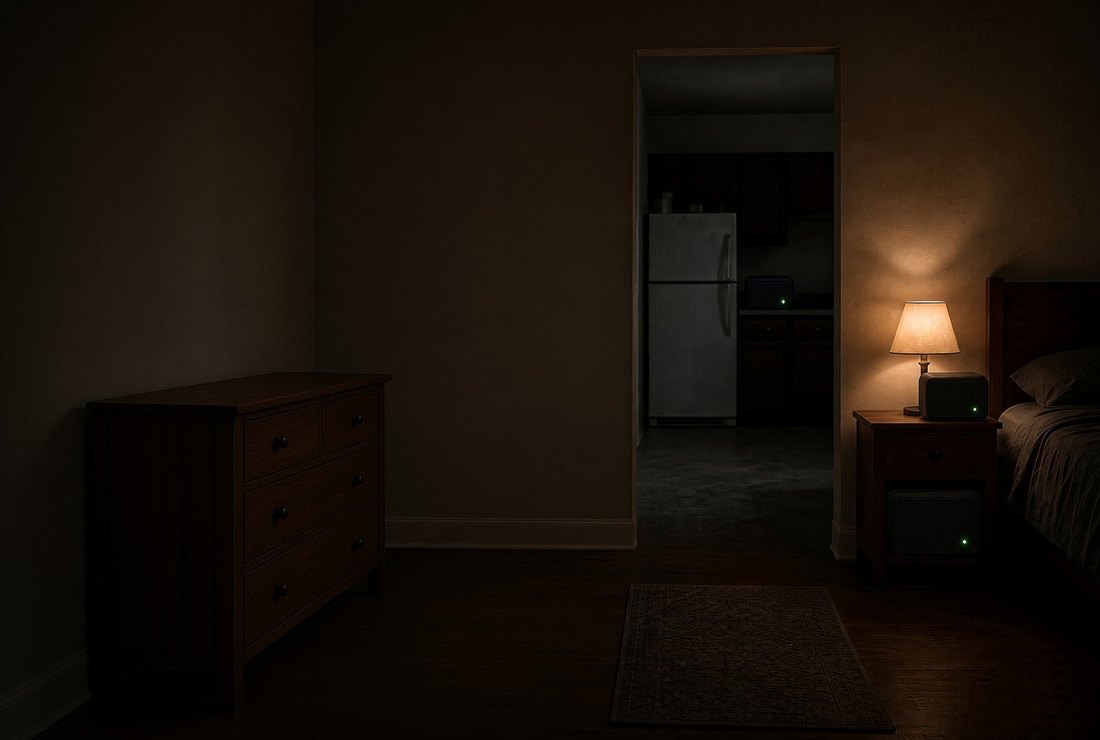
Two things are worth doing before the first station, because they cost next to nothing. Put rechargeable night lights in the hallway, the bedroom and the bathroom — they glow in the ordinary way and carry on by themselves when the power fails, so the house is never a black maze with a rug in it (our night lights page). And put a battery-powered carbon monoxide alarm outside the bedroom, because the day a generator enters this story, it becomes the most important thing in the house.
If a station a month is more than the budget allows — and for plenty of people it will be — buy one every other month, or one a season. The order stays the same. It simply takes longer to reach the bottom of the table, and every step you have taken is already working.
By the end of it, four stations is about four kilowatt-hours of storage spread through the house. That is a refrigerator, a bedroom and a living room carried through a night with room to spare, and, with some way to refill them, carried through a good deal more than one night.
💵 What One Costs This Month
Here are three that were on Walmart's website in September 2026, all about the right size and all lithium iron phosphate. Check the "sold and shipped by" line on any listing, because on Walmart.com it is often the maker's own store rather than Walmart itself, and that decides who handles a return. They are examples, not endorsements, and the prices will have moved by the time you read this.
| Station | Storage | Output | Listed Price |
|---|---|---|---|
| Bluetti AC180 | 1,152 Wh | 1,800 W, 2,700 W surge | $449 (was $579) |
| EcoFlow DELTA 2 Lite | 950 Wh | 1,800 W | $478.99, with a 110 W solar panel |
| Anker SOLIX C1000X Gen 2 | 1,024 Wh | 2,000 W, 2,400 W surge | $549.99 (was $799.99) |
So the going rate for a good one-kilowatt-hour station is somewhere around $450 to $550, and four of them over four months is somewhere around $1,800 to $2,200.
Two honest notes on that.
First, the "was" prices are real, and so are the sales. These stations go on sale often and deeply. A person buying one a month has an advantage nobody else in the store has: she does not have to buy this month. If the price is high, she can wait for the next sale and buy two. That is a patience discount, and on a fixed income it is worth more than a coupon.
Second, per kilowatt-hour, this is the dear way to do it. Every one of those boxes carries its own inverter, its own charger and its own safety testing, and you pay for all of that four times over. That is precisely what makes it safe for one person to set up with no tools — but it is not the cheapest storage there is. The cheaper way is next.
If you would rather search than walk the aisles: 1,000 Wh LiFePO4 power stations with UPS mode · folding solar panels for power stations · rechargeable power-failure night lights · battery-operated CO alarms.
☀️ Filling Them Back Up
A battery is a bucket. It does not make anything. Every one of these stations is full on the first night of an outage and empty some while after, and what happens after that depends entirely on what you have to fill it with.
From the wall, between storms. This is the easy part. In UPS mode they simply stay plugged in and stay full, waiting.
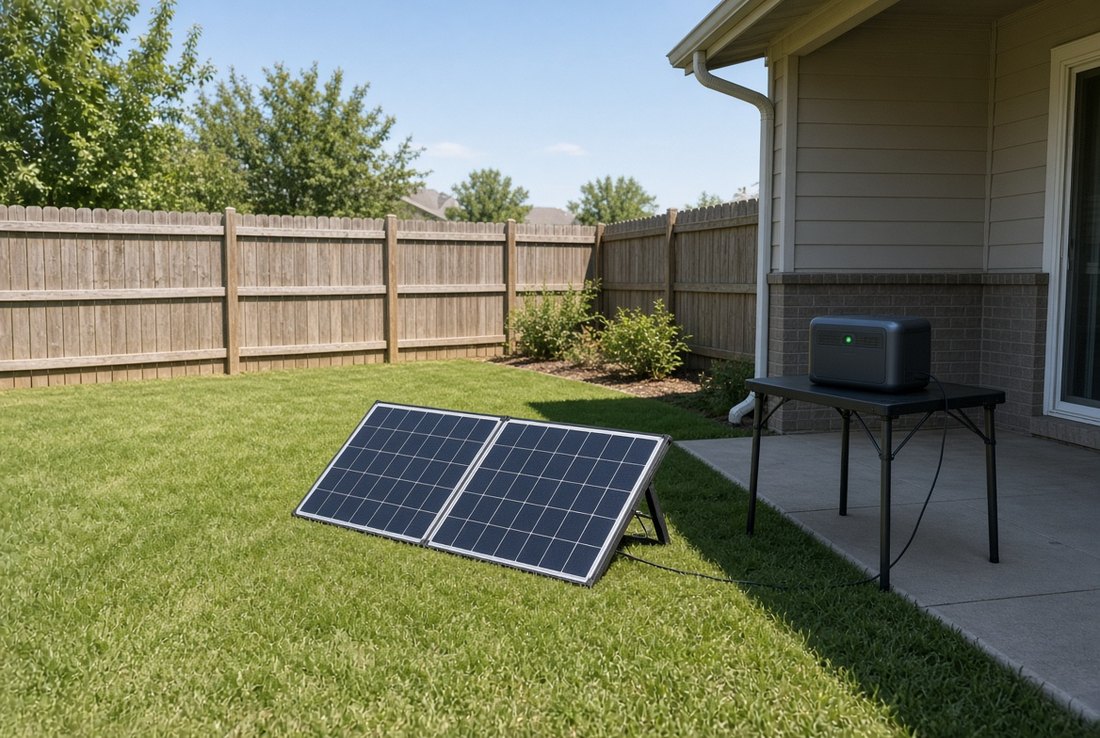
From a folding solar panel. A portable panel of a hundred or two hundred watts, laid out in the yard on a clear day, puts back a useful part of a station's charge by evening. Not all of it, on most days, and very little under cloud. But it is silent, it burns nothing, it needs nobody to go out with a gas can, and it is the one refill method that still works in the third week. One of the stations above comes with a small panel already in the box.
From a small generator, by day. This is your day-shift, night-shift idea from the poor man's battery backup, and it works exactly the same way here. The generator runs in the daytime, outside, at least twenty feet from the house. The stations plug into it, one or two at a time, and fill up. At dusk the generator goes off and the stations carry the night.
And here is why the adjustable charging rate matters. Some of these stations can pull well over a thousand watts from whatever they are plugged into while charging at full speed. That is wonderful from a wall outlet. From a small generator, two of them charging flat out at once can be more than the generator can give, and it will stall or trip. Turn the charging speed down in the settings when the station is on the generator, and charge them one after another rather than all together. It takes a little longer. It works.
Carbon monoxide. The U.S. Consumer Product Safety Commission says to run a portable generator outside only, at least twenty feet from the house, with the exhaust pointed away from the home and away from doors, windows and vents. Never in a garage, even with the door open. Have battery-powered or battery-backup CO alarms outside every sleeping area and on every floor, and test them monthly.
🔋 Way Two: The Brick Bank, With a Helper
The second way is cheaper for the storage, and it comes with a condition that has to be said at the top: somebody has to wire it. Not an electrician, necessarily. But a son, a neighbour, a friend from church who has put a battery in a boat and knows what a fuse is for.
The pieces are the ones on the poor man's battery backup page. An inverter, a charger, and 12-volt lithium iron phosphate batteries — the ones that look like car batteries, weigh about twenty-something pounds, and in September 2026 were listed at about $126 to $260 each on Walmart's website. One of them holds about as much as one of the power stations above, for a fraction of the price.
So you would think the plan writes itself. Inverter and charger and one battery in the first month, then one more battery every month after that, for a year.
It does not, and the reason is in the battery makers' own instructions.
LiTime, one of the larger makers of these batteries, says to connect in parallel only batteries of the same specifications, capacity and age; to fully charge each one on its own before connecting them together; that most of its batteries allow no more than four in parallel; and that batteries added to a bank are best bought within about a month of the original ones. Other makers say much the same. A bank of batteries is a team, and a team works best when everybody on it is the same age and started on the same day.
That changes the plan, and it is better to know now than after the fourth battery.
With the brick bank, the monthly part is the saving, not the buying. Put the money aside every month in an envelope marked for it. Buy the inverter and the charger first, and the first battery with them, so there is a working system from the start. Then, when the envelope holds enough, buy the rest of the bank — up to four batteries in all — at the same time, the same make and the same model, and have your helper connect them together in one afternoon.
Four 12-volt, 100 amp-hour batteries is about five kilowatt-hours. That is more than four power stations hold, for a good deal less money. The price is that it all lives in one place, it is wired together, and somebody who knows what they are doing has to do the wiring.
If you build the brick bank: follow the battery maker's and the inverter maker's manuals exactly. Use batteries of the same make, model, capacity and age. Charge each one fully on its own before connecting them. Do not exceed the number the maker allows in parallel. Put a fuse on the positive cable as close to the batteries as the manual says. Do not charge lithium iron phosphate batteries below freezing unless they are made to allow it. And never connect the inverter to a wall outlet or to the house wiring.
⚖️ The Two Ways, Side by Side
Here is the choice laid flat, so it can be made at the kitchen table rather than in the store.
| A Station at a Time | The Brick Bank | |
|---|---|---|
| Wiring | None. Plug in and go. | Yes. Needs a handy helper. |
| Truly one a month? | Yes. Each one stands alone. | Save monthly; buy the batteries together. |
| Four units hold about | 4 kWh | 5 kWh |
| Rough total | About $1,800–$2,200 for four | About $850–$1,700 with inverter and charger |
| Where it lives | Spread through the house, one per job | One place, with cords run from it |
| If one part fails | The others carry on | If the inverter fails, it all stops |
| If you move | Put them in the car | Unhook it, then put it in the car |
The brick bank total is the inverter and charger ($260–$500), four batteries ($500–$1,040), and the fuse, cables and cord (about $95–$190), all at the prices on the poor man's page.
So the honest summary is short. If you are doing this alone, buy the stations. You will pay more for each kilowatt-hour, and every dollar of the difference is buying you the right to do the whole thing yourself, with no tools, in any order, a month at a time. If you have a good helper and can save up for the batteries, the brick bank gets you more for less. Neither one is the wrong answer. The wrong answer is waiting until you can afford the big one.
⚠️ The Mistakes That Undo It
These are written flat, because every one of them is a way to get hurt or to waste the year's money.
Never plug a power station, an inverter or a generator into a wall outlet to power the house. It can send power back out onto the lines, where it can electrocute the utility crews working to restore your power. Everything in this plan connects by cord, straight to the appliance. The only safe connection to house wiring is a transfer switch or interlock installed by a licensed electrician.
Do not plug one power station into another to "add them together." They are not designed to be chained, and doing it can damage both. Each station runs its own jobs. Some makers sell an extra battery that plugs into the side of their own station, which is the one way to make a single station bigger — and only with that maker's matching part.
Do not run a space heater, a hair dryer or an electric kettle from a station unless you have done the arithmetic. Anything that makes heat from electricity empties a one-kilowatt-hour battery in well under an hour.
Do not lift what you should not lift. A one-kilowatt-hour station weighs roughly twenty-five to thirty-five pounds. Use a cart, keep it low, and ask for help. Talk to your doctor before taking on any lifting, carrying or bending described on this page.
And the quiet mistake, the one that costs nothing and ruins everything: never trying it. Once each station is home, pick a mild evening and run its job from it overnight with the power still on. In the morning, look at what is left on the screen. That number is the only one on this page that is really about your house.
❓ Questions People Ask
Can I build a home battery backup a little at a time?
Yes, if every piece works on its own the day it arrives. Portable power stations do: each is a battery, inverter and charger in one box, and each can run a refrigerator or a bedroom by itself. Buying one about every month or two, in order of importance, builds a real backup over a year with no wiring and no installer.
What size power station do I need to run a refrigerator overnight?
About 1,000 watt-hours, with at least 1,500 watts of continuous output and a higher surge rating for the compressor. A typical refrigerator uses roughly 500 to 800 watt-hours over a twelve-hour night; the yellow EnergyGuide label on yours gives the yearly figure to divide down.
How much does a 1,000 watt-hour power station cost?
In September 2026, three lithium iron phosphate stations of about that size were listed on Walmart's website at $449 to $549.99, and they go on sale often. Prices change, so check before buying.
Can I add 12-volt lithium batteries to my bank one at a time?
Battery makers advise against it. LiTime, for example, says to connect in parallel only batteries of the same specification, capacity and age, to fully charge each one before connecting them, that most of its batteries allow no more than four in parallel, and that added batteries are best bought within about a month of the originals. The practical approach is to save monthly and buy the batteries for the bank together.
Can I charge a power station from a portable generator?
Yes. Most can charge from a generator's ordinary outlet. Some pull well over a thousand watts while charging at full speed, so turn the charging rate down in the settings and charge one station at a time on a small generator. Run the generator outside, at least twenty feet from the house.
What safety listing should a portable power station have?
Look for UL 2743, the UL standard for portable power packs made of batteries in an enclosure and intended as a power source when grid power is not available. If the listing or manual does not mention it, ask the seller before buying.
💰 Why This Is a Fifty-Year-Old's Errand
There is a particular kind of plan that only works if you start it early, and this is one of them.
A station a month is easy to start and slow to finish. At fifty-five, with a paycheck still coming, a person can buy the first one on a Saturday without thinking twice, and have all four before the next storm season. At seventy-five, on a fixed income, the same plan takes a year or two, and every one of those months is a month the refrigerator is not covered.
The best time to buy the fourth station is before you need the first one.
Prices do not help, either. Every piece on this page will cost more next year than it does this year. That is not a guess. It is the only direction prices have ever gone.
And there is the part nobody puts on a price tag. A person who owns four small stations, knows which one runs what, and has run each of them for a night on purpose, is a person who can sit through a storm in her own house instead of waiting in a shelter for somebody to decide when she can go home. That is the thing being bought here, a piece at a time.
So the errand is simple. Buy the night lights and the CO alarm this week. Put the first station on the refrigerator this month. And write the other three on the calendar, one to a page, so that the plan is still there on the day the money is.
Sources: power station prices and specifications are from Walmart's listings for the Bluetti AC180, the EcoFlow DELTA 2 Lite and the Anker SOLIX C1000X Gen 2, and 12-volt battery prices from Walmart's 12V 100Ah LiFePO4 best-seller list, all as of September 2026. The scope of UL 2743 is from UL Solutions. The parallel-connection rules for 12-volt lithium batteries are from battery maker LiTime. Refrigerator and freezer food-safety times are from FoodSafety.gov. Generator placement and CO alarm guidance are from the U.S. Consumer Product Safety Commission. The backfeeding warning is from Safe Electricity, the Energy Education Council's program with University of Illinois Extension. Station weights and refrigerator energy use are the site's own round figures; your own labels and manuals give the real ones.