Some links on this page are affiliate links and we may earn a commission if you buy through one. It costs you nothing extra. Nothing in the safety sections is influenced by it, and we have left out products we would not put in our own house.
🔌 The Engine Works Days. The Batteries Work Nights.
Plainly, first. This page is for educational purposes only. BuyItAt50 is not an electrician, not an engineer and not a battery company, and it has no connection to any company that makes or sells anything described here. It explains published safety guidance and manufacturers' own instructions in plain words. For your own house, your own equipment and your own circumstances, read the manuals that came in the boxes, and ask a licensed electrician where anything is unclear.
There are two ways to get through a week without power, and most people only ever hear about one of them.
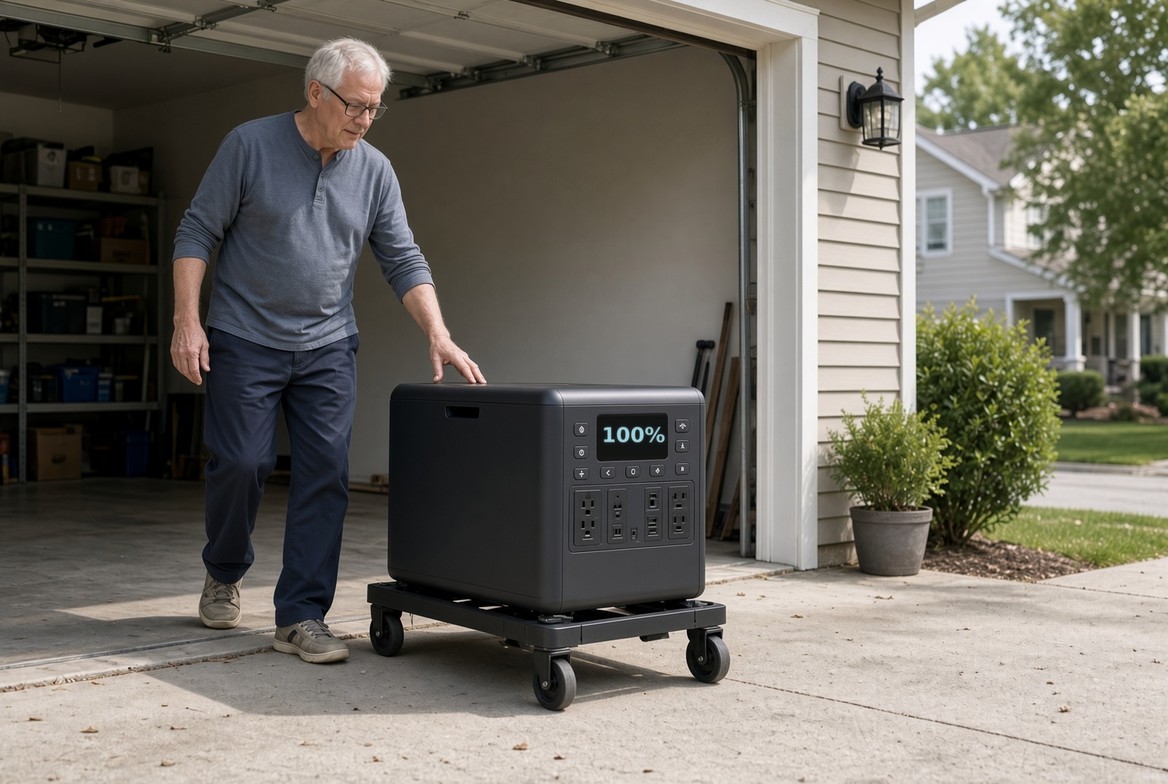
The one they hear about is the big one. A standby generator on a concrete pad, or a lithium power station the size of a filing cabinet with a price to match. Both of them work. Both of them cost somewhere between a good used car and a fair slice of one, and a man on a pension is entitled to look at those numbers and say no thank you.
The other way is older and cheaper and not nearly as handsome. You already have a small generator, or you mean to get one. It runs during the day, when you are awake and can keep an eye on it. It keeps the refrigerator cold, and while it is doing that it fills up a few batteries sitting in the garage. At dusk you shut it off.
Then the batteries take the night shift.
They keep the refrigerator going while you sleep. They keep a few small lights burning so the hallway is not a black hole with a rug in it. They keep the alarm panel awake and the phones charged. And the whole time, the engine is sitting outside, cold and quiet, burning nothing.
That is the poor man's battery backup. It is not a new idea. People living on boats and in the back country have run their lives on it for longer than most of us have been alive. It is simply an idea that got forgotten about the day somebody learned to sell a whole-house generator on the installment plan.
Here is what it is for, so there is no disappointment later. Food cold. Lights on. A quiet evening. A decent night's sleep. That is the whole list.
Here is what it is not for. It will not run the air conditioner, the furnace, the electric water heater, the electric stove or the clothes dryer, and nothing on this page is going to pretend otherwise. Those are the big loads, and they are what the generator is for in the daytime, if they are for anything at all. On city water you do not even have a well pump to worry about, which takes the one hard job left off the list.
If you want the bigger, better, more expensive version — the one that runs a house for weeks — it has its own page: the battery with an engine behind it. This is the version for everybody who read that page, did the sum, and put it down again.
🌙 What One Night Actually Takes
Most people buy batteries the way they buy a sack of potatoes. They look at the size of the sack, decide it seems like plenty, and find out later.
A better way is to add up the night first. It takes ten minutes and a pencil, and it is the difference between a system that works and a very heavy disappointment.
Now I am going to be dull for a little while, and I would be obliged if you let me. These are the numbers that decide how many batteries you need. They are written plain, in the order they matter, and each one tells you where to find the real figure for your own house instead of trusting mine.
| Load | About a 12-Hour Night | Where Your Real Number Is |
|---|---|---|
| 🧊 Refrigerator | 500–800 watt-hours | The yellow EnergyGuide label. Divide the yearly kWh by 365, then by two for a night. |
| 💡 Six LED night lights | About 50–100 watt-hours | The watts printed on the light, times the hours. |
| 🚨 Alarm panel | Often nothing — see below | The panel's manual, under “standby battery.” |
| 📱 Two phones | About 30 watt-hours | Close enough for any phone made this century. |
| ⚙️ The inverter itself | About 100–150 watt-hours | The spec sheet, under “no-load” or “idle” current. |
| 😴 CPAP, humidifier off | 300–450 watt-hours, if it runs from the bank | Our CPAP battery calculator. |
| Total, without the CPAP | About 0.7–1.1 kilowatt-hours | Your own column, added up. |
That is the dull part done. Now we can talk like people again.
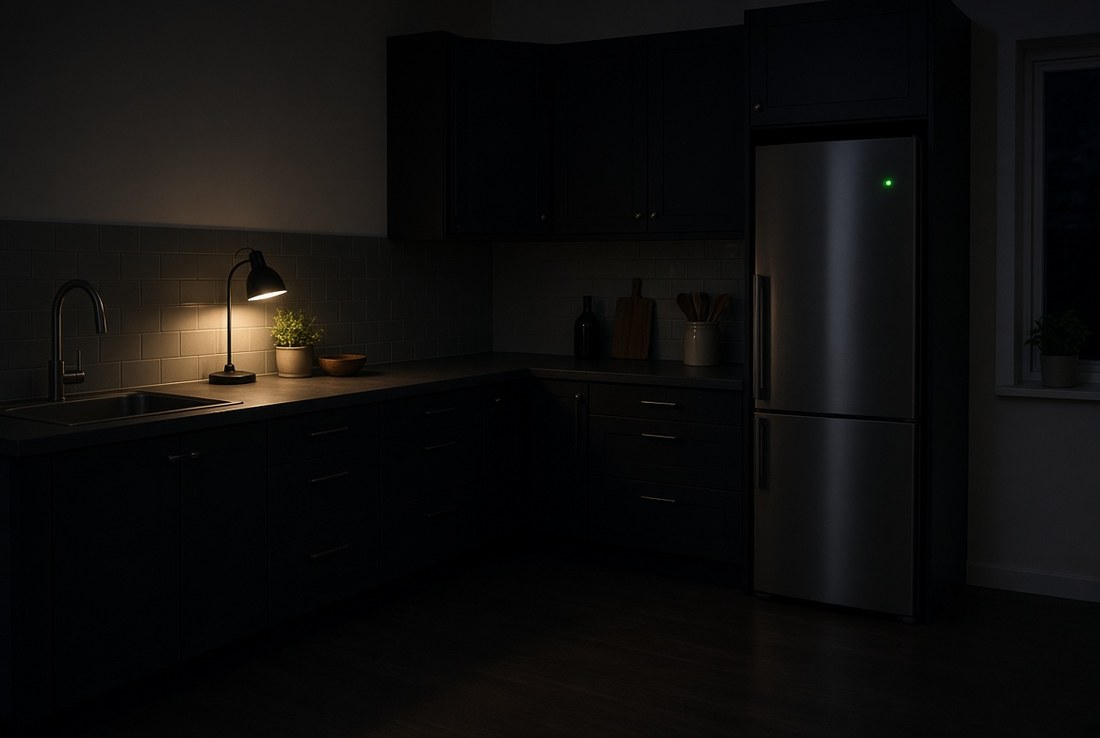
Look at the table and one line is doing nearly all the work. The refrigerator is the night. Everything else put together is a rounding error beside it. So the refrigerator is where the arithmetic starts, and the yellow sticker on it is the best free information in the house. Most people have never read it. Most people have walked past it a thousand times on the way to the milk.
Why the refrigerator needs power at night at all is worth a word. FoodSafety.gov says a refrigerator with its door kept shut holds food safely for about four hours without power. A night is three times that. A full freezer does far better — about forty-eight hours closed, twenty-four if it is half full — which is why a freezer kept full is doing a good share of this job for you already. The refrigerator is the one that cannot wait for morning.
The alarm panel is the pleasant surprise. Most burglar-alarm panels have a small standby battery of their own inside the metal box, put there precisely so the panel keeps working when the lights go out. How many hours it gives you is in the manual. If it covers the night, the panel comes off the list entirely. If it is an old panel whose battery has not been changed since it was put in, that is a ten-minute job worth doing this month, not in the dark. We have a page on alarm systems if you are starting from nothing.
The CPAP deserves its own paragraph, because it changes the answer more than anything else on the list. Many CPAP machines have a battery made for them — on some it is sold separately, on a few it comes in the box. If yours has one, it carries itself through the night and the bank only has to recharge it in the daytime while the generator runs. If it does not, it is the second-biggest load you have, and it wants a direct 12-volt cord to the battery rather than going through the inverter. How to find out whether yours has one, in five minutes.
So for most households the night comes to somewhere around one kilowatt-hour. Keep that number in your pocket. The rest of this page is about how to carry it.
🕯️ The Lights Are the Cheap Part
The reason people want lights in an outage is not so they can read. It is so they can get to the bathroom at three in the morning without meeting the ottoman.
A house with no power in it is a different house. Every rug is a rug you forgot about. Every doorway is a step you are guessing at. And a fall at seventy is not the same event as a fall at forty — it is the event that decides a good many things afterwards.
The good news is that the light that solves this is almost free to run. A small plug-in LED night light draws about a watt, and some draw less. Six of them burning all night use less power than the refrigerator uses in half an hour.
The better news is that you may not need the batteries for them at all. Rechargeable night lights plug into the wall like any other, glow in the ordinary way, and simply carry on by themselves when the power fails. They cost a few dollars more than a plain one, they never need to be switched on, and they work whether the bank is charged or not. Put one in the bedroom, the hallway and the bathroom and that part of the problem is solved before the storm is even named. Our night lights page goes through the kinds, and the emergency lighting guide covers the rest of the house.
So the lights come off the bank as well, or nearly. Which leaves the refrigerator and a few odds and ends, and that is a job a few batteries can actually do.
🔋 Lead-Acid: The Old Workhorse, Told Honestly
The lead-acid battery is the oldest rechargeable battery there is. It started cars before most of our grandparents were born, and it has been doing the same work in the same black box ever since, with no fuss and no great improvement.
It has three virtues. It is cheap. It is everywhere. And it is forgiving in a way that newer things are not — it will charge in a cold garage, it does not care much which charger you use, and every auto parts store in the country knows what to do with a dead one.
The one you want is a deep-cycle battery, usually sold as a marine or RV battery. It is not the same thing as a car battery, though it looks the same and sits on the next shelf. A car battery is built to throw a great deal of current for a few seconds to turn an engine over, and then be topped up again at once. Drain it deep, night after night, and it does not last long. A deep-cycle battery is built for exactly that kind of night.
As of September 2026, Walmart lists a group 24 deep-cycle marine battery at $99.84, rated at 101 amp-hours, and a larger group 29 at $129.84 and 114 amp-hours. Other stores are in the same neighbourhood. Prices move, and they will have moved by the time you read this, and not downwards.
The rule that decides how many you buy
Here is the fact the price tag leaves out. You only get to use about half of it.
A 100 amp-hour, 12-volt battery holds about 1,200 watt-hours on paper. Trojan Battery, which has been making deep-cycle batteries since the 1920s, recommends discharging them only twenty to fifty per cent for the best life, and never beyond eighty. Drain a lead-acid battery flat regularly and it will still work, for a while. Then it will not.
So a 100 amp-hour lead-acid battery is really a 600 watt-hour battery that happens to weigh as much as a 1,200 watt-hour one. Hold that against the one-kilowatt-hour night from the table, and the answer comes out on its own:
- Two batteries carry a careful night, with nothing to spare.
- Three carry it comfortably, with room for a warm evening when the refrigerator runs more.
- Four if a CPAP with no battery of its own is on the bank too.
Buy them at the same time, the same make and the same size, and wire them together as the inverter's manual shows for the voltage it wants. Mixing an old battery with new ones drags the new ones down to the old one's level. They are like a team of mules that way.
Flooded or AGM
The cheap ones are flooded — liquid acid inside, with caps on top. They give off gas while they charge, which decides where they are allowed to live (see below), and some want topping up with distilled water now and then.
The dearer ones are AGM — sealed, no liquid to spill, no water to add, far less gas. They cost noticeably more for the same size and they are the better choice if the batteries have to be anywhere near where people live. Either kind does the job.
What lead-acid does not do well
Every page on this site tries to say where the honest edge is, and lead-acid has three.
It is heavy. Deep-cycle batteries in these sizes commonly weigh somewhere between forty-five and sixty-five pounds each. Three of them is a hundred and fifty pounds or more of lead, and that is not a small thing to be moving about at any age.
It is slow to fill the last of the way. A lead-acid battery takes charge quickly while it is low and then slows right down as it gets near full. The last fifth can take hours. In a long outage, with a generator running only by day, that matters, and there is more about it in the day shift.
It hates being left half-charged. Trojan says it outright: a lead-acid battery kept in a partial state of charge grows lead sulfate on its plates — sulfation — and loses capacity it does not get back. A battery that sat half-empty in the garage from one hurricane season to the next is not the battery it was. Between storms it wants a small charger keeping it topped up, which is the subject of the last part of this page.
⚖️ The Brick That Changed the Arithmetic
I would be doing you a poor turn if I left this part out, because it is the part the lead-acid videos do not mention.
A few years ago a lithium battery for this kind of work cost several times what lead-acid cost, and the sensible answer for anybody on a fixed income was lead-acid and no argument. That is not true any more.
The kind to look at is a 12-volt, 100 amp-hour lithium iron phosphate battery — LiFePO4 on the label. It is the same shape as a lead-acid battery and it drops into the same place. In September 2026 Walmart's best-seller list for that exact size ran from about $126 to $260 a battery, with the well-known premium brands far above that.
Here is why that price matters more than it looks.
- You get to use nearly all of it, not half. So one lithium battery does about the work of two lead-acid batteries.
- It weighs roughly a third to a half as much as a lead-acid battery of the same size — typically twenty-something pounds rather than fifty-something.
- It takes charge fast, right to the top, which is exactly the thing lead-acid does badly with a generator running only by day.
- It does not sulfate sitting in the garage, and the makers rate them for thousands of cycles rather than hundreds.
Put those together and one lithium battery at $130 to $260 is competing with two lead-acid batteries at about $200. On a good day it is cheaper for the same night. On any day it is a great deal lighter.
Its own honest edges
It must not be charged below freezing. Lithium iron phosphate is charged between about 32°F and 113°F by the makers' own figures. Many now have a built-in low-temperature cut-off that refuses to charge when it is too cold, which is a safety feature and also a nuisance in an unheated garage in January. In the northern half of the country, that is a real reason to keep the batteries somewhere that stays above freezing, or to choose lead-acid.
It wants a charger with a lithium setting. Most modern multi-stage chargers have one. An old lead-acid charger from the back of the shed may not, and should not be used on it.
The cheapest ones are made by companies you have never heard of, sold under names that change from year to year. Buy from a store that takes returns, keep the receipt, and do not buy the cheapest one on the page simply because it is the cheapest one on the page.
Read the line that says “Sold and shipped by.” A good many of the cheap ones on a big store's website are not sold by the store at all. They come from outside sellers using the store's shelf space, and that decides who takes the battery back and who honours the warranty if it fails. It is one line on the listing, usually just under the price, and it is worth the ten seconds.
Do not believe the cycle count on the box. Some of the cheapest listings promise fifteen thousand cycles. That would be one full charge and discharge every day for over forty years, and nobody has tested a battery that sells for a hundred and thirty dollars for forty years. A few thousand cycles is the honest expectation, which is still many times what a lead-acid battery gives. And look at how many reviews there are, not just the stars: seventy-nine people saying four stars is information, and nine people saying it is a rumour.
So which one? If you can lift it, can keep it above freezing, and are buying new, the lithium battery is now the better buy for most people, and often the cheaper one per night. If the garage freezes, if you already own good deep-cycle batteries, or if you need something off the shelf in town this afternoon, lead-acid still does the job it has always done. The system around it is the same either way, and that system is the real subject of this page.
🔧 The Rest of the Kit
A battery on its own is a very heavy paperweight. It stores 12-volt direct current, and a refrigerator wants 120-volt alternating current out of a wall socket. Three more pieces close that gap.
This next part is a shopping list and it reads like one. I have kept it plain on purpose, because these are the numbers you take to the store, and the store is no place to be decoding somebody's jokes.
What Goes With the Batteries
That is all of it. No transfer switch, no interlock plate, no electrician, no permit, no hole in the wall.
The joining-up is simple 12-volt work, but it is heavy current, and heavy current does not forgive a loose nut or the wrong-sized wire. Follow the inverter's manual exactly, and if you have not done this kind of thing before, do it the first time with somebody who has. There is no shame in that. It is how everybody who knows how to do it learned.
The fuse is not optional. A 12-volt battery can deliver enough current into a short circuit to melt a wrench and set a cable on fire. The fuse or breaker goes on the positive cable, as close to the battery as the inverter's manual says, and it is sized to the manual's figure. Put it in before anything is connected to anything else.
☀️ The Day Shift
This is the part of the plan that makes it cheap, and it is worth understanding properly.
In the morning the generator goes out to where it lives, at least twenty feet from the house, and starts. It runs the refrigerator, which cools right down again after the night. It runs the coffee maker, the television, the fan — whatever you have decided to allow. And in the corner of all that, quietly, it runs the battery charger.
A 40-amp charger draws somewhere around six or seven hundred watts from the generator. Beside a refrigerator and a few small things, a modest generator does not even notice.
At dusk, you stop. The refrigerator's cord moves from the generator to the inverter. The generator is shut off and left to cool, and you go in and have your evening.
That is the whole of the daily routine, and it answers two questions nobody asks until the second night. Who is going out to put fuel in the thing at two in the morning? Nobody, because it is not running. How much gasoline does a night of refrigerator cost? None at all. It was paid for in the afternoon, at the generator's most efficient load, in a battery.
How long the batteries take to fill
Honestly, this is where lead-acid shows its age.
A lead-acid bank that used half of itself overnight takes the first part of its charge back quickly — a few hours at full current. Then the charger slows down on purpose, because that is what the battery needs, and the last stretch to full can take several more hours. A generator running from breakfast to supper will get it most of the way back, day after day. It may not get it all the way.
For a night or two that makes no difference at all. Over a long outage it is the reason to have three batteries rather than two, and the reason to give them a long, full charge the day the power comes back. A lithium bank does not have this problem — it takes nearly full current almost to the top, and a day's running fills it with room to spare.
Carbon monoxide. The U.S. Consumer Product Safety Commission says to run a portable generator outside only, at least twenty feet from the house, with the exhaust pointed away from the home and away from doors, windows and vents. Never in a garage, even with the door open. Never in a shed, a carport or a porch. Carbon monoxide has no smell and no colour, and it kills people in their sleep. Have battery-powered or battery-backup CO alarms outside every sleeping area and on every floor, and test them monthly.
Never plug the generator or the inverter into a wall outlet. Connecting either one to the house wiring through an outlet can send power back out through the lines to the street — called backfeeding — where it can electrocute the utility crews working to restore your power, or your neighbours. The only safe connection to house wiring is a transfer switch or interlock installed by a licensed electrician. In this plan, everything connects by cord, straight to the appliance.
🏠 Where the Batteries Live
Batteries are not dramatic things, which is exactly why people get careless with them.
They sit in a corner for a year and nothing happens, and so the corner gets more crowded, and somebody leans a rake on them, and a grandchild finds them interesting. None of that matters until the day it does. Where they live is the one decision that keeps it from ever mattering.
This part is written flat and it is going to stay flat.
Flooded lead-acid batteries give off hydrogen while they charge, and hydrogen explodes. OSHA's rule for battery charging is that ventilation shall be provided to diffuse the gases and prevent an explosive mixture from building up, and Trojan's own guide says to charge in well-ventilated areas with the vent caps in place. That means a ventilated garage or an outbuilding — never a bedroom, a closet, a cupboard or a sealed box. No sparks, flames or cigarettes near them while they charge. Sealed AGM and lithium batteries give off far less or none in normal use, but the same common sense applies: not in a closed cupboard, and not in a room where people sleep.
Do not lift a battery by yourself. A deep-cycle lead-acid battery commonly weighs forty-five to sixty-five pounds, and it is dense, awkward and full of acid. Treat every one as a two-person job. Place them once, on a low, sturdy surface near where they will be used, so they never have to be carried again. Talk to your doctor before taking on any lifting, carrying or bending described on this page.
Battery acid burns. Wear safety glasses and gloves when handling flooded batteries or checking their water. Keep baking soda and water nearby for spills. Keep batteries away from children and pets.
Past the warnings, the good news is this. Nothing in this plan touches the house. There is no wiring into the walls, no plate on the panel, nothing screwed to anything. If you rent, the landlord never needs to hear about it. If you move, it goes in the back of the car. The batteries live in the garage, the inverter sits beside them, and one cord runs from the inverter to the refrigerator, or from the garage through the door to wherever the refrigerator is.
📅 The Other Three Hundred and Sixty Days
Here is the thing about backup power that nobody likes to hear. It spends almost its whole life doing nothing, and doing nothing is what ruins it.
A lead-acid battery left alone slowly empties itself. Trojan's guide says a stored flooded battery should be checked every four to six weeks — every two to four in a hot garage — and recharged when it falls to about seventy per cent. AGM batteries can go two or three months. And a lead-acid battery that is not fully charged can freeze in a cold garage, which a charged one will not.
Nobody remembers to do that every four weeks. Which is why the answer is a small, cheap battery maintainer — a little charger that stays connected, keeps the battery full, and stops by itself. Many multi-stage chargers have a maintenance mode that does the same job. Plug it in once, and the problem is solved for as long as you own the batteries.
Lithium batteries hold their charge far better sitting still, and their makers' storage advice is not the same as lead-acid's. Read the one page of the manual that covers storage. It takes two minutes.
And then, once a year, practise. Pick a mild Saturday before the storm season. Run the refrigerator off the inverter overnight while the power is still on. In the morning, look at how much the batteries used. That one night tells you more than this whole page, because it is your refrigerator, your batteries and your house. The first time you do it should not be the first night of a hurricane.
💵 What It Costs
Here are the figures laid out side by side. They are ranges, because prices move and your town is not mine, and they assume you already own a generator. If you do not, a small inverter generator is its own line, and the bigger page prices one.
| Part | Lead-Acid Build | Lithium Build |
|---|---|---|
| Batteries | Three 12V deep-cycle, about $300–$400 | Two 12V 100Ah LiFePO4, about $250–$520 |
| Usable per night | About 1.8 kWh (half of what is stored) | About 2.2–2.4 kWh |
| Weight of the batteries | About 135–195 lb | About 40–55 lb |
| Inverter, 1,000W pure sine | $160–$300 | $160–$300 |
| Charger, 30–40A | $100–$200 | $100–$200 (lithium setting) |
| Fuse, cables, boxes, cord | $95–$190 | $95–$190 |
| Total | About $650–$1,100 | About $600–$1,200 |
Look at the bottom line and the two builds cost about the same. That is the surprise of the last few years, and it is the reason this page does not simply tell you to go and buy lead-acid.
What differs is everything else. The lithium build carries more of the night, weighs about a third as much, and fills up faster by day. The lead-acid build is on the shelf in every town, charges in a freezing garage, and costs less for the first battery if you are buying one at a time. Either one is a fraction of a standby generator, and either one is yours the day it comes home.
And if the money is tighter than either column: start with one battery, the inverter and the charger. One battery carries the refrigerator for part of the night, and the four-hour rule covers some of the rest. Add the second battery when you can. This is a system you are allowed to buy in pieces, and every piece works on the day you buy it.
If buying in pieces is the whole point for you, there is a page built around exactly that: a battery a month, and the one kind of battery a person can buy that way by herself.
If you would rather search for the parts than walk the aisles, here are the plain searches: 12-volt deep-cycle AGM batteries · 12-volt LiFePO4 batteries with low-temperature protection · 1,000-watt pure sine wave inverters · 40-amp lead-acid and lithium chargers · battery maintainers · rechargeable power-failure night lights.
❓ Questions People Ask
Can lead-acid batteries run a refrigerator overnight during a power outage?
Yes, with a pure sine wave inverter and enough batteries. A typical refrigerator uses roughly 500 to 800 watt-hours over a twelve-hour night; the yellow EnergyGuide label gives your own figure. Because a lead-acid battery should only be run down about halfway, a 100 amp-hour, 12-volt deep-cycle battery gives about 600 usable watt-hours, so most households need two or three.
How many deep-cycle batteries do I need to get through one night?
Add up the night first. For a refrigerator, a few LED night lights, two phones and the inverter's own draw, most households come to about 0.7 to 1.1 kilowatt-hours. That is two 100 amp-hour lead-acid batteries for a careful night, three for a comfortable one, and four if a CPAP with no battery of its own is also on the bank. With lithium iron phosphate batteries, which can use nearly all of their capacity, one or two do the same job.
Can I use a car battery instead of a deep-cycle battery?
Not for this. A car battery is built to deliver a large burst of current for a few seconds and then be recharged at once. Drained deeply night after night it wears out quickly. Buy batteries sold as deep-cycle, usually labelled marine or RV.
Is it safe to keep lead-acid batteries in the house?
Flooded lead-acid batteries give off hydrogen while charging, and OSHA requires ventilation wherever batteries are charged so an explosive mixture cannot build up. Keep them in a ventilated garage or outbuilding, never in a bedroom, closet or sealed box, and away from sparks and flames. Sealed AGM batteries give off far less gas, but they should still not be kept in a closed cupboard or a room where people sleep.
Can I plug my inverter or generator into a wall outlet to power the house?
No. Connecting a generator or inverter to house wiring through an outlet can backfeed power onto the utility lines, where it can electrocute line workers restoring power. Run each appliance by cord straight from the inverter or generator. The only safe way to feed house wiring is a transfer switch or interlock installed by a licensed electrician.
Is a lithium LiFePO4 battery worth it over lead-acid?
For most people buying new, yes. In September 2026 a 12-volt, 100 amp-hour LiFePO4 battery was listed at roughly $126 to $260, against about $100 for a lead-acid deep-cycle battery of the same size. The lithium battery can use nearly all its capacity instead of half, weighs roughly a third to a half as much, and recharges faster. It must not be charged below about 32°F and needs a charger with a lithium setting, so lead-acid still makes sense in a garage that freezes.
How long does a generator take to recharge the batteries?
A lead-acid bank that used half its charge overnight takes the first part back in a few hours on a 30 to 40 amp charger, then slows down near full, so the last stretch can take several more hours. A generator running through the day gets most of it back. A lithium bank accepts nearly full current almost to the top and refills faster.
Do I need an electrician for this?
Not for the system on this page, because nothing is connected to the house wiring: the batteries feed an inverter, and the refrigerator plugs into the inverter by cord. The battery connections are simple but carry heavy current, so follow the inverter's manual exactly, including the fuse, and have somebody experienced help the first time. Anything that connects to your electrical panel is a job for a licensed electrician.
💰 Why This Is a Fifty-Year-Old's Errand
Look back over this page and sort it by what it asks of a body.
Reading a yellow sticker on a refrigerator is nothing. Plugging in a night light is nothing. Moving a cord from one outlet to another at dusk is nothing at all.
Then there are the batteries. Three of them at fifty or sixty pounds apiece, carried from the car, set down on a low shelf and wired together on your knees in the garage. That is the part of this plan that quietly gets harder every year, and it is the part you only have to do once.
Nobody buys batteries in the week before a hurricane at a good price, and nobody wires them up well by torchlight. The batteries that work are the ones that went in on a dull afternoon in April.
There is the money side as well. Every part on this list costs more next year than this year. That is not a guess; it is the only direction prices have ever gone. A system bought while you are still earning is paid for out of earnings. The same system bought after you retire is paid for out of whatever is left.
And there is the thing nobody puts in a price. A household that knows how its own backup works is a household that can sleep in a storm. The first time is the only hard one. After that it is a cord you move at supper and move back at breakfast, for as many nights as the power company needs.
So the errand is this. Read the label on your refrigerator tonight. Find out whether your CPAP has a battery of its own. Put rechargeable night lights in the hallway, the bedroom and the bathroom. And on the next mild weekend, with somebody to help you lift, put the batteries in once, in the right place, on a charger — and then run it for one night while the power is still on, so that the first night you need it is not the first night you tried it.
Sources: food safety times without power (refrigerator about four hours with the door closed; full freezer about 48 hours, half-full about 24) are from FoodSafety.gov. Generator placement at least twenty feet from the house and CO alarm guidance are from the U.S. Consumer Product Safety Commission's What to Know About Generators and Carbon Monoxide. The backfeeding warning is from Safe Electricity, the public-safety program of the Energy Education Council with University of Illinois Extension. The battery-charging ventilation requirement is OSHA 29 CFR 1926.441. Depth-of-discharge, sulfation, charge-rate, storage and freezing guidance for lead-acid batteries is from Trojan Battery's FAQ and User's Guide. Lead-acid prices and ratings are from Walmart's listings for the group 24 and group 29 deep-cycle batteries, and lithium prices from Walmart's 12V 100Ah LiFePO4 best-seller list, all as of September 2026. The inverter surge and idle figures are from Renogy's product page, named as an example only. The lithium charging temperature range is from battery maker Timeusb. Everyday load figures (night lights, phones, refrigerator range) are the site's own round estimates; your own labels and manuals give the real ones.