
⚡ Three Ways a House Can Turn On You
A house is fed by three things, and every one of them is perfectly obedient right up until it is not.
Water will run for a fortnight into a room nobody is standing in. Gas will fill a kitchen quietly and wait for somebody to reach for a light switch. Electricity will sit in eight inches of floodwater looking exactly like water.
Each of the three has a place where you can shut it off. That is not the difficult part. The difficult part is that most people do not know where theirs are, and find out on the worst day of their lives, in the dark, in a hurry.
This page is a Saturday afternoon’s work when nothing at all is wrong. Go and find three things, write down what you learn, and put the page away. That is the entire job.
📋 The Whole Page in Four Lines
What you are going out to find
Where the water shuts off, and whether you are allowed to use it.
Where the gas shuts off, and what you need in your hand to turn it.
Where the electric panel is, and whether the main breaker is labelled.
Whether anything in the house would tell you there was a gas leak at three in the morning.
Why the steps are here. This is not a repair manual, and we are not trying to make a tradesman out of anybody.
The steps are on the page so you can weigh the job. The name of a job tells you nothing at all. What it costs, what it takes, and how long you will be on the floor tells you everything, because now you can set it beside what somebody would charge to come out and do it, and decide for yourself. That decision is the whole point of the page. The instructions are only how we show our working.
Some of these you will read and think: not for me. That is a real answer and it cost you four minutes. Take it and hire the job out with your eyes open, which is a better position than most people are in when they make that call.
But take your time with one. Look it up twice. Watch somebody do it before you touch anything. A fair number of people who do that find the job was a good deal smaller than the fear of it — and then find out the same is true of the next one. That is what we are actually after. Not the repair. The surprise.
💧 The Water: Two Valves, and One of Them May Not Be Yours
Almost every house has two places the water can be stopped.
There is one out at the meter, usually in a box in the ground near the street with a lid you cannot lift by hand. And there is one where the line comes into the house — on a basement or crawlspace wall in most of the country, in a garage or a utility closet where there is no basement, and on the outside wall near a hose bib in a good many warm-climate houses built on a slab.
The one in the house is the one you use. It is nearer, it is dry, and nobody has to give you permission.
The night you are most likely to want it is a cold one. A pipe that freezes and splits runs at house pressure until somebody turns this valve, which is the argument for turning it once on a dry afternoon first.
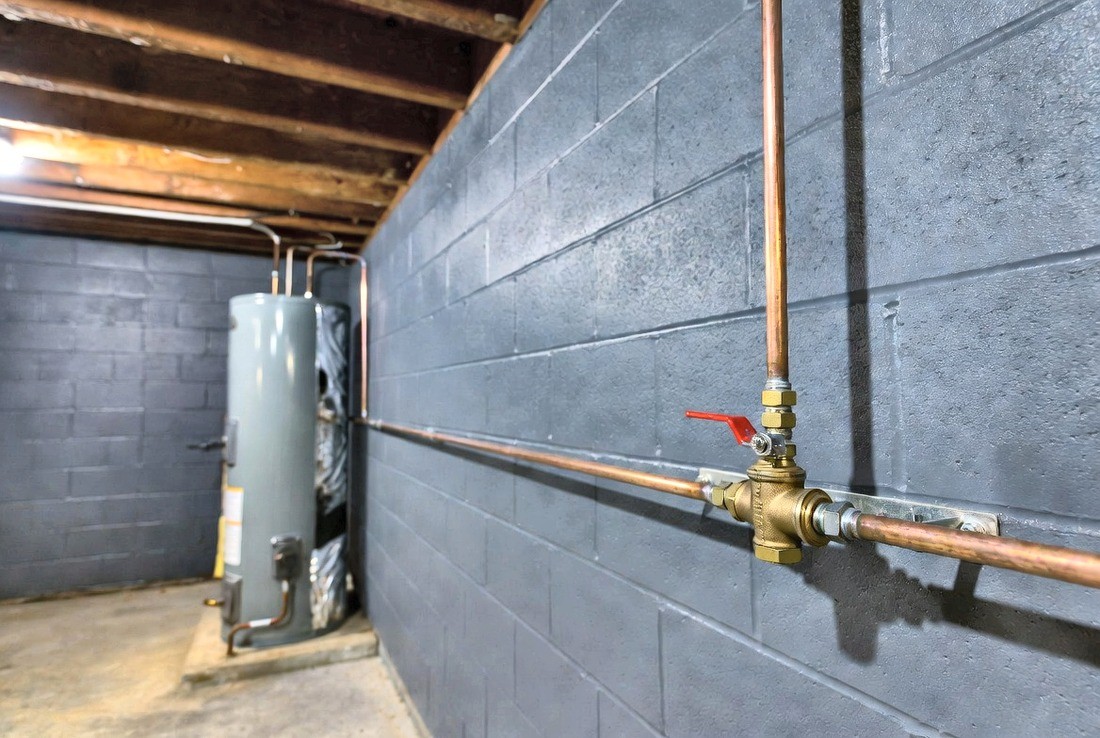
The one at the meter is more complicated, and this is the part worth knowing before you need it. The valve on the street side of the meter generally belongs to the utility, not to you. Some places will tell you plainly that no one but their own crew may open that box — homeowners and plumbers alike. Others will tell you the opposite, that the box and the valve are the property owner’s to maintain and keep clear. There is no national answer.
📞 The Five-Minute Phone Call
Ring them on a dry afternoon
Ask your water utility one question: in an emergency, am I permitted to shut the water off at the meter myself? Whatever they say, you now know, and you knew it before there was water coming through a ceiling. If the answer is no, then finding the valve inside the house stops being a nice idea and becomes the job.
To get the lid up and the valve turned you want a meter key — a long steel bar, usually a couple of feet of it, with a handle across the top and a forked or notched end that straddles the valve tang. They are cheap. Keep it where you will find it in the dark, which is not the back of the garage.
And go out once, on a dry day, and turn it. A valve that has not moved in twenty years is a valve nobody knows the condition of, and the day you find out should not be the day it matters. If it will not move under reasonable pressure, stop. That bar gives you a great deal of leverage and the operating nut is the part that snaps, and in some districts you will be paying for what you break.

If you go looking inside the house and there simply is not one — and on older slab-built houses there often is not — then that is the thing to have fitted. It is about an hour of a plumber’s time. Have it done on a visit you were already paying a call-out for and it costs you almost nothing extra, which is an argument this site makes about nearly everything.
🔥 The Gas: A Quarter Turn, and One Rule You Do Not Break
Gas is laid out the same way water is. There is a valve on the utility’s side, out at the meter where the pipe comes up from the ground, and there is usually a house-side valve where the line goes in. Older houses sometimes have only the one.
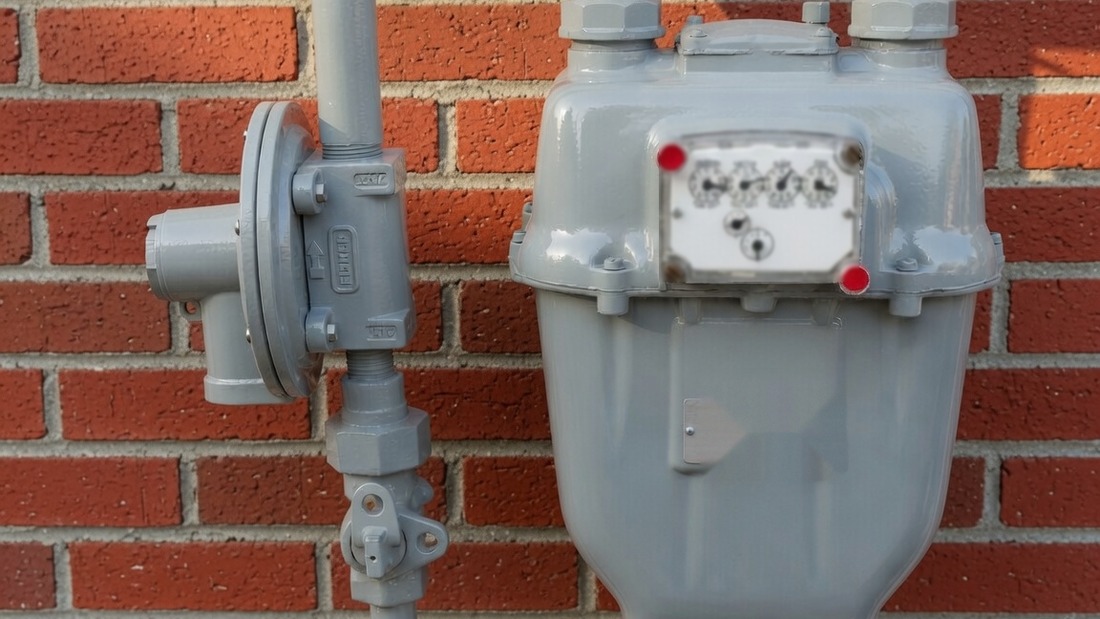
The valve is not a handle you grip. It is a flat rectangular tang on top of a fitting, and it takes a wrench.
That is the whole mechanism. A quarter turn in either direction until the tang sits crosswise to the pipe and the gas is off. Nothing to remember, nothing to unscrew.
Keep a twelve-inch adjustable wrench where you can get it — with the storm supplies, or in a bag by the door. Not hung on the meter and not resting on the gas piping, which the gas companies ask specifically and for reasons that ought to be obvious once you think about a length of steel lying against a joint for ten years.
⚠️ Two Flat Rules
Read both before you touch a gas valve
Only shut the gas off if you smell it, hear it hissing, see the meter dial spinning, or see a
broken line. Otherwise leave it alone. Shutting it off for no reason is its own kind of
trouble.
Once it is off, it stays off until the utility comes. Do not turn it back on yourself, not
ever, not even a little to check. Restoring gas means checking the system for leaks and relighting every
pilot in the house, and turning it back on yourself is how gas ends up collecting in a building with
nobody watching.
And if you can smell gas indoors, the order is not up for debate: everybody goes outside first, and the phone call is made from outside. Not from the kitchen. No light switches on the way out, no garage door opener, nothing that makes a spark. You are not saving the house at that point. You are getting people out of it.
One more thing that gets missed. Nearly every gas appliance has its own little shutoff behind or beneath it, and if the trouble is one appliance, that valve is the right one to close rather than killing the whole house and buying yourself a utility visit to get it all lit again.
🔩 The Safe Way to Test It
An eighth of a turn, and back
You can find out whether that valve will actually move without shutting your gas off. Turn it an eighth of a turn one way and an eighth back. An eighth will not close it. If it will not budge at all, that is a phone call to the gas company — a valve that will not turn is not a valve.
👃 The Nose You Cannot Entirely Trust
Natural gas has no smell. What you are smelling is mercaptan, put in on purpose so that a leak announces itself, and for most people most of the time it works.
Here is the trouble with resting a house on it.
In one study, forty-five percent of elderly subjects could not detect the warning odour in natural gas at the level the safety standard is built around. Not a few of them. Nearly half. And that is before you get to the ordinary things — a head cold, a lifetime of smoking, a medication that flattens the sense out, a nose that has already been in the room long enough to stop registering the smell at all.
There is a larger study sitting behind that one. Among two and a half thousand people between fifty-three and ninety-seven, a quarter of the whole group did poorly at identifying smells at all, and among those past eighty it was closer to two thirds. Meanwhile the federal rule says gas must be odorized so that a person with a normal sense of smell can detect it at a fifth of the concentration where it would go off. It never says what a normal sense of smell is. Nobody defined it. The standard has a hole in it shaped exactly like the people reading this.
The gas companies say this themselves. They will tell you that soil can strip the odorant out of a leak that is underground, that the smell may not wake a sleeping person, and that a few minutes of exposure causes the nose to give up on it. Which is why the utilities recommend a listed combustible gas detector rather than trusting the only sensor you were born with.
⚠️ The Thing Almost Everybody Has Wrong
A carbon monoxide alarm does not detect a gas leak
They are two different gases and two different sensors, and there is no overlap between them. A CO alarm watches for carbon monoxide, which is what comes off fuel that has burned badly. It has no ability whatever to smell raw methane or propane leaking out of a line. If the only thing on your wall is a CO detector, you are not covered for a gas leak, and a great many people believe they are.
What you want is a combustible gas alarm, or a combination unit that does both jobs. And then the one detail that decides whether it works at all:
Three gases, three heights, and getting it wrong turns the alarm into an ornament.
Natural gas rises. Methane is lighter than air, so it gathers at the ceiling first. A natural gas alarm goes high on the wall — and this one is not a preference, it is written down. The fuel-gas alarm standard says a wall-mounted natural gas alarm sits no more than twelve inches below the ceiling, with four to twelve inches the working window. It also says the alarm belongs in the same room as the appliance it is watching, at least three feet away from it and not more than ten.
Propane sinks. LP is heavier than air and behaves like water — it runs downhill and pools on the floor, in basements, in crawlspaces. An LP alarm goes low, four to twelve inches off the ground depending on whose instructions you are reading. That matters across a great deal of the country: propane heats and cooks in rural houses in every state, and in cabins, and in every camper ever built.
Carbon monoxide sits in the middle. CO weighs about the same as air, so it does not climb and it does not settle — it goes where you are. That one belongs in the breathing zone, four to six feet off the floor. Which is, near enough, the height your thermostat is already at.
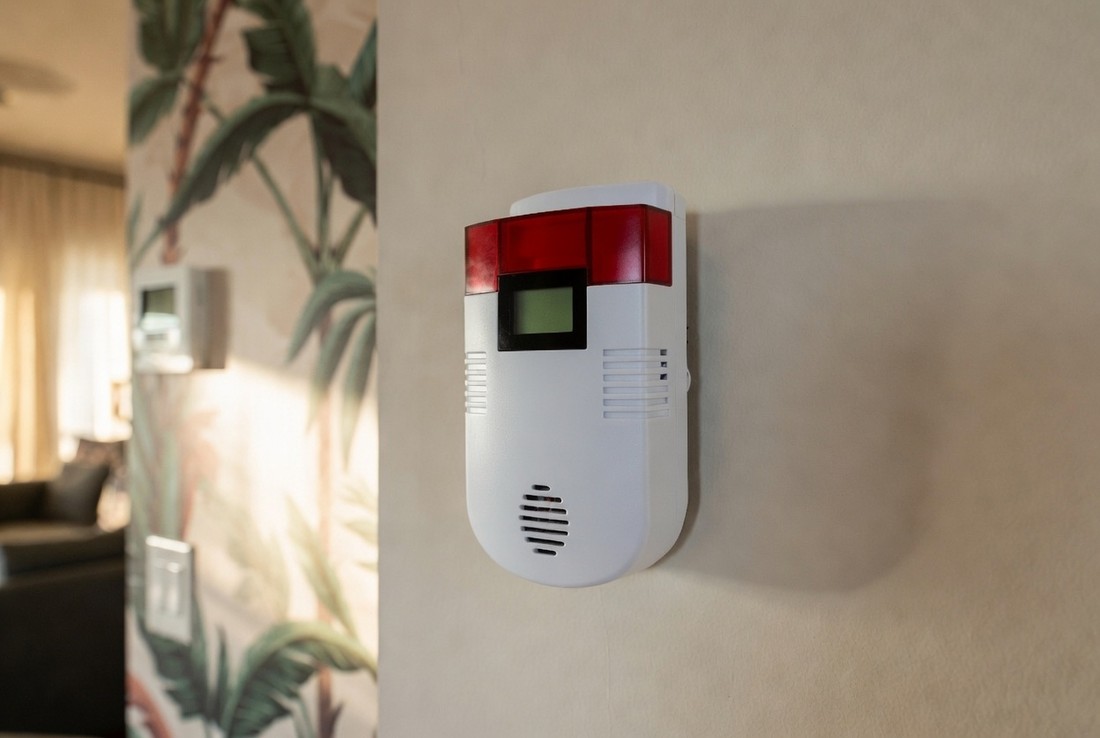
The trap in a plug-in alarm. A wall outlet is about a foot off the floor, and that is exactly right for propane and exactly wrong for natural gas. A plug-in unit watching for methane is sitting eight feet below the place the gas actually collects, and it will not speak up until the room is full. If the house runs on natural gas, you want a unit you can mount high, which usually means a battery one.
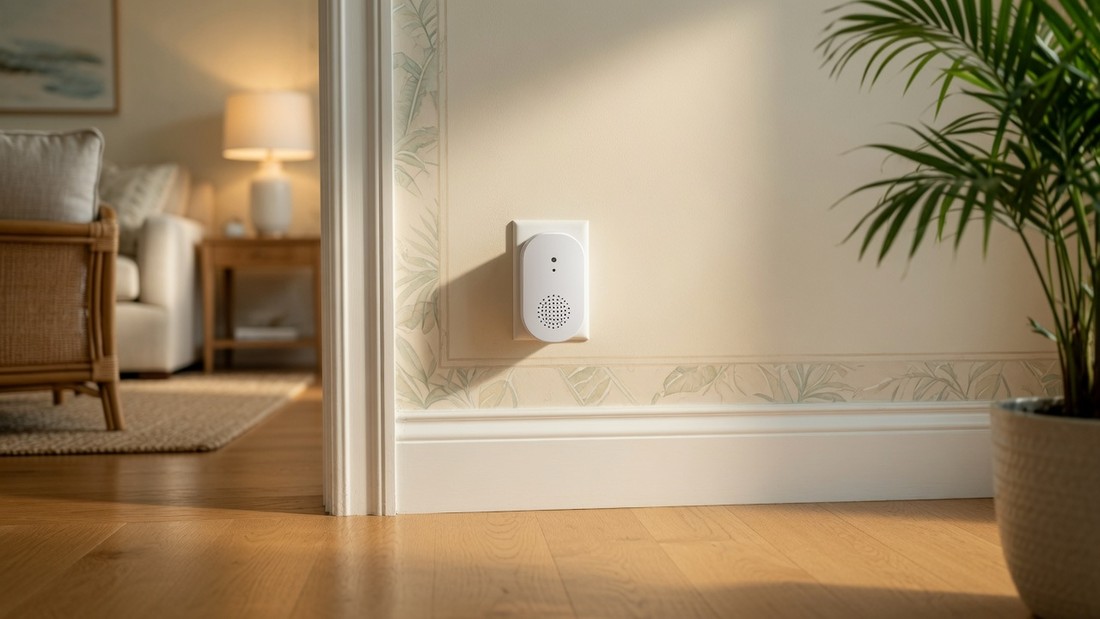
Check what the label says and where the maker tells you to put it. Gas detectors get replaced about every five to seven years and CO alarms about every five to ten, and both of them print the date on the back.
🔌 The Panel: Label It While Everything Is Fine
The electric panel is the one people are most frightened of and it is the one that asks the least of you. You are not opening anything. You are looking at a grey door, and behind it a column of switches with one bigger switch at the top.
That big one is the main. It cuts everything.
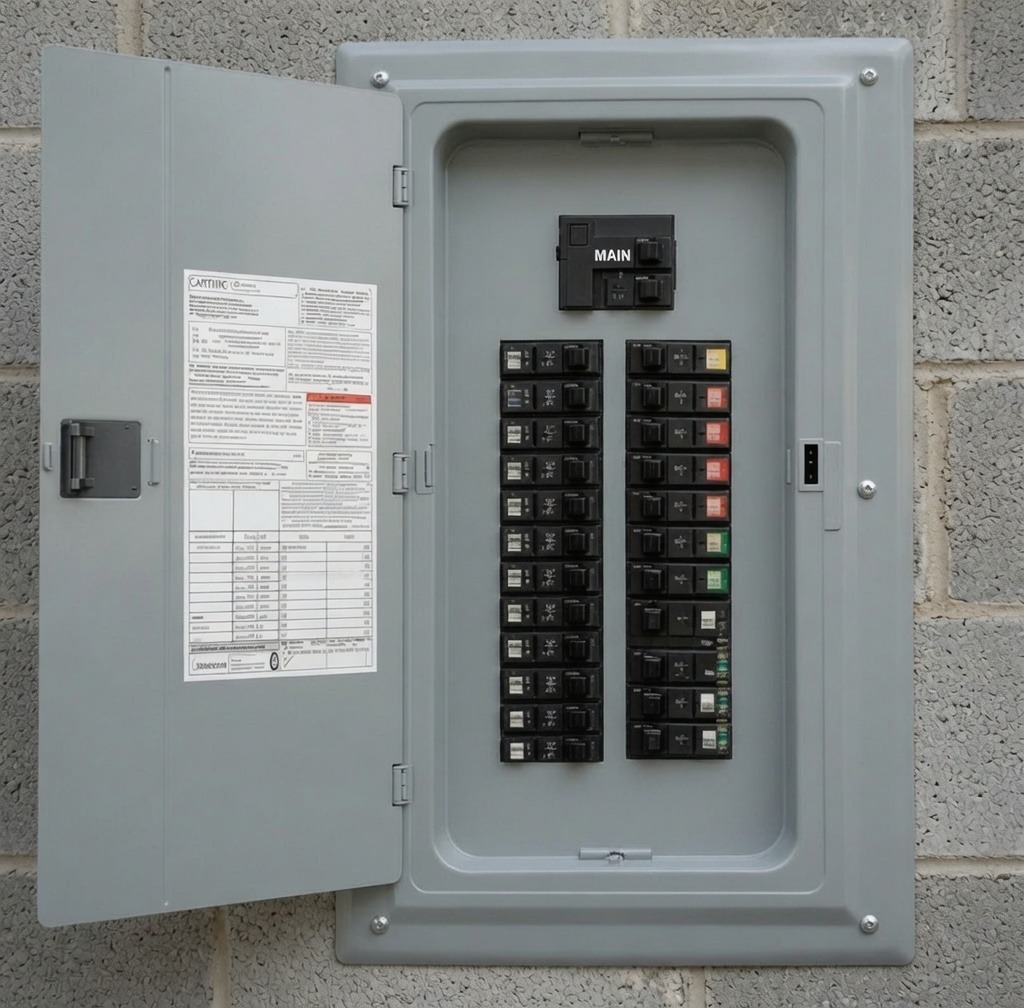
Three things worth doing on the same afternoon you find it. Make sure you can get at it — a panel behind a bookcase or a stack of boxes in a closet is a panel you cannot reach at speed. Label the breakers, which takes two people and half an hour and is the single most useful thing anybody has ever done in a basement. And put a torch beside it, because the reason you are standing there is very often that the lights are out.
🔦 How to Stand at a Panel
Side on, one hand, dry feet
Stand to the side of the door rather than square in front of it, work with one hand and keep the other at your side, and never touch a breaker with wet hands or while standing on a wet floor. When you are switching everything off, do the individual breakers first and the main last. Coming back on, the main first and then the branches one at a time.
The main breaker is what you reach for when there is water where water should not be, when there is a smell of burning, or when a repair needs a circuit dead and you would rather be certain than trusting a label somebody wrote in 1994.
🌊 Going Back Into a House That Has Flooded
This is the one where doing the obvious thing in the wrong order is what kills people, and it is worth its own section.
The instinct is right: get the electricity off before you do anything else. Floodwater and a live house are a genuinely lethal combination, and water standing against outlets, cords and appliances should be treated as energized, because it may be.
But there is a condition on it that matters more than the instruction does.
⚠️ The Line That Has to Be Read Twice
Only if you can reach the panel from dry ground
If you can turn the main off standing somewhere dry, do it, and do it before anything else even if it holds up the clean-up. If you would have to walk into standing water to reach the panel, you do not do it. You call an electrician, or you ring the electric utility and have them cut it at the meter outside. That is what they are for, and there is no version of this where wading to a breaker box is the brave choice.
The rest of it follows the same shape. Do not go into a flooded basement or a flooded room at all unless you are certain the power is dead. If the outside service equipment went underwater, the utility should pull their metering gear before anybody goes in, because restoring power to a drowned meter is how you get a fire instead of a flood.
And it does not go back on because the water went away. A house that has been flooded wants an electrician to look at the system before it is energized, and anything that was actually submerged — breakers, fuses, the GFCI and arc-fault devices, surge protectors — gets thrown away rather than dried out and trusted. Most wet appliances are finished too, whatever they look like.
Gas gets the same treatment on the way back in. If there is any smell of it, nobody turns on a light, everybody goes out, and the call is made from the yard.
None of that is a repair. It is an order of operations, and it is worth reading now rather than working out on a doorstep with the water still going down.
🛑 What Is Not on This List
Finding these things is yours. Most of what follows from finding them is not.
Any valve that will not turn. Discovering it is stuck is the useful part. Freeing it, replacing it, or cutting into the pipe to do so is a trade.
Turning gas back on, in any circumstance whatsoever. This has no exceptions and no degrees.
Anything inside the electric panel. The door stays shut. Labelling is done from the front with the switches, not with a screwdriver.
Re-energizing a house that has been under water. An electrician looks at it first.
Fitting a house-side main where there is not one. Worth having, worth paying for, not worth doing yourself.
⚖️ Why This One Belongs on the List
Nothing on this page is a repair. Nothing on it costs anything much. A meter key, an adjustable wrench, a gas alarm, a roll of labels and one phone call.
What it buys is the ten minutes at the start, and the ten minutes at the start is the entire difference between a wet carpet and a wrecked house, or between a gas leak and a funeral.
People do not fail at this because it is hard. They fail at it because there is never a reason to do it today. It is the same shape as every other thing on this site: cheap and easy and optional, right up until it is none of those.
Go and find the three of them this weekend. Write down where they are and stick it inside a kitchen cupboard door where somebody else in the house will find it too, because you may very well not be the one standing there.
Elsewhere on this site, if it is useful:

the plumbing that never announces itself
The running toilet, the tap gone weak, the supply line quietly ageing behind the washing machine.
Read the guide →
the loud ones — clogs, and the tools that fix them
A stopped drain and a stopped toilet, and why the tool for one is the wrong tool for the other.
Read the guide →
the forty small things that cost people their houses
Not the roof. Forty little jobs across eight years, every one reasonable to have put off.
Read the guide →What This One Buys You
Knowing, before anybody has to ask you.
Every valve on this page is free to find and costs an afternoon to learn. The people who lose a house to water or gas almost never lose it because the job was hard. They lose it because nobody in the building knew where the switch was, and the ten minutes it would have taken to find out were the ten minutes there were not.