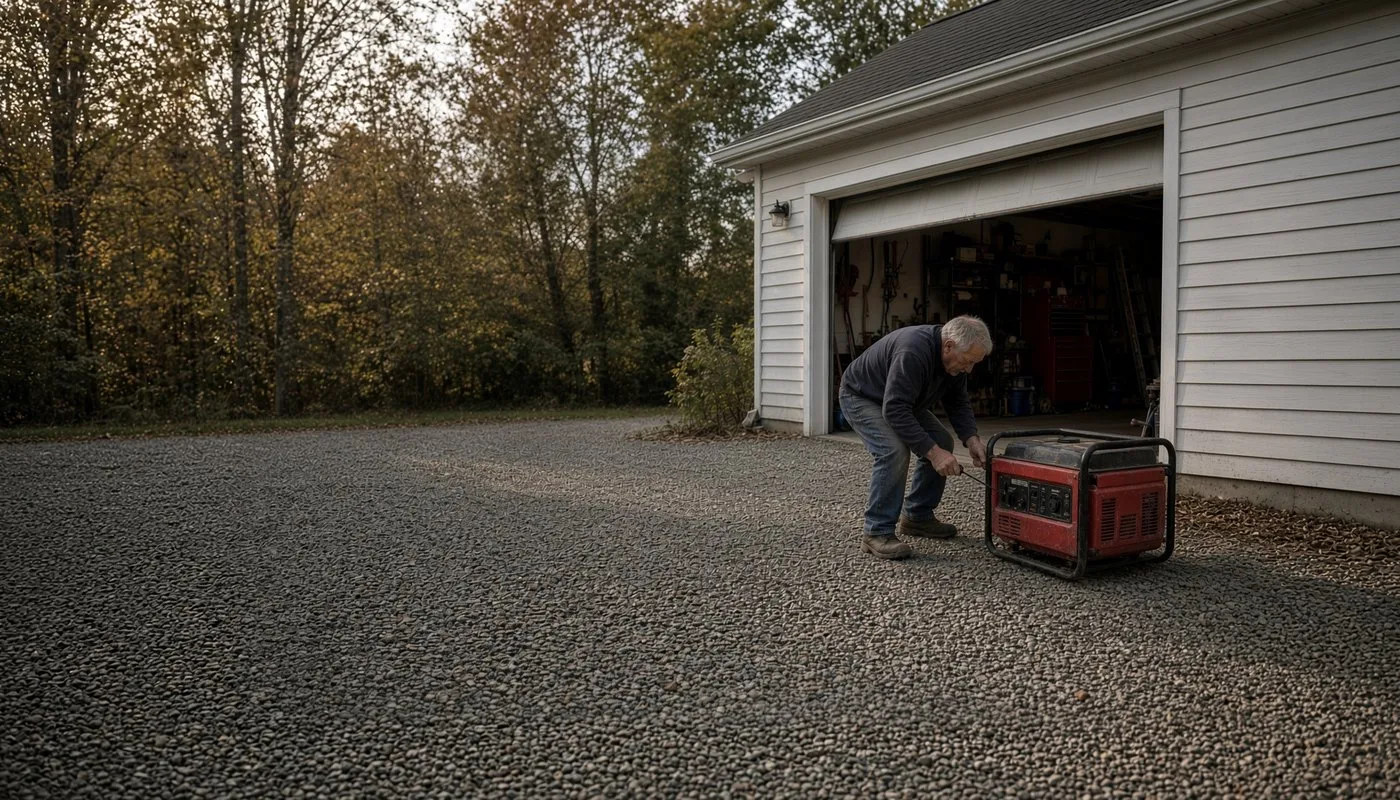
💰 The Fifty-Dollar Machine
Plainly, first. This page is for educational purposes only. BuyItAt50 is not a small-engine mechanic, a repair shop, an electrician or a dealer, and it has no connection to Harbor Freight, Honda or any other company named on this page. Nobody paid to be mentioned. This page does not teach you to open a generator’s electrical end, and it does not tell you to. That part is for a shop. The rest comes from my own years of pulling carburetors off lawn mowers and working on just about every kind of gas engine a house ever owned.
Here is the deal, and it is a good one. A gas-powered machine is two things bolted together. There is the engine, which is the small, hot, busy part with a hundred ways to go wrong. And there is everything else: the generator end, the hydraulic pump and the ram on a splitter, the tines on a tiller, the deck on a mower, the frame and the wheels. That second part has very little to wear out, and it is most of what you paid for.
When the engine quits, the owner does not see it that way. He sees a machine that will not start. He has already bought a new one, or he does not want to bother, or the man at the shop quoted him more than he cares to spend. So it goes on Marketplace for fifty dollars, or out to the curb, with “dead” in the listing.
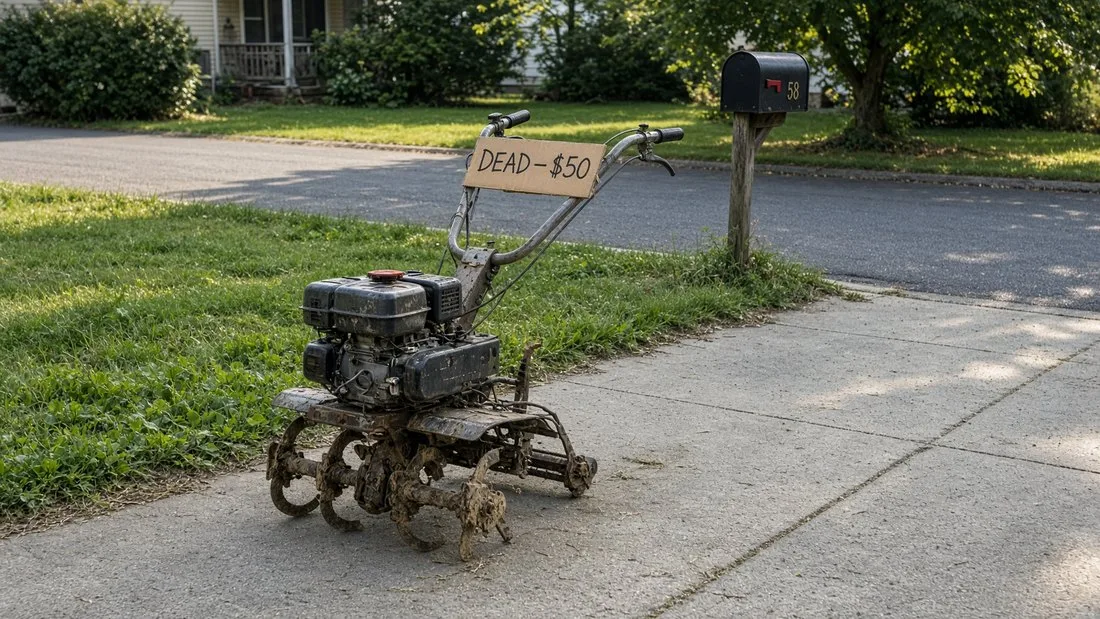
The buyer who knows the difference between a dead engine and a dead machine gets the whole machine for the price of a tank of gas. Sometimes the fix is a carburetor. Sometimes it is a new engine. Either way, the rest of it was never broken.
⛽ Why Most of Them Die: The Gas
Most “dead” small engines are not dead. They have a carburetor full of old gas. That has been true of nearly every one I ever opened. The machine ran fine in September, sat all winter with gas in it, and in April it would not start. Or it sat through a long, hot summer in a shed, with the same result.
The gas at the pump today is mostly blended with ethanol. The University of Georgia Extension calls that blend the biggest problem small engines have, because ethanol draws water, and it says the worst thing you can do to a small motor is store it all winter with untreated ethanol fuel. It also says that in as little as a couple of weeks the ethanol can begin to clog the tiny air and fuel passages in the carburetor (University of Georgia Extension).
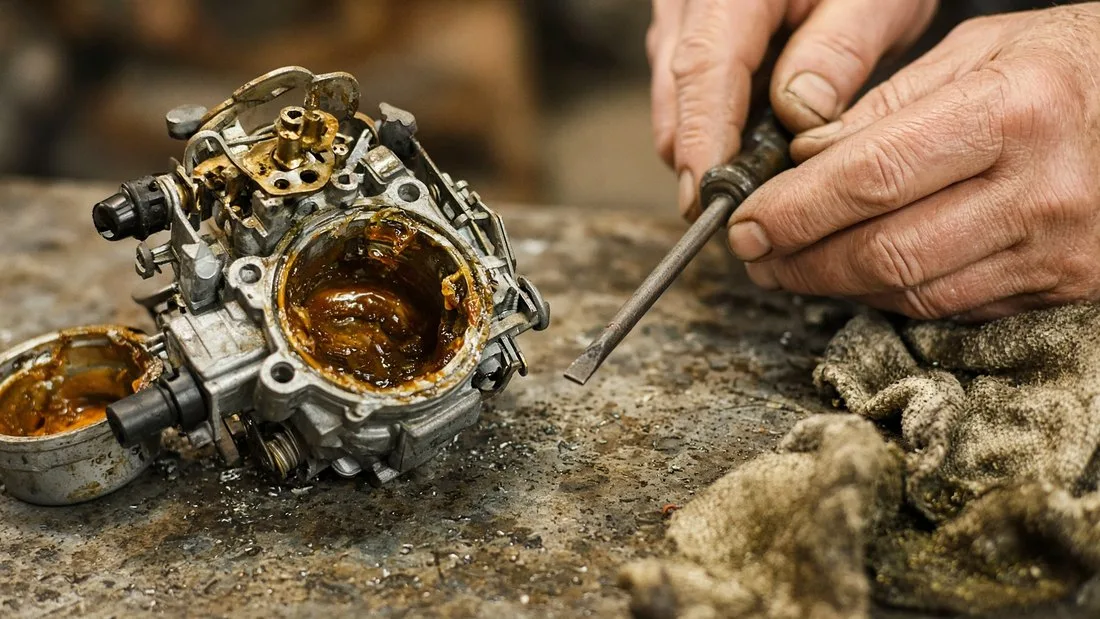
What happens next you can see with your own eyes if you take the bowl off the bottom of a carburetor that sat with gas in it. The light part of the fuel goes off, and what is left dries into a varnish, a gum, sometimes a waxy crust, right in the passages the engine needs to breathe through. Those passages are finer than a pin. It does not take much.
The federal government has a word on the subject too. When the EPA allowed gasoline with 15 percent ethanol for newer cars, it specifically did not approve it for lawn mowers, chainsaws and the rest of what it calls nonroad engines (U.S. Environmental Protection Agency). If the pump says E15, it is not for the machine you just bought.
The lesson the seller never learned is the one you keep. The reason his machine is dead is the reason yours will stay alive: what you leave in the tank when you put it away. That is the last section on this page, and it is the cheapest one.
🔧 Three Kinds of Dead
When a seller says “dead,” he could mean any of three things. They cost very different money, and you can usually tell which one you are looking at before you hand over a dollar.
Dead, Kind One: A Gummed Carburetor
The Cheap OneThe engine turns over freely when you pull the cord. You feel it push back against your hand once each turn, which is compression, and that is what you want to feel. It just will not catch, or it catches and dies, or it only runs with the choke on.
That is fuel, nine times in ten. A replacement carburetor for the common engines costs very little, and swapping one is usually two nuts, a fuel line and a little linkage. A small-engine shop will do it for not much more if you would rather not.
Dead, Kind Two: Something Small
The PuzzleA mower that hit a stump and would not start again has often sheared the little soft metal key that holds the flywheel in time with the crankshaft. The key is made to break so the crankshaft does not. A spark plug that is fouled, a stuck float, a clogged fuel filter, or an oil sensor that shuts the engine off because the oil is low all look like “dead” to a man who does not want to look further.
These are cheap parts. Whether they are cheap jobs depends on how handy you are, and on how much you enjoy a puzzle.
Dead, Kind Three: Really Dead
The New-Engine OneThe cord will not pull at all, or it pulls with no push-back anywhere in the turn. The seller says it ran out of oil, or it made a terrible noise and stopped, or there is a hole in the side of the block. That engine is finished.
That is not the end of the machine. It is the reason the machine is fifty dollars. The rest of it can take a new engine. That is the next part of this page, and on a generator it is a job with one catch you need to know about first.
📋 The Checklist to Take With You
Print this and put it in your pocket. It works for any piece of gas equipment, and it has a few lines at the end for the special cases. Take somebody with you. You are meeting a stranger, and most of these machines take two people to lift into a truck.
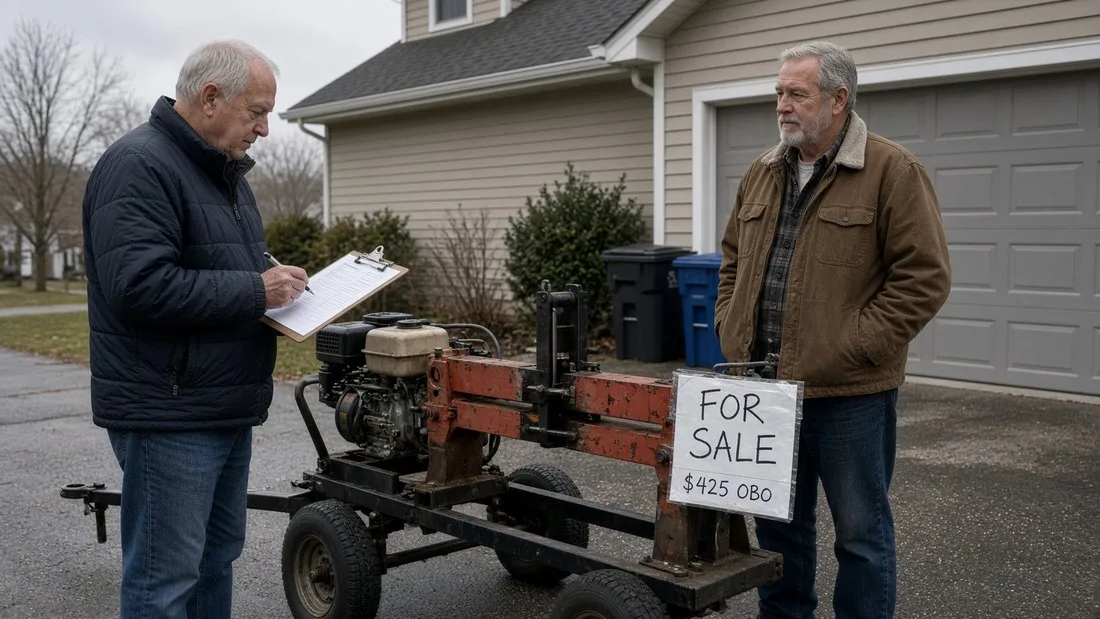
Before you go: ask the seller on the phone
- How did it die? Did it slowly get hard to start, or did it stop all at once with a noise?
- How long has it been sitting, and was there gas in it when it was put away?
- Was it ever run without oil, or did the oil light ever shut it off?
- Has anybody already had it apart? A box of loose parts costs you more than it saves.
- Do you have the manual, or the model and serial numbers off the sticker? Write them down.
At the machine: every kind
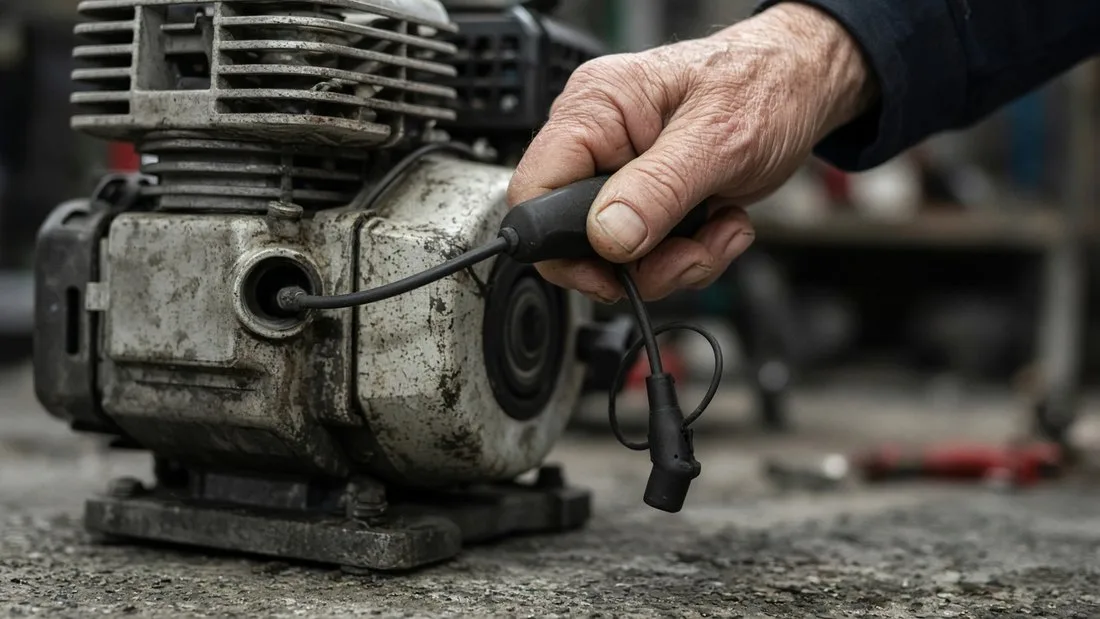
- Pull the spark plug wire off first, keep hands and feet clear of any blade, then pull the starter cord slowly. It turns, and pushes back once each turn: likely a carburetor job. It will not move at all: likely a new engine.
- Pull the dipstick. Milky oil, metal glitter, or no oil at all tells you the engine’s story.
- Look in the gas tank with a flashlight. Brown varnish or rust flakes mean the tank and lines need cleaning too.
- Look for a mouse nest under the shroud and chewed wires. Mice love a machine that sat.
- Check the frame, the wheels and the handle. Rust that goes all the way through is a different machine.
- Look at the bolts that hold the engine down. Clean and turnable is a weekend; rusted solid is a fight.
- Look for the model sticker on the engine itself. It tells you exactly which carburetor or engine fits.
Generators only
- Look at the outlets, the breakers and the panel. Melted plastic, scorch marks or a burnt smell: walk away.
- Ask whether it was running something when it died, or whether it smoked under load. Overloaded windings are not a cheap fix.
- Read the plate for the running and starting watts, so you know what it was built to carry.
- Do not plan to open the electrical end yourself. If the engine needs replacing, price the shop job before you pay.
Wood splitters only
- Look at the hydraulic hoses for cracks, wet spots and weeping fittings. Never run your hand along one.
- Look at the ram (the shiny rod) for scoring, rust pits and a bend.
- Check the beam and the wedge for cracked welds.
- Ask what kind of hydraulic fluid is in it, and look at its color. Milky means water got in.
Tillers, trenchers and mowers
- Turn the tines, the chain or the blade by hand with the plug wire off. Stiff is fine; locked solid means the gearbox, not the engine.
- Check the belts and the drive. A worn belt is cheap; a broken transmission case is not.
- On a mower, ask whether it hit something before it died. That is the flywheel key, nine times in ten.
- On a trencher, check the chain and the teeth. They are the expensive wear parts.
Walk away if
- The seller will not let you pull the cord or look under the shroud.
- The price for “dead” is more than half of what a running one sells for near you.
- The serial plate has been ground off. That is not your problem to inherit.
- You would need to lift it alone. You would not. Come back with help.
⚙️ When It Needs a New Engine
Here is the part that makes the whole thing work. The small horizontal-shaft engines that run most of this equipment are close to a standard size. Honda’s are the ones everybody knows. Harbor Freight sells its Predator engines and lists, model by model, which competitor engines each one is meant to replace, Honda among them (Harbor Freight). Other makers sell replacement engines in the same sizes. Check the current price yourself, because it moves, but a new engine of that size usually costs a small fraction of what the machine cost new.
So the fifty-dollar machine plus a new engine is still a long way short of a new machine. That is the whole idea, and on a splitter, a tiller or a pump it works very well.
Before you buy an engine, match these five things to the old one. Write them on the back of the checklist:
- Horizontal or vertical shaft. Most mowers are vertical. Generators, splitters, tillers and pumps are mostly horizontal. They do not swap.
- The shaft itself. Its diameter, its length, and whether it is straight with a keyway or a taper. This is the one people get wrong.
- The bolt pattern on the base, so it sits on the same holes.
- Roughly the same size and power. Too small and it bogs; much too big and it may not fit the frame or the guard.
- The throttle and the controls, so the machine’s own levers still work it.
On a splitter or a tiller, the engine usually turns a pump or a belt through a coupling or a pulley on a straight, keyed shaft. That is about as plain a mechanical job as a gas engine offers. If you have never done it, a small-engine shop has, and the labor on a swap is still small next to the price of the machine.
In California, read this first. The California Air Resources Board requires most newly made small off-road engines to be zero emission from model year 2024, with portable generators following from model year 2028. It says plainly that people can keep using the gas equipment they already have, and that there is no ban on older or used equipment (California Air Resources Board). What it does change is which new replacement engines can be sold there, so check what a California store will actually sell you before you buy the machine.
⚡ Generators Are the Special Case
The generator is the best bargain on this page and the one with the most care attached. The bargain is real: the electrical end of a portable generator has almost nothing to wear out, and it is the engine that dies.
The catch is how the two are joined. On many portable generators, the spinning part of the generator end, called the rotor, sits directly on the end of the engine’s crankshaft, pressed onto a taper. There is no coupling and no belt. That means a replacement engine has to have the same crankshaft end, and getting the old rotor off its taper is a job of its own (owners describing the job). An engine with a straight keyed shaft, the kind that suits a splitter, will not simply bolt on.
The second catch is speed. A generator makes the right power only when its engine runs at the speed the generator was built for, and the engine’s governor is what holds it there. Get that wrong and the power comes out wrong, the kind of wrong that is hard on a refrigerator and harder on anything with a circuit board.
Where this page stops. I do not want anybody opening up the electrical end of a generator on my say-so, and this page does not show you how. Buy the dead generator if the checklist says the electrical end is sound. Then take it to a small-engine shop for the engine work and ask them to check its output before it comes home. It is still a bargain with the shop bill on top.
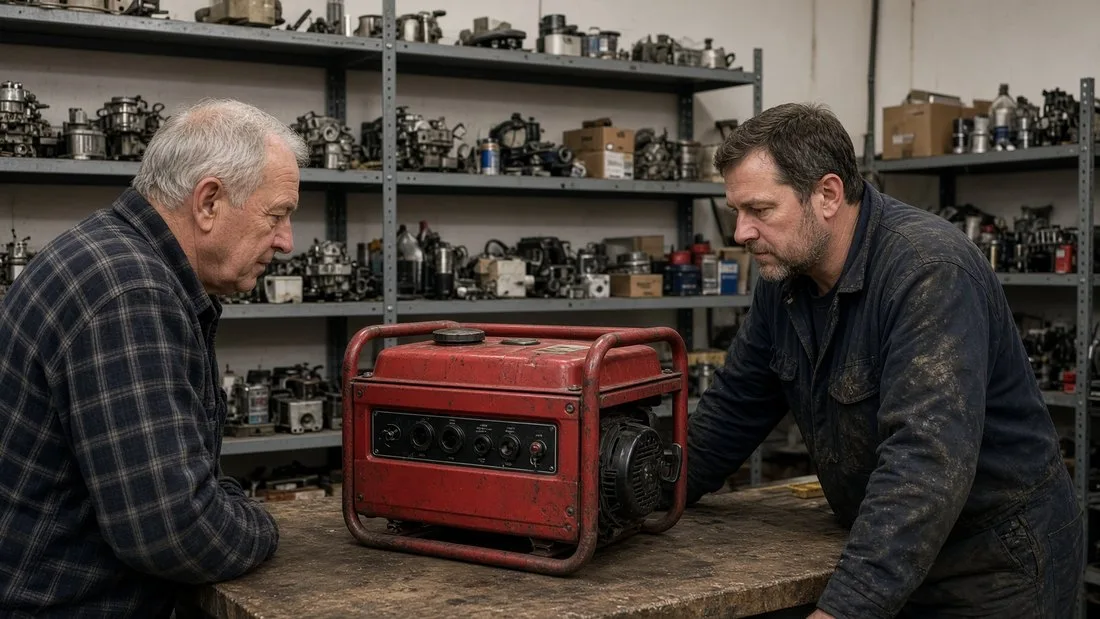
And before a generator you rescued powers anything, the rules that keep people alive. The Consumer Product Safety Commission counts an estimated 765 carbon monoxide deaths connected to portable generators from 2009 through 2019. It says to run one only outdoors, at least 20 feet from the house, with the exhaust pointed away, and never in a garage, basement, crawlspace or shed, even with the doors open (Consumer Product Safety Commission). Never plug a generator into a wall outlet to feed the house, either. That sends power back up the line toward the men working on it. How to hook one up properly, and how big it needs to be, are on the generator page and the generator calculator.
🪓 Wood Splitters: The Other Easy One
A gas wood splitter is an engine turning a hydraulic pump, which pushes a ram, which drives a log onto a wedge. The pump, the ram, the valve and the beam are heavy, simple and long-lived. The engine is the part on top that sits out in the weather. That makes a splitter with a dead engine about the best candidate there is for a new one: a straight shaft, a coupling to the pump, and four bolts.
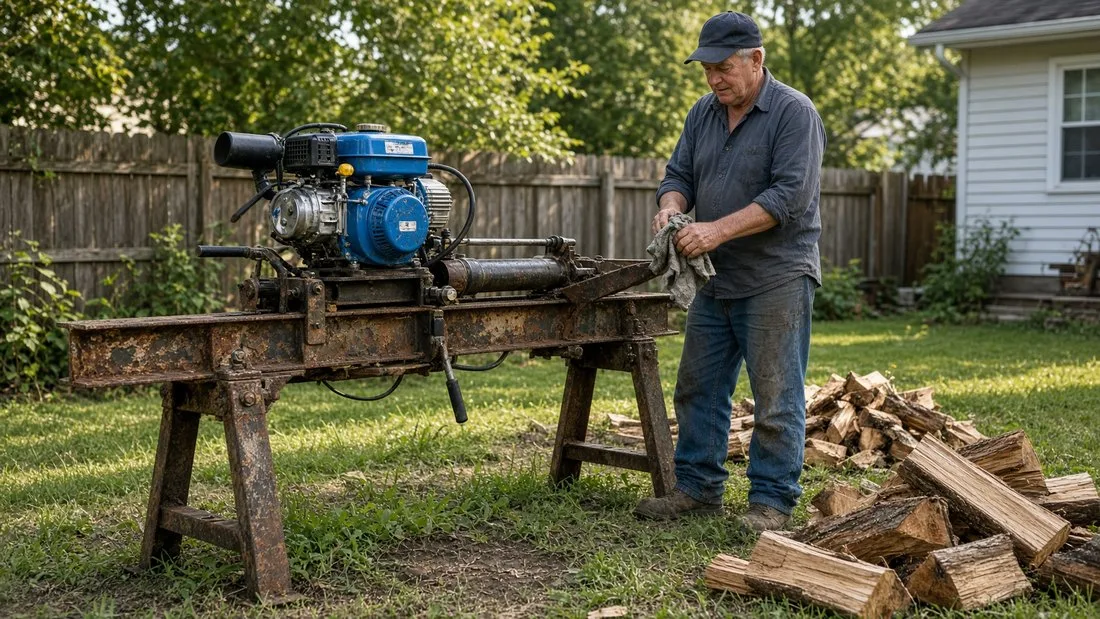
One hard rule about hydraulics. Fluid under pressure can come out of a pinhole fast enough to go through skin. A splitter maker’s own instructions say to find a leak by passing a piece of cardboard or wood along the hose and looking for the stain, and to see a doctor immediately if escaping fluid ever injures you, because serious infection can follow (a splitter maker’s instructions). Never use your hand. What to do with the wood once it is split is on the firewood page.
🛢️ The Gas: How Yours Stays Alive
Everything on this page started with somebody else’s gas. Here is how to keep the same thing from happening to you, from the same University of Georgia publication:
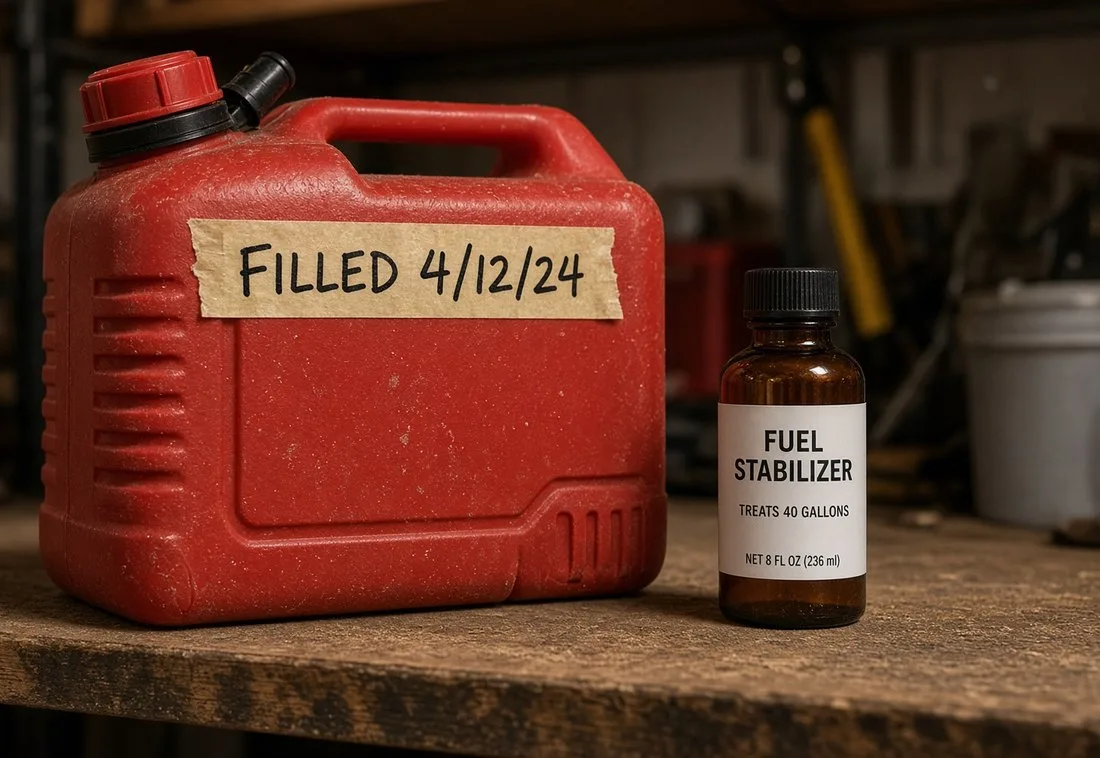
- Stabilizer goes in fresh gas, not old. It only works on fresh fuel, and most products extend its life by about two or three months (University of Georgia Extension). Put it in the can at the pump, not in the tank in March.
- For a long sit, store it dry. Pour the extra fuel back into an approved can and run the engine until the carburetor is empty. The same publication calls that the best way to store most small engines.
- Buy small cans of gas. Buy what you will burn this season, not a drum that ages in the shed.
Gasoline itself deserves respect. Maryland’s Department of the Environment says to keep it only in approved, labeled containers, never in glass, away from heat such as the sun and the water heater, never to siphon it by mouth, and never to pour old gas on the ground or down a drain (Maryland Department of the Environment). Your county’s household hazardous waste day is where the old stuff goes.
⚡ Why This Belongs on the Fifty List
This whole site keeps telling you to own good tools and know how to use them. Here is a place to put them to work that pays you back the same weekend.
Fifty is the age to do this. You can still lift your end of a splitter into a truck. You have the wrenches, or you are buying them anyway. You have time on a Saturday. And you have the patience a twenty-five-year-old does not, to sit with a carburetor and a can of cleaner until it runs.
At seventy you will want the machines that run. A tiller for the garden, a splitter for the stove, a generator for the week the power is out. Buying them dead at fifty, and bringing them back yourself, is how you own all three without paying for all three. It is also how you learn the engine well enough to keep it running when nobody is around to ask.
And when you are done with one, somebody else is standing in your driveway with a checklist. Sell it running.
Never lift one of these alone. A generator or a splitter is heavy and awkward, and a back is not a part you can order. Two people, a ramp, and the tricks on the moving-heavy-things page.
❓ Questions People Actually Ask
Why won’t my small engine start after sitting all winter?
Usually it is old gas in the carburetor. Ethanol-blended gasoline left in a small engine goes stale, and the residue gums up the fine passages in the carburetor. Cleaning or replacing the carburetor and starting with fresh gas fixes most of them.
Is it worth buying a generator with a dead engine?
Often, yes, if the electrical end is sound. The generator end has little to wear out, and the engine is what usually fails. But on many portable generators the rotor sits on a tapered crankshaft, so a replacement engine has to match, and the engine speed has to be set correctly. Have a small-engine shop do that work and check the output.
How can I tell if a small engine is seized?
Pull the starter cord slowly. If it turns and pushes back once each turn, the engine has compression and is probably not seized. If the cord will not move at all, the engine is likely seized, or something it drives is locked.
Can I put E15 gas in my lawn mower?
No. The EPA did not approve gasoline with 15 percent ethanol for lawn mowers, chainsaws and other small off-road engines. Use the fuel the engine’s manual calls for.
How long does gas with stabilizer last in a small engine?
About two or three months for most products. The University of Georgia Extension says most stabilizers extend fuel life by that much, and only when added to fresh gas. For longer storage, drain the fuel and run the engine until the carburetor is empty.
📚 Where This Comes From
Every outside fact on this page is linked where it appears, and every source is listed again here. The carburetor work is from my own years on small engines. BuyItAt50 has no connection to any company named on this page, and nobody paid to be mentioned.
- Ethanol, stale fuel, stabilizer and storing an engine dry — University of Georgia Extension, Circular 1073, Winterizing Motorized Garden Equipment
- E15 not approved for small engines — U.S. EPA, E15 Partial Waiver Decision (EPA-420-F-10-054), October 2010
- Portable generator carbon monoxide deaths and placement — Consumer Product Safety Commission, New CPSC Report Shows Upward Trend in Carbon Monoxide Fatalities, March 2023
- California small off-road engine rules — California Air Resources Board, small off-road engine regulation announcement
- Replacement engines by model — Harbor Freight, Replace your current engine with Predator (a seller’s own page, cited for what it lists)
- The generator rotor on a tapered crankshaft — iboats forum, Portable generator engine replacement (owners’ accounts, not an official procedure)
- Checking a hydraulic leak safely — Troy-Bilt, How to check for hydraulic fluid leaks on a log splitter (a maker’s own instructions)
- Handling and disposing of gasoline — Maryland Department of the Environment, Gasoline Safety fact sheet