🩺 Before Any of This, Talk to Your Doctor
This is not a formality and it is not us covering ourselves. It is the single most useful thing on the page, and it is free.
Do not take on any physical effort described here — pushing, pulling, sliding, levering, or helping somebody else do it — without asking your own doctor first whether it is a reasonable thing for you to be doing.
Your doctor knows things about you that no website can know and that you may not have thought about in this context:
- What you are taking. Blood pressure medication, blood thinners, anything that affects balance or dizziness, anything that makes bruising or bleeding worse — all of it changes what a sudden strain or a stumble means for you.
- How strong your bones are. Reduced bone density does not announce itself, and the first many people hear of it is a fracture from something that should not have caused one.
- What your back and joints will actually tolerate, as opposed to what they tolerated a decade ago, and whether there is anything in there that a sideways strain would make considerably worse.
- Your hands. Arthritis, reduced grip, numbness — a grip that lets go halfway through is a different kind of accident from a back that aches afterwards.
- Your heart. Hard pushing is exertion, and exertion is exactly the kind of thing a doctor wants to have discussed with you in advance rather than afterwards.
And this is the part people skip: a push can pull a muscle just as easily as a lift can. There is nothing magic about keeping something on the floor. A slider makes the job possible; it does not make your shoulder, your back or your knee twenty years younger. A sudden give, a caught wheel, a foot that slips — and the injury is the same one you were trying to avoid.

So: ask. It is one question at an appointment you are probably already going to. And if the answer is no, or not that one, that is a real answer and it has saved you something.
⛔ The Things This Site Will Not Tell You How to Move
There is a version of this page that explains how to walk a refrigerator across a kitchen on your own. It exists on plenty of websites. It is not going to exist on this one, because the people who read this site are not twenty-five and the consequences of getting it wrong are not a sore afternoon.
Do not attempt to move, tip, rock, walk or otherwise shift any of these yourself, with or without equipment:
Refrigerators · upright freezers · chest freezers · washing machines and dryers · ranges and ovens · water heaters · tall cabinets · bookcases · wardrobes and armoires · chests of drawers · china cabinets · gun safes · pianos · anything taller than it is wide · anything you cannot see over · anything you cannot get both hands onto comfortably.
These are jobs for other people. Family, neighbours, a couple of younger friends, or a professional mover — and for an appliance with a gas, water or electrical connection, a professional every time.
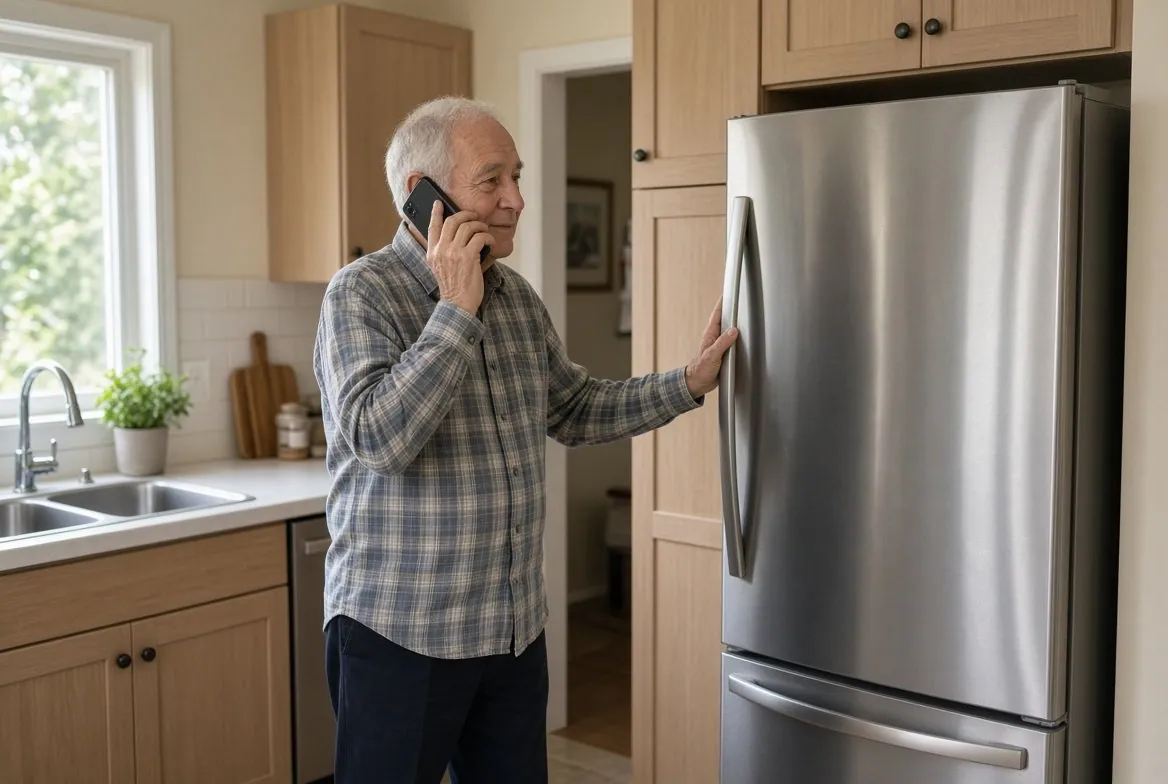
The reason is not the weight. It is that a tall object going over does not give you a warning and does not give you a second chance. It goes from upright to unrecoverable in about a second, and nothing you can do with your arms in that second will change the outcome. Equipment does not help with this. A hand truck, a set of straps or a dolly under a tall appliance changes how hard it is to move and changes nothing at all about what happens when it starts to fall.
And there is no clever version of it. There is no technique, no order of operations, no trick with a rope that makes a refrigerator a sensible thing for a seventy-year-old to be alone in a room with while it is in motion.
What is left, and it is genuinely useful: low, stable things on a flat floor — a loaded box, a low cabinet, a bin, a piece of furniture that is wider than it is tall and already sitting where you can push it. With help, on the level, having asked your doctor. That is a real category and most households have plenty in it.
⚖️ Why Pushing Is Easier Than Lifting — and Why That Is Not Permission
Worth understanding, because it explains what the equipment is doing and why the helpers still matter.
For lifting there is the NIOSH lifting equation. It begins at fifty-one pounds — the maximum load nearly all healthy workers can lift under ideal conditions — and every real complication cuts it down. Reaching cuts it. Lifting from the floor cuts it. Twisting cuts it.
For pushing and pulling there is a separate body of research, the Liberty Mutual tables published by Snook and Ciriello, still the standard reference forty years on. The figures there are larger, because pushing uses your body weight and your legs rather than your spine and your grip.
Now the honest reading, because those numbers get quoted carelessly. The fifty and seventy-five pound figures are a fiftieth-percentile male at low frequency, used as design targets for industrial trolleys. The published tables themselves aim lower — at the force acceptable to seventy-five per cent of women. And not one of these figures was calculated for anybody over fifty, let alone over seventy.
They describe healthy adults of working age in workplaces. They are not a permission slip and they are not a limit for you. The limit for you is a conversation with your doctor.
🧮 Why Sliders Work, and Which Ones
Almost everything written about furniture sliders is published by somebody selling them, and it all says the same unhelpful thing: they reduce friction. By how much?
This part is physics rather than salesmanship. The force needed to slide something is its weight multiplied by the coefficient of friction between it and the floor. Published typical coefficients run roughly: rubber or wooden feet on carpet around 0.5 to 0.7; wood on a wood floor around 0.3 to 0.5; felt on a hard floor around 0.2 to 0.3; and PTFE, sold as Teflon, around 0.04 to 0.1, about the lowest of any solid.
So a 300-pound item on carpet needs roughly 180 pounds of push as it stands, and something nearer 60 on hard plastic sliders. That is a real and large difference, and it is why the pads cost four dollars and are worth it. It is also why sixty pounds of push is still sixty pounds of push, applied by your shoulder, on a floor that may be slippery, to something that may stop suddenly.
Hard plastic sliders go on carpet. Soft felt sliders go on hard floors. It is the opposite of what it sounds like and it is the mistake nearly everybody makes. The slider has to be slipperier than what it rides on: a hard dome rides on top of carpet pile, and felt slides on a smooth surface while protecting it.
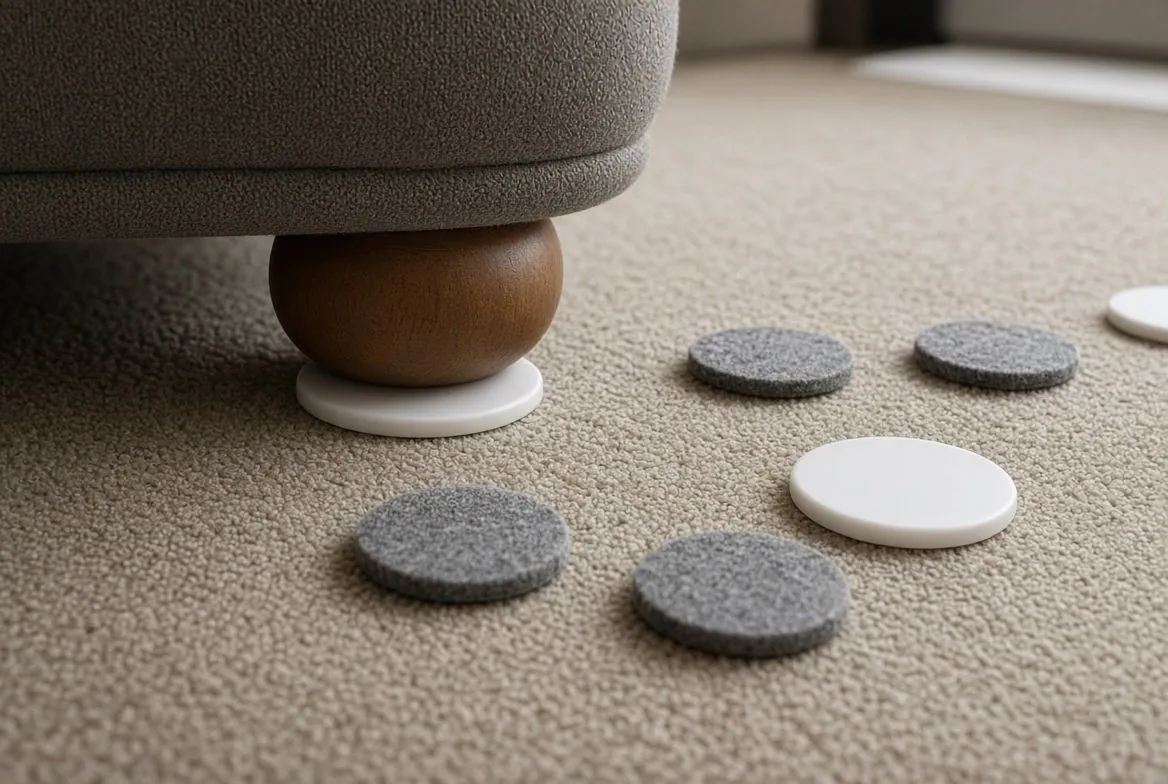
Getting them underneath is the part that needs the help, because something has to be tipped for a pad to go under it, and tipping is where the danger is. On a low, stable item, a helper rocks it while you place the pads. On anything tall, this is not a job to do at all — see the list above.
🤝 Getting the Hands, Which Is the Actual Skill
The useful skill here is not technique. It is being willing to ask, early, before you have already started.
Ask before the day, not during it. A neighbour asked on Tuesday for twenty minutes on Saturday will nearly always say yes. The same neighbour knocked on at four in the afternoon with a wardrobe already half out of a doorway is being asked something much bigger.
Two is a minimum and three is better for anything with height to it — one on each side and one watching the route, calling the door frames and the thresholds. The person watching is not spare. They are the one who sees the thing that everybody carrying is too busy to see.
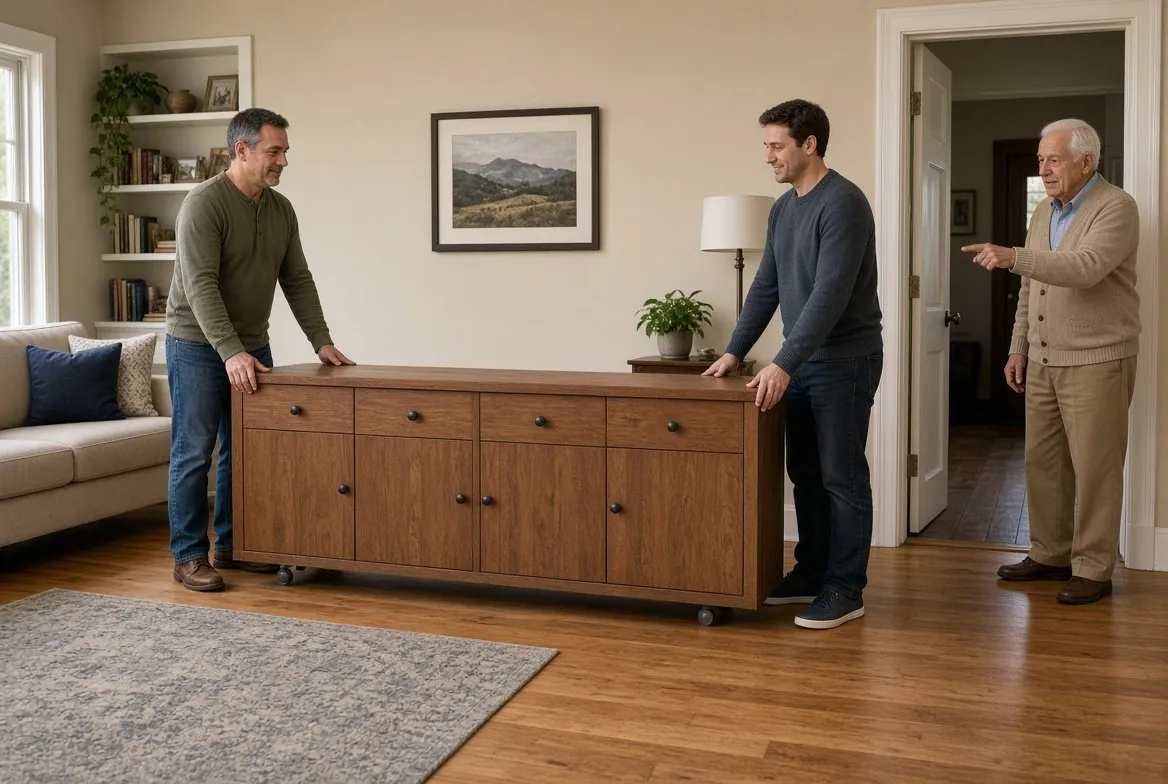
Pay somebody, and stop treating that as a defeat. Two movers for an hour costs less than most people assume and a great deal less than a fracture. For an appliance with a water line, a gas connection or its own circuit, hiring it out is not the expensive option — it is the only one, because the connection is the part that hurts people afterwards rather than during.
And ask the delivery people. When a new appliance is being delivered, taking the old one away and putting the new one in place is usually a line on the order form for a modest fee. It is the single most overlooked answer to this entire page.
The same thought as everywhere else on this site: the buddy system is not a concession. Most retired people know other retired people, and a cup of coffee buys a second pair of eyes for an afternoon. Handing off the jobs that genuinely need two people is how you go on doing the rest yourself for years longer.
⚠️ What Actually Hurts People
The back injury is the one everybody expects. These are the ones that get missed.
Tipping. Tall furniture goes over sideways far more easily than it looks, and fastest at the moment it starts moving or stops suddenly. This is why the list above exists. A tall item on sliders has less resistance at the bottom and exactly the same mass up high.
The sudden give. A load that has been resisting and then lets go all at once is how muscles get pulled, and it happens when pushing just as readily as when lifting. It is also how people end up on the floor, because the push you were bracing into no longer has anything to push against.
Feet and fingers. A heavy item running over a foot in a slipper, or a hand caught between a load and a door frame. Shoes on. Hands flat on surfaces, never on edges and never in a gap.
Stairs. Nothing heavy goes up or down stairs with you involved. Not with a stair-climbing hand truck, not with straps, not with help. That is a professional mover's job and it is worth every penny of what they charge for it.
The connections. A washing machine has hoses and a valve. A refrigerator with an ice maker has a water line that is usually just long enough to be pulled out of its fitting. Anything gas — a range, a dryer, a water heater — is not a moving problem at all but a get-somebody-qualified problem, and a flexible gas connector flexed once too often is how people end up in the news. The shutoffs page covers where your valves are before you need them.
And one that only bites afterwards. A refrigerator or freezer that has been laid down needs to stand upright for a good while before it is switched on again, so the compressor oil settles. Manufacturers differ — check the manual for your machine.
🧰 What Is Worth Owning
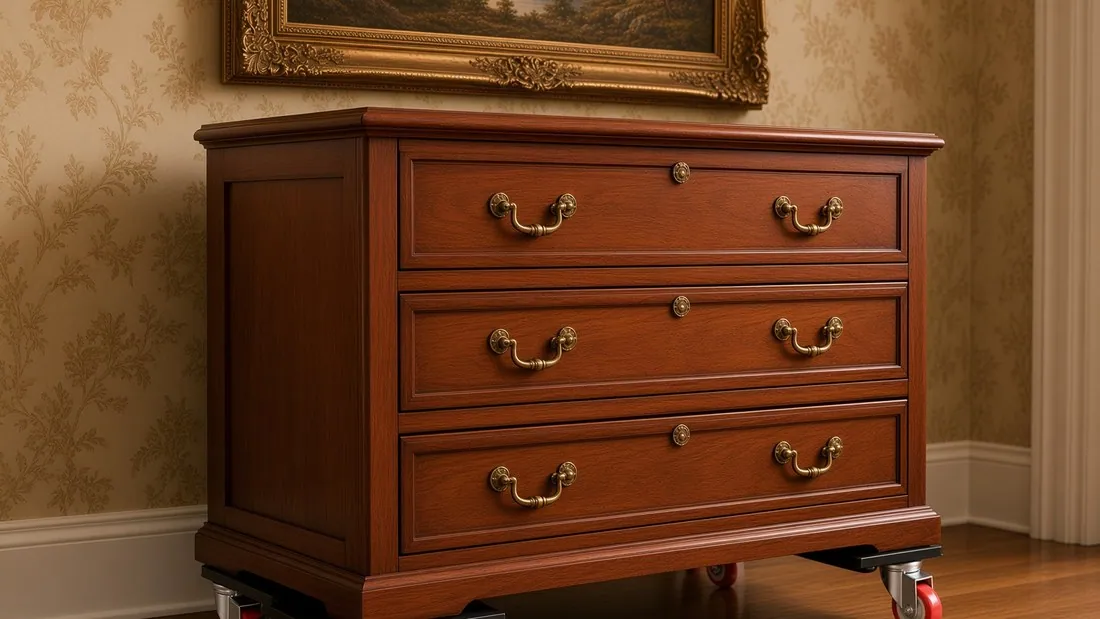
A short list, for the low and stable things that are genuinely yours to move, with help and with your doctor's blessing.
- A set of hard plastic sliders and a set of felt ones. Both, because you have both kinds of floor. A few dollars each.
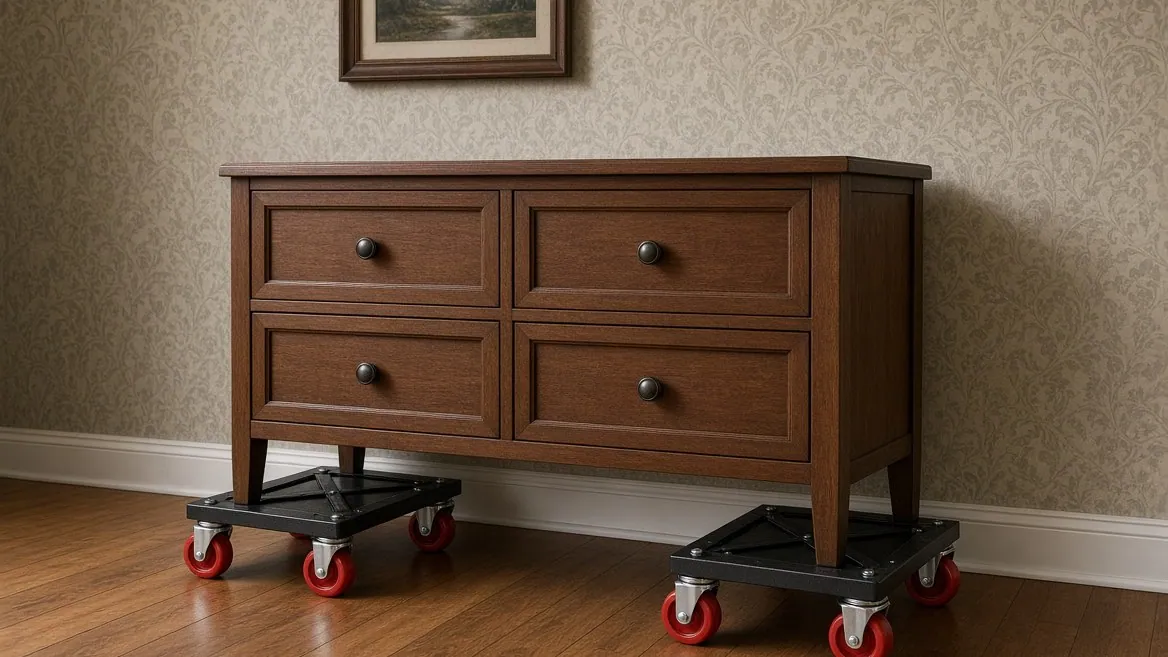
- A four-wheel furniture dolly for boxes and low cabinets on the flat. Around thirty dollars.
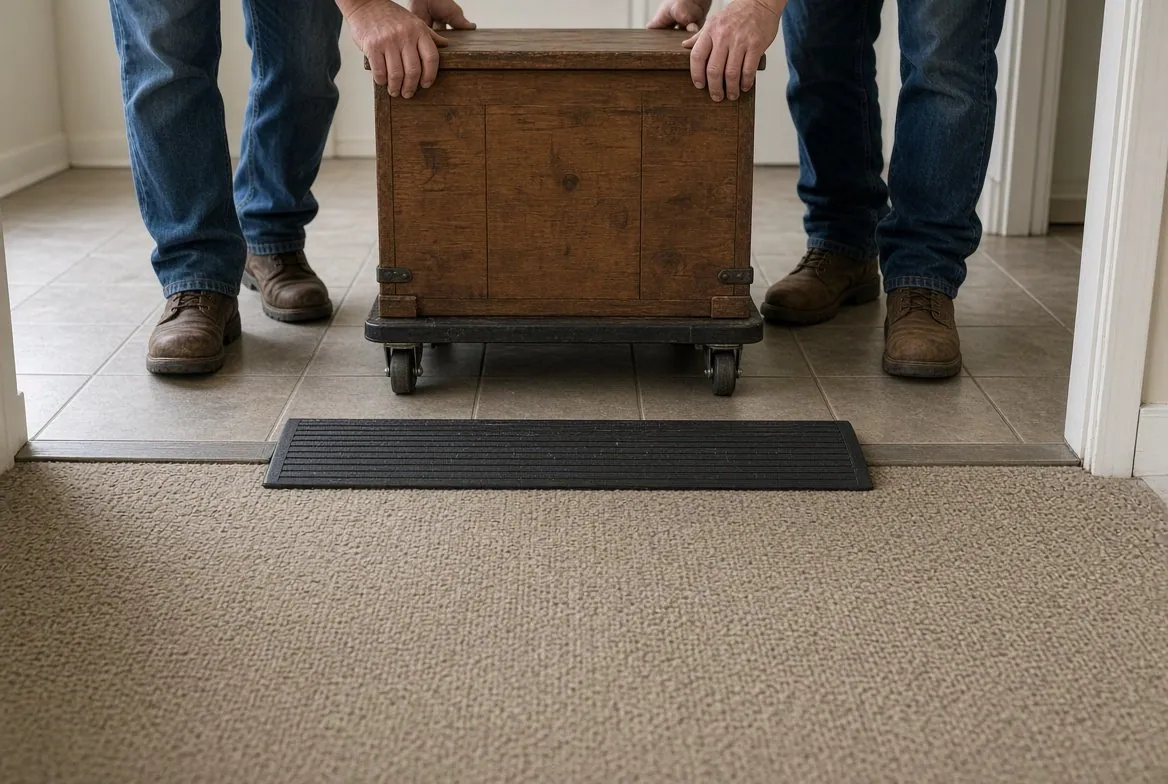
- A rubber threshold ramp if there is a raised strip in the route. A few dollars, and it removes the place a low load usually stops dead.
- A pry bar and a scrap block of wood, for raising a low corner an inch. You very likely own the bar already — it is in the grandfather toolkit.
Not on the list, deliberately: the appliance hand truck. It is the right tool for tall appliances and tall appliances are not on this page. If one is coming out of your house, the people who own that tool should be the ones bringing it.
Everything above comes to well under fifty dollars. The item it does not include is the help, and that is a phone call rather than a purchase.
📋 Buy It at 50 — Which Here Means Arrange It at 50
Most things on this site are a purchase. This one is mostly a habit, and the habit is asking early.
The washer dies on a Saturday. The delivery men will take the old one but only from the kerb. Suddenly a job that wanted a phone call on Tuesday wants a favour this afternoon from somebody who is at work — and that is the moment people decide to have a go themselves, which is the moment this page exists to prevent.
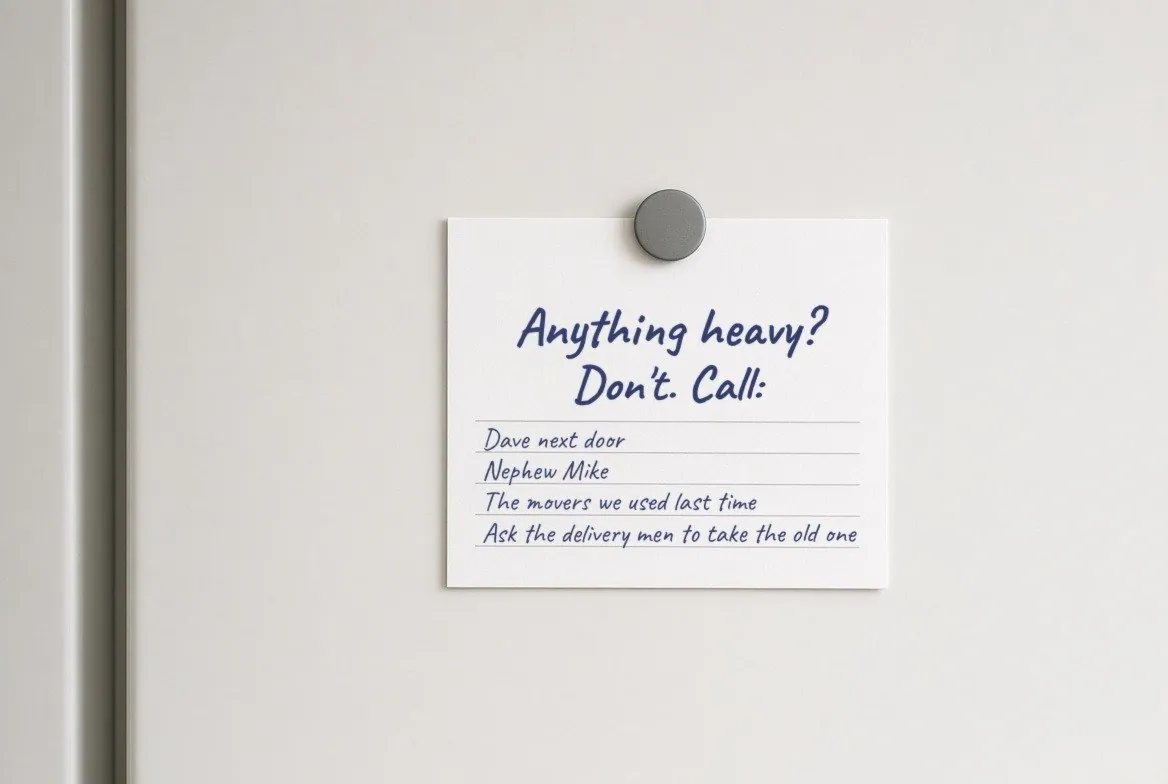
So the thing to set up at fifty is not the equipment. It is the two or three names. The neighbour who is handy. The nephew who owes you one. The mover you have used before and would use again. Written down, where you can find them, before anything needs moving.
And the part that is not about backs at all. Asking somebody is not the same as not being able. Anybody you would think of calling would far rather give you twenty minutes on a Saturday than visit you in a hospital afterwards, and if you ask them they will say so themselves.
This site exists so that you go on running your own house. Handing off the handful of jobs that genuinely want other people is exactly how you keep doing the rest of it yourself — for years longer than the man who insisted on all of them and lost the lot in one afternoon.
❓ Questions People Actually Ask
Should someone over 50 move a refrigerator or other tall furniture themselves?
No. This site does not recommend that anybody past fifty attempt to move, tip, rock or walk a refrigerator, freezer, washing machine, tall cabinet, bookcase, wardrobe, chest of drawers or anything else taller than it is wide, with or without equipment. A tall object going over gives no warning and no second chance, and no tool changes that. Those jobs belong to family, friends, or a professional mover, and any appliance with a gas, water or electrical connection belongs to a professional every time.
Do I need to ask my doctor before moving furniture?
Yes, and it costs nothing. Your doctor knows what medications you are taking and how they affect balance, bleeding and blood pressure; how strong your bones are; what your back and joints will actually tolerate now; what your grip and any arthritis will do partway through a job; and whether hard exertion is something you should be doing at all. None of that is on a website. Ask before you take on any pushing, pulling or sliding, including helping somebody else with theirs.
Is pushing something safer than lifting it?
It is easier on the spine, which is not the same as safe. A push can pull a muscle just as readily as a lift, especially when a load that has been resisting suddenly gives way and there is nothing left to push against. Research on lifting (the NIOSH equation) and on pushing and pulling (the Liberty Mutual tables) both describe healthy adults of working age in workplaces; neither was calculated for anyone over fifty, and neither is a limit for any individual person.
Do furniture sliders go on carpet or hard floors?
Both, but not the same ones. Hard plastic sliders are for carpet, because a smooth hard dome rides on top of the pile instead of digging in. Soft felt sliders are for hardwood, tile, laminate and vinyl, because felt slides on a smooth surface and protects it rather than scratching it. Getting any slider underneath means tipping the item, which needs a second person, and on anything tall it should not be attempted at all.
How much force does it take to push heavy furniture?
Weight multiplied by the coefficient of friction between the object and the floor. A 300-pound item on carpet, where the coefficient is roughly 0.6, needs about 180 pounds of push. On hard plastic sliders the coefficient drops nearer 0.2, so the same item needs about 60 pounds. Sixty pounds is a large reduction and still a substantial effort, applied by your shoulder, on a floor that may be slippery.
Who should move a washing machine or a gas range?
Somebody qualified. A washing machine has hoses and a shutoff valve, a refrigerator with an ice maker has a water line that pulls out of its fitting easily, and any gas appliance involves a flexible connector that must not be flexed by an amateur. Appliance delivery firms will usually remove the old machine and place the new one for a modest fee added to the order, which is the most overlooked answer to this whole subject.
What can I safely move myself?
Low, stable things on a flat floor, with help and after asking your doctor: a loaded box, a bin, a low cabinet, a piece of furniture wider than it is tall that is already sitting where you can push it. Sliders, a four-wheel dolly and a threshold ramp all make that category easier. Anything with height to it, anything you cannot see over, and anything that has to go up or down stairs is outside it.