
🌇 The Sky Over New York
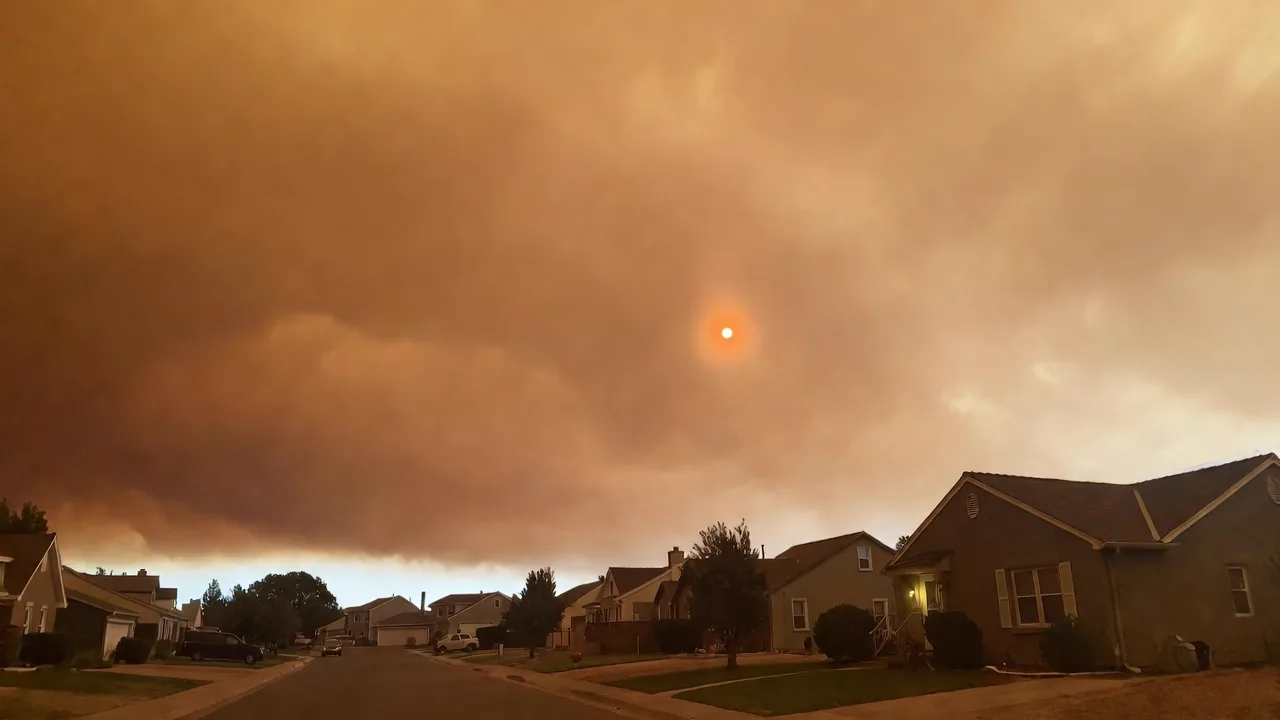
On June 7, 2023, people in New York City looked up in the middle of the day and saw a sky the color of a pumpkin.
There was no fire in New York. The smoke had come down from wildfires burning in Canada, hundreds of miles away, and it had settled over the city like a lid.
That day, according to the air-quality company IQAir as reported by Fox Weather, New York had the worst air of any major city in the world.
Most people think of wildfire smoke as somebody else’s problem — a California problem, an out-West problem. New York thought so too, until about lunchtime.
Smoke ignores state lines. If you live in or near fire country, you already know this page is for you. If you do not, the sky over Manhattan is the reason it is for you anyway.
🔥 The Fire on the Hill
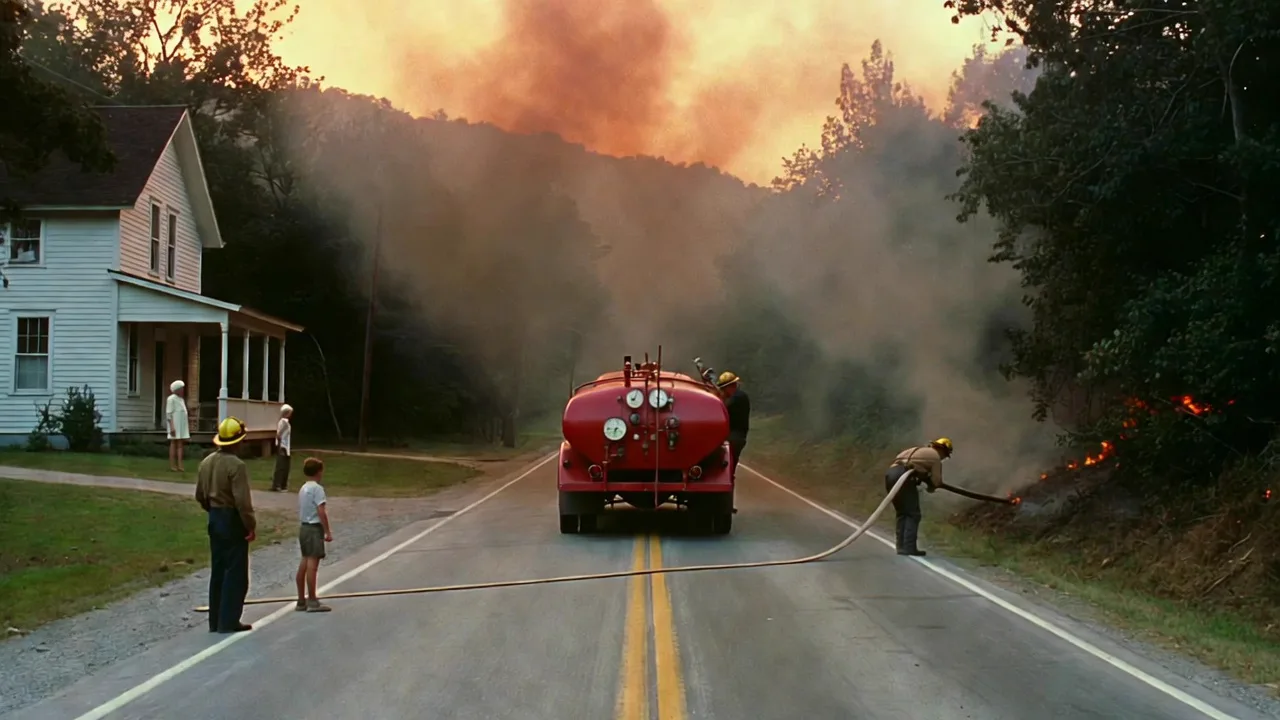
When I was a boy we lived on the hill, and a small forest fire came over the ridge and started down toward the lake and the cabins. There was a road there that served as a firebreak, and that is where the firefighters held the line. They ran their trucks up and down that road and put out anything that caught on the far side before it could get away.
The smoke was everywhere. Most people held a wet washcloth or a hand towel over their nose and mouth and breathed through it. That is what folks did then.
What health officials say now: a wet towel or a bandana catches the big stuff but not the fine particles in smoke. A tight-fitting N95 mask does catch them, but only if it seals against the skin, and a beard breaks the seal. So for a good many men, and for anybody who cannot wear one, the real answer is cleaning the air in one room.
🚪 One Clean-Air Room
The EPA’s advice for a smoke day is short, and it will sound familiar to anybody who has read One Cool Room on this site.
Stay inside. Close the windows and doors. Then clean the air in one room — a room you actually spend your time in.
You are not trying to clean the whole house, any more than you try to cool the whole house in a heat wave. You are trying to make one room where the air is fit to breathe, and to live in it until the sky goes back to the right color.
The bedroom is usually the right choice. You spend a third of the day there whether you plan to or not, and the door shuts.
🧰 The Kit in the Closet

Here is the whole list:
- One 20-inch box fan.
- Four 20x20 MERV 13 filters — the ordinary furnace filters, in the size that matches the fan.
- One roll of duct tape.
- Optional: a flat piece of cardboard a little bigger than the fan.
That is all of it. There is no motor to wire and no part to order.
The trick is not the building. The trick is the buying. On a smoke day, the stores sell out. Everybody in the region reads the same news on the same morning and drives to the same hardware store, and the filter aisle is bare by ten.
So buy it now, on a nice day, when nobody is thinking about smoke. Put the fan, the filters and the tape in one closet, together. A kit spread across a garage, a basement and a kitchen drawer is not a kit. It is a scavenger hunt.
🔧 The Two Ways to Build It
One Filter, Taped to the Back of the Fan
Take one filter and tape it flat against the back of the fan — the side that pulls air in, not the side that blows it out.
Every filter has an arrow printed on its frame. The arrow points toward the fan, the way the air travels.
Tape all four edges so air cannot sneak around the filter instead of going through it. That is the whole job, and it takes about as long as wrapping a birthday present badly.
The Corsi-Rosenthal Box
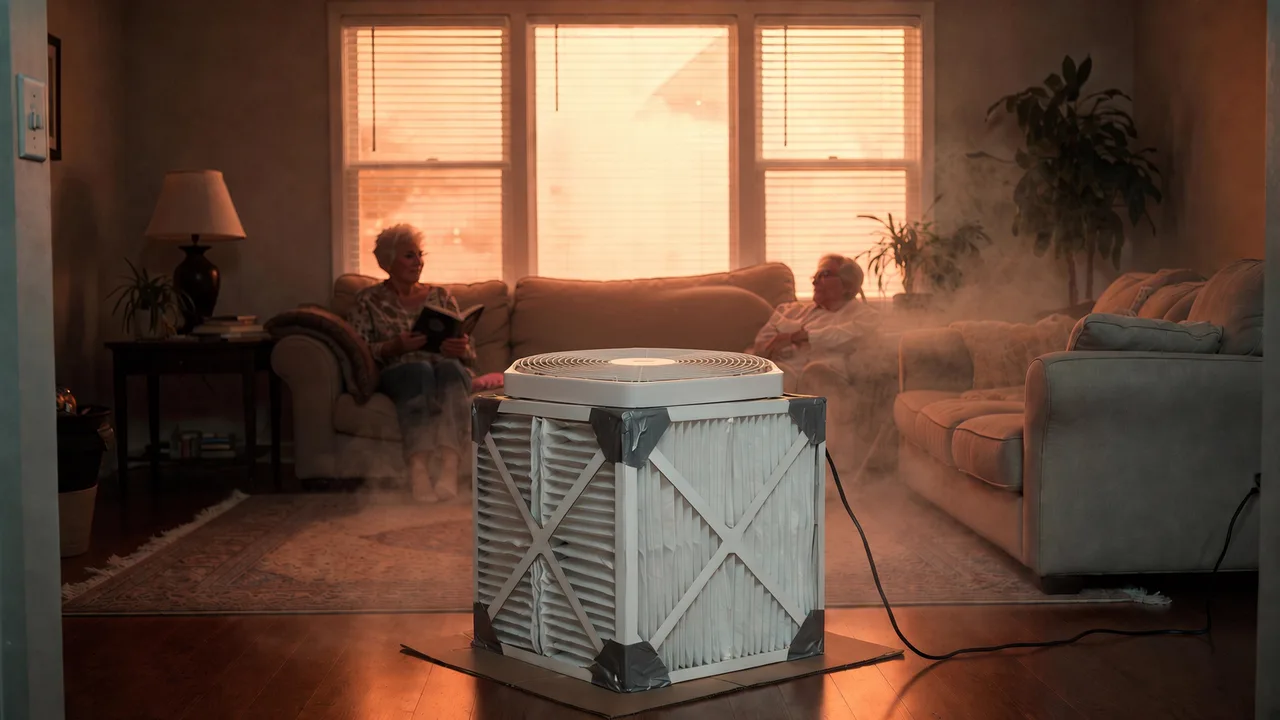
In 2020 two men, Richard Corsi and Jim Rosenthal, worked out a better arrangement, and it carries their names.
Tape the four filters together into an open cube, arrows pointing in. Set the fan on top, blowing up, away from the filters. Tape the fan to the cube.
Then seal every seam with tape, including the corners where the filters meet. Air is lazy. It will go through any gap it can find rather than push through a filter.
Four filters give the air four times the doorway to come in by, and that is the whole secret of why the box does so much better than the single filter.
📊 Does It Really Work?
It does, and the government has measured it.
The EPA tested these fans in a lab with real smoke and measured what is called the clean air delivery rate — how much clean air the thing puts out.
A store-bought HEPA unit catches more of the smoke each time the air passes through it. That is true, and it is worth saying.
But the box moves far more air, and in a room full of smoke, how much air you clean counts for more than how perfectly you clean each mouthful.
A study at UC Davis put a price on it: the box cleans air at about one-tenth the cost per unit of air cleaned.
Store HEPA units run about $200 to $500 and up. This kit runs roughly $60 to $100.
📏 How Big a Room?
The appliance makers’ trade group, AHAM, has a rule of thumb, and the EPA cites it: the clean air delivery rate should be about equal to the room’s square footage.
So the four-filter box, at about 400, is good for a room of roughly 400 square feet. The one-filter fan, at about 110, is good for about 110.
Measure your bedroom with a tape measure, length times width. Most bedrooms land well inside what the four-filter box can handle. A one-filter fan will do a small bedroom, and not much more.
📦 The Cardboard Trick
A box fan wastes a little of its effort. At the corners, where the round blades do not reach, some of the air it just pushed out curls back around and gets pulled in again.
The fix is a piece of cardboard. Cover the front of the fan with it and cut a circle in the middle about the size of the blades. The EPA calls this a shroud.
Compare the numbers above: the shroud took the one-filter fan from 111 to 156. That is about 40 percent more clean air, for a piece of a shipping box and five minutes with a kitchen knife.
There are not many things left in this world that get better for free. This is one of them.
⚠️ Two Mistakes
Mistake one: the old fan from the garage
Every garage in America has a box fan in it older than some of the cars. Leave it there.
Use a fan made in 2012 or later, with a UL or ETL mark on its label. Newer listed fans have a fused plug and a thermal cutoff — a part that shuts the motor off if it gets too hot.
That matters here, because a filter makes the fan work harder, and a motor that works harder runs hotter.
If an older fan is all you have, never run it unattended and never run it while you sleep.
Mistake two: the dirty filter
A filter catches smoke by filling up with it. Sooner or later it is full.
During smoke, check the filter every day. Replace it when it turns dark gray or brown, or when it smells of smoke.
The EPA found that dirty filters were almost completely ineffective. The fan still hums and the air still moves, so it looks like it is working. It is not.
That is why the closet holds spares. A second set of filters, bought on the same nice day as the first, is what keeps the room clean on day four.
🛑 Safety
Before you run it, every time:
- No extension cords. Plug the fan straight into a wall outlet.
- No damaged fans. A cracked housing, a frayed cord or a bent guard means a different fan.
- Keep it clear. Nothing against the intake or the outlet — no curtains, no bedding, no furniture.
- Working smoke alarms in the house, tested.
- Watch the heat. A house closed up against smoke in summer gets hot. Have a way to stay cool: One Cool Room.
- If officials say leave, leave. A clean-air room is for smoke. It is not a shelter from fire.
Frequently Asked Questions
Do box fan air filters really work for wildfire smoke?
Yes. In EPA lab tests with smoke, a box fan with one MERV 13 filter delivered a clean air delivery rate of 111, and a four-filter Corsi-Rosenthal box with a cardboard shroud delivered 401. A store-bought HEPA unit catches more per pass, but the box moves far more air.
What do I need to build one?
A 20-inch box fan made in 2012 or later with a UL or ETL mark, four 20x20 MERV 13 filters, and a roll of duct tape. A piece of cardboard for a shroud is optional and adds about 40 percent more clean air.
How big a room will it clean?
The rule of thumb from AHAM, cited by the EPA, is a clean air delivery rate about equal to the room's square footage. A four-filter box covers roughly a 400 square foot room; a fan with one filter covers about 110 square feet.
How often should I change the filters?
Check them every day during smoke. Replace them when they turn dark gray or brown or smell of smoke. The EPA found dirty filters were almost completely ineffective, which is why you keep a spare set.
Is it safe to run a box fan with a filter on it?
Use a fan made in 2012 or later with a UL or ETL mark, which has a fused plug and a thermal cutoff, because a filter makes the motor run hotter. Plug it straight into the wall with no extension cord, keep it clear of anything that could block it, and never run an older fan unattended or while you sleep.
📚 Sources
- • U.S. EPA — Research on DIY Air Cleaners to Reduce Wildfire Smoke Indoors
- • U.S. EPA — DIY Air Purifier Infographic (PDF)
- • Chemical Insights Research Institute — DIY box fan air cleaner study (PDF)
- • Characterizing the Performance of a Do-It-Yourself (DIY) Box Fan Air Filter (PDF)
- • South Central Public Health District (Idaho) — Wildfire Smoke FAQs (PDF)
- • City of Menlo Park — Wildfires and Smoke
- • Fox Weather — New York’s orange sky and Canadian wildfire smoke
Page last reviewed: October 2026 | Author: Franklyn Galusha