⚖️ The Number That Says You Were Right to Worry
Start with the thing nobody tells you, because it is federal research and it is not an opinion.
OSHA has no rule about how much a person may lift. What exists instead is the NIOSH lifting equation, developed by the National Institute for Occupational Safety and Health, and it starts from a single figure: 51 pounds is the maximum load that nearly all healthy workers can lift under ideal conditions. That is the ceiling, not the target.
Now read the small print on that ceiling, because this is the part that matters. Ideal conditions means the load is right up against your body, at about waist height, with good handles, lifted straight without any twist, and only occasionally. Every way a real job differs from that knocks the number down. Reaching out for it knocks it down. Picking it up off the ground knocks it down. Turning as you stand knocks it down. A bag with nothing to hold onto knocks it down.
So take an ordinary Tuesday. A fifty-pound bag of potting soil, lying flat in the trunk of a car. You reach in for it, which puts it a foot and a half from your spine. You lift it from below waist height. You have nothing to grip but a slippery plastic bag. And you turn as you come up, because the wheelbarrow is behind you.
Run those through the equation and the recommended limit for that particular lift lands somewhere around twenty-five pounds. The bag weighs fifty. You are at roughly twice the limit — and that limit was calculated for healthy adults of working age, not for the man who is doing it at seventy-one because nobody else is coming.
Nothing about that says you will be hurt. People do it every weekend and walk away. It says the odds are worse than they look, that they get worse with every repetition, and that the day it goes wrong there is no warning first — and being laid up for three weeks at seventy-five costs more than the three weeks. It costs whatever muscle you lose lying still, which at that age you do not get all the way back.
The same trade works indoors, on the things too big to go in a wagon at all — the refrigerator, the freezer, the washer and the furniture can all be moved across a floor without being lifted either, and for about the same money.
A wagon does not make you lift better. It deletes the lift. You slide the bag from the trunk into the bed, which is a horizontal slide of about eight inches rather than a lift, and then you pull. That is the whole argument and there is not much more to it.
🩺 Before Any of This, Talk to Your Doctor
This is free, it takes one question at an appointment you are probably already going to, and it is the most useful thing on the page.
Do not take on any of the pulling, loading or sliding described here without asking your own doctor whether it is a reasonable thing for you to be doing. Your doctor knows what medications you are on and how they affect balance, bleeding and blood pressure; how strong your bones are; what your back and joints will actually tolerate now rather than a decade ago; what your grip and any arthritis will do partway through; and whether hard exertion is something you should be taking on at all. None of that is on a website.
And the thing people skip: a push can pull a muscle just as easily as a lift can. There is nothing magic about keeping a load on wheels. A wagon makes the job possible; it does not make your shoulder, your back or your knee twenty years younger, and a load that catches or gives way suddenly does the damage either way.
And nothing tall goes in the wagon or gets moved by you. A refrigerator, a freezer, a cabinet, a bookcase, a wardrobe — anything taller than it is wide — is not a job to attempt yourself at any age past fifty, with a wagon or without one. Those belong to able helpers or to professional movers. The companion page covers why, and what to do instead.
Nothing here should be done without help either. Loading is where people get hurt, not pulling, and a second pair of hands costs a phone call. You are fifty or better. That is not a limitation, it is just the arithmetic, and the arithmetic is worth respecting while you still have the choice.
📦 What It Actually Carries, Which Is More Than You Think
Most people buy one for the garden and then find it has quietly taken over half the property. Here is the honest list, roughly in order of how often ours gets used for each.
Water, which is heavier than anybody expects
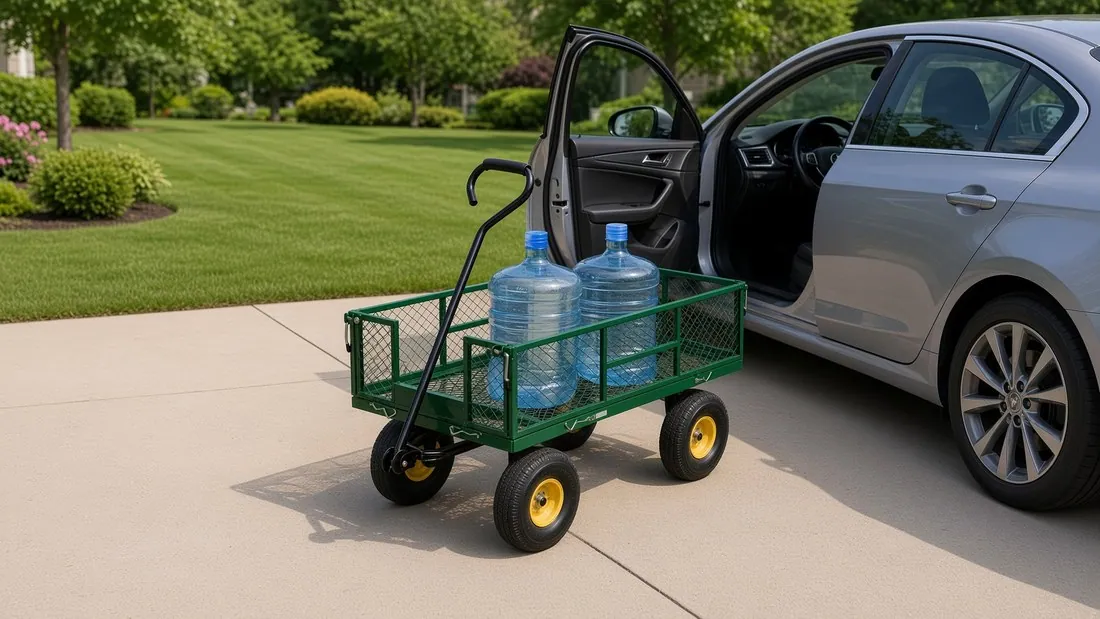
Water weighs 8.34 pounds a gallon. A five-gallon jug is therefore about 42 pounds, with a handle designed for a hand younger than yours, and it is the single most awkward thing most people carry. Three of them in a wagon is 126 pounds you never picked up. If you are storing water for an outage — and the water storage calculator will tell you how much — the wagon is how it gets from the car to the garage and from the garage to wherever you actually need it.
Firewood
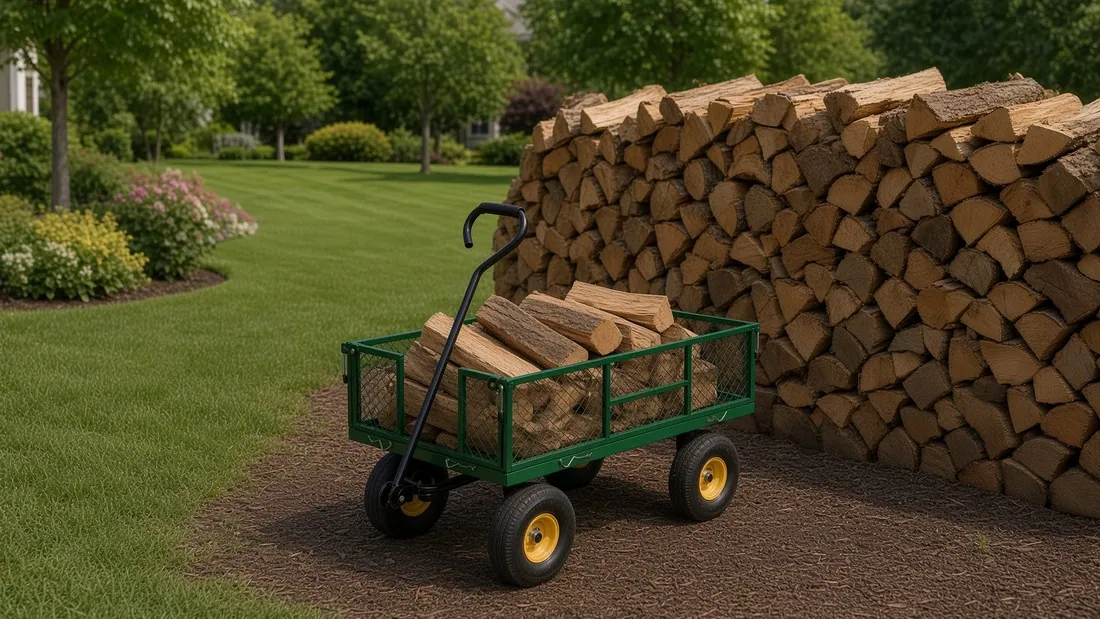
A wagon holds more than your arms and does not require you to walk with a load pressed against your chest where you cannot see your feet. It also lets you work down from the top of a stack rather than pulling from the middle. The firewood guide covers the seasoning and the stacking — and carries the warning about what lives under a tarped woodpile, which is worth reading before you reach into one.
Groceries from the car to the kitchen
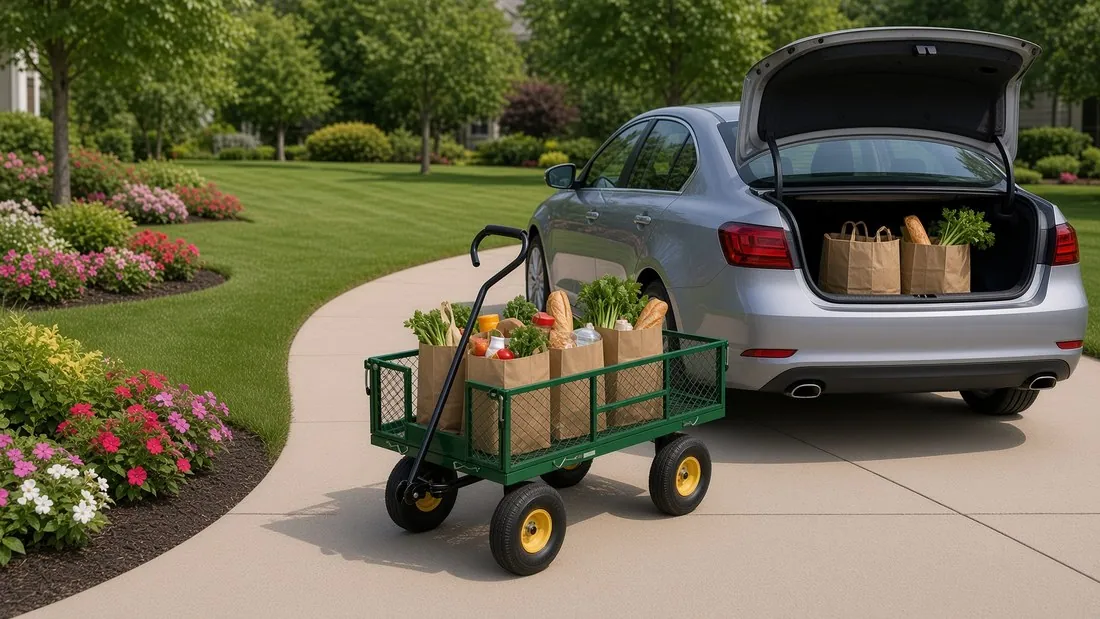
This is the one nobody thinks of and everybody ends up using. A full trunk becomes one trip instead of four, and four trips is where people get careless on the last one. If the path from the driveway to the door is level, the wagon does the whole job.
Bags — soil, mulch, feed, salt, sand
Potting soil and mulch come in 40 and 50-pound bags. Chicken feed comes in 50. Water softener salt comes in 40. Every one of them sits at ground level in a store and at ground level in your car, which is the worst possible geometry for a lift. Slide, do not lift. If you keep hens, the backyard chickens guide covers the rest of the routine that feed bag belongs to.
The garden itself
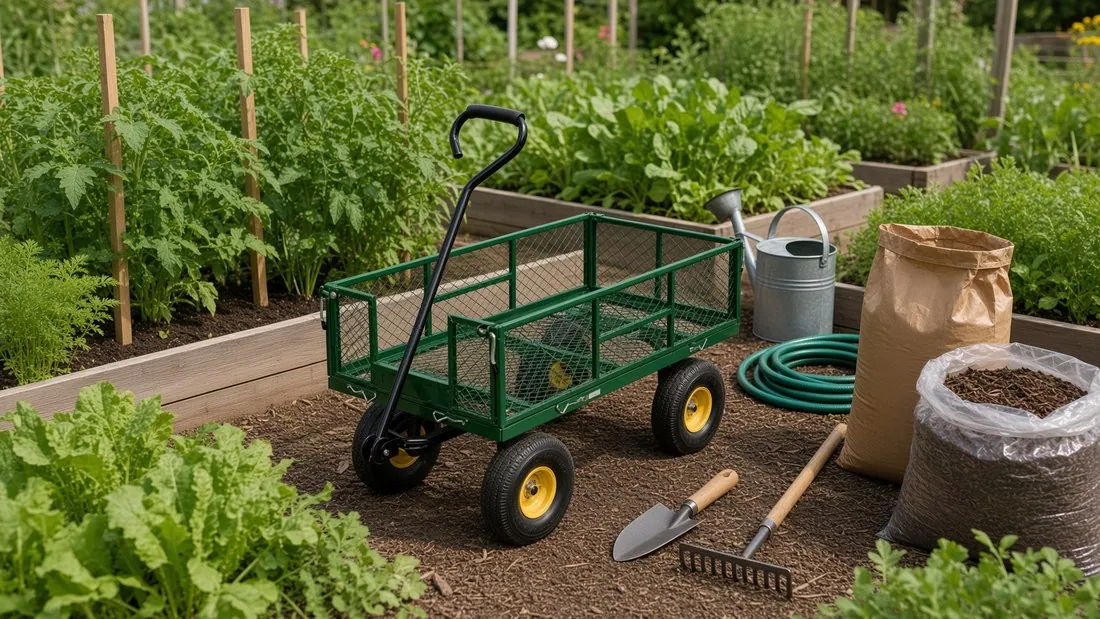
Flats of seedlings, the harvest coming back, pots being moved for the season, tools going out and coming in. Vegetable gardening for seniors is built around raised beds and staying off your knees; the wagon is the same idea applied to the walking part.
Tools, and the trip back for the one you forgot
The reason a job takes three hours instead of one is the walking. Load the wagon at the bench, take the whole kit to the far corner of the property, and the job takes the time the job takes. The grandfather toolkit is the list of what lives in it.
The cooler
A loaded cooler is one of the worst carries there is — heavy, wide, no good grip, and it swings. The cooler guide makes the case for the size you can actually handle; a wagon makes the size question a good deal less urgent.
Loading the car to leave
If an evacuation is ever on the table, the wagon is how the go-bag, the medications, the water and the pet carrier get from the house to the car in one pass instead of six, at the exact moment when hurrying is how people get hurt. If there is a bird or a cat in the plan, that carrier rides too.
Yard waste, and the trash to the kerb
Brush, leaves, the branch that came down. And on a wet Tuesday in February, the bin to the road and back without walking it twice.
⚡ The Generator, Which Is Where This Page Came From
A portable generator is the hardest single object most households own. They run from about forty pounds for a small inverter up past a hundred and thirty for the mid-size machine most people actually want, and they come with two small wheels and a stub of a handle — which works fine for a strong person on smooth concrete and works badly for everyone else on grass, gravel and a garage threshold.
Tilting a hundred and thirty pounds onto two wheels and holding it there is a lift, a carry and a twist at the same time. It is the single worst movement on this page and it happens at the worst possible moment — in the dark, in the wet, when the power has just gone out and you are already tired.
In a wagon the machine rides flat and the cord, the fuel, the funnel and the oil ride beside it. Generator night starts with one handle instead of four corners of the garage and a flashlight.
The full version of this — what rides in the wagon, how it gets strapped down, and why you should stop lifting the gas can to pour as well — sits with the cooling guide, and it is worth reading before you buy either thing. The generator size calculator will ask you who moves the machine and give you a weight ceiling to shop against, and the generator guide covers the rest.
One rule that overrides everything convenient about this. The wagon is for moving the generator, not for running it. A generator runs outdoors, at least twenty feet from the house, with the exhaust pointed away from every window and door — on level ground, where it cannot roll and cannot tip. Never in a garage, never on a porch, never under an overhang, not even for a minute, and not even with the door open. Carbon monoxide is the thing that kills people after storms, and it kills them indoors.
🛑 The Tires Are the Decision. Everything Else Is Preference.
If you take one thing from this page into the store, take this: the tires decide whether the wagon gets used or resented. There are three kinds and the differences are not subtle.
Pneumatic — air-filled, like a wheelbarrow tyre
These are what you want if the wagon crosses grass, gravel, a lawn, a garden path, or a threshold. Air absorbs the bumps, the tyre deforms over obstacles instead of stopping against them, and a loaded wagon rolls with a fraction of the effort. The cost is that they can go flat, they lose pressure sitting all winter, and you will need a pump. That is a real chore and it is worth it.
Never-flat — solid foam or solid rubber
Nothing to puncture and nothing to check. On a smooth driveway or a garage floor they are fine and you will never think about them again. On grass and gravel they are noticeably harder work, because a solid tyre climbs over every bump rather than absorbing it, and the whole point of this purchase was to make the work smaller.
Small hard plastic wheels
Avoid. These are what the cheapest wagons come with, and a big load on small hard wheels on soft ground is how you end up dragging the thing. The wagon that lives in the corner unused almost always has these.
The rule that covers nearly everybody: if it will ever cross grass, buy pneumatic and accept the pump. If it will only ever go from the car to the kitchen across concrete, never-flat is genuinely fine and one less thing to think about.
And whichever you choose, look at the diameter. A ten-inch tyre rolls over a lot of things a six-inch tyre stops dead against, and the difference in effort at the handle is larger than the difference in price at the till.
🔧 The Bed, the Handle, and What the Weight Rating Really Means
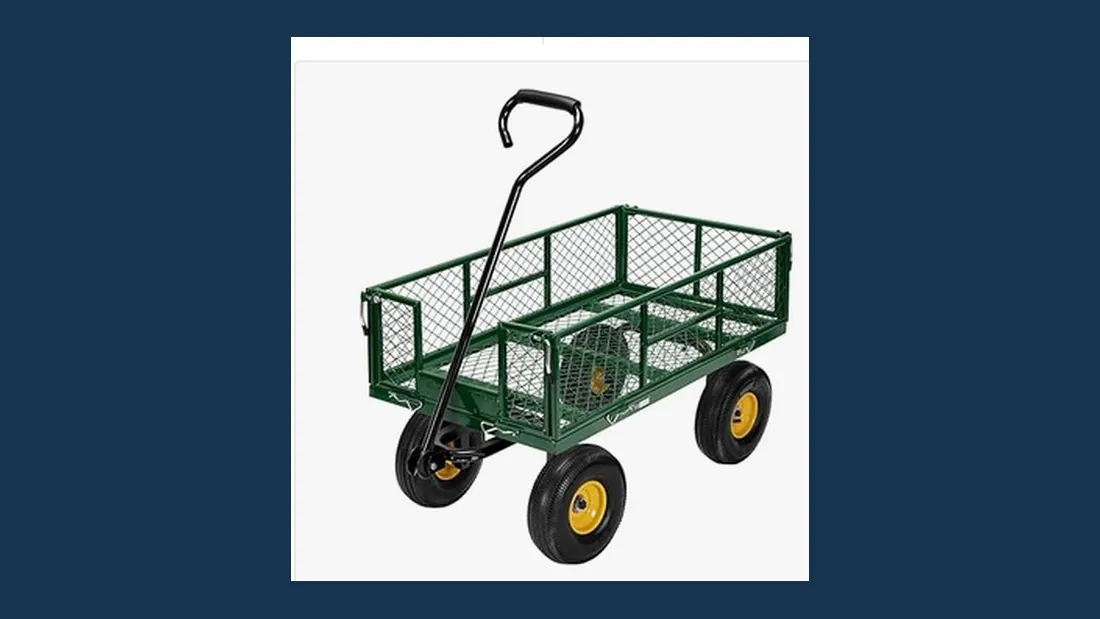
Steel mesh or a solid poly tub
Steel mesh with drop-down sides is the more useful of the two for most people, and the sides are the reason. Drop a side and the wagon stops being a box you must lift things over and becomes a flat platform you can slide things onto. That single feature is most of what makes it a lifting aid rather than a container. Mesh also lets dirt and water fall through instead of collecting.
A solid poly tub holds water, holds loose soil, will not rust, and hoses out. If the main job is compost, mulch and wet garden work it is the better bed. But the walls are fixed, so everything goes in over the top, and over the top is a lift.
The handle
Longer is better, and the reason is posture rather than leverage: a short handle makes you walk bent, and a long one lets you stand up. Check that it folds down or stands up on its own, because a handle lying flat across a garage floor is a trip hazard in a dark garage — which is exactly where and when you will be using it.
Look for a swivel front axle. Without one the wagon turns like a trailer and you will be reversing it into corners; with one it follows you around a bed of tomatoes. Some models add a dump feature that releases the bed and tips the load out. Do not buy one. It is sold as a convenience for mulch, and what it actually adds is a catch that can let go with a load on board — on a slope, over a threshold, or at the moment you set the handle down. A bed that is bolted down cannot dump three hundred pounds onto your feet, and emptying a wagon with a shovel has never hurt anybody. This site does not recommend anything with a tipping mechanism in it.
The weight rating, told honestly
These are usually sold with a capacity figure — commonly somewhere between three hundred and twelve hundred pounds. That number describes the frame, not you. It is the load the steel and the axles will carry without bending. It says nothing whatever about the load you can start moving from a standstill, hold on a slope, or stop once it is rolling.
The number that actually governs your day is not printed anywhere on the box, and it is the same one from earlier: how much you can get into the wagon in the first place. A twelve-hundred-pound rating on a wagon you load fifty pounds at a time is twelve hundred pounds of reassurance and fifty pounds of reality.
⚠️ What a Wagon Will Not Do for You
This site does not sell things by leaving out the awkward part, so here is the awkward part.
A wagon does not make heavy things light. It only removes the carry. Something still has to get the load from wherever it is into the bed, and getting it in is the moment the injury happens — not the pulling. Every bit of technique you were going to use on the lift, you still need on the load.
Which is why the drop-down side matters more than the capacity rating, and why the wagon wants to be parked at the same height as whatever you are moving. Back it up to the open trunk. Put it beside the woodpile rather than at the end of the path. Slide, do not lift — and if it cannot be slid, it is a two-person job or a job for another day.
A loaded wagon on a slope is a different machine. Three hundred pounds behind you on a downhill will push you, and it does not stop when you do. Going down, keep it in front of you and let it lead against your body weight rather than towing it behind. On any real grade, take two half loads. And never park a loaded one on a slope without chocking a wheel — a wagon that rolls away on its own will find the one thing in the yard you did not want it to hit.
They arrive in a box. Nearly all of these ship flat and want assembling: axles, cotter pins, side panels, a handle, and tyres that may need inflating before first use. It is an hour on the garage floor with a wrench, and it is worth knowing before it turns up rather than after. If somebody in the family is offering to help with something, this is a good thing to let them do.
And they are not for carrying people. Not grandchildren, not down the driveway, not just to the end of the road. They have no brakes, no restraints, and a high tipping point when loaded high — and grandchildren are extremely persuasive. Decide the answer now, while nobody is asking.
🤝 The Part No Tool on This Page Can Do for You
Everything here makes a job possible. Possible and advisable are different words, and the gap between them is where people get hurt.
The honest question is not can I do this — you probably can. It is can I do this today, on this floor, in these shoes, at this hour of the evening, and what happens if it goes wrong halfway through. Because that is where these jobs fail. Not at the start, when you are still deciding. In the middle, when a heavy thing is already moving and you have just found out something you did not know.
Strength is not the only thing that changed. Balance changed. Grip changed. Reaction time changed — and reaction time is exactly what a load in motion is testing. So did how long it takes to get over it, which is the one nobody counts until they are three weeks into counting it.
Ask yourself who is in the house. If something pins you, or you go down, how long before anybody knows? Put the phone in your pocket before you start, not on the kitchen counter where it is no use to anybody. That one habit costs nothing and it is the difference between an hour and a morning.
And then the part that is not about safety at all. Calling somebody is not the same as not being able. It is a phone call. Anybody you would think of calling would far rather give you twenty minutes on a Saturday than visit you in a hospital afterwards, and if you ask them they will tell you so themselves.
This whole site exists so that you go on running your own house. Handing off the one job in ten that genuinely wants two people is how you keep doing the other nine yourself — for years longer than the man who insisted on all ten and lost the lot in one afternoon.
📋 Buy It at 50 — Why This One Is Almost Free
Most things on this site cost real money and buy you something years from now. This one runs about a hundred dollars, and it is useful the day it comes out of the box — which makes it the easiest entry on the whole list.
The Buy It At 50 argument still applies, and it is worth saying plainly. Nobody buys one of these at seventy-five because they have decided to be sensible. They buy one after something goes wrong: after the bag in the trunk, after the fall on the gravel, after the three weeks of not being able to stand up straight. Bought at fifty it is a convenience that saves you a hundred trips a year. Bought after, it is a piece of medical equipment you resent.
And there is the part that has nothing to do with backs. A wagon is what lets somebody keep doing the job themselves. The alternative to pulling your own firewood is not lifting it. The alternative is waiting for somebody to come and do it for you, on their schedule, which is how a person stops being the one who runs their own property. A hundred dollars of steel and four tyres buys a good many more years of not having to ask.
Look at what you already carry in your arms in an ordinary week. Then price the wagon against one afternoon in an urgent care clinic, and the decision makes itself.
❓ Questions People Actually Ask
How much weight can a garden wagon hold?
Capacity ratings commonly run from about 300 to 1,200 pounds, but that figure describes what the frame and axles will carry without bending. Avoid any model with a dump or tipping bed: the release catch adds a way for a loaded bed to let go at the wrong moment, and a fixed bed cannot do that. It says nothing about what you can load into it, start moving from a standstill, hold on a slope, or stop once it is rolling. The practical limit for most people is how much they can get into the bed in the first place.
Are pneumatic or never-flat tires better on a garden wagon?
Pneumatic air-filled tires are much easier to pull across grass, gravel and thresholds because the tire absorbs bumps instead of stopping against them, but they can go flat and lose pressure over winter, so you will need a pump. Never-flat solid tires need no maintenance and are fine on smooth concrete, but they are noticeably harder work on soft ground. If the wagon will ever cross grass, buy pneumatic. Larger diameter helps more than the price difference suggests.
How much weight is safe for a senior to lift?
There is no legal limit, and no general answer that fits an individual. The NIOSH lifting equation puts 51 pounds as the maximum nearly all healthy workers can lift under ideal conditions, and every real-world factor reduces it: reaching away from the body, lifting from the ground, twisting, poor grip, and repetition. Those figures describe healthy adults of working age in workplaces, not any particular older person, and what is safe for you is a question for your own doctor.
What is a garden wagon useful for besides gardening?
Moving a portable generator and its fuel and cords, carrying water jugs, hauling firewood, bringing groceries in from the car in one trip, moving bags of soil, mulch, salt or animal feed, carrying tools to the far end of a property, moving a loaded cooler, taking bins to the kerb, clearing yard waste, and loading the car quickly if you ever have to leave in a hurry.
Can you move a generator in a garden wagon?
Yes, and it is far safer than tilting one onto its two small wheels and holding it across grass and thresholds. The generator rides flat and the cord, fuel, funnel and oil ride with it. The wagon is for moving the machine, not running it: a generator must be run outdoors on level ground, at least 20 feet from the house, with the exhaust pointed away from every window and door.
Should I get a steel mesh wagon or a solid poly tub?
Steel mesh with drop-down sides suits most people, because dropping a side turns the wagon from a box you lift things over into a flat platform you can slide things onto, which is most of the point. A solid poly tub is better if the main job is wet garden work, compost or loose soil, since it holds water and hoses out, but its walls are fixed so everything goes in over the top.