A Car Hit a Pole at 2 AM. You Lost Power for Six Hours. Your CPAP Stopped.
Vehicle collisions with utility poles are one of the most common causes of residential power outages in America. They happen every day, in every state, in every weather condition. A drunk driver. A medical emergency at the wheel. Ice on a road at 2 AM. The result is a knocked-down pole, downed lines, and darkness for everyone downstream. For a senior sleeping with a CPAP machine, the 2 AM outage they did not know about is the one that matters most.
Every cause on this page ends the same way: your lights out. These three steps work against all of them.
🚨 Suburban Columbus, Ohio — January 2020 — 2:17 AM
A Driver Lost Control on Ice. Hit a Pole. Walter’s CPAP Stopped at 2:17 AM. He Didn’t Know for Three Hours.
A driver on ice, a utility pole, and a machine that stopped at seventeen minutes past two. Nobody plans around this because there is nothing to plan around — no forecast, no season, no warning — only whether the thing beside the bed keeps running once the wall stops.
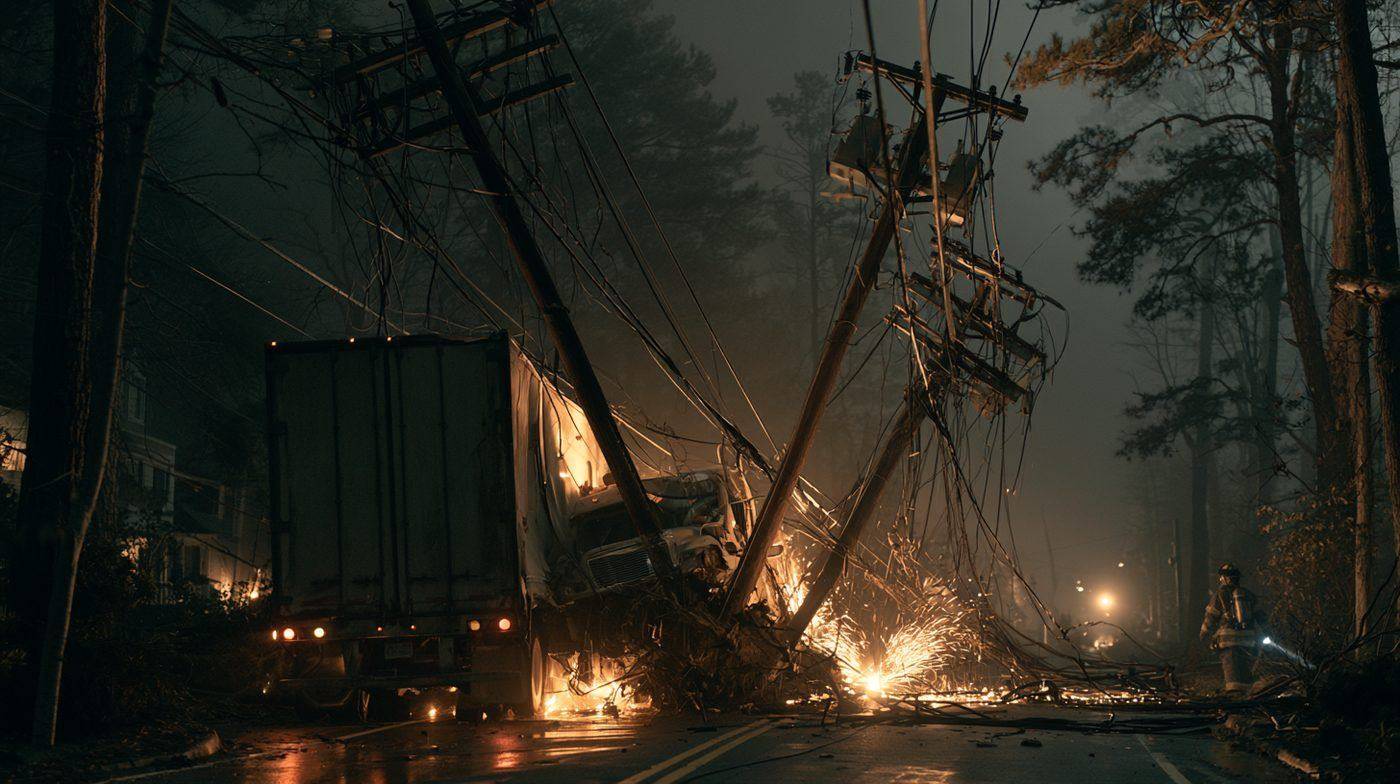
Walter was 71 and had severe sleep apnea. He used a CPAP machine every night. On January 14, 2020, a driver lost control on an icy road in his Columbus suburb and hit a utility pole at 2:17 AM, knocking it down and severing the lines to Walter’s block. Power to about 800 homes went out.
Walter’s CPAP machine stopped. He did not wake up immediately — the machine stopping is not loud. He woke at approximately 5 AM, three hours after the outage began, with a severe headache, disorientation, and oxygen saturation his doctor later estimated had likely dropped significantly during unassisted sleep. He had not slept properly. His apnea had been untreated for three hours.
Walter was not in immediate medical crisis. But his sleep medicine physician told him afterward that repeated undetected CPAP outages — particularly during the deep sleep phases that occur in the early morning hours — carry real cardiac and cognitive risks for patients with severe apnea. “The problem,” his doctor said, “is that you don’t know it’s happening.” The pole was replaced and power restored at 8:43 AM. Walter had been awake since 5, groggy and unwell, with no explanation until he checked the utility outage map on his phone.
✅ What a UPS and generator would have meant: A UPS (uninterruptible power supply) for his CPAP machine would have bridged the gap or alarmed him immediately. A whole-home standby generator would have restarted within 11 seconds of the outage — his CPAP machine would have continued running through the entire night without interruption. He would have woken normally, well-rested, and learned about the downed pole from his neighbor over coffee.
Daily
Vehicle-pole collisions causing residential outages occur somewhere in the US every day
4-8 hrs
Typical restoration time when a vehicle knocks down a utility pole
2 AM
Peak hours for vehicle accidents are late night to early morning — when seniors are asleep on medical equipment
800
Homes affected by a single pole collision in Walter’s neighborhood
How Often Vehicles Take Down Power Lines
Vehicle collisions with utility poles are among the most frequent causes of neighborhood-level power outages in the United States. State utility commission outage data consistently identifies vehicle-pole collisions as a top cause of outages affecting individual circuits — the distribution lines that serve specific blocks and neighborhoods.
The incidents range in severity from a single car hitting a single pole — affecting a few dozen homes for a few hours — to a semi-truck taking out a row of poles on a major distribution line, affecting thousands of homes for most of a day. In areas with heavy truck traffic or rural roads with limited lighting, major vehicle-caused outages are a regular seasonal occurrence, particularly in winter when ice makes roads treacherous.
Unlike substation events that are reported in regional news, neighborhood-level pole collisions rarely make the news. They are simply logged as outage events by the utility, assigned to a repair crew, and resolved. For the households affected, the cause is often unknown until power is restored and they check the utility’s outage report.
The Night Problem: When the Outage Starts While You Sleep
Vehicle accidents peak during late night and early morning hours — between midnight and 6 AM — when impaired driving, fatigue, and reduced visibility are most prevalent. This means a significant proportion of vehicle-caused outages begin during exactly the hours when seniors are asleep with medical equipment running.
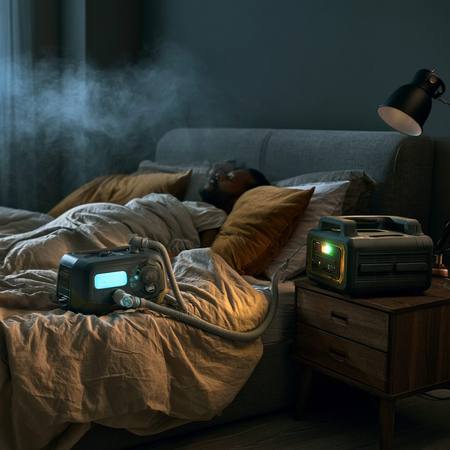
Covers thrown back, the machine silent, and a streetlight the only thing still working. The outage that begins at two in the morning is the dangerous one, because nobody is awake to notice anything has stopped — an alarm that runs off its own battery is the whole of the difference.
A CPAP machine that stops at 2 AM does not wake most users immediately. The machine stopping is a reduction in noise and airflow — not an alarm. Most people who use CPAP machines for sleep apnea are not aware their machine stopped until they wake. For someone with severe apnea, the untreated hours before waking can include significant desaturation events with cardiac and cognitive consequences.
An oxygen concentrator that stops at 3 AM similarly does not alarm the user immediately. A person sleeping may not register the change in oxygen availability until symptoms develop — which, depending on their baseline condition, can take minutes to hours. The night outage is the most dangerous scenario for seniors on powered medical equipment because it removes the ability to respond immediately.
This is why a whole-home standby generator that starts automatically within 11 seconds — without requiring anyone to wake up, go outside, or do anything — is the specific solution for this specific risk. The user is asleep and remains asleep. The generator handles the outage without them.
The 50–70 Math: Vehicle Accidents Happen at 2 AM on Tuesday Nights
Vehicle-caused outages happen when you are asleep, when the weather may be fine, when you had no reason to prepare for an outage that day. They are caused by someone else’s decision — a driver who should not have been driving, on a road you did not know existed, at a time when you were not awake to respond.
At 55, discovering your CPAP machine was off for three hours is concerning. At 71, like Walter, it is a medical incident that requires a physician visit and a difficult conversation about cardiac risk. At 78, with more advanced cardiovascular or pulmonary disease, it may be something worse.
The generator decision at 55 is about who you are at 75. The 75-year-old version of you will not be able to retrofit preparation for the 2 AM outage they did not see coming. The 55-year-old version of you can make the decision that makes the 2 AM outage irrelevant.
The Car That Hits the Pole Will Not Wait Until You’re Ready.
Vehicle-caused outages start when they start. Your generator can be ready before they do. A whole-home standby generator that starts automatically within 11 seconds protects you from outages at 2 AM, at noon, in good weather, in bad weather, from every cause on this list. It just starts. Your medical equipment keeps running. You stay asleep.
Can a UPS protect my CPAP machine during a short vehicle-caused outage?
Yes. A UPS (uninterruptible power supply) provides seamless bridge power for brief outages — typically 15 to 60 minutes depending on the unit and load. Many CPAP machine outages caused by vehicle accidents are resolved within a few hours, but a UPS alone cannot cover a full night if the repair takes 6 to 8 hours. A UPS plus a portable battery station, or a whole-home generator, provides more complete protection.
How will I know if my CPAP stopped during the night?
Most modern CPAP machines log usage data and can detect power interruptions. Your CPAP data software or your machine’s display will often show if the session was interrupted. Some machines have audible alarms when power is lost. Check with your equipment provider about whether your specific machine has low-power or power-loss notification capabilities.
Are some areas more prone to vehicle-caused power outages than others?
Yes. Rural areas with high-speed roads, limited lighting, and overhead distribution lines along roadways tend to experience higher rates of vehicle-caused outages. Areas with significant winter ice events see more outages in December through February. Tourist areas with high drunk-driving rates see more late-night incidents. Your state’s public utilities commission outage data can reveal the historical frequency for your area.
How often do vehicle accidents cause power outages?
Vehicle collisions with utility poles are one of the most frequent causes of residential power outages in the United States. The EIA and state utility commission data consistently identify vehicle-pole collisions as a top cause of outages affecting individual neighborhoods. They occur daily across the country, affecting anywhere from a few dozen to a few thousand homes per incident.
How long do vehicle-caused outages typically last?
Replacing a knocked-down utility pole typically takes 4 to 8 hours under normal conditions. The process requires a crew to secure the scene, remove the damaged pole, transport and set a replacement pole, reattach wires and equipment, and restore power. If the accident also damaged the transformer on the pole, additional time is required to replace that equipment.
Do vehicle-caused outages happen at predictable times?
No. Vehicle accidents occur at all hours but peak during late night and early morning hours when impaired driving and fatigue are most prevalent. This means a significant portion of vehicle-caused outages begin between midnight and 6 AM — exactly when seniors are asleep with medical equipment running and least able to respond quickly to a sudden power failure.
Founder, Franklyns Bay LLC — Florida resident since 1984 — 25+ years SEO & web publishing — Nature Coast homeowner & 40+ hurricane seasons lived through. Full bio →
Now you know why it happens.
Be the house on the street that barely notices. Start with the generator calculator — it takes two minutes.
General Information Disclaimer: Content on this site is provided for general educational and informational purposes only and does not constitute medical, legal, or financial advice. Statistics cited are drawn from public domain government sources including FEMA, NOAA, CDC, EIA, NERC, DOE, and FERC. Composite narratives represent documented conditions across many real events; no specific living individuals are identified. In any emergency, follow guidance from local authorities and FEMA Ready.gov. Amazon links are affiliate links. Some content on this Site is produced with the assistance of AI tools and is reviewed by a person before publication; see our Editorial Standards and Corrections policy. Full disclaimer →