The numbers first
How long does insulin last without a refrigerator?
Insulin in the maker’s own vial or cartridge — opened or unopened — may be kept out of the refrigerator at 59°F to 86°F for up to 28 days and still work. That is the FDA’s figure.
- In the refrigerator: 36°F to 46°F.
- Out of it: 59°F to 86°F, for up to 28 days.
- Above 86°F: it starts to lose strength. The FDA says that in an emergency you may still need to use insulin that has been hotter than that. Keep it out of direct heat and sunlight, and replace it as soon as you can store it properly again.
- Frozen: do not use it.
- In a pump: if pump insulin has been above 98.6°F, throw it away.
Your own insulin’s package insert has the exact numbers for your product, and your pharmacist will read them to you. The whole plan — coolers, ice, and what to ask your doctor now — is on the refrigerated medication plan page.
The story below is a composite of what happened to diabetic seniors in heat-wave blackouts. The numbers above are not.
Sources: FDA: Insulin storage in an emergency · checked September 29, 2026
The Day the Heat Won

Gloria was 68 years old, a retired school administrator, and a Type 1 diabetic who had managed her condition with insulin for thirty-one years. She lived alone in a single-story home in the east Phoenix suburbs. She was careful about her health, active in her neighborhood, and considered herself well-organized.

On a Tuesday in mid-July, the temperature reached 116 degrees Fahrenheit by 2 PM. The demand for air conditioning across the Phoenix metro spiked to record levels and APS — Arizona Public Service — began implementing rolling load reductions to prevent total grid collapse. Gloria's neighborhood lost power at 3:47 PM.
The utility's automated system told her restoration was estimated at 6 to 8 hours. She settled in with a battery-powered fan and a book. At 8 PM the power was still out. At midnight it was still out. By the next morning, with her home approaching 95 degrees Fahrenheit inside and the refrigerator no longer maintaining safe temperature, she faced a problem she had never thought through: her insulin, which required refrigeration to remain effective, had now been at unsafe temperature for fifteen hours.
"I knew insulin had to stay cold. I had known that for thirty-one years. What I had never actually thought about was what I would do if cold became impossible. I had always assumed the power would come back."
The Insulin Math Nobody Tells You
The figures below are general reference points, not guidance for any specific insulin product. Storage tolerances vary by insulin type and manufacturer — always check the temperature guidance printed on your specific medication's label or package insert, and ask your pharmacist if you are unsure.
The FDA says insulin in the maker’s own vial or cartridge — opened or unopened — may be kept out of the refrigerator at 59 to 86 degrees Fahrenheit for up to 28 days and still work.* Above 86 degrees, it starts to lose strength. At the temperatures Gloria's refrigerator had reached — and the ambient 95 degrees inside her home — her insulin was past that line, and losing strength every hour it stayed there.
* Insulin storage temperatures and the 28-day figure reflect FDA guidance and the American Diabetes Association. Storage requirements vary by product — always check your insulin’s label and your pharmacist. We encourage you to check these sources yourself. This is general information, not medical advice — ask your own doctor how it applies to you.
She had three vials of insulin in her refrigerator. One was open and had been at room temperature for three days already, which is within normal guidelines. The other two were unopened and had now spent fifteen hours at temperatures she could not measure because her kitchen thermometer was battery-operated and dead.
She had a cooler. She did not have ice — she had not thought to buy any before the heat event because she had not anticipated losing power. The gas stations in her area were also without power. The nearest functioning store with ice was eleven miles away in a direction the traffic was not moving.
She had approximately 36 hours of insulin remaining at her current dosing schedule. After that, if the power did not return and she could not get replacement insulin, she was facing a diabetic emergency in 95-degree heat with no functioning air conditioning.
🌡️ General Temperature Guidance — Always Check Your Label
These are general reference ranges only. Different insulin products have different stability profiles — the numbers below do not apply uniformly to every insulin type.
What Gloria Did — and What Worked
Gloria called her endocrinologist's emergency line at 7 AM on the second day without power. Her doctor told her exactly what she needed to know: the insulin she had been storing had likely spent most of a day well above 86 degrees, and she should use what she had if she had nothing else, and replace it the same day.
Her doctor called ahead to a pharmacy in Scottsdale — fifteen miles away in a neighborhood that still had power — and arranged for an emergency supply. Gloria's neighbor, whose home was also without power but who had a full tank of gas, drove her there and back. The trip took two hours in the heat-event traffic.
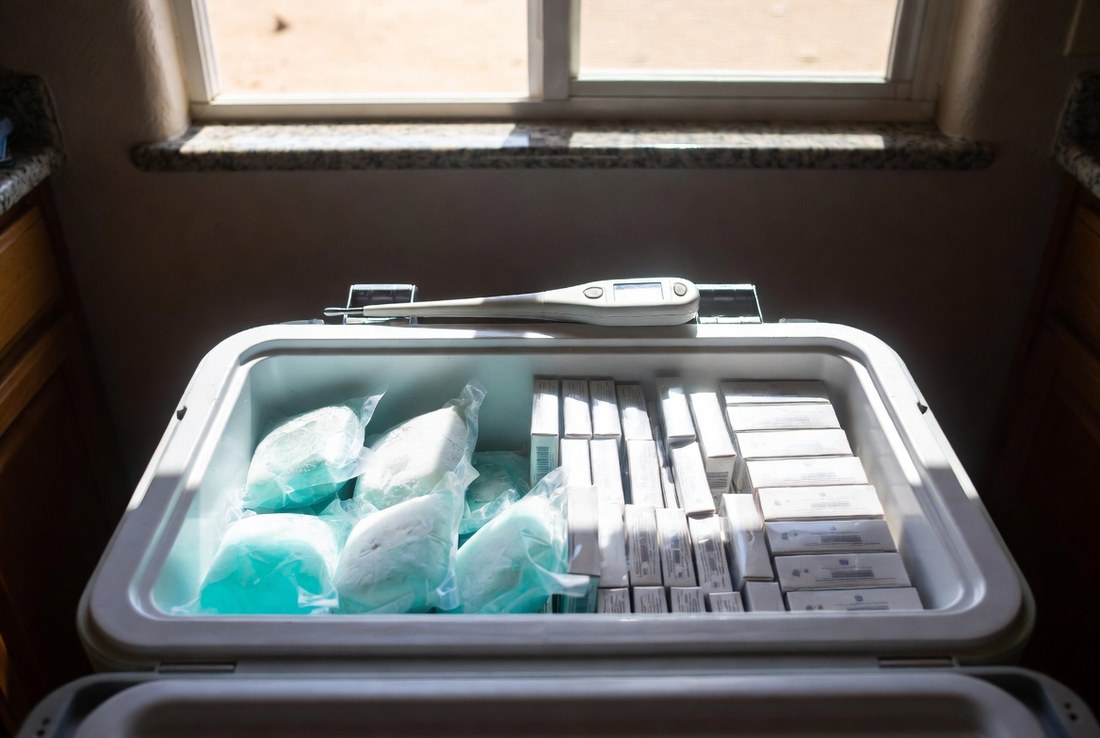
She came home with replacement insulin packed in a pharmacy cooler bag with four gel ice packs. The ice packs, maintained in the pharmacy's powered freezer, gave her approximately eight hours of safe storage temperature. She rationed them carefully, refreezing them at a neighbor's house that had power from a portable generator.
The power in her neighborhood came back 31 hours after it had gone out. She had managed. But it had required an emergency physician call, a neighbor's car and two hours of her neighbor's day, a pharmacy that happened to be open and powered eleven miles away, and careful ration management of pharmaceutical ice packs. One failure at any point in that chain and she would have been in an emergency room.
"My endocrinologist told me afterward: 'You got lucky. If your neighbor had not been home, or if the pharmacy had been closed, or if the traffic had been worse, this would have been a different kind of call.' I have thought about that conversation almost every day since."
How It Changed Her Community
Gloria was active in a neighborhood association that included many seniors. In the autumn following her July experience, she organized a preparedness meeting and told her story. Fifteen households attended. What emerged was a simple system that the neighborhood now maintains.
✅ The Five-Point System Her Neighborhood Adopted
Your Medication Storage Plan — Starting Today
You do not need to live in Phoenix for this to matter. Heat events capable of degrading refrigerated medications are documented in every US state. The CDC reports heat-related deaths in all 50 states every year. And rolling blackouts during heat events — exactly like the one that hit Gloria — are increasing in frequency as grid demand exceeds generation capacity during extreme weather.
💊 Your Medication Storage Action Plan
Gloria now has a whole-home standby generator. She installed it the following spring, financed over five years. Her monthly payment is $180. "I spent more than that on stress during those 31 hours," she said. "And I will never spend it again."
This story is a composite narrative drawn from documented experiences of diabetic seniors during heat-event rolling blackouts, primarily in the southwestern United States. Names are fictional. Insulin storage temperature ranges discussed are general reference points drawn from American Diabetes Association and FDA published guidance and do not apply uniformly to every insulin product — always follow the storage instructions on your specific medication's label. For official preparedness guidance for diabetics, visit CDC Diabetes Emergency Preparedness and FEMA Ready.gov Senior Preparedness.
📖 The Other Stories
Other people, other outages, the same few hours that decided everything.