
The One Thing True Almost Everywhere
Your state does not regulate backyard chickens — your city does. With a handful of exceptions (Texas has a statewide "Right to Farm" law that sets a floor of six hens cities can't ban below), there is no state-level chicken law most readers will ever encounter. The real rule that applies to you is written into your specific city or county's municipal code, and it can differ dramatically from a city twenty minutes away, even within the same metro area and the same state.
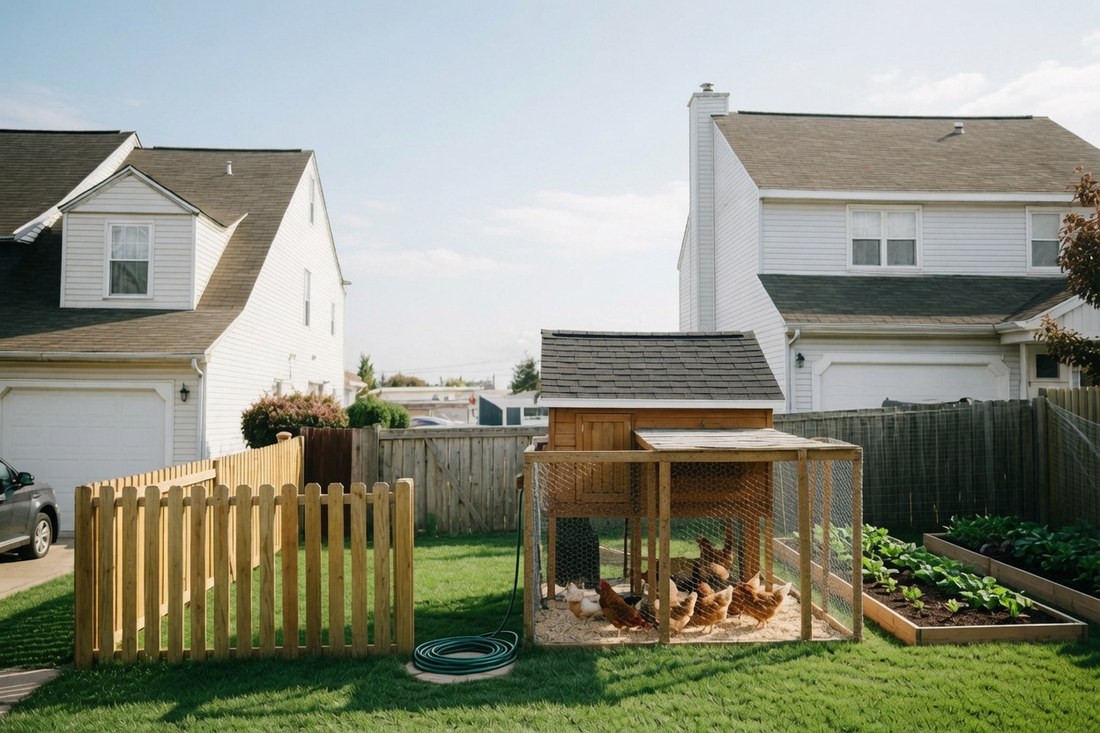
That said, a clear national pattern shows up again and again across hundreds of cities: 4 to 8 hens allowed per residential lot, roosters banned, a simple permit or registration (often $20–$50 a year) rather than a complicated application, and a coop setback of roughly 10–25 feet from a neighboring dwelling. If you remember nothing else from this page, that pattern is your starting expectation almost anywhere in the country — useful for planning, but never a substitute for checking your own city's actual code.
✅ This page covers (this is not exhaustive): Real, specific examples from California, Oregon, Colorado, Texas, Arkansas, North Carolina, Ohio, and New York, chosen to represent the West, South, Midwest, and Northeast. They're here to show you the range — from highly permissive to surprisingly strict — not to cover all 50 states. See the "Find Your City" section below for how to get your own exact answer regardless of where you live.
🏔️ West
California
| Pattern | Hens generally allowed almost everywhere, scaled to lot size; roosters nearly universally banned in residential zones. |
| Los Angeles | 1 hen per 500 sq ft of lot area, no hard cap beyond that. |
| San Diego | Up to 25 hens on lots 10,000+ sq ft; fewer on smaller lots. |
| Sacramento / San Jose | Up to 6 hens, no roosters. |
| Setbacks | Typically 20 ft from neighboring dwellings, 5 ft from property lines. |
Oregon
| Pattern | Most cities allow 4–6 hens with no roosters; unincorporated/rural areas are far more permissive. |
| Eugene | Up to 6 hens on standard lots. |
| Hood River | Up to 5 hens. |
| Junction City | Currently prohibited in residential zones as of 2026. |
| Setbacks | Commonly 10–20 ft from property lines or neighboring dwellings. |
Colorado
| Pattern | Generally permissive, with Denver and Front Range cities leading the way; newer-subdivision HOAs are the more common obstacle. |
| Denver | Up to 8 hens with a permit, no roosters. |
| Boulder / Fort Collins | Allow hens with standard setback and sanitation rules. |
🌽 South
Texas
| Statewide floor | Texas Agriculture Code §251.007 prohibits most cities from banning fewer than 6 hens on a residential lot — one of the strongest state-level protections in the country. |
| Houston | Up to 8 hens, no permit required, no roosters, rear-yard placement, 30 ft setback. |
| Renters | State protection applies to property owners; landlords can still prohibit poultry in a lease. |
North Carolina
| Pattern | Highly city-dependent — permissive cities sit right next to decades-old total bans. |
| Raleigh | Up to 15 hens with a permit. |
| Charlotte | Permitted as a "limited use," strict distance requirements. |
| Archdale | 50+ year total ban, violations can carry jail time — about 80 miles from Raleigh. |
Arkansas
| Pattern | No statewide rule; cities handle it individually, rural counties largely unrestricted. |
| Fayetteville | Up to 20 hens on lots over 5,000 sq ft, no roosters, annual permit. |
| Fort Smith | No permit needed for up to 6 hens; roosters banned. |
| Egg sales | Direct-to-consumer sales allowed with no license for small volumes. |
🌾 Midwest
Ohio
| Pattern | State doesn't prohibit chickens, but courts have upheld cities' right to ban them entirely — wide variation city to city. |
| Columbus | Limit set by lot size (avg. 4–8 hens), $100 permit valid 4 years. |
| Cleveland | 1 bird per 800 sq ft, roughly 6 on a standard lot, no permit for basic flocks. |
| Lakewood | Up to 6 hens, but requires completing a paid "Henkeeping Education Course" before permit approval. |
| Banned outright | Grandview Heights, Grove City, Reynoldsburg. |
Illinois, Michigan, and Pennsylvania follow a similar "city-by-city, generally 3–8 hens, no roosters" pattern to Ohio — major cities tend to be permissive with a permit, while smaller suburbs vary widely. The same check-your-specific-city rule applies.
🍁 Northeast
New York
| Pattern | No statewide law; larger cities typically allow 4–8 hens with a permit, smaller towns often default to general zoning/nuisance rules with no dedicated ordinance at all. |
| New York City | Hens allowed as of 2024, no permit required, no roosters. |
| Rural towns/villages | Villages tend to be noticeably stricter than surrounding towns — always confirm which you're in. |
Massachusetts, Connecticut, and the rest of New England follow the same pattern as New York: no statewide ban, city/town-by-town rules, with rural and exurban areas generally far more permissive than dense city centers.
🔍 Find Your Exact City's Rule
Since none of the regional examples above may match your specific address, here's the actual process for getting a real answer:

- Call your city or county zoning/animal control office directly. This is the single most reliable source — a five-minute phone call gets you the current, accurate answer, not a 2023 blog post that may already be out of date.
- Search "[your city name] municipal code chickens" or "poultry." Most cities publish their full code online through services like Municode or eCode360, searchable by keyword.
- Check your county's Cooperative Extension office (see the main backyard chickens guide for more on this) — many run free classes that also walk through local permit requirements as part of the curriculum.
- Check your HOA covenants separately, in writing. An HOA can prohibit poultry even in a city that explicitly allows it, and this is one of the most common reasons a legally-compliant coop still becomes a dispute.
✅ The three questions to ask, every time: (1) How many hens am I allowed on my specific lot size? (2) How far does the coop need to be from a neighboring dwelling or property line? (3) Do I need a permit, registration, or fee, and if so, how much and how often does it renew? Get clear answers to those three before you build anything.
💬 What Happens When You Look It Up and Find Out You Can
“I assumed backyard chickens were illegal where I lived. I assumed this for four years without ever checking. My neighbor mentioned she had three hens and I thought she was breaking the law. I finally looked it up. My city allows six hens, no permit required, coop must be fifteen feet from a property line. I had four years of fresh eggs I did not need to miss. I built a small coop the following month. The permit question took me about eight minutes to answer online. I spent four years assuming instead of eight minutes looking. I do not recommend that approach.”
“I wanted chickens and my husband said the city would never allow it. We had just moved into a new house and I looked up the ordinance the first week. Our city allows four hens, no roosters, coop set back ten feet from any neighboring structure. My husband built the coop. He is now more attached to those hens than I am. He names them. He talks about them to people at work. The man who said the city would never allow it now goes out to check on them twice in the evening.”
“I looked up my city ordinance, found that backyard chickens were allowed, and mentioned it to two neighbors. Both of them also did not know. Now there are three backyard flocks on my street. We trade eggs. We trade garden vegetables. We help each other when someone goes on vacation and the chickens need tending. My street is more of a community than it was before any of us had chickens. I am not sure I could have predicted that outcome from looking up a city ordinance, but here we are.”
Frequently Asked Questions
Does my state allow backyard chickens?
Almost certainly the state itself doesn't prohibit them. Backyard chicken rules are set almost entirely at the city and county level, not the state level. A handful of states like Texas have a "Right to Farm" law setting a statewide minimum (six hens that cities can't ban below), but the real rule that applies to you comes from your specific city or county zoning office, and sometimes your HOA on top of that.
The reader accounts on this page are composite voices drawn from common, real experiences — the names are not those of real individuals, and these are not customer testimonials. Individual results vary.
Why do two nearby cities have completely different chicken laws?
Because each city writes and enforces its own ordinance independently, even within the same state and the same metro area. It is common for one city to allow 6 hens with no permit while a neighboring city bans poultry outright, sometimes less than an hour apart. This is why checking your specific city's code, not general advice about your state, is the only reliable way to know the rule that actually applies to you.
What's the most common backyard chicken rule across U.S. cities?
The most common pattern nationwide is 4 to 8 hens allowed per residential lot, no roosters, a simple permit or registration (often $20-50 per year) rather than a complex application, and a coop setback of roughly 10-25 feet from a neighboring dwelling. Most major U.S. cities follow some version of this pattern, though exact numbers vary.
📚 Primary Sources & Official Data
- • Published municipal codes for the cities cited above, current as of 2026 — always re-verify directly, as ordinances change without notice
- • Texas Agriculture Code §251.007 (Right to Farm)
- • Cooperative Extension Poultry Portal (poultry.extension.org)
Page last reviewed: June 2026 | Author: Franklyn Galusha